
The ops team gets their dashboard request approved in March. By June it has four spreadsheets bolted onto it, a Slack channel for manual fixes, and one person who quietly knows why the nightly sync fails on the third of every month. That is what happens when web application development services get scoped like a website build. The tool works in the demo. It collapses when real users, real data, and real permissions arrive.
We have inherited enough of these systems to know where the seams split. This article walks the full lifecycle of building browser-based software, from the product boundary decision to the handover artifacts, with the failure modes named at each step.
Reading time: 11 min
Key points
- Web application development services cover the full lifecycle, from discovery and architecture through testing, deployment, and operation, not the coding slice alone.
- The product boundary decision, who the users are and which workflows the system owns, shapes the cost curve more than any technology choice.
- Custom web solutions usually rot at the integration layer, not the core, and only automated contract checks with alerting catch that class of failure.
- Owning the code, the infrastructure definitions, and the operational knowledge is what reduces vendor lock-in.
Table of contents
What web application development services cover in practice
Web application development services cover the full lifecycle of browser-based software, not the coding slice alone. That means discovery and requirements, architecture, UI and UX design, backend implementation, integrations, testing, deployment, and post-launch operation. A typical engagement producing an internal ops dashboard to replace spreadsheet workflows delivers concrete artifacts at each stage: an API specification in OpenAPI, a data model, environment definitions in Terraform, CI/CD pipelines in GitHub Actions, a deployment runbook, and a monitoring dashboard wired to PagerDuty.
Teams that buy only the coding slice get exactly that. The brittle system that collapses under real user loads usually traces back to skipped architecture and skipped load testing, not to bad code.
Buying services should mean buying a lifecycle partnership. When you engage a partner for end-to-end software solutions, the deliverable is a running system with operational ownership, not a pile of hours against a ticket queue.
Where teams confuse websites with web based software
A website publishes content. Web-based software executes workflows, enforces permissions, and mutates data based on what users do. The distinction sounds obvious until you read a requirements doc that says “simple portal” and means role-based access, audit logging, and multi-tenant data isolation.
Take a customer portal. Every action needs an authenticated identity, a role check, and a record in an audit log. Data ownership has to be explicit, because a customer seeing another customer’s invoices is not a UI bug, it is a breach. Uptime targets matter too, because the portal is now part of someone’s daily job, not a brochure visited once.
Under-scoping a web app as a site is the most common failure we see in inherited projects. Authentication gets bolted on late, data modeling gets improvised, and uptime expectations were never written down. Custom web solutions fail at the moment real data arrives, and by then the architecture is already committed.
The decision that shapes everything is the product boundary
Before any web app development starts, one decision determines the cost curve more than any technology choice: the product boundary. Who are the named users, what workflows does the system own, which data does it hold as the source of truth, and which external systems does it touch?
A one-page context diagram and a workflow map cost a day and prevent a quarter of rework. They lock down user roles, data entities, and latency expectations before a line of code exists. When a client arrives with these already sketched, our first week looks like engineering. When they arrive without them, our first week looks like archaeology.
The failure mode is predictable. A portal scoped for one user role quietly absorbs a second role, then a partner-facing view, then a sync with the CRM, and mid-sprint it is a multi-system platform. The rework lands in the worst places: the data model, the permission layer, and every UI flow that assumed a single actor.
Discovery that produces buildable requirements
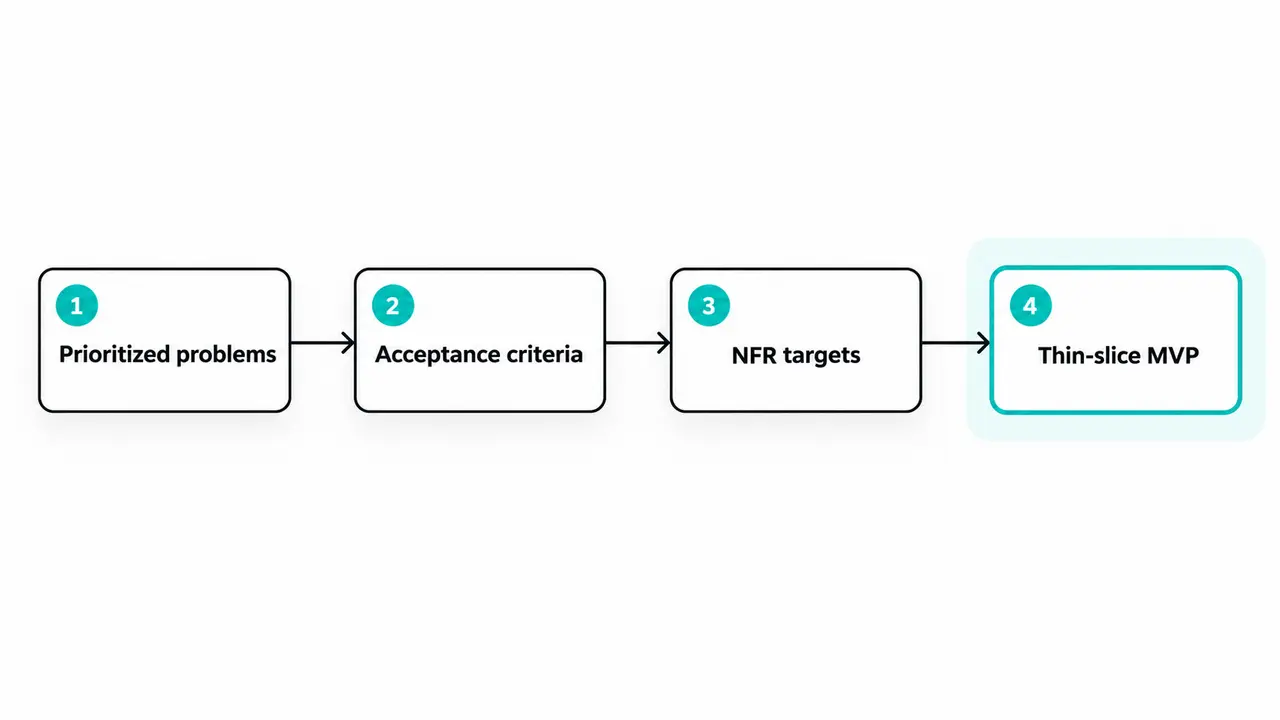
Discovery earns its cost only when the output is decisions engineers can implement. A slide deck of aspirations is not discovery, it is theater. The minimum viable output is a set of prioritized problem statements, acceptance criteria for the top three flows, non-functional requirements written as numbers, and a thin-slice MVP definition that a single team could build in weeks.
The IEEE/ISO/IEC 12207 standard for software life cycle processes frames requirements work as a formal process with defined inputs and outputs, not a brainstorming phase. That framing is worth adopting even in a five-person startup, because it forces the question of what “done” means before the sprint starts. You can read the standard at the IEEE Standards Association.
There is a counter-case. If your requirements are already testable and stable, discovery should compress into a two-day alignment workshop, not expand into a consulting engagement. Web application development services that always prescribe a full discovery phase are selling you a process, not solving your problem.
Architecture work that prevents a rewrite at scale
Architecture is not diagrams on a wall. It is the set of constraints that keeps feature delivery predictable as usage, data volume, and team size grow. Good architecture shows up as boring sprint after boring sprint where estimates hold.
The practical tool is the Architecture Decision Record. For every irreversible choice, write a short document: the options considered, the decision, and the consequences. Modular boundaries, API contracts, and caching strategy deserve ADRs. Whether you use PostgreSQL or MySQL does not, because that decision is reversible at moderate cost.
Skipping explicit data and service boundaries is the expensive omission in custom web solutions. Six months in, the performance fix you need is an invasive refactor, and it arrives at the worst possible time, usually the week before a launch. We have watched teams pay for the same refactor twice because the first one was done under pressure without a record of why.
UI and UX that respects operational reality
UX for B2B web-based software is mostly about reducing operator time, preventing mistakes, and making edge cases visible. It is not about delight. A user who processes 200 records a day in your tool does not want an animation, they want fewer clicks and an undo.
Two artifacts do most of the work. First, a clickable prototype covering the top two workflows, built in Figma and tested with the actual operators before implementation. Second, an error-state inventory: every screen listed with its empty state, its permission-denied state, its timeout state, and its partial-failure state.
Pretty screens collapse when real data arrives. The customer record with a missing phone number, the sync that returned half a payload, the upload that exceeded the size limit. Exception handling is a design requirement, not a backend detail, and teams that treat it as one ship interfaces operators immediately route around.
Backend engineering that keeps complexity contained
Backend quality is invisible until it is not. It shows up as stable APIs, predictable data behavior, and a clear answer to the question of which layer owns a business rule. When you ask two engineers where the discount calculation lives and they give different answers, you have found the problem.
For web app development at any serious scale, mandate two things. An API specification, maintained in OpenAPI and treated as a contract, so frontend and backend teams work against the same interface. And a strict versioning policy, so a mobile client built last year does not break because someone renamed a field. Add idempotency keys for critical writes, because payment endpoints retried by flaky networks will otherwise charge cards twice.
The failure mode is business logic duplicated across frontend and backend. The validation rules drift apart, users see one behavior in the form and another in the API response, and every change becomes a two-team coordination exercise.
Integrations that do not turn into a permanent fire drill
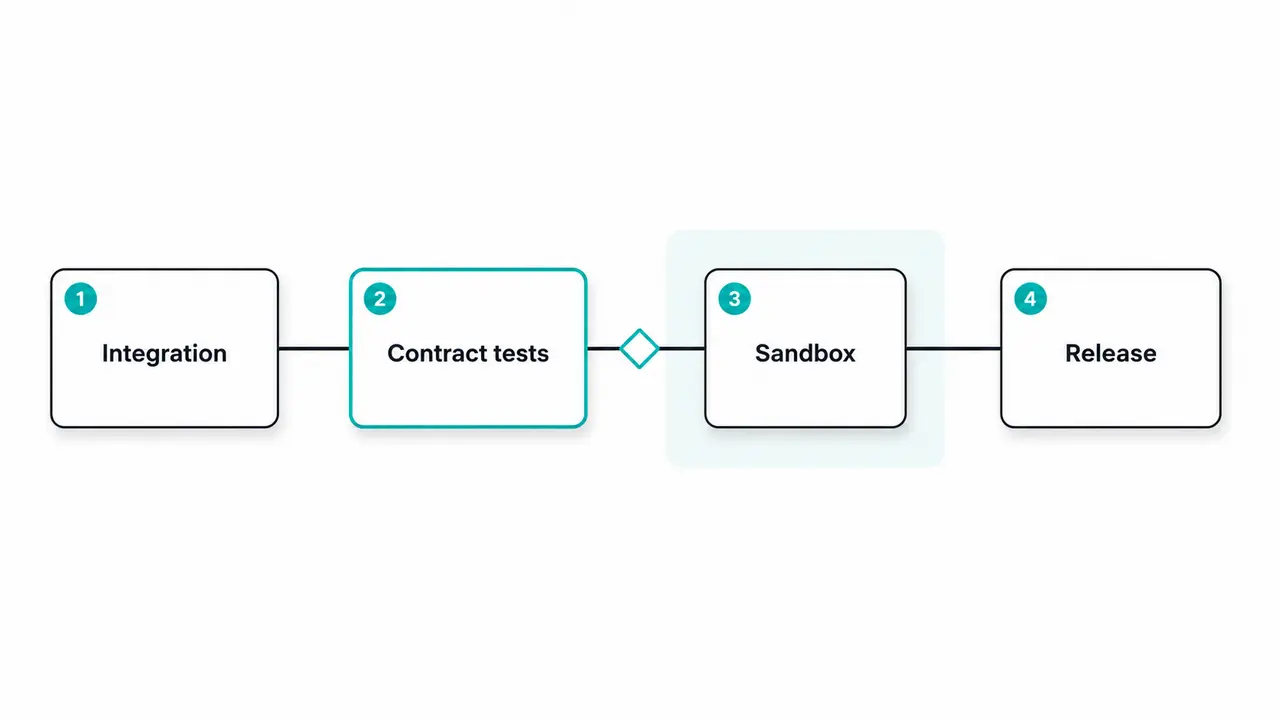
Integrations succeed when they are treated as products, with contracts, monitoring, and failure handling, rather than as one-time connection tasks. The typical B2B web app touches an identity provider like Okta or Azure AD, a payment processor like Stripe, a CRM like Salesforce or HubSpot, and at least one internal system nobody documented.
For each dependency, require integration contract tests running in a sandbox environment on every release. The test should exercise the real failure paths: expired tokens, rate limits, malformed payloads. A connection that worked once in staging proves nothing about next quarter.
Custom web solutions usually rot at the integration layer, not the core. Silent failures accumulate, data drifts between systems, and nobody notices for weeks because the sync “completed” with a 200 status and an empty body. Manual testing cannot catch this class of bug. Only automated contract checks with alerting can, and they pay for themselves the first time a vendor changes a field name without announcing it.
Security that is designed in, not audited in
Security in web-based software is a set of disciplined defaults, not a pre-launch audit. Access control with least privilege, secrets handled in a vault rather than a repo, dependency hygiene through automated patching, and a delivery pipeline that runs static analysis on every merge. The NIST Secure Software Development Framework, SP 800-218, describes exactly this set of practices as a core part of every SDLC implementation.
The concrete starting point is a threat model for your top workflows. Walk through the payment flow and the authentication flow and ask, for each step, what an attacker sees. From that exercise, baseline controls fall out naturally: least privilege on service accounts, secure session management, rate limiting on the login endpoint.
Regulated environments demand formal documentation and audit trails. The engineering primitives stay the same. A team doing security well for a fintech client and a team doing it well for an internal tool write the same code, just with different paperwork.
Performance and reliability as engineering requirements
Performance and reliability are features. They need explicit targets and instrumentation from the first sprint, or they get tuned in a panic the week before launch. Web application development services that cannot quote your latency target back to you are not managing it.
Define SLO-style targets for the flows that matter: p95 API latency under 300 milliseconds for the main list view, error rate below 0.1 percent on write endpoints, availability at 99.9 percent for business hours. Back those targets with a load test plan executed against a production-like environment, and a rollback strategy that has actually been rehearsed, not just written down.
Launch-day surprises almost always trace to one omission: nobody measured the system under realistic concurrency. A dashboard that serves 40 concurrent operators behaves differently from one serving 3 testers, and the difference shows up in database connection pools and Nginx timeouts. Measure before the users do it for you.
QA that catches workflow breakage before users do
Effective QA for web app development mixes automated checks with scenario testing across roles, permissions, and integrations. Neither half works alone. Automation catches regressions cheaply. Scenario testing catches the workflow breakage that only appears when a manager, an operator, and an external API interact in sequence.
Build a regression suite tied directly to your acceptance criteria. Unit tests for the calculation logic, integration tests for the API layer, and end-to-end tests in Playwright or Cypress for the critical flows, ideally no more than a dozen of them, kept fast and reliable. When a test fails intermittently, fix it or delete it. A flaky suite trains the team to ignore red builds.
The failure mode compounds quietly. Shipping fast without a safety net works for three months, then every release breaks something that was working, and release cadence drops from weekly to monthly because nobody trusts the deploy button. The hidden breakage tax is paid on every subsequent release, forever.
Delivery cadence that technical leaders can actually govern
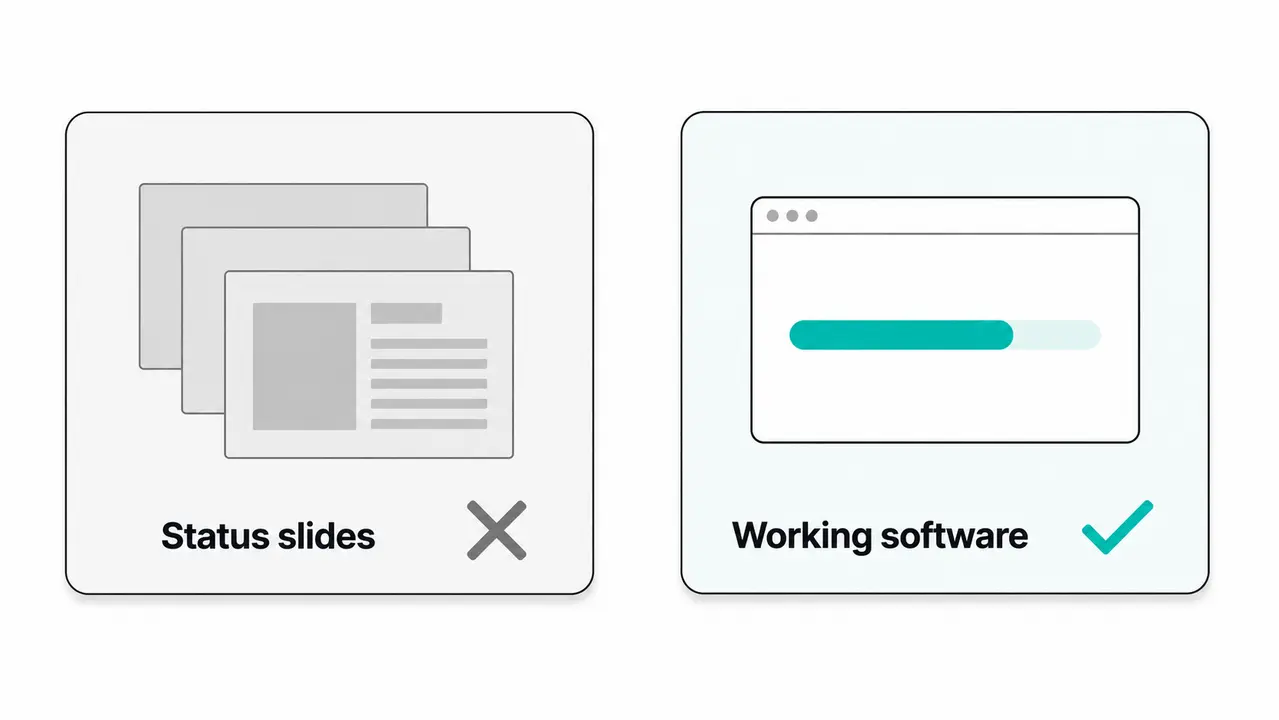
A good delivery model makes progress visible weekly through working software, not status reports. If the only artifact your partner produces between demos is a slide about being 90 percent complete, you cannot govern anything. Working software in a staging environment is the only honest status report.
Run short cycles with demoable increments. Maintain an explicit definition of done that includes tests, documentation, and deployment. Write release notes that map each change to user value, so a non-technical stakeholder can read them and know what improved.
The 90 percent trap is real, and we have walked into projects that lived there for a year. Custom web solutions reported as nearly done, sprint after sprint, with no deployable increment, because “done” was never defined and integration was deferred to the end. When that convergence moment arrives, it never converges. Insist on the demo, in the environment, every week, starting week two.
Engagement models that match how startups and scaleups operate
The right engagement model depends on where your bottleneck sits. If the bottleneck is leadership, you need a partner who owns architecture and delivery. If it is capacity, you need engineers who plug into an existing machine. If it is specialized expertise, you need a small senior team for a bounded problem.
Three models cover the space. An embedded team extension, where engineers join your rituals and your roadmap. Project-based delivery, where the partner owns scope, schedule, and production. And hybrids, where a core team is embedded but specific workstreams are delivered project-style. Each answers differently the two questions that matter: who owns the roadmap, and who carries the pager.
Hiring pressure makes this decision urgent. Eurostat reports that more than 10 million ICT specialists were employed across the EU in 2024, 5.0 percent of all employed people, and the share keeps rising, which tells you how hard you are competing for the same people. For fast-changing products where internal hiring is too slow, dedicated software engineering teams embedded with clear ownership outperform rigid handoffs. That is the model Sentice has built around since 2013.
How the three engagement models compare
A side-by-side comparison clarifies the tradeoffs in control, speed, and risk that a sales conversation tends to blur. Here is how the three models stack up for a typical scaleup building web-based software.
| Dimension | Embedded team | Project-based delivery | Hybrid |
|---|---|---|---|
| Onboarding time | 2 to 4 weeks to first commit | 4 to 8 weeks to first milestone | 3 to 5 weeks |
| Roadmap ownership | Your team | Partner | Shared by workstream |
| Knowledge retention | High, sits with your team | Low without handover planning | Medium |
| Handover friction | Minimal | High, needs a formal phase | Medium |
| Best fit stage | Product live and evolving | Fixed scope, fixed deadline | Core product plus side builds |
The rule of thumb by stage: pre-product startups benefit from project-based delivery with a partner who owns architecture, scaleups with live products need embedded teams, and companies in between run hybrids. The weakest arrangement is the one that splits ownership of production incidents across organizations. When an outage requires a bridge call between two companies before anyone can touch the database, recovery is slow and the postmortem becomes a negotiation about blame.
Not sure which model fits your roadmap?
Tell us where your bottleneck sits and we will help you weigh embedded, project-based, and hybrid delivery against your product stage.
What to ask before signing with a development partner
Vet how a team makes decisions, proves quality, and handles uncertainty. Not what their sales deck promises. Three requests separate the two. Ask for an example Architecture Decision Record from a real project, and read whether it shows rejected options and reasoning. Ask for their test strategy on the last release, including what they chose not to automate and why. Ask for a sanitized incident postmortem, and look for whether it names systemic causes or individual mistakes.
Insist on meeting the actual tech lead before signing. The person who runs the discovery call will not write your code.
Teams that skip this vetting and select web application development services on sales narrative inherit the consequences in month four, when the first architectural problem surfaces and there is no decision-making process to resolve it. When you are scaling engineering capacity, the delivery mechanics matter more than the pitch, and the piece on scaling smart how boutique partnerships accelerate tech team growth covers what that vetting looks like in practice.
Delivery artifacts that reduce vendor lock in
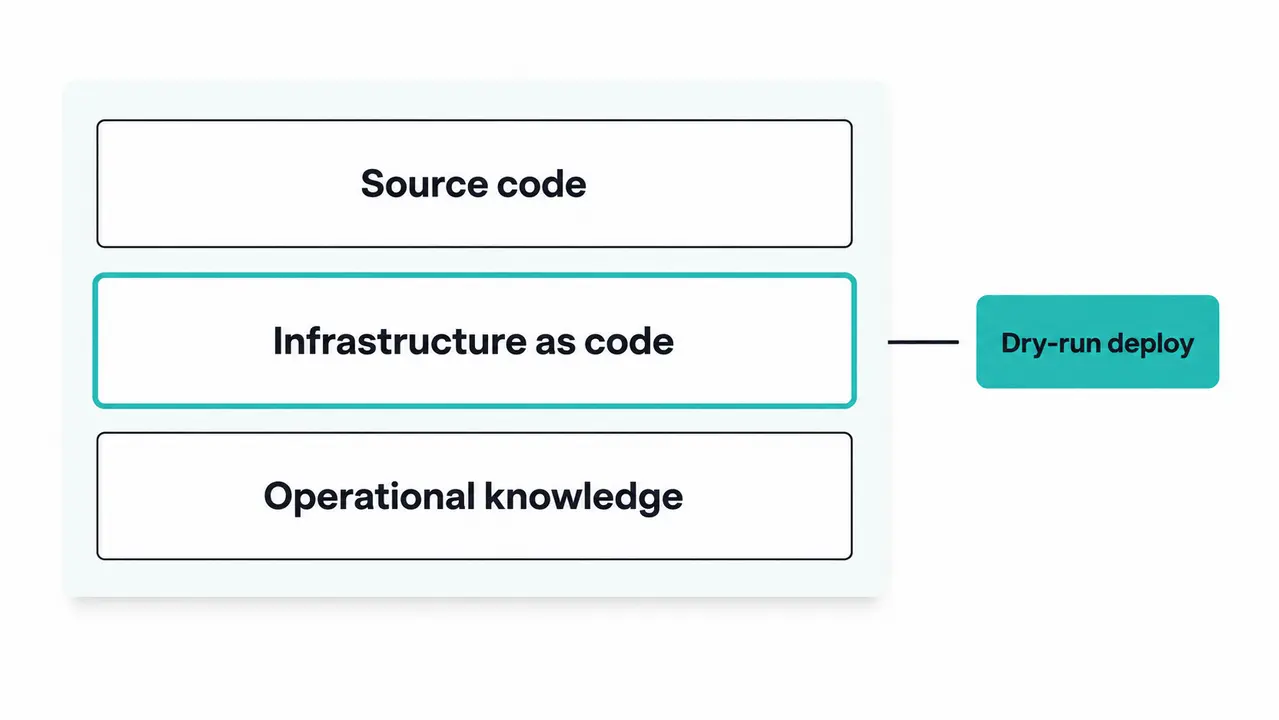
Lock-in is reduced by owning three things: the code, the infrastructure definitions, and the operational knowledge required to run the system. A partner who resists handing over any of the three is building a dependency, not a product.
Concretely, demand repo access from day one, CI/CD pipelines you can read and trigger, infrastructure as code in Terraform, runbooks for the top failure scenarios, and an onboarding guide validated by a dry-run deployment. The dry run is the part everyone skips and the part that proves everything. Have someone outside the engagement, or at least outside the delivery team, deploy the system from scratch using only the documentation.
If they cannot, the documentation is decoration. The “only they can ship” dependency is the expensive trap in custom web solutions, and it shows up as update cycles measured in weeks for changes that should take hours, priced at whatever the market will bear, because you have no alternative. Structure the artifacts so you always have one.
Using AI coding tools without lowering engineering standards
AI coding tools accelerate routine work and review cycles. Humans keep ownership of architecture, security, and correctness. That division is not a concession, it is the only stable arrangement, and the Stack Overflow Developer Survey shows how thoroughly these tools have entered normal engineering practice.
At Sentice, we use Claude Code, Cursor, and similar assistants for boilerplate, test scaffolding, and first-draft refactors, behind a mandatory code review checklist and automated linting gates in the CI pipeline. AI-generated code for authentication and payment flows gets the strictest human review on the team. No exceptions, regardless of how confident the tool sounds.
The hard line is data migrations. Blindly accepting AI-generated migration code is how silent data corruption happens, because the model will produce plausible SQL that handles the happy path and quietly mangles the edge cases. In web app development, a corrupted migration is the one failure you may never fully recover from.
Frequently asked questions
How long does it take to build a custom web application?
A thin-slice MVP covering one workflow for one user role can ship in 4 to 8 weeks. Full platforms with multiple integrations and role-based access typically take 4 to 9 months. The schedule becomes predictable only when workflows and non-functional requirements are explicit, because ambiguity in scope converts directly into schedule variance.
What should be included in a handover?
Source code with full repository history, CI/CD pipelines, infrastructure definitions in code, runbooks for the top failure scenarios, monitoring dashboards, and a deploy-from-scratch walkthrough performed by the receiving team. If any item is missing, the handover is incomplete, and you will discover which one it was during your first incident.
Do web apps need ongoing maintenance?
Yes. Dependencies age, security patches arrive on vendor schedules, and operational improvements accumulate as usage grows. Plan explicit ownership for upgrades and incident response, whether that sits with your team or the partner, and review the plan quarterly rather than assuming it still holds.
What is a reasonable way to start without overcommitting?
Start with a discovery-to-blueprint phase that outputs buildable specifications and a thin-slice plan, typically 2 to 4 weeks. Expand into delivery once the product boundary is stable. This caps your downside at the cost of the blueprint while giving you artifacts you keep regardless of what happens next.
How do we evaluate code quality before a long engagement?
Review a small module the team has already shipped in production, check test coverage on the critical flows rather than the aggregate number, and read their documentation and decision records for clarity. A team that writes clean ADRs and honest runbooks will write clean code. A team whose documentation is thin will not improve after signing.
A next step that de risks the build
Treat the first engagement as a bounded pilot with explicit exit criteria rather than a multi-year commitment. Define one milestone, such as a thin-slice MVP deployed to a staging environment with the top workflow working end to end. That single milestone proves the delivery mechanics, the communication rhythm, and the quality bar. If it holds, scale with confidence. If it does not, you found out at the price of a pilot, not the price of a roadmap.
About Sentice

Sentice is a boutique software engineering partner founded in 2013 by Roni Levi and Martin Petkovic, now headquartered in Skopje, North Macedonia. Rather than supplying individual developers, we build embedded teams that blend with a client’s culture, tech stack and goals, working together from a single office under our own technical leadership. We deliver dedicated software engineering teams, end-to-end software solutions, product development, and system and embedded engineering, and we act as technical advisors across the full development lifecycle, from specification and architecture through development, testing and support. We use AI coding tools across every project, and we help clients integrate AI into their own products through chatbots, MCP services, connected application layers and workflow automation. Some of the clients we started with more than a decade ago are still building with us today.
Get in touch: info@sentice.com | +389 70 307 837