
The architecture decision has been on the agenda for six weeks. Three options, two strong opinions, no decision record, and a roadmap that quietly depends on the answer. Your senior engineers are split, your CTO is out of bandwidth, and every sprint that passes adds another service built on assumptions nobody agreed to. That stalled decision is what technology consulting services exist to unblock.
Below, we’ll separate consulting from delivery, walk through what a real engagement produces in its first 30 days, compare advisory against staff augmentation and managed services, and give you the questions and red flags that separate senior advisors from sales scripts.
Reading time: 12 min
Key points
- Technology consulting is decision support for high-stakes technical choices, not extra engineering capacity.
- Judge any consulting proposal by the artifacts it names, not the expertise it claims.
- Staff augmentation adds capacity under your management; consulting owns the quality of the plan your backlog should follow.
- Preparation, meaning access, context and a decision maker, is the cheapest multiplier in the entire engagement.
Table of contents
Technology consulting services are decision support for high stakes technical choices
Technology consulting services help you make and execute critical technical decisions when the cost of being wrong is high and your internal bandwidth is thin. The work is decision support, not extra hands. It narrows options, names the tradeoffs you are actually choosing between, and produces implementation-ready artifacts: an architecture diagram your team can build against, a decision log your stakeholders can sign, a phased plan your leads can sequence into sprints.
Think of tech consulting as the difference between a debate and a decision. Without it, teams keep re-litigating the same meeting, ship inconsistent solutions under deadline pressure, and accumulate platform debt that taxes every sprint afterward. The debt compounds quietly. Eighteen months later you are paying for it in review queues and rework, and the original question is still technically unanswered.
Where teams confuse consulting with delivery and why it backfires
The most common purchasing mistake is treating consulting as a way to add engineers. It is not. Consulting sells diagnosis and decisions; delivery sells throughput. When you buy one and expect the other, you get vague advice with no owner, or execution with no direction.
IT advisory work succeeds or fails on ownership boundaries, so define them before signing. Who writes the Requests for Comments? Who runs the architecture review? Who merges code? A good engagement answers those questions in the statement of work, not in week three when the friction starts.
There is a clean counter-case. If your plan is already clear, the architecture is settled, and you simply need more output per sprint, consulting is the wrong purchase. Look at staffing models instead and spend nothing on advisory you will not use.
The deliverables that make consulting usable by engineering teams
The best consulting output is an artifact your team can pick up on a Monday morning without translation. Slides are not that. A technology strategy engagement should end with a current state assessment, a target architecture, a risk register, a phased roadmap with dependencies made explicit, and non-functional requirements written at a level your engineers can test against.
Each artifact earns its place by preventing a specific failure. A roadmap that ignores dependencies produces two teams waiting on each other in phase two. An architecture the existing team structure cannot deliver produces a design document that ages in Confluence while the codebase drifts somewhere else entirely.
We have inherited both. The fix is simple in hindsight: judge any consulting proposal by the artifacts it names, not the expertise it claims.
How a technology strategy engagement runs in the first 30 days
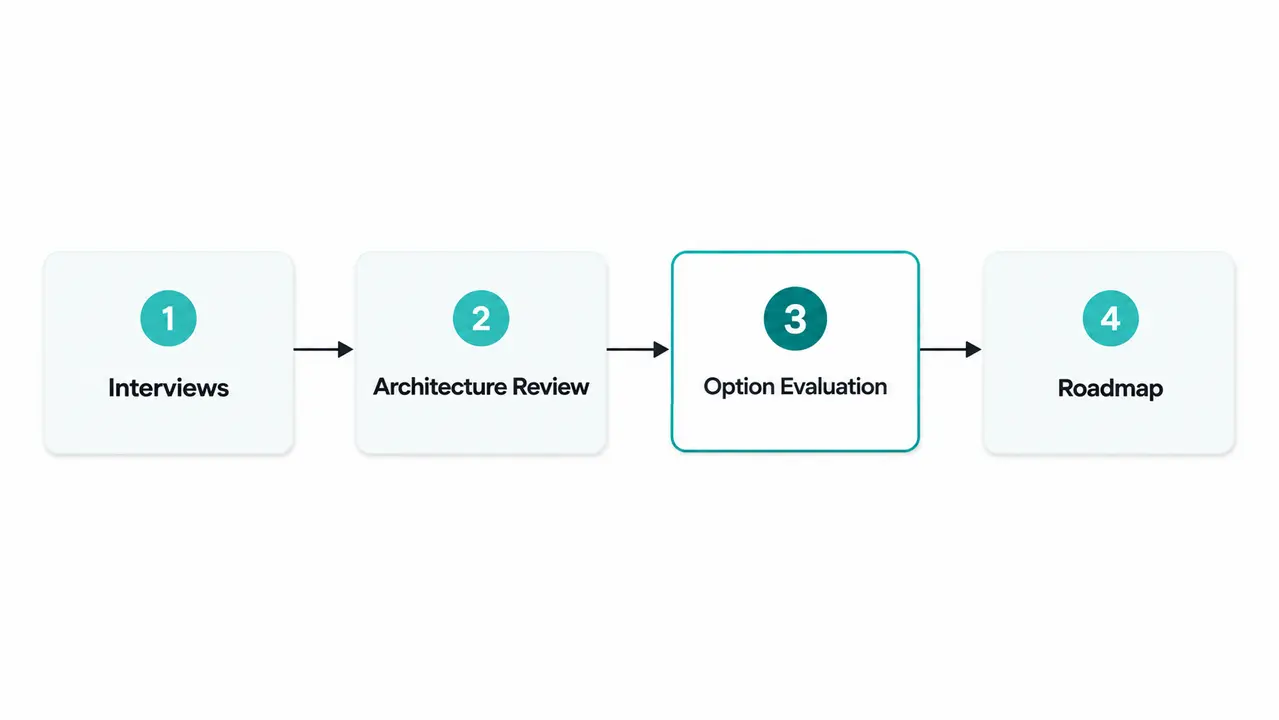
A strong technology consulting services engagement front-loads discovery and back-loads commitment. Week one is stakeholder interviews, because the disagreements between your VP of Product and your lead engineer are usually the real constraint. Week two is architecture review: service maps, dependency graphs, the incident history nobody reads until a customer escalation. Week three is option evaluation, where the shortlist gets tested against cost, operability, and your team’s actual ability to execute. Week four turns decisions into a sequenced roadmap with one accountable first move.
The failure mode is spending the entire month reconstructing context. A technology strategy engagement that only produces understanding has failed, even if the understanding is correct. Insist that recommendations land by week three so week four is sequencing, not synthesis.
Recognizing when you need outside advisory instead of more hiring
You need advisory when the problem is ambiguity and risk, not raw capacity. The signals are recognizable once you name them. The same module gets rewritten twice in a quarter. Review queues stretch past two days because every change touches contested ground. A founder is acting as the architecture committee in between investor calls. Platform decisions sit in a recurring meeting that has produced no decision in six weeks.
Hiring does not fix any of that. More engineers with unclear direction produce more inconsistent output, faster.
Tech consulting is the right purchase when the bottleneck is a decision nobody internally has the mandate or the distance to make. If the bottleneck is QA execution or feature throughput against a stable architecture, prioritize staffing or process tuning instead. Diagnose first, then buy.
Architecture reviews that surface the real constraints
A useful architecture review does not grade your system. It identifies the constraints your system is actually operating under and tests whether the current design still matches them. The inputs matter more than the opinions: service maps, dependency graphs, incident history, build times, and test coverage mapped by risk area rather than by line count.
IT advisory engagements fail here when they review the diagram instead of the system. The diagram says the monolith is the problem. The incident history says deploys fail because of a shared test database. Those lead to different plans.
The classic misdiagnosis is optimizing for scale when the real issue is operability, or recommending microservices to a team of nine that cannot run them. We have watched both happen. The review exists to prevent exactly that mismatch between ambition and operating reality.
Modernization planning without pausing the product roadmap
Modernization succeeds when it is sequenced into shippable slices tied to business milestones. It fails when it is scoped as a rewrite with a finish line two years out. The first slice should be one user flow, one service boundary, or one data domain, extracted with an incremental pattern like the strangler approach so the product keeps shipping throughout.
Each slice needs a business reason to exist. Migrating the billing domain first makes sense when billing is what blocks your enterprise deals. Migrating the notification service first makes sense when it is what pages your on-call at 3 a.m.
A technology strategy that frames modernization as a single rewrite is usually a plan to freeze the roadmap and hope. There is one honest exception: when the current system cannot meet safety, reliability, or device constraints, a complete rewrite is valid. Say so early and budget for it honestly.
Embedded and IoT programs need a different consulting lens
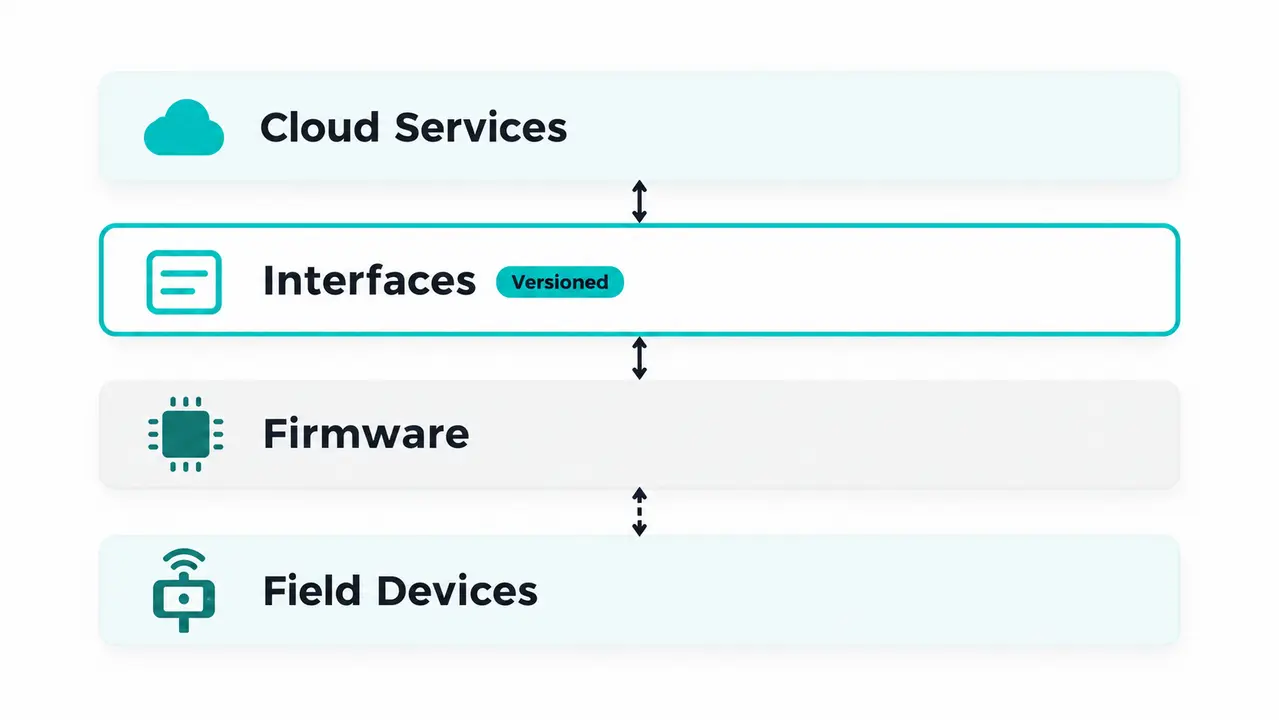
Technology consulting for embedded systems has to cover the whole system: firmware, hardware constraints, cloud services, and field operations. An advisory engagement that reviews only the cloud side of an IoT product is reviewing a third of the problem. The device fleet in the field is where the expensive failures live.
Two artifacts matter most. First, defined interfaces between device firmware and cloud APIs, versioned explicitly, so the firmware team and the cloud team stop shipping incompatible assumptions at each other. Second, a field observability plan built on Over-The-Air updates and telemetry, because you cannot debug a fleet you cannot see. This is the core of our system and embedded engineering practice at Sentice, and it is the difference between a program that ships and a program that recalls.
The failure mode is concrete: firmware and cloud teams each hold a private assumption about the protocol, integration testing happens late, and the mismatch surfaces as a costly field failure instead of a failed CI run.
Data and AI readiness work that avoids feature theater
Most AI initiatives stall between the demo and production, and the cause is rarely the model. It is everything around it. Tech consulting for AI should start with platform readiness, not model selection: data pipeline quality, an evaluation harness, inference latency monitoring, and a deployment plan. That is the minimal production path. Anything less ships a demo that breaks on the first real traffic.
The evaluation harness is the piece teams skip and regret. Without a repeatable way to score model output against known cases, every change is a vibe check and every regression ships to users unnoticed.
Be honest about the counter-case. If your product value is not tied to AI outcomes, keep the scope to automation and engineering productivity. Not every roadmap needs a model in it, and forcing one wastes the readiness work that would matter elsewhere.
Cloud and infrastructure advisory that focuses on operability
The point of a cloud strategy is not migration. It is operability, resilience, and predictable delivery. Moving workloads to AWS or GCP while keeping the same brittle release process and the same absent monitoring gives you the same outages at higher unit cost, plus a migration to debug.
Advisory work in this space should produce a Service Level Objective set and an on-call model sized for a startup, not an enterprise NOC. It should cover environment strategy, so staging stops being a rumor, and incident response, so the first severe incident does not invent your runbooks live. This is where IT advisory earns its fee or exposes itself as a reseller in disguise.
The verdict on tooling follows from the objectives. Terraform and Kubernetes are correct answers to some operating models and expensive distractions in others. Define the SLOs first, then choose.
Security and compliance decisions that engineering can implement
Security advisory is valuable when it converts into prioritized engineering work. A risk register full of generic statements about exposure produces nothing except a slide for the board. A backlog item that says “secrets rotation: done means all credentials rotate automatically every 30 days, with a runbook for emergency revocation” produces a change.
The translation layer is the whole job. For each control, define what done means in terms a mid-level engineer can implement in a sprint: least privilege IAM scoped per service, dependency scanning wired into GitHub Actions, audit logging that actually gets queried. Technology strategy work that skips this translation produces compliance theater, and auditors are getting better at spotting it.
One boundary worth knowing. If you need 24/7 monitoring and response, that is managed security, not consulting. Buy the right thing.
Product and platform operating models that scale past the first 20 engineers
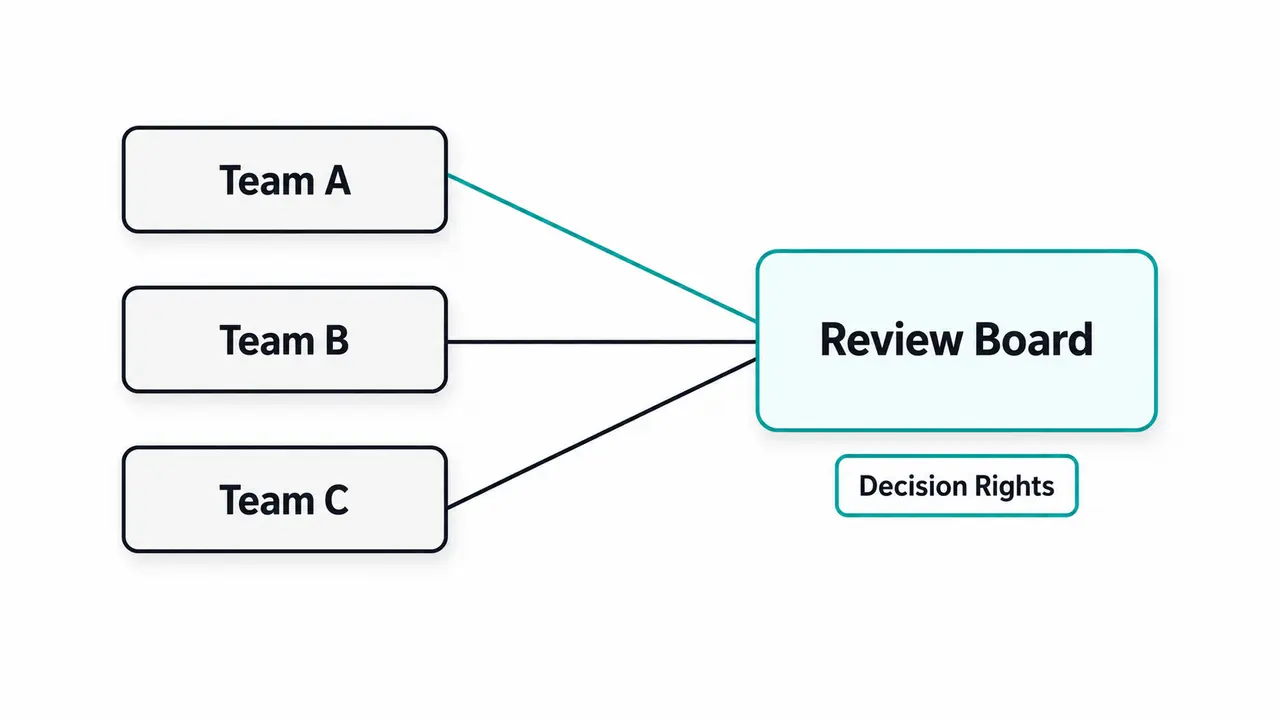
Many scaling problems are operating model problems wearing an architecture costume. The symptoms look technical: slow delivery, endless review cycles, teams blocking each other. The cause is often structural. Nobody knows who owns which decision, so every change requires consensus, and your senior engineers become gatekeepers whose throughput caps the entire org.
The fix is two artifacts. Decision rights, written down, so ownership boundaries are explicit instead of negotiated per pull request. And a lightweight architecture review board with a real cadence, weekly, timeboxed, empowered to decide rather than to admire. Release trains follow naturally once the decision path is clear.
If you are weighing team structure against headcount, our piece on scaling smart a strategic guide in house expansion outsourcing partnerships covers the tradeoffs in depth. The short version: adding engineers to an unclear operating model scales the confusion along with the capacity.
How staff augmentation differs from technology consulting in day to day control
The two models sell different things. Staff augmentation adds capacity under your management. Consulting sells diagnosis and a plan, led by senior expertise, with the consultant accountable for the quality of the recommendation. Neither is better in the abstract. They solve different problems, and buying the wrong one costs you a quarter.
A week in each model looks nothing alike. In augmentation, your dedicated software engineering teams join your standups, work your backlog, and follow your architecture decisions. In consulting, the week is interviews, reviews, decision records, and a roadmap review with your leadership. The consultant does not own your backlog. They own the plan your backlog should follow.
Staff augmentation is the weaker option for ambiguous strategy problems. Extra engineers cannot resolve a decision deadlock, because the deadlock is not a capacity problem. Two more votes do not break a tie; a decision record with a named rationale does.
| Dimension | Staff augmentation | Technology consulting |
|---|---|---|
| What it sells | Capacity under your management | Diagnosis and a plan, led by senior expertise |
| A typical week | Your standups, your backlog, your architecture decisions | Interviews, reviews, decision records, a roadmap review with leadership |
| Who is accountable | You manage the output | The consultant is accountable for the quality of the recommendation |
| Weaker when | The problem is a decision deadlock, which is not a capacity problem | The architecture is settled and you simply need more output per sprint |
Managed services versus consulting when reliability is the pain
Managed services make sense when you want a provider to run an operational function against service targets: monitoring, patching, alert triage, on-call coverage. Consulting makes sense when the system itself needs to change: reliability architecture, SLO definition, incident process design. One optimizes steady state. The other redesigns what the steady state is.
Reliability pain usually starts as a design problem and, if unaddressed, becomes an operational one. That is why the labor market context matters. In 2025, 10.45 million people were employed as ICT specialists across the EU, representing 5.0% of all employed people, and demand keeps growing, which makes hiring your way to a reliability function slow and expensive.
Managed services is the weaker option for product engineering teams that need architectural change, because it optimizes the current system rather than questioning it. Buy it to run what you have. Buy consulting when what you have is the problem.
What to ask in the first call to separate senior advisory from sales scripts
You can qualify a consulting partner in one call, before anyone discusses team size or rates. Test how they think about tradeoffs, constraints, and deliverables. Senior advisors respond to constraint talk with specific questions. Sales scripts respond with capability lists.
Ask for an example of a decision record they have written, and a phased roadmap structure from a past engagement. Redact the client name if needed; the structure is what you are evaluating. Ask how they handle disagreements with a client’s CTO, and listen for a real answer rather than a harmony story. Ask how they validate assumptions they cannot verify in week one.
Technology consulting services live or die on the quality of those artifacts. A partner who cannot show you a decision record has never written one, and you will discover that in week four instead of in the call. The question costs nothing. Skipping it costs an engagement.
Red flags that predict a bad engagement
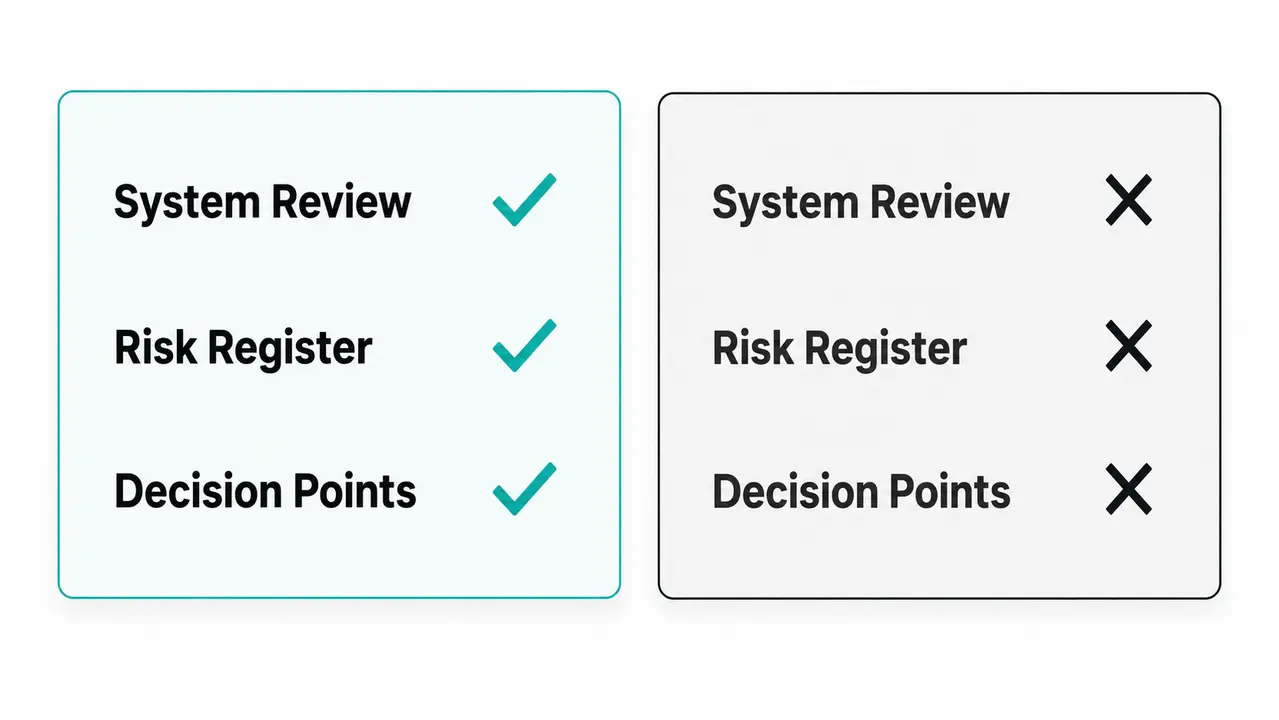
Bad consulting engagements fail in three predictable ways: they avoid specifics, they avoid ownership, and they avoid measurable outcomes. All three are visible before you sign, if you look.
A proposal with no system review scheduled in week one means the recommendations will be generic. No risk register in the deliverables list means the risks will be yours alone. No named decision points means nobody is accountable when the plan meets your codebase. IT advisory that will not commit to artifacts is selling opinions, and opinions do not survive contact with a legacy codebase.
The counterweight is a written scope that names deliverables and decision points explicitly. Early stage discovery can be lightweight, a two-week assessment rather than a program, as long as it still produces clear next steps. Lightweight is fine. Vague is not, and the difference between the two is whether the output names anything specific.
Preparing your team so consulting time turns into shipped changes
Preparation determines whether a consulting engagement produces shipped changes or a shelf document. It is about access, context, and decision makers, not polished documentation. A messy system diagram drawn in the call beats a beautiful one that arrives in week three.
The prep checklist is short. A current system diagram, even a rough one. A repo access plan approved before day one, not during it. Incident history from the last two quarters. And one internal owner nominated to make decisions, with the mandate to actually make them.
We have run engagements at Sentice both prepared and unprepared, and the difference is stark. When context arrives on day one, week four ends with a sequenced roadmap. When consultants spend three weeks reconstructing context, recommendations arrive after the quarterly planning lock, and the roadmap waits another quarter. Preparation is the cheapest multiplier in the entire engagement.
De-risk the decision you have been postponing
Tell us which platform decision has been sitting on your agenda, and we will help you turn it into a decision record your team can act on.
Frequently asked questions
How long does a technology consulting engagement take?
A focused assessment typically runs two to four weeks. A multi-phase engagement that includes roadmap delivery and execution support can run several months. The scope of the decisions and the complexity of the system set the duration, and a good partner will tell you which one you need before you commit.
Do technology consultants write code?
Some do, usually in targeted spikes or reference implementations that de-risk a specific choice. The core value is architectural decision support and engineering enablement. If what you need is sustained code output, a delivery model fits better than an advisory one.
What is the difference between technology consulting and IT consulting?
IT advisory traditionally focuses on infrastructure, procurement, and managed systems. Technology consulting for product companies focuses on custom software architecture, engineering delivery, and technology strategy. The overlap is real, but the center of gravity differs, and so does the type of engineer each field employs.
What KPIs should improve after tech consulting?
Watch deployment frequency, lead time for changes, incident recovery time, and platform operability metrics like build duration and environment stability. Tech consulting that cannot name the metrics it expects to move is guessing, and you will not be able to tell whether the engagement worked.
What should a technology strategy document contain?
A current state assessment, a target architecture, a decision log with rationale, a risk register, and a phased delivery roadmap with dependencies made explicit. Anything less is a slide deck. Anything more is usually padding around those five artifacts.
How do consultants assess a tech stack?
They review code repositories, service maps, deployment pipelines, and incident histories to find bottlenecks and architectural drift. The incident history usually tells more than the code does. What breaks, how often, and how long recovery takes is the honest record of what the architecture actually delivers.
Closing
Start by mapping your current bottleneck to one specific deliverable, whether that is an architecture review, a decision log, or an operating model redesign. Generic advisory produces slides; engineering-led consulting produces implementation-ready decisions your team can act on the same week. Use the resulting decision record to align stakeholders and unblock the roadmap without waiting out a hiring cycle. Which platform decision have you been postponing because nobody internally has the bandwidth to de-risk it?
About Sentice

Sentice is a boutique software engineering partner founded in 2013 by Roni Levi and Martin Petkovic, now headquartered in Skopje, North Macedonia. Rather than supplying individual developers, we build embedded teams that blend with a client’s culture, tech stack and goals, working together from a single office under our own technical leadership. We deliver dedicated software engineering teams, end-to-end software solutions, product development, and system and embedded engineering, and we act as technical advisors across the full development lifecycle, from specification and architecture through development, testing and support. We use AI coding tools across every project, and we help clients integrate AI into their own products through chatbots, MCP services, connected application layers and workflow automation. Some of the clients we started with more than a decade ago are still building with us today.