
The release was supposed to go out Thursday. It went out the following Tuesday, and the two-day gap was not engineering time. It was triage. An external QA team had seen the build for the first time on Wednesday afternoon, filed forty-one defects by Friday morning, and eleven of them were serious enough to reopen decisions your team had locked two sprints earlier. Nobody did anything wrong. The testers were competent, the defects were real, and the process was followed exactly as contracted. The structure was the problem. QA arrived after the decisions, so it could only produce verdicts, not information. Most teams that sour on software QA services are describing this exact dynamic, and they usually misdiagnose it as a talent issue.
This article walks through where QA outsourcing breaks, what a modern engagement should include, how the three engagement models differ, and how to wire external quality work into your CI pipeline so it produces signal instead of verdicts.
Reading time: 12 min
Key points
- QA fails as a late-stage gate: the problem is where in the sprint the quality signal arrives, not tester skill.
- Testing finds defects; quality assurance prevents them. If your escaped-defect rate is flat while execution counts climb, you are buying testing and calling it QA.
- The three engagement models, staff augmentation, a dedicated QA pod, and managed testing, differ in who owns test strategy, automation, and release sign-off.
- Unstable environments and unrealistic test data cause more QA outsourcing failures than tester skill ever will.
Table of contents
When software QA services become a release blocker instead of a safety net
Software QA services earn their keep when they shorten feedback loops and reduce production risk. They fail when they operate as a late-stage gate that discovers issues after decisions are already locked. The difference is not tester skill. It is where in the sprint the quality signal arrives.
Picture a scaleup shipping weekly. Leadership adds external testers who only see builds at the end of the sprint. Within a month there is a two-day bug triage queue, missed release windows, and a product manager who has started routing urgent checks around the QA team entirely. The gate everyone built for safety now sets the release date.
The failure mode to watch for is the ticket factory. The external team files defects in volume but owns no quality signals and no prevention practices. Nobody on their side asks why the same class of bug keeps recurring, because the contract pays for findings, not for the defect rate to go down. If your QA vendor cannot tell you whether quality is trending up or down, you have a ticket factory.
What software QA services include in a modern delivery pipeline
A modern software testing engagement bundles more than execution. The core deliverables are a test strategy tied to product risk, test design, manual and automated execution, structured defect reporting, and automation work that plugs into your continuous integration and release gating. If a vendor quotes you a menu of manual test case counts, keep shopping.
Concretely, expect four artifacts in the first month: a risk-based coverage map that says which user journeys matter most, a smoke and regression suite mapped to those risks, contributions to your automation framework in your stack, and a defined reporting cadence your engineers will actually read. Anything less is execution hours with a QA label.
The trap is treating QA as manual clicking only. Prevention practices belong in the same engagement: acceptance criteria reviews before development starts, testability feedback on stories, and measurable quality controls such as escaped-defect rate and flake rate. A team that reviews acceptance criteria catches the ambiguous requirement on Monday instead of the bug it produces two weeks later.
The difference between QA and testing in outsourced engagements
Testing finds defects in a build. Quality assurance is the system of practices that prevents defects from reaching users and makes quality measurable across the SDLC. The distinction matters most in QA outsourcing, because the two get sold under the same label at very different prices.
Pure test execution looks like this: more UI clicks per sprint, more defects filed, the same bugs next sprint. Quality assurance looks like contract tests at service boundaries, testability improvements requested in sprint planning, and a defect taxonomy that tells you where your process leaks. One produces activity. The other changes a number.
Here is the failure we see repeatedly. A company pays for test execution quarter after quarter while product quality degrades sprint over sprint, because the upstream checks were never anyone’s job. If your escaped-defect rate is flat or rising while your test execution count climbs, you are buying testing and calling it QA. Rank the two. Prevention wins.
Where teams underestimate onboarding for external QA
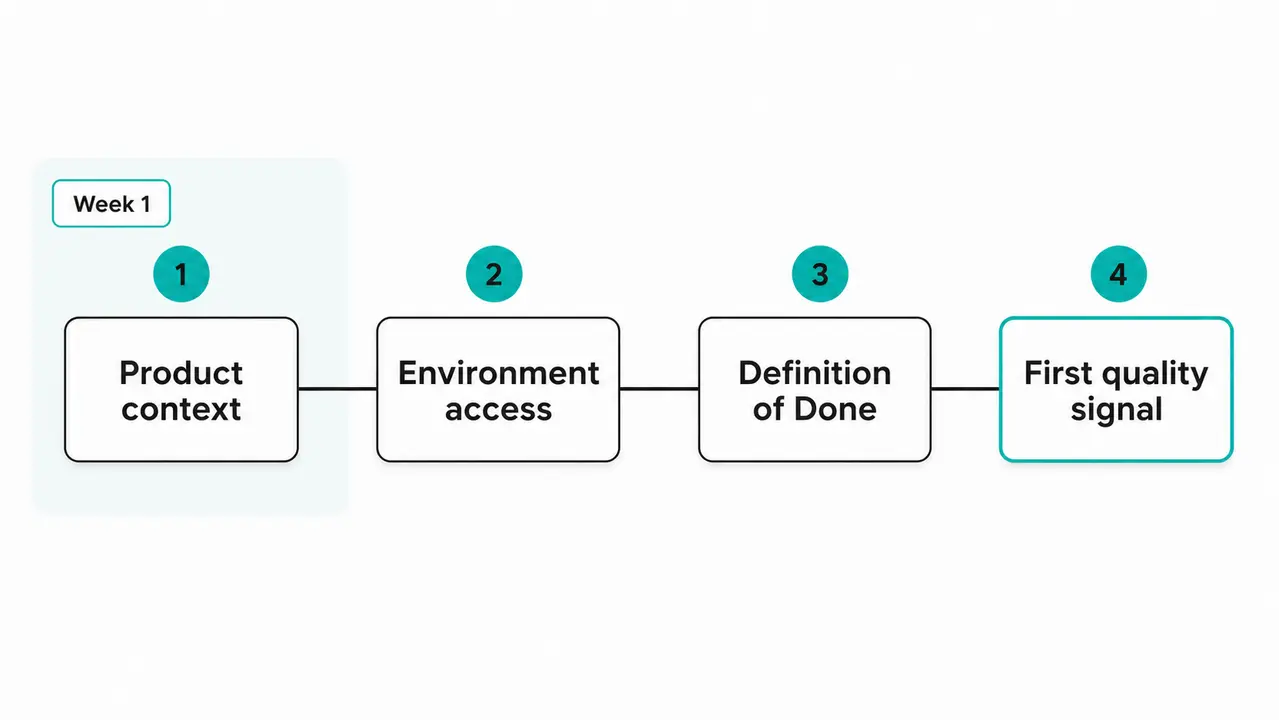
External QA ramps fastest when the team receives product context, environment access, and a clear Definition of Done in the first week. Most engagements miss all three and spend the first month discovering them by friction.
The onboarding artifacts that actually matter are an architecture overview, a list of critical user journeys, staging parity notes, and a designated internal owner for environment readiness. Sharing architecture context works best when your partner already thinks in terms of product development end to end, not just test execution, because the questions they ask on day one will be the right ones. A tester who understands why the billing service is eventually consistent will test it differently than one who does not.
The blocked QA scenario is the expensive one. Testers burn sprint time waiting for credentials, secrets handling approvals, and stable test data, and you pay for the waiting. Assign one engineer to clear that path before the engagement starts. A week of internal prep saves a month of ramp.
The engagement models that show up in software QA services
Buyers of software QA services typically choose between three models, and the choice is really about how much outcome ownership you want to delegate. Staff augmentation adds hands to your process. A dedicated QA pod runs quality as a function inside your delivery rhythm. Managed testing services hand the whole quality outcome to one accountable party.
You can define each model by three questions: who owns test strategy, who maintains the automation framework, and who signs off on release candidates. The table below maps that.
| Dimension | Staff augmentation | Dedicated QA pod | Managed testing |
|---|---|---|---|
| Test strategy owner | Your internal leads | Shared, pod leads | Vendor |
| Automation framework | Your team maintains | Pod maintains with you | Vendor maintains |
| Release sign-off | Your team | Joint review | Vendor certifies |
| Best fit | Immediate capacity gap | Continuity with collaboration | Multiple products, one owner |
Staff augmentation fails when you need a durable quality system. Managed services fail when you need tight day-to-day collaboration on codebase testability. Pick the failure you can live with.
Why staff augmentation often stalls once the test suite grows
Staff augmentation works for filling immediate capacity gaps. It weakens when quality depends on shared standards and sustained ownership of environments, which is exactly what happens as a test suite grows past a few hundred automated checks.
The pattern is familiar. An external automation engineer joins, adds a solid Playwright suite against your checkout flow, and delivers well. The engagement ends. Six months later the internal team inherits inconsistent test naming, no coverage targets, and a flake rate climbing from 3 percent toward 15. Nobody owns the decay, so nobody fixes it.
The capacity pressure behind this model is real. Eurostat reported that in 2023, 9.8 million people in the EU worked as ICT specialists, representing 4.8% of the total people in employment, and demand keeps outrunning supply, which is precisely why companies reach for augmentation (Eurostat, 2024). Hands are hard to find. Standards are harder. If your quality depends on the latter, shift to a model with sustained ownership and shared triage rather than renting more hands.
Dedicated QA teams that embed like an engineering pod
A dedicated QA team is strongest when you need continuity, product context, and a stable cadence of release validation without building the function in-house. The pod model, the same structure we use for dedicated software engineering teams, consists of a QA lead and one to three engineers who share your backlog, attend your sprint ceremonies, and run a weekly quality review with your tech lead.
Continuity is the whole point. The pod learns why the permissions model is shaped the way it is, which integrations fail silently, and which regression the support team dreads most. That knowledge compounds. A rotating augmentation resource starts from zero every quarter.
Know when the model is wrong for you. If your product is too early to justify ongoing regression investment, a pod is overhead you do not need yet. If your staging environment collapses twice a week, fix that first, because a pod against unstable environments produces noise, not signal.
Managed testing services when you want one accountable owner
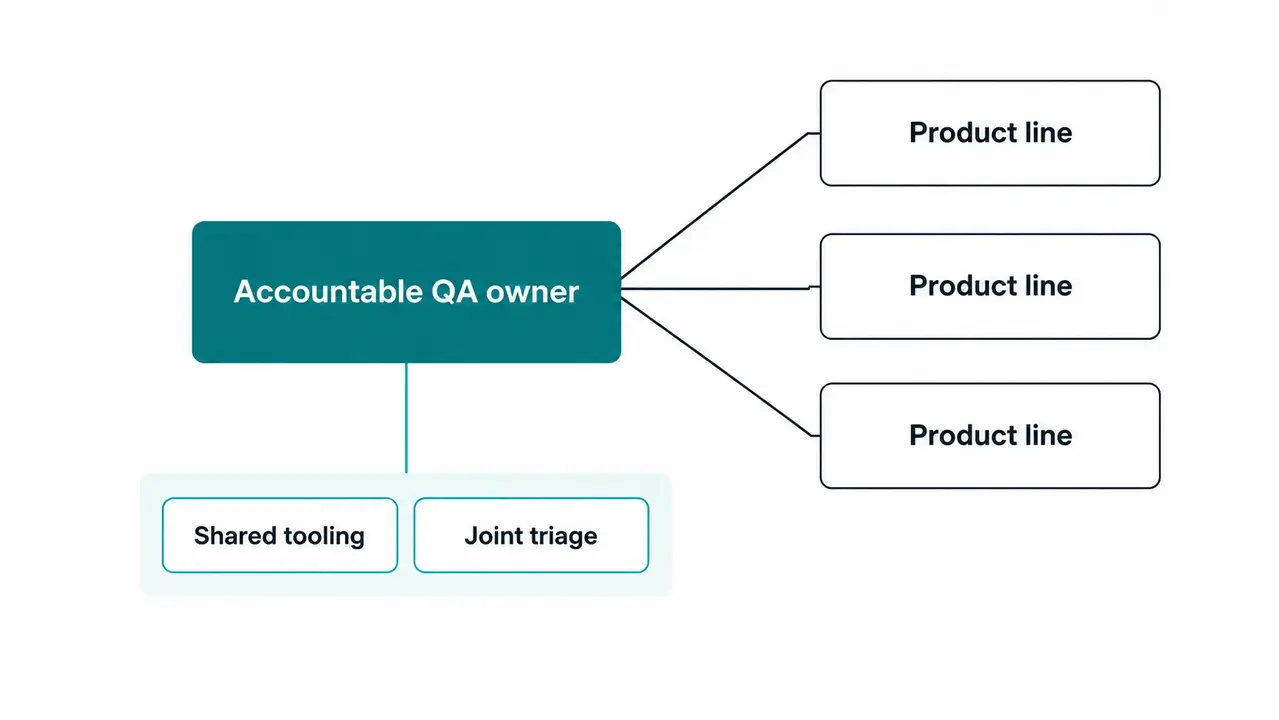
Managed testing services fit when leadership wants a single party accountable for QA outcomes, reporting, and process consistency across products. The software testing work is the same in kind. What changes is where the accountability sits, and for a VP of R&D running three product lines with no central quality function, that consolidation is the entire purchase.
Governance is what separates a real managed service from a body shop with a nice logo. Demand defined KPIs such as escaped-defect rate and regression pass rate, a release certification workflow with explicit entry and exit criteria, and written escalation paths for critical defects, including who gets called at 2 a.m. and in what order.
The failure mode is the silo. A managed vendor that runs its own tooling, its own defect tracker, and its own triage meetings becomes a black box between your engineers and your quality data. Enforce shared tooling, joint triage with your developers, and strict access discipline. We run managed engagements this way, with the vendor’s dashboard and the client’s engineering channel pointing at the same defects.
How scaleups decide between in house QA and QA outsourcing
In-house QA wins when quality is a core product differentiator and you can sustain the hiring. QA outsourcing wins when you need speed and specialized coverage you cannot recruit for. Both claims get repeated constantly. The decision is rarely that clean, so anchor it in four measurable inputs: hiring lead time for your market, release frequency, incident load per quarter, and how much proprietary domain knowledge the testing requires.
Two of those usually dominate. If your hiring lead time for senior QA engineers runs past four months while your release cadence is weekly, outsourcing is not a compromise, it is the only option that ships. We have written elsewhere about the mechanics of scaling up tech teams quickly without compromising quality, and the hiring bottleneck is almost always the first wall teams hit.
Regulated domains split the difference. They often outsource specialized verification, performance testing, or accessibility audits while keeping quality ownership internal, because compliance accountability cannot be delegated and the domain context takes years to build.
What to automate first in an outsourced QA setup
Automate the checks that block releases and repeat every sprint. That means smoke flows, API-level regression for core business paths, and contract tests at service boundaries. Everything else can wait, and most of it should.
Priority targets are boring and universal: login and session handling, checkout, permissions, billing events, and the critical integrations that fail silently, the webhook processor nobody watches until a customer complains. These are the paths where a defect costs revenue or trust in minutes, and they justify automation before anything else does.
The strategy to refuse is UI-only automation. It feels productive because it demos well, then it produces slow feedback loops, flaky selectors, and a maintenance bill that grows with every redesign. A suite that takes ninety minutes and fails randomly teaches your engineers to ignore red builds, which is worse than no suite at all.
A simple automation priority ladder for SaaS and platform teams
Tier 1 is API and contract checks against core business paths, running on every pull request, with a target feedback time under ten minutes. Tier 2 is critical UI smoke, a handful of end-to-end journeys through login, the primary workflow, and checkout, running on build promotion. Tier 3 is full UI regression, run nightly, accepted as occasionally flaky, and never a merge blocker. Build in that order. Teams that start at Tier 3 spend their first quarter automating clicks and their second quarter deleting them.
How external QA plugs into CI and pull request workflows
External QA is most effective when quality checks run automatically on every change and the humans focus on exploratory testing and release readiness. The moment your external team is manually verifying merged code, you have rebuilt the late-stage gate with extra steps.
The integration points are concrete. PR checks run the Tier 1 API and contract suite. Build promotion rules require a green smoke suite before a candidate reaches staging. Nightly regression catches the slow failures. A release candidate checklist, owned by the QA lead, gates the final promotion. The DORA 2024 State of DevOps report ties continuous integration and delivery performance directly to organizational outcomes, which is the strongest published evidence we have that this wiring matters (DORA, 2024).
The failure mode is QA validating after merge. A defect found post-merge costs a rollback decision, a hotfix branch, and a coordination burden across the team. The same defect found in a PR costs one comment and a force push. Wire the checks to run before the merge, every time.
Test environments and data that make or break QA outsourcing
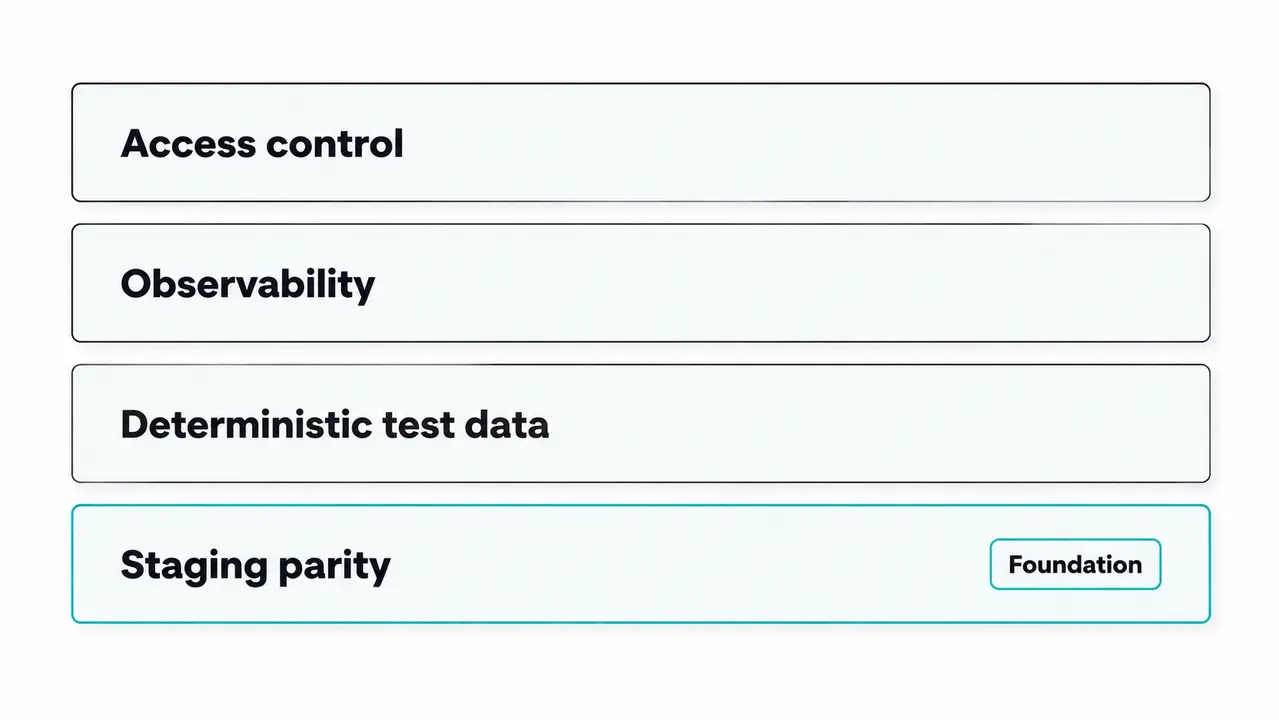
Most QA outsourcing failures trace back to unstable environments, missing observability, and unrealistic test data. Not tester skill. We have watched strong external teams produce garbage for six weeks against a staging environment that drifted from production in three unnoticed ways, and the client blamed the vendor.
Environment readiness is a checklist, not an aspiration. Staging parity with production configuration, seeded datasets that cover the edge cases, synthetic users for role-based flows, feature flags under test control, and environment reset scripts that a QA engineer can run without filing a ticket. Observability counts too. A tester with access to logs and traces diagnoses a failure in ten minutes. A tester without access files a defect that says “error on checkout” and burns a day of your engineer’s time reproducing it.
Security discipline is part of the same checklist: least-privilege access, audit trails, masked datasets, and strict rules against production data in test environments. QA outsourcing expands your access surface, and pretending otherwise is how leaks happen.
A minimum environment readiness checklist
Three items make the floor. Build deploy repeatability, meaning a fresh staging deployment from a tagged commit works with no manual steps. Deterministic test data, meaning the same seed produces the same state every run, so failures are reproducible. A known-good baseline build, meaning a reference version that passes the full smoke suite, so when everything breaks you know whether it is the environment or the change. If any of the three is missing, fix it before you scale test execution. Testing against an unready environment measures the environment, not the product.
Reporting that technical leaders actually use
QA reporting should drive engineering decisions. Most of it produces vanity dashboards of executed test cases, which nobody has ever used to decide anything.
Decision-ready output is short and specific. A release readiness note with a clear go or no-go and the reasons. Top risk areas named by feature, not by test suite. New regressions separated from known issues, so the trend is visible. A flake rate trend for the automation suite, because a rising flake rate predicts the week your engineers stop trusting the pipeline.
The test for any quality assurance metric is whether it is tied to a trigger. If the escaped-defect rate for payments crosses a threshold, you pause the rollout. If flake rate exceeds 5 percent, automation maintenance becomes a sprint priority with named owners. A metric with no trigger attached is decoration, and decoration costs you reading attention you will need later. Cut any report nobody has acted on in the last month.
Security and access governance in QA outsourcing
A credible QA service operates with strict access controls, clear data handling rules, and an audit-friendly workflow for credentials and artifacts. If a vendor cannot describe its access model in one paragraph, treat that as the evaluation result.
The practices are standard and non-negotiable. Role-based access scoped to the environments each tester actually needs. Isolated test tenants rather than shared accounts. Time-bound approvals for any elevated access, with automatic expiry. Sanitized bug reproduction logs, so a screenshot or a HAR file attached to a defect never carries a real customer’s data into a ticketing system your security team does not govern.
Here is the part teams skip. Vendor access becomes part of your threat model the day the contract is signed, so governance must be explicit and tested, not assumed. Run periodic access reviews, quarterly at minimum, and revoke what is unused. Most incidents in outsourced QA setups are not malicious. They are a credential from a finished engagement that nobody rotated.
Embedded and IoT products that need a different QA service shape
Embedded and connected-device QA requires hardware-in-the-loop planning, firmware coordination, and a physical lab strategy that standard web QA has no equivalent for. Sentice learned this building validation work for IoT products, and the shape of the service changes at the root.
The lab anchors are concrete. A device matrix covering the hardware revisions you actually ship. A firmware version grid, because the failure often lives in the interaction between two releases, not in either one alone. Connectivity conditions, including degraded networks and timing edge cases, reproduced with test rigs rather than luck. A bug that appears only when a device loses connectivity mid-OTA update will never surface in a web-style test plan.
A generic web-only QA team fails here, predictably. Device ecosystems, interoperability, and power behavior are central to the product’s value proposition, and testing them requires engineers who have debugged a race condition on real hardware. If your vendor’s resume is all SaaS, the device matrix will be the first casualty.
Key questions for a QA services evaluation call
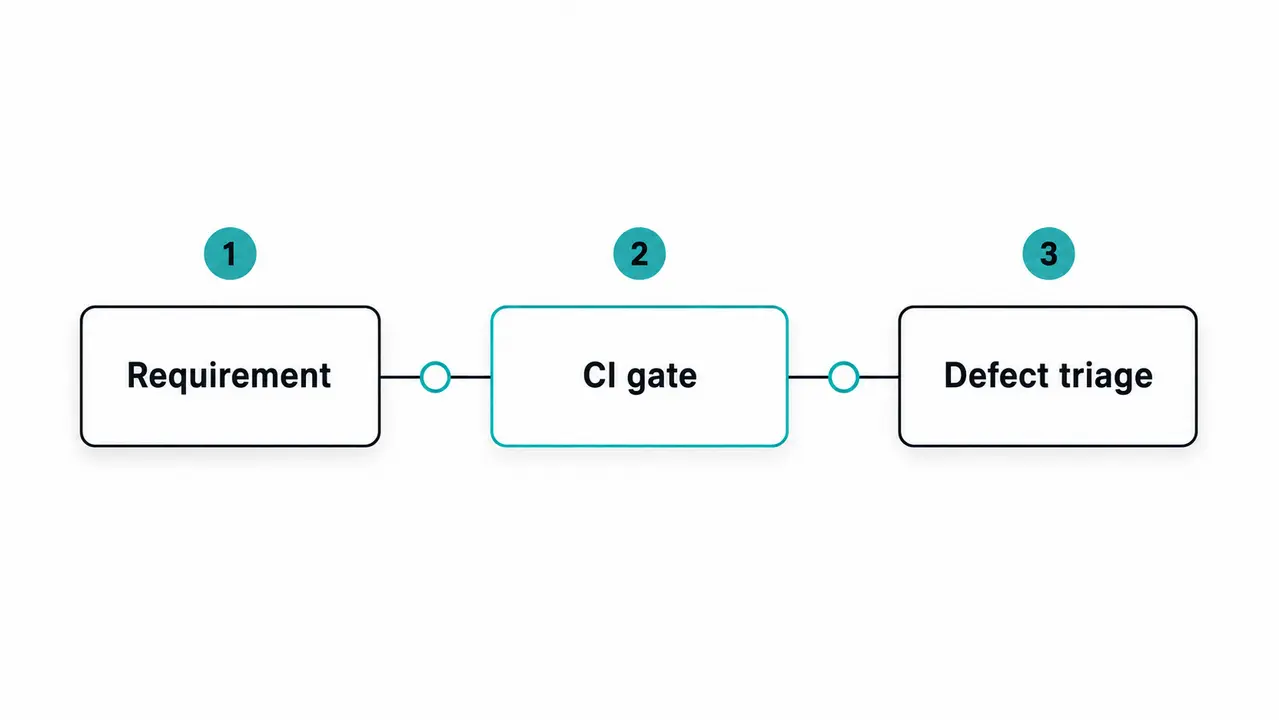
The best evaluation questions expose delivery mechanics, automation maintenance habits, and behavior under release pressure. Generic capability questions produce generic answers, and every vendor on your shortlist has answered them identically for years.
Ask for artifacts, not claims. A sample weekly report from a real engagement, with client data removed. An example test plan and the risk assessment behind it. Their written definition of done for a user story. Their flaky test triage process, including who owns it and how long a flaky test survives before it is quarantined.
Then ask for a walkthrough, requirement to CI gate to defect triage, for one recent feature. Follow a single story through their process and watch where the handoffs happen. The vendors who can narrate that cleanly are the ones whose software QA services actually run as a system. The ones who pivot to headcount and tool lists are telling you what they staff, not how they deliver. Choose the narration.
A 30 day rollout plan for embedded QA
A strong first month for QA outsourcing establishes access, baseline coverage, and a repeatable release workflow, so the value shows up in the next sprint cycle rather than the next quarter. We structure the first thirty days the same way regardless of product, because the sequence is what matters.
Week 1 is onboarding and risk mapping: environment access, architecture walkthrough, and a prioritized coverage map signed off by your tech lead. Week 2 integrates CI and the defect workflow, with the smoke suite wired to build promotion and triage running daily. Weeks 3 and 4 stabilize and expand: flake rate brought under control, regression coverage extended into the second and third risk tiers, and the first release certified through the new workflow.
One caveat decides everything. If environments are unstable, that plan is wrong. Prioritize environment fixes and data seeding first, before scaling test execution or automation, because every test run against a broken environment produces a defect you will spend hours disproving.
Frequently asked questions
How do software QA services handle time zones for daily triage?
Most engagements run with a defined overlap window of three to four hours for joint triage and sprint ceremonies, and asynchronous work outside it. What matters is that defect triage has a fixed daily slot inside the overlap, so blockers never wait a full day. Ask any vendor for their specific overlap hours relative to your team before signing.
What deliverables should be included in a QA handover if the engagement ends?
Expect the full automation repository with documentation, the coverage map and test plans, the defect history with triage decisions, environment and data setup scripts, and access records for revocation. Agree on this list contractually at the start. A handover negotiated at the end is a negotiation you will lose.
Can QA services work if we have no existing test cases?
Yes, and it is often better, because the first weeks go into a risk-based coverage map instead of inheriting stale documentation. The team builds the smoke suite from critical user journeys and works outward by risk. The one prerequisite is access to someone who knows the product well enough to rank those journeys.
What is a reasonable definition of done when QA is external?
The same as when QA is internal, with one addition. Code merged, automated checks green, acceptance criteria verified by the QA owner, and no open defects above an agreed severity. The addition is that the external QA lead explicitly signs the story, so accountability has a name attached rather than a process.
How do you avoid duplicated work between developers and QA?
Split by layer and write it down. Developers own unit tests and integration tests inside the service boundary. QA owns end-to-end flows, exploratory testing, and the regression suite. Where both touch the same path, the automated check should exist once, in the layer that gives the fastest feedback. A short ownership table in the team wiki ends most of the overlap arguments.
The next step for your release pipeline
Look at your last three releases and name what actually blocked each one. If the answer is capacity, software QA services bought as augmentation will help. If the answer is late signal, flaky suites, or environment instability, you need a built-in quality system, and a generic testing contract will make it worse. Map your top three flaky tests or recurring incident triggers to a dedicated pod or a managed service model. Do not sign anything until staging parity and an automated smoke suite exist.
Let’s scope your team
Tell us what blocked your last three releases and we will map it to the right engagement model, from a dedicated QA pod to a fully managed quality function.
About Sentice

Sentice is a boutique software engineering partner founded in 2013 by Roni Levi and Martin Petkovic, now headquartered in Skopje, North Macedonia. Rather than supplying individual developers, we build embedded teams that blend with a client’s culture, tech stack and goals, working together from a single office under our own technical leadership. We deliver dedicated software engineering teams, end-to-end software solutions, product development, and system and embedded engineering, and we act as technical advisors across the full development lifecycle, from specification and architecture through development, testing and support. We use AI coding tools across every project, and we help clients integrate AI into their own products through chatbots, MCP services, connected application layers and workflow automation. Some of the clients we started with more than a decade ago are still building with us today.