
The sprint demo is in two days and nobody can say whether the release will make it. Engineering says the features are done. QA says half of them fail acceptance. Your CEO asks for a date and receives a story point total. This is not an engineering problem. It is a delivery problem, and it shows up in almost every scaleup between the second squad and the second product line. Below, we’ll unpack what a delivery system actually consists of, where internal fixes break down, how to keep scope and risk visible, and what to ask before you trust a vendor with delivery.
Reading time: 13 min
Key points
- Software project management services are a packaged delivery capability with cadences, artifacts, and escalation paths, not a job title.
- A sound delivery engagement produces clarity artifacts, a realistic milestone plan, and a reporting rhythm within the first ten business days.
- Predictability comes from a small set of living documents: six maintained weekly beat twenty maintained never.
- For product work where requirements move, the embedded team model wins on delivery control and speed over classic outsourcing.
Table of contents
Software project management services as a delivery system not a role title
Software project management services are a packaged delivery capability, not a job title you hand to someone. The system converts product intent into an execution plan and holds control over scope, decisions, and risks until the release ships. It has specific cadences, real artifacts like a project charter and a milestone plan, and defined escalation paths. Project governance is the connective tissue between those pieces.
What teams usually have instead is a role. Someone with “PM” in their title chases status, runs standups, and updates a board. Everyone feels busy. Meanwhile the integration work and acceptance tasks drift quietly to the end of the timeline, where they collide with the release date at full speed.
A delivery system prevents that drift by making the drift visible. The charter names the goal. The milestone plan names the gates. The escalation path names who decides when something slips. Project delivery becomes inspectable rather than assumed.
The moment startups feel the need for external delivery leadership
External delivery leadership becomes necessary when engineering output is no longer the bottleneck and coordination is. You feel it in specific places. You run more than one squad and shared components need an owner. Your tech leads spend their calendar on stakeholder updates instead of code review. A founder CEO asks for a delivery date and gets story points as the only answer.
That is the moment outsourced project management starts to earn its keep, because delivery management is a distinct discipline from writing good software. The macro picture makes internal fixes harder too. In 2024, more than 10 million people were employed as ICT specialists across the EU, representing 5.0% of all employed people, according to Eurostat. Demand for technical talent keeps rising, which means the people you would pull into a coordination role are exactly the people you cannot spare.
Hiring your way out of the problem takes quarters. The coordination problem compounds in weeks.
Where teams confuse development management with project delivery
Development management operates the engineering organization. Project delivery drives a specific outcome through scope, schedule, and acceptance criteria. These are different jobs that frequently land on the same person by accident.
Development management means hiring, technical direction, architecture stewardship, and growing engineers. Delivery means maintaining a milestone plan, mapping dependencies, and proving release readiness against acceptance criteria. A strong dev manager keeps the organization healthy. A strong delivery capability gets one specific product out the door on a date both teams and stakeholders believe.
The confusion costs you your tech leads. When they default into the PM role, deep technical work and code review get squeezed out first, because those are the tasks with the softest deadlines. You lose exactly the contribution you hired them for. Name the two functions explicitly, even if one person temporarily covers both, and the milestone plan stops competing with the architecture decisions for the same hours.
The week a senior leaves mid migration
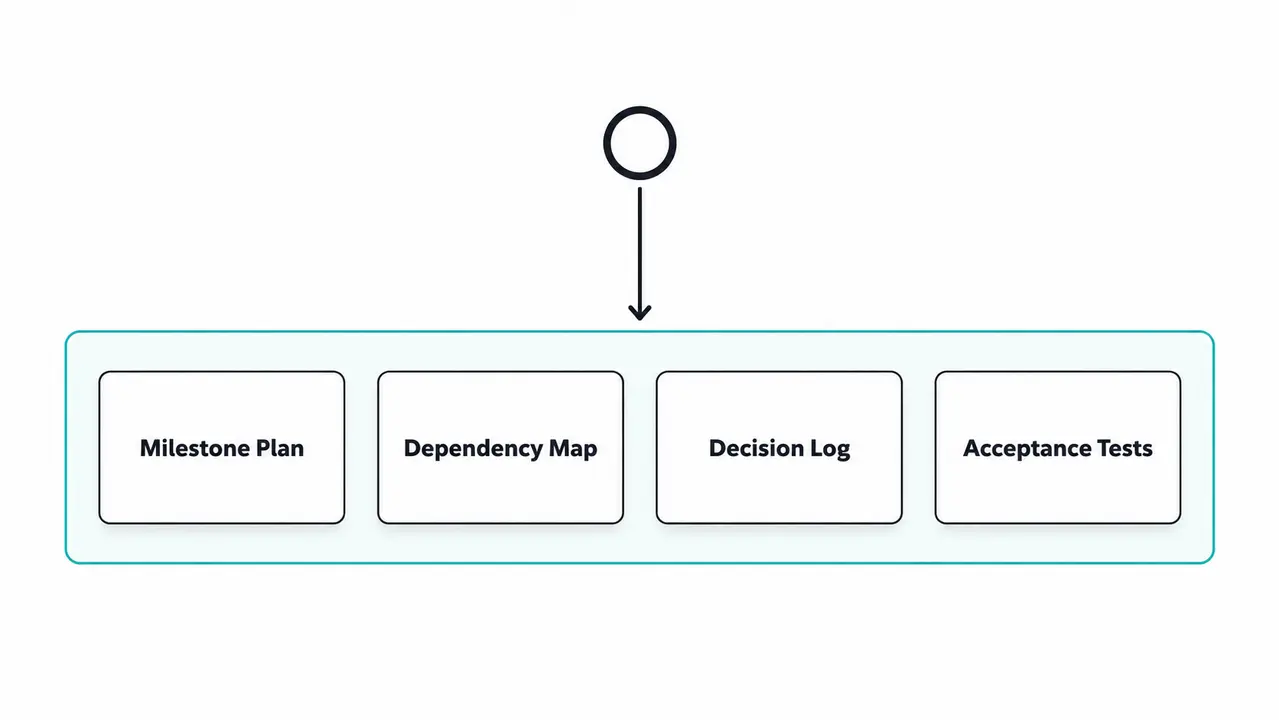
A senior engineer resigns during a database migration. The repository has the code. The context lives in their head. If your delivery approach is sound, this is a hard week. If it is not, this is a project collapse.
The difference is whether tacit knowledge has been converted into explicit artifacts. A current milestone plan, a dependency map, a decision log, and acceptance tests tied to each migration step mean the departure is recoverable. Project recovery starts with three moves: rebaseline the plan against remaining capacity, lock the interfaces the departing engineer owned, and update the RACI matrix so every open workstream has a named new owner within days, not weeks.
The RACI matters more than people admit. Half the damage of a departure is not lost knowledge, it is orphaned work that nobody realizes they now own. A decision log answers the questions nobody can ask anymore: why we chose this migration order, why we skipped that fallback. Write those down while the person is still in the building.
What good looks like in the first ten business days
The first ten business days of a delivery engagement must produce clarity artifacts, a realistic plan, and a reporting rhythm that actively reduces ad hoc meetings. Days one to three go to stakeholder mapping, tool access, and reading the backlog as it actually exists, not as the roadmap says it does. Days four to seven produce the milestone plan, the first risk register, and an honest statement of what is unknown. Days eight to ten establish the first demo cadence and the status template everyone will live with.
What you should not see is a month of vague discovery. Discovery that produces no artifact by day ten is a stall, and the delivery cadence never recovers its credibility with your executives.
The counter-case is real: a two-person team with one product does not need this weight. The moment a second workstream or a shared component appears, the ten-day standard applies.
The minimum artifact set for a clean kickoff
A clean kickoff needs a baseline set of living documents that anchor the engagement. The list is short: a charter stating the goal and its boundaries, a scope definition with explicit exclusions, a delivery calendar, a RAID log, a communications plan, and a release checklist. Each one prevents a specific failure, and the RAID log and release checklist prevent the two most expensive ones, namely misaligned expectations about what done means and a release day nobody rehearsed. If a document exists but nobody updates it, it is not an artifact. It is decoration.
The artifacts that keep delivery predictable
Predictability comes from a small set of living documents that make scope, decisions, and risk visible to both engineers and business stakeholders. The weekly status report carries four things and nothing else: progress against the milestone plan, current risks, decisions needed from stakeholders, and the next milestone. A decision log records what was decided, by whom, and when, which prevents the same debate from reopening every three weeks. Stakeholder alignment is a byproduct of these documents, not a meeting you schedule.
The quiet killer these artifacts prevent is silent scope creep. New requests arrive, someone helpful says yes, and the timeline absorbs the cost invisibly until it cannot. Change control does not mean saying no. It means every accepted change carries an impact note and a visible timeline adjustment, so the tradeoff is chosen deliberately rather than discovered at the release date.
Keep the set small. Six documents maintained weekly beat twenty maintained never.
How to keep documentation from becoming a second job
Documentation overhead drops when every artifact has one home and one template. A single source of truth work tracker, auto-generated meeting notes piped into Confluence, and a status report assembled from the tracker rather than rewritten by hand prevent duplicate data entry. Engineers abandon documentation for exactly one reason: it requires manual syncing across disconnected tools. A periodic delivery audit of your project controls should ask which documents people actually read, and delete the rest.
How sprint cadence breaks in embedded plus cloud products
Sprint cadence breaks when hardware, firmware, and cloud teams operate with mismatched integration points and incompatible definitions of done. We have watched firmware declare a feature complete without a test harness, while the cloud side declares the same feature complete without a device simulator to exercise it. Both teams were honest. Both definitions were local.
The failure surfaces late. Integration happens in the final phase, simple defects get misdiagnosed as fundamental architecture problems, and the team burns two sprints debugging a protocol mismatch that hardware in the loop testing would have caught in an afternoon. Simulators are the cheapest insurance in this stack: a device simulator lets cloud iterate daily instead of waiting for a firmware release, and a stub cloud service lets firmware test against stable contracts.
The fix is aligning integration points across the whole chain, which is the core discipline in system and embedded engineering. Every firmware release needs a paired cloud contract version, and the definition of done must be shared across all three layers.
Managing scope without freezing innovation
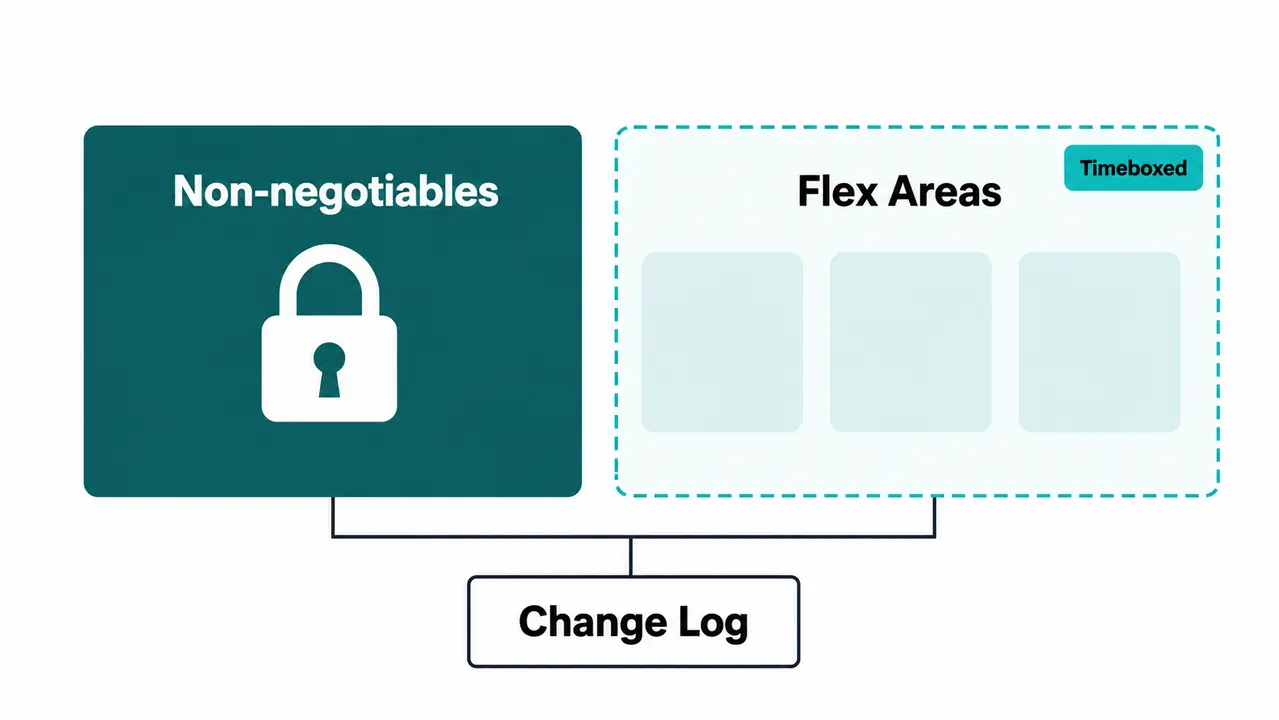
Scope control has a bad reputation because teams practice it as a wall. Rejecting every change means you ship something the market stopped wanting. Accepting every change means you miss the release window entirely. Effective scope management protects the core release goal while keeping a safe lane open for learning.
The mechanism has four parts. Define the non-negotiables of the release in writing. Name the flex areas where change is welcome. Timebox discovery spikes so learning has a budget. Maintain a strict change log so every accepted request shows its cost. Backlog grooming then becomes the place where flex items enter the plan deliberately, instead of slipping in through a hallway conversation.
The definition of done is your stabilizer. When change pressure rises, the definition of done does not bend. You change what gets built, never how carefully it gets built.
A practical change request workflow for fast moving teams
Fast moving teams need a lightweight intake, not a committee. The workflow is five steps: intake in a single channel, an impact note written in one page, a named decision owner, a decision deadline, and a plan update if accepted. The impact note checks the dependency map so hidden couplings surface before commitment. The named owner is the piece teams skip, and skipping it is why decisions sit open for weeks. Change control this light takes minutes per request and keeps the plan honest.
Stakeholder communication that does not steal engineering time
The best delivery services reduce engineering interruptions by making the update rhythm predictable and the escalation path singular. A standard cadence looks like this: a weekly executive update in writing, a delivery sync twice a week with the leads, and a sprint demo open to everyone. Anything urgent travels one path, through the delivery manager, not through a direct message to whichever engineer built the feature last quarter.
Without that structure, your engineers spend hours re-explaining the same context to different stakeholders in separate meetings. Delivery management exists partly to absorb that repetition so the people writing code do not have to.
Stakeholder alignment follows from rhythm, not from charm. When the weekly update lands every Friday at the same time with the same four sections, stakeholders stop scheduling interrupt meetings to get answers, because the answers arrive before the anxiety does.
Risk management that engineers will actually use
Risk management works when it is tied to technical reality and reviewed on a schedule. It fails when it lives in an abandoned spreadsheet that someone filled out during kickoff. The RAID log must be reviewed in a fixed weekly meeting where every risk has an owner, a trigger condition, a mitigation, and a decision date. No owner, no risk. That rule keeps the register honest.
Estimation is where risk hides first. PMI research on software cost estimation documents how difficult forecasting remains in this field, noting that the Standish Group’s 2006 CHAOS report found only 34% of software projects succeeded, while 51% came in late, over budget, or without required functionality, and 15% failed outright (PMI). Those numbers argue for treating the risk register as a live instrument, not a formality.
Engineers engage with risk work when it maps to the critical path. A risk on the critical path gets a mitigation plan in sprint planning. A risk three paths off the critical path gets a watch flag. Both are real. Only one gets budget.
The hidden work between code complete and release
Delivery slips most often after feature complete, because release readiness tasks were never planned as first-class work items. QA hardening, data migration scripts, observability hooks, runbooks, rollback plans, and device provisioning all live in the gap between “the code works” and “the product shipped”. None of it appears on a feature board, and all of it consumes calendar.
A UAT plan is the classic casualty. User acceptance testing gets scheduled as a one-week box after development, then discovers that the test users have no accounts provisioned, the staging environment diverges from production, and nobody wrote the rollback script. That one-week box becomes three.
The release checklist is the fix. Build it once, per product, and treat every item on it as a ticket with an owner and a date in the plan. When the checklist items sit in the sprint alongside features, the release date stops being a hope and becomes a forecast.
How to run a takeover when a project is already late
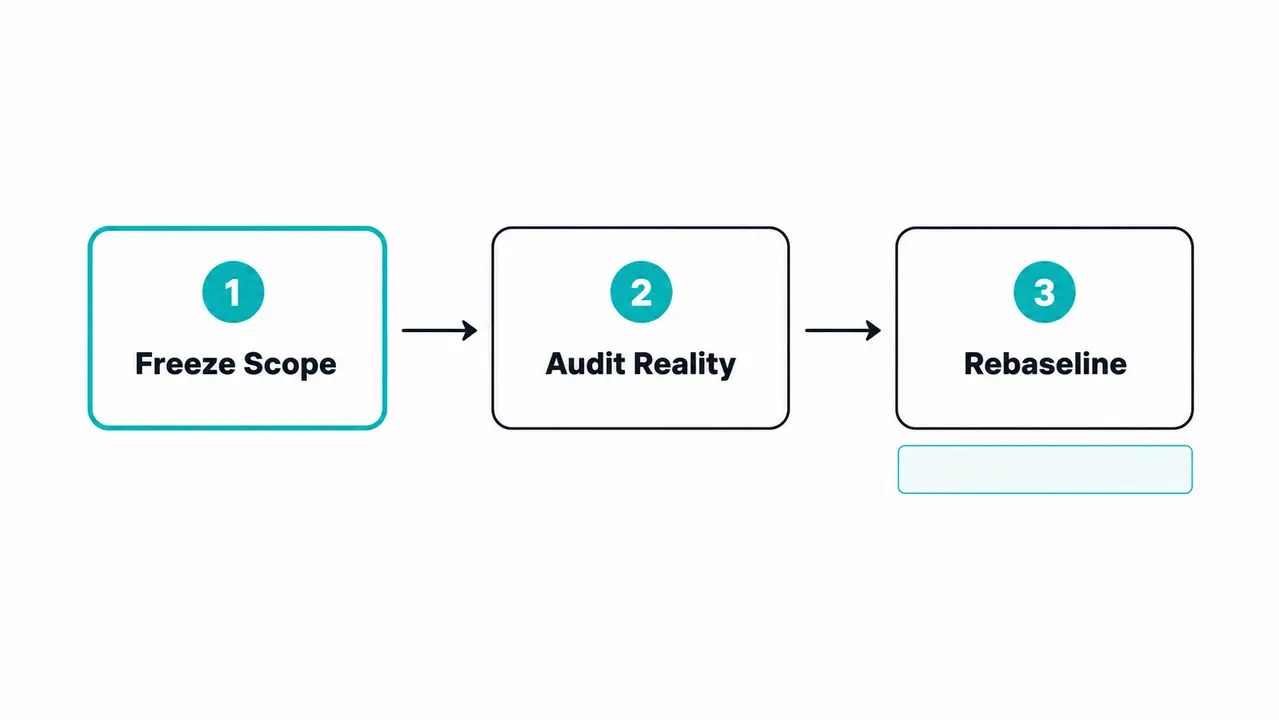
A project takeover succeeds by stabilizing reality first, then replanning with explicit tradeoffs and a new operating cadence. Step one is freezing new scope for a short, defined window, usually two to three weeks, so the team stops digging. Step two is auditing what actually exists: test coverage, integration status, which features are demo-able versus merely coded. Step three is rebaselining the milestones against the real state, with the tradeoffs written down and chosen by the stakeholders, not absorbed silently by the team.
The temptation to avoid is adding features to a late project to increase its value. Every addition increases instability, and instability is already the problem. Project recovery is subtraction until the ground is solid.
Expect the rebaseline to be uncomfortable. The first honest plan in months looks worse than the fiction it replaces, and it is the only plan anyone can actually steer by.
The fastest way to find the real critical path
Finding the critical path starts with mapping dependencies and validating the map with your senior engineers, because the documented dependencies and the real ones rarely match. Look for the integration gates, the points where work from separate streams must meet, and align them against hard constraints like app store submission windows or manufacturing handoffs. A theoretical critical path that ignores an actual technical bottleneck is worse than no plan, because it allocates buffer to the wrong places. The validation conversation takes an afternoon and saves a quarter.
Choosing between PM services and a fractional delivery lead
PM services fit when you need a repeatable delivery system across multiple workstreams. A fractional delivery lead fits when the system already exists and needs senior steering. The distinction matters because hiring the wrong one wastes a quarter.
PM services bring templates, reporting, coordination capacity, and PMO support that scales across squads. A fractional lead brings governance design, executive alignment, and judgment about what to stop doing. One operates the machine. The other tunes it.
The failure mode we see most often is the fractional hire into a team with no delivery hygiene. The leader arrives to steer and finds there is nothing stable to steer: no cadence, no decision log, no honest milestone plan. Verdict: if your weekly status report does not exist or nobody trusts it, buy the system first. Bring in the fractional lead once the system produces signal worth interpreting.
Why in house hiring stalls at scale
Hiring an internal project manager can be slower than the delivery problem you are solving, especially when the role needs deep domain context. Count the time sinks honestly: recruiting and interview loops, onboarding, learning the product domain, and earning credibility with an engineering team that has watched three process initiatives die. That sequence runs two quarters before the hire produces a plan anyone follows.
Meanwhile delivery risk compounds across releases. An external project manager arrives with a proven playbook and adapts it to your stack in weeks, which is why how boutique partnerships accelerate tech team growth is worth understanding before you post the job ad. The internal hire can come later, inheriting a working delivery cadence instead of building one from zero under pressure.
This is not an argument against internal hiring. It is an argument against internal hiring as the emergency response. Emergencies need something that starts Monday.
Embedded team model versus classic outsourcing for delivery control
An embedded team model improves delivery control because the partner shares your cadence, your tools, and your definition of done instead of operating as a separate factory behind a statement of work. In the embedded model, dedicated software engineering teams work from a shared backlog, present in shared demos, and hold to a shared quality bar across the entire product team. There is one program management view of the work, not two reconciled reports.
Classic outsourcing optimizes for contract compliance. Feedback travels through account managers, scope disputes become commercial disputes, and the definition of done splits into a vendor version and a client version. Integration defects become negotiation leverage. That is how feedback loops stretch from hours to weeks.
Verdict: for product work where requirements move, the embedded model wins on control and speed. Classic outsourcing retains a place for well-specified, stable work with hard boundaries. Most startup delivery does not look like that.
| Dimension | Embedded team model | Classic outsourcing |
|---|---|---|
| Operating posture | Shares your cadence, tools, and definition of done | Separate factory behind a statement of work |
| Backlog and demos | Shared backlog, shared demos, shared quality bar | Definition of done splits into a vendor version and a client version |
| Feedback path | Direct, loops measured in hours | Travels through account managers, loops stretch to weeks |
| Program view | One program management view of the work | Two reconciled reports, disputes become commercial disputes |
| Best fit | Product work where requirements move | Well-specified, stable work with hard boundaries |
What to ask before you trust a vendor with delivery
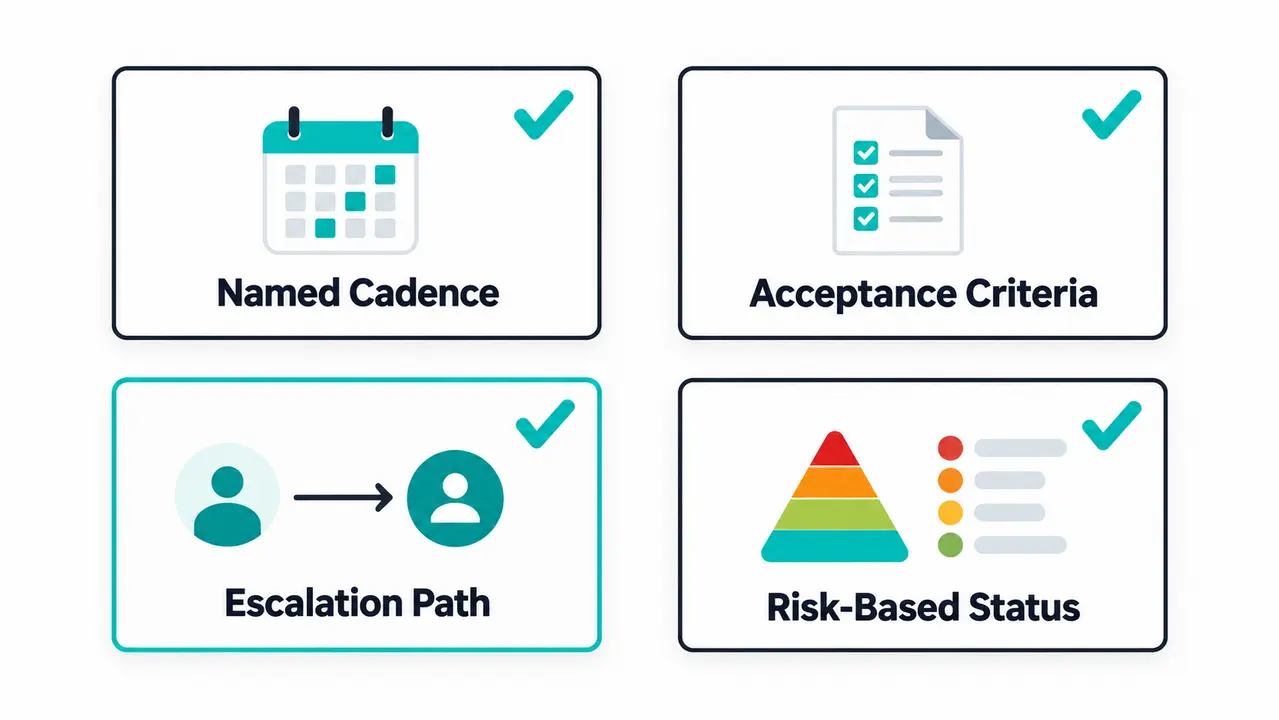
Ask questions that force operational specifics, and distrust methodology slogans. Anyone can say agile. Fewer can answer who owns the backlog when two stakeholders disagree, or what their weekly status template actually contains, or what happened the last time a sprint goal was missed.
Three questions do most of the screening work. Who owns the backlog and how are conflicts resolved? Show me a sample weekly status report from a real engagement. When a sprint planning commitment misses, what changes the following week? The answers reveal whether project governance exists or is aspirational.
Watch for process theater. Impressive tooling, a polished dashboard, and a certified framework can coexist with decisions made in hallways and documented nowhere. The artifacts and the decision behavior have to match.
Red flags technical leaders spot in the first two calls
Technical leaders can screen weak delivery practices early by looking for specific gaps. No named cadence, meaning nobody can state when status happens and who attends. No acceptance criteria discipline on the sample backlog they show you. Vague escalation paths where the answer is “we escalate to management”. Reporting built entirely on percent complete, which measures effort and tells you nothing about remaining risk. A quick delivery audit of these four tells you whether the vendor needs micromanagement to produce basic artifacts. If they do, the engagement will consume your senior people anyway.
The tooling stack that supports delivery visibility
Tools do not create delivery maturity. They support it once workflows and ownership are defined. The typical stack is small: an issue tracker as the single source of truth for work state, a documentation space for the decision log and charter, a roadmap view for stakeholders, and CI visibility wired into the tracker so a red pipeline is a status change, not a rumor.
Each tool should own exactly one function. The moment two tools both hold work state, you have a synchronization job, and synchronization jobs are where honest status goes to die.
The failure mode at the other end is over-tooling an early-stage team. Five engineers do not need a portfolio management platform, a separate test management suite, and three dashboards. Every extra tool fragments context and adds overhead without improving project controls. Start with a tracker and a docs space. Add a tool only when a specific visibility gap hurts, and delivery visibility should be demonstrably better within two sprints of the addition or the tool goes.
How project delivery ties back to engineering quality
Good delivery management protects quality by planning time for testing, refactoring, and integration instead of treating them as optional extras squeezed between features. Quality is a scheduling decision long before it is a code decision. When the plan contains no line item for verification and validation, quality gets whatever time is left, and what is left shrinks as the deadline approaches.
The mechanism is the definition of done. Its quality gates must include automated tests, code review, observability hooks, and operability documentation, written against the system requirements so the gates trace to something. In embedded work the chain extends further: a clean manufacturing handoff requires that firmware, test fixtures, and production tooling are release-ready together, not serially.
Ship without those gates and you are not saving time. You are exporting technical debt into the next release, which arrives slower and more fragile than the one you just cut. The plan is where that outcome is decided.
What success looks like after ninety days
After ninety days you should see a stable cadence, fewer surprises, and a team that can forecast with defensible confidence. The signals are concrete. Demos happen on schedule and show working software, not slide decks. Blocker age drops, meaning the time between a blocker appearing and being resolved shortens week over week. Ownership is clear enough that asking “who owns this” gets a name in under a minute. Release checklist discipline holds, and the checklist shrinks the chaos of each release instead of documenting it.
Program management at the ninety-day mark is measured by what stops happening. No last-minute scope fights, because changes carry impact notes. No unpredictable status, because the cadence never breaks.
The trust effect is the real return. Executives who get honest bad news early stop treating every plan as fiction, and the delivery cadence becomes the most boring, most valuable meeting on the calendar.
Frequently asked questions
How do PM services work with a CTO who wants to stay hands on?
The service takes over operational coordination and reporting: status, dependencies, stakeholder updates, and risk tracking. You keep final decision authority on scope, architecture, and priorities. Most hands-on CTOs find the first month returns ten or more hours a week, which goes back into technical direction.
What is the difference between project management and product management in a services engagement?
Product management defines what to build and why, owning the backlog priorities and the market reasoning. Project management services define how and when it gets built, managing scope, schedule, and execution constraints. In smaller engagements one person can cover both, but the two responsibilities should still be tracked separately.
Can PM services work with agile, waterfall, or a hybrid delivery model?
Yes. The delivery system adapts by adjusting cadence and artifacts to the framework. Pure waterfall needs heavier upfront milestone planning and formal stage gates. Hybrid models, common in embedded and regulated work, usually run agile sprints inside a waterfall release frame.
What should I prepare before kickoff to avoid losing the first month?
Prepare four things: tool access for every system the team will touch, a high-level product vision document, a list of key stakeholders with their decision rights, and any existing architecture documentation. A current backlog export helps, even a messy one. Access delays are the number one cause of a slow start.
How do you handle time zones and async communication in global teams?
Define overlap hours for synchronous meetings, record demos for people who cannot attend live, and keep a strict decision log so async work does not stall waiting for a meeting. The rule is simple: decisions can be async, blockers cannot. Anything blocking work gets escalated into the next overlap window.
Run a short delivery diagnostic before changing team structure
Before you restructure anything, run a short diagnostic to surface the actual delivery constraints. Ask for a sample weekly status report, a draft RAID, and a first-pass milestone plan built from your current backlog. The quality of those three artifacts tells you whether you need full PM services, a takeover reset, or only light governance tuning.
Let’s scope your delivery system
Tell us where your releases slip and we’ll map the artifacts, cadence, and ownership your team needs to forecast with confidence.
About Sentice

Sentice is a boutique software engineering partner founded in 2013 by Roni Levi and Martin Petkovic, now headquartered in Skopje, North Macedonia. Rather than supplying individual developers, we build embedded teams that blend with a client’s culture, tech stack and goals, working together from a single office under our own technical leadership. We deliver dedicated software engineering teams, end-to-end software solutions, product development, and system and embedded engineering, and we act as technical advisors across the full development lifecycle, from specification and architecture through development, testing and support. We use AI coding tools across every project, and we help clients integrate AI into their own products through chatbots, MCP services, connected application layers and workflow automation. Some of the clients we started with more than a decade ago are still building with us today.