
Launch day arrives, the champagne photo goes out, and three weeks later nobody has answered the question of who handles the pager at 3 a.m. That gap between “shipped” and “operable” is where most lifecycle failures begin. Teams plan the build with care and treat everything after the release as an afterthought, then wonder why iteration slows and incidents pile up. Below, we’ll separate the SDLC from the product lifecycle, define the phases and artifacts that make each one real, and outline the gates, metrics and ownership rules that keep delivery fast without losing control.
Reading time: 9 min
Key points
- The SDLC is the engineering execution loop; the product lifecycle runs from idea through operation and retirement. Merging them blurs ownership and slows delivery.
- A phase without an artifact is a meeting, not a phase. Every gate needs a named output and a named accountable owner.
- Testing, security and observability belong across the lifecycle, not bolted on at the end.
- For most startups and scaleups, iterative delivery wins; the V-Model earns its overhead only when post-release change is punishing.
Table of contents
When teams confuse SDLC with the product lifecycle delivery slows down
The SDLC is the engineering execution loop: how you build, change, and verify software. The product lifecycle is the business journey from idea through launch, operation, and eventual retirement. They overlap in the middle, and that overlap is where teams get into trouble. We have seen startups declare the lifecycle “done” at launch, only to discover there was no plan for monitoring, incident response, or the second release. The software product development lifecycle did not end. It had barely started.
When the two get merged, roadmaps become feature lists. There are no architecture gates, no quality gates, no operational readiness gates. Decisions that belong to the business, like whether to keep supporting a product line, get mixed with decisions that belong to engineering, like whether the release is safe to deploy. Ownership blurs. Late surprises follow.
Keep two timelines. Name what each one decides.
A practical definition of the software product development lifecycle
Strip away the diagrams and the lifecycle is a repeatable set of phases and decision gates that takes a product from concept through build, release, operation, and evolution, with explicit outputs at each step. The outputs are the point. A phase without an artifact is a meeting, not a phase.
The anchor deliverables are concrete. A one-page product brief. Requirements with acceptance criteria. Architecture decision records. A test strategy. A release plan. Runbooks. If you cannot name the artifact a phase produces, you cannot tell whether the phase happened, and neither can the engineer who joins six months later.
Prototypes and spikes can skip the heavy paperwork. They still need a decision record and a rollback plan, because unmanaged experiments have a way of becoming production systems. When we take clients through end-to-end product development, the first thing we establish is which artifact each gate produces, so the process stays lightweight but never silent.
The lifecycle as a set of decision gates not a linear checklist
High-performing teams use phases to force decisions at the right time, not to enforce a rigid sequence. The goal is to validate assumptions before they get expensive. The development phases exist to structure decisions, and each gate asks a question the team must answer before more money flows.
The gates are things like problem validation, solution feasibility, security posture acceptance, and operability readiness. Each one has a yes-or-no answer and a named person accountable for it. That is what makes it a gate rather than a milestone on a Gantt chart.
The failure mode is familiar. A team codes first, then discovers constraints in integration, performance, or compliance during the final sprint. Around the same time a senior engineer leaves mid-migration, and nobody can explain why the message queue was chosen over the API gateway. The decisions were made. They were just never recorded, never reviewed, and never owned by anyone still present.
Discovery work that prevents building the wrong product
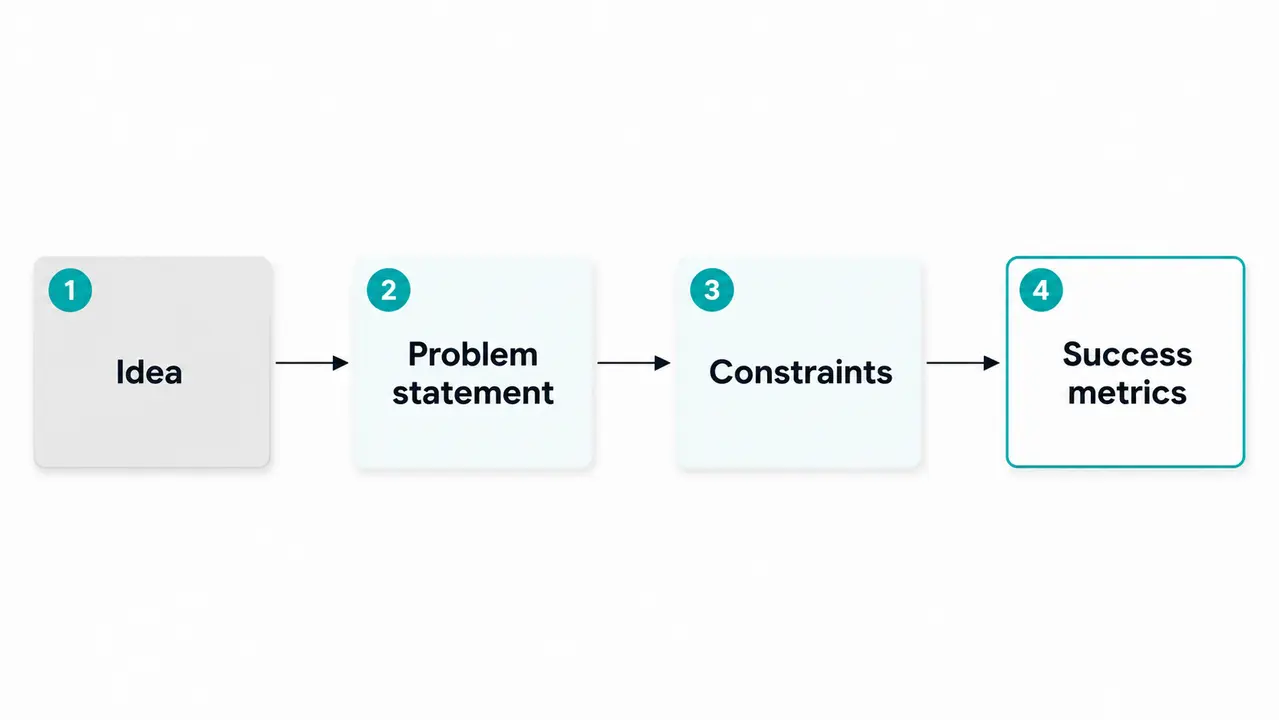
Discovery turns a vague idea into a testable problem statement, a target user, and a measurable outcome. It is the phase that protects engineering capacity, because a week of discovery costs a fraction of a quarter spent building the wrong thing.
The outputs fit on a few pages. A one-page product brief. User journeys. A constraints list covering latency targets, offline behavior, device constraints, and integration boundaries. Success metrics you could actually measure after launch. Define these before committing to architecture, because a 200 ms latency target and a 2-second target produce different systems.
Without discovery, requirements become a moving backlog with no definition of value. Engineers burn sprints on features nobody can defend, and the product drifts. NIST’s Secure Software Development Framework makes the same point from the security side, recommending that secure development planning happen as a core practice integrated into the lifecycle from the start rather than bolted on late (NIST SP 800-218). Discovery is where that planning lands.
Requirements that engineers can actually build from
Good requirements specify behavior, constraints, and acceptance criteria in a way that supports estimation, testing, and change control. Behavior tells the engineer what the system does. Constraints tell them what it must not do. Acceptance criteria tell everyone when it is finished.
Cover both functional and nonfunctional ground: performance, reliability, security, maintainability, and observability. Most teams write the functional half and skip the rest, then argue in production about what “slow” means. Write acceptance criteria as testable statements tied to deployability. “The checkout flow completes within 3 seconds at the 95th percentile under normal load” can become a test. “Checkout should be fast” cannot.
The failure mode is requirements as UI notes. A wireframe with three annotations goes to engineering, edge cases get discovered by customers, and by then the cheap pivot window has closed. Every requirement that arrives without acceptance criteria is a deferred argument, and deferred arguments cost more.
Architecture decisions that survive the second release
Architecture in the lifecycle means making a small set of explicit choices that reduce future coupling and enable change. Not a 60-page document. Five or six decisions, written down, each with a rationale and a reversal cost.
The artifacts are a high-level architecture diagram, interface contracts, architecture decision records, and threat model notes. For an embedded device paired with a cloud service, the boundaries matter most: who owns firmware updates, how telemetry flows, how authentication works between device and backend. We handle these boundary questions regularly in our embedded and system engineering work, and the teams that struggle are always the ones where those boundaries were implied rather than specified.
The “just ship it” mentality feels fast for one release. By the third, hidden dependencies block scaling, and onboarding a new engineer takes months instead of weeks. Architecture is what you buy so the second release costs less than the first.
Design work that aligns product engineering and QA
Design translates requirements into interaction flows, system behavior, and testable scenarios. It is where ambiguity gets removed before coding begins, and it is cheaper to remove ambiguity on a whiteboard than in a pull request.
The concrete outputs are wireframes, API contracts, state diagrams for edge cases, and test scenarios derived from user journeys. The state diagrams matter more than teams expect. What happens when payment succeeds but inventory allocation fails? When the device reconnects after a 20-minute gap? If the diagram does not cover it, the code will improvise, and QA will find the improvisation in staging or, worse, in production.
When design skips this, QA becomes a late-stage interpreter of intent instead of a partner in defining it. We have watched two subsystems built by competent teams fail integration because the contract between them was implied rather than written. Both sides were right. The missing document was wrong.
Implementation practices that keep velocity without losing control
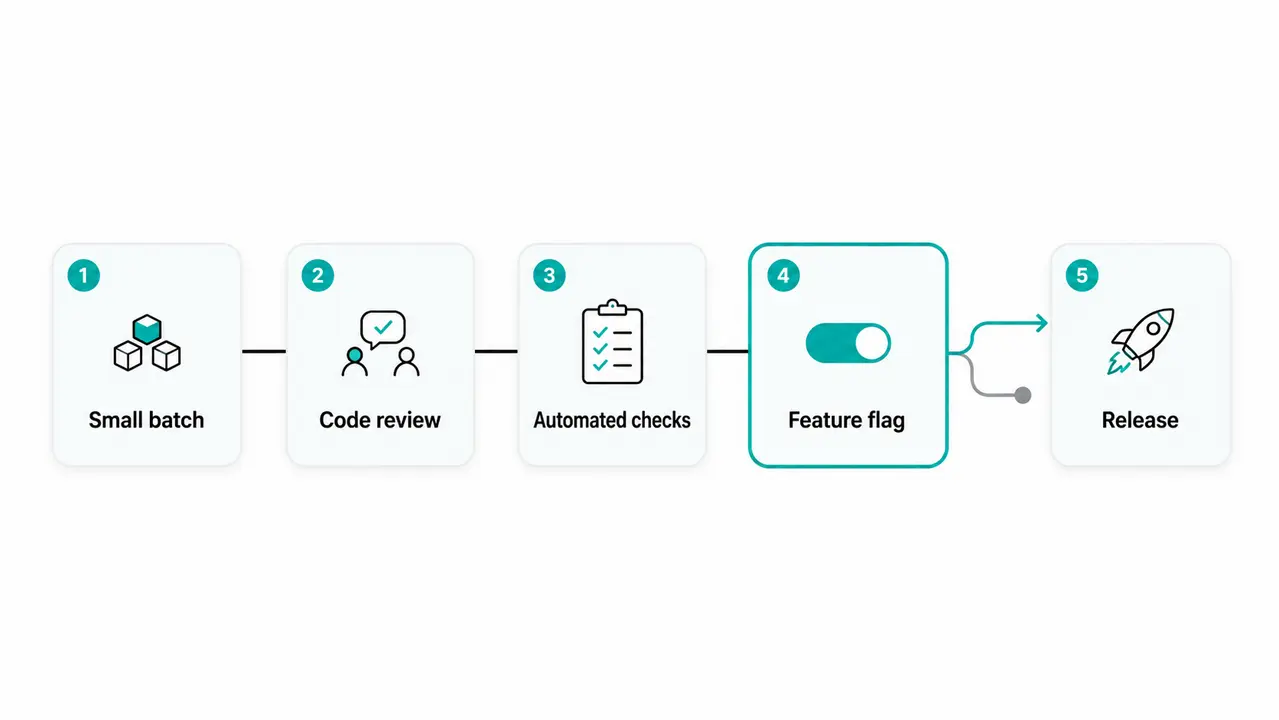
Implementation should optimize for safe change. Small increments, code review discipline, automated checks, and clear ownership of components. Velocity comes from the absence of rework, not from skipping the brakes.
The mechanics are unglamorous. A branching strategy your whole team actually follows. A pull request checklist that catches the recurring mistakes. Coding standards enforced by tooling, not by review comments. A CI pipeline in GitHub Actions or GitLab CI that runs tests, linting, and a build on every commit. Feature flags for risky changes, so release and exposure become separate decisions. Trunk-based development or short-lived branches, chosen to match your release cadence rather than someone’s ideology.
Long-lived branches are the trap. A three-week branch accumulates invisible integration risk, and the merge conflict that finally surfaces can halt deployment for days. Small batches feel slower daily and are faster weekly.
Testing as a product risk strategy not a QA phase at the end
Testing belongs across the lifecycle, with different test types reducing different risks. Unit tests protect logic. Integration tests protect contracts. End-to-end tests protect critical flows. Performance tests protect the bottleneck you have not met yet. Concentrating all testing at the end raises cycle time and production defects simultaneously, which is the exact opposite of what a deadline pressure was supposed to achieve.
DORA’s research on delivery metrics shows why this matters: teams that test continuously sustain higher deployment frequency and lower change failure rate, and the metric set has evolved specifically to capture rework and recovery, including deployment rework rate introduced in 2024 (DORA metrics history). Testing is not overhead on delivery performance. It is a driver of it.
Choosing the smallest reliable test suite for a startup
Prioritize ruthlessly. Cover core revenue flows first, because a broken checkout costs more than a broken settings page. Cover data integrity second, since corrupted data outlives any bug. Cover safety-critical device behavior third, where a field failure can mean recalls. Everything else can wait, and a lean suite that runs in four minutes beats a comprehensive one nobody runs.
Release readiness that avoids fragile launches
Release readiness is the set of checks that prove the product can be deployed, observed, supported, and rolled back. It is a lifecycle gate, not a calendar event. The difference shows up the first time a launch goes wrong.
The artifacts are a release checklist, a rollout plan, a rollback plan, runbooks, and a named on-call owner. Use staged rollouts and canary releases so exposure grows with confidence. Maintain a versioning strategy for APIs and device firmware, because “just redeploy the previous build” stops working the moment a database migration or a firmware constraint enters the picture.
The failure mode is mistaking deploy success for user safety. The pipeline goes green, the release ships, and real user load breaks it in ways staging never predicted. A green build proves the code deployed. It says nothing about whether the product survived contact with customers.
Deployment and operations as first-class lifecycle phases
After deployment, the lifecycle continues through monitoring, incident response, and iterative improvement. Operational maturity is part of product quality, not a separate concern handed to whoever answers the phone.
The building blocks are dashboards, alert thresholds, error budgets, incident postmortems, and service level objectives. For connected products, route telemetry from devices to the cloud with clear ownership for data quality and privacy constraints, because telemetry nobody trusts is telemetry nobody uses. Set your SLOs before the incident, not during it.
Without observability, bugs are discovered by customers first. Every one of those discoveries costs trust and support hours, and the pattern compounds. A team that learns about failures from Twitter is running a lifecycle that ended at deploy, whether anyone admits it or not.
Maintenance work that keeps the product evolvable
Maintenance is not just bug fixes. It includes dependency updates, refactoring, security patches, and keeping the build and test systems healthy. The systems decay quietly, and the decay is invisible until something breaks.
Run an upgrade cadence for your dependencies rather than heroic annual catch-ups. Publish a deprecation policy so consumers of your APIs know what to expect. Keep a tech debt register tied to roadmap impact, so a refactor competes with features on evidence instead of on who argues loudest. Schedule planned refactors right after major feature pushes, when the pressure drops and the architectural drift is still fresh.
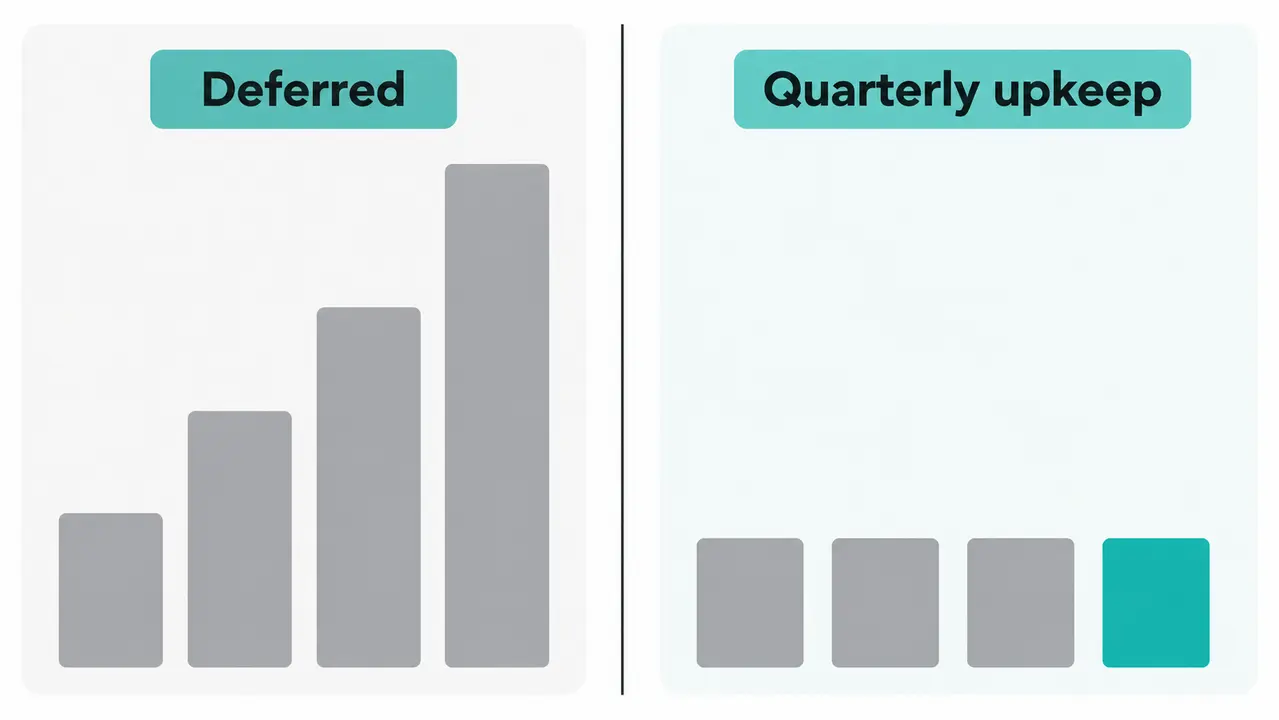
Deferred maintenance has a compounding cost curve. Teams that skip it for two years usually arrive at the conclusion that a full rewrite is the only option, and rewrites cost multiples of what incremental upkeep would have. The cheapest time to pay was every quarter.
How Agile fits into the lifecycle without turning phases into theater
Agile changes how you move through phases, not whether the phases exist. Discovery, requirements, design, build, test, release, and operate still happen. The feedback loops between them just get tighter, and the artifacts get smaller.
Map sprint planning to lifecycle outputs, not just story points. A sprint that produces working software but no updated contracts or no reviewed decision records is accumulating invisible debt. Use definitions of ready and done to prevent churn, and make sure “done” includes the quality gates, not just the demo.
The failure mode is Agile as an excuse. Teams stop documenting anything, onboarding takes a quarter, and quality collapses because context lives entirely in the heads of three engineers. That is not agility. That is fragility with a standup.
Waterfall V-Model and iterative delivery in real product teams
Different lifecycle models change sequencing and validation points. The right choice depends on your risk profile, your integration complexity, and how expensive change is after release. Here is how the three common models compare on the dimensions that actually drive the decision.
| Dimension | Waterfall | V-Model | Iterative |
|---|---|---|---|
| Definition upfront | Heavy and fixed | Heavy with mapped verification | Light, evolving |
| Validation point | End of project | Per phase, against specs | Every increment |
| Cost of late change | Very high | High | Low |
| Best fit | Fixed-scope contracts | Regulated or safety-critical systems | Products with uncertain demand |
Our verdict for startups and scaleups is iterative delivery, almost always. Ship an MVP, learn from real usage, and iterate. The exception is real: when hardware constraints, safety expectations, or validation costs make post-release change punishing, the V-Model’s upfront rigor earns its overhead. Choosing Waterfall for a software product with uncertain demand is choosing to be wrong at full cost.
Lifecycle roles and ownership that prevent handoff failures
Clear ownership keeps phases from becoming handoffs. The lifecycle works when product, engineering, QA, and operations share responsibility for outcomes, with each artifact having one accountable name attached.
Use a RACI matrix for the key artifacts, assign a single accountable owner per subsystem, and involve QA in acceptance criteria definition rather than inviting them after the fact. The matrix sounds bureaucratic until you watch a release stall because two teams each assumed the other owned the rollout plan.
The “throw it over the wall” mentality between functions produces a predictable result. New engineers ship regressions because the context is tribal and undocumented, and nobody can say who approved the original behavior. When we staff dedicated software engineering teams for clients, ownership of artifacts is the first thing we define, before any code is written. Shared responsibility without named ownership is just distributed blame.
Lifecycle metrics that show whether the process is working
Lifecycle health shows up in flow and quality metrics, not in how many ceremonies exist. Measure what predicts rework and customer impact.
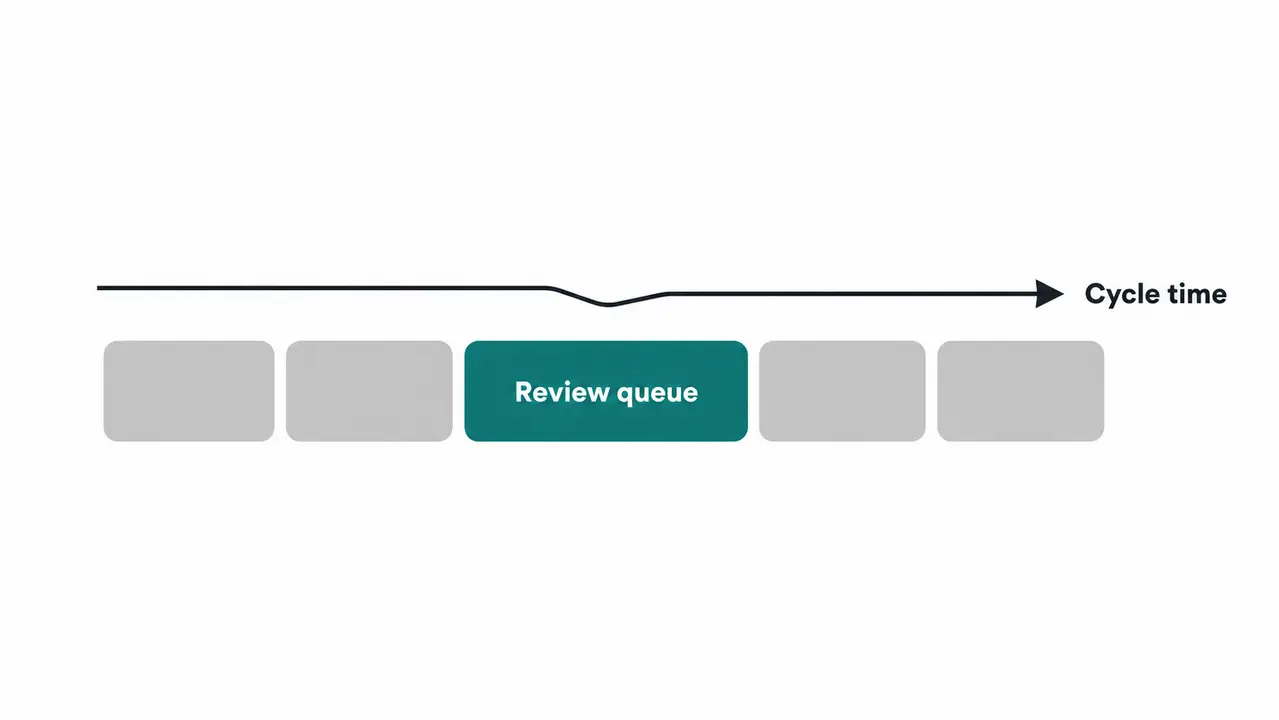
Track lead time for change, deployment frequency, change failure rate, mean time to recovery, and defect escape rate. Then look at what the numbers expose. A two-day review queue does not just annoy engineers. Every change waiting in it accumulates risk, blocks the next change behind it, and quietly doubles your effective cycle time. Fixing the queue is often the highest-leverage process change a team can make in a single month.
The failure mode is optimizing velocity while incidents rise. Story points go up, burndown looks beautiful, and the pager keeps firing. Developer experience data points the same direction. In the 2024 Stack Overflow Developer Survey, 42% of developers reported hybrid work and 20% in-person, which makes written process and measurable quality the shared fabric of distributed teams (Stack Overflow Developer Survey 2024). Metrics are how a distributed team sees the same reality.
Common lifecycle breakdowns and the fixes that hold up under pressure
Most lifecycle failures come from missing gates, unclear artifacts, or unmanaged dependencies. The fixes are boring and they work, because each one removes a specific ambiguity and shortens a specific feedback loop.
| Breakdown | Detection signal | Fix that holds |
|---|---|---|
| Unclear acceptance criteria | Reopened bugs, scope arguments | Testable criteria written before build |
| Weak integration contracts | Failures only in staging | Contract tests in CI |
| No rollback plan | Multi-hour incident recovery | Release checklist with rollback step |
| Testing at the end | Release freezes, escape rate rising | Shift-left test types per risk |
| No observability | Customers report bugs first | Dashboards and alert thresholds |
Lightweight ADRs, contract tests, release checklists, and staged rollouts cover most of the table. The counter-case matters too. Over-process slows small teams to a crawl, so keep every artifact minimal and decision-driven. If a document does not record a decision or unblock a person, delete it.
Frequently asked questions
What are the standard SDLC phases in most definitions?
Common lists include planning, requirements, design, development, testing, deployment, and maintenance. Naming varies by framework, with some adding verification or operations as separate phases. The names matter less than whether each phase has an owner and an output.
Where does DevSecOps fit in the lifecycle?
Security checks and threat modeling are integrated across phases, with automated scanning and reviews embedded into CI and release gates. NIST’s Secure Software Development Framework, SP 800-218, describes exactly this integration, positioning security practices as a core set woven through the SDLC rather than a final inspection step.
What documents are worth keeping for long-lived products?
An architecture diagram, architecture decision records, interface contracts, a test strategy, runbooks, and a deprecation policy. Keep each one short and current. A stale 40-page specification is worse than no document, because it lies with authority.
How do embedded products change the lifecycle?
Firmware updates, hardware constraints, and field reliability raise the cost of change dramatically. Validation gets stricter, rollout control becomes staged by device cohort, and observability extends to the field, since you cannot walk over to a customer’s sensor and read the logs.
How do you reduce rework when requirements change weekly?
Use explicit acceptance criteria, small batches, feature flags, and contract tests. Treat every change as a decision with recorded impact rather than a silent backlog edit. The churn rarely stops, but its blast radius shrinks with each practice.
Pick one lifecycle gate to tighten this month
Choose the gate currently leaking the most risk, whether that is acceptance criteria, integration contracts, release readiness, or observability. Tighten it with one specific artifact and one explicit ownership rule. Run the change for two releases and measure the direct impact on rework. Keep what reduces risk and discard what adds bureaucracy without value.
Tighten the gate together
If you are not sure which gate is leaking, a short conversation with our engineers will surface it fast. Tell us where delivery hurts and we will map it to the lifecycle.
About Sentice

Sentice is a boutique software engineering partner founded in 2013 by Roni Levi and Martin Petkovic, now headquartered in Skopje, North Macedonia. Rather than supplying individual developers, we build embedded teams that blend with a client’s culture, tech stack and goals, working together from a single office under our own technical leadership. We deliver dedicated software engineering teams, end-to-end software solutions, product development, and system and embedded engineering, and we act as technical advisors across the full development lifecycle, from specification and architecture through development, testing and support. We use AI coding tools across every project, and we help clients integrate AI into their own products through chatbots, MCP services, connected application layers and workflow automation. Some of the clients we started with more than a decade ago are still building with us today.