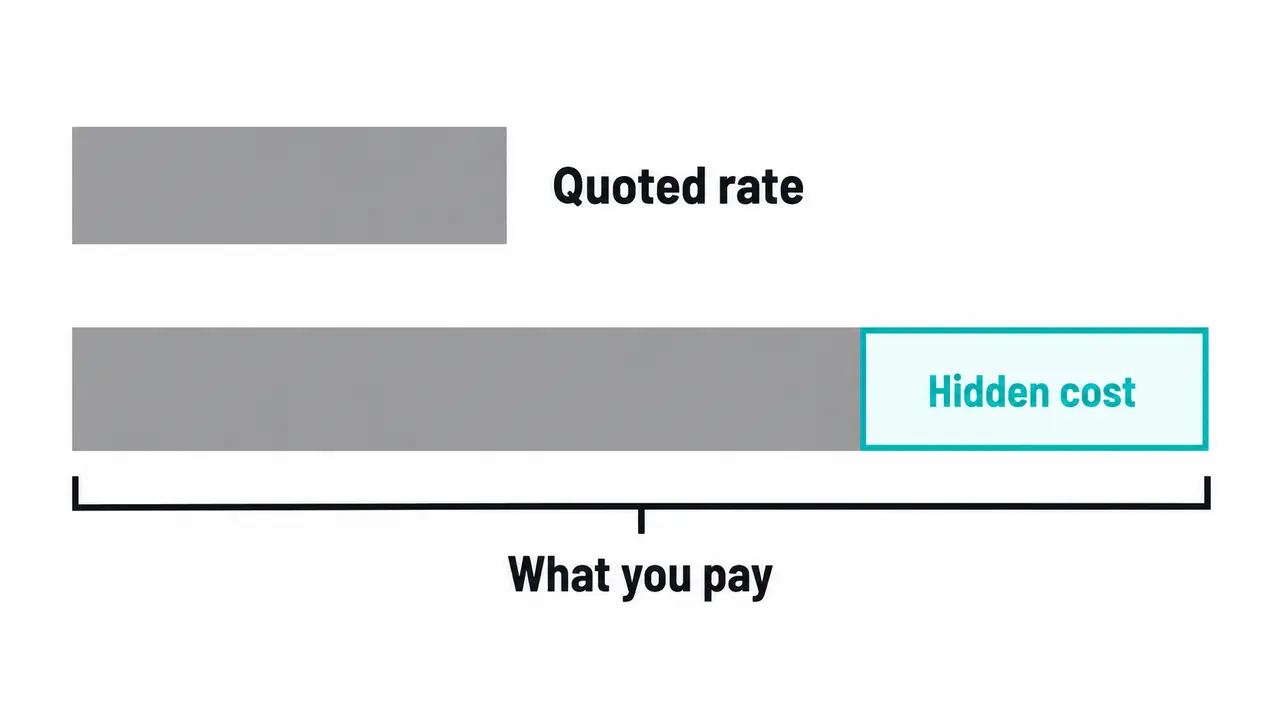
Two quotes land on your desk. Same team shape, same stack, same headline rate. Three months later one has shipped eleven releases and the other is still arguing about the definition of a user story. Nothing in either spreadsheet predicted that outcome, because the number you compared was never the number you were going to pay.
Reading time: 12 min
Key points
- Rate cards describe capacity, not delivery; review latency, defect escape rate, and release frequency predict real spend far better.
- Every pricing model is really a risk allocation: fixed scope puts risk on the vendor, time and materials on you, a dedicated team splits it across a shared roadmap.
- Seniority mix and a structured one-week onboarding influence total spend more than any rate difference.
- Compare proposals by delivery system, team shape, governance, quality gates, and integration ownership, not by hourly figures.
Table of contents
The number you compare is rarely the number you pay
Software outsourcing pricing is usually presented as a rate card or a monthly team fee. That number describes capacity, not delivery. What you actually pay is the total cost to ship and operate the software, and that total depends on things no rate card lists: how fast pull requests get reviewed, how often incidents hit production, how frequently you can release. Those three metrics tell you more about your real spend than any outsourcing rates table ever will.
Picture two identical-looking offers. One carries a twelve-hour average review latency and a defect escape rate that keeps your on-call engineers busy every second week. The other merges code the same day and releases on Tuesdays without ceremony. The first is cheaper per hour and more expensive per shipped feature. The gap compounds. Global software spending reached USD 675 billion in 2024, according to the World Intellectual Property Organization, and most of that money buys capacity, not outcomes. The buyers who understand the difference negotiate differently.
What software outsourcing pricing usually includes
Most quotes cover delivery labor and basic project management. Everything else is ambiguous until someone writes it down. Development costs look predictable on paper, then grow quietly because the quote never stated whether discovery, environment setup, or post-release support were inside the engagement. Unclear inclusions distort the true expenditure more than any rate difference.
The hard boundary is your definition of done. If acceptance criteria say “feature works in staging,” the vendor owes you staging. If they do not mention production hardening, that work is yours. Get the definition of done written, reviewed, and attached to the contract before kickoff.
Watch the standard exclusions. Discovery depth, security hardening, data migration, observability setup, and compliance evidence are the five that most often expand scope after kickoff. Each one sounds small in the sales conversation. Each one is a workstream once engineering starts. A vendor who lists exclusions explicitly is doing you a favor, even when the list looks long.
The hidden engagement drivers that show up after kickoff
The expensive parts of an engagement rarely appear in the proposal. They appear in week six, when ownership of an API contract is unclear, priorities shift mid-sprint, the test strategy turns out to be a paragraph, and staging goes down for two days. Work gets marked complete without integrating cleanly. Sprint spillover becomes the norm.
Rework compounds. Every unclear contract generates two conversations and one reimplementation. Every unstable environment pushes verification later, where it costs more. Over a multi-quarter roadmap this is what erodes viability: the roadmap itself becomes a queue of half-integrated features sitting on accumulating technical debt.
The fix is unglamorous. Run a weekly demo of working software against a shared backlog with explicit acceptance tests. We have watched this single ritual replace entire governance decks. When the demo shows real software every Friday, misalignment surfaces in days instead of quarters, and the hidden drivers lose most of their power.
Pricing models are really risk allocation
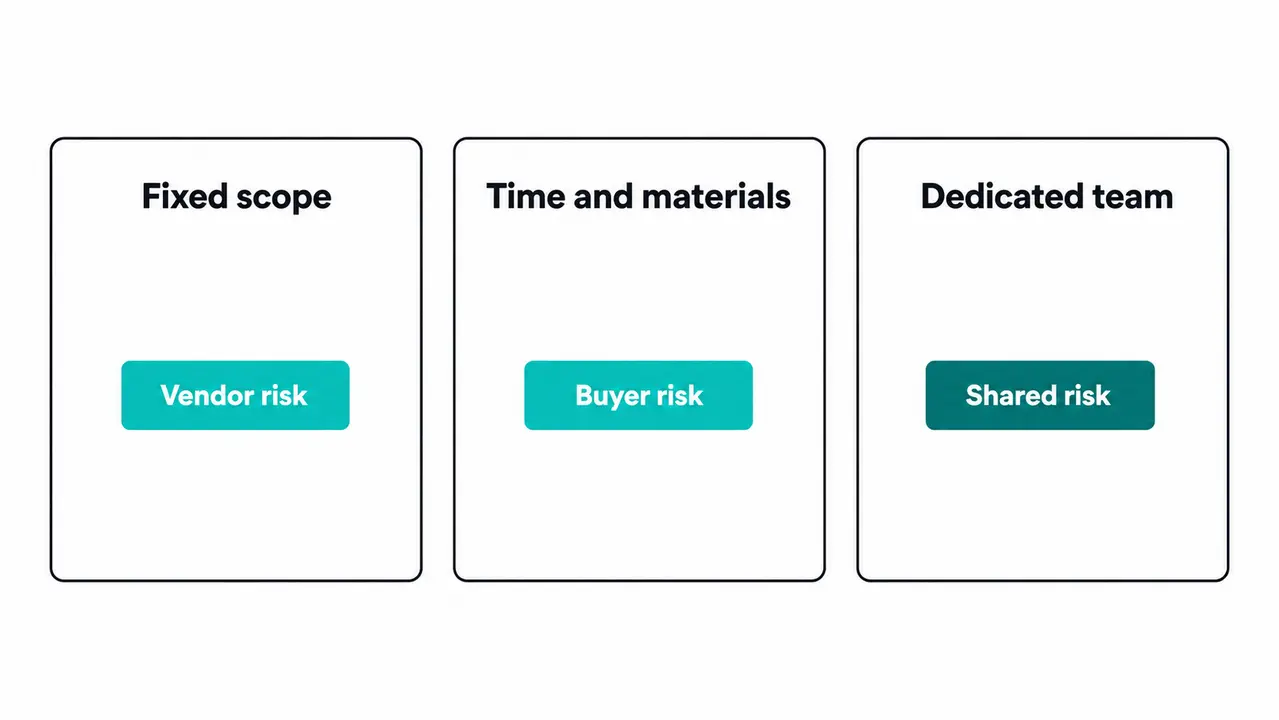
Every pricing model answers one question: who pays when reality differs from the plan? Fixed scope puts that risk on the vendor. Time and materials puts it on you. A dedicated team splits it across a shared roadmap. None of these is inherently safer. Each is a bet on how stable your requirements are and how uncertain your dependencies are.
Choose based on scope volatility, not on which model sounds protective. Models that appear to shield the buyer usually price in conflict: heavy buffers, rigid boundaries, and a change process designed for disputes rather than collaboration. The OECD Digital Economy Outlook 2024 makes the structural point well: managing digital project risks through explicit governance changes engagement outcomes. Risk that is named and allocated gets managed. Risk that is buried in contract language surfaces as friction.
Whatever model you pick, institute a formal change request workflow with a documented escalation path and a designated business owner who signs off on deviations. The workflow is not bureaucracy. It is how the model adapts without renegotiation.
Fixed scope delivery when requirements are stable
Fixed scope fits a narrow case: small, well-specified work where requirements can be frozen and acceptance criteria validated before a line of code is written. A migration with a known schema, an integration against a documented API, a reporting module with agreed output formats. In those cases fixed scope gives you a number you can plan around.
Before signing, require a written specification pack, interface contracts, a detailed test plan, and demo milestones tied to delivery phases. If the vendor cannot produce those artifacts, the scope is not stable enough for the model.
Understand what you are buying. Vendors protect their margins against scope creep with heavy buffers and strict change control, so a minor pivot becomes a contractual negotiation. That is rational behavior on their side and a poor fit on yours if the product is still moving. Fixed scope weakens fast when discovery is active or external dependencies are uncertain, which describes most startup environments in their first two years of a product. Use it for the stable slice, not the evolving core.
Time and materials when the roadmap is moving
Time and materials is the most controllable model for an evolving product, provided you manage it. Controllable does not mean open-ended. It means you steer weekly, measure outcomes through shipped increments, and can stop or redirect without renegotiating a contract.
Discipline makes it work. Enforce a two-week sprint cadence, rigorous backlog hygiene, and a strict release branch policy. Without sprint goals and throughput metrics, a time and materials engagement becomes a budget drain with no ceiling, and you will discover it three months late when the invoice trajectory and the shipped-feature count stop matching.
Define stop rules before you start. A maximum ramp period, a minimum throughput threshold, a review point at sprint six. The model fails when the buyer cannot provide fast decisions or lacks a strong product owner. If nobody on your side owns the backlog, the team will fill its time with plausible work that is not the right work. That failure is on the buyer side, and no vendor can fix it for you.
Dedicated team economics for long-lived products
A dedicated team makes sense when you want stable velocity, retained context, and predictable capacity over a multi-quarter roadmap. The economics rest on one asset: architectural context. A team that has lived inside your codebase for a year estimates better, breaks less, and onboards new members faster than any rotating squad can.
Protect that asset contractually. Secure a named team roster, a documented replacement policy, and an explicit allocation percentage so members are not silently split across multiple clients. A “dedicated” engineer who spends two days a week on another account is staff augmentation with worse continuity.
The failure mode runs the other direction too. If your backlog runs dry or priorities go dormant, a dedicated team idles and burns capacity without producing value. This is why dedicated software engineering teams work best when the buyer commits to keeping the roadmap fed, and why we always ask about backlog depth before proposing the model. Context compounds in both directions: retained teams accumulate knowledge, idle teams accumulate cost.
Outcome based delivery is rare for custom software for a reason
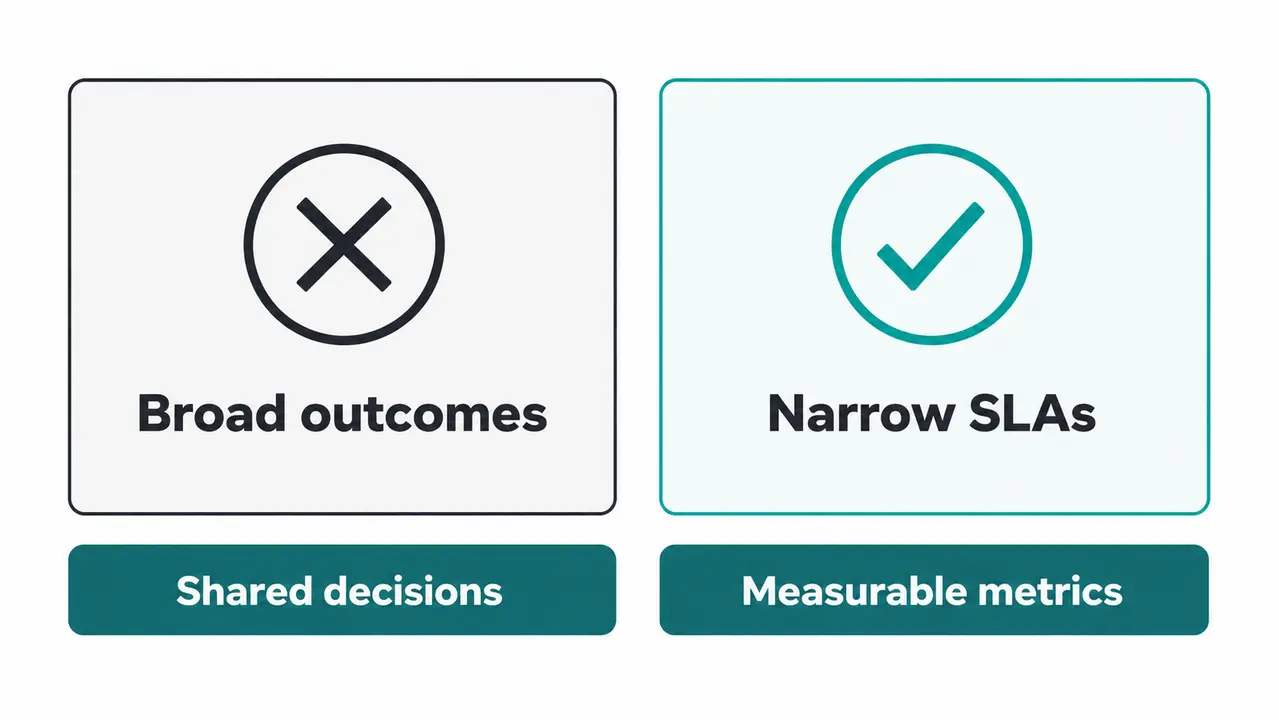
Outcome-based pricing sounds ideal. Pay for results, not hours. In custom software it rarely survives contact with reality, because outcomes depend on product decisions, user adoption, and market constraints the vendor does not control. A vendor cannot guarantee conversion improvements for a product whose roadmap you steer.
Restrict the model to narrow deliverables with measurable service levels. Response time on a specific endpoint. Defect escape rate on a defined module. Uptime on infrastructure the vendor fully owns. Those metrics have well-defined interfaces and clear measurement, so accountability is possible.
Be careful what the incentives do. Tying commercial terms to high-level metrics pushes the vendor toward short-term visible gains over long-term maintainability, and you will pay for that tradeoff in year two. Broad end-to-end software solutions cannot honestly be guaranteed on outcomes unless product responsibility is shared, which most buyers are not prepared to give up. Share the responsibility or price the work, not both halves separately.
How to compare two proposals without looking at rates
Put the rate cards aside and compare delivery systems. Team shape, governance, quality gates, integration ownership. Those four dimensions predict what the engagement will feel like at sprint ten far better than an hourly figure does.
Ask each vendor for an example sprint plan and a sample status artifact. A real sprint plan shows whether they plan around dependencies or around ticket counts. A real status report shows whether they surface risks early or bury them under green checkmarks. Vendors with polished sales processes and vague delivery mechanics are common, and the polish is the tell: the effort went into winning, not shipping.
Look for transparency in five places: seniority mix, code review process, testing strategy, release process, and security posture. A vendor who answers all five concretely, with named tools and named owners, is showing you their operating system. One who answers in generalities is showing you their marketing. Rate differences between those two vendors are trivial next to the delivery differences.
Seniority mix is the real delivery lever
The seniority mix determines how much of the engagement is spent on rework, supervision, and architectural correction. A junior-heavy team with one overloaded lead produces code that looks productive in the burndown chart and costs you for years afterward. You will feel it in review queues, in incident reviews, in the structural decisions nobody questioned at the time.
Demand clarity on three ownership points. Who owns architecture decisions. Who merges to the main branch. Who runs incident reviews when production breaks. If the answer is “the team,” nobody owns it.
A “blended team” without named technical lead accountability is the classic trap. It looks cost-efficient on paper. It generates maintenance cost through poor structural choices that surface long after the invoice. The Stack Overflow Developer Survey 2024 documents how much experience levels and work structures vary across the industry and shape how software actually gets built. When you evaluate a proposal, the mix matters more than the average. One strong lead with four mid-level engineers outperforms six juniors at the same total spend.
Onboarding is where budgets get burned quietly
Onboarding cost is mostly invisible because it is paid in your team’s time. Every clarifying question your senior engineers answer, every access request chased, every undocumented convention explained, is capacity removed from your roadmap. An unstructured start can consume a meaningful slice of your outsourcing budget before a single feature ships.
Require a one-week onboarding plan before kickoff. It should include pre-provisioned access requests, current architecture diagrams, and explicit success criteria for the first sprint. If the vendor asks for these, that is a good sign. If they arrive and start improvising, expect four weeks of ramp instead of one.
The quiet killers are missing runbooks, absent local development setups, and undefined data access policies. Each one stalls ramp time and drags your engineers into reactive support roles they did not budget for. We plan onboarding as a deliverable with its own acceptance criteria, the same as any feature slice, because treating it as an informal phase is exactly how it silently eats the funds you allocated for delivery.
Where teams underestimate management overhead
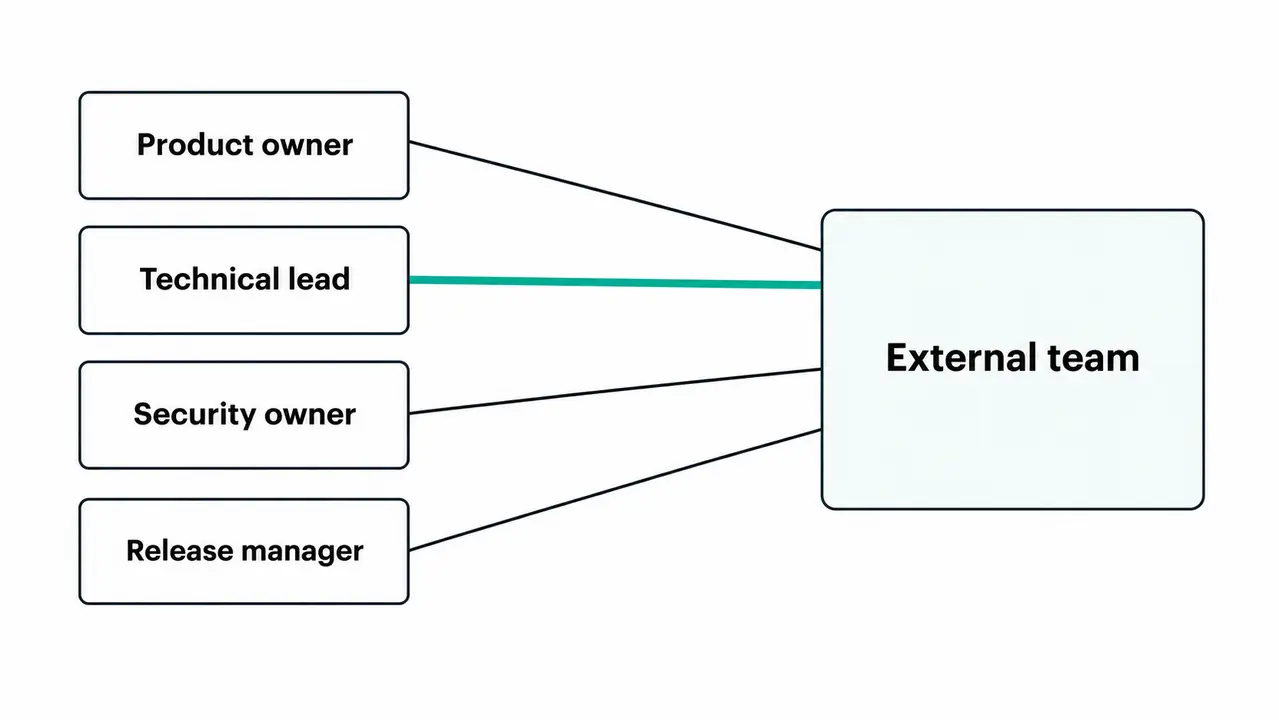
Outsourcing does not outsource management. You still provide internal engineering management, product decisions, and fast feedback, and the cost shows up as opportunity cost on your side. Your technical lead spending eight hours a week unblocking an external team is eight hours not spent on your architecture.
Define a meeting cadence and a decision service level agreement. If the vendor can expect an answer within one business day, tasks keep moving. If answers take four days, velocity collapses, and the eventual rush to catch up introduces integration defects and shortcuts.
Count the roles you must still staff: a product owner, a technical lead counterpart, a security owner, and a release manager overseeing the partnership. That is real internal capacity, and it belongs in the business case. Teams that model this overhead honestly choose smaller external teams and get better outcomes. Teams that assume the vendor “just handles it” discover the assumption in month two, when everything stalls waiting on decisions nobody on the vendor side is authorized to make.
Timezone overlap as a delivery constraint
Timezone overlap is not a culture preference. It is a throughput constraint. Low overlap turns code reviews into overnight queues, and a two-minute clarification becomes a day-long round trip. Cycle time stretches, defect turnaround stretches with it, and sprint flow breaks at exactly the moments that need speed.
Set mandatory overlap windows for the work that must be synchronous: pairing sessions, incident response, and design reviews. Everything else can be asynchronous, and should be. A three-hour daily window, used deliberately, beats a nominal full overlap that nobody schedules.
Embedded systems raise the bar. Lab access and hardware debugging sessions require strictly synchronized time blocks, because validating a firmware change against a physical device cannot be done over a ticket comment. If your engagement involves hardware, treat overlap as an engineering requirement in the contract, not a preference to negotiate later. We have run embedded engagements where the single most valuable contractual clause was the agreed lab session calendar.
IP repos and environments should be owned from day one
Predictability improves when you control the delivery surface area. Source control, continuous integration, cloud accounts, artifact storage. When the vendor works inside your Git organization, your CI pipeline, and your cloud tenant, the engagement produces assets you already own, under access rules you already trust.
Mandate it from day one, with least-privilege access controls. Vendor engineers get scoped permissions in your systems, not broad admin rights, and not accounts in systems you cannot see.
The alternative creates hostage risk. Let a vendor host the repositories and environments, and an amicable ending still leaves you with a migration project you never planned: extracting code, recreating pipelines, rebuilding environments, transferring domain knowledge that lived in their tooling. Strict ownership boundaries cut switching costs and protect your intellectual property throughout the lifecycle, including the part after the relationship ends. Any vendor worth working with prefers working in your systems. Resistance on this point tells you something.
Change control that does not slow delivery
Good change control is lightweight and continuous. Bad change control is a monthly commercial negotiation with a signature queue. The difference is not the amount of process, it is whether the rules are defined before the change arrives.
Define a threshold that separates a small change from a scope change, and base it on complexity and test impact rather than raw hours. A one-line copy tweak is small. A one-line change that alters a public API contract is not, because it ripples through consumers and test suites. Hours measure effort, not consequence.
Without a practical change request template and impact notes, every minor adjustment becomes a negotiation, and negotiation erodes trust faster than any single dispute. Frame the approval path as an alignment mechanism, not a gate. The goal is that both sides know within a day whether a change fits the sprint or needs re-estimation, and nobody spends that day arguing about whose fault the change is. When change control works well, you barely notice it exists.
Quality gates that protect the budget
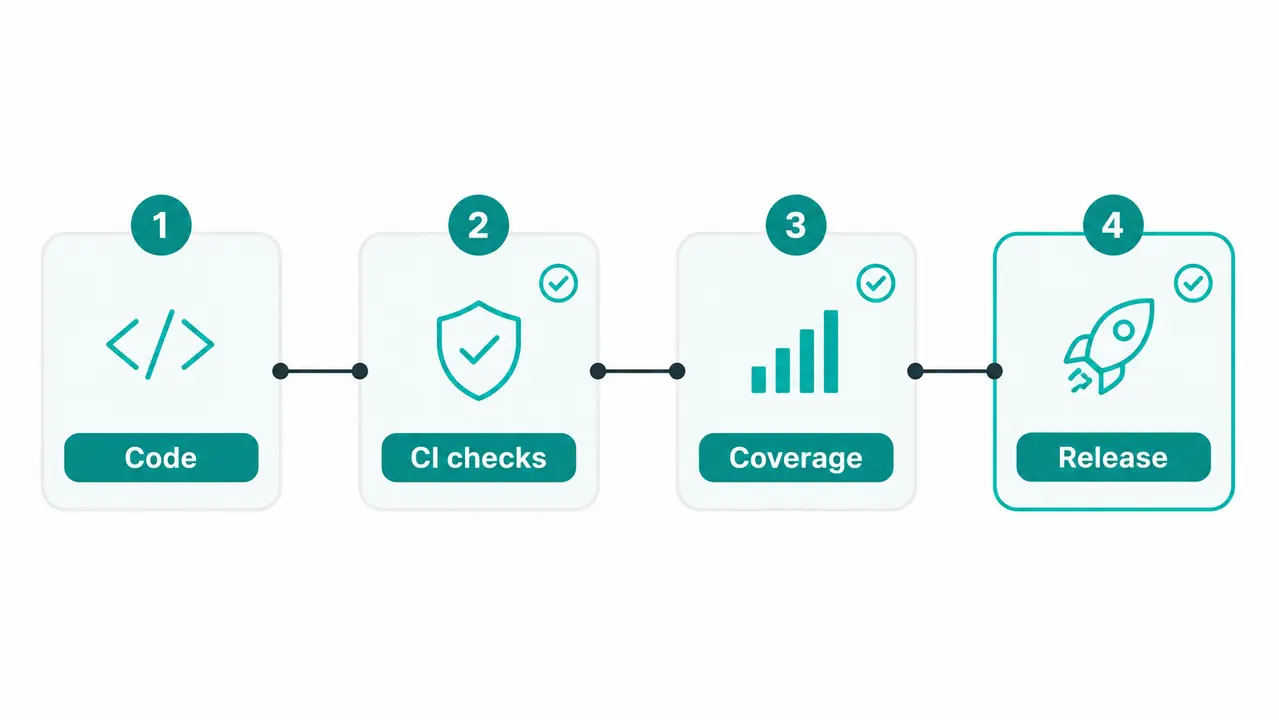
Quality gates feel slow in the moment and cheap in aggregate. Required CI checks before merge, a minimum test coverage policy on the modules where business logic lives, an automated smoke suite before every release. Each one costs minutes. Skipping them costs weeks, later, at the worst possible time.
The predictable failure pattern is the “stabilization sprint.” Velocity pressure builds, gates get skipped to hit a milestone, defects accumulate quietly, and eventually a full sprint (sometimes two) is lost to bug fixing instead of feature delivery. The milestone was hit on paper. The roadmap slipped in reality.
Formalizing these practices is not gold-plating. The NIST Secure Software Development Framework, SP 800-218, lays out how embedding security and quality practices into the development lifecycle reduces rework and mitigates vulnerability risk. Treat the framework as a checklist for what your vendor should already be doing. A team that pushes back on pre-merge checks is telling you how they will behave under deadline pressure, and that is exactly when the behavior matters.
Embedded and IoT work changes the engagement conversation
Embedded and IoT delivery is governed by hardware dependencies, certification constraints, and system-level integration testing. The commercial structure has to account for all three, because a firmware change that passes every unit test can still fail against a physical device with a specific silicon revision.
Before signing, require a hardware-in-the-loop testing plan, device fleet staging, and a clear lab access protocol. If the vendor cannot describe how changes get validated against real hardware, they have not done embedded work at your level of complexity.
Standard fixed scope models fail here in a specific way. Hardware revisions keep evolving during development, and firmware constraints make late changes extremely expensive relative to web work. A scope frozen in month one is obsolete by month three, and the contract has no honest mechanism to absorb that. This is why working with embedded and IoT engineering partners who understand hardware-software integration is a structural decision, not a nice-to-have. The right partner structures the engagement around hardware milestones, not software ones.
Vendor selection signals that correlate with predictable spend
Predictable spend correlates with delivery discipline, transparency, and clear ownership boundaries, all visible before you sign anything. You just have to ask for the right artifacts instead of the right references.
Ask for a redacted example of a previous client’s weekly demo agenda and release checklist. A vendor with operational maturity produces these without hesitation, because they exist already. A vendor who needs a week to “prepare something” is creating artifacts for the sales process, which tells you what their artifacts normally are.
The positive signals to look for are specific: a named technical lead, sample sprint artifacts, a demo-first culture, clear escalation paths, and documented security practices. The negative signal is a highly polished sales process paired with vague answers about delivery mechanics. Polish costs money, and money spent winning deals is priced into the deals that get won. We would rather show you a real sprint review from week fourteen of a live engagement than any slide deck, and any vendor with confidence in their delivery operation feels the same way.
Comparing the models side by side
The four commercial models differ less in price than in what each one assumes about your stability and your ownership capacity. This table compares them on the dimensions that actually drive total spend.
| Dimension | Fixed scope | Time and materials | Dedicated team | Outcome based |
|---|---|---|---|---|
| Best fit | Stable, well-specified work | Evolving roadmap | Multi-quarter product | Narrow measurable service |
| Who absorbs scope change | Vendor, via buffers | Buyer, via budget | Shared, via roadmap | Vendor, within SLA |
| Buyer time required | Low after spec freeze | High, weekly steering | Medium, sustained | Low, but metric design is heavy |
| Predictability of spend | High until first change | Managed by stop rules | High with fed backlog | High if metrics are narrow |
| Typical failure mode | Contractual gridlock | Open-ended drain | Idle capacity | Maintainability sacrificed |
Frequently asked questions
What artifacts should I provide before asking for a quote to avoid guesswork?
Provide a current architecture summary, a prioritized feature list with business context, access to the existing repo or a code sample, and a statement of what done means for the first milestone. Add your release constraints, such as compliance requirements or integration partners, because vendors price uncertainty they can see. A quote built without these artifacts is a guess with a number attached, and you will both discover the gap at kickoff.
How do I structure a pilot so it tests delivery capability rather than just coding speed?
Choose a slice that touches a real integration point, requires a code review from your side, and ends in an actual release step, even if it ships behind a feature flag. Cap it at four to six weeks with written acceptance tests. The pilot should exercise the whole delivery system: branching, review, CI, deployment, communication. Coding speed tells you almost nothing. How the team behaves when the pipeline breaks tells you everything.
What contract clauses matter most for maintaining engagement predictability?
Four clauses carry most of the weight. A named team roster with a replacement policy and a notice period. An explicit definition of done with acceptance criteria attached to each milestone. A change request workflow with a defined threshold and timeline. And ownership of repositories, pipelines, and cloud accounts resting with you from day one. Everything else in the contract is cleanup around those four. If they are missing, no volume of boilerplate will save the engagement.
How do I evaluate an outsourcing partner for security without turning it into an audit project?
Ask three questions and request one artifact. Ask how secrets are managed, how access to your systems is provisioned and revoked, and what their incident response process was the last time something broke. Request a sample of their secure development practices mapped to a recognized framework such as NIST SP 800-218. A team that answers concretely in twenty minutes has real practices. A team that answers with a compliance certificate and a promise has a sales answer, and you will inherit the gap.
When should I stop an engagement to prevent sunk-cost escalation?
Stop when the evidence stops matching the promises across two consecutive review points, not after one bad sprint. The signals to watch for are review latency that never improves, demo software that never integrates into your environments, and answers that consistently defer problems to the next phase. Set the stop criteria in writing before kickoff, including throughput thresholds and a review date, because the decision is nearly impossible to make objectively once you are six months in and emotionally invested.
The next step is to make delivery measurable
Treat the commercial structure as a set of measurable delivery assumptions and test them in a short pilot with real integration, real code reviews, and real release steps. Require the vendor to leave that pilot with a specific backlog slice, passing CI checks, documented acceptance tests, and a clear ownership map. Those artifacts, not the proposal, are your evidence. Trust negotiated in a sales process is a hypothesis. A green pipeline with your name on it is data.
Test the delivery system, not the pitch
Tell us about your roadmap and we will scope a pilot with real integration, real code reviews, and a release step you can judge.
About Sentice

Sentice is a boutique software engineering partner founded in 2013 by Roni Levi and Martin Petkovic, now headquartered in Skopje, North Macedonia. Rather than supplying individual developers, we build embedded teams that blend with a client’s culture, tech stack and goals, working together from a single office under our own technical leadership. We deliver dedicated software engineering teams, end-to-end software solutions, product development, and system and embedded engineering, and we act as technical advisors across the full development lifecycle, from specification and architecture through development, testing and support. We use AI coding tools across every project, and we help clients integrate AI into their own products through chatbots, MCP services, connected application layers and workflow automation. Some of the clients we started with more than a decade ago are still building with us today.