The sprint is going well until Thursday afternoon, when someone asks a question nobody in the room can answer from memory: who actually owns the service layer the vendor wrote last quarter? The question sits in the backlog while the release ships. Six months later, during an audit or an acquisition diligence review, that unanswered question becomes a three-week legal exercise. Most contract problems in software outsourcing do not start as disputes. They start as small ambiguities nobody had time to resolve. This article walks through the full document stack, from the master services agreement to the exit clause, and shows what each one must contain to keep agile delivery out of legal trouble.
Reading time: 10 min
Key points
- A software outsourcing agreement works best as a small stack of documents with clear boundaries, not one mega-contract.
- Testable acceptance criteria keep disputes objective and delivery speed intact during release pressure.
- Present-tense IP assignment, subcontractor flow-down, and SBOM delivery are the clauses that protect your codebase.
- Own the systems of record: repos, CI, cloud accounts and documentation should live in accounts you control.
Table of contents
The contract stack that keeps agile delivery out of legal trouble
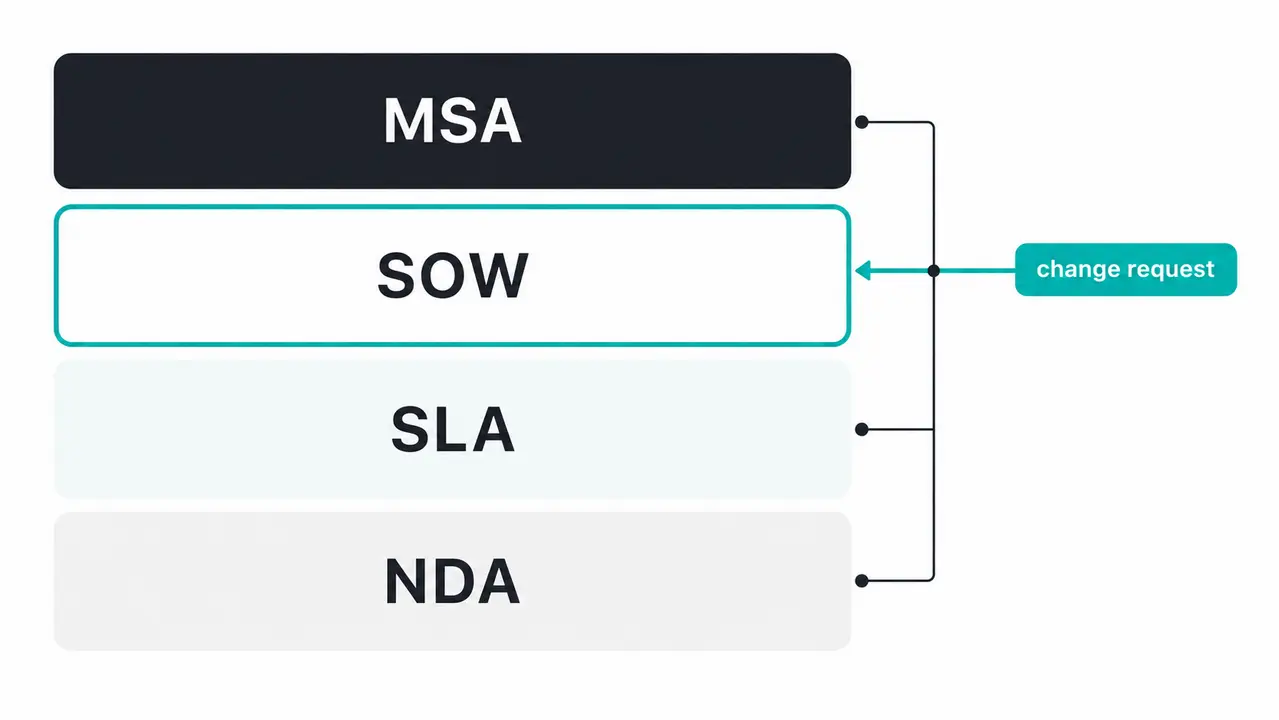
A software outsourcing agreement works best as a small set of documents with clear boundaries, not a single document trying to do everything. You need one place for legal and governance rules, one place for deliverables and acceptance, one place for measurable service levels, and one place for confidentiality before anything sensitive is shared. When these boundaries hold, a backlog change stays a backlog change instead of becoming a legal renegotiation.
The practical stack looks like this. A master services agreement (MSA) carries liability, warranty, and IP terms. A statement of work (SOW) defines deliverables, assumptions, and acceptance criteria. A service level agreement (SLA) sets measurable operational targets once systems run in production. An NDA covers pre-contract sharing. Providers that structure dedicated software engineering teams around this stack can absorb scope changes without touching the outsourcing contract itself.
The failure mode is the mega-contract. Sprint tasks mixed with legal boilerplate create friction on every minor adjustment, and your engineers start avoiding the change process entirely.
Where teams confuse an outsourcing agreement with a staffing contract
Every software outsourcing agreement should define deliverables and accountability, not just time and roles. A staffing contract guarantees that a mid-level backend engineer works forty hours a week on your backlog. It guarantees nothing about outcomes. If you sign one and the timeline slips, the vendor has met its obligation and you have absorbed the loss.
The distinction matters because the market for staff provision keeps growing. Research and Markets reports the global staff augmentation services market grew from USD 6.89 billion in 2024 to USD 7.35 billion in 2025, with a projection of USD 11.94 billion by 2032 at a 7.11% CAGR (Research and Markets). More companies are buying capacity this way, and many of them are signing delivery contracts when what they bought was hours.
The contract should specify who holds technical decision rights for architecture and security sign-offs, what acceptance tests close a deliverable, and when ownership transfers. A mid-level backend engineer works forty hours a week and you still own the risk. That is the staffing contract verdict: fine for capacity, wrong for accountability.
The definition of done that survives a tense release week
Acceptance criteria fail when they are subjective. “Feature complete” and “works as expected” produce different interpretations under release pressure, and the vendor’s interpretation will always be more generous than yours. Testable acceptance criteria keep disputes objective and delivery speed intact.
Write acceptance inputs as artifacts your team can verify. User stories, non-functional requirements covering performance and accessibility, test plans, and data constraints including volume and masking rules. A concrete example: a feature is accepted only when automated tests pass in CI on the main branch and deployment succeeds in staging with seeded data. Two checks, both observable, neither requiring a meeting.
The failure mode without this is the almost-done loop. A developer marks a ticket complete, your QA lead finds gaps, the ticket bounces back, and the cycle repeats through release week. Late surprises compound, and the argument shifts from “is it done” to “what does done mean,” which nobody can win. Testable acceptance criteria always outperform subjective developer claims of completion.
Statement of Work structure that manages change requests
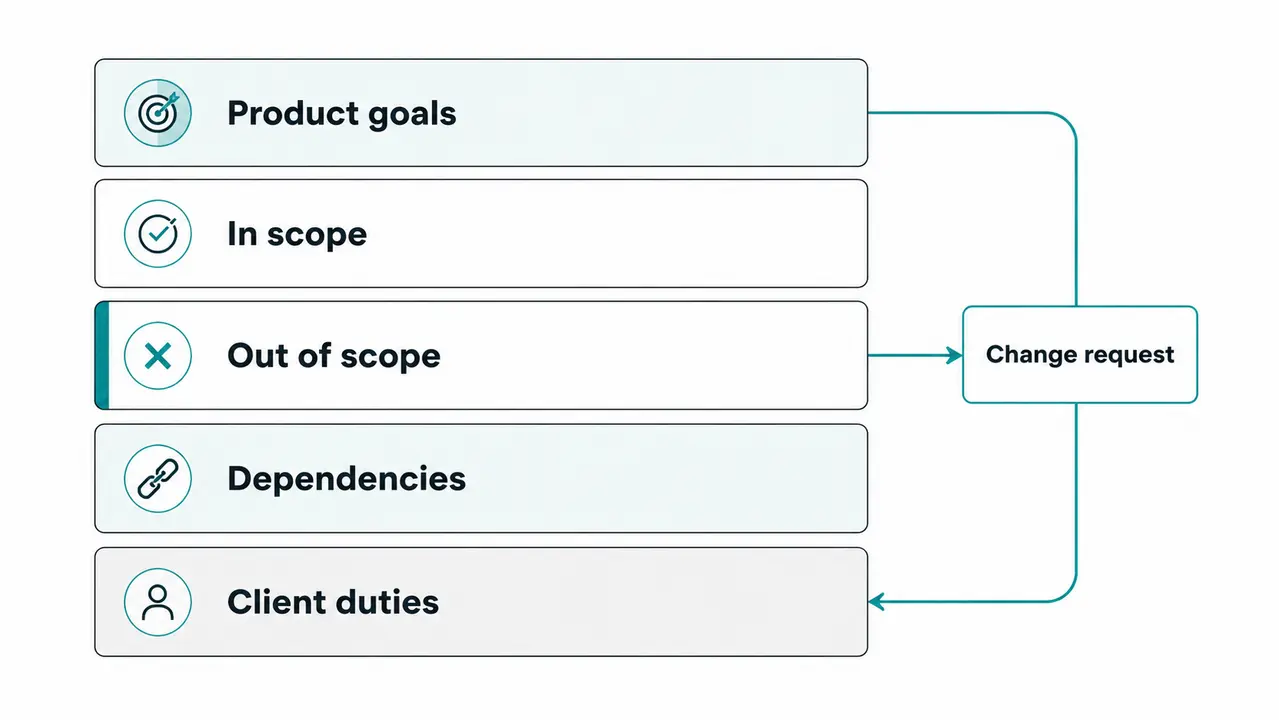
A strong SOW defines boundaries, assumptions, deliverables, and the change process. It does not attempt to predict every sprint task, because any document that tries becomes stale within a month and gets ignored.
Use a layered scope. Start with product goals and success metrics, then list in-scope modules by name, then an explicit out-of-scope list, then dependencies on your side including API access and staging environments, and finally your own responsibilities as the client. Define change control triggers: a new integration, a changed performance target, a new compliance requirement. Each trigger routes through a lightweight change request with impact on timeline and architecture, not through a renegotiation of the whole agreement.
The comparison lands on a clear verdict. A layered SOW with strict change control handles agile delivery better than a rigid, exhaustive task list. The task list fails quietly, through scope creep disguised as small tweaks that never hit the change process and silently derail the timeline.
IP ownership that is enforceable in real life
You only own what the contract explicitly assigns to you. “Work made for hire” language borrowed from other industries does not reliably cover contracted software development across borders, and it does nothing at all for subcontractor-created work unless the subcontractor agreement flows the same assignment upstream.
Require present-tense assignment. The language should say the vendor assigns all foreground IP in the deliverables upon creation, not upon payment, not upon acceptance. Attach a deliverables schedule listing exactly what gets assigned, release by release. For any embedded background IP the vendor brings in, require a perpetual, transferable license sufficient to operate and modify the product. Cover third-party components separately, with license compliance confirmed per release.
The failure mode here is ugly. A vendor legally unable to transfer what it does not own leaves you with untransferable code, and the subcontractor who wrote the critical module left two years ago. Explicit foreground IP assignment is the only reliable way to secure your codebase.
Open-source usage that will not surprise your security review
Outsourcing agreements should set rules for open-source selection, license compliance, and disclosure. Without contractual rules, library choices are made at 4 p.m. on a Friday by whoever is closest to the problem, and your legal team finds out during the next funding round.
Require a bill of materials for third-party dependencies with every release. Enforce a written policy for copyleft licenses, specifying whether GPL-family components are permitted at all and under what review. Wire dependency scanning into CI so vulnerable packages block merges rather than surfacing in a quarterly audit. Tools like Dependabot or Snyk do this continuously, but the contract, not the tool, is what makes it mandatory.
The failure mode is discovering a restrictive license in a production deployment. A single viral-licensed dependency in your distributed product can force a rewrite of the module around it. Proactive SBOM generation beats post-deployment security audits every time.
Data access boundaries that protect customers and speed up debugging
Define what data the vendor can access, where it can live, and how it is sanitized. Done well, this enables development and support without uncontrolled exposure. Done badly, it either blocks debugging entirely or spreads customer data across machines you will never audit.
Set the default to no production access. Use masked datasets for development and testing, with masking rules documented in the SOW. For production incidents, enforce time-boxed break-glass access: a named engineer gets elevated access for a defined window, the access is logged, and it expires automatically. Back this with an access control list reviewed monthly and revocation steps executed at offboarding within a defined number of business days.
The failure mode is uncontrolled data copies on vendor laptops and personal cloud accounts, which no offboarding process ever fully recalls. Masked datasets and strict role-based access control provide a safer debugging environment than raw production access.
Security obligations that belong in the contract
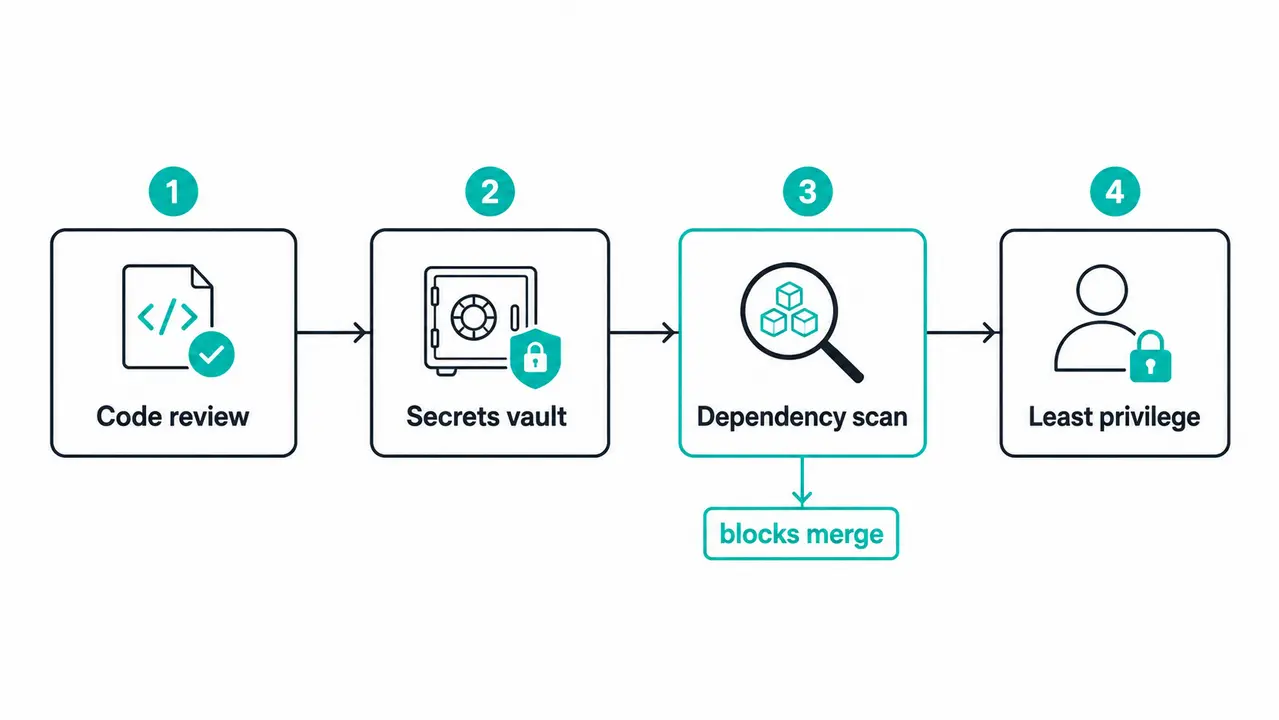
Security requirements must be contractual. Policies without enforcement do not survive schedule pressure. When a release date is at risk, the secure path loses to the fast path every time unless the contract makes the secure path the default.
Define minimum controls. Mandatory code review before merge, secrets management through a vault rather than repository files, dependency scanning in CI, and least-privilege access for all environments. Set vulnerability remediation expectations by severity: critical issues addressed within a defined window, high severity within a longer one, with severity classified by an agreed taxonomy. Define notification duties for incidents, including who is told, how fast, and what cooperation the vendor owes during investigation.
The failure mode is security devolving into best-effort activity. Known gaps stay unpatched because nobody is contractually required to patch them on a timeline. Contractual security thresholds with defined remediation timelines outperform informal security promises.
SLA metrics engineering teams can actually measure
An SLA should focus on measurable outcomes: response times, defect handling, and service availability for supported systems. Anything you cannot pull from a system of record will eventually become an argument.
Separate build-time quality targets from run-time support targets. Build-time metrics include defect leakage, review latency, and cycle time from ticket to merged code. Run-time metrics include incident response, time to restore, and availability percentages for systems the vendor supports. Your data sources already exist: ticketing system timestamps from Jira or Linear, on-call logs from PagerDuty, CI records from GitHub Actions. SLA development means wiring the agreement to those systems so compliance is a query, not an opinion.
The failure mode is the SLA dispute. Both sides pull their own numbers, neither trusts the other’s spreadsheet, and the actual delivery problem goes unaddressed while the argument runs. Metrics anchored in shared tooling end that dispute before it starts.
When an SLA is the wrong tool and a quality plan works better
For greenfield builds, an SLA can be actively misleading. The service does not exist yet, availability is undefined, and incident response targets measure nothing meaningful. You get metrics that look reassuring and tell you nothing.
Use a quality plan instead. It should contain a definition of ready so work enters sprints with clear inputs, a definition of done tied to automated checks, a test strategy covering unit, integration, and end-to-end coverage, and code review rules enforced in CI. Assign ownership of the quality gates to a named role, typically the QA lead, who can block a release without negotiating.
The verdict depends on lifecycle stage. Quality plans outpace SLAs for new builds, while SLAs become valuable once the vendor supports stable production systems. The failure mode is false confidence: an SLA dashboard full of green indicators during the months when the product is being shaped and nothing is yet measurable.
Governance that prevents slow drift between two engineering cultures
Governance should specify cadence, artifacts, and decision rights. When priorities shift and team composition changes, and both happen constantly, alignment survives only if it is structural rather than dependent on two people who get along well.
Define the rhythm: weekly delivery reviews against sprint goals, biweekly roadmap syncs between your product owner and the vendor lead, monthly architecture reviews where technical decisions are ratified or revisited. Include a RACI matrix covering the product owner, tech lead, QA lead, and security reviewer, so decision rights survive personnel changes on either side.
The context matters because the talent market keeps tightening. Eurostat reports that the number of ICT specialists across the EU increased 59.4% between 2015 and 2025, compared with 9.8% growth in total employment (Eurostat). Companies are integrating new engineering talent rapidly, and robust governance is what keeps that integration coherent. The failure mode is silent misalignment that only surfaces when a critical deadline breaks.
Onboarding procedures that make week two productive
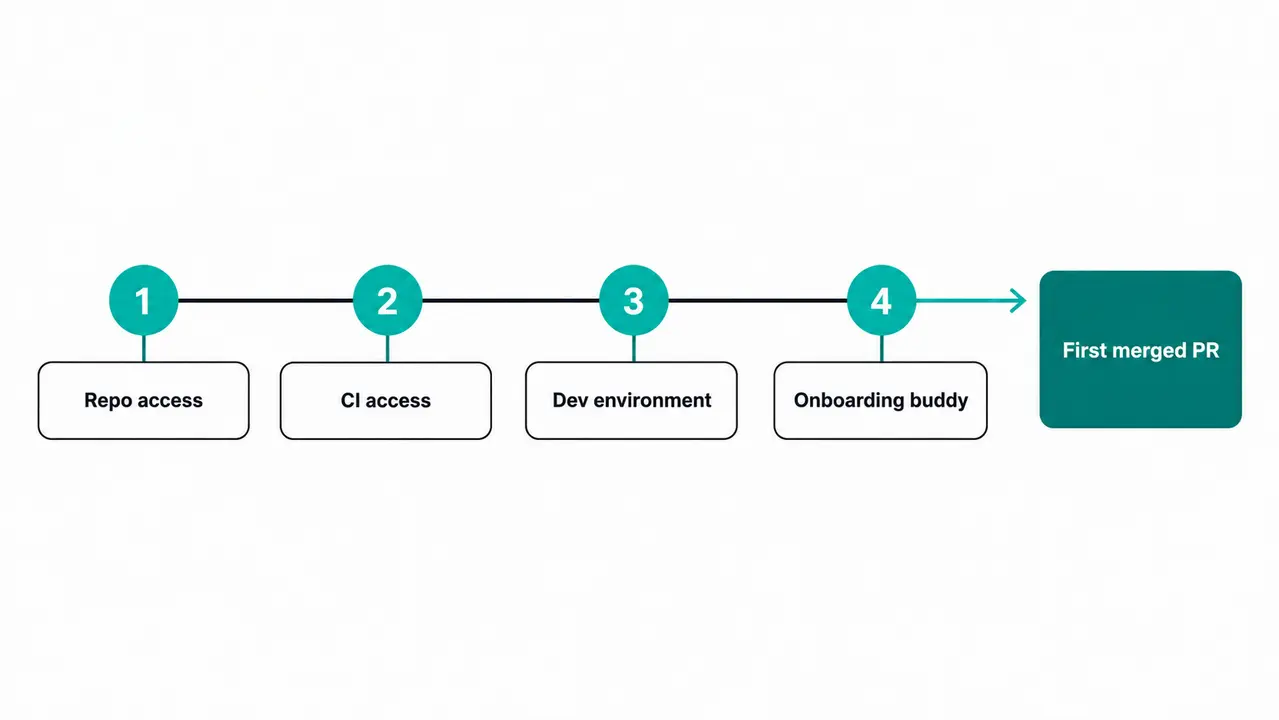
Onboarding must be treated as a deliverable with prerequisites and timelines. Treat it as an afterthought and you get a velocity drop in the first month, followed by blame aimed at individuals who never had what they needed.
List the prerequisites in the SOW. Repository access, CI permissions, development environments that provision in hours rather than days, architecture documentation, and a named onboarding buddy on your side. Track an onboarding checklist with a concrete first milestone: a merged pull request within a defined window, usually the first week. That first PR forces the entire access chain to work end to end.
For teams expanding quickly, the integration method matters as much as the checklist. When engineers sit together in one office and follow your practices from day one, onboarding stops being a phase and becomes a handover. The broader pattern of how boutique partnerships accelerate tech team growth rests on exactly this: structural ramp-up, not improvisation. The failure mode is extended ramp-up time and inconsistent implementation patterns spreading through your codebase.
Tooling and access that keeps you in control of the build
Control comes from owning the systems of record. Code repositories, CI/CD pipelines, cloud accounts, monitoring, and documentation should live in accounts you control, with work happening in your environment or an explicitly agreed shared environment.
Define the specifics in writing. Where code lives, who can merge and under what review conditions, how secrets are stored and rotated, and how environments are provisioned and torn down. Require that pull requests and tickets are created in your Jira and your GitLab, not in private vendor systems you cannot audit. For projects blending hardware and software, where build tooling and test rigs are part of the delivery surface, the same ownership rules apply to system and embedded engineering environments, including flashing stations and device farms.
The failure mode is hostage risk. The vendor controls the entire build infrastructure, the relationship sours, and the handover you receive is incomplete by omission rather than malice. Others simply supply developers. We work in your systems from the first commit, so the handover question never arises.
Subcontractors and key personnel clauses that reduce continuity risk
If subcontractors are allowed at all, the agreement must control them through approval rights and flow-down obligations. An unmanaged subcontractor chain is the most common way IP assignment quietly breaks.
Require disclosure of every subcontractor before they touch your code. Enforce the same confidentiality, IP assignment, and security obligations on them as on the prime vendor, with the vendor remaining fully liable for their work. On personnel, name the key roles in the SOW, typically the tech lead and QA lead. Attach a replacement notice period, a defined number of weeks rather than “reasonable notice,” and an overlap requirement so the departing engineer transfers context to the replacement before leaving.
The failure mode is the silent team swap. A tech lead who understood your architecture rotates to another client, the replacement spends six weeks reading code, and the timeline absorbs the gap. Named key personnel with mandated overlap periods secure project continuity better than generic staffing guarantees.
Termination clauses that make exit a process
Termination clauses should define transition assistance, deliverables at exit, and timelines. The goal is simple: your product stays maintainable even if the relationship ends badly.
Define exit deliverables precisely. Final source code, up-to-date documentation, runbooks covering deployment and incident response, credential handoff with rotation completed on your side, environment diagrams, and the current backlog state with known issues recorded. Include a transition period of a defined length, weekly knowledge transfer sessions during that period, and a final acceptance checklist signed by both parties before the engagement closes.
Read the exit clause before you sign, not after you need it. The failure mode is scrambling to reconstruct how the system works once the vendor is gone, reverse-engineering deployment procedures from server configuration. A structured exit transition turns a potential crisis into a manageable operational process.
Source code escrow and release triggers in plain language
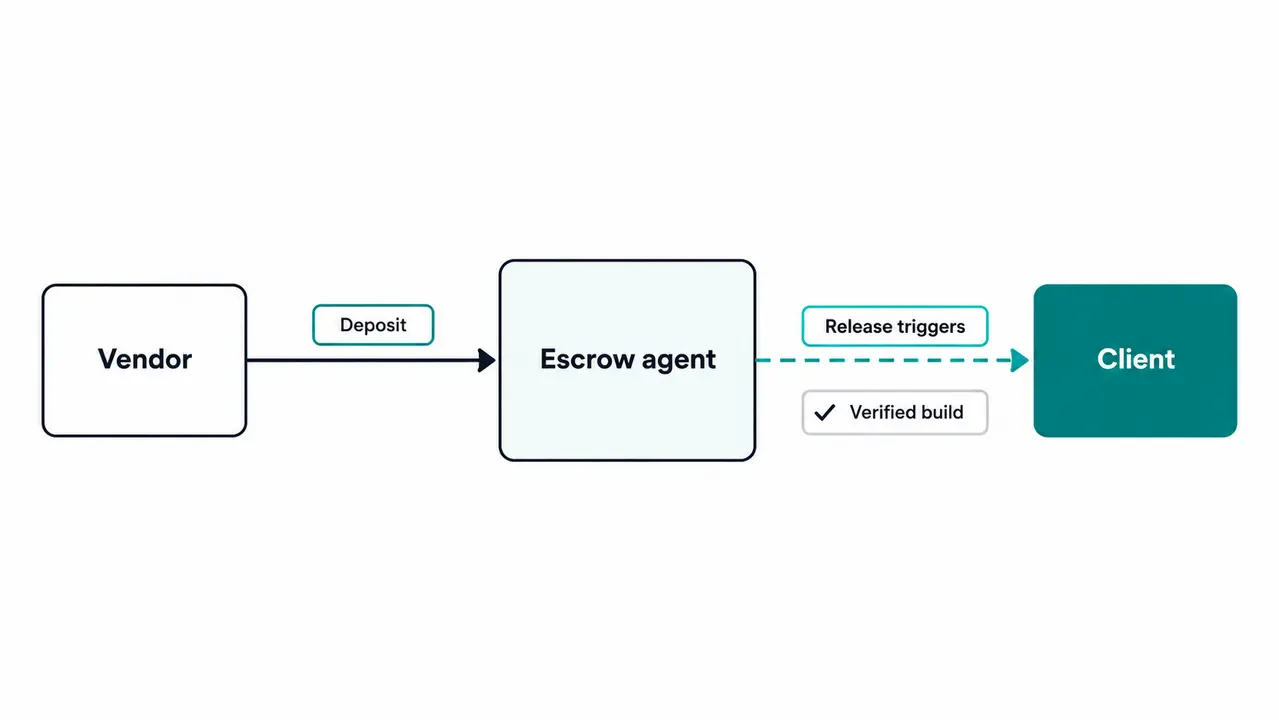
Escrow can be useful when you cannot guarantee ongoing access to the code and build materials. It is a deposit arrangement: the vendor places materials with a neutral agent, and the deposit releases to you only on defined events.
Specify the deposit contents. Source code alone is not enough. Require build scripts, pinned dependency versions, database migration files, infrastructure templates in Terraform or equivalent, and deployment documentation. Define the release events in exact terms: vendor insolvency, cessation of support operations, or failure to meet support obligations for a defined continuous period. Require the deposit to be updated on a schedule, quarterly is common, and verify it once by building the product from the deposit alone.
The failure mode is the unusable escrow. The deposit releases during a crisis and lacks build scripts, so you own code you cannot compile. That said, if you already own the repo and CI in your accounts, direct ownership makes escrow largely unnecessary.
Liability and warranty terms that engineering leaders should sanity-check
Engineering leaders should review liability, warranties, and indemnities for operational realism, because these clauses shape how defects, security issues, and third-party claims are handled in practice. Legal considerations of this kind are not just for the lawyers; the clauses encode engineering assumptions.
Focus on three areas. Warranty scope for defect fixes, including how long the warranty runs and whether fixes cover labor only or also regression testing. Exclusions for defects introduced by client-side changes, which should be narrow and explicit. Handling of third-party IP claims, where the vendor should defend and indemnify if a delivered component infringes. Define the warranty start point tied to acceptance rather than delivery, and adopt a defect severity taxonomy shared between engineering teams so “critical” means the same thing to both sides.
The failure mode is the warranty too vague to enforce when a critical production defect appears, and the argument lands on definitions instead of fixes.
Warning signs that show up in real outsourcing agreements
Most contract failures are predictable from the document itself. The warning signs repeat across engagements: vague scope with no out-of-scope list, unclear IP assignment with no deliverables schedule, vendor-controlled repositories, weak acceptance criteria, and missing exit mechanics.
Check for subtler problems too. “Best efforts” quality clauses with no measurable definition. Missing security exhibits, meaning security exists as an email promise rather than an obligation. No change control process. No subcontractor flow-down of confidentiality and IP terms. Add an order of precedence clause so the SOW and SLA cannot conflict silently with the master agreement; when documents disagree, you want the resolution defined in advance.
We structure agreements at Sentice to avoid these red flags precisely, with acceptance gates and IP flow-down written in before the first sprint. That is the standard to hold any partner to. The failure mode of ignoring these signs is a dispute that becomes expensive and slow because the contract lacked operational specificity.
Choosing between contract documents when you start from scratch
Teams signing their first outsourcing agreement often ask which document to negotiate first and what each one controls. The answer determines where your negotiating effort goes.
Introduce the stack by function.
| Document | What it controls | Change frequency |
|---|---|---|
| MSA | Liability, warranty, IP, governance | Once, reviewed annually |
| SOW | Deliverables, scope, acceptance criteria | Per project or phase |
| SLA | Response times, availability, defect handling | When supported systems change |
| NDA | Pre-contract confidential sharing | Once |
| Quality plan | Definition of ready and done, test strategy | Per build phase |
The verdict: negotiate the MSA hardest, since it anchors everything else. Spend your SOW effort on the out-of-scope list, which is where ambiguity lives. An SLA without a running system is decoration; draft it when the first production deployment is planned.
Frequently asked questions
What is the difference between an MSA and a SOW for outsourcing?
The MSA handles legal boilerplate and liability, while the SOW handles sprint deliverables and acceptance criteria. The MSA is negotiated once and governs the whole relationship, covering IP assignment, warranties, and termination. Each SOW inherits those terms and adds project-specific scope, so you never renegotiate liability when a new phase starts.
How do you handle change requests without constant renegotiation?
Use a change request template with impact fields tied directly to the SOW. A change request records the scope delta, the timeline impact, and any new dependencies, then gets approved or rejected in days rather than weeks. Because the MSA stays untouched, the change stays an engineering decision instead of a legal one.
What happens if the vendor uses open-source libraries?
The contract must require SBOM delivery and strict license compliance checks in CI for every release. The vendor selects libraries from an approved policy, flags any copyleft component before merging it, and the dependency scan blocks vulnerable packages automatically. Your security review then sees the same bill of materials the vendor produced.
Should I require source code escrow or direct repo access?
Direct repo access in your own GitHub or GitLab tenant provides better control than escrow. When the code lives in your accounts and CI runs on your infrastructure, there is nothing to release on a trigger event because you already hold everything. Escrow earns its place only when the vendor must retain control of build materials, for example with licensed platform components.
What access should we insist on for repos, CI, and cloud accounts?
Insist on admin-level access in your own cloud tenant rather than vendor-controlled accounts. Your team should be able to audit merges, review CI history, and provision or revoke environments without asking permission. If any layer of the build requires a vendor login to operate, treat it as an ownership gap and close it before the next release.
What is a sane SLA for bug fixes and production incidents?
Use severity-based response windows measured by ticketing system timestamps and on-call logs. A common shape pairs a short response window for critical incidents, meaning someone is actively working the problem, with a longer resolution target that acknowledges diagnosis time. Non-critical defects get tracked with response targets only, since resolution promises on minor bugs inflate effort without reducing risk.
Let’s scope your team
If you want a partnership built on this kind of contract discipline, with acceptance gates, IP flow-down and your own systems of record from day one, tell us about your roadmap.
Next steps for structuring your engineering partnership
Scaling delivery capacity without losing engineering standards comes down to the document stack you sign before the first sprint. A precise contract stack trades upfront legal effort for downstream execution speed and IP protection. Audit your current vendor agreements this week for missing acceptance gates and IP flow-down clauses, because those are the two gaps that cost the most when they surface. Are your engineering standards protected if your vendor relationship ends tomorrow?
About Sentice

Sentice is a boutique software engineering partner founded in 2013 by Roni Levi and Martin Petkovic, now headquartered in Skopje, North Macedonia. Rather than supplying individual developers, we build embedded teams that blend with a client’s culture, tech stack and goals, working together from a single office under our own technical leadership. We deliver dedicated software engineering teams, end-to-end software solutions, product development, and system and embedded engineering, and we act as technical advisors across the full development lifecycle, from specification and architecture through development, testing and support. We use AI coding tools across every project, and we help clients integrate AI into their own products through chatbots, MCP services, connected application layers and workflow automation. Some of the clients we started with more than a decade ago are still building with us today.