The quarterly business review is in two weeks, your roadmap has changed twice since June, and someone just asked whether the new enterprise integration should go to the internal team or to a partner. The question sounds operational. It is not. It is a governance decision about who makes product calls, who holds architectural context, and who can deploy on a Friday afternoon when a release is at risk. Teams that treat it as a hiring question get the wrong answer. Below, we unpack how to frame the decision, which work should stay internal, how the delivery models actually differ, and the practical gates that keep an external team governable.
Reading time: 11 min
Key points
- Outsourcing versus in-house development is an operating model and governance decision, not a cost question.
- Product definition, architecture decisions and acceptance criteria should stay under internal ownership when the software is a core differentiator.
- Dedicated teams, project outsourcing and staff augmentation are different structures, not points on one slider.
- Quality and security come from enforced practices and access design, not from employment model or SLA promises.
Table of contents
Outsourcing versus in house development is an operating model decision
The debate over outsourcing vs in-house development is usually framed as a cost question. That framing is wrong. Choose the delivery model based on how your organization makes decisions, ships changes, and retains product knowledge, not on a generic belief that one option is inherently better. A scaleup shipping weekly platform changes needs a governance structure where the people writing code can talk directly to the people changing the requirements. A company delivering a fixed-scope enterprise integration with a signed specification needs milestone discipline and a vendor who can be measured against acceptance criteria.
These are different machines. The most common failure we see is a leadership team picking a model based on past comfort, the way things were done at their previous company, rather than current roadmap volatility. Eighteen months later the product context has evaporated, every change request routes through a project manager, and execution stalls in a way no amount of vendor management can fix. The model has to match how the product actually moves.
Where teams confuse build versus buy with outsource versus in house
Two decisions get tangled together constantly, and untangling them early saves months. “Build vs buy” asks whether you should own a capability at all. Outsource versus in house asks who executes the work and how you govern that execution. They are orthogonal, and treating them as one question produces expensive mistakes.
Consider an off-the-shelf analytics tool against a custom data pipeline that encodes how your business models revenue. The analytics tool is a buy, full stop, and arguing about whether to build it in house or with a partner is a waste of a planning cycle. The pipeline is core intellectual property, and the real question is whether your internal architects own its design or merely review someone else’s.
The failure mode is predictable. Teams outsource custom development when they actually needed a SaaS subscription, and end up maintaining bespoke code they never wanted to own. Every vendor release is now your maintenance burden. The capability decision comes first; the delivery model is the second question, and it deserves its own debate.
The work that should stay internal to protect product direction
Some artifacts cannot leave the building without long-term damage. Keep product definition, architecture decisions, and acceptance criteria strictly internal when the software is a core differentiator or changes weekly. Concretely, that means system design documents, API contracts, and the formal definition of done stay under internal ownership, with named people accountable for them. An external team can contribute to these documents. It cannot own them, because ownership drifts toward whoever writes the artifact, and after six months of drift your product direction lives in someone else’s Confluence space.
The counter-case matters as much as the rule. A stable, non-differentiating subsystem with bounded scope, think invoice PDF generation or a legacy reporting module, gains nothing from internal ownership. Insisting on it there slows delivery and consumes the attention your architects should be spending on the differentiating surface. Internalize what defines you. Delegate what merely needs to exist.
Why in house hiring stalls when delivery pressure spikes
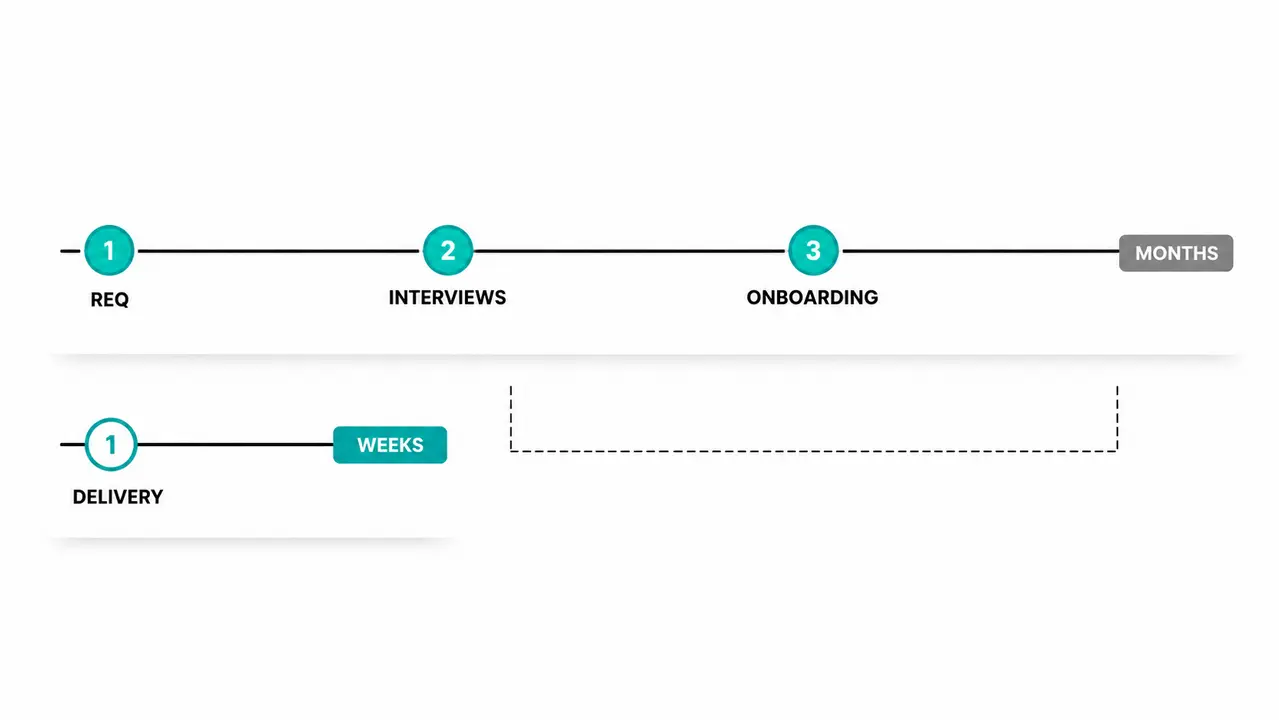
In-house teams are often the right long-term choice. The trouble is timing. Hiring, onboarding, and team formation run on a clock of months, while delivery pressure runs on a clock of weeks, and those clocks refuse to sync.
Picture the scenario: your largest customer requests an enterprise feature set, audit logging, SSO, role hierarchies, and they want it inside one quarter. Your internal team is already at full capacity keeping the platform alive. You open a requisition, and reality intervenes. Your senior engineers spend interview hours they do not have. The new hire, once found, needs six weeks of onboarding that loads the same senior engineers again. Actual throughput on the enterprise feature does not improve for a quarter, and it degrades for the first month because the people who should be building it are instead reviewing take-home exercises.
Ignore those hidden constraints and hiring becomes the reason you miss the deadline rather than the way you meet it. Capacity added on paper is not capacity added to the sprint.
Outsourcing succeeds when the interface is designed not improvised
External execution works when the ownership boundaries are defined before any code is written. Improvised interfaces fail predictably, so treat the interface itself as a deliverable. At minimum you need a written scope boundary, an architecture decision record process so design choices are documented rather than remembered, PR review rules that say who approves what, and a release checklist that both sides sign. When we onboard Dedicated software engineering teams for clients, these artifacts are produced in the first two weeks precisely because they are what makes the team governable.
The failure mode is the specification thrown over the wall. The external team receives a document with no operational constraints, no context on why the current system looks the way it does, and no authority to make local decisions. They build exactly what was written. It is wrong in ways the specification could not anticipate, and the rework cycle starts on day one. A designed interface turns that rework into review comments.
Dedicated team project outsourcing and staff augmentation are not the same
Any honest development models comparison has to start with the fact that these three models differ in team continuity, accountability, and how much product context the team retains over time. They are not points on a price slider. They are different structures.
A multi-quarter platform build benefits from a dedicated team whose context compounds: they know why the billing service has that strange fallback path, because they were there when it was written. A one-off data migration with a fixed schema fits a project delivery model, where bounded scope and acceptance criteria carry the day and continuity adds little. Staff augmentation adds hands to an existing structure and expects your leads to supply the context continuously.
Teams that treat these as interchangeable pay for it. An evolving product handed to a rotating augmentation pool loses context at every rotation, and each new developer spends their first month rediscovering decisions the previous one already made. Match the model to the shape of the work, or spend your roadmap paying for the mismatch.
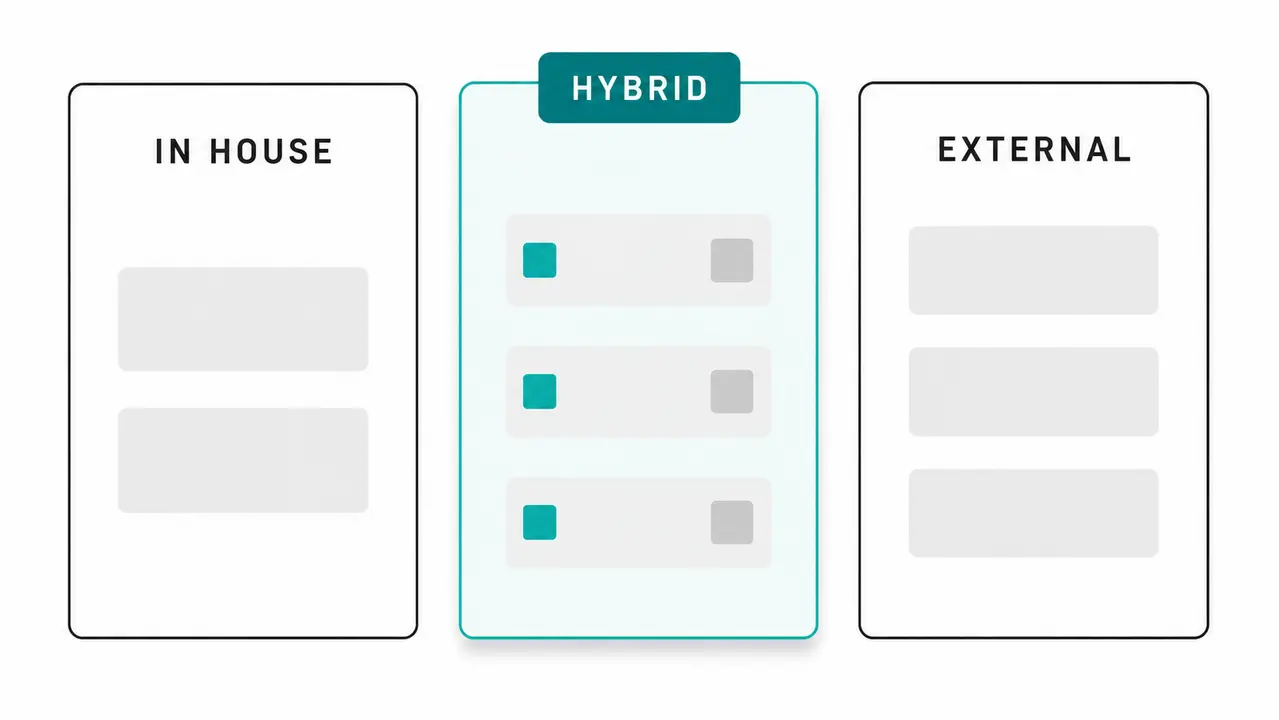
Hybrid delivery is the default for teams that need both speed and control
Most teams we work with land on hybrid, and for good reason. A hybrid model keeps product ownership and technical leadership internal while using an external team for execution capacity and specialized skills. You get the speed of added capacity without surrendering the decisions that define the product. We have written more about structuring this in scaling smart a strategic guide in house expansion outsourcing partnerships, because the split is where the work actually is.
Define the split explicitly. Internal roles: product owner, security owner, the architect who owns cross-cutting decisions. External roles: feature teams with their own tech lead, DevOps support, specialists in the areas where you have permanent gaps. Written down, in a table, with names attached.
Pure outsourcing fails when the roadmap is volatile. Every requirement change becomes a negotiation, context leaks at every handoff, and decision latency compounds during the exact iterations where speed matters most. Hybrid is the default because it is the model that survives a roadmap that changes its mind.
How to decide using three variables that predict outcomes
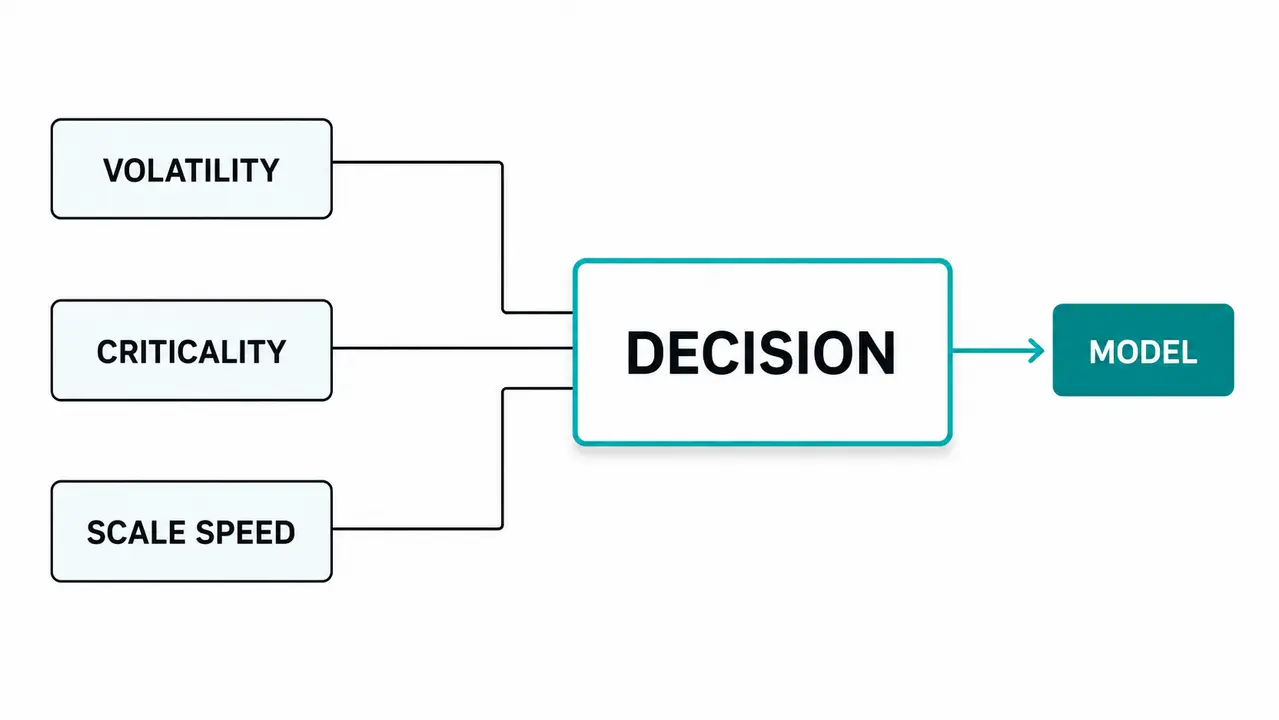
Strip away the vocabulary and most delivery decisions reduce to three variables: the volatility of requirements, the criticality of the system, and how fast you need to scale delivery. Everything else, the vendor shortlists, the rate debates, the tooling arguments, is downstream of these three.
Apply the rubric directly. High volatility plus high criticality favors in-house leadership, with external hands only when the internal architect retains decision authority. Low volatility plus bounded scope favors external execution, because a stable specification is governable from a distance. High criticality plus bounded scope still favors internal leadership on the critical path even when the scope is small, since a compliance-heavy subsystem carries consequences that outweigh any efficiency gain. A marketing site rebuild, by contrast, can safely go to an external team regardless of your other constraints, because the blast radius of a mistake is a bad page, not a broken product.
The rubric is crude on purpose. Crude rubrics get used in the meeting where the decision is actually made, and that is the only meeting that counts.
What engineering leaders underestimate about onboarding an external team
Onboarding is not a kickoff meeting. It is a transfer of domain assumptions, failure history, and operational constraints, and treating it as a calendar event guarantees the transfer fails. The external team will ship technically correct code that violates operational reality, because nothing in the codebase tells them that the nightly batch job must finish before 2 a.m. for the warehouse team, or that one enterprise customer still runs an API version you officially deprecated.
Require specific artifacts before sprint one. An architecture walkthrough recorded and kept current. Incident postmortems from the last two quarters, which encode more real requirements than any specification. Staging environment access with realistic data. A domain glossary, because half your internal vocabulary is shorthand for decisions that were never documented. In System and embedded engineering work especially, where hardware constraints and timing behavior never show up in code review, this context transfer is the difference between a working device and a demo that fails on site.
Quality control is a system not a promise
Quality does not come from an SLA clause promising excellence. It comes from enforced practices: reviews, tests, and CI gates that run regardless of who wrote the code or where they sit. Employment model is irrelevant to this. An internal team without branch protection ships the same defects as an outsourced one.
Implement the mechanics. Branch protection on main so nothing lands unreviewed. CODEOWNERS files so the right reviewer is assigned automatically rather than by goodwill. Static analysis in the pipeline, strict test coverage expectations written into the definition of done, and release gates that block on failure. These practices align with the secure software development frameworks published by NIST, which describe exactly this kind of enforced pipeline discipline as a baseline rather than an aspiration.
The failure mode sits on the client side. Outsourcing fails when you cannot enforce the gates, or when no internal reviewer exists who can genuinely evaluate a critical pull request. Then the gate becomes theater, and theater fails silently until production.
Security and IP risk comes from access design and data handling
The risk in distributed delivery is not the presence of external people. It is unmanaged access, unclear data classification, and a missing secure SDLC process. A contractor with least-privilege access and an audited trail is a smaller risk surface than a permanent employee with the production keys from three roles ago.
Enforce the basics with discipline. Least-privilege access reviewed monthly. Secrets in a managed vault, never in a Slack message or a .env file committed by accident. Audit logs on everything that touches production data. Explicit IP assignment clauses in contracts, written by a lawyer rather than copied from a template. Pair this with dependency scanning and secure code review practices that map to the common application security risks tracked by OWASP, and you have a process rather than a hope.
The concrete failure is quieter than the policy failures: production database access granted during a rush deployment in month two, never revoked, still active at month twenty. Nobody chose to create that blind spot. It accumulated.
Communication overhead shows up as review queues and decision latency
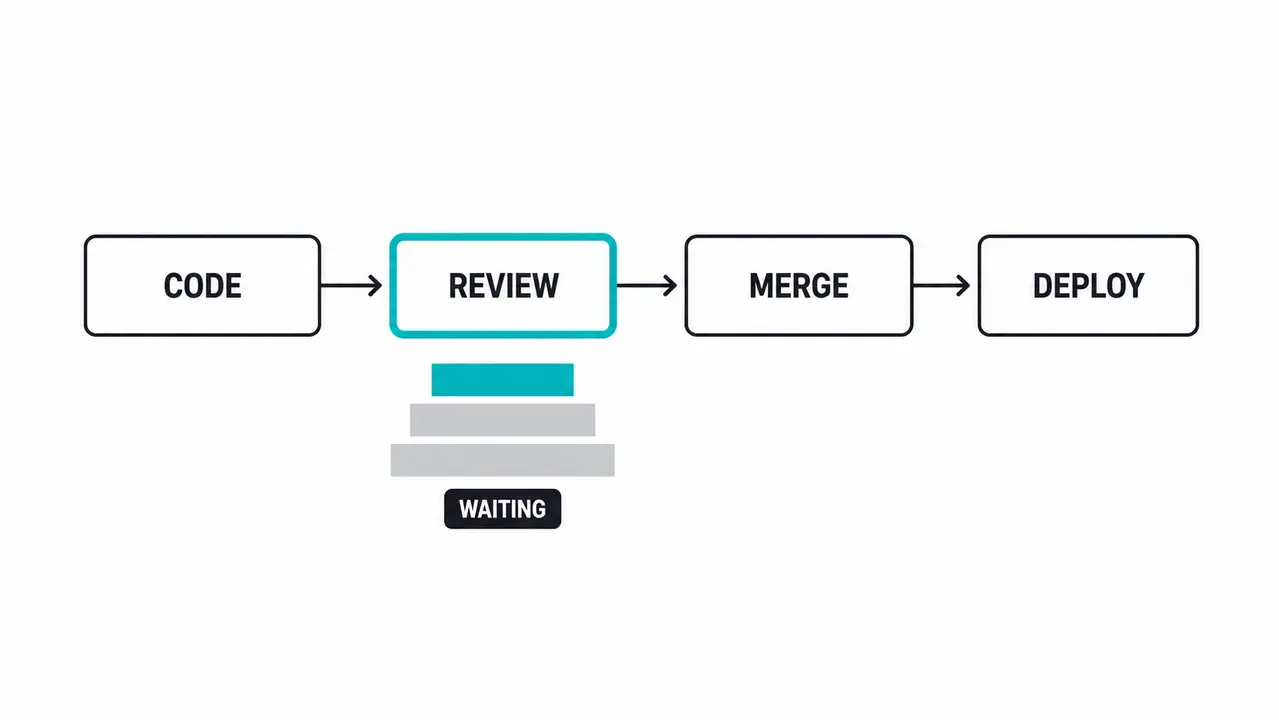
Measure the internal vs external team question where the work actually flows. Distributed delivery does not fail because time zones differ, though overlapping hours help. It fails when feedback loops are slow, and slow feedback loops are visible in your cycle time metrics before anyone feels the pain.
Put structures in place that cap the latency. A service level agreement for pull request reviews, such as first response within one business day, measured and reported. A weekly architecture sync for decisions that exceed what a PR comment can carry. An async decision log so choices made in a call are findable three months later by someone who was not on the call.
Here is what a two-day PR review queue actually does. Cycle time multiplies. Merge conflicts pile up while branches age. Developers context-switch to other work and lose the mental model of their own change. Within a sprint, the queue has destroyed the capacity benefit that motivated the hybrid model in the first place. The overhead is not in the meetings. It is in the waiting.
The week a senior engineer leaves mid build is the real stress test
Every delivery model looks fine while the team is stable. The test is the week a senior engineer leaves mid build, and the model that survives that week is the one with documentation, shared ownership, and reproducible environments. Plan for the departure on day one, not the day it happens.
Require three things. Onboarding docs good enough that a new developer ships in their first week. Infrastructure as code, Terraform or Ansible or whatever your stack supports, so environments are rebuilt rather than begged from the one person who knows the incantations. A “first day” developer environment script that runs end to end without manual intervention, tested by an actual new joiner, not by the person who wrote it.
Context loss is brutal when knowledge concentrates in a single lead, internal or external. We have inherited systems where one departing engineer took the entire deployment procedure with them, unwritten, into their notice period. The roadmap halted for a month. Spread the knowledge while nobody is leaving, because the day you need to spread it is the day it is too late.
How to run agile delivery with a mixed internal and external team
Agile works across a mixed team when two things stay centralized: planning and acceptance. The product owner owns the backlog. The tech lead owns technical direction. Execution is organized into stable, cross-functional teams that include external members, treated as team members rather than as a vendor sprinting in parallel.
Maintain a single backlog. One definition of ready, one definition of done, applied identically to a story whether an internal or external engineer picks it up. A regular demo cadence where the whole mixed team shows working software to stakeholders, which forces integration to happen continuously instead of at the end. Shared incident rotation rules, so an external engineer can be on-call and an internal engineer learns the subsystem the external team built.
The failure mode is fragmentation. Separate backlogs, competing priorities, an internal team building the “real” product while the external team works a shadow roadmap that integrates never. Integration disasters are not technical accidents. They are the scheduled outcome of two teams that stopped sharing a backlog in month two.
Vendor lock in is usually a documentation and ownership failure
Lock-in does not happen because an external team helped you build something. It happens when only that team can operate the result. The distinction is everything, and it is decided by ownership of assets, not by who wrote the code.
Enforce internal ownership from day one. Repositories under your GitHub organization, not the vendor’s. CI/CD pipelines in your GitLab or GitHub Actions instance, visible to your engineers. Cloud accounts, observability tools, and release signing keys registered to your company with your people as admins. The external team works inside your perimeter. The perimeter never moves to theirs.
The alternative is a project outsourcing engagement without explicit handover milestones, ending with a client who cannot deploy a hotfix without paying for emergency support. We have watched teams discover, during a production incident, that the deploy pipeline lives in a vendor’s account and nobody internal has ever run it. That is lock-in with a production outage attached. Documentation and asset ownership are cheap on day one and unavailable on the day of the incident.
Bringing development back in house without a rewrite
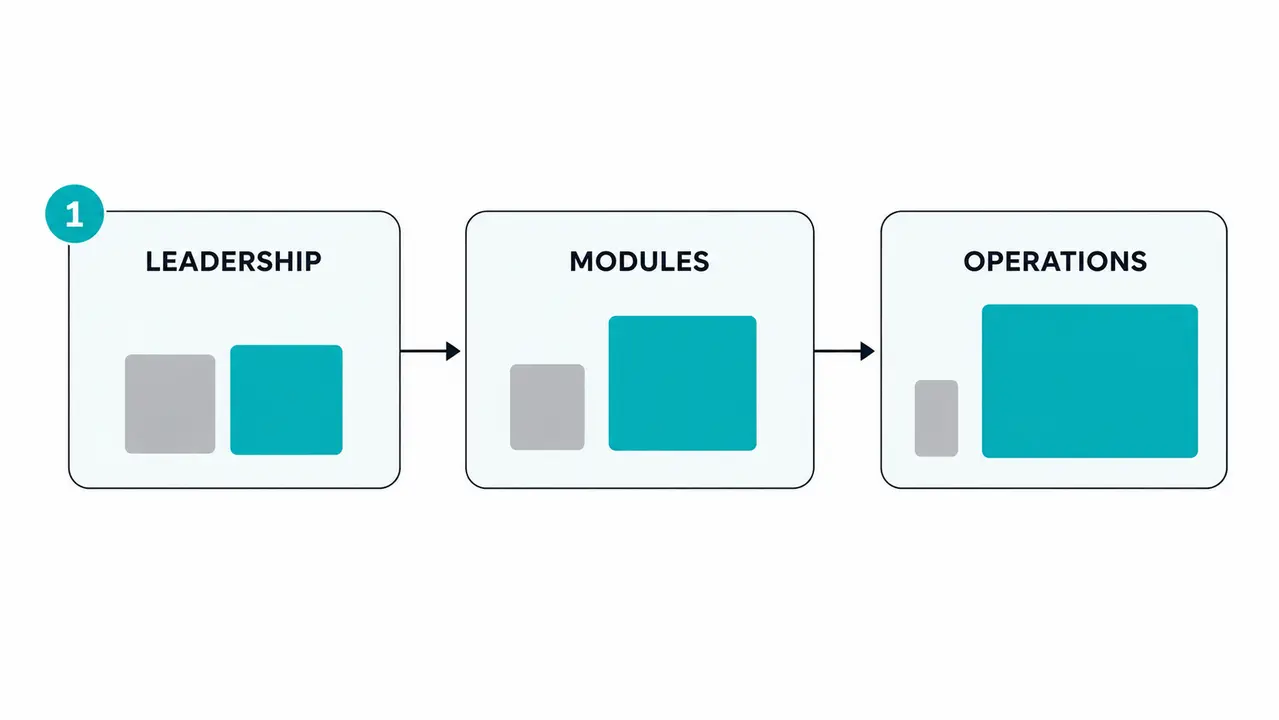
Teams that outsource heavily often reach a point where internalizing makes sense, and the instinct is to do it all at once. Resist that. You can transition by internalizing leadership first, then ownership of individual modules, then operations, while keeping delivery moving the entire time. The rewrite instinct is expensive and mostly unnecessary.
Execute it in phases. An internal tech lead shadows the external team for a full sprint cycle, attending their ceremonies and reviewing their PRs without owning anything yet. Then internal reviewers join the review rotation, so every change passes through both sets of eyes. Then the internal team takes over one service at a time, smallest risk first, with the external team remaining as backup for the services not yet transferred.
The big-bang transition is the failure to avoid. It stalls the roadmap for a quarter and creates a knowledge vacuum in the middle of it, where nobody can deploy confidently. Phased transfer costs a little coordination every week. The rewrite costs your roadmap once, completely, and often costs the rewrite too.
Pressure-test your delivery model with us
If the matrix above leaves you between two models, a short conversation with our engineers will map your roadmap volatility, criticality and scaling pressure onto a concrete team structure.
A decision matrix you can use in a leadership meeting
Bring a verdict-forcing tool to the meeting rather than a debate. A simple matrix, scored in fifteen minutes, forces the decision to reflect current constraints instead of team preferences or the loudest opinion in the room. Score each row honestly and the model tends to announce itself.
| Dimension | Favors internal | Favors external execution |
|---|---|---|
| Roadmap volatility | Requirements change weekly | Scope stable for quarters |
| System criticality | Core differentiator or revenue path | Supporting, bounded subsystem |
| Integration complexity | Deep coupling with legacy core | Isolated interface, clean contracts |
| Internal leadership bandwidth | Architect and PO capacity available | Leads already fully committed |
| Compliance exposure | Audited, regulated data flows | No sensitive data handling |
Do not decide on a single factor like delivery speed. Speed without continuity and without tolerance for decision latency produces a model mismatch that shows up as rework, stalls, and an eighteen-month cleanup. The matrix exists to catch exactly that.
Frequently asked questions
Can you outsource embedded or IoT development safely?
Yes, with tighter constraints than application work. Firmware bugs ship with hardware, so the contract must specify hardware-in-the-loop testing, a signed test plan per release, and clear ownership of the toolchain. We deliver embedded and IoT programs regularly, and the engagements that work share one trait: the client keeps an internal engineer who understands the constraints well enough to challenge the firmware team.
What is the minimum internal team needed to make outsourcing work?
Two people, in most cases. A product owner who owns the backlog and acceptance, and a technical lead who can review architecture and evaluate critical pull requests. Below that, you have no governance surface, and the external team is effectively deciding your product direction by default.
How do you measure success in the first 30 days with an external team?
Track three signals. Time to first merged pull request, which should land inside two weeks if onboarding is real. Cycle time trend, which should stabilize by week four rather than degrade. And the ratio of clarifying questions to assumptions, because a team that asks many small questions early is building context, while a silent team is guessing.
What should be included in a handover package?
A runnable repository with a first-day setup script, infrastructure as code, current architecture documentation, a decision log covering the significant tradeoffs, runbooks for the top operational scenarios, access inventories for every system touched, and a walkthrough session recorded for the people who join later.
Can an external team own on-call and production support?
They can share the rotation, and for systems they built they often carry deeper diagnostic knowledge than anyone internal. Full sole ownership is a risk, because it recreates lock-in at the operational layer. A shared rotation with an internal escalation path keeps the knowledge distributed.
How do you handle tooling differences across internal and external teams?
You do not handle them. You eliminate them. One issue tracker, one repository host, one CI system, one communication channel, with the external team working inside your stack from day one. Running parallel toolchains doubles the communication overhead and guarantees that context lives in two places, findable in neither.
Pick the model you can govern on your worst week
Choose the approach that still works when priorities shift mid-sprint, a senior engineer is on leave, and a release is at risk. Write down the ownership boundary today, define the quality gates, and decide who owns architecture and production access before the pressure arrives. Here is the question worth answering honestly: if your best external partner vanished tomorrow, could your internal team still deploy and operate the system? If the answer is no, you have found your next priority.
About Sentice

Sentice is a boutique software engineering partner founded in 2013 by Roni Levi and Martin Petkovic, now headquartered in Skopje, North Macedonia. Rather than supplying individual developers, we build embedded teams that blend with a client’s culture, tech stack and goals, working together from a single office under our own technical leadership. We deliver dedicated software engineering teams, end-to-end software solutions, product development, and system and embedded engineering, and we act as technical advisors across the full development lifecycle, from specification and architecture through development, testing and support. We use AI coding tools across every project, and we help clients integrate AI into their own products through chatbots, MCP services, connected application layers and workflow automation. Some of the clients we started with more than a decade ago are still building with us today.