
The demo is Thursday. The vendor’s status report has said “on track” for three weeks. You open the pull request queue and find eleven open requests, the oldest nine days without a comment, and a merge to main that bypassed review entirely. Nothing in the report was false. Everything important was missing.
This is where outsourced engineering engagements actually fail. Not in the talent, and rarely in the code. They fail in the space between your organization and theirs, in decisions nobody was assigned, in interfaces nobody designed. Managing outsourced development is an interface design problem before it is a people problem, and almost every team learns this after the first expensive rework cycle. Below, we unpack where these engagements break, how to build a control system of signals and gates instead of meetings, and the practical levers you can implement this week.
Reading time: 11 min
Key points
- Outsourced development usually fails at the seam between organizations, not in engineering skill, so treat the interface itself as a deliverable.
- Oversight should run on observable artifacts, backlog health, pull request flow, build status, demo cadence, and incident trends, rather than status assurances.
- The engagement model you buy, augmentation, managed team, or embedded pod, determines how much coordination debt lands on your own leadership.
- Quality gates, a code review SLA, and a single backlog catch delivery slips weeks before a sprint demo would reveal them.
Table of contents
Outsourced development fails at the interface between teams
When managing outsourced development goes wrong, the postmortem almost never blames engineering skill. It blames the seam. Product decisions live in your organization. Implementation lives in another. Two systems, each internally coherent, connected by nothing except goodwill and a weekly call. If the seam is undefined, every ambiguity gets resolved twice, once by each side, usually differently.
The fix is unglamorous and it works. Draw an ownership map that states, per area, who decides and who executes. Attach a release checklist that covers observability, logging, alerts, and rollback, not just features. We have watched a polished feature ship and break the monitoring stack the same afternoon because non-functional requirements had no owner. Nobody was negligent. Nobody was assigned. The incident cost two weeks of rework, which is roughly the cost of drawing the two documents correctly on day one.
Treat the interface as a deliverable. It deserves the same review attention as the codebase.
Managing outsourced development means designing a control system
A common mistake, stated flatly: leaders respond to distance with more meetings. What they need is a system where work stays observable and quality stays gated, so that trust is measured in artifacts rather than assurances.
The signals that matter are specific. Backlog health, meaning how many tickets sit in progress and how old they are. Pull request flow, meaning open count, review latency, and merge frequency. Build status across the last two weeks. Demo cadence, whether a working increment actually appears every sprint. Incident trends since the last release. Five signals, checkable in ten minutes a day.
The counter-case arrives quietly. A status dashboard glows green while the pull request queue grows and merges stall for a week. The dashboard measures what the vendor controls, the queue measures what your product depends on. Superficial reporting and true observability can agree for a month and then diverge catastrophically in the sprint that mattered. Watch the queue.
The engagement model determines your oversight workload
Oversight load is not a fixed tax. It is a function of what you actually bought. Staff augmentation sells you capacity, and you supply the product owner, the tech lead, and the release owner yourself. A managed team offloads part of that, with the vendor running delivery while you keep product and architecture authority. An embedded, outcome-oriented pod carries the work further, holding quality and delivery against an agreed roadmap.
Most buyers underestimate the first category. Pure augmentation is the right choice when your internal leadership has real bandwidth, and the weaker one when it does not, because coordination debt lands entirely on you. If your tech lead is already at capacity, hiring three more external engineers adds throughput on paper and subtracts it in practice. Matching the model to your leadership bandwidth matters more than matching skills to the stack.
If bandwidth is the constraint, dedicated software engineering teams shift the coordination load to the partner while keeping your decision rights intact.
How the three engagement models compare
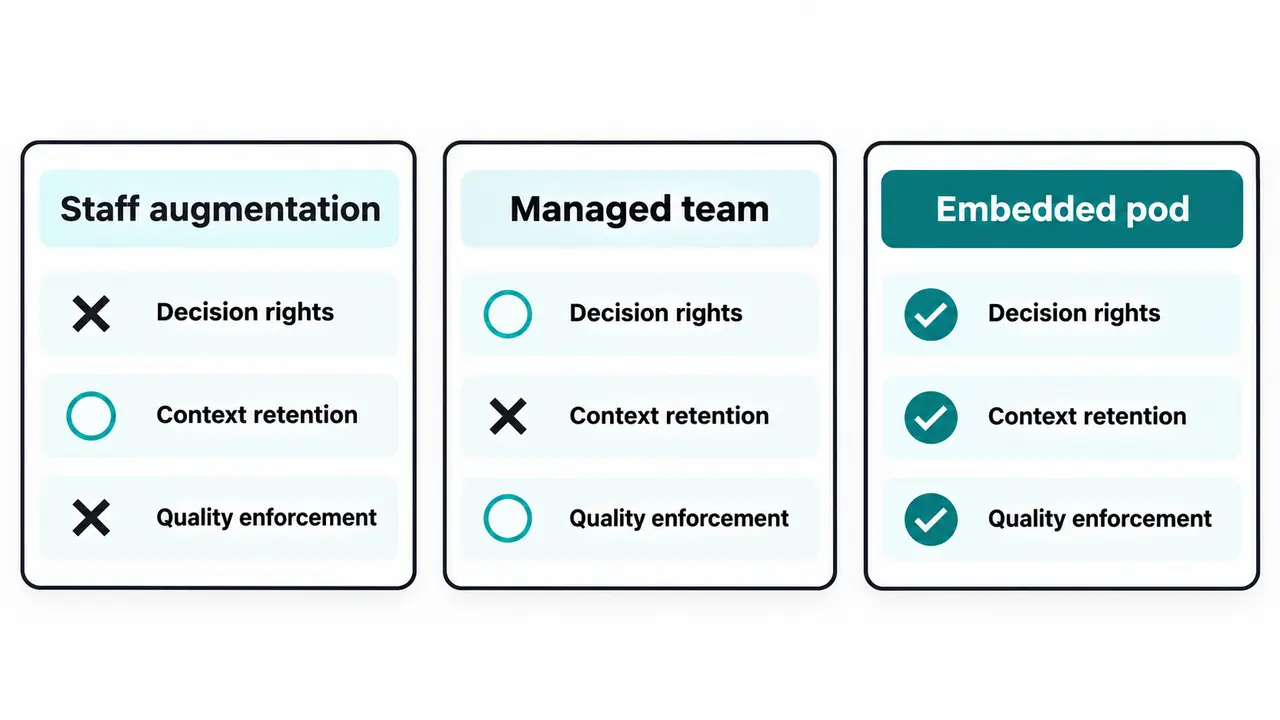
The honest comparison is not about quality, since any model can deliver either. It is about ownership, continuity, and how fast decisions travel.
| Dimension | Staff augmentation | Managed team | Embedded pod |
|---|---|---|---|
| Decision rights | Buyer owns all | Shared, buyer holds product | Pod owns delivery, buyer owns direction |
| Onboarding time | Weeks, buyer-driven | Two to four weeks | Four to six weeks, deeper context |
| Context retention | Low, per-engineer | Medium, team-level | High, institutional |
| Quality enforcement | Buyer’s gates only | Vendor gates plus buyer review | Shared gates, joint ownership |
| Escalation speed | Direct, per person | Through vendor lead | Fastest, shared ceremonies |
Project-based outsourcing deserves its reputation for evolving products. Every scope change becomes a negotiation, and change control turns into friction that compounds monthly. Embedded teams move in the opposite direction: they shine when the roadmap stays fluid and the quality bar stays high, because the pod absorbs change as normal work rather than as a commercial event. For a product still finding its shape, end-to-end product development under one accountable team beats assembling the pieces yourself.
Where teams underestimate onboarding
Onboarding outsourced engineers is a production readiness process, not a welcome document. The failures are predictable and they arrive in week two, when it turns out the local development environment never actually ran, the test database was a copy of a copy, and the engineer has spent five days reverse-engineering a setup script nobody documented.
Set a hard target and measure it. A senior engineer should open a first meaningful pull request within three to five working days. Meaningful means touching real logic, not fixing a typo in the README. If it takes longer, the blocker is almost always environmental, not technical.
An outsourced team onboarding checklist closes the gap. Repository and CI access on day one, a reproducible local environment verified by a script, a small starter ticket reserved for each new joiner, a named buddy reviewer, and the communication contract in writing. Misaligned assumptions are what make code reviews slow later. The engineer who merged a change that broke staging, because nobody said staging was shared, was onboarded by omission.
A communication contract beats more meetings
Define a communication contract before you need it. State what gets discussed where, expected response times per channel, and who is called for which kind of problem. Then protect deep work inside it.
By purpose, the channels look like this. Async daily updates in writing, the working core of outsourced dev team daily standup alternatives, where each engineer posts what moved, what is blocked, and what comes next. Sprint planning live, once, short. Tech design reviews on a recorded call with a written decision afterward. A dedicated incident channel that pages a named role. A release readiness review before every deploy, run against the checklist.
The failure mode is small and corrosive. A “quick question” direct message sits unread for six hours, the sender waits politely, implementation stalls, and nobody escalates because it was, after all, just a quick question. Undefined channels break delivery flow as reliably as bad code. The contract exists so that every message has a home and every home has a response time.
Time zone overlap is a design constraint
Treat time zones the way you treat latency in a distributed system: a constraint you design around, not a problem you complain about. Decide explicitly what must be synchronous, then engineer everything else for asynchronous throughput. The trend line only points one way, as the number of ICT specialists across the EU continues to grow, per Eurostat, which means distributed coordination is becoming the default condition of software work, not the exception.
Minimum viable overlap is two windows. One shared block for sprint ceremonies, planning and demo together. One reservable block for technical pairing, used when a design genuinely needs a whiteboard. Everything else runs on recorded walkthroughs and written decision logs.
Zero overlap is the weaker configuration for a fast-changing product. When every clarification costs a full day of latency, clarification latency becomes the dominant delay in your delivery pipeline, larger than build time, larger than review time. A team in Skopje working with a US East Coast product owner gets three to four natural hours daily. That is enough. None is not a constraint, it is a handicap.
Project oversight starts with decision rights
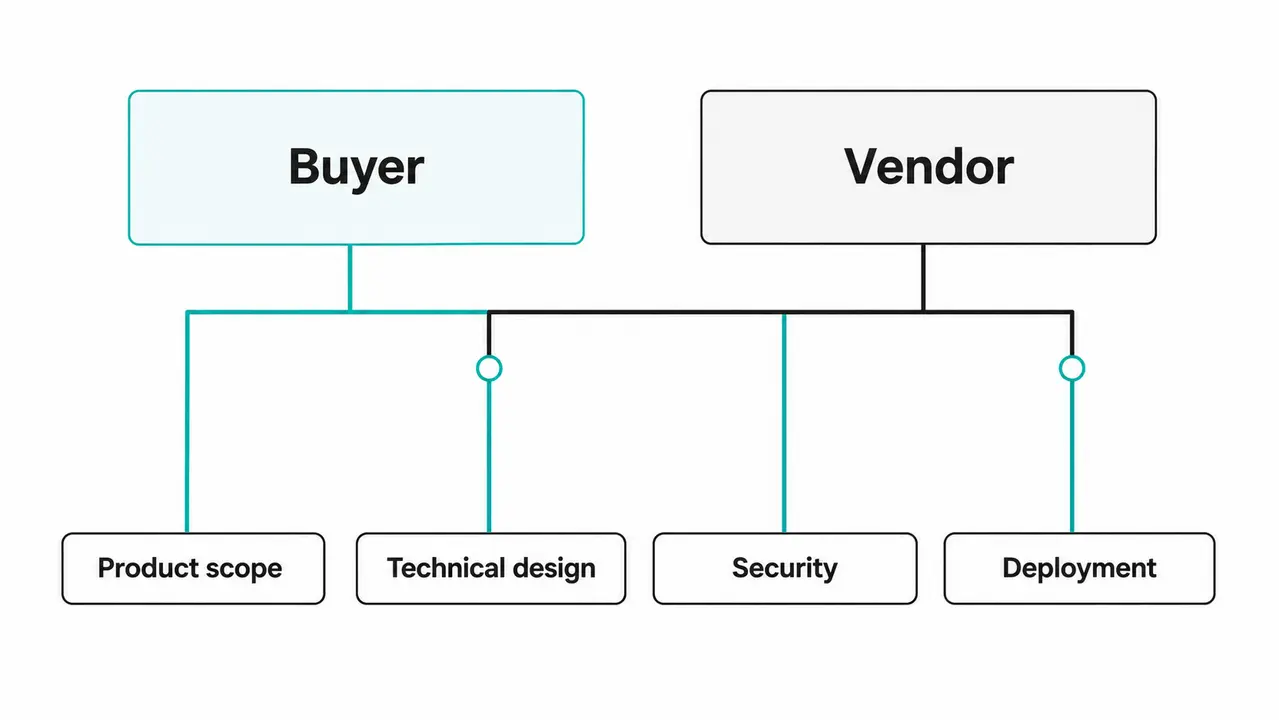
Outsource development project oversight becomes manageable the moment decision rights stop being implicit. Write down who decides product scope, who decides architecture, who signs off on tradeoffs, and who declares release readiness. Four categories, named owners, one page.
A RACI-style map covers the ground: product scope, technical design, security, quality assurance, deployment. For each, one person accountable, the people responsible, the people consulted. Ten minutes to draft, and it removes the most expensive category of conflict, which is two parties each certain they owned the decision.
The classic failure is structural. The vendor’s project manager owns the schedule but cannot approve a technical compromise, so the compromise happens silently inside the code instead of loudly inside a meeting. You get unapproved technical debt, discovered at the worst moment, with no record of who accepted it. A vendor that cannot be granted real decision authority must at least be required to surface every tradeoff it makes. Anything less hides risk in the repository.
A single backlog prevents parallel realities
Run one backlog with one prioritization authority. The moment a second backlog exists, whether it is the vendor’s internal tracker or a spreadsheet the engineering lead keeps “for convenience,” you have two versions of the plan and no way to tell which one people are executing.
The working pattern is simple. Your internal product owner sets priority. The external team estimates, questions, and flags risk. Both happen in one weekly backlog grooming session with the engineering lead present, so estimates get challenged in the room instead of in a status report. This is also where remote team management gets easier, because a single backlog means remote and in-house engineers literally cannot drift onto different priorities.
Side work is the tell. Someone “quickly” builds an endpoint off-board, outside the backlog, to unblock themselves. It works in isolation. Three weeks later it breaks the release integration because it never went through review, never got tests, and never matched the interface the main team agreed on. Every off-board shortcut is a deferred integration failure.
Specs that survive outsourcing are testable
A spec that cannot be turned into tests is not a spec, it is a wish. Distributed teams magnify this, because a spec read in another time zone cannot be clarified by leaning over a desk. Ambiguity does not get resolved, it gets implemented, in whichever interpretation was cheapest.
Enforce a definition of ready on every ticket. Before work starts, the ticket carries acceptance criteria, example payloads, error states, edge cases, and non-functional requirements like response time or file size limits. That is also the practical definition of done for outsourced team work, the point where nothing is left to interpretation.
Consider a real one. A ticket says “add export.” No file size limit, no permission model, no mention of audit logging. The engineer builds a CSV export of the full dataset for any user who asks. The rework, permissions, pagination, audit events, streaming for large files, exceeds the original build. Scope creep was not the engineer’s fault. The ticket was an invitation to guess, and guessing is what distant teams do when the spec runs out.
Quality gates replace trust-based merging
Quality holds when merges are gated by rules both sides agreed to, not by trust that accumulates over months. The gate list is short and boring, which is the point. Required unit tests with coverage thresholds. Linting on every push. Security scanning in CI, dependency and container both. A pull request size limit, because 3,000-line reviews are not reviews. And a rule with no exceptions: no direct pushes to the main branch, ever, for anyone, including leads.
An outsourced development code review process that runs through these gates scales without drama. The gates enforce the standard so the humans can spend review attention on design instead of formatting.
The failure mode is graduational. Gates get skipped once during a crunch, then during every crunch. Late-stage quality assurance then discovers not a bug but a pattern, missing tests across a whole module, insecure queries in three services, and what were minor defects have compounded into architectural flaws. Restoring the gates costs a hardening sprint. A hardening sprint is a polite name for rework you already paid for once.
Code review is your highest leverage oversight tool
If you can only watch one artifact, watch the pull request flow. Code review is where standards transfer, where context transfers, and where you learn what the team actually believes about quality, all before anything reaches production.
Set a code review SLA and honor it from both sides. First response within one business day for normal pull requests. Hotfixes get faster, hours not days. Rotate reviewers deliberately so knowledge spreads and no single internal engineer becomes the bottleneck whose vacation stalls the vendor.
The compounding failure works like this. The review queue grows. Engineers, waiting, batch their work into huge pull requests to make the wait worthwhile. Large requests get shallow reviews. Defects slip through. Review quality drops further, the queue grows again. Within a month you have 900-line requests getting “looks good” in eleven minutes. The SLA exists to break that loop before it starts, and it costs almost nothing to enforce.

Measuring flow catches problems before delivery slips
Delivery oversight for external teams should run on flow metrics, because flow degrades weeks before the milestone does. Track cycle time from ticket start to production. Pull request aging. Work in progress against the limit. Escaped defects per release. Rework rate, the share of merged code reopened or reverted.
Put one hard threshold on the weekly oversight dashboard: no pull request older than three business days without a comment. Three days of silence means something is stuck, a reviewer is missing, a design dispute is unresolved, an engineer is blocked and too polite to escalate. The threshold converts silence into a signal.
Teams that skip flow measurement discover delivery slips at the sprint demo, which is the last moment with any corrective room. The demo shows the slip. It offers no time to fix it. The difference between the two situations is a month of warning, and the dashboard that provides it takes an afternoon to assemble from data your CI and issue tracker already produce.
The week a senior leaves mid-milestone
Attrition is guaranteed, so the question is where the knowledge lives when it happens. Knowledge trapped in one engineer’s head is a single point of failure wearing a salary. The week a senior leaves mid-milestone, you find out how much of your system existed only as intuition in that person.
The mitigation is lightweight and habitual. Architecture decision records for every significant choice, one page each. Runbooks for release, rollback, and the two or three operations someone always gets paged about. Onboarding notes for risky modules, and payment integrations deserve special paranoia, covering the edge cases that only surface in production. Pairing habits on those same modules so at least two people have touched them this quarter.
We have seen a core module stall for weeks because exactly one person knew which incoming webhooks were safe to retry and which were not. Nothing in the code said so. Continuity is the quiet advantage of a partner whose engineers sit together and retain context across years; as a Sentice boutique engineering partner, we treat retained knowledge as an asset class of its own, and you should expect the same from any partner you choose.
Escalation paths prevent silent failure
Define an escalation path for engineering delivery before anything goes wrong, covering three risk families: scope risk, quality risk, and delivery risk. The goal is simple and non-negotiable in effect: bad news arrives before the demo, not during it.
Build a severity ladder with named roles. Technical blockers go to the tech lead, same day. Scope risks go to the product owner, because only that role can trade scope against dates. Security vulnerabilities go directly to whoever owns security, bypassing the delivery chain entirely, because a vulnerability discovered by a delivery manager three days late is a vulnerability you did not have three days to fix.
The signature failure is the repeated “almost done.” Status updates stay cheerful, dependencies never surface, and the miss appears fully formed at the milestone. Almost done, twice in a row, with no named blocker, is itself an escalation trigger. Write that rule down. Teams escalate reliably only when escalating early is explicitly safer than escalating late, and that safety is a leadership behavior, not a document.
Security and IP hygiene belongs in the workflow
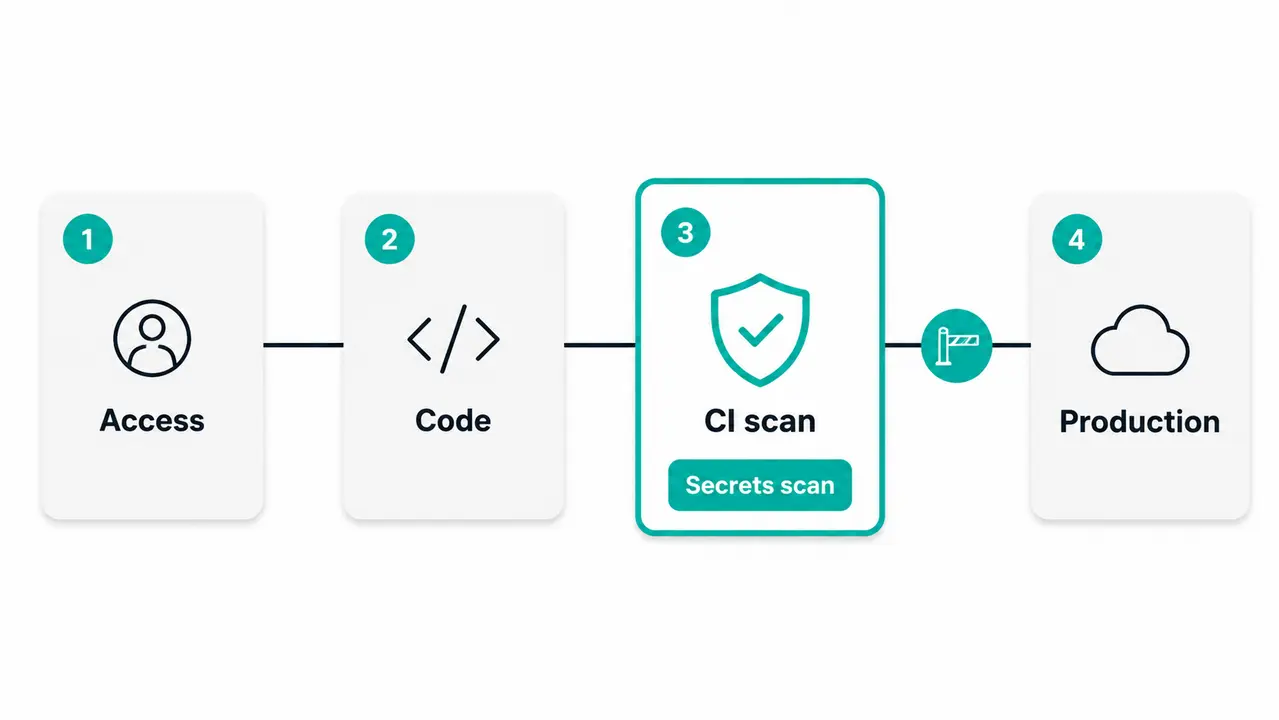
Security for a distributed team is strongest when it lives in access control, CI checks, and review gates. A policy document nobody rereads is security theater with a table of contents.
The working rules are concrete. Least-privilege access to repositories, cloud consoles, and production systems, granted per role and reviewed quarterly. Short-lived credentials everywhere, no permanent cloud keys in CI. An offboarding checklist that removes repository and infrastructure access the same day an engineer rotates off. Secrets scanning in the pipeline, on every push.
For baselines, align the engagement with the NIST Secure Software Development Framework and review against the OWASP Top 10, which gives both teams a shared vocabulary instead of an argument about standards. The failure case is blunt: an engagement relying on one policy document, without enforced review, ends with a cloud provider key committed to version control and a very long afternoon of rotation and incident review. Enforcement beats intention every time.
When to switch vendors or bring work back in-house
Switch when the system cannot be corrected, not when it annoys you. The signals that justify a switch are specific: repeated missed quality gates after two corrective cycles, persistent lack of transparency in reporting, or an inability to retain context that shows up as the same questions answered differently every quarter. Friction you can fix. A partner that will not operate inside your governance rules you cannot.
If you switch, run a real transition. A documentation sprint to capture what exists only in heads. Knowledge transfer sessions recorded and indexed. A code freeze window on the old team. A repository cleanup that removes stale branches, dead services, and credentials that predate your tenure.
Keeping a partner that refuses governance creates maintenance debt worse than the velocity dip of a transition, and the dip is real but short. Strong outsourcing communication is the first thing to test with any new model, because transparency is a precondition for everything else. If you are weighing expansion versus repatriation, our guide on scaling smart with outsourcing partnerships walks the decision in detail.
Make your next engagement observable
If you want a partner whose teams already run on shared gates, a single backlog, and full pull request visibility, tell us what you are building.
Frequently asked questions
How do I manage an outsourced development team without daily standups?
Use async daily updates in writing, weekly demos of working software, and full pull request visibility as your baseline. Reserve live meetings for decisions and blockers, the conversations that genuinely need two-way speed. Most teams that drop standups report the written updates carry more signal than the spoken ones ever did.
Who should own the backlog when development is outsourced?
Product ownership stays internal, always. The external team estimates, challenges, and flags risk, but prioritization authority belongs with the person accountable for the product outcome. A vendor-side proxy product owner can work, but only when decision rights are documented so the proxy knows exactly what it can and cannot decide.
What should I do if the vendor PM reports progress but engineering output is unclear?
Shift the reporting to observable artifacts. Pull requests opened, reviewed, and merged. CI results per branch. Backlog movement, meaning tickets actually closing rather than percentages. If the vendor cannot show output in those terms within a week, that absence is itself the report.
How do I integrate outsourced engineers into my culture without forcing it?
Align on the mechanics, skip the rituals. Agree on working agreements, feedback norms, review expectations, and the quality bar, then let the social side develop through shared work. Forcing performative culture activities onto a remote team produces compliance, not belonging, and wastes the goodwill you need for hard delivery conversations.
What is the minimum documentation that pays off fast?
Three documents. Architecture decision records for significant choices, one page each, so tradeoffs stop being rediscovered. A runbook covering release and rollback, so deploys stop depending on one person. A ticket template with strict acceptance criteria, so specs stop dissolving into interpretation. Everything else can wait.
Pick one governance change to implement this week
Choose one lever that increases visibility fast, whether that is a single backlog, a review SLA, or a weekly demo run against a release checklist. Implement it for two sprints without exceptions, no waivers during crunch. Watch which friction the change removes, because the answer is usually bigger than expected. Then lock it in as policy before you add anything else.
About Sentice

Sentice is a boutique software engineering partner founded in 2013 by Roni Levi and Martin Petkovic, now headquartered in Skopje, North Macedonia. Rather than supplying individual developers, we build embedded teams that blend with a client’s culture, tech stack and goals, working together from a single office under our own technical leadership. We deliver dedicated software engineering teams, end-to-end software solutions, product development, and system and embedded engineering, and we act as technical advisors across the full development lifecycle, from specification and architecture through development, testing and support. We use AI coding tools across every project, and we help clients integrate AI into their own products through chatbots, MCP services, connected application layers and workflow automation. Some of the clients we started with more than a decade ago are still building with us today.
Contact us at info@sentice.com or call +389 70 307 837.