
The contract is signed, the team is ramping up, and six weeks later you are staring at a pull request nobody on your side can review. The code works. The demo passed. The problem is that your internal engineers cannot safely change it, your security team has never seen the dependency list, and the only person who understands the deployment pipeline sits in another time zone on a vendor’s payroll. That is the moment most companies discover they bought capacity when what they needed was an operating model.
Reading time: 12 min
Key points
- Treat enterprise software outsourcing as an operating model you design, not a vendor purchase that ends at contract signature.
- Choose an engagement model, staff augmentation, dedicated team, or managed project, based on scope volatility and internal management bandwidth.
- Keep the product owner, the core platform tech lead, and the security owner internal regardless of model.
- Validate any partnership with a 4 to 6 week pilot that tests integration into your SDLC, not just output.
Table of contents
Enterprise software outsourcing is an operating model not a vendor purchase
Treat enterprise software outsourcing as a way to run part of your engineering organization, not as a procurement event that concludes when the contract is countersigned. Software development outsourcing fails most often at the boundary between the external team and your existing delivery system, and that boundary is something you design, not something you buy. The distinction matters because a purchase ends at delivery, while an operating model defines how work enters, moves through, and leaves the system every single week.
The minimum artifacts to start are small and non-negotiable. You need a roadmap slice that fits in one quarter, architecture guardrails that say which decisions the external team can make alone, a definition of done that includes tests and documentation, and a release process the external team participates in rather than hands over. Four documents. Without them, you get a codebase nobody internally can safely change or support, which is the most expensive possible outcome of an engagement that looked cheap on paper.
Where enterprise outsourcing fits in a modern product organization
The pattern that works is consistent: internal leadership owns product direction and architecture, and the external development team owns execution inside agreed boundaries. Enterprise software development outsourcing is strongest where the work is well-bounded but capacity-hungry, and weakest where the work is ambiguous and nobody internal is steering it.
Concrete scenarios where this holds up include platform modernization, integration-heavy features that connect your product to third-party systems, internal tooling that has outgrown the spreadsheet it started as, and embedded systems components with clear hardware interfaces. Product engineering effort concentrates in these seams because they consume senior time without advancing the core roadmap.
The counter-case matters just as much. Do not outsource your core differentiator when requirements are still ambiguous and no internal product owner exists. You will pay twice, once for the wrong build and once for the rebuild. Three roles must stay internal regardless of model: the product owner, the tech lead for the core platform, and the security owner. Everything else is a candidate for extension.
The work that breaks first when you outsource the wrong layer
Failures never start in the code. They start at the boundaries: integrations, data contracts, release coordination, and incident response. A typical sequence looks like this. The outsourced development team ships a feature on schedule. Your internal team owns the deployment because the production credentials never left your side. A regression appears on a Friday, and nobody can answer a simple question, who rolls it back. The external team cannot, it has no production access. The internal team will not, it did not write the change.
That gap is where release management discipline earns its keep. Maintain a live interface inventory covering APIs, event schemas, data contracts, and hardware interfaces, and assign a named owner to each entry. The inventory takes an afternoon to create and answers the ownership question before it becomes an outage.
The deeper risk is integration debt that disguises itself as a slow team. When every release requires a week of reconciliation between two codebases that nobody mapped, the problem looks like velocity. It is really missing ownership. Fix the inventory and the velocity returns.
Engagement models that show up in real enterprise delivery
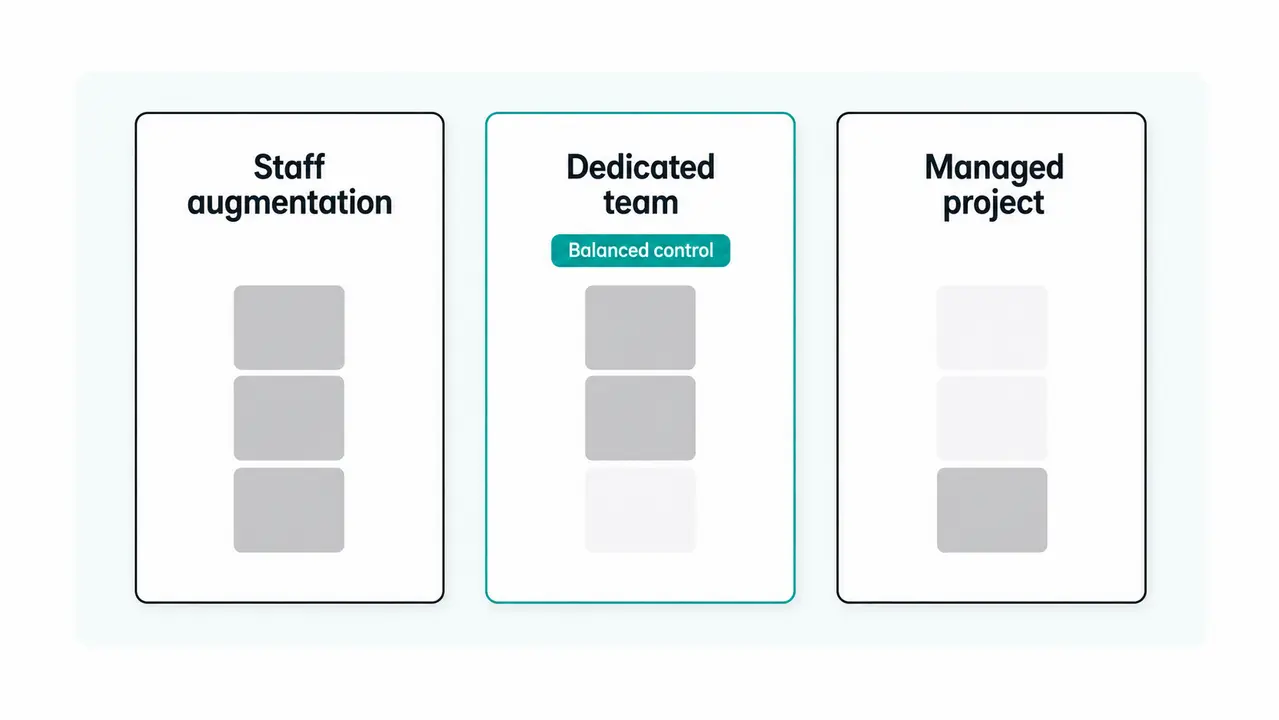
Most enterprise IT outsourcing services arrangements collapse into three practical models, and each one assigns control and accountability differently. The question to settle before signing anything is who manages the backlog, who approves architecture decisions, and who runs the QA strategy. Every dispute you will have in month six traces back to one of those three questions left ambiguous in week one.
Staff augmentation in one sentence
You add pre-vetted engineers to an existing in-house team to boost capacity, and your existing managers keep running the show.
Dedicated team in one sentence
A self-contained unit delivers a specific workstream under shared governance, with defined boundaries between its scope and yours.
Managed project in one sentence
You hand over a defined scope from start to finish, with fixed deliverables and vendor-led execution against an agreed specification.
None of these is inherently superior. Staff augmentation gives you maximum control and demands maximum management bandwidth. A dedicated team trades some control for self-sufficiency. A managed project trades the most control for the least internal effort, and carries the most risk when requirements move.
How the three engagement models compare
Choose your delivery model based on scope volatility and internal management bandwidth, not on how confident a vendor sounds in the sales cycle. IT outsourcing decisions made on confidence alone tend to select the model the vendor prefers to sell rather than the one your roadmap needs. For enterprise application development, the honest question is how often your priorities shift per quarter.
The comparison below maps the three models across the dimensions that actually cause friction.
| Dimension | Staff augmentation | Dedicated team | Managed project |
|---|---|---|---|
| Backlog ownership | Your internal lead | Shared, with vendor input | Vendor, per contract scope |
| Architecture approval | Entirely yours | Guardrails set by you | Vendor proposes, you accept |
| Change handling | Reprioritize next sprint | Reprioritize next sprint | Change request queue |
| Onboarding load | Low, per engineer | Moderate, once per team | High, per phase |
| Release responsibility | Your team | Joint, defined in writing | Vendor, until handover |
| Documentation burden | Follows your standards | Negotiated at start | Contract deliverable |
The verdict on managed projects for evolving product work is negative, and for a structural reason. Change control friction compounds over time, and context decays between phases because the vendor team rotates. Contrast the two dynamics in the change handling row. A dedicated team that functions as a self-contained unit, like the approach described under Dedicated software engineering teams, reprioritizes in the next sprint planning session. A managed project routes the same request through a change request queue, and by the third request you are negotiating instead of building.
Why in house hiring stalls at scaleups under delivery pressure
Hiring is a throughput system with a lead time, and that lead time rarely matches the timing of roadmap commitments. The scenario repeats across every scaleup we have worked with: two quarters of roadmap are planned and communicated, one key engineer resigns, and the hiring pipeline needs four months to produce a backfill who then needs three more months to reach full productivity. Seven months of schedule risk from a single departure.
Onboarding and ramp time are the hidden schedule risk. A senior engineer who interviews well in March is not delivering at senior capacity until June, and your Q2 commitments were made in January. An engineering team extension closes that gap because the external engineers arrive with the ramp already behind them, having worked similar systems before.
The counter-case is real. In-house hiring works when you have a stable domain, a long runway, and a recruiting engine that consistently produces good candidates. Distributed engineering teams and external capacity are the answer when two of those three conditions fail. For a fuller treatment of both paths, see scaling smart a strategic guide in house expansion outsourcing partnerships.
When corporate outsourcing becomes the safer choice for delivery
Corporate outsourcing is safer when you can define interfaces, acceptance criteria, and operational ownership more clearly than you can define a hiring plan. That inversion happens more often than engineering leaders expect, because specifying a bounded workstream is easier than predicting a recruiting market.
The work that fits this profile includes parallel feature squads that relieve a bottlenecked core team, migration workstreams with a fixed target architecture, test automation expansion across a growing regression suite, and embedded firmware modules with stable hardware requirements. Each has a boundary you can draw on a whiteboard.
One rule makes or breaks it. The definition of done must include observability and runbooks, not just passing tests. Corporate outsourcing for software development that ships features without dashboards, alerts, and operational documentation produces a specific failure: features your internal team cannot support, cannot debug, and eventually fears touching. Acceptance criteria written at the story level, including metrics exposure and alert coverage, prevent that outcome before the first line of code is written.
Large scale development needs governance before it needs more engineers
At large scale, the constraint is coordination and decision latency, not headcount. Adding engineers to a system with slow decisions makes the queue longer, not shorter. Governance is what converts capacity into throughput, and it has to be designed before the capacity arrives.
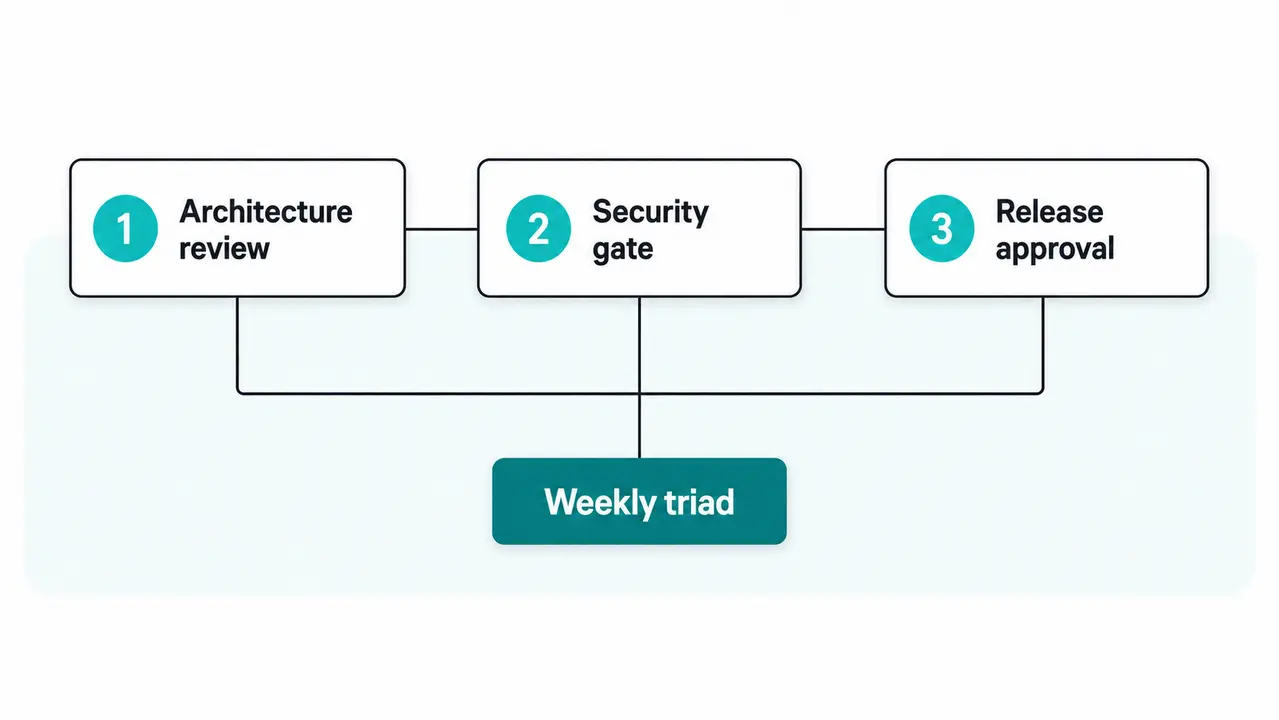
Governance here means lightweight, recurring decisions, not a committee. An architecture review cadence, a security review gate before any externally written code touches production data, and a release approval step that one named person owns. Three mechanisms, each running on a schedule.
The anchor that holds it together is a weekly triad meeting with a fixed agenda: product, engineering, and the external team lead, thirty minutes, decisions recorded. Platform modernization and complex migration workstreams are exactly where this pays off, and where an End-to-end software solutions approach with built-in outsourcing governance outperforms a loose collection of teams. The failure mode without it is predictable: parallel teams building incompatible solutions to the same problem, followed by the rework quarter nobody budgeted for.
The onboarding plan that prevents month one from being wasted
A strong onboarding plan transfers context through documents and working sessions, not through scattered chat messages. We have watched external teams lose three weeks waiting for environment access that nobody had been assigned to grant. The onboarding plan exists to make that impossible.
Require five artifacts before day one: a system map showing services and their dependencies, a repository tour recorded once and reused, a local dev setup guide that actually runs on a clean machine, a CI pipeline walkthrough, and an environment access checklist with named approvers. The checklist is the one that saves the most time.
Break the first 10 working days into milestones tied to deliverables. Days one and two are setup and access. Days three to five, the first small pull request merged into a non-critical service. Days six to eight, a second change touching an integration point. Days nine and ten, participation in a release. Knowledge transfer through CI CD integration happens naturally when the first task forces the external engineer through the same pipeline your team uses. The failure this prevents is an external team blocked on tribal knowledge for a month while the invoice clock runs.
Where teams underestimate documentation and pay for it later
Documentation is not a deliverable that arrives at the end of a project. It is the mechanism that keeps ownership transferable while the project is running. Outsourced software engineering that treats documentation as a closing phase produces exactly one outcome: a knowledge cliff at handover that nobody can climb.
The minimum set to enforce is five artifacts. Architecture decision records, so future engineers know why the system looks the way it does. API contracts, so consumers are not reverse-engineering endpoints from code. Runbooks, so on-call engineers can act at 3 a.m. without calling the author. A test strategy, so quality is a design rather than an accident. Release checklists, so shipping is a procedure rather than a memory exercise.
The enforcement mechanism is one sentence in your documentation standards: the definition of done includes updating one of these artifacts when the change touches it. The counter-case is genuine. Throwaway prototypes with no maintenance expectation do not need heavy documentation, and pretending otherwise wastes effort. Anything expected to live longer than a quarter does.
Enterprise IT services require clear ownership of security work
Security succeeds when responsibilities are explicit across code, infrastructure, dependencies, and access, regardless of who writes the code. The most common failure in enterprise IT services is not a vulnerability, it is ambiguity, the assumption that security is entirely the vendor’s job because the vendor writes the code.
Define the split in writing. Secure coding practices and dependency scanning belong to whoever commits code, which in practice means the external team follows the same standards your internal team follows, aligned with frameworks such as the NIST Secure Software Development Framework. Secrets handling, access control, and infrastructure hardening stay with your platform owners. Incident response participation is shared, with external engineers on the escalation path for the components they built.
Make it operational rather than aspirational. Include security acceptance criteria per story and per release, the same way you include functional criteria. DevSecOps alignment means the external team’s pipeline runs the same dependency and static analysis checks yours does, with results visible to both sides. Service level expectations for security fixes, measured in hours for critical findings, close the loop.
IP, code ownership, and repo access rules that avoid lock in
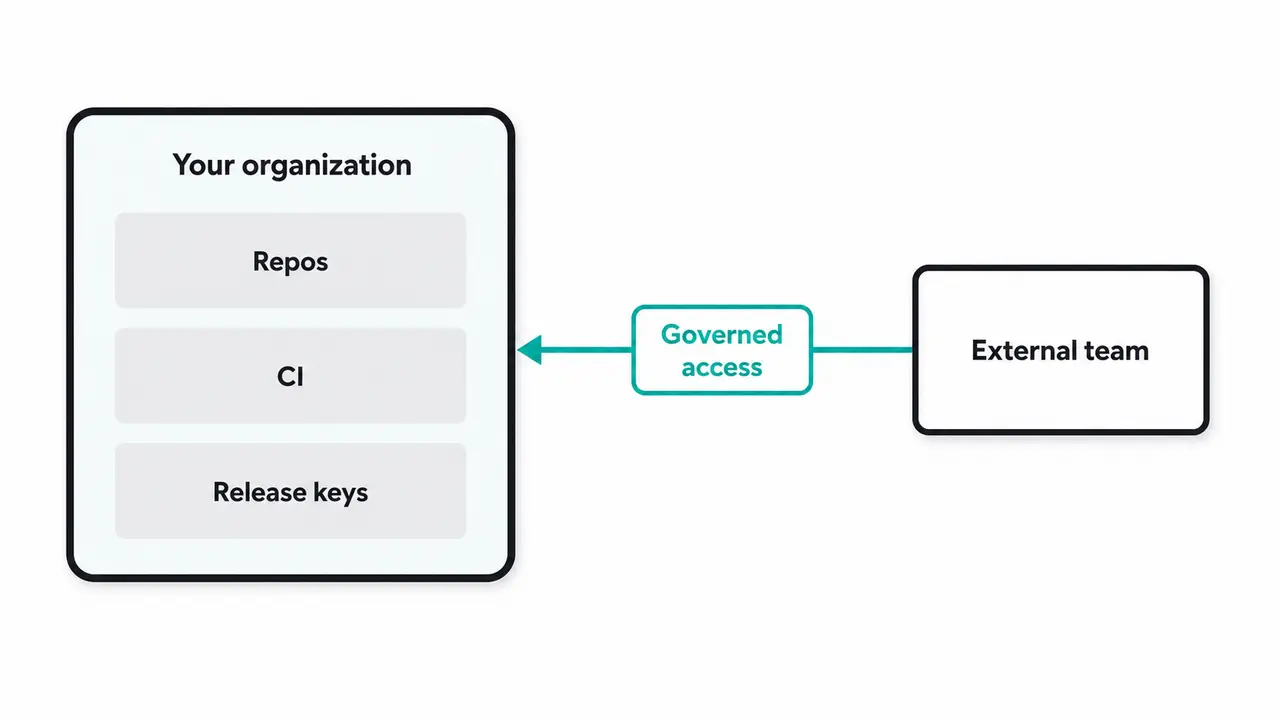
Prevent lock in by making ownership operational rather than contractual. Your organization controls the repositories, the CI system, the environments, and the release keys. The external team contributes through governed access. The contract says who owns the IP, but the access model determines who can actually ship, and those are not the same question.
Three rules cover most of the risk. Enforce a branching strategy so the external team’s work integrates the way yours does. Require code review with named internal reviewers on anything touching core services. Maintain an offboarding checklist that revokes tokens, keys, and environment access within a day of a rotation.
Enterprise application outsourcing goes wrong at the end, not the beginning, when the repository lives on the vendor’s infrastructure or the release pipeline depends on the vendor’s accounts. When the relationship changes, you discover you cannot ship your own product. Code ownership that exists only as a clause in a master services agreement is not ownership. IP protection follows the same logic, what you can access, audit, and build without permission, you own.
The delivery cadence that keeps quality visible
Quality stays visible when you review working software on a fixed cadence and tie every review to measurable acceptance criteria. The cadence is the mechanism, not the review itself. A sprint demo every two weeks, run against a production-like environment, with release notes and test evidence attached, gives you a heartbeat you can monitor.
The evidence matters more than the demo. Track automated test coverage trends, build stability in your CI system, escaped defects found in production, and lead time to change. Nearshore development and offshore development arrangements both live or die on this transparency, because distance hides what a shared office would expose. Your QA strategy should specify what evidence accompanies each release, and validation depth can follow recognized standards such as IEEE 1012-2024 for verification and validation rigor.
The counter-case explains the stakes. Long milestones with late integration feel efficient because nobody is interrupted. They hide critical defects until integration week, when those defects are most expensive to fix, and they deny you the early signal that the direction is wrong. Short cadences cost a little ceremony and buy you the ability to correct course while correction is still cheap.
What to measure weekly so outsourcing does not drift
Track a small set of operational metrics that reveal drift early, and resist the urge to track more. Throughput, predictability, quality signals, and decision latency cover the ground. Everything else is noise that makes the scorecard easier to ignore.
Concretely, watch six numbers. Cycle time from commit to production. Pull request review time, because slow reviews on either side strangle the pipeline. Build failure rate. Defect reopen rate, which tells you whether fixes are real or cosmetic. Incident participation by the external team. Backlog churn, which tells you whether priorities are stable or the roadmap is being rewritten silently.
The anchor is a one-page weekly scorecard owned by your internal engineering lead. Not the vendor’s report, your lead’s scorecard, built from the same data both teams see. A good vendor evaluation checklist includes this from the start, and a good outsourcing partner welcomes it. The definition of done, cycle time, and reopen rate on one page, reviewed in fifteen minutes every Monday, prevents the classic failure: discovering in week twelve that the quarter was lost in week four, after the budget was already spent.
Communication patterns that work across time zones
Use asynchronous defaults with scheduled overlap reserved for decisions, and document decisions where engineers actually work. A decision made in a meeting that half the team could not attend is a decision that will be relitigated in a month, usually at the worst possible moment.
Four artifacts make it work. Overlap window rules, two to three hours minimum for nearshore arrangements, less for offshore with compensating documentation. An escalation path with named people and response expectations. A decision log that anyone can read without asking. A matrix for who decides what, so architecture questions do not wait on product owners and vice versa.
Put each decision type in its natural home. Architecture decisions live in ADRs in the repository. Product decisions live in tickets. Operational decisions live in runbooks next to the systems they govern. Finding distributed engineering teams across regions has become a structural reality rather than a strategy choice, with the number of ICT specialists in the EU continuing to grow according to Eurostat. Knowledge transfer across those regions succeeds on written decisions, not on meeting attendance.
Vendor evaluation signals that matter more than a portfolio
A portfolio tells you what a vendor built. It tells you almost nothing about how they will behave inside your SDLC when requirements shift and a production incident lands mid-sprint. The strongest signal is delivery discipline: how they run discovery, what engineering standards they hold themselves to, and what happens when you hand them ambiguity.
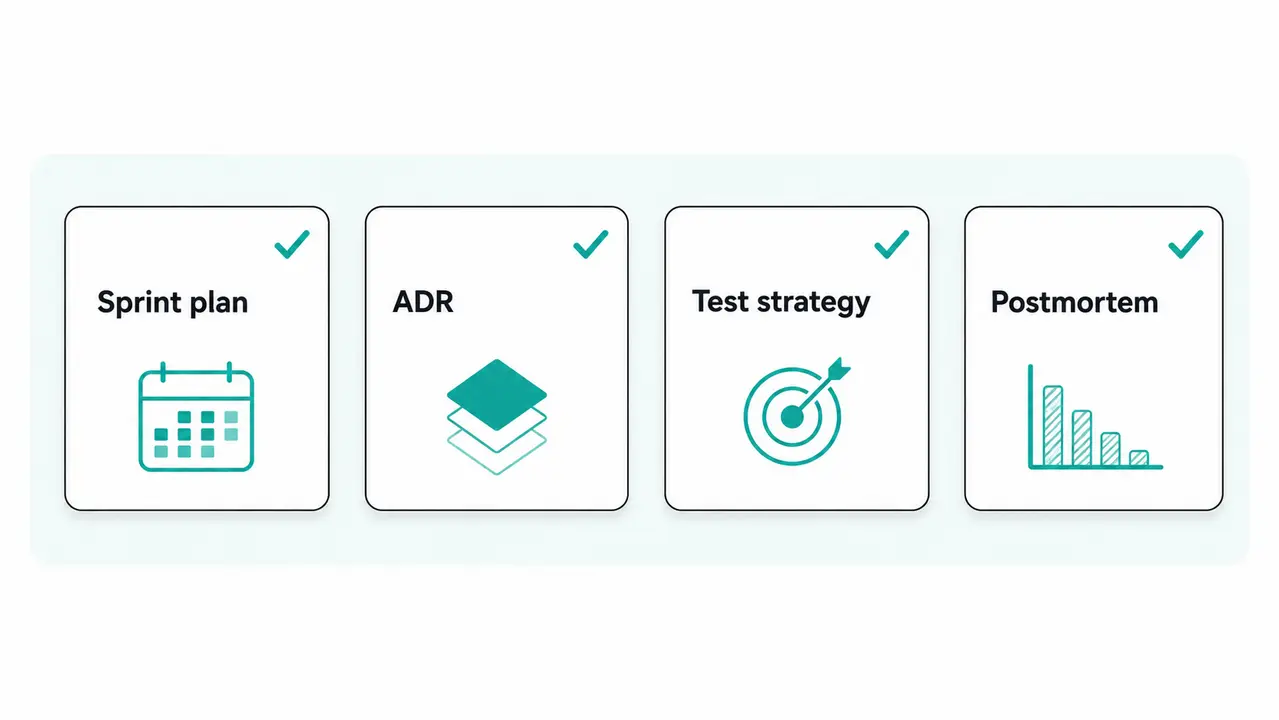
Ask for sanitized sample artifacts rather than case studies. A sprint plan, an architecture decision record, a test strategy, and an incident postmortem template. A team that produces these documents for itself will produce them for you. A team that cannot show them will improvise, at your expense.
Watch for three warning signs. A vague QA story, meaning no named approach to test strategy and no evidence discipline. No clear technical leadership, meaning nobody on the vendor side can push back on a bad architectural decision. Unclear ownership of releases, meaning the handover problem from earlier in this article. Partners optimized for project completion are weaker for long-lived enterprise application development, because maintenance and evolution dominate the lifecycle of an enterprise system. Sentice was built around the opposite bet, long-lived relationships where the same engineers stay on your systems year over year.
A pilot that proves integration not just output
A good pilot validates working relationships and integration into your SDLC, not just a small feature shipped in isolation. A feature delivered in a vacuum proves nothing about the operating model, which is the thing you are actually testing. Corporate outsourcing for software development decisions deserve better evidence than a demo.
Scope the pilot to include one real integration, one full deployment through your pipeline, one monitoring dashboard wired to your alerting, and one runbook written and reviewed by your on-call engineer. If any of those four is missing, the pilot proves output and tells you nothing about whether the delivery model survives contact with your operations.
Run it for 4 to 6 weeks with explicit exit criteria written before the pilot starts. Criteria like cycle time under an agreed threshold, zero blocked days from missing access, and a runbook your internal engineer can execute unaided. The failure this prevents is expensive and common: scaling a relationship that never integrated properly into your technical operations, then discovering at three times the team size that the seams were broken from week one.
A next step that de risks the decision without slowing delivery
Run a short discovery and operating-model design workshop before committing to any delivery model, then launch a pilot with strict exit criteria behind it. The outputs you want are concrete: an ownership map, a chosen engagement model, an onboarding plan with the first ten days scheduled, a weekly scorecard, and a pilot scope with one integration and one deployment in it. Two weeks of design work against a multi-year commitment is the cheapest insurance available, and your current delivery keeps running while you do it.
Let’s scope your team
Tell us about your roadmap and the boundaries you need to protect, and we will help you design the engagement model, onboarding plan, and pilot scope before anyone writes code.
Frequently asked questions
Is enterprise software outsourcing the same as managed services?
No. Enterprise software outsourcing covers the build side, designing and delivering software with an external team. Managed services cover the run side, operating and maintaining systems under an ongoing service agreement. Application management sits between the two and can be added once the build work stabilizes, but the ownership questions and contracts differ.
Can we mix staff augmentation and a dedicated team?
Yes, and it works well when boundaries are explicit. Keep the augmented engineers on your core services under your tech lead, and give the dedicated team a bounded workstream with its own backlog. One internal owner must arbitrate architecture decisions across both, otherwise you get two patterns solving the same problem.
What should we insist on before the first sprint starts?
Five things, in writing. Environment access for every engineer. A definition of done that includes tests and documentation. Security responsibilities split by domain. A release process the external team participates in. And a named internal counterpart for every external lead. Access is the one teams forget, and it costs the most.
How do we handle turnover on the outsourced side?
Require documentation habits in the definition of done, pair new engineers with existing ones for their first weeks, and set rotation limits in the agreement so critical knowledge never lives in one head. An offboarding checklist that captures knowledge transfer before departure closes the gap. Turnover is normal, silent turnover is not.
When should we stop outsourcing and bring it in house?
When the work becomes core differentiation and your internal leadership has the bandwidth to own it end to end. If you cannot name an internal product owner and tech lead for the work, you are not ready to internalize it regardless of strategy. Until both conditions hold, the external team is protecting you from a gap, not filling one.
About Sentice

Sentice is a boutique software engineering partner founded in 2013 by Roni Levi and Martin Petkovic, now headquartered in Skopje, North Macedonia. Rather than supplying individual developers, we build embedded teams that blend with a client’s culture, tech stack and goals, working together from a single office under our own technical leadership. We deliver dedicated software engineering teams, end-to-end software solutions, product development, and system and embedded engineering, and we act as technical advisors across the full development lifecycle, from specification and architecture through development, testing and support. We use AI coding tools across every project, and we help clients integrate AI into their own products through chatbots, MCP services, connected application layers and workflow automation. Some of the clients we started with more than a decade ago are still building with us today.