
The sprint started eleven days ago and the burndown chart has been flat for six of them. Three tickets are “in review”, one is blocked on an API nobody owns, and the estimate you gave the board three weeks ago now looks like fiction. You are not short of engineers. You are short of predictability, and that is a different problem with a different fix.
Most software development challenges do not announce themselves as crises. They show up as small, repeated losses of control over outcomes. Teams that treat these development problems as individual performance issues stay stuck, because the system that generated the delay keeps generating it. Below, we’ll walk through where predictability actually breaks, from ambiguous requirements and scope creep to review queues, AI-assisted coding and key-person risk, and close with a triage order for fixing the constraint that matters first.
Reading time: 12 min
Key points
- Delivery problems usually live in queues, handoffs and ambiguous requirements, not in typing speed.
- Four weekly metrics, lead time, change failure rate, time to first review and escaped defects, expose slips before the burndown chart does.
- AI coding tools move the bottleneck from writing code to verifying it, so review discipline becomes the single point of failure.
- Fix constraints in order: flow blockers first, quality leaks second, integration third, architecture last.
Table of contents
The day delivery stops feeling predictable
Predictability dies quietly. Work starts, standups happen, tickets move, and yet outcomes stop matching plans. When that gap appears, your instinct is to look at who is slow. The correct instinct is to look at where work waits. Software development challenges almost always live in queues, handoffs, and ambiguous requirements rather than in typing speed, and the development problems that hurt most are the ones you cannot see in a task board.
Build a one-page delivery health snapshot and review it weekly. Track lead time from commit to production, change failure rate, median time to first review, and escaped defects per release. Four numbers on one page will tell you more than any retro. We have run this exercise with teams that believed they had a talent problem and found a review queue averaging nine days.
Treat unpredictability as a system problem. Blame the engineers and your process keeps producing the same delays with different names attached.
Requirements that sound clear until the first demo
“Users should be able to manage their notifications.” Everyone nods in the planning meeting. Then implementation starts and the questions surface. Which channels? Who can disable what? Does an admin override user preferences? The spec was never clear, it was only quiet. These software project obstacles cost more than any technology decision, because rework after a demo is twice as expensive as clarity before a sprint.
Run a 45-minute spec review before implementation, with product, engineering, QA, and a domain owner in the room. Output three artifacts: user stories with testable acceptance criteria, a written list of edge cases, and an explicit out-of-scope list. The out-of-scope list matters most. It is the only document that survives contact with a stakeholder who “assumed” something was included.
Without this, you build the wrong feature, patch it in a rush, and absorb silent scope expansion as the cost of goodwill.
Resolving stakeholder disagreements in spec reviews
Product wants the full feature for the launch event. Engineering says the data model only supports half of it in the time available. Do not average the two positions. Document the trade-off explicitly: what option A delivers and by when, what option B delivers and by when, and what each one forecloses. Put the decision, the decider, and the date in the ticket. Disagreement is cheap when it is written down. Unwritten disagreement resurfaces in the demo as a defect.
Handling unknowns without blocking the sprint
Some unknowns are real. The third-party payment provider might rate-limit your webhook volume, and nobody knows until you try. Create a spike ticket, time-box it to two or three days, and define its output as knowledge, not code. A spike that answers “yes, rate limits apply at 100 requests per second” lets the sprint continue with a design that respects the constraint. A spike without a time box becomes a research project. Cap them, and force the finding back into an estimable story.
Where scope creep enters through side doors
Nobody approves a 40 percent scope increase. They approve a small icon change, a quick export button, one extra filter, a “tiny” change to the permissions model. Each request is defensible. The sum is a project that ships three months late, and these common issues never appear in any change control document because each one was too small to document.
Force a trade-off rule: new scope must displace old scope, explicitly. Maintain a change log tied to tickets that records who requested the change and which specific work moved out to make room. When the product owner sees that adding the export button pushes the payment retry logic out of the release, the conversation changes from “can we also” to “is this worth that”. That is the conversation you want.
Silent timeline expansion does double damage. It burns engineering capacity, and it degrades code quality, because the shortcuts taken to absorb the extra scope become the debt you service next quarter.
Two roadmaps competing inside one backlog
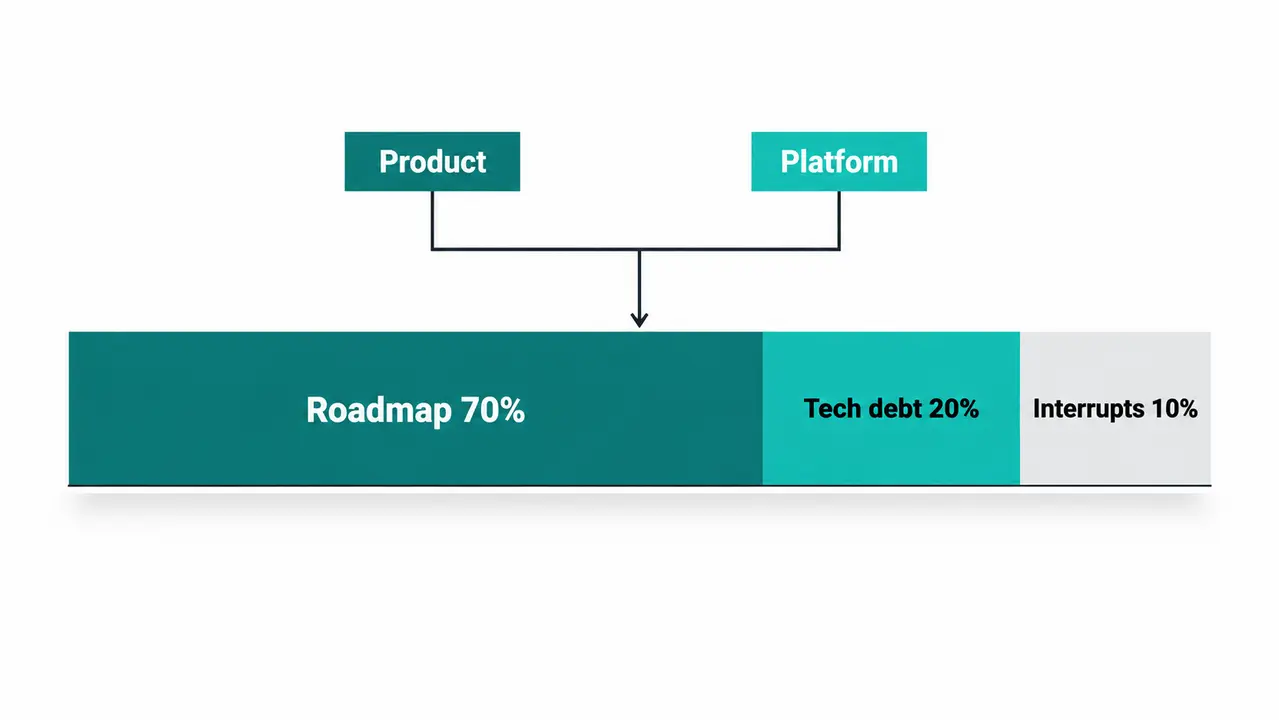
Your backlog is lying to you. It looks like one prioritized list. It is actually two roadmaps fighting: the product features the business wants and the platform stabilization the engineers need. With no defined policy, interrupts win every time, because an outage in production is always more urgent than an index that would have prevented it.
Set a capacity split and treat it as engineering policy, not a rule carved in stone. A workable starting point is 70 percent roadmap, 20 percent tech debt, 10 percent interrupts, adjusted by reality each quarter. Run a weekly triage with explicit criteria for what qualifies as an interrupt: severity, customer impact, security exposure. Everything else waits for its slot.
The failure mode is predictable. Platform work gets postponed for a year, an outage forces an emergency rewrite, and the rewrite costs four times what the incremental work would have. We have inherited codebases in exactly this state, and the recovery always starts the same way: a written capacity policy the CTO will defend.
Technical debt that turns every estimate into fiction
Estimates are not wrong because engineers are bad at estimating. They are wrong because the relationship between effort and outcome has broken. A feature that should take three days takes three weeks, because touching the user module means updating four dependent services and hand-testing the flows no automated suite covers. That is not an estimation problem. That is debt with interest.
Prioritize debt by whether it blocks change, not by whether it offends taste. Keep a debt register that records impact: change amplification, where touching one file requires touching ten. A messy but isolated module can wait. A tangled dependency graph on your core entity cannot.
Left alone, the end state is padded estimates that nobody believes, missed commitments, and a complete loss of trust between engineering and leadership. Rebuilding that trust takes quarters. The refactor takes weeks.
Distinguishing debt from defects and missing architecture
Teams use “technical debt” as a catch-all for three different things, and each one gets a different response. Poor implementation choices are debt in the strict sense: the design is right, the code is hard to change, and a refactor fixes it. Broken functionality is a defect, and defects belong in the normal queue with severity and customer impact, not in a debt register nobody schedules. Missing architecture is neither. When the design itself cannot support the product’s shape, no amount of refactoring helps, and you are facing an architectural decision, not a cleanup task. Mislabel these and you will refactor code that should have been redesigned, or redesign systems that only needed a bug fix.
Integration work that never fits the sprint
Every sprint plan has the same fiction at the bottom: “integrate with the vendor API” scheduled for the final three days. Integration is treated as a phase. It is actually an activity that should start on day one, and treating it as a finale is why these project obstacles turn release week into a hostage negotiation.
De-risk it early. Stand up stubs of external dependencies in week one, write consumer-driven contract tests that verify both sides still speak the same language, and enforce a versioned API policy so a partner’s deploy cannot silently break your checkout flow. A staging environment that mirrors production topology, not just a shared test server, catches the breaks that only appear under real network conditions.
The alternative is the “it works on my branch” release, the last-week crunch, and a delayed release train. Integration failures also do quiet damage to the people doing the work, and the impact of system integration issues on team morale shows up as attrition long before it shows up in a retro.
The hidden queue in code review and QA
Pull your cycle time data and split it. You will usually find that coding is a minority of the elapsed time. The majority sits in queues: PRs waiting for a reviewer, and tickets waiting for QA. Adding engineers does not shorten a queue. Shortening the queue shortens the queue.
Track two numbers weekly: median time from PR opened to first review, and median time from ready for QA to tested. Enforce work-in-progress limits on open PRs and a review service level agreement on critical paths, something like four working hours. Small pull requests are an engineering discipline, not a stylistic preference. A 200-line PR gets reviewed the same afternoon. A 2,000-line PR sits for days while reviewers find a free hour, and by the time it merges, the branch is stale.
QA as a late gate is the same failure at a larger scale. When testing starts after development “finishes”, design problems surface too late to fix cheaply. Shift the questions earlier and the queue shrinks on its own.
When quality drops because speed becomes the only KPI
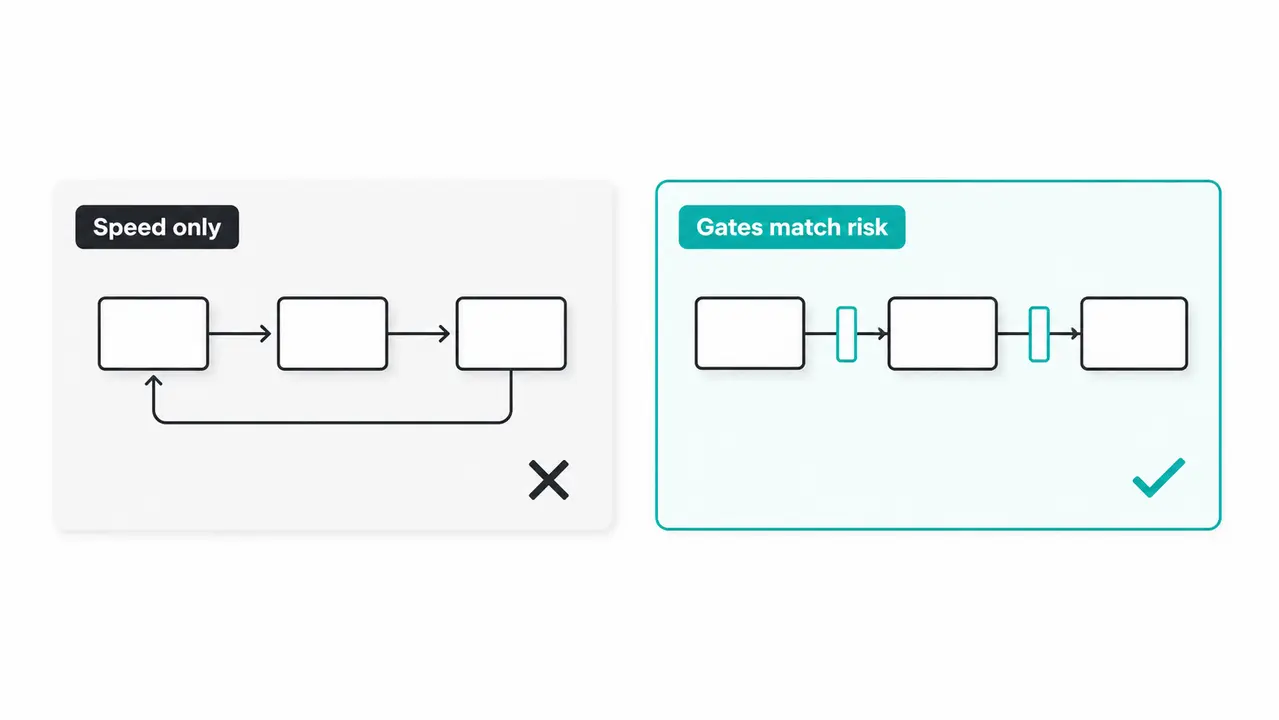
A new leadership mandate arrives: ship faster. The team ships faster for two sprints. Tests get skipped, review gets lighter, the release checklist gets “temporarily” suspended. By sprint six, velocity is lower than before the mandate, because half the team is firefighting regressions and the other half is afraid to touch anything.
Speed without quality controls is a regression loop. Match quality gates to risk levels instead of applying one standard everywhere. Core payment logic gets automated unit tests, static analysis, and dependency scanning. A marketing page gets a lighter touch. High-risk changes get a release checklist with a named approver. The point is not bureaucracy. The point is that the gates scale with the blast radius.
Teams that skip this trade two sprints of apparent speed for six sprints of hotfixes. Run the arithmetic on that exchange once and the argument for gates ends itself.
AI-assisted coding that shifts the bottleneck to verification
Your engineers are drafting code dramatically faster with AI tools. We use Claude Code, Codex, Cursor and Gemini internally, so we see this firsthand. What the tools do not accelerate is verification. The bottleneck moves from writing code to validating behavior, security, and fit with the existing architecture. If your review process was weak before, it is now your single point of failure.
Update your definition of done for generated code. Tests are mandatory, not optional. Exposed endpoints get a threat consideration before merge. Generated code gets a specific reviewer checklist, because reviewers default to trusting plausible-looking code, and plausible-looking code that passes happy-path tests while failing on edge cases is the exact artifact these tools produce at scale.
Industry reporting on techradar.com has flagged the growing risk of unverified AI-generated code reaching production while governance lags behind adoption speed. The teams that win with AI are the ones that invested in specs and tests before the tools arrived, not after.
Security and privacy work that arrives too late
The penetration test is scheduled two weeks before launch. It finds that the architecture exposes admin functions to every authenticated user, that secrets live in the repository, and that there is no audit trail on financial operations. None of these are fixable in two weeks without a redesign, and the launch slips anyway.
Security becomes a severe development challenge precisely when it arrives after the architecture is locked. Shift it left. Run a 60-minute threat modeling session for every new surface area, before the first commit. Establish secure defaults once and inherit them everywhere: least privilege on service accounts, centralized secrets management, audit logging on sensitive actions.
The cost argument is settled. An hour of threat modeling against a late, architecture-level security finding is not a close trade, and the teams that run the session before the first commit are the ones that keep their launch date.
The week a senior leaves mid-migration
The engineer who designed your event pipeline gives notice. The migration from the monolith is 60 percent complete. Nothing is documented, because she was the documentation, and every architectural decision of the last two years lives in her head and her Slack DMs. This is key-person risk, and it is a delivery risk of the first order.
The mitigation is to make knowledge explicit and reviewable while the person is still there. Require Architecture Decision Records for major choices, so the reasoning survives the person. Maintain runbooks for deployments and incident response that someone else has actually executed. Map ownership for every service, so “who knows how this works” is a query, not an archaeology project.
Documentation here is not bureaucracy. It is insurance against the week your senior engineer walks out mid-migration and leaves behind stalled work, fragile releases, and modules nobody dares touch.
Onboarding that never finishes in fast-growing teams
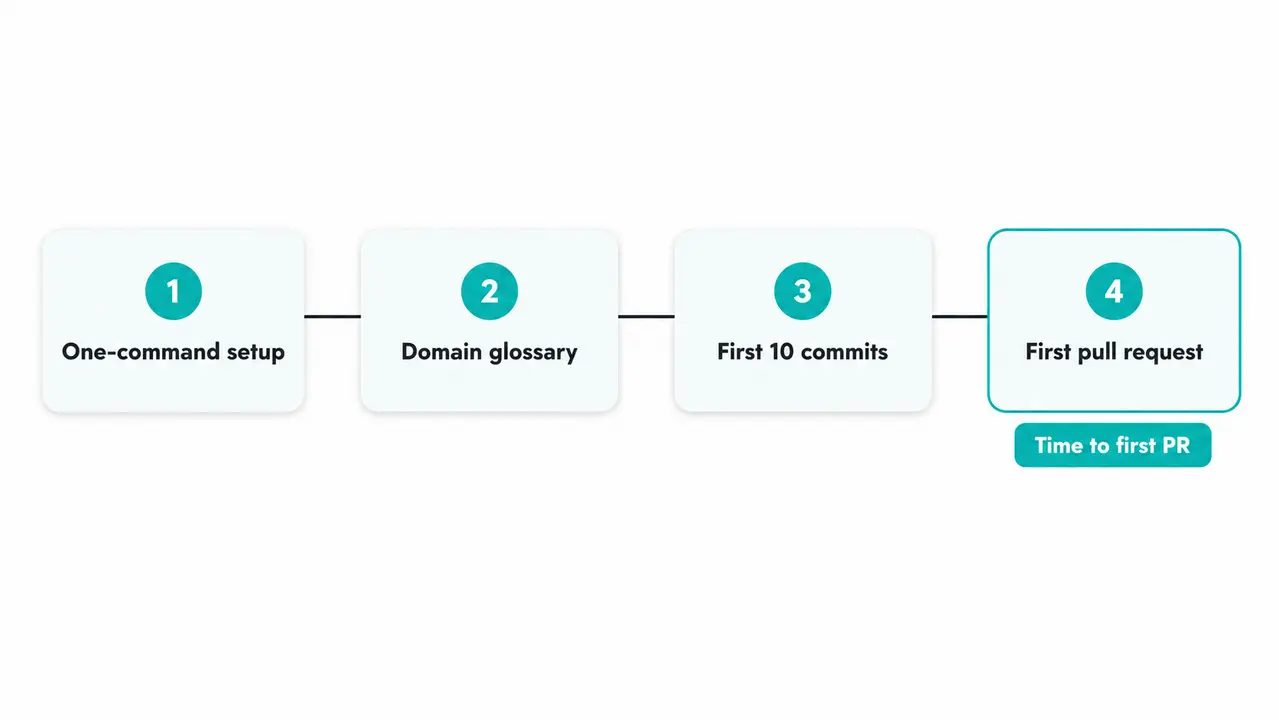
You hired six engineers this quarter. Each one needs environment setup help, domain context, and answers to questions the documentation does not cover. Your seniors are now full-time support staff, and the velocity of the entire organization has dropped, which is the opposite of what hiring was supposed to do. Onboarding is a system that requires deliberate design, and if you are scaling engineering capacity, the question of how to grow your tech team without losing speed or quality starts here.
Standardize the first month. Automate the development environment so setup takes one command, not three days. Provide a glossary of domain terms, because half of onboarding friction is vocabulary. Define a first 10 commits path with small, real tasks. Run a buddy rotation so support is distributed instead of concentrated on one burned-out senior.
Track time to first meaningful pull request as your onboarding metric. If it is not shrinking as you hire, your system is not scaling.
Distributed collaboration that breaks at handoffs
A ticket moves from your Berlin team to your contractor team at 6 p.m. local time. The contractor has a question. The answer arrives fourteen hours later. The next question adds another day. A three-day task takes a week and a half, and nobody did anything wrong. Distributed teams fail at handoffs, not at work.
The fix is written clarity and fewer cross-time-zone dependencies. Require Requests for Comments for design decisions instead of meetings that half the team attends at 11 p.m. Record async demo videos instead of scheduling live walkthroughs. Keep decision logs so the same debate does not restart with each shift. Standardize a handoff template for tickets: current state, open questions, next action, who owns it.
The 2025 Stack Overflow Developer Survey documents how much of developer work now happens across distributed arrangements, with 45 percent of US developers working remotely (source: survey.stackoverflow.co). The teams that thrive are the ones that write as a habit, not as an exception.
Estimation that becomes a negotiation instead of a forecast
There is a moment in every planning cycle when the estimate stops being a forecast. The CEO needs the feature at the conference. The estimate is eight weeks. The conversation becomes a negotiation, the estimate becomes six weeks, and the commitment becomes a promise nobody can keep. The forecast was never the problem. The use of the forecast was.
Use estimation to manage risk, not to promise dates. Slice epics into increments that can ship independently, so a six-week miss is a two-week miss. Track your actual cycle time distribution and forecast from data, not from hope. Run a pre-mortem on the top three risks of each milestone: integration, data migration, performance. Name what could break before it breaks.
Between negotiation and forecasting, forecasting wins every time. Padded estimates and missed commitments erode trust between engineering and leadership, and that erosion is far more expensive than an honest range delivered early.
When the architecture no longer matches the product
The architecture was right for the product you had. The product changed. Now every feature requires changes across four services, releases are coupled because the services share a database, and engineers spend more time coordinating than building. If this sounds familiar, the question of is your tech stack driving growth or dragging you down has a measurable answer hiding in your repo.
Identify the mismatch with data, not opinion. Count how many services a typical feature touches. Measure release coupling: how often must two services deploy together? Where those numbers are high, find the smallest architectural move that restores changeability. A well-placed interface or an extracted service often beats a full rewrite.
Run an architecture review that outputs a migration path with milestones and rollback points. Endless workarounds are the alternative, and they make the system slower and more fragile with every sprint that passes.
Criteria for refactoring, re-architecting, or rebuilding
Choose the scope of intervention with a simple matrix built on two signals: coupling and defect rate. Low coupling and low defect rate means leave it alone. High defect rate with low coupling is a refactor: the boundaries are fine, the implementation is rotten. High coupling with a contained blast radius points to re-architecting the specific seam, extracting the service or introducing the interface that decouples the two domains. High coupling across the whole system with rising defect rates everywhere is the only case that justifies a rebuild, and it should scare you, because rebuilds fail more often than they succeed.
| Signal | What it means | Recommended response |
|---|---|---|
| Low coupling, low defect rate | The system changes easily and behaves reliably. | Leave it alone. |
| High defect rate, low coupling | The boundaries are fine, the implementation is rotten. | Refactor the code. |
| High coupling, contained blast radius | One seam of the system is tangled but the damage stays local. | Re-architect that seam: extract the service or introduce a decoupling interface. |
| High coupling everywhere, rising defect rates | The whole system resists change and fails increasingly often. | The only case that justifies a rebuild, and rebuilds fail more often than they succeed. |
Staging migrations without freezing feature work
The mistake teams make is treating migration as a freeze: no features until the new architecture is done. Six months later the new architecture is half built, the business is furious, and the team is exhausted. Use the strangler fig pattern instead. Route traffic through the new component incrementally, feature by feature, behind feature flags that let you cut over and roll back without a big-bang deploy. The old path stays alive until the new one has proven itself in production. Feature work continues the entire time, because the migration is a series of small releases, not one heroic one.
The minimum operating system for reliable delivery
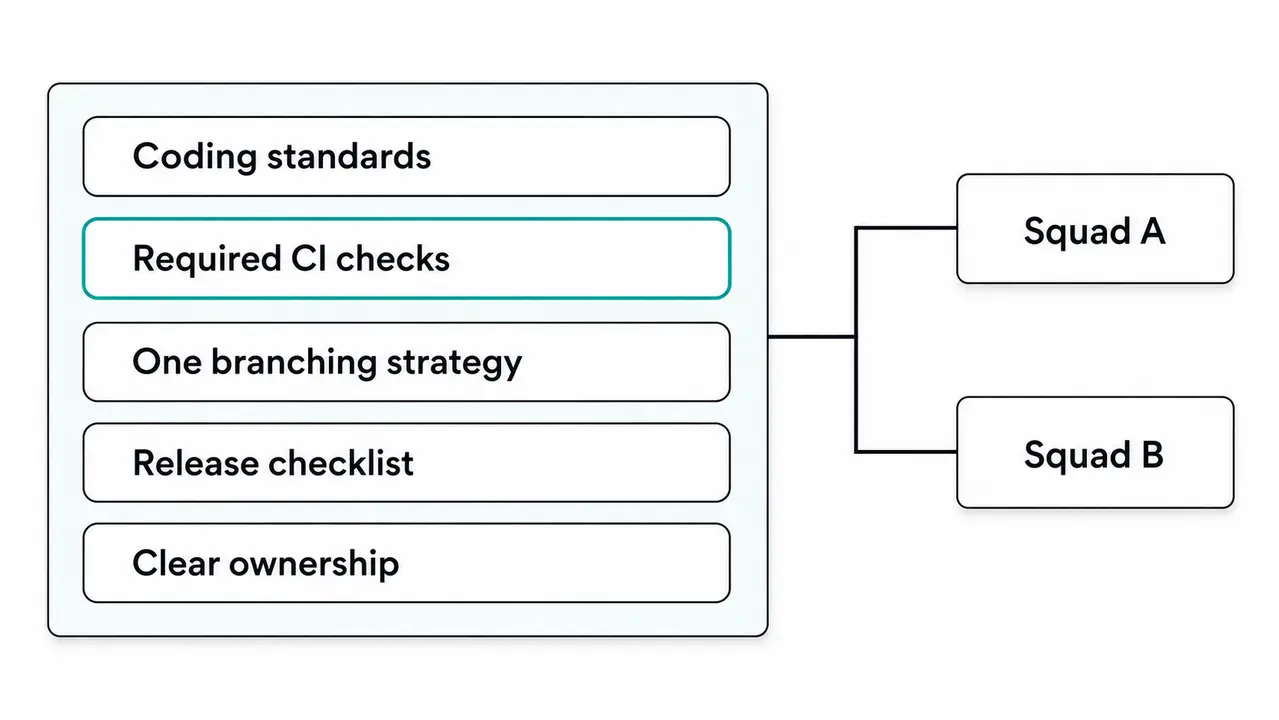
Pick any two squads in your company and compare how they work. Different branching strategies, different review norms, different release processes, different definitions of done. Each choice is locally reasonable. Together they make cross-team collaboration unpredictable and integration points fragile, because every handoff carries a translation cost.
Reliable delivery comes from a small set of enforced practices, not a heavy process. Define a baseline every team follows without exception: coding standards, required CI checks, one branching strategy, a release checklist, an incident review template, and clear ownership rules for every service. That is the whole list. Anything beyond it should be team choice.
The NIST Secure Software Development Framework, SP 800-218, describes exactly this kind of baseline for secure development practices, and it is a sound reference for what belongs in yours (source: csrc.nist.gov). Every squad inventing its own process is how a ten-team company ends up with ten ways to deploy, nine of them risky.
A practical triage map for development problems
When everything feels broken at once, teams reach for random process changes. A new tool, a new ceremony, a reorganization. Two months later, nothing has moved, because the actual constraint was never addressed. Development problems need a triage order, and the order matters.
Start with flow blockers. Is work stuck in queues? Fix review and QA wait times first, because nothing else improves while work cannot move. Move to quality leaks second: are defects driving rework that crowds out new delivery? Integration failures come third, and architecture constraints last, because architectural fixes cannot help while the flow is broken upstream.
Use a decision tree, then commit to a two-week stabilization sprint with explicit exit criteria: lead time down by a stated amount, change failure rate under a stated threshold. Software project obstacles respond to sequence, not to enthusiasm. Without exit criteria, the stabilization sprint becomes the new normal and the constraint survives.
Frequently asked questions
What are the most common software development challenges for startups?
Startups hit requirements ambiguity, scope creep, and key-person risk hardest, because small teams have no redundancy in either people or process. Quality erosion under deadline pressure is the next common issue, followed by integration surprises when the first external dependencies arrive. Architecture mismatch usually arrives in the second or third year, once the product finds its real shape.
Which challenges are process problems versus technical problems?
If the same failure repeats across different engineers, it is a process problem. Review delays, scope creep, and unclear acceptance criteria are process issues with process fixes. If the failure concentrates in one part of the system regardless of who touches it, it is technical: coupling, debt, or missing architecture. Most project obstacles are misdiagnosed as people problems first, which is why they persist.
What should a CTO measure weekly to catch delivery issues early?
Track four numbers: median lead time from commit to production, change failure rate, median time to first PR review, and escaped defects per release. Review them on one page every week. A rising review queue predicts a delivery slip two sprints before the burndown chart shows it, which is the entire value of the exercise.
How do you keep documentation useful without slowing engineers down?
Write documents that answer a question someone will actually ask, and put them where the work happens. Architecture Decision Records, runbooks, and a domain glossary cover 90 percent of real needs. Avoid living documents nobody maintains. A short, dated record beats a comprehensive wiki that is six months stale.
When does adding more developers make delivery slower?
When the constraint is a queue rather than capacity. New engineers add review load and onboarding interrupts while the actual bottleneck, usually review time or an ambiguous spec, stays untouched. If lead time is flat or rising while headcount grows, adding people makes the common issues worse. Fix the queue first, then hire.
The next step after you identify your top two constraints
Pick the two constraints that most distort your predictability and give each one an owner, one metric, and a two-week experiment. Keep the scope narrow enough to learn fast. If the experiment does not move the metric, revert and pull the next lever. Treat this as engineering work, not motivation work.
Need a second pair of senior eyes on your delivery system?
Tell us which constraint is distorting your predictability and our engineers will help you scope the experiment.
About Sentice

Sentice is a boutique software engineering partner founded in 2013 by Roni Levi and Martin Petkovic, now headquartered in Skopje, North Macedonia. Rather than supplying individual developers, we build embedded teams that blend with a client’s culture, tech stack and goals, working together from a single office under our own technical leadership. We deliver dedicated software engineering teams, end-to-end software solutions, product development, and system and embedded engineering, and we act as technical advisors across the full development lifecycle, from specification and architecture through development, testing and support. We use AI coding tools across every project, and we help clients integrate AI into their own products through chatbots, MCP services, connected application layers and workflow automation. Some of the clients we started with more than a decade ago are still building with us today.