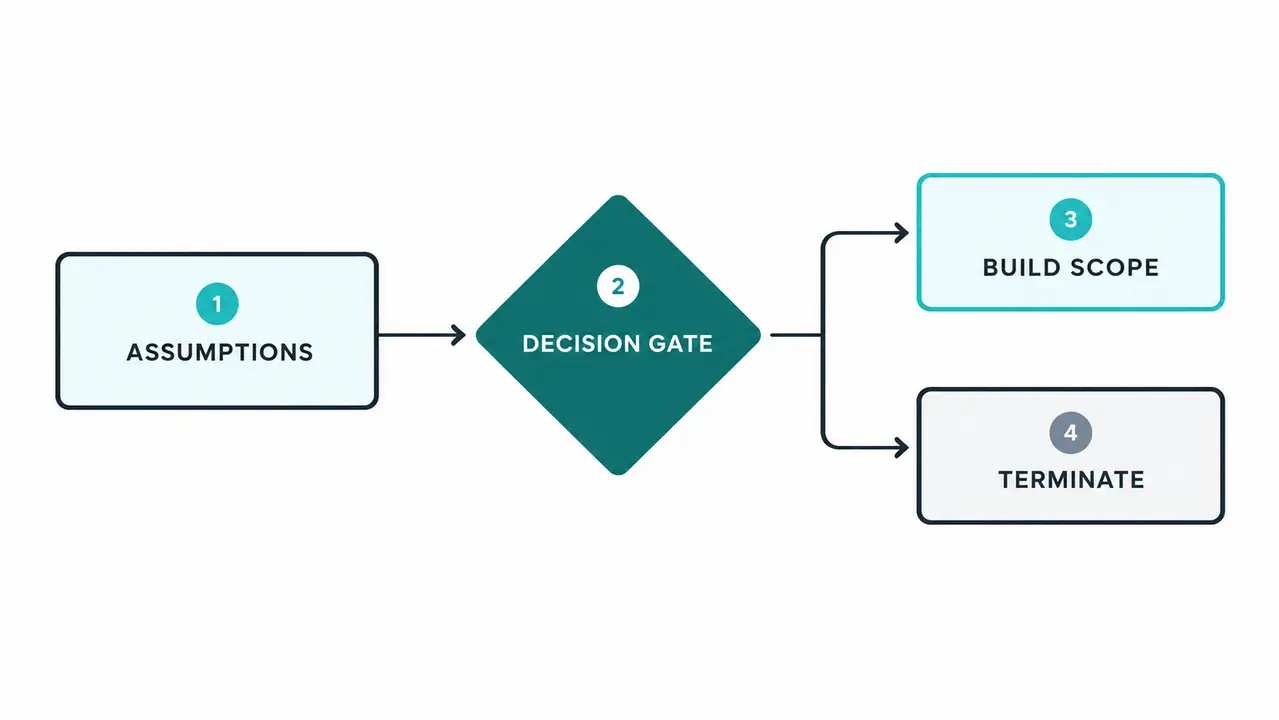
Your engineering team can spend four months building authentication, billing, and dashboards, and still learn nothing about whether anyone wants the core product. MVP market validation exists to force that answer before capacity commits to code: it is a decision gate with a defined output, not a research phase that produces comfort. This guide covers the risk you are actually reducing, why problem validation must precede solution validation, how to choose test methods by signal strength, how to run a fourteen-day validation sprint, and the stop rules that keep a weak concept from becoming a zombie MVP.
Reading time: 12 min
Key points
- MVP validation is a formal decision gate: it ends in a build, pivot, or kill decision, never an open-ended research report.
- Problem validation comes before solution validation; running both at the same time contaminates your data.
- Eight to twelve deep interviews reach saturation for a tightly defined ICP; multi-sided platforms need fifteen to twenty-five.
- Pass thresholds, such as a forty percent core-action completion rate, must be set in writing before external traffic sees the product.
Table of contents
MVP market validation is a decision gate not a research phase
An engineering team spends four months building an authentication service, billing pipes, and custom dashboards, only to discover nobody wants the core calculation engine behind them. That waste happens when discovery is treated as an open-ended exploration phase rather than a formal decision gate. MVP market validation exists to force an explicit choice before engineering capacity commits to code. It is not a research exercise meant to produce comfort. Early product validation either generates hard evidence or kills the initiative.
A structured build-measure-learn loop requires a single-page artifact we call the validation brief. Before any sprint planning begins, this document records the three riskiest assumptions, the specific test executed for each, the exact metrics observed, and the resulting action. The brief forces a selection among five outcomes, including building the scoped product, pivoting the target customer profile, reframing the underlying problem, altering the solution model, or terminating the project immediately. Teams that skip this gate rationalize ambiguous user feedback and build anyway.
The risk you are reducing is not technical risk
Most failed software initiatives do not collapse because the architecture broke. They fail because the engineering organization built a system nobody needed. Your primary exposure sits in market acceptance and day-to-day workflow alignment, not execution capacity. Assumption mapping separates these vectors by plotting every operational belief across desirability, integration feasibility, and commercial viability against uncertainty. You isolate the top assumptions where high uncertainty collides with fatal business consequences, prioritizing them over interface polish.
Customer discovery frequently fails at the boundary where software meets corporate reality. Deployment constraints, restricted API endpoints, data governance rules, and strict internal security posture routinely block adoption after end users praise an interactive Figma prototype. Running a workflow integration test reveals whether enterprise environments will actually allow your payload across their network. Deep tech products represent the lone exception to this sequence. When fundamental algorithmic or hardware execution is unproven, run a timeboxed feasibility spike with strict pass criteria in parallel with commercial testing.
Problem validation comes before solution validation
Teams frequently rush into prototype validation before establishing whether anyone suffers enough to pay for relief. Problem validation proves that an operational bottleneck exists, recurs frequently, and forces teams to maintain painful manual workarounds. Solution validation determines whether your software architecture represents the remedy those teams will select and retain. Running these exercises simultaneously contaminates your data. Conducting disciplined problem interviews before scheduling solution interviews keeps customer development grounded in real jobs to be done.
Effective interviews hunt for quantifiable evidence to support your value proposition. You need to record the exact hours lost per occurrence, the identity of the budget owner, the active manual scripts in use, and the operational switching triggers. Capture this reality on a one-page before and after workflow sketch, then test that diagram with at least five target operators. If the baseline workflow reveals minor friction rather than severe economic loss, stop. Mild annoyance creates polite interview notes, but high switching costs prevent product adoption every time.
A strong hypothesis beats a long feature list
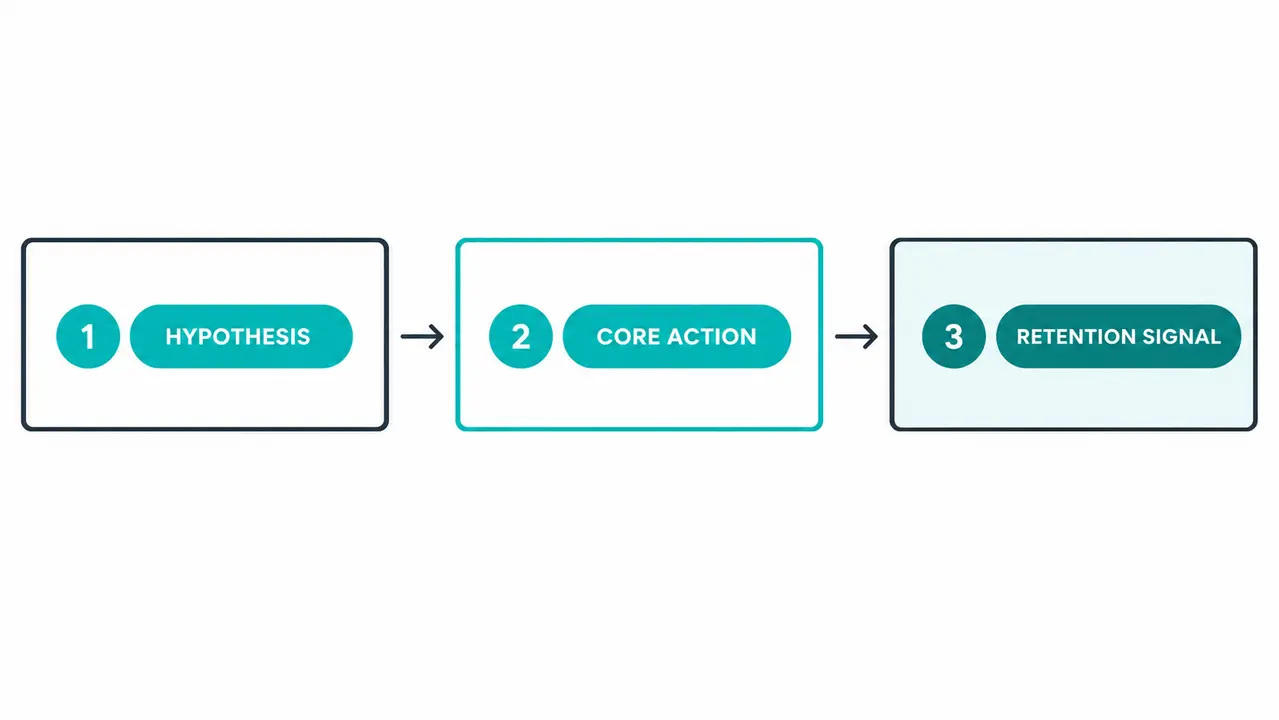
Engineering backlogs expand rapidly when discovery lacks scientific rigor. You do not validate features. You test falsifiable assertions about user jobs to be done and system constraints, treating individual codebase components as simple measurement instruments. Rigorous experiment design starts with a standardized hypothesis template written before design sprints begin: For [role] in [context], [pain] causes [cost]. If we provide [capability], they will [behavior] within [time].
Every concept validation initiative must define two explicit behaviors on its validation checklist. First is the core action, representing the singular event that delivers direct utility, such as parsing an unstructured log file into structured tables. Second is the retention signal, representing the operational pattern that proves ongoing reliance, such as recurring weekly automated ingest runs. If your team cannot identify the single core action before building, you will measure dozens of secondary platform interactions while missing whether the primary value loop actually functions.
Where teams confuse interest with intent
Signups on a static marketing page rarely predict production usage. Teams frequently celebrate vanity metrics such as newsletter additions, raw click counts, and enthusiastic compliments during video calls fueled by vanity metrics. These inputs provide an unreliable qualitative signal rather than commercial commitment. A smoke test or landing page test can capture a preliminary quantitative signal, but using traffic spikes to justify months of custom backend development produces expensive false positives.
You validate demand by extracting meaningful operational commitments from an early adopter. Weak indicators include survey praise, waitlists without subsequent session activity, and positive verbal reactions that end without a calendar commitment. Strong signals demand commercial friction: securing an executive signature on pilot terms, receiving scrubbed production datasets for testing, scheduling an introductory call with the security lead, or securing an agreement to alter daily operating procedures on a specified date. Treat curiosity as an early marketing lead. Treat skin in the game as validation.
Choosing validation methods by signal strength
Selecting among MVP validation methods requires matching the test fidelity to your buyer’s operational environment. Problem interviews, smoke tests, landing page tests, concierge workflows, wizard-of-oz simulations, prototype testing, and paid pilot programs deliver ascending tiers of behavioral truth. The correct instrument is always the least expensive technique capable of falsifying your core hypothesis.
When a landing page is enough
A landing page test works strictly for self-serve utilities with zero integration requirements, low switching costs, and a single purchasing authority. Run the test for two weeks with a defined account creation threshold. Tracking total visitor pageviews instead of completed signups produces misleading conclusions.
When you need a concierge workflow
Enterprise systems require a concierge MVP or a wizard-of-oz prototype. When multi-stakeholder approval, cross-database integration, and compliance rules exist, automation is premature. Coordinate manual workflows for three design partner accounts over three weeks. The table below ranks these validation techniques by verification depth.
| Validation Method | Signal Strength | Target Operating Context | Primary Failure Mode |
|---|---|---|---|
| Landing Page Test | Low | Self-serve tools, single user | Measuring traffic volume instead of conversion actions |
| Concierge MVP | Moderate | Complex manual operations | Automating infrastructure before the process functions |
| Wizard-of-Oz Prototype | High | Workflow integration, complex logic | Simulating edge cases the backend cannot sustain |
| Paid Pilot Program | Highest | Enterprise procurement, compliance | Commencing deployment without signed success thresholds |
Designing interviews that produce engineering-grade requirements
Customer discovery conversations fail when they resemble polite product demos rather than technical post-mortems. Your engineering team needs operational boundaries, data format requirements, and system permissions, not speculative wish lists. Structure every interview chronologically to sharpen your ICP definition, investigating the operational context, mapping the step-by-step existing process, analyzing the exact date the failure last occurred, inspecting what broke, reviewing previous replacement attempts, and cataloging necessary permissions. Stakeholder mapping must happen during these conversations to uncover who approves the network change.
Tag every technical finding into four operational categories: environmental constraints, failure triggers, required data payloads, and dealbreaker security rules. This taxonomy feeds directly into your initial architecture backlog. If an interview yields emotional excitement but fails to define database fields or API dependencies, that session failed. Teams that ignore workflow integration realities during early user testing for MVP requirements inevitably build applications that get blocked by internal IT on day one.
Sample size is about saturation not statistics
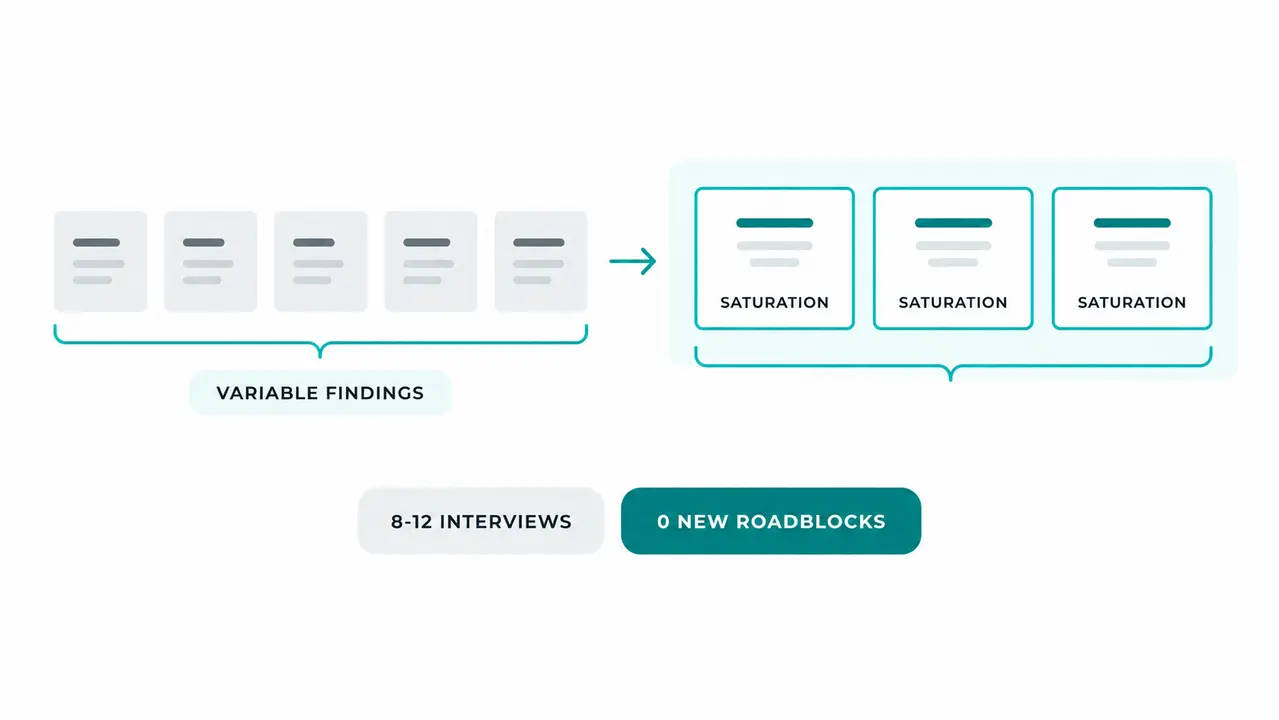
Founders with quantitative backgrounds often stall discovery by chasing statistical significance across hundreds of survey respondents. Early validation seeks recurring behavioral patterns and architectural roadblocks, not academic certainty. A reliable qualitative signal outweighs a muddy quantitative signal during initial discovery. When conducting customer development for a tightly defined ICP definition, eight to twelve deep interviews yield clear consensus. Multi-sided platforms or marketplaces require fifteen to twenty-five discussions to capture contrasting expectations across buyer and supplier segments.
You reach saturation when incremental conversations fail to alter your build plan. Define explicit saturation criteria in your validation metrics before speaking to your first early adopter: zero novel operational bottlenecks surfaced, zero unfamiliar compliance hurdles reported, and consistent trial commitments across three consecutive meetings. Consumer applications relying on paid acquisition tests demand larger statistical samples to verify unit economics, but channel metrics represent a distinct operational question. Never allow paid advertising tests to stall a straightforward prototype usability decision.
The two-week validation sprint that technical teams can run
Discovery efforts easily degenerate into indefinite analysis loops when technical leadership fails to enforce strict time limits. A disciplined validation sprint spans exactly fourteen calendar days, applying structured experiment design to isolate a single primary hypothesis. Days one through three execute structured problem interviews. Days four through six deploy an interactive smoke test or lightweight interface prototype. Days seven through nine run a manual concierge MVP or wizard-of-oz prototype with candidate users. Days ten through twelve synthesize quantitative completion metrics and qualitative notes. Days thirteen and fourteen freeze the build scope or cancel the initiative.
Governance during this cycle demands rigor. The tech lead and product manager must hold a fifteen-minute daily checkpoint to update the assumption mapping matrix and log new discoveries. Completing every stage on the validation checklist forces rapid convergence. Teams that run open-ended research without a locked calendar date accumulate subjective opinions, delay development, and inevitably produce an inflated MVP scope definition based on internal compromise rather than user evidence.
Turning validation into an MVP scope that engineers can ship
An MVP is the smallest technical build that resolves the riskiest remaining uncertainty with real users. It is never a fragile, miniature edition of your five-year product vision. You govern engineering resources by establishing a rigid MVP scope definition divided into three explicit categories: what the build must prove, what infrastructure it must support, and what administrative overhead it must exclude. The validated scope becomes the input for your product development sprint, not a wish list.
Treating prototype validation as a formal gate aligns directly with the software lifecycle framework established in IEEE/ISO/IEC 12207. Document the technical boundary through a one-page PRD paired with a single-page architecture note that specifies data pipelines, authentication hooks, and core telemetry. If an administrative configuration panel or performance optimization does not alter your go-to-market validation result, strip it from the build. The table below outlines this boundary structure for engineering clarity.
| Boundary Classification | Functional Scope | Architectural Requirements | Governance Action |
|---|---|---|---|
| Must Prove | Core calculation engine, primary workflow step | Basic event logging, data ingest pipeline | Build and instrument first |
| Must Support | Baseline tenant isolation, secure data storage | Production database, minimal authentication | Implement with proven components |
| Must Exclude | Multi-role permissions, custom billing engines | Automated self-service provisioning | Defend against scope creep |
Metrics that matter in MVP market validation
Tracking page impressions, account registrations, and email clicks creates an illusion of momentum fueled by vanity metrics. You evaluate MVP validation methods by measuring execution and recurring utility, not top-of-funnel discovery. Four validation metrics determine whether a concept warrants production engineering: the core action completion rate during onboarding, the exact time to first value measured in minutes, the recurring usage frequency across a seven-day cycle, and direct feedback confirming operational disruption if access ended.
Set numerical pass thresholds in writing before exposing software to external traffic. Require forty percent of onboarded operators to complete the core transaction on their first login, measure a retention signal where sixty percent return within seven days, and verify that four out of five pilot participants report severe workflow damage if the system shuts down. A healthy activation rate directly predicts sustained product adoption. Moving your statistical goalposts after observing weak activation produces false positives, locking valuable engineering capacity into dead-end feature maintenance.
What to do when you validate the wrong user
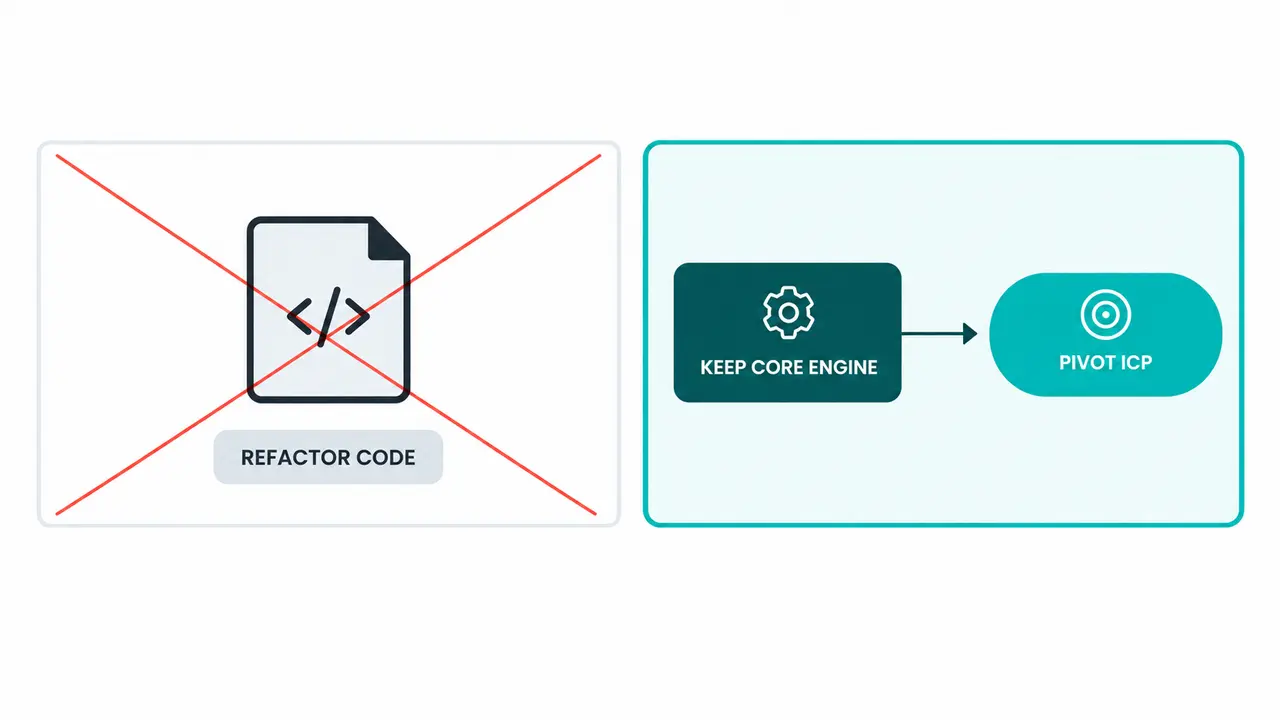
Engineering organizations often rewrite backend logic when pilot adoption stalls, assuming the application failed. In many cases, the technical capability solved a genuine failure, but the team targeted the wrong operational persona. When end users praise an automation tool yet corporate IT blocks deployment, or when department directors demand compliance reporting that individual contributors ignore, you face a positioning breakdown rather than an architectural flaw.
Keep the underlying engine, change the organizational entry point. Define your pivot criteria around customer discovery rather than code refactoring. Update your ICP definition card across five specific fields: corporate role, operating environment, technical constraints, economic buying trigger, and explicit disqualifying conditions. Documenting disqualifying conditions prevents sales conversations with organizations whose procurement processes or governance frameworks eliminate small vendors immediately. Stakeholder mapping reveals whether your real champion is the compliance officer rather than the systems engineer, allowing you to validate enterprise viability without throwing away your existing codebase.
Validation for sales-led and enterprise buying cycles
Selling to enterprise accounts demands more than positive end-user feedback. You must demonstrate that your software architecture survives internal governance, passes rigorous security review assessments, and integrates with legacy infrastructure. Securing design partner commitments requires early validation of technical baseline standards. Enterprise security officers evaluate external vendors against established industry frameworks such as NIST SP 800-218, which governs the Secure Software Development Framework Version 1.1. If your team cannot satisfy these compliance baselines, technical excellence in the user interface becomes irrelevant.
Reviewing operational case studies from client success stories illustrates how early alignment with corporate procurement timelines prevents commercial stalls. Establish a formal pilot program bound by a written deployment agreement before provisioning accounts. This document must specify data access scopes, identify a named executive sponsor, detail technical integration feasibility, and establish unambiguous pass criteria. Mapping the approval chain early ensures your team does not build complex systems that stall permanently inside corporate compliance reviews.
Validation when the product touches hardware or embedded systems
Validating hardware-connected platforms introduces physical variables that pure cloud software never encounters. You de-risk connected systems by validating operational constraints, interface workflows, and telemetry pipelines long before freezing final circuit board designs. Execute concept validation through structured, progressive stages: inject simulated sensor inputs into cloud backends, transition to off-the-shelf development boards, conduct laboratory bench tests, and conclude with monitored field trials. Each phase requires explicit pass thresholds covering signal latency, battery consumption, and environmental packet loss.
Translating field observations into an execution plan requires specialized system and embedded engineering capable of balancing firmware limitations against cloud ingestion speeds. Draft your operational constraints, operating temperature ranges, and remote telemetry logging specifications in writing before soldering hardware. Where regulatory compliance or industrial safety certifications dictate system feasibility, run compliance spikes concurrently with commercial testing. Uncovering RF interference or power distribution failures during prototype testing prevents costly tooling revisions once custom enclosures enter manufacturing.
Where teams overtrust AI-assisted user testing
Generative models accelerate discovery workflows, but they cannot simulate genuine customer intent. Machine intelligence serves as an operational drafting tool, not a source of empirical truth. You can deploy modern language models to cluster hundreds of interview notes, draft standardized testing scripts, and summarize session telemetry. These applications accelerate your build-measure-learn loop by eliminating hours of manual transcription.
Teams court disaster when they substitute synthetic personas for living operators during prototype testing and user testing for MVP roadmaps. Simulating buyer behavior using prompt templates produces dangerous false positives, fabricating uniform enthusiasm where genuine corporate buyers face internal budget battles. Writing code faster with intelligent IDE assistants does not mean you validate an MVP idea. A compressed sprint cycle that gathers artificial feedback merely produces incorrect software at a higher velocity. Observing a real human operator struggle through your workflow interface remains the only qualitative signal that justifies architecture investments.
Clear stop rules prevent zombie MVPs
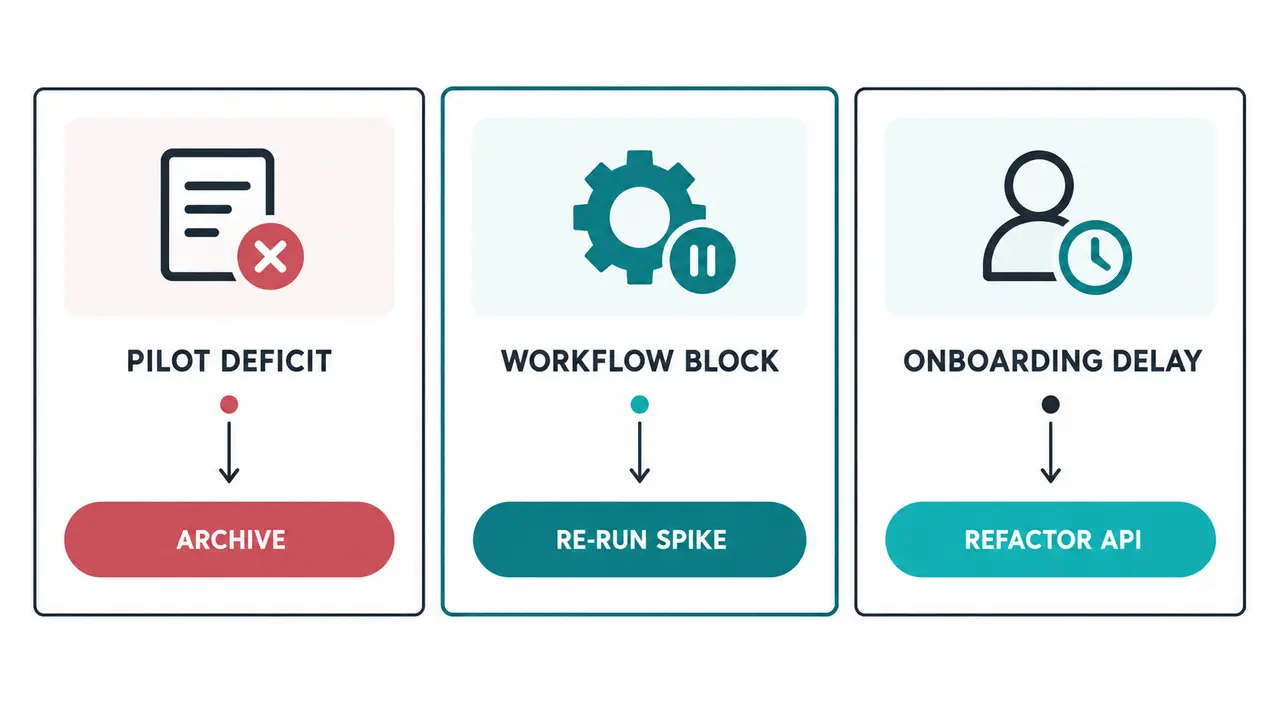
Without pre-established stop rules, engineering teams inevitably fall victim to sunk-cost fallacies. When validation metrics return ambiguous results, technical organizations tend to add secondary features rather than admitting the core concept failed. A defensive decision gate requires rigid boundaries established before discovery sprints begin. Pre-commit to hard operational boundaries by canceling the initiative if fewer than three qualified enterprise accounts agree to pilot terms, pivoting the workflow if four consecutive interviews surface the same architectural blocker, and halting front-end development if onboarding time exceeds fifteen minutes.
Hold a formal evaluation session on the final afternoon of your validation sprint. The output must be binary: commit engineering capacity to a scoped build, trigger defined pivot criteria, or shut down the repository completely. Documenting clear operational responses to failure signals protects your roadmap from vanity metrics and endless feature iteration. The table below details common stop rules and their corresponding architectural decisions.
| Stop Rule Category | Trigger Condition | Engineering Action | Roadmap Consequence |
|---|---|---|---|
| Enterprise Pilot Deficit | Fewer than two commitments in 14 days | Terminate custom infrastructure build | Archive repository |
| Workflow Blockage | Four accounts cite same privacy barrier | Shift pipeline to local on-premise execution | Re-run technical spike |
| Excessive Onboarding | Time to first value exceeds 20 minutes | Refactor ingestion API to accept raw formats | Delay interface development |
| Engagement Decay | Return rate falls below 25 percent | Halt user interface design expansion | Re-evaluate core value proposition |
Validation deliverables a CTO can review in 30 minutes
Engineering leadership cannot manage roadmaps through sixty-page research dossiers. A defensible validation package should be readable, auditable, and structured for a thirty-minute architectural evaluation against your validation checklist. The complete package contains seven concise artifacts: the finalized ICP definition card, the scored assumption mapping matrix, an interview synthesis tagging recurring bottlenecks, raw quantitative experiment outcomes, the MVP scope definition, the pilot deployment agreement, and a prioritized risk register.
Anchor these findings with a single technical diagram mapping the validated user workflow and data flow alongside explicit environmental constraints. This deliverable package serves as a binding decision gate. Once technical leadership signs the scope lock, execution transitions to engineering delivery. Teams frequently partner with an external boutique software engineering partner like Sentice to execute the validated build sprint, keeping internal product leads focused on commercial traction. If your validation materials cannot justify an immediate build decision, you have generated academic documentation rather than operational validation.
Turn your validated scope into a shipped build
If your validation package is signed and the scope is locked, our engineers can pick up the build sprint while your product leads stay focused on commercial traction.
Frequently asked questions
How does MVP validation differ from product market fit?
MVP validation provides pre-build evidence justifying software development investment. Product market fit represents post-launch evidence of scalable retention. Validation earns the right to write code; product market fit is proven through iterative engineering after deployment.
When does a waitlist represent genuine demand?
A waitlist is a weak indicator when it merely collects email addresses. It becomes reliable only when a measurable percentage of subscribers execute paid trials, share workflow data, or schedule technical onboarding sessions within a strict timeframe.
What should you do when users praise the tool but refuse to switch?
This hesitation reveals that switching costs outweigh your perceived value proposition. Test whether automated migration scripts overcome the friction. If target operators still decline to switch from their incumbent tools, terminate the project.
How do you validate a two-sided marketplace?
Validate the supply side first, which typically carries higher switching costs and operational friction. Run separate assumption maps for each audience. Never assume that validating buyer excitement guarantees vendor participation.
Can you validate market demand with internal employees?
Internal staff help identify interface bugs, but they cannot validate commercial demand. They face no financial risk and no migration costs. External buyers operating under genuine budgetary constraints must confirm demand.
What is the minimum prototype fidelity needed for feedback?
The prototype must allow users to complete the core action without guidance. Clickable mockups evaluate visual navigation, while a working backend script is necessary when data integration represents the riskiest operational unknown.
Run your next validation cycle like an engineering experiment
Treat validation as an experiment with a hypothesis, a test, and an explicit decision gate rather than a comfort exercise. Pick your single riskiest assumption, define what evidence would disprove it, and apply structured experiment design to run the smallest test possible. Lock your MVP scope definition strictly around what customer behavior earned, feeding validated findings into your next build-measure-learn loop. Build only what the evidence paid for, and let the next sprint earn the rest.
About Sentice

Sentice is a boutique software engineering partner founded in 2013 by Roni Levi and Martin Petkovic, now headquartered in Skopje, North Macedonia. Rather than supplying individual developers, we build embedded teams that blend with a client’s culture, tech stack and goals, working together from a single office under our own technical leadership. We deliver dedicated software engineering teams, end-to-end software solutions, product development, and system and embedded engineering, and we act as technical advisors across the full development lifecycle, from specification and architecture through development, testing and support. We use AI coding tools across every project, and we help clients integrate AI into their own products through chatbots, MCP services, connected application layers and workflow automation. Some of the clients we started with more than a decade ago are still building with us today.
Get in touch: info@sentice.com | +389 70 307 837