
Preparing an MVP for an investor pitch is a scoping decision before it is an engineering one. The build that closes a round is rarely the broadest one on the table; it is the one that retires the exact doubt a technical partner will probe first. This article walks through how to pick that single risk and what a live demo must survive, as well as which telemetry turns a working build into diligence-grade evidence and how to reach investor-ready delivery without stacking technical debt. Along the way it covers the boundary between prototypes and MVPs and the security basics that prevent a diligence stall, as well as the data room investors will ask for within twenty-four hours and the readiness checklist for booking your meetings.
Reading time: 12 min
Key points
- One core transaction completed end-to-end proves market pull, product value, and team execution better than five half-built screens.
- Scope the build around the single risk most likely to kill the deal during diligence, and drop every ticket that does not address it.
- Telemetry on activation and workflow completion, along with repeat sessions and drop-off events, turns a working build into diligence-grade evidence.
- Your MVP is pitch-ready when the core workflow runs deterministically across five consecutive dry runs and the data room is current.
Table of contents
An investor pitch MVP is about evidence rather than a feature set
A pitch deck promises a future, but an MVP for an investor pitch delivers immediate evidence. You are not building a miniature version of your five-year product vision. You are assembling a targeted proof package that combines one functional workflow with behavioral data to eliminate early investment doubt. Early capital prices three specific risks including market pull, product value, and team execution. Completing one core transaction end-to-end proves all three far better than five half-built screens ever could. Adding non-essential features increases your surface area for bugs and dilutes the signal you bring to the table. Amateur founders chase feature volume, while seasoned technical teams ship verified signals.
The one-sentence test for MVP scope
To protect engineering capacity during fundraising prep, force your entire build into a strict definition. State that for user X, you reduce pain Y by enabling action Z, measured by metric M. If a proposed ticket does not directly support action Z or measure metric M, drop it from the sprint immediately.
The investor meeting is a reliability test disguised as a demo
Investors evaluate your engineering judgment through the lens of your product walkthrough. A stalling interface or an unhandled exception signals execution risk regardless of how compelling your market thesis sounds. When an investor demo fails on a basic interaction, technical partners assume your production systems carry similar instability. Spending twenty minutes debugging authentication tokens or payment gateway webhooks burns meeting time that belongs to traction metrics and growth roadmaps. At Sentice, our engineers structure staging environments to mirror production networking rules so that unexpected CORS or timeout errors never interrupt partner reviews. Demo hygiene demands a pristine seed dataset, a pre-warmed staging container, and an offline backup file ready on your desktop.
A simple fallback ladder for demo day
Technical failures happen on guest wireless networks. Protect the pitch by following a strict operational ladder. Run the live application first, and shift to a local ninety-second screen recording if latency spikes. Advance through static high-resolution interface captures if local containers misbehave, and present documented behavioral metrics if visual assets stall.
Picking the single risk your MVP must retire
A successful fundraising MVP must be scoped strictly around the single risk that prevents your team from securing capital today. Early-stage ventures face existential questions about technical feasibility and distribution costs as well as user engagement and unit economics. Trying to answer all four questions simultaneously spreads your engineering bandwidth thin, leaving every assumption half-proven. Run a focused thirty-minute alignment session between your CTO and founder. Write down every perceived vulnerability, rank them by their potential to kill the deal during diligence, and discard everything beneath the top item. If your technical feasibility is unquestioned but enterprise buyers might reject the workflow, building custom microservices is a waste of time. Focus your sprint on proving workflow adoption. Building secondary components before retiring your fatal risk usually wastes the sprint. Address the fatal risk first, because unresolved primary risks kill deals while secondary gaps merely shape future sprint plans.
Proof of concept, prototype, and MVP in investor language
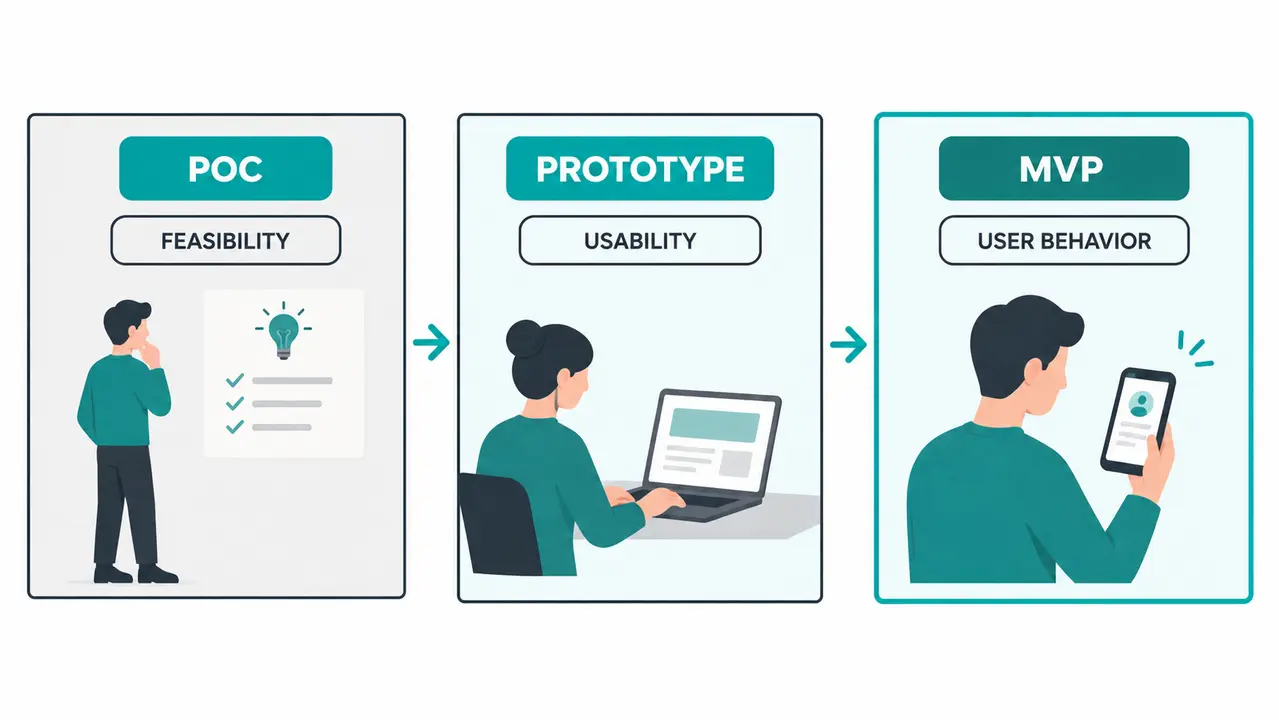
Engineering teams often blur the boundaries between technical artifacts, but institutional investors evaluate them through distinct criteria. A proof of concept exists to demonstrate technical feasibility, verifying whether an unproven algorithm can process real-time sensor streams under a fifty-millisecond latency threshold. A prototype tests usability and user comprehension, confirming that an operator understands navigation paths across interactive design boards. An MVP operates in an entirely different category by capturing genuine user behavior inside an active production environment.
Claiming market traction with an interactive design prototype is an immediate failure during diligence. Clickable mockups cannot measure retention, database integrity, or operational willingness to pay. The following framework clarifies how to align your build with investor expectations.
| Evaluation Stage | Core Question Answered | Artifact Delivered | Diligence Verdict |
|---|---|---|---|
| Proof of concept | Can this system work under technical limits? | Benchmark latency report | Proves technical feasibility only |
| Prototype | Can users understand the interaction flow? | Clickable interface mockup | Proves usability but lacks behavioral validation |
| MVP | Will target users return and pay? | Instrumented functional workflow | Validates operational execution and market pull |
A prototype shows how software looks, while an MVP proves how users behave. Choose the artifact that matches your actual fundraising requirement.
Where founders overscope the investor demo
The most frequent scoping error in early fundraising is attempting to display your entire five-year architectural vision in a single session. Experienced partners do not reward broad surface area. They look for sharp judgment regarding what you intentionally omitted from the codebase. Common overscoping traps include granular role-based access control, complex multi-tenant billing settings, and speculative third-party connectors that add brittle failure points to your deployment. These non-essential modules distract from the primary value transaction and break during live walkthroughs. Walking an investor through half-finished account management screens forces your engineering leads to apologize for incomplete UI elements. Apologies erode technical credibility faster than missing secondary features ever will. Ruthlessly excise any view that does not directly advance the user toward their primary outcome. Build the happy path with solid error boundaries, leave peripheral administrative settings for future post-seed sprints, and present your restraint as deliberate engineering discipline.
The minimum demo flow that still feels real
A credible MVP for an investor pitch anchors the product in reality rather than theoretical capability. Your walkthrough must present a believable persona operating from a realistic initial state, completing their core operational objective in under seven minutes. Populate your database with rich, domain-specific seed records rather than generic placeholders like Test User 1 or Lorem Ipsum descriptions. Realistic data demonstrates that your team understands the operational nuances of the target industry. Do not wander through navigation menus or describe UI layout choices. A wandering interface tour exhausts partner attention and obscures your underlying economic value.
A demo script template technical teams can rehearse
Rehearse your presentation using a tight four-part structure. State the operational bottleneck in one clear sentence. Execute the technical workflow across three precise interactions that resolve the bottleneck. Display the financial or operational outcome using a single concrete metric. Conclude by summarizing the next technical milestone your upcoming round will pay for.
Instrumentation that turns an MVP into a fundraising asset
An uninstrumented release is merely an unvalidated story. Integrating disciplined telemetry transforms your fundraising MVP into an undeniable asset by proving that your team measures user friction and adapts based on objective data. Configure an analytics pipeline using tools like PostHog or Segment before onboarding your initial pilot cohort. Track four user interactions every week, which are the initial activation event and the primary value action as well as the repeat session trigger and explicit workflow failure drops. Unsubstantiated claims about user enthusiasm crumble quickly under technical partner scrutiny. Presenting telemetry graphs that demonstrate how actual operators move through your pipeline establishes immediate authority.
Metrics that matter when revenue is not the point yet
When monetization is deferred, prioritize metrics that demonstrate product engagement and user pull. Report time to first value by tracking minutes elapsed between account provisioning and initial task completion. Measure workflow completion rates to prove usability, and document your repeat usage rate within seven days to demonstrate natural retention.
Traction signals you can show without pretending you have scale
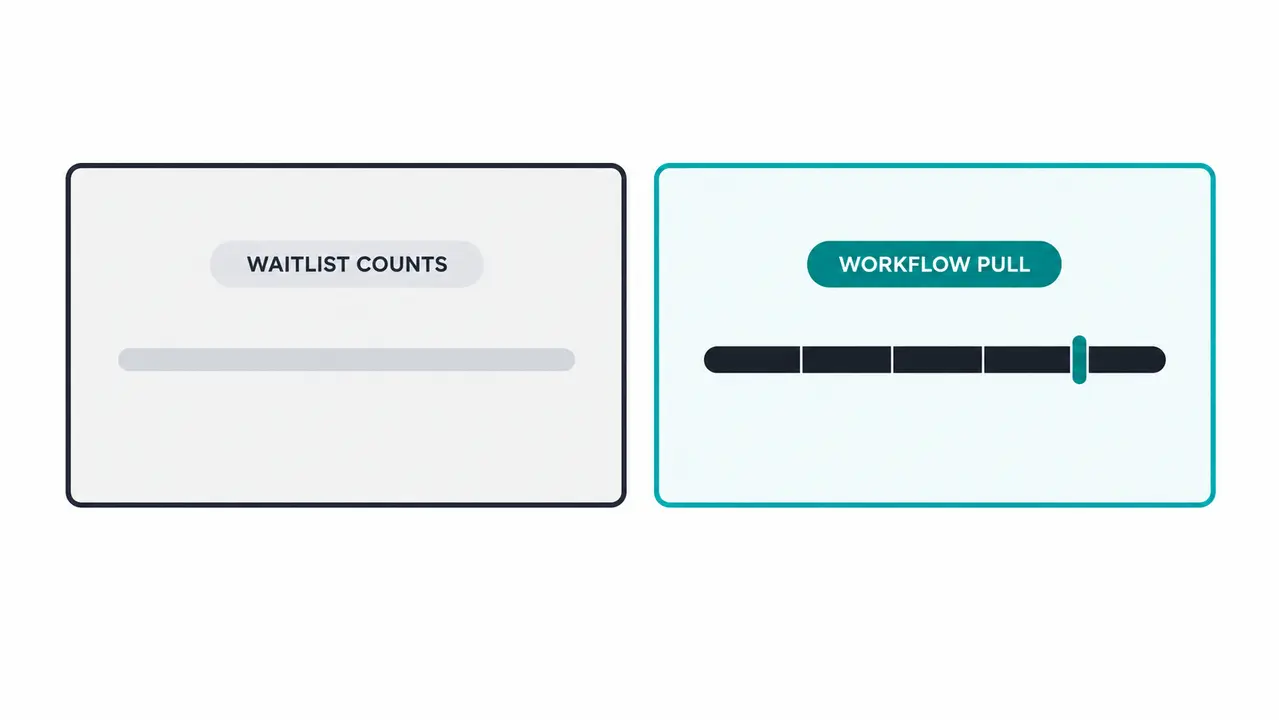
You do not need thousands of active accounts to prove market demand during an early seed round. At this stage, genuine traction is proof of workflow pull and engineering learning velocity. Demonstrating that twelve targeted corporate teams use your MVP every business morning provides far stronger validation than ten thousand unverified waitlist signups. Vanity registration counters impress no one during technical diligence because they carry zero engagement data. Highlight structured pilot agreements that outline explicit success criteria, such as reducing invoice processing cycles from three days to four hours. Show how your core engine has embedded itself directly into daily operational routines. If five departmental leads rely on your software to export their weekly compliance reports, you have proven authentic utility. Dense engagement within a narrow cohort usually outweighs shallow, uncommitted signups across an indifferent audience.
The engineering choices investors infer from your MVP
Technical partners review your architecture to evaluate engineering maturity and capital efficiency. They look for clean boundaries, modular components, and an infrastructure baseline that avoids an expensive rewrite after funding. Building custom message brokers or proprietary authentication engines for an initial release indicates poor judgment. Relying on battle-tested managed services like AWS RDS for PostgreSQL, Auth0 for identity, and Datadog for telemetry reflects pragmatic product development practices that preserve early runway. Over-engineering distributed microservices before validating user demand burns engineering hours and cripples iteration speed. Your architecture should prove that you prioritize speed to customer value without introducing reckless technical shortcuts. Show clean REST or GraphQL API documentation generated via Swagger, enforce relational integrity at the database layer, and demonstrate that your data models isolate tenant domains cleanly. Simplicity in early infrastructure demonstrates executive discipline, not technical limitation.
What technical decision makers should prepare for investor questions
During technical diligence, partners probe the operational boundaries of your fundraising MVP to evaluate how your leadership team handles architectural trade-offs. They will ask what breaks when concurrent transaction volume increases tenfold, how database migrations are handled, and how much human intervention powers behind-the-scenes workflows. Never answer these inquiries with defensive bravado or attempt to conceal manual operational steps. Discovering undocumented manual scripts or brittle point-to-point integrations during code review destroys investor trust instantly. Structure each technical answer around four points, which are the current system baseline and the documented breaking threshold, followed by the planned engineering mitigation and its delivery timeline. Stating that your background workers experience latency bottlenecks at two thousand concurrent jobs, and that Redis queue clustering is scheduled for sprint four, demonstrates operational command. Investors do not expect finished enterprise platforms, but they do invest in technical leaders who understand their operational constraints.
Security and privacy basics that prevent a diligence stall
Early capital rounds do not require SOC 2 certification, but elementary security oversights will stall a term sheet during partner diligence. Investors inspect your code repositories to confirm that you handle sensitive data with care and do not treat security as an afterthought. Aligning your delivery pipeline with secure software development frameworks ensures that your team avoids basic diligence failures from day one. Replace hardcoded API keys and shared administrative credentials with centralized secrets management systems like AWS Secrets Manager. Enforce least-privilege role separation across your cloud infrastructure and purge all real personal data from development databases before granting external repository access. An early proof of concept might tolerate informal access controls, but code handling customer workflows must demonstrate fundamental hygiene. Showing encrypted data at rest, parameterized database queries, and clean dependency audit scans reassures investors that your codebase will not collapse under compliance scrutiny.
The data room MVP teams forget to build
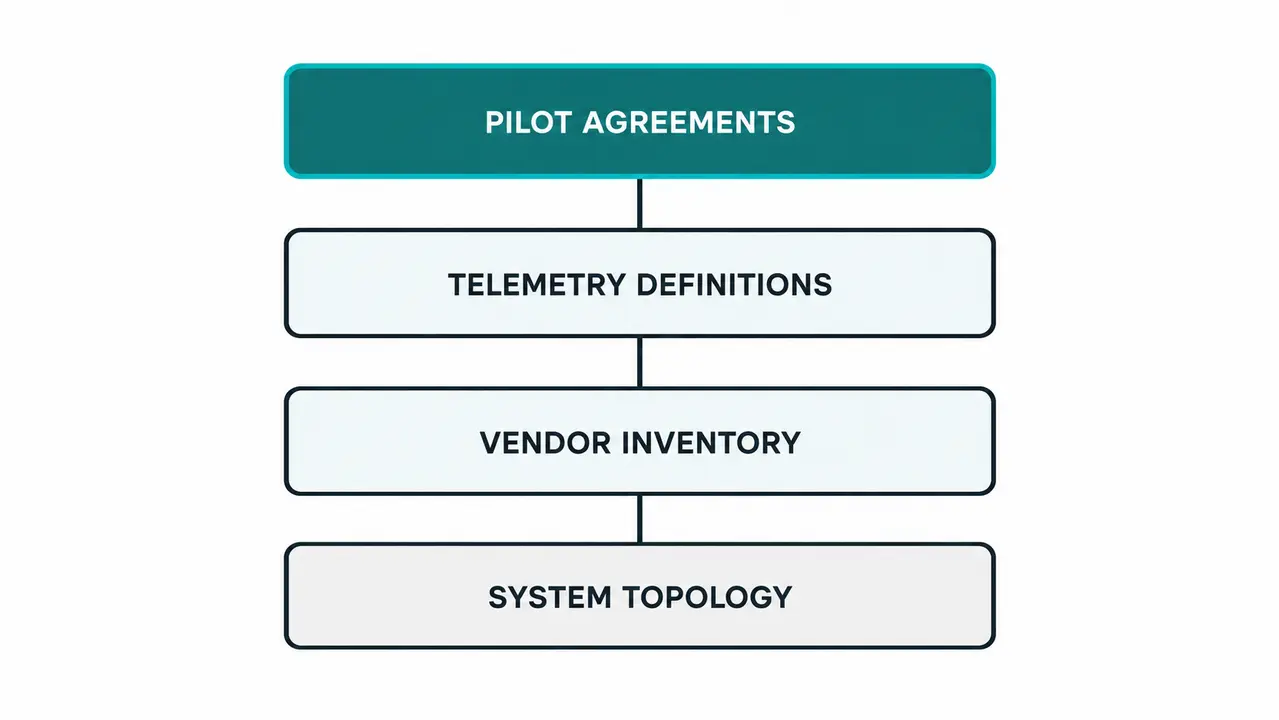
A functional build only represents half of an investor-ready package. When an introductory walkthrough goes well, technical partners request access to your documentation room within twenty-four hours. Scrambling to produce basic architectural diagrams or infrastructure cost breakdowns signals operational disorganization and kills deal momentum. Your technical repository must support your MVP for an investor pitch with concise, structured documentation. Include a high-level system topology diagram that clarifies data flow between clients, load balancers, and persistent stores. Provide a comprehensive inventory of third-party SaaS vendors that lists what each one does and what it costs per month, along with the data it can access. Add a data dictionary defining how key engagement metrics are computed in your telemetry layer, alongside executed pilot agreements or letters of intent. Assembling these artifacts in advance demonstrates mature technical governance and turns diligence from a stressful interrogation into a routine verification of your operational discipline.
A roadmap that reads like execution rather than wishful thinking
Presenting a roadmap filled with speculative feature requests illustrates a lack of strategic focus. Savvy investors review your post-funding schedule to verify how systematically your engineering leadership translates capital into market value. Structure your roadmap as an execution plan where every release cycle directly reduces technical or commercial risk. Organize development milestones into two-week to four-week increments, and pair each release with a defined scope boundary and a concrete success metric as well as the commercial unlock it enables. For example, specify that migrating from single-tenant containers to a partitioned multi-tenant database reduces hosting overhead by sixty percent while enabling self-serve onboarding. This approach proves that your fundraising MVP serves as a stepping stone toward a scalable commercial platform. Speculative roadmaps list features without metrics, while disciplined ones sequence measurable risk reductions. Show investors exactly how their capital accelerates your trajectory toward defensible unit economics.
Building an MVP for investor pitch when the product is technical or embedded
Deep technology and IoT ventures cannot rely on standard web interface walkthroughs. For these systems, an MVP for an investor pitch requires a dual demonstration strategy that balances raw feasibility data with a practical user workflow. Partnering with specialized embedded engineering teams helps bridge the gap between firmware benchmarks and commercial interfaces. Presenting a polished web dashboard without validating underlying sensor communications or signal processing pipelines invites immediate skepticism during technical diligence. Combine structured bench testing data with a lean interface to prove commercial viability. Openly document your operating boundaries, such as power consumption ratings and bandwidth constraints as well as edge processing latency ceilings.
Evidence artifacts that work well for technical products
Support your technical demonstration with verifiable laboratory artifacts. Provide automated hardware test logs, continuous integration build histories, and uncut video recordings of repeatable bench routines across multiple environmental conditions. A technical proof of concept supported by recorded error rates across ten thousand test cycles provides undeniable evidence of execution.
When a clickable prototype is the better fundraising move
Writing production software is not always the correct first step. When your primary business uncertainty centers on user comprehension and workflow ergonomics or on category creation, presenting a clickable prototype is the smarter strategic move. Building interactive Figma components allows product teams to test complex multi-step interactions with prospective enterprise buyers in days rather than months. Support your design walkthrough with documented discovery interviews, recorded user sessions, and an architectural decision log stored in Notion. This documentation proves that your interface decisions reflect validated market feedback rather than internal assumptions. Do not rely on an interactive prototype during an investor demo if you need to demonstrate retention or payment intent. Prototypes cannot capture authentic user commitment or operational reliability. If investors question whether buyers will pay or return weekly, interactive mockups are insufficient, so deploy working code that captures verified user commitments.
The fastest path to an investor-ready MVP without creating tech debt
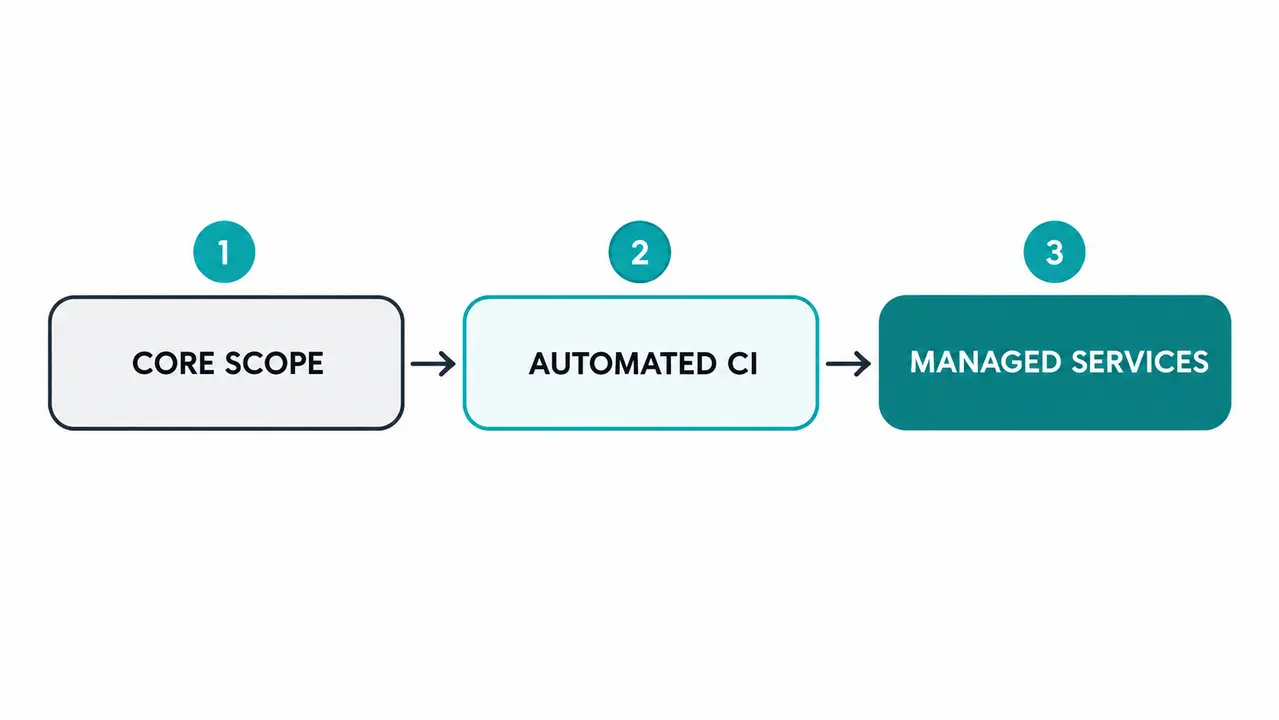
Achieving rapid delivery does not require abandoning engineering standards or building throwaway prototypes. Speed comes from ruthless scope reduction, targeting one persona on a single platform using proven off-the-shelf components. Collaborating with dedicated software engineering teams establishes a disciplined delivery cadence that generates demonstrable features every week. At Sentice, our teams set up continuous integration pipelines with GitHub Actions on day one, so every pull request runs automated unit tests and linting rules and gets a preview deployment. Generic agencies assemble disconnected screens, while we build focused engines that prove user intent. Shipping code carelessly under the guise of speed creates compounding technical debt that demands an immediate rewrite after closing a round, paralyzing your product momentum. Choose standard relational databases, managed authentication services, and modular application layers. This approach allows you to ship an investor-ready fundraising MVP within weeks while preserving an architectural foundation that supports your post-seed scale.
Ship evidence every week, not screens
If your runway clock is ticking faster than your roadmap, an embedded senior team can compress the distance between a validated thesis and a pitchable build. Tell us what your round needs to prove and we will map the shortest engineering path to that proof.
Recognizing when your MVP is ready to pitch
Teams frequently mistime their first investor meetings, either pitching too early with unstable builds or polishing secondary interfaces long after their core thesis was proven. Your MVP for an investor pitch is ready when the primary operational workflow functions deterministically across five consecutive dry runs without manual database resets. Telemetry must be actively capturing user transitions, and your technical documentation room must hold current architectural diagrams and vendor inventories. You must be prepared to articulate your current technical bottlenecks and remediation plans without hesitation. Pitching before these conditions are met damages your credibility and leaves you unable to specify the exact milestones your round will finance. Once your core workflow runs reliably and your metrics reflect authentic user pull, with fallback assets saved on your presentation machine, stop writing non-critical code. Book your investor meetings and let your execution record speak for itself.
Frequently asked questions
These are the technical and operational questions engineering leaders face when translating an early build into an investor pitch asset.
How polished does an MVP need to be for investors?
The interface must be clean enough that nothing appears broken during your primary user workflow. Visual design should prioritize speed, responsive feedback, and functional typography over decorative animations. Polished interactions on your primary transaction build confidence, while visual styling on peripheral screens adds zero diligence value.
Should the MVP be live in production before pitching?
Deploying to an active production domain is not strictly mandatory, but real users must be able to complete tasks in a realistic environment. Running on a staging environment with authentic seed data is acceptable if external pilot users already access the build. Investors evaluate whether the software handles real workflows without manual intervention.
What if parts of the workflow are still manual behind the scenes?
Executing manual backend tasks during early validation is completely acceptable if you disclose it honestly in diligence. Present a clear architectural automation plan detailing how upcoming capital will replace manual operations with automated background services. Concealing manual operations destroys investor trust during code review.
What metrics should we track before the first investor meetings?
Instrument your fundraising MVP to capture initial activation and core workflow completion, along with repeat session rates within seven days and specific pipeline drop-off events. Tracking these four events proves that your engineering team measures behavioral patterns and makes data-driven product decisions.
Can we raise with only a proof of concept?
Raising on a proof of concept is possible when technical feasibility is the primary investment risk, as seen in deep tech and embedded hardware ventures. Enterprise software and consumer platforms require an MVP for an investor pitch because investors demand verifiable proof of user pull and workflow adoption.
The next step for your investor demo
Audit your current workflow and instrumentation against this evidence framework before you schedule your next investor demo. Technical credibility is earned through what you intentionally leave out of the codebase rather than the sheer volume of features you deliver. Your MVP for an investor pitch succeeds when it provides undeniable proof that your team builds reliably and measures reality accurately. Would your current codebase survive a rigorous technical diligence session tomorrow morning without any prepared excuses?
Pressure-test your build before the pitch
Run your scoping question past engineers who have taken early-stage builds through technical diligence before. A short conversation can tell you whether your current sprint is retiring the right risk.
About Sentice

Sentice is a boutique software engineering partner founded in 2013 by Roni Levi and Martin Petkovic, now headquartered in Skopje, North Macedonia. Rather than supplying individual developers, we build embedded teams that blend with a client’s culture, tech stack and goals, working together from a single office under our own technical leadership. We deliver dedicated software engineering teams, end-to-end software solutions, product development, and system and embedded engineering, and we act as technical advisors across the full development lifecycle, from specification and architecture through development, testing and support. We use AI coding tools across every project, and we help clients integrate AI into their own products through chatbots, MCP services, connected application layers and workflow automation. Some of the clients we started with more than a decade ago are still building with us today.