
The estimate arrived on a Tuesday. Two hundred thousand, six weeks, twelve screens. The founder approved it, the team built it, and eighteen months later the company was paying for the third rewrite of a system that had never really worked. Nothing about that number was wrong. The problem was that the number was an answer to a question nobody had asked precisely.
MVP development cost is not a figure you look up on a vendor’s pricing page. It is the output of a specific set of decisions about scope depth, delivery risk, and how much production readiness you want in version one. Teams that treat it as a lookup price almost always pay for that convenience later, when edge cases surface in production and the happy path turns out to be a fraction of the actual system.
We have spent more than a decade building MVPs for startups and scaleups. The cheapest ones to build were never the ones that skipped planning. They were the ones where someone wrote down, on one page, what the product would and would not do before a single estimate was requested. Below, we unpack where MVP budgets actually leak, what separates an estimate from a guess, and the practical artifacts that keep v1 effort from drifting.
Reading time: 13 min
Key points
- MVP development cost is driven by scope depth, delivery risk and production-readiness decisions, not by feature counts.
- A one-page scope brief, a permissions matrix and an integration inventory are what make an estimate defensible.
- Backend depth, integrations and error-state handling are where identical-looking products diverge in effort.
- The team model you choose, in-house, freelancers or an embedded team, shifts delivery risk more than it shifts the estimate itself.
Table of contents
MVP development cost is a scope and risk decision, not a lookup number
Consider a feature as ordinary as file upload. In its simplest form, it is a signed URL to a storage bucket and a database row. That is a day of work. The same feature in a regulated context means virus scanning, OCR extraction, automatic redaction of sensitive fields, immutable audit trails, and a retention policy tied to document type. That is a month. Same button on the screen, same user story, thirty times the effort.
This is why any estimate you receive without a written scope is fiction. The estimator is filling your silence with assumptions, and their assumptions will not match yours.
Before you ask anyone for numbers, write a one-page scope brief. It should state the user roles, the target platforms, the integrations you already know you need, and the level of operational polish you expect from v1. That single document shifts your startup budget from guesswork to defined scope, and it is the first real step to controlling your development investment. Teams that skip it do not save time. They move the uncertainty from the estimate into the build, where it costs more.
Where teams confuse MVP, prototype, and proof of concept
A prototype validates usability. A proof of concept validates technical feasibility. An MVP validates a product hypothesis with real users in a real environment. These three artifacts look similar in a pitch meeting and cost wildly different amounts to build.
A prototype is a clickable Figma demo with no backend. A proof of concept is a script that proves, for example, that a particular ML model returns acceptable accuracy on your data. An MVP is a deployed system with authentication, data persistence, and users who can leave. When a stakeholder says “MVP” but means “demo for the sales discovery call next month”, you get production plumbing built for something that should have stayed a throwaway.
We have watched teams spend two months on multi-tenant architecture for a prototype that was shown twice and discarded. The reverse also happens, and it is worse: a Figma mockup is shipped to customers as if it were a product.
Ask one question before scoping any engineering work. What, specifically, needs to be validated? If the answer is a sales demo, build the prototype and stop there.
The cost drivers that move estimates even when features look the same
Two products with identical screen counts can differ by a factor of five in build effort. The drivers are rarely visible in the UI. They are platforms, integrations, permission complexity, and data lifecycle.
Write a permissions matrix before you request an estimate. Who can see what, and under which conditions? Do the same for integrations in an inventory document, listing every external system and the direction of data flow. These two artifacts capture the system-level requirements that a feature list hides.
The failure mode is subtle. Requirements written in marketing terms, “secure”, “scalable”, “real-time”, force each estimator to guess what those words mean, and they will guess differently. That is why two vendors quoting the same feature list return numbers that diverge by 300 percent. The scope brief, not the marketing copy, is the shared language.
State the heavy drivers explicitly if they apply: multi-tenant architecture, offline mode, real-time sync, audit logging. And note when they do not apply. A single-user internal tool can safely ignore most of them, and saying so early cuts scope dramatically.
Two MVPs with the same UI can have different backend depth
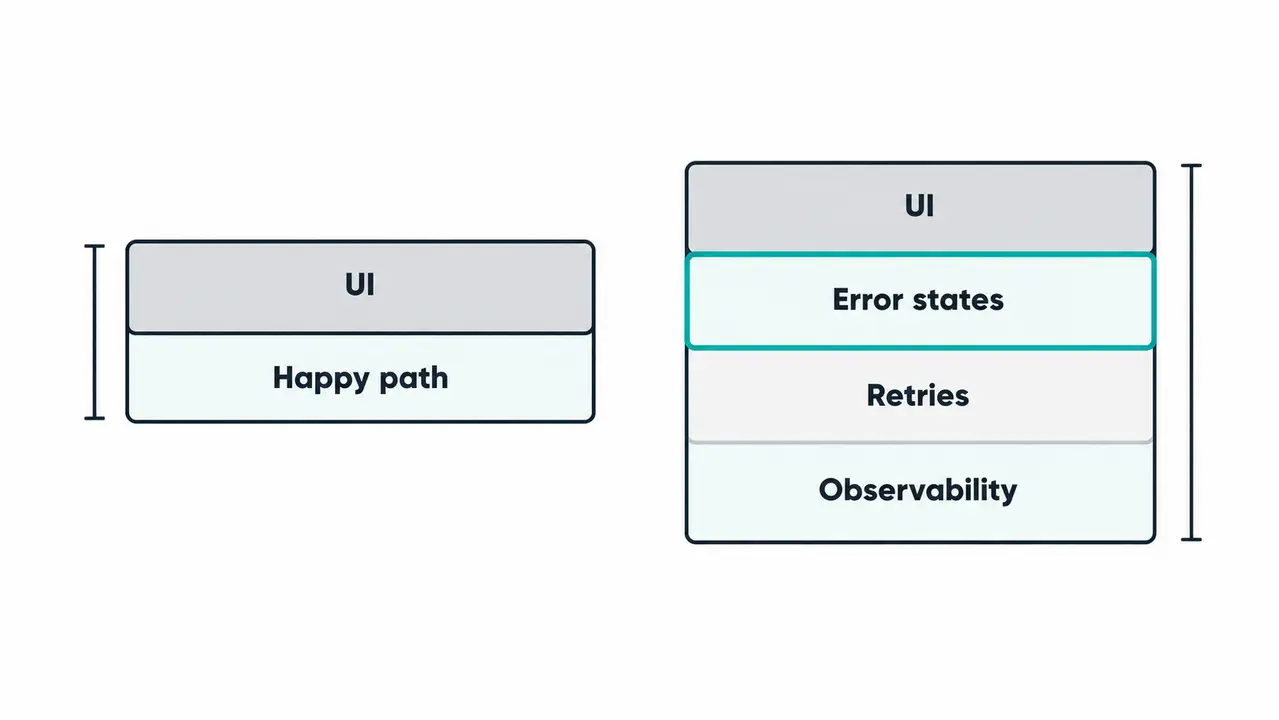
Backend depth is where scope quietly expands. Idempotency keys on payment submissions. Retry logic with exponential backoff on third-party calls. Data validation on every write path. Concurrency handling when two users edit the same record. Observability so you can answer why an order failed at 2 a.m. None of this shows up in Figma. All of it shows up in production.
Draft a sequence diagram for one critical workflow, such as a checkout flow that involves a payment provider, webhooks, and dispute handling. The diagram will surface more questions than any requirements document, because it forces you to answer what happens when the webhook arrives twice, or arrives never, or arrives before the user’s session is committed. These are the states that separate a demo from a system.
Build only the happy path and the bill arrives after launch, paid in manual intervention and operational load. We have inherited systems where every failed transaction became a support ticket, because error states were never designed.
Define data validation and error handling states alongside the primary interface, not as a cleanup task. If your product sits close to hardware or low-level systems, the same depth question applies to system and embedded engineering, where architectural fit is even harder to change later.
Discovery work is what makes an MVP estimate defensible
Discovery reduces uncertainty by converting assumptions into decisions. The output is not a slide deck. It is a set of artifacts your engineers can act on: a PRD-lite, user stories with acceptance criteria, an architecture sketch, and a risk register naming the three things most likely to derail delivery.
Skip discovery and the work does not disappear. It migrates into build time, where it costs more and moves slower. You will see the symptoms within a month: weekly product direction changes, engineering churn on half-finished features, and an estimate that has been revised twice.
The most valuable discovery output is often negative. Deciding during discovery that a data model assumption is wrong costs a whiteboard discussion. Discovering it three sprints in costs a migration. The same holds for third-party integration points, which is where we push teams to spike early, before a contract is signed with a provider whose API cannot do what the roadmap assumes.
There is a legitimate shortcut. A closed internal pilot with a controlled audience and fixed constraints can run on lighter discovery. If you know exactly who the users are and they sit within shouting distance, some formality can wait.
The minimum engineering practices that keep v1 from becoming a rewrite
An MVP can be lean without being fragile. The difference is a small set of protected practices: code review on every merge, automated tests on the critical paths, basic CI, and a release checklist that someone actually owns. Everything else can be deferred. These four cannot.
Write a definition of done for v1 and make it visible. Linting passes. Authentication and payment flows have test coverage. A rollback plan exists in writing, not in someone’s memory. Teams that abandon these practices to ship two weeks faster are borrowing against their next funding round, and technical debt of that kind shows up in diligence.
Prioritize reliability on the features that actually ship over breadth. Five solid features beat nine fragile ones, because the fragile nine generate the support load that stops iteration entirely. The NIST Secure Software Development Framework sets out baseline practices for code review and testing that map cleanly onto MVP-scale work, and it is a reasonable public reference for what “minimum” should mean (csrc.nist.gov).
Architecture choices that change effort early and compound later
Early architecture decisions affect both the build and every iteration after it. Monolith or services. Shared database with a tenant column, or schema-per-tenant. Where the boundaries of your data model sit. Each of these is cheap to choose and expensive to reverse.
Write an architecture decision record even for v1. One page, capturing the choice, the alternatives, and the reason, framed around the next two iterations of the roadmap rather than the enterprise vision. Six months later, when someone asks why the system is built this way, the answer exists instead of a shrug.
Premature microservices are the most common self-inflicted wound. A team of four does not need fourteen deployable units, distributed tracing, and a service mesh. It needs a monolith with clean module boundaries that can be split later if a real requirement appears. The operational overhead of services eats small teams alive.
The counter-case is real. If your first customers are enterprises whose contracts legally require tenant isolation, choosing multi-tenancy with strict separation from day one is correct, not premature. The rule is to build for the roadmap you have funded, not the one you imagine.
Integrations are the fastest way to blow up MVP scope
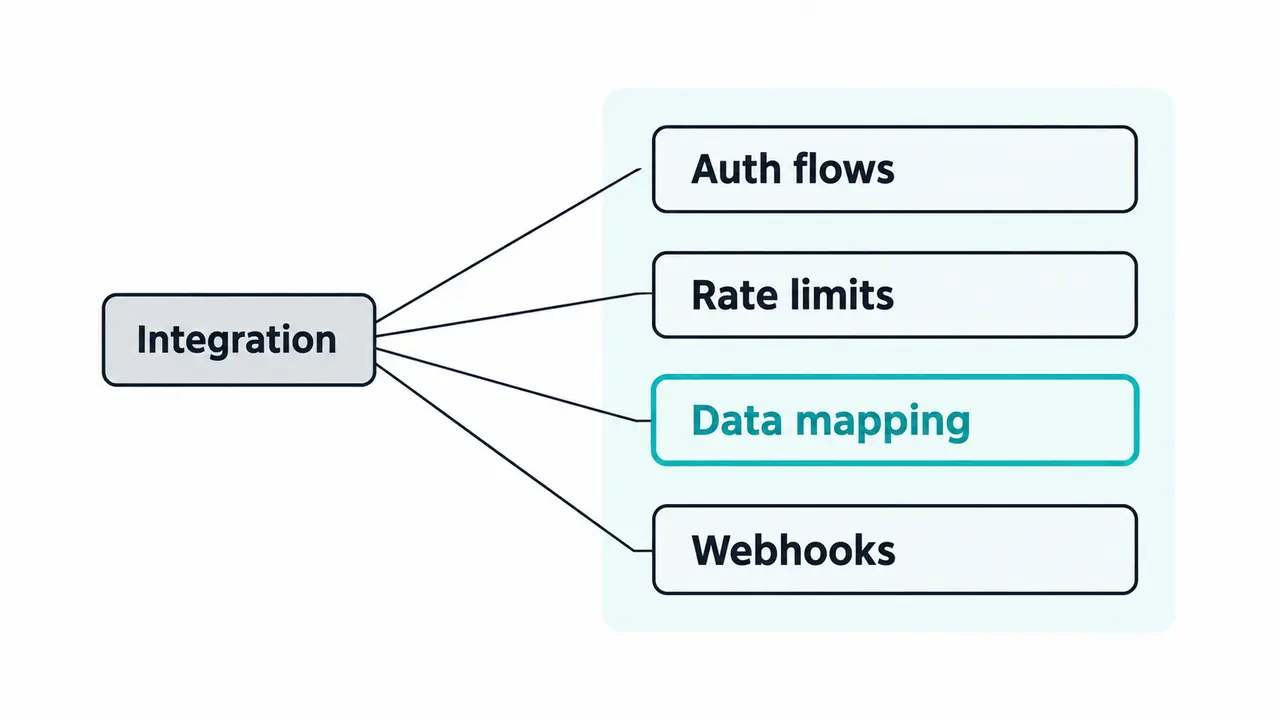
An integration looks like a checkbox in the feature list. In the codebase it is auth flows, rate limits, data mapping, retries, sandbox-versus-production behavior, and a support burden that starts the day the third party changes its API without telling you.
Treat every integration as a first-class feature with its own acceptance criteria. Draft an integration contract document for each connected service: which endpoints you call, which ones call you, who owns the credentials, and what happens on failure. The failure section is the one that matters. IEEE’s software safety material covers failure handling in interconnected systems and is worth a read before you design the retry policy (technav.ieee.org).
The pattern we see repeatedly: an estimate assumes a payment or CRM integration is two days of work because the API is “simple”. Then the data mapping reveals that the third party’s object model does not match yours, pagination behaves unexpectedly at scale, and the sandbox environment does not implement the webhook behavior production has. Three weeks gone, none of it visible in the UI.
Count your integrations honestly during scoping. Each one is a feature, an ongoing operational relationship, and a point of failure you do not control.
Data handling decisions that create long-term cost
Retention, auditability, and privacy expectations shape how deeply the storage layer must be built. Teams postpone these decisions because they feel like compliance paperwork. They are actually schema decisions, and schema decisions get harder to change with every week of accumulated data.
Before designing the database, draft a data classification table. Which fields are personal data, which are sensitive, who can access them, and how long must each class be kept? Attach a basic retention policy. This takes an afternoon and prevents a rebuild.
The classic trap is account deletion. “Users can delete their account” sounds like one endpoint. In reality it forces cascading deletes across every related table, anonymization strategies for records you must keep for audit, log policy changes, and decisions about what happens to data already synced to a third party. Teams that did not classify their data end up rebuilding their storage foundations midstream, with users actively waiting.
A closed internal pilot can run simpler policies if no external compliance applies. The moment real customers arrive with GDPR in scope, the classification work is no longer optional, and doing it before the schema exists is dramatically cheaper than after.
QA and release readiness as a controlled budget, not a late scramble
Scope testing like a feature. Decide what will be tested, how, and by whom, at the same time you decide what will be built. Saving all QA for the final sprint does not compress it; it multiplies it, because every defect discovered late costs more to fix and pushes the release date in a way nobody planned for.
Build a test plan for v1 with three components. Smoke tests on every critical path, run on each build. Regression coverage on the core flows, automated in CI. A device and browser matrix aligned to your actual target users, which for a B2B tool often means three versions of Chrome and nothing else.
Define the release checklist early and put a name next to each verification step. Ownership is the difference between a checklist and a piece of documentation nobody reads. Who verifies the deployment? Who watches the error dashboard for the first hour? Who is authorized to roll back, and at what threshold?
Perfect coverage is not the goal and never was. Critical paths stable, known gaps documented, and a rollback that has been rehearsed once. That is a defensible release position for v1.
The week after launch is part of MVP development cost
Most releases require immediate iteration. Bugs that only surface with real traffic, onboarding friction that analytics finally makes visible, instrumentation that was logging the wrong event all along. If your budget ends at launch, you have budgeted for the easy half.
Schedule a stabilization sprint immediately after launch, two weeks, with a prioritized defect triage process. Triage matters more than speed. Without it, the loudest stakeholder decides what gets fixed, the angry email becomes the backlog, and the actual blockers wait in the queue.
Treat telemetry and logging as release features, not as nice-to-haves. You cannot remove onboarding friction you cannot see. Instrument the activation funnel before launch so the first cohort of users produces signal rather than anecdote.
A closed beta with a small cohort changes the math significantly. The support load drops, the iteration cycle can run slower, and the cost of any single defect is a conversation rather than a churn event. If your hypothesis can be tested on twenty hand-picked users, that is a cheaper experiment than a public launch, and it is a scope decision worth making deliberately.
Team model choices that change delivery risk
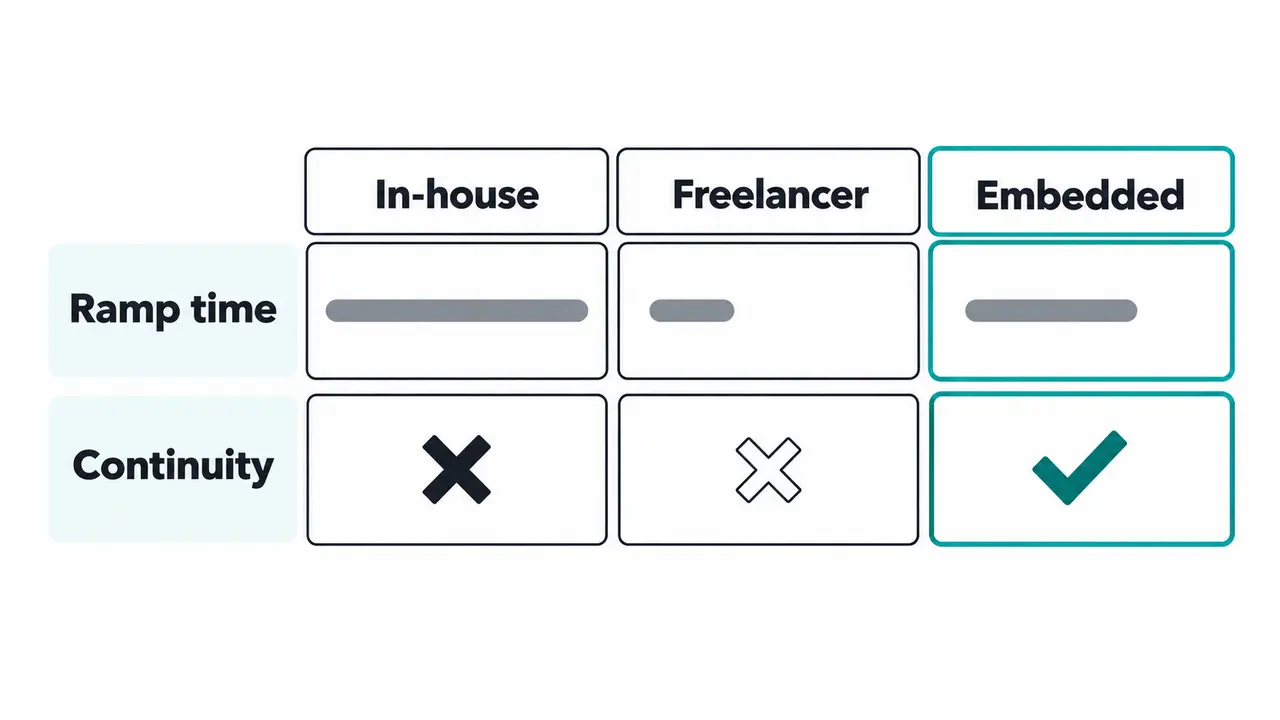
In-house, freelancers, or an embedded team. Each model shifts delivery risk between you and the builder in a different way, and the trade-offs are not primarily about cost. They are about control, continuity, and how much management bandwidth you have.
Before comparing options, create a responsibility matrix covering product ownership, architecture, QA, DevOps, and delivery management. Then check who carries each responsibility under each model. The comparison below uses the same dimensions.
| Dimension | In-house hire | Freelancer | Embedded team |
|---|---|---|---|
| Ramp time | Months of recruiting and onboarding | Days, for narrow scope | Weeks, with existing team structure |
| Continuity | High if retention holds | Low, ends with contract | High, built for duration |
| Management load on you | Full people management | High if scope is vague | Shared with technical leadership |
| Best fit | Long-term core ownership | Isolated technical tasks | End-to-end MVP delivery |
Choose a model solely on perceived speed and you will find the bottleneck in your own calendar. Evaluate how each option handles cross-functional delivery, code review, QA, and the iteration that follows launch. Sentice describes its approach to dedicated software engineering teams on its services page, which is a useful reference point for what the embedded model commits to on those dimensions.
Why in-house hiring stalls when the roadmap is urgent
In-house hiring is the strongest model for long-term ownership and often the slowest path to first shipment. Recruiting a senior engineer in a competitive market takes months. Onboarding takes another month before the first meaningful commit. If your objective is time-to-learning, that timeline is the constraint, not the code.
Draft a hiring plan and an onboarding plan side by side, and the hidden work becomes visible: sourcing, interview loops, offer negotiation, equipment, environment setup, and the first-ninety-days ramp. Now compare that against the window in which your MVP needs to be in users’ hands.
The sharper risk is concentration. A first engineering hire who owns the architecture, the code reviews, the deployment pipeline, and the domain knowledge is a single point of failure. When that person is sick, on vacation, or poached by a better offer, delivery stops. Early-stage companies rarely recognize this until it happens.
None of this argues against in-house. It argues against in-house as the fast path. If the roadmap is urgent, this is the weaker option, and the honest move is to plan it as the second phase rather than the first.
Freelancers can reduce coordination cost or multiply it
Freelancers work best when the scope is narrow, the interfaces are clear, and someone inside your company can integrate the output directly. A well-specified API integration, a performance investigation, a design-to-HTML conversion. In those cases the model is fast and the coordination cost is genuinely low.
Use freelancers for end-to-end product delivery and the model inverts. Multi-surface products need a product owner, a QA function, and someone arbitrating between the frontend contract and the backend contract. When three freelancers hold those three pieces, the founder becomes the de facto product manager, tester, and integration layer. That is a real job, and doing it while also running the company is where MVP timelines die.
Protect yourself with paperwork if you go this route. A statement of work with explicit deliverables and acceptance tests, per engagement, every time. Vague deliverables produce vague results and no recourse.
For an MVP that needs complex integrations and continuous iteration after launch, freelancers are the weaker option. The model has no mechanism for accumulating product context across iterations, and that context is most of what an MVP becomes.
Embedded engineering teams optimize for continuity and predictable iteration
An embedded team is strongest when you need a stable delivery unit that builds product context over time and owns quality with its own technical leadership. The team plans, reviews, and releases on a cadence you agree on, with ownership boundaries written down. Churn is the enemy of that model, and the model exists specifically to prevent it.
Constant team rotation destroys domain knowledge and forces repeated context switching. Every new engineer spends weeks learning what the previous one knew. An embedded structure, where the same group carries the product across iterations, is the direct countermeasure, and it is why end-to-end product development partnerships suit situations where the MVP is the start of a product line rather than a one-off build.
Stack Overflow’s 2024 Developer Survey reports that 42 percent of developers work hybrid and 20 percent in person, which reflects the distributed reality most delivery teams now operate in (survey.stackoverflow.co). Stable teams with strong engineering culture remain the variable you control regardless of where people sit.
Others simply supply developers. We become part of your company, and for an MVP that must survive its own launch, that distinction is the whole decision.
A scoping workflow that keeps MVP effort from drifting
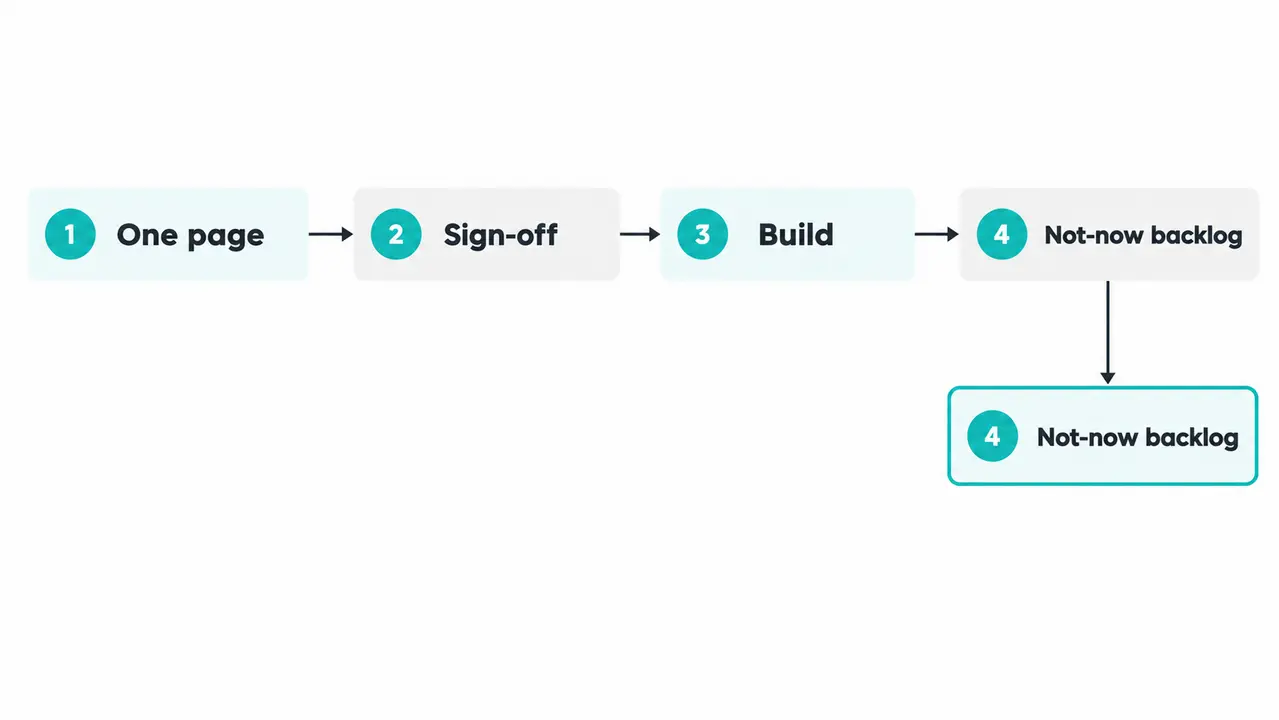
Scope drift is rarely a dramatic decision. It is a sequence of small tweaks, each defensible, each arriving from a stakeholder who “just needs one thing” before the launch. Six weeks later the effort has doubled and nobody approved a doubling.
Scope holds when three things are written down before code: the hypothesis you are testing, the single user journey that tests it, and the minimum operational requirements to run that journey in reality. Compress it into a one-page v1 boundaries document and get sign-off from product and engineering leadership. One page matters. If it does not fit, the scope is not yet decided.
Then apply a hard rule. One primary user, one core job-to-be-done, one success metric. Everything else goes into a backlog with a stated “not now” rationale, which is different from “no” and protects the relationship with stakeholders whose ideas are recorded rather than dismissed.
That backlog is also what protects your startup budget. Every addition disguised as a tweak is an expansion of MVP pricing, and the boundaries document is the artifact that makes the expansion visible the moment it is proposed, while it is still a decision instead of an invoice.
What to bring to an estimation call so you get a usable answer
You get a usable estimate when you bring decision-ready inputs. A pitch deck produces a number; a scope brief produces a plan. The number will change, the plan will not.
Prepare a specific checklist before the call. Target platforms. User roles and the permissions matrix. The integration inventory. Data sensitivity classification. Migration needs, if any legacy data must come across. Expected load bands, even as rough ranges, because they change architectural assumptions immediately.
Bring sample artifacts if you have them. Wireframes, even rough ones. A workflow diagram for the core journey. Acceptance criteria for the top five user stories. These do not need to be polished. They need to remove the estimator’s need to guess, because every guess is a place where the estimate silently diverges from what you actually want.
If you only have an idea, that is not a failure state, but requesting a build estimate is the wrong move. Start with a discovery phase instead, and let the estimate come out of it. Committing to a build number before scope exists is how rework gets scheduled in advance.
Put your scope on one page before anyone quotes it
Bring your roadmap and your constraints to a consultation, and we will help you turn them into a scope brief that holds.
Frequently asked questions
What is the difference between MVP scope and product roadmap scope?
MVP scope covers only the minimum features needed to validate your core hypothesis with real users. Roadmap scope includes the iterations, scaling features, and secondary audiences that come after validation. Mixing the two is the most common cause of inflated v1 estimates.
How do I decide what production-ready means for v1?
Production-ready for v1 means the system handles real users securely, has basic monitoring in place, and does not collapse under expected load. It does not mean high availability, multi-region deployment, or a full observability stack. Define the threshold in writing before the build starts.
What makes two estimates for the same MVP differ so much?
Estimates diverge because of assumptions about backend depth, integration complexity, and the level of automated testing included. One vendor assumes the happy path; another prices the error states. The estimate that looks expensive is often the one that assumed reality.
How do integrations change MVP effort even if the UI is simple?
Integrations require handling external API failures, rate limits, and data synchronization, all of which are invisible in the interface. Each connected service also carries ongoing support burden when the third party changes its API. Treat every integration as its own feature with acceptance criteria.
What should be documented before engineering starts?
You need a scope brief, user stories with acceptance criteria, an architecture sketch, and a basic risk register. Add a permissions matrix and an integration inventory if either applies. Together these documents are what make any estimate defensible weeks later.
How do I prevent a v1 from turning into a rewrite?
Protect basic engineering practices like code review, CI, and tests on critical paths, while keeping the architecture simple enough for your current team size. A clean monolith with tested core flows can iterate for years. A fragmented codebase with no review process cannot, no matter how fast it shipped.
The next step is to choose what you are willing to risk
An MVP is a controlled bet on a product hypothesis, and the cost is set by how much risk you choose to carry. Decide now what v1 optimizes for, whether that is speed to learning, operational stability, or future extensibility. If you cannot state your non-goals in one paragraph, no estimate will hold. Align on the boundaries and the delivery model before anyone writes code.
About Sentice

Sentice is a boutique software engineering partner founded in 2013 by Roni Levi and Martin Petkovic, now headquartered in Skopje, North Macedonia. Rather than supplying individual developers, we build embedded teams that blend with a client’s culture, tech stack and goals, working together from a single office under our own technical leadership. We deliver dedicated software engineering teams, end-to-end software solutions, product development, and system and embedded engineering, and we act as technical advisors across the full development lifecycle, from specification and architecture through development, testing and support. We use AI coding tools across every project, and we help clients integrate AI into their own products through chatbots, MCP services, connected application layers and workflow automation. Some of the clients we started with more than a decade ago are still building with us today.