
Your team has been building the mobile app for four months. The backlog is half done, the store listing is drafted, and nobody can answer the one question that matters: will a real user complete the core job and come back? That question was never written down. The build started from a feature list, the feature list grew, and the learning goal got lost somewhere around sprint three. This is how most mobile MVPs die, and it is preventable with one document and a set of decisions made before the first screen is designed. Below, we walk through how to define the single testable journey, scope it, choose the platform strategy, instrument it, and run the learning loop after launch.
Reading time: 14 min
Key points
- A mobile MVP is one complete end-to-end journey that tests a single written hypothesis, not a smaller version of the roadmap.
- A two-page scope document with the hypothesis, the core journey, and the non-goals beats a twenty-page PRD nobody re-reads.
- Analytics and crash reporting are part of the build, not post-launch work; an unmeasured MVP produces zero learning.
- The week after launch is where most MVPs stop learning; a weekly data review protects the entire investment.
Table of contents
An MVP for mobile app delivery means one testable journey, not a smaller product
An MVP for a mobile app is the smallest release that lets a real user complete one end-to-end job and produces evidence about a single risky assumption. That is the whole definition. The minimum viable product for mobile is not a shrunken version of the roadmap. It is one complete loop: an entry point, a core action, a visible result, and a reason to return. That loop is the core user journey.
Teams that ship “lite versions of everything” fail on mobile for a specific reason. Screen space is scarce, permissions create friction, and offline behavior punishes half-finished flows. Mobile users tolerate fewer steps than web users, so every added surface raises uninstall risk rather than adding value. The deliverable is a working build distributed through TestFlight or an internal testing track, not a slide deck or a clickable mockup. When a team ships a small version of every planned feature, it learns nothing about any single one and cannot decide what to build next.
The hypothesis the MVP must prove
Every MVP begins with a written hypothesis in measurable terms. Something like “users will complete onboarding in under two minutes” or “users will return within seven days without push reminders.” Product discovery for mobile is the activity that produces this hypothesis, through interviews, workflow observation, and competitor teardowns with the target segment. The hypothesis determines the scope, not the other way around. If the scope is already fixed and the hypothesis is being retrofitted to justify it, you are building a product, not running an experiment.
The decision you need before scoping is what you are trying to learn
Scope becomes straightforward once the team writes down the learning goal in measurable terms, not feature terms. “Will users complete onboarding in under two minutes” is a learning goal. “Will they return within seven days without reminders” is another. Each one maps to a minimal build. The onboarding goal requires an onboarding funnel with instrumentation on every step. The return goal requires a return-session event and a waiting period, which means the app must be stable enough to sit on a device for a week.
The artifact that makes this real is a one-page learning goal memo, signed by the product lead and the engineering lead before any screen is designed. Translated into engineering tasks, it produces the MVP requirements. The failure it prevents is polished UI wrapped around an untested value proposition, which happens when a team skips the learning question and jumps straight to features. One counter-case to watch for: if your team cannot agree on a single learning goal, that disagreement is itself the signal. Narrow the user segment further before scoping anything.
Where teams confuse mobile prototype work with MVP work
A mobile prototype validates comprehension and flow. An MVP validates behavior under real-world conditions, including latency, permission prompts, and interruptions from other apps. The line between mobile prototype vs MVP work is whether real user data is being captured on real devices.
Prototype artifacts are clickable Figma files, low-code demos, and scripted usability tests. They answer the question “can users understand the flow.” MVP artifacts are production-like authentication, analytics events, crash reporting, and a deployable build. They answer “will users actually use it.” There is a legitimate case for stopping at the prototype stage: complex workflow alignment with enterprise stakeholders before any code is written, where the cost of a misunderstanding exceeds the cost of a two-week Figma sprint. We have seen teams spend six engineering weeks on a build that a prototype would have resolved in days, because the real problem was workflow confusion, not product behavior. The verdict is simple. If the open question is about understanding, prototype. If it is about behavior, build the MVP and instrument it.
App validation starts with a narrow user segment you can actually reach
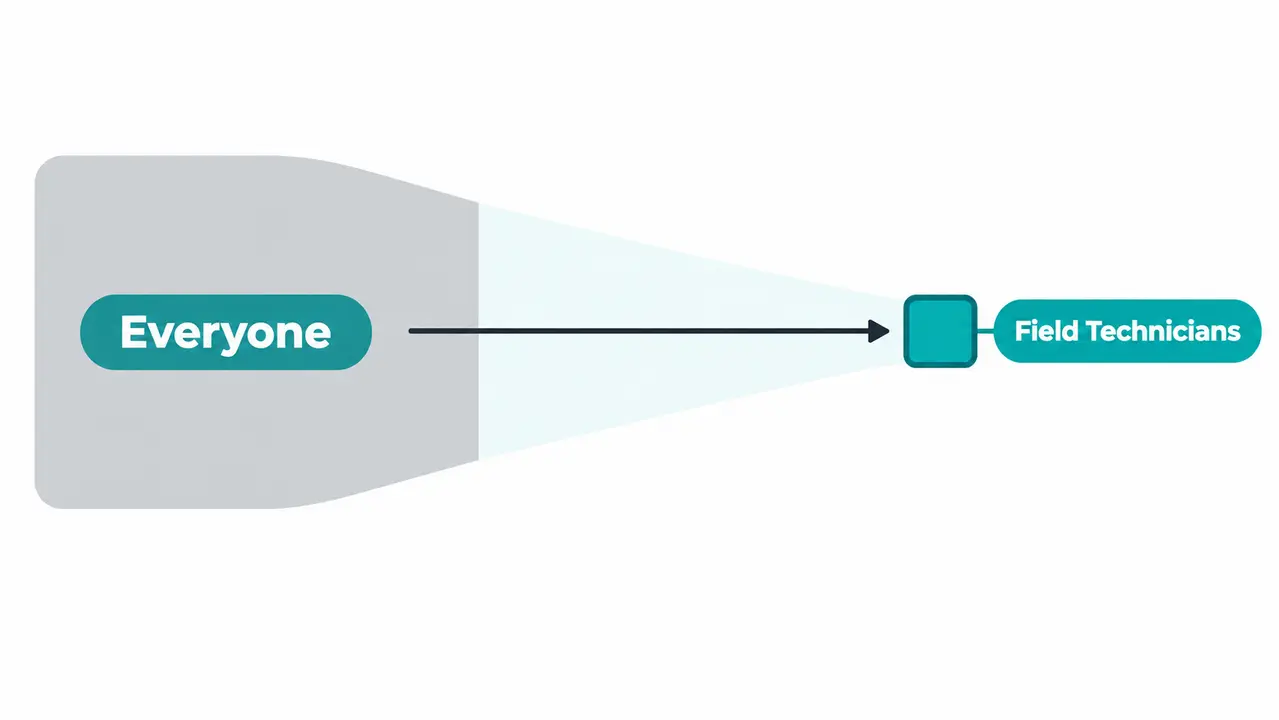
App validation fails when the target user is “everyone.” It works when the first cohort is specific enough to recruit within weeks. Define the cohort by role, context, and trigger: field technicians closing jobs onsite, or property managers confirming turnovers between tenants. Both descriptions tell you where to find these people and what moment the app must serve.
Recruitment channels are closer than you think. Existing customer lists, partner communities, sales discovery calls, and founder networks all work. No public store launch is needed, and none should be attempted yet. Before the first build ships, you want a recruitment plan with 15 to 20 named participants already contacted. The app validation plan is the document that captures the cohort definition, the recruitment method, and the feedback collection approach. It is the operating plan for the whole effort to validate an app idea. Shipping to the public store with no distribution plan, then waiting for organic downloads that never come, is the failure mode this prevents. Store reviews from strangers cannot replace structured interviews with a defined segment.
The MVP scope document that keeps engineering and product aligned
A short scope document beats a long PRD for MVPs when it locks three things: the hypothesis, the core journey, and the non-goals. The MVP scope document should be two pages. It contains a problem statement, a target user, a success metric, an out-of-scope list, and the MVP acceptance criteria for the one journey. Nothing else earns a place in it.
The concrete anchor is a single happy-path sequence diagram plus a screen inventory of no more than 8 to 12 screens. If the inventory runs longer, the journey has grown a second journey. The out-of-scope list is what protects the timeline, because scope creep arrives disguised as small additions that each seem harmless and together push the build past the learning window. A well-structured product development engagement starts with this scope document before any code is written, and the MVP acceptance criteria it defines are the checkpoint that determines when the build is done. A two-page document signed by both leads is stronger than a twenty-page PRD that no one re-reads during the build.
Feature selection works best when you start by deleting
The fastest way to a viable MVP is to remove anything that does not directly support the core journey or its measurement. MVP feature prioritization is mostly a deletion exercise, and it should be run as one. The standard deletions for a first mobile release: social features, referral programs, theming options, multi-language support, complex admin portals, and settings pages. None of them changes the validation decision.
Define “must-have” precisely. A must-have is something required to complete the core user journey reliably, not something that would be nice to have at launch. Run a single feature deletion meeting where the product lead must justify each surviving feature against the learning goal, out loud, feature by feature. The survivors become the MVP launch checklist, which is the build reference the engineers work from. The failure this prevents is the steady accumulation of one feature per stakeholder request until the team ships a bundle that tests nothing cleanly. Deletion here is a deliberate engineering decision, not a budget constraint. If a feature does not change the validation decision, shipping sooner with instrumentation beats shipping later with that feature.
Native versus cross-platform is a delivery risk decision, not a preference
Pick the approach that minimizes schedule and maintenance risk for the first learning cycle, then revisit once retention is proven. The native vs cross-platform decision is a risk assessment, and it should be made against a written platform risk list, not developer sentiment.
| Risk area | Native strength | Cross-platform strength |
|---|---|---|
| Push notifications | Full platform API access | Adequate for standard use |
| Deep links | Reliable on all OS versions | Needs per-platform testing |
| Offline behavior | Direct storage control | Good with local databases |
| Camera and media | Full hardware access | Covered by mature plugins |
| Bluetooth Low Energy | Complete background support | Frequent plugin gaps |
| Background processing | Full OS capability | Framework-dependent |
Native wins when the product depends on deep platform integrations, performance-critical UI, or hardware-dependent features. A React Native MVP or a Flutter MVP wins when the differentiator is the workflow, not the hardware: one codebase, faster iteration, consistent UI, and a smaller team footprint. Cross-platform is the weaker choice when the differentiator depends on low-level hardware access or OS-specific behavior a framework abstracts poorly. The classic failure is choosing a framework because the team knows it, then discovering a platform limitation three weeks before the first beta.
iOS first, Android first, or both depends on your earliest distribution path
Platform order should follow where the first reachable users already are, not where the team feels most comfortable. If your first cohort is internal enterprise testers on managed devices, follow that fleet reality, even if it means building for the platform your lead engineer likes least. If the product needs rapid iteration with fewer device permutations, one platform first reduces noise in early data, and noise is the enemy of a small-cohort study.
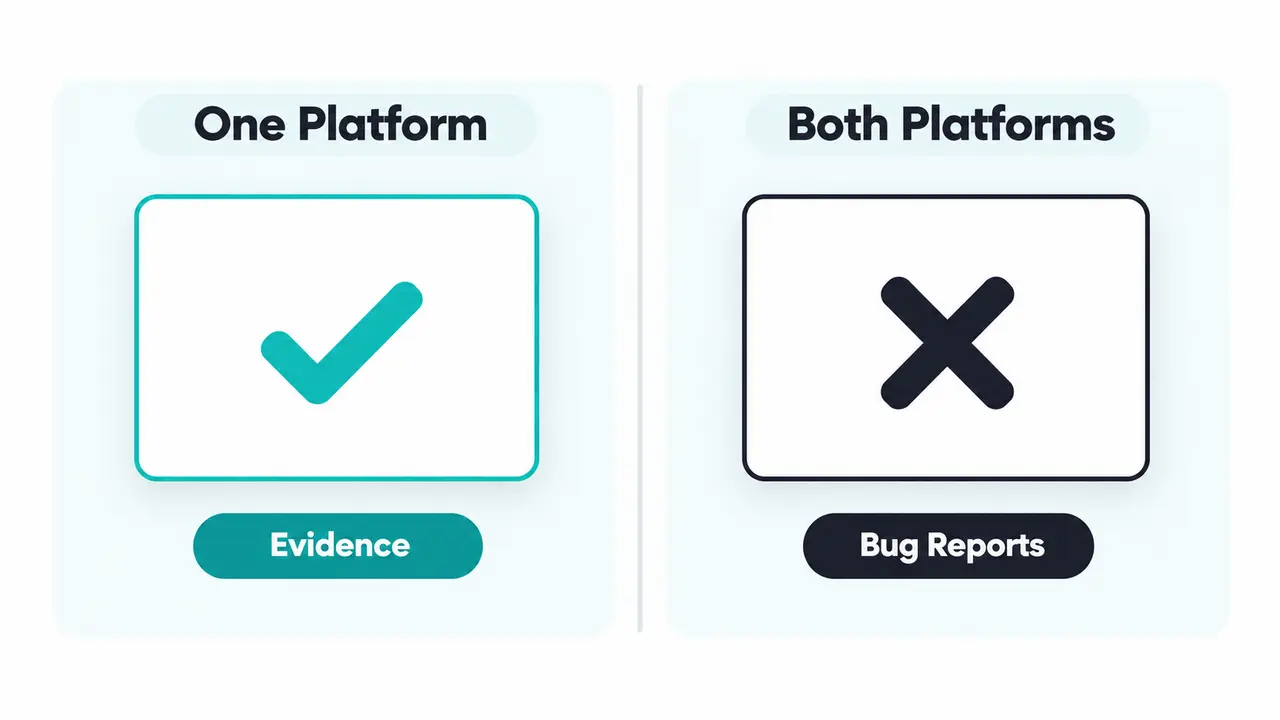
Write a platform selection memo with three items: a user share estimate by platform for your specific cohort, the device constraints that cohort operates under, and the release workflow per platform. The memo takes an afternoon. The failure it prevents is building both platforms in parallel when the team cannot support two release trains during validation, which produces delayed fixes on both sides and a learning loop that stalls. Building both platforms in parallel is weaker than building one well when the team has fewer than four mobile engineers. One platform, shipped and instrumented, produces evidence. Two platforms, half-shipped, produce bug reports.
When a mobile web MVP is the better first step
A responsive web app is the right first step when the learning question is about workflow comprehension, not native behavior. If the cohort reaches the product through shared links and the core journey needs no camera, push, or background processing, the web test answers the question faster and cheaper. The mobile app MVP build is the native path that follows if the web test validates. Web-first is stronger in that scenario, weaker in any scenario where the hypothesis itself depends on native permissions or device sensors.
Viable on mobile includes reliability work people try to postpone
Mobile viability is less about feature count and more about resilience. Crashes, offline behavior, permission failures, and slow networks are the conditions your MVP actually ships into, and users judge the product under those conditions, not the demo conditions. The minimum reliability set is crash reporting, basic performance monitoring, and graceful error states with retry options on every API call.
Track crash-free sessions from day one as the primary reliability metric. Decide your offline stance explicitly: offline-first, offline-tolerant, or online-only with clear messaging to the user. Document that decision, because an undocumented stance produces inconsistent behavior across screens. Your push notifications strategy also affects perceived reliability, since silent delivery failures look exactly like bugs to users. Build a reliability checklist with three items: crash reporter configured, error states designed for every API call, and the offline stance written down. Early adopters churn after a single “it did not work once” moment and rarely return for a second chance. Shipping without crash reporting is weaker than delaying launch by two days to wire it in, because a crash-free session rate below 95 percent invalidates every other metric you collected.
The minimum backend for an MVP is usually smaller than the minimum app
Many MVPs need a thin backend that supports identity, data storage, and event tracking. Not a microservices architecture, not an event bus, not a service mesh. Start with a modular monolith or a small set of services with clear boundaries between domains, and resist anything more until the data forces the issue.
Define the data model for the core journey, plus an audit trail for the key actions your validation metrics depend on. If the metric is “core action success,” the backend must record when core actions succeed, and that record must be trustworthy. Mobile app instrumentation is a backend responsibility as much as a client one, because the event data your team needs flows through an ingest endpoint you own. The failure mode here is over-architecting before product-market evidence, which we have watched teams do repeatedly: event buses and service meshes built for traffic that never arrives during validation. Within a disciplined MVP app development process, backend scope should be derived from the analytics spec, not from anticipated scale. A single well-structured service beats five microservices when the user base is under 200 testers.
Analytics design is part of MVP development, not a post-launch task
If the team cannot measure the core journey, it cannot validate the MVP, even if users rave in interviews. App MVP development has to include analytics in the build plan, wired into the same sprints as the screens. The event taxonomy follows the hypothesis: onboarding start, onboarding complete, core action start, core action success, return session. Five events, each mapped to a step in the journey the MVP exists to test.
The document that holds this together is the analytics event tracking plan, listing every event name, its properties, and the owner responsible for correct instrumentation. The practical version is an analytics spec table with five columns: event name, trigger condition, properties, platform, and owner. The onboarding funnel should be the first instrumented flow, because that is where most mobile MVPs lose users before the core action ever runs. We have sat in post-launch reviews where the team argued from opinions for an hour because the data was simply never captured. A build without instrumentation is weaker than a one-week delay to wire events, because an unmeasured MVP produces zero learning.
A mobile MVP needs a release workflow that supports weekly learning
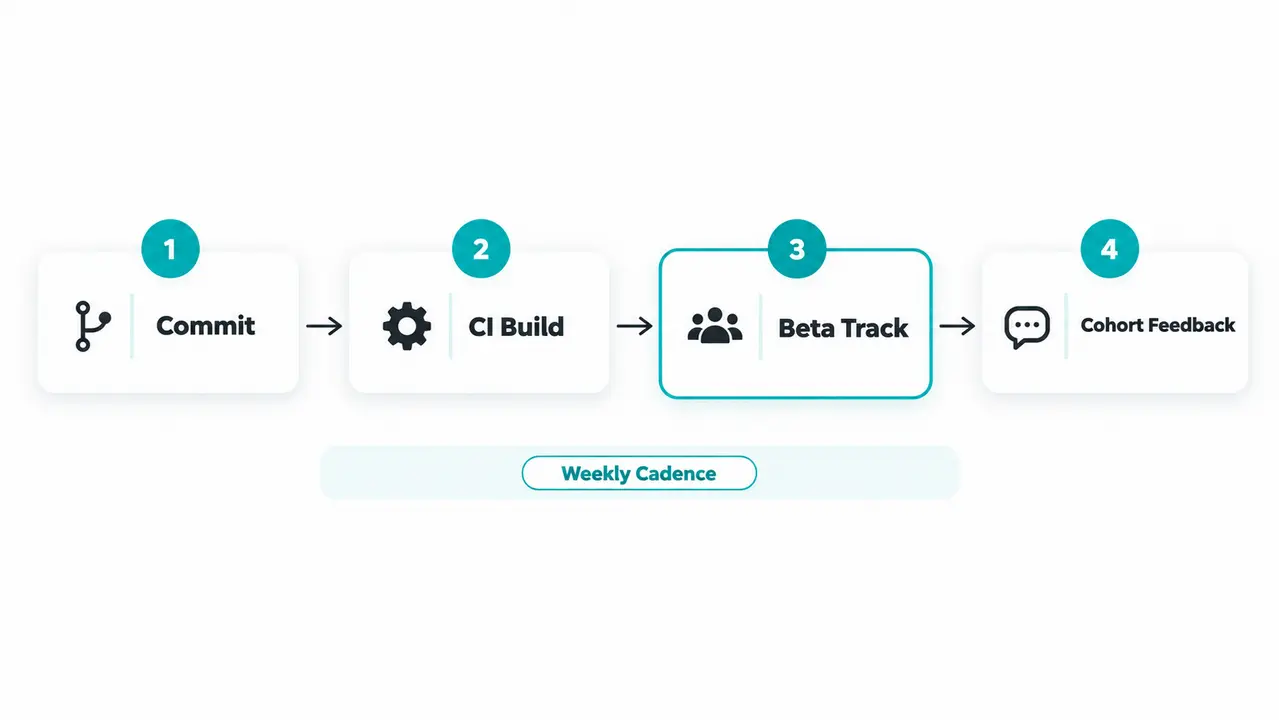
Validation speed depends on a predictable release pipeline, not heroic pushes right before demos. Set up CI, automated builds, and a beta distribution process early, before the first feature is complete. The beta release pipeline is what makes weekly releases possible, and the release train is the cadence concept: a fixed weekly or biweekly release window the whole team commits to, with a rollback plan attached.
On iOS, TestFlight beta is the distribution channel for external testers, with the internal testing track playing the same role on Android. Both need to be configured before the cohort is recruited, not during recruitment week when App Store review times become an unplanned variable. A release cadence and a rollback plan belong in the definition of done, alongside QA on a device matrix, basic security checks, and a signed release artifact. GitHub Actions handles the build automation for most teams at this stage. The failure mode is quiet and cumulative: releases become unpredictable events tied to individual developers, the learning loop stretches from one week to four, and the cohort loses interest before the second build arrives. A one-week cadence with modest automation beats “release when ready,” which in practice means never.
Security and privacy decisions you cannot defer past MVP
You can defer advanced controls. You cannot defer basic data handling decisions once real users and real data are involved. The minimum security set for an MVP is secure authentication, secrets management, encrypted transport, and least-privilege access to storage. Feature flags belong in this set too, as a practice that limits exposure of unfinished features and supports safe iteration on a live cohort.
The concrete artifact is a short data-handling decision document listing what data the MVP collects, where it is stored, who can access it, and what the deletion policy is. One page, four questions, answered before the first external tester enrolls. For a vendor-neutral reference on baseline practices, the NIST Secure Software Development Framework provides guidance for mitigating software vulnerability risk during development. The failure this document prevents is rework: compliance or enterprise procurement enters the conversation after launch, and the team must rebuild authentication and storage under pressure. Deciding what data not to collect is stronger than collecting broadly and discovering a compliance gap later.
The week after launch is where most MVPs stop learning
An MVP only pays off if the team has a structured plan for interviews, data review, and iteration immediately after release. The MVP iteration cycle is not a meeting. It is an operating discipline that starts the day the cohort gets the build. The loop we run: 10 to 20 user sessions in the first two weeks, a weekly metric review, and a prioritized experiment backlog that every new observation feeds into.
The learning review meeting has three sections, always the same three. What the data showed. What users said in sessions. What the next experiment is. Thirty minutes, weekly, with the product lead and the engineering lead present. Watch retention metrics as the primary signal in the first two weeks, not download counts, which tell you about marketing and nothing about the product. The most common failure in the entire MVP lifecycle happens here: the team celebrates the launch, returns to the backlog, and never reviews the data the MVP was built to produce. Adding more features in week two is weaker than fixing the core journey when completion rates sit below target. Protect the review.
What good looks like in early mobile MVP metrics
Early success is evidence of repeatable value, shown through completion, retention, and the qualitative “would be disappointed if removed” signal from cohort interviews. The right metric depends on the product type. Transactional apps look at task completion rate and time to complete. Daily-use apps look at day-1 and day-7 retention. Internal tools look at task adoption and support ticket reduction.
Choose 3 primary metrics and 3 guardrails. The guardrails are crash-free session rate, API latency p95, and support ticket volume, and they exist to tell you whether the primaries are trustworthy. A completion rate measured on a crashing app is not a completion rate. The MVP roadmap is the document that gets updated based on what these metrics show, and the MVP launch checklist is the pre-launch artifact that confirms the metrics are instrumented before the first user touches the build. The failure this structure prevents is the celebration scenario: downloads applauded while the core journey completion rate sits below 30 percent. A single north-star metric tied to the hypothesis beats a dashboard of twelve vanity metrics.
Common MVP failure modes that force a rebuild
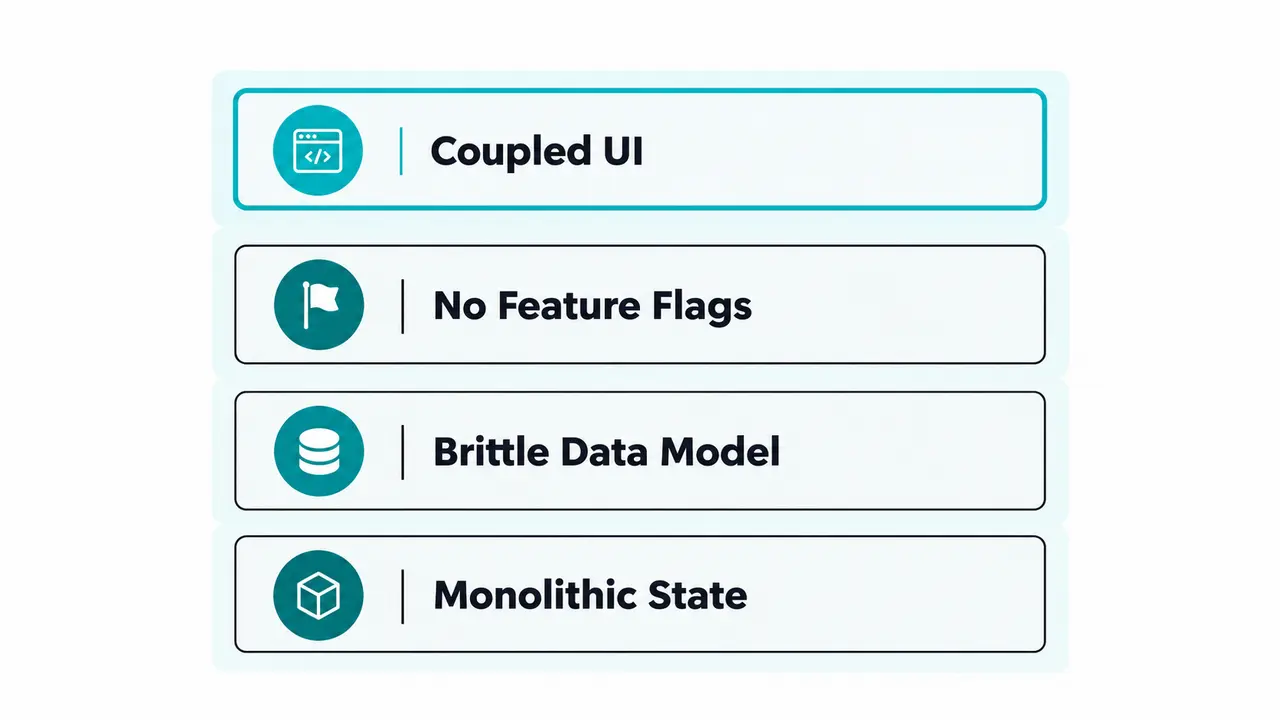
Most rebuilds come from three sources: unclear scope, missing instrumentation, and architecture choices that block iteration. The technical debt patterns we see forcing rebuilds are consistent. Tightly coupled UI and business logic, so the next screen drags three others with it. No feature flags, so nothing can be shipped dark and tested on a subset. Brittle data models with no migration path. Monolithic state management that turns every change into a regression hunt.
During MVP planning, create a technical risk register: a short document listing the known architectural risks and their mitigation. Review it at every release and add the risks testing uncovers. The mobile app proof of concept is the stage that should surface the worst of these risks before the MVP build begins, especially anything touching device hardware or background processing. Skipping that stage to save a week is how teams end up shipping fast, accumulating enough coupling that the next feature takes three times longer than the first, and rewriting at month six. One week of engineering hygiene now is cheaper than a stable base you never get.
When to involve an embedded engineering partner versus hiring in-house
Bring in an embedded partner when speed-to-learning matters and you need senior execution plus technical leadership without a six-month hiring cycle. Typical scenarios: a founder-led product with limited engineering bandwidth, a scaleup with competing roadmap priorities, or a team that needs mobile plus backend plus DevOps coverage in one coordinated cohort.
“Embedded” has an operational meaning. Shared rituals, shared code ownership, documentation, and direct integration with your internal leads. Not a handed-off black box. Sentice works this way, placing dedicated engineers inside client teams from one office in Skopje. The hiring-cycle argument is not rhetoric: Eurostat reports that the number of ICT specialists in the EU continues to grow, which means demand for senior engineering talent keeps rising and hiring timelines keep stretching. An embedded model provides dedicated software engineering teams without that delay. For scaleups especially, boutique partnerships accelerate tech team growth by compressing the time between scoping and first release. In-house hiring is weaker when it pushes the first validation cycle past the window where the market question is still urgent.
Short on senior mobile capacity before your validation window closes?
Tell us about your roadmap and we will help you scope the smallest build that answers your riskiest assumption.
Frequently asked questions
How is an MVP different from a proof of concept for a mobile app?
A mobile app proof of concept tests whether a specific technical approach works, such as whether background BLE scanning behaves correctly on a device fleet. An MVP tests whether users complete a real journey and come back. If your open question is technical feasibility, build the proof of concept first.
What should an app MVP include for app store readiness without overbuilding?
Store readiness requires a privacy policy, complete app metadata, crash-free stability, and a working core journey. Defer ratings prompts, social sharing, and localization to the post-validation phase. Your MVP launch checklist should confirm these minimum items before submission.
How many users do you need to validate a mobile MVP?
Fifteen to thirty users from a defined cohort provide enough signal to judge completion and return behavior. Statistical significance is not the goal at this stage. Directional evidence from the right segment beats a larger sample from the wrong one.
What is the minimum QA needed before an external beta?
Test the happy path on three device sizes and the minimum OS version you support, confirm every analytics event fires correctly, and verify crash reporting is active. Run this pass through the internal testing track before wider beta distribution. No full regression suite is needed for a first cohort of twenty testers.
What is a reasonable iteration cadence after the first release?
Weekly releases for the first four weeks, then biweekly once the core journey is stable. The MVP iteration cycle should match the learning loop, not the feature backlog. If releases outpace your ability to review the data, slow the cadence.
When does it make sense to rebuild the MVP into a v1 product?
Rebuild when the core journey is validated, the data model needs structural change to support scale, and you have a documented list of what the MVP proved and what v1 must add. Capture that transition plan in the MVP roadmap so the rebuild is scoped by evidence, not enthusiasm.
Choose the next experiment before you write the next ticket
Write the hypothesis, define the one core journey, and decide the single metric that triggers “double down” or “change direction.” Your job as the decision-maker is to protect engineering time by forcing that clarity before the next release begins. A well-run MVP for mobile app delivery is a measurement instrument first and a product second. A team that ships without a hypothesis ships a product, not an MVP. If you want a senior team to pressure-test that plan, book a free consultation.
About Sentice

Sentice is a boutique software engineering partner founded in 2013 by Roni Levi and Martin Petkovic, now headquartered in Skopje, North Macedonia. Rather than supplying individual developers, we build embedded teams that blend with a client’s culture, tech stack and goals, working together from a single office under our own technical leadership. We deliver dedicated software engineering teams, end-to-end software solutions, product development, and system and embedded engineering, and we act as technical advisors across the full development lifecycle, from specification and architecture through development, testing and support. We use AI coding tools across every project, and we help clients integrate AI into their own products through chatbots, MCP services, connected application layers and workflow automation. Some of the clients we started with more than a decade ago are still building with us today.