
A payment gateway response drops while a user steps into a subway tunnel. Your staging environment ran over high-speed office fiber, so every automated test passed with zero latency. In production, spotty cellular handoffs turn that delayed response into an unhandled exception.
Your customer sees a spinning wheel, taps the purchase button three more times, and ends up with multiple pending charges. The engineering team spends Monday morning digging through fragmented crash logs instead of shipping roadmap features.
Mobile app API integrations represent your real product interface, because users judge your application entirely on network reliability. When an external partner endpoint slows down or drops a payload, your client application absorbs the blame. Getting this integration boundary right protects your revenue, your release velocity, and your engineering sanity. This guide walks through the decisions that keep that boundary reliable, from authentication and token lifecycle to idempotent retries, offline behavior and observability.
Reading time: 13 min
Key points
- Mobile app API integrations are a product surface, not plumbing. Users blame your app when a vendor endpoint fails.
- Sensitive transactions belong behind a backend proxy. Direct vendor calls from the binary expose secrets and remove outage control.
- OAuth 2.0 Authorization Code with PKCE through the system browser, with secrets and exchange tokens kept server-side.
- Idempotency keys and exponential backoff with jitter prevent duplicate charges when responses vanish mid-transfer.
Table of contents
Mobile app API integrations as a product surface
Most teams treat network calls as invisible plumbing. We treat them as critical user interfaces.
When a payment gateway takes four seconds to confirm a charge during an LTE handoff, the user blames your software rather than the card processor. Every network timeout, malformed payload, or unexpected 502 status code surfaces directly as a product defect. In our engineering engagements, we frequently see staging suites that test endpoints against steady broadband connections. Those builds look immaculate until real devices hit patchy cellular towers in downtown Chicago.
Treating mobile app API integrations as mere background wiring guarantees that reliability flaws remain hidden until release day. A mobile client operates across erratic network boundaries with sudden radio drops and hostile operating system constraints. If your architecture treats vendor interactions as reliable pipes, your customer support desk becomes your monitoring system. Engineering leaders must design external contracts with the assumption that every remote dependency will fail repeatedly during normal usage.
Where teams misread the term third party integration
The phrase third-party integration covers four distinct structural patterns, yet product roadmaps routinely lump them into a single checklist item. A team might bundle an embedded SDK, call vendor endpoints directly from the device, or route requests through a server proxy.
Each topology creates entirely different operational burdens.
When leadership leaves these boundaries undefined, organizational friction follows immediately. Mobile developers assume backend engineers handle token rotation, while the platform team expects the native client to manage vendor quotas. This confusion produces duplicate authentication logic and inconsistent payload validation across your codebase.
Security teams need clear oversight of outbound network permissions, while client engineers need predictable payloads that match Swift and Kotlin models. Direct vendor dependencies inside client apps introduce unmonitored attack surfaces that backend firewalls cannot see. Establishing strict ownership between client, server, and security teams early prevents expensive refactoring cycles when compliance audits arrive.
When the app should not call vendor APIs directly
Calling vendor endpoints straight from iOS or Android binaries seems like an easy shortcut for rapid prototyping. That convenience comes with severe architectural costs. When the app opens a direct API connection to an external vendor, you give up control of traffic and outage mitigation, and you can no longer keep secrets confidential.
Android security documentation explicitly warns that compiling static credentials into client binaries allows reverse engineers to extract them using basic decompilers. If that vendor changes an authentication requirement, every installed version of your application breaks simultaneously until an emergency patch passes App Store review. Your backend cannot throttle outbound spikes, strip sensitive telemetry, or reroute failing traffic to backup providers.
Direct connections should remain restricted to public, read-only resources like mapping tiles or static asset distribution. Every business transaction involving sensitive user records or financial movement belongs behind a mediation tier. Placing a backend proxy between the client and third parties turns uncontrollable external risk into a governed boundary.
A quick decision rule for direct vs mediated calls
This decision framework outlines when to proxy external services through your backend infrastructure versus permitting direct client communication.
| Integration Requirement | Direct Client Call | Backend Mediated Proxy |
|---|---|---|
| Secret management | Severe key extraction risk | Safe secret storage in vault |
| Outage failover | Impossible without binary updates | Instant backend rerouting |
| Response caching | Fragmented device cache | Shared Redis caching tier |
| Rate limit defense | Vulnerable to client spikes | Central gateway queuing |
A reference architecture that survives real mobile conditions
A durable mobile architecture enforces strict division of labor across the network boundary.
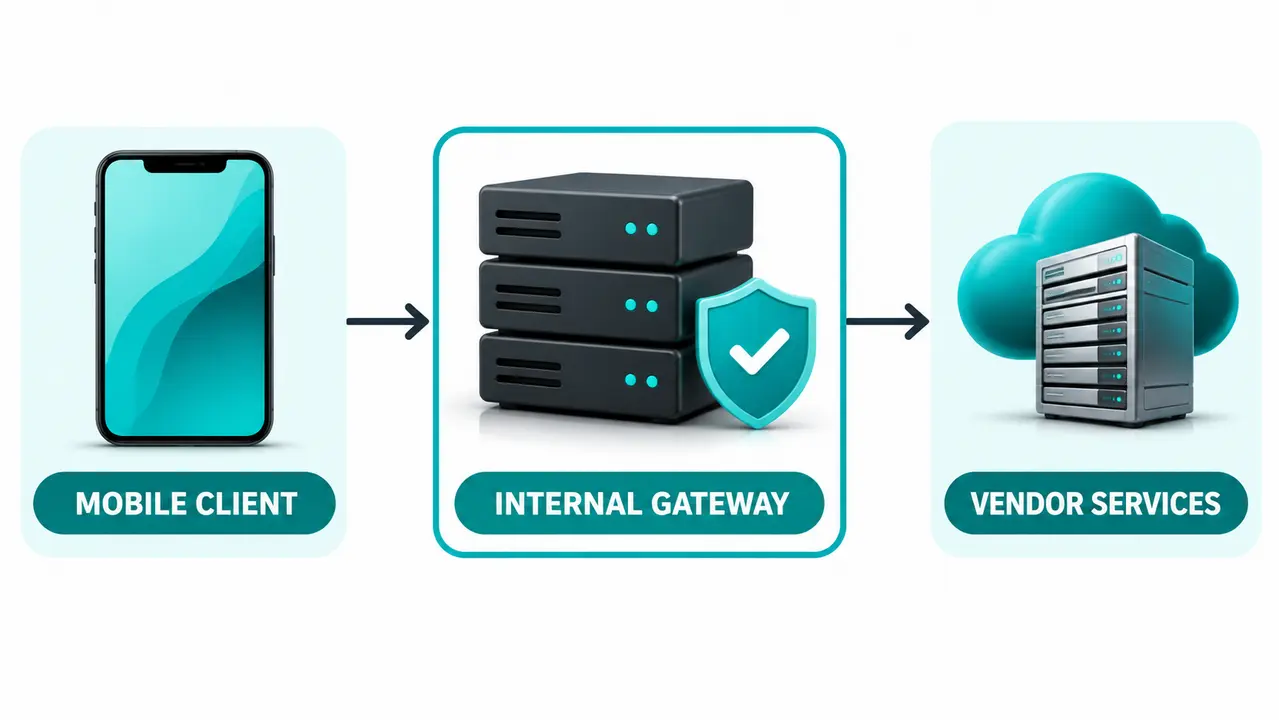
The native client focuses entirely on user experience, responsive state rendering, and local cache hydration. Your internal API gateway handles identity validation and payload transformation, keeping external providers completely isolated from device logic.
When a partner endpoint suffers degraded latency, your gateway swallows the delay and returns cached or synthetic defaults. The mobile user never sees an ugly raw stack trace or an unhandled timeout alert. This separation ensures that vendor contract changes require zero synchronized client updates.
To make this architecture maintainable, Sentice engineering teams maintain an integration README for every connected partner service. This document defines precise token scopes and strict timeout limits for every route, along with its retry policy and graceful fallback expectations. Without this explicit specification, integrations turn into black boxes understood by only one engineer, introducing an unacceptable operational vulnerability.
Authentication patterns that fit native apps
Authenticating native applications requires protocols designed for public clients that cannot protect confidential client credentials. The established standard is OAuth 2.0 Authorization Code with Proof Key for Code Exchange, executed through the system browser. Embedded WebViews look smooth, but they permit host applications to inspect credentials and violate OWASP mobile security recommendations. System browser sessions preserve shared cookie jars and separate authentication contexts from device code.
Redirect URIs, deep links, and universal links as integration plumbing
Universal Links on iOS and Android App Links provide verified cryptographic handoffs from the system browser back into your application. Custom URI schemes allow competing malicious apps to register identical prefixes and hijack incoming authorization codes. Verified domain links tie your backend to your specific application signature using hosted verification files, guaranteeing authorization codes return exclusively to your genuine native binary.
Keeping secrets out of the mobile binary
Every string, certificate, and configuration value bundled inside an application package is visible to anyone running basic disassembly tools. Obfuscators like ProGuard or DexGuard increase the effort required for extraction, but they do not stop a determined attacker. The only keys that belong inside your mobile binary are public client identifiers specifically designed for open distribution.
Third-party payment secrets, private signing keys, and administrative access credentials must reside exclusively on your backend infrastructure. When client apps need vendor capabilities, they request short-lived, narrowly scoped exchange tokens from your server. We recommend implementing strict linting checks in your CI/CD pipeline to block builds containing suspicious credential patterns.
Following the secure software development recommendations published in NIST SP 800-218, engineering teams should automate secret scanning across every commit. Leaking a private vendor secret risks data breaches, unauthorized billing spikes, and immediate provider suspension that grounds your entire business.
Token lifecycle design that avoids surprise logouts
Few mobile bugs frustrate active users more than getting booted to a login screen in the middle of a checkout flow. These surprise logouts typically happen because engineering teams treat session handling as a simple boolean flag rather than an asynchronous lifecycle.
Network requests must queue transparently behind active refresh operations when access tokens expire. If three concurrent requests encounter an expired token, your HTTP client must trigger a single refresh exchange and replay all pending calls once new credentials arrive. OWASP session management guidelines emphasize that local tokens must be purged from secure hardware storage like iOS Keychain or Android Keystore during explicit user logouts.
Testing this layer requires simulating extreme conditions before code reaches production devices. Teams should intentionally simulate device clock drift, expired refresh tokens, and network loss during token rotation. Handling these edge cases gracefully stops users from getting trapped in repetitive authentication loops after transient connectivity hiccups.
API contracts that tolerate old app versions
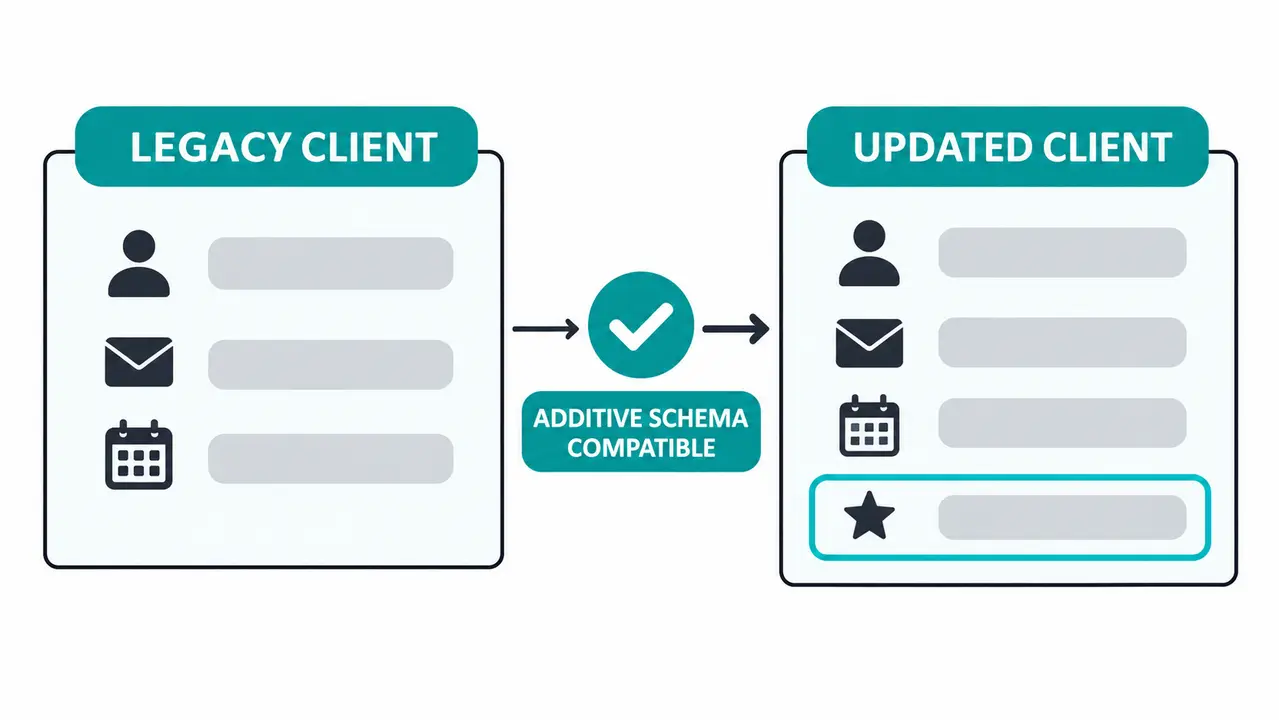
Web applications update instantly across all users, but native mobile clients linger in production environments for months. Users frequently disable automatic app updates, travel across low-bandwidth regions, or run older hardware that caps operating system compatibility. If your backend team alters an existing payload schema or renames a key, legacy installations crash instantly.
A lightweight versioning approach that works without duplicating the whole API
Maintaining backward compatibility does not require duplicating entire microservices for each minor iteration. Adopting strictly additive schema changes allows existing clients to ignore new keys while fresh releases parse them safely. Teams can manage structural migrations using server-driven configurations and runtime feature flags delivered via response headers. Deprecating legacy endpoints requires publishing clear migration schedules and tracking client version headers in server logs to confirm zero traffic before decommissioning.
Idempotent retries and timeouts as integration requirements
Mobile network requests do not simply succeed or fail.
They often succeed on the remote server while the response packet vanishes during a radio tower switch. When an app receives a network timeout on a transaction, the client has no way of knowing whether the backend processed the write.
Submitting an unthrottled retry without unique request identifiers creates catastrophic state duplication, such as charging a credit card twice or creating duplicate booking orders. Resilient architectures solve this through mandatory idempotency keys generated on the device and attached to request headers. If the server receives an identical idempotency key within a defined window, it returns the cached result without re-executing the operation.
Clients must pair these keys with exponential backoff algorithms containing randomized jitter. Blind retry loops hammer recovering servers and drain device batteries, turning temporary upstream latency into an extended blackout.
Offline behavior that does not corrupt data
Treating offline capability as a cosmetic caching trick guarantees corrupted databases and disgruntled users. Offline functionality represents a rigorous distributed data consistency challenge between local storage engines and remote source-of-truth databases.
When a user updates information while disconnected, the app records that modification in a durable local queue. The central engineering question is what happens when that device reconnects after another client modified the exact same record. Android architecture documentation recommends explicit conflict resolution strategies such as server-wins, client-wins, or differential merge algorithms. Letting clients blindly overwrite remote tables causes silent data destruction that developers struggle to diagnose.
Uninformed optimistic UI updates create ghost states where users believe an action succeeded, only for the backend to reject the payload minutes later. Reliable systems clearly distinguish between confirmed server commits and provisional local updates, giving users visual indicators whenever data remains pending synchronization.
Rate limits and quotas as a mobile UX problem
A runaway loop inside a mobile client can exhaust third-party API quotas within minutes, shutting down features for your entire user base. When an app release triggers infinite polling during network reconnects, vendor gateways return HTTP 429 Too Many Requests responses. If your mobile user experience treats that status code as a generic network failure, the client continues spamming the endpoint.
Mobile architectures must manage rate limits collaboratively between client and server layers. Your internal API gateway should absorb downstream quota governance, tracking vendor capacity and returning standardized Retry-After headers to devices. The client application must parse these headers, halt outbound calls, and display informative holding states to users.
Graceful degradation keeps secondary features from breaking primary customer journeys. If a live social feed hits its quota cap, the application should display stale cached data rather than crashing the primary checkout screen.
Observability that makes integration bugs debuggable
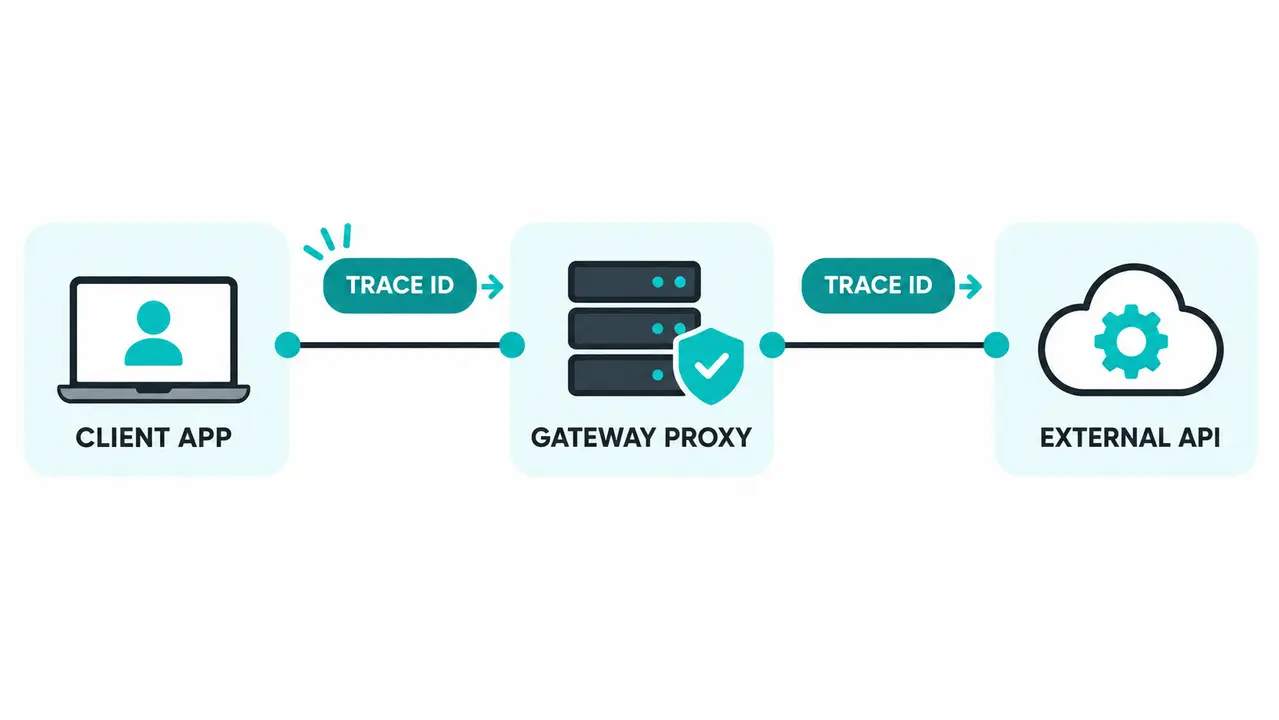
Tracking a failed network transaction across distributed systems is impossible without consistent telemetry. When a mobile customer reports that a third-party payment failed, engineers waste days searching unconnected server logs if the device did not attach a unique correlation identifier. Every outbound client call must generate an X-Correlation-ID header that propagates through your API gateway down to external vendor requests.
Client-side logging boundaries and privacy constraints
Capturing integration telemetry requires strict boundary rules to protect user privacy. Client applications must log HTTP status codes, latency timings, and error definitions while redacting authorization headers and personal data. Transporting raw JSON response bodies to third-party crash reporters frequently violates regional privacy regulations. Structured logging pipelines should sanitize all network metadata before writing entries to disk, ensuring that engineering observability never compromises compliance posture.
Testing strategy for third party APIs without brittle mocks
Relying exclusively on hardcoded mock data in client test suites creates dangerous overconfidence. Mocks reflect how developers assume a partner works, not how the provider behaves during live network disruptions. When a provider quietly alters a date format or changes a status code from 400 to 422, brittle unit tests continue passing green while production builds crash.
A professional third-party integration testing strategy balances three distinct tiers. Consumer-driven contract tests validate that your internal API responses match mobile client expectations. Automated synthetic test suites execute against vendor sandbox environments on regular schedules to catch unexpected external schema changes.
For local developer workflows, recording and replaying sanitized HTTP interactions using tools like WireMock or VCR provides deterministic realism without hitting live rate limits. This layered validation catches authentication scope mismatches and payload drift before binaries head to app store review pipelines.
SDK integrations and the hidden blast radius
Dropping a closed-source vendor SDK into your application binary grants that provider complete access to your client runtime. SDKs can swizzle network methods, track user location without disclosure, and trigger uncaught exceptions that crash your app.
Engineering leaders must treat mobile SDKs with the same scrutiny applied to core infrastructure dependencies. Teams need a formal software bill of materials and a documented update cadence. Upgrading a third-party library should never happen as a casual secondary commit inside an unrelated feature pull request.
At Sentice, our delivery teams isolate third-party SDKs behind internal facade interfaces rather than exposing vendor classes across the UI layer. This protective wrapper ensures that if an SDK introduces instability, developers can disable the feature via remote configuration flags without pushing an emergency release. Restricting vendor blast radiuses keeps your primary application stable when external code deteriorates.
System linking across mobile, backend, and embedded products
When a mobile application acts as the primary control interface for connected hardware, system integration introduces unique operational hazards. Unlike cloud microservices that redeploy in seconds, physical devices run heterogeneous firmware revisions across unpredictable field environments.
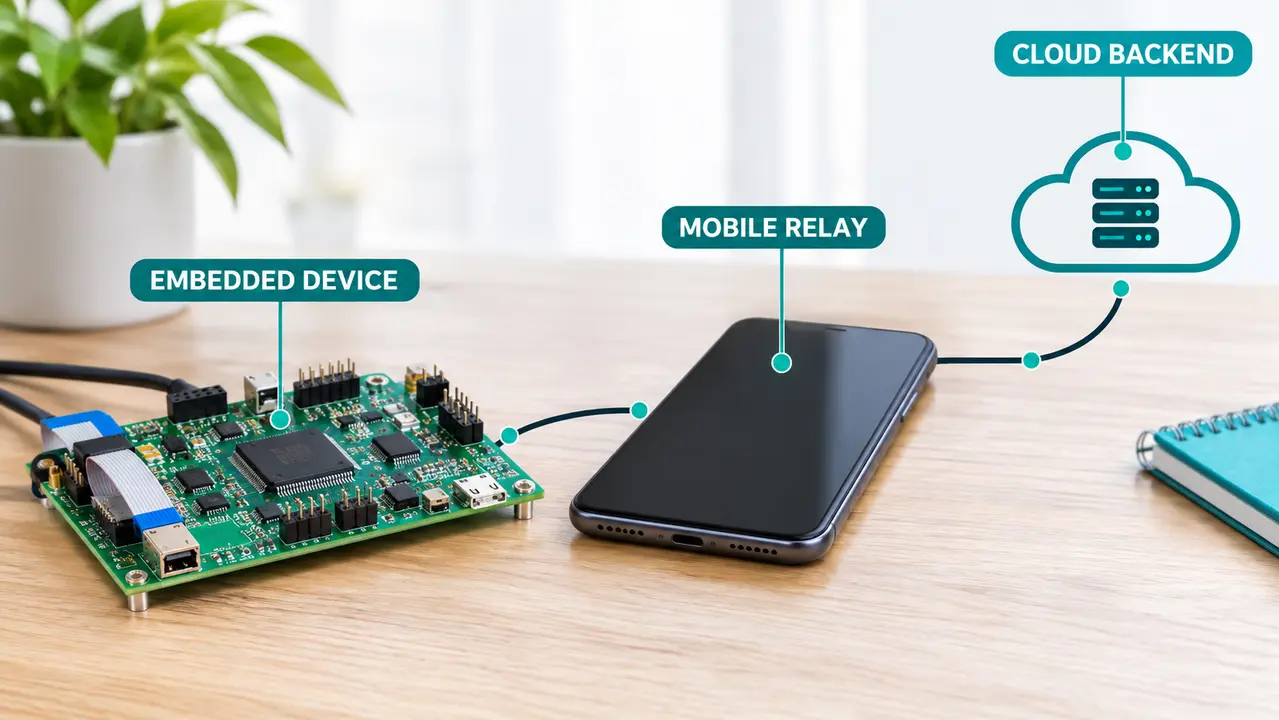
A mobile phone frequently functions as the bridge between low-power Bluetooth peripherals and remote cloud infrastructure. If your architecture lacks a centralized source of truth for hardware state, transient pairing failures result in orphaned records and duplicate device entries. Teams tackling these challenges benefit from specialized system and embedded engineering expertise to structure reliable pairing handshakes and secure firmware updates.
Engineering specifications must define every lifecycle state from initial factory provisioning through field retirement. Documenting exact timeout thresholds for Bluetooth Low Energy handshakes prevents synchronization deadlocks when local radio interference interrupts data transfers. Clear boundary governance across hardware, mobile, and cloud components eliminates confusing support escalations after customer device resets.
A delivery playbook for integration work across teams
Unclear ownership causes more integration breakdowns than flawed code.
When a critical third-party service degrades at midnight, teams lose precious hours debating whether client developers or backend platform engineers own the on-call response. Building dependable services requires an explicit delivery playbook. Every external dependency must have an assigned engineer who manages the vendor contract, monitors API deprecation calendars, and maintains operational dashboards. Many growing scaleups deploy dedicated software engineering teams to maintain operational discipline across complex integration boundaries.
Distributed engineering work demands structured standards, especially when teams split between remote and in-person setups. The Stack Overflow Developer Survey recorded that 34.8% of developers work fully remote while 17.6% work in-person. A rigorous definition of done for any integration must require automated contract validation, production error budgets, and written rollback runbooks before merging pull requests.
Recognizing when it is time to rebuild the integration layer
Engineering organizations rarely schedule integration rewrites until operational pain becomes unbearable. The warning signals appear as recurring emergency hotfixes, synchronized release bottlenecks, and duplicated authentication logic scattered across disparate repositories. If swapping an SMS provider or payment gateway requires editing twelve application screens, your architecture is dangerously coupled.
A minimal refactor path before a full rebuild
Before undertaking a risky ground-up rewrite, teams can introduce an anti-corruption layer to isolate legacy dependencies. This architectural pattern wraps volatile vendor endpoints behind clean internal contracts, shielding client code from external quirks. When scaleups require comprehensive modernization, partnering with specialists in end-to-end software solutions helps stabilize delivery velocity while isolating technical debt. Structured facades allow engineering teams to refactor legacy services incrementally without disrupting ongoing product roadmap commitments.
Frequently asked questions
What is the difference between an API and an SDK in a mobile app?
An API is a defined protocol accessed over HTTP that enables two systems to exchange data across network boundaries. An SDK is a compiled software package embedded directly into your mobile binary that executes code within your application runtime. APIs isolate operational failure behind network gateways, while SDK bugs can crash the host application directly.
How do you handle API changes without breaking old app versions?
You handle schema evolution by adopting additive changes where new fields never replace or modify existing payload structures. Backend teams use server-driven configuration and feature flags to roll out modifications to updated clients while serving legacy payloads to older installations. Client version headers tracked in gateway logs tell engineers exactly when obsolete endpoints can be retired safely.
Why do mobile apps fail on bad networks even when the API is fine?
Mobile connections experience severe packet loss and radio tower handoffs that sever HTTP connections after the server processes a request. When response packets vanish, the client encounters a timeout despite the backend transaction succeeding. Without client-side idempotency keys and exponential backoff retry algorithms, the application generates duplicate writes or throws unhandled exceptions.
What is the best way to authenticate a mobile app to an API?
The most secure industry pattern is OAuth 2.0 Authorization Code with PKCE executed via the operating system browser. This architecture avoids exposing user credentials to embedded WebViews and protects intermediate tokens from extraction. Tokens stored locally must reside in platform-provided encrypted hardware vaults like iOS Keychain or Android Keystore.
How do you test third-party integrations before release?
Combine consumer-driven contract tests for internal APIs with scheduled synthetic monitors running against vendor sandbox environments. Developers should record and replay sanitized vendor HTTP interactions to validate parsing logic without hitting live endpoints. This multi-tiered strategy detects breaking schema changes early without relying on brittle static mock data.
That payment gateway timeout in downtown Chicago will repeat every time an engineering team mistakes a passing staging test for production resilience. Securing mobile architectures against hostile networks and external vendor drift requires deliberate architectural boundaries rather than panicked post-release hotfixes. Building mediated gateways, explicit token lifecycles, and automated contract testing demands disciplined effort upfront. How would your current client integration layer survive if your primary vendor suffered an unannounced three-hour outage next Tuesday?
Strengthen your integration boundary before the next outage
Our embedded engineers work across mobile, backend and system layers, from gateway architecture and token lifecycle design to contract testing and observability.
About Sentice

Sentice is a boutique software engineering partner founded in 2013 by Roni Levi and Martin Petkovic, now headquartered in Skopje, North Macedonia. Rather than supplying individual developers, we build embedded teams that blend with a client’s culture, tech stack and goals, working together from a single office under our own technical leadership. We deliver dedicated software engineering teams, end-to-end software solutions, product development, and system and embedded engineering, and we act as technical advisors across the full development lifecycle, from specification and architecture through development, testing and support. We use AI coding tools across every project, and we help clients integrate AI into their own products through chatbots, MCP services, connected application layers and workflow automation. Some of the clients we started with more than a decade ago are still building with us today.