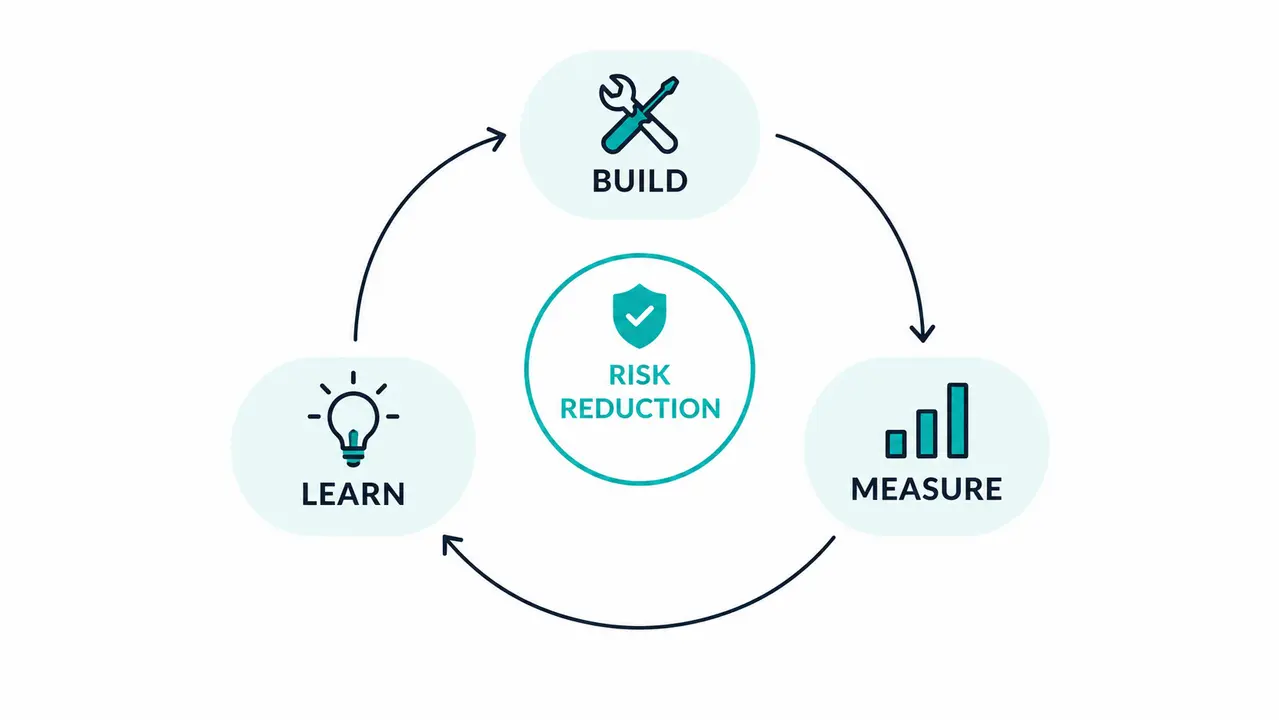
Building a minimum viable product sounds simple until the first scope meeting. Feature requests pile up, every stakeholder defends their priority, and six weeks later your engineers are polishing screens that teach you nothing about whether anyone will pay. Lean MVP development treats that problem as an engineering discipline: the goal is the smallest slice of working software that produces trusted evidence about your riskiest assumption. Below, we’ll unpack how to define scope around a decision rather than a wishlist and how to separate prototypes from pilots and MVPs, then how to protect engineering guardrails while cutting features and instrument the core loop so every release produces data your leadership can act on.
Reading time: 13 min
Key points
- Lean MVP scope derives from the next business or technical decision you must resolve, not from a feature wishlist.
- Prototypes test usability, pilots test operational fit, and MVPs test market demand with production software and telemetry.
- Cut user-facing features freely but never cut secrets management, authentication, audit trails or rollback automation.
- Treat analytics events as first-class architectural scope; an uninstrumented release teaches you nothing.
Table of contents
Lean MVP development is a risk reduction system, not a smaller roadmap
A founder hands engineering a forty-page specification and calls it a minimum viable product. Six months pass, the budget evaporates, and the release lands with deafening silence from actual users. Lean MVP development exists to prevent that exact failure by treating product creation as a systematic risk reduction exercise. The objective is never to assemble a stripped-down feature backlog. You build the absolute smallest slice of software capable of generating reliable evidence about your riskiest technical and market assumptions. Most agencies trim feature lists to fit an arbitrary launch date. At Sentice, we strip away unverified scope to protect technical foundations that are brutal to alter later. When your engineers run a tight build-measure-learn cycle, they focus on efficient development anchored by measurable user behavior. Visual demos that satisfy internal executives while yielding zero operational telemetry are vanity exercises. Real viability requires instrumentation, deliberate user actions, and explicit decision points before another sprint begins.
The decision you are trying to make should drive the MVP scope
Teams often treat scope as a negotiation between product optimism and engineering capacity. That framing is backwards. Your scope should derive entirely from the specific business or technical decision you must resolve next. A successful release makes your next move obvious because it shows whether to keep investing, pivot the core workflow, or cancel the initiative. When leadership fails to define that decision before writing code, teams inevitably drift toward building decorative convenience features. Demand validation requires a different technical posture than integration feasibility or operational scalability. We enforce this discipline through a one-page MVP decision memo signed by both product management and engineering leads before sprint planning starts. The document names the exact hypothesis, the quantitative threshold required to confirm it, and the date the team will review the metrics. Shipping a visually polished application that leaves leadership arguing about what to build next is an engineering failure.
Where teams confuse prototypes, pilots and MVPs
Calling every early technical deliverable an MVP obscures the engineering compromises your team is making. A prototype evaluates usability and visual interaction through disposable code or design tools. A pilot evaluates system deployment and operational tolerance within a specific customer environment, frequently relying on extensive human intervention behind the scenes. An MVP evaluates an unproven market hypothesis by exposing real users to production software that tracks their behavior. When product leaders conflate these distinct artifacts, engineers end up building fragile production systems or over-engineering disposable user interface tests. We map these boundaries clearly before committing technical resources so expectations align with actual system capabilities.
The following breakdown illustrates how these project types differ across core delivery dimensions.
| Dimension | Prototype | Pilot | Minimum Viable Product |
|---|---|---|---|
| Primary Goal | Validate interface concept and usability | Test operational fit within one client | Validate market demand and core workflow |
| Engineering Rigor | Disposable scripts and mock data | Targeted scripts with manual workarounds | Production baseline with secure authentication |
| Feedback Output | Qualitative stakeholder opinions | Operational exception logs and notes | Quantitative behavioral metrics and retention |
| Typical Lifespan | One to three weeks | Two to six months | Iterated continuously into version one |
If your organization needs behavioral data from genuine transactions, you must build an MVP. If you only need internal stakeholder buy-in or quick qualitative design feedback, building a prototype saves months of engineering labor.
Start by mapping the end to end user journey you can actually support
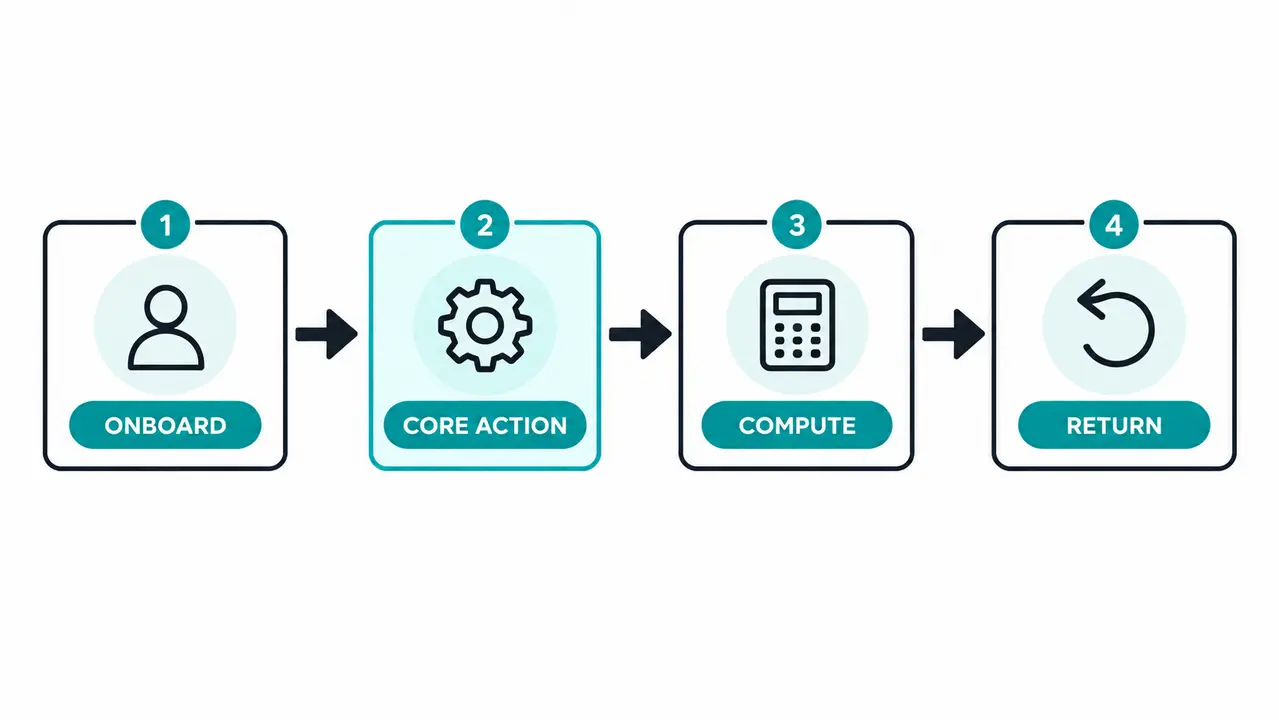
Choosing the one workflow that determines initial adoption
Can your user complete their primary task without manual intervention from your engineering team? Viability lives in a closed, functioning loop rather than a sprawling list of half-finished capabilities. You must isolate one primary user persona, one fundamental job to be done, and the most direct path to a finished transaction. Picture a workflow where a user registers and runs the core transaction, then receives the computed result and logs back in the next morning. Supporting that path means planning for real-world friction. Your team needs explicit owners for manual onboarding exceptions, automated email deliverability failures, and malformed input recovery. Building disconnected interface screens that lead to dead ends breaks the feedback mechanism before users can form habits. Focus every ounce of sprint capacity on the single workflow carrying the highest technical uncertainty and commercial impact. If users reject the primary interaction, surrounding secondary features will not rescue the product.
Feature selection works better when you rank assumptions, not requests
Internal stakeholders will always supply an endless backlog of feature requests. Treating those requests as mandatory project scope guarantees delayed releases and wasted capital. Engineering leaders must force product teams to catalog existential business and technical assumptions instead of wishlists. You rank the risks that could render the software worthless, then engineer the simplest technical mechanism capable of disproving them. When your premise relies on third-party API availability or on users completing heavy data entry or on sub-second search responses, you build precisely enough code to test those variables under production conditions. Creating a shrunken copy of an enterprise platform produces bloated software that answers no meaningful questions.
The evaluation matrix below outlines how technical teams systematically connect architectural assumptions to minimal build requirements.
| Core Assumption | Primary Risk | Verification Method | Minimal Build Required |
|---|---|---|---|
| Users submit dense financial records | High onboarding drop-off during data entry | Funnel event tracking on step completion | Single-view input form with immediate validation |
| External catalog data syncs reliably | Third-party vendor API rate limits block ingest | Load tests against sandbox endpoints | Scheduled worker script with automated retry queue |
| Users return weekly for core insights | One-time problem resolution with zero retention | Fourteen-day cohort return telemetry | Authentication service and transaction update alerts |
| Sub-second calculation drives usage | Slow database queries cause abandonment | Server-side latency logs under peak load | Indexed transactional table on managed PostgreSQL |
Rank your backlog by risk severity and invalidate your most dangerous assumptions before committing teams to multi-month roadmaps.
Minimal features still need strict engineering guardrails
Cutting engineering discipline in the name of speed is the fastest way to kill an early product. Teams routinely confuse pruning user-facing features with abandoning operational hygiene, security baselines, and deployment automation. You can defer complex user permissions, advanced caching tiers, and multi-region failover. You cannot defer centralized secrets management or secure authentication tokens, and you need basic audit trails and automated rollback triggers from the start. Following recognized secure software development practices protects your team from catastrophic data exposures that destroy company credibility during initial trials. Tools like Sentry for real-time error tracking and AWS Secrets Manager require minimal setup time when implemented on day one. Adding them retroactively to an unruly codebase takes far more labor. A disposable sandbox experiment might justify ignoring security controls, but production MVPs handling genuine customer data require fundamental defensive engineering from the very first commit.
Discovery outputs that keep engineering and product aligned
What “ready for build” means for a lean MVP
Two weeks spent defining precise technical boundaries prevents two months of frantic code refactoring. Discovery work should never generate a hundred-page requirements binder nobody reads. Its sole purpose is ensuring engineering, product, and QA share an identical understanding of system constraints and success thresholds. A functional discovery phase yields five essential artifacts. The team writes a crisp problem statement and maps the user journey, then sets an explicit scope boundary and drafts an event tracking plan alongside a preliminary architecture sketch. Role accountability must remain unequivocal throughout this period. The tech lead owns the system architecture sketch and environment plan, the product owner owns the scope boundary and persona definitions, and the QA lead defines the automated acceptance criteria. Without these foundational boundaries, your first development sprint turns into a disorganized debate about interface design and database schema choices. Clear entry criteria keep teams shipping working software instead of arguing over unstated assumptions.
A two-speed backlog keeps the MVP from turning into a platform rewrite
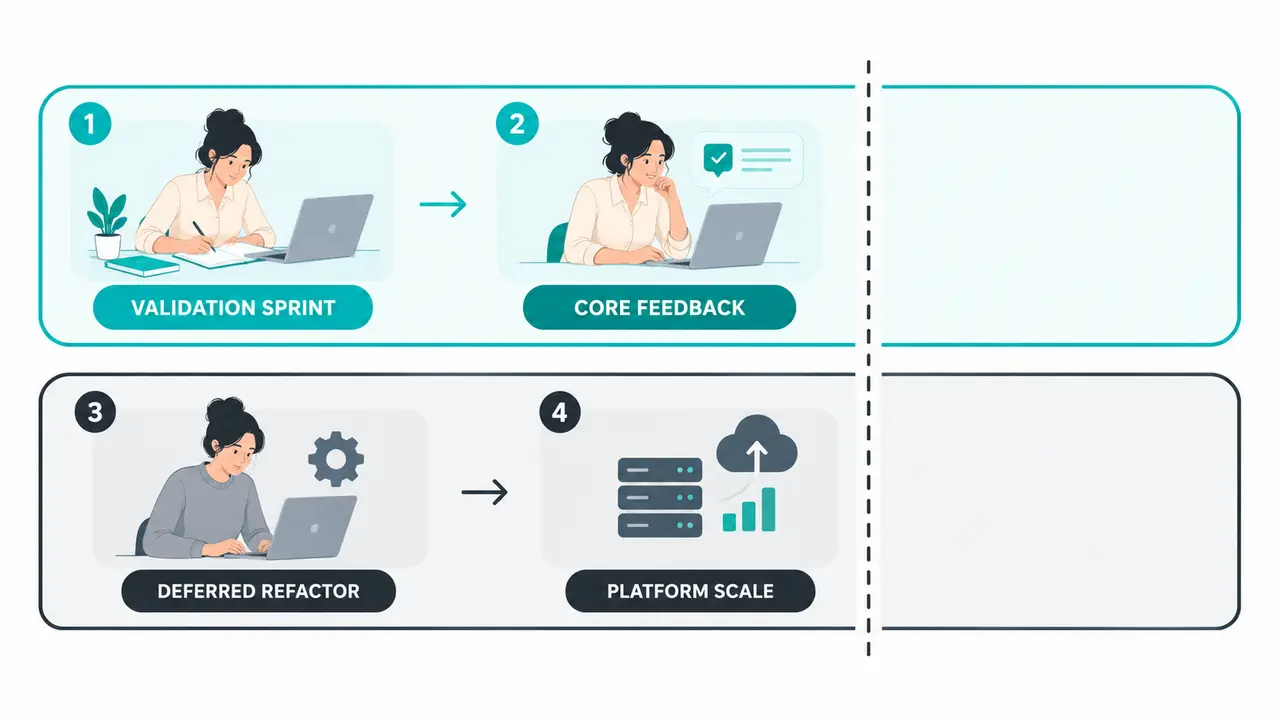
Engineers naturally gravitate toward building elegant foundational systems rather than scrappy validation experiments. Left unchecked, your team will spend six weeks perfecting an event-driven messaging pipeline for a product that lacks active users. You counter this instinct by splitting engineering tasks into two distinct backlogs, one for learning-critical tickets and one for deferred platform enhancements. The secondary backlog contains database optimizations, complex microservice abstractions, and automated billing reconciliations. These tasks stay parked until telemetry proves customer adoption warrants the investment. When managing fast iterations, our dedicated software engineering teams use separate swimlanes to enforce strict gating between hypothesis validation and technical debt remediation. Every item in the primary swimlane requires a definition of done tied directly to user instrumentation and explicit validation outcomes. Guarding that boundary prevents infrastructure speculation from consuming the sprint capacity you need for customer feedback loops.
Architecture choices that support fast change without locking you in
Irreversible technical decisions to surface early
Simple and reversible architecture beats hypothetical scalability every single time. Modern cloud platforms tempt early-stage teams into assembling distributed microservices, message queues, and Kubernetes clusters before finding a single paying customer. That architectural overhead slows engineering velocity to a crawl. A well-structured modular monolith written in Golang, Node.js, or Python with a managed PostgreSQL database provides all the operational throughput an early venture needs. It allows engineers to refactor data schemas and domain boundaries in minutes rather than orchestrating complex multi-service deployments. Deploying feature flags through Unleash lets you roll out functional changes to specific cohorts safely. You must document irreversible structural choices, such as tenant isolation patterns and primary database engines, using Architecture Decision Records. Building for edge devices or systems with hard real-time latency limits represents the lone exception where structural constraints must be solved up front rather than deferred.
Integrations are where lean MVP timelines get destroyed
Connecting three external enterprise APIs can triple your initial development timeline without providing a shred of user validation. Third-party platforms bring undocumented rate limits and erratic response payloads, and their sandboxes often diverge from production and use unstable authentication flows. A single external dependency often balloons into three distinct integration projects when accounting, customer identity, and notification vendors get looped in early. These technical bottlenecks delay delivery and drag down team morale across the engineering organization. You must ruthlessly stub, simulate, or mock external APIs whenever an integration does not directly answer your primary learning objective. Use a mock payment gateway or CSV exports instead of complex real-time ERP synchronization until customer demand proves itself. If an external service does not alter your core validation outcome, strip it out of the initial build without hesitation.
Ship a smaller, smarter release
Tell us which assumption you need to test first. Our engineers map the smallest production-ready build that answers it, with instrumentation and release criteria baked in from day one.
QA for lean MVPs is about release criteria, not perfect coverage
Chasing ninety percent test coverage on code you might delete next week burns engineering resources without improving software reliability. Disciplined teams establish explicit release criteria tied directly to the core user journey rather than obsessing over exhaustive unit test counts. Your quality bar should require zero blocking defects across the primary onboarding flow and smoke tests passing in GitHub Actions, along with rollback scripts verified in staging. This targeted approach prevents regressions in critical transactions while allowing developers to iterate quickly on secondary views. Regulated environments such as healthcare or financial transactions demand higher baseline verification standards, but those parameters remain definable and timeboxed. Traditional consultancies enforce rigid, bureaucratic test phases that stall releases for weeks. We implement continuous integration pipelines with automated core-path tests, catching showstoppers instantly while giving early adopters a stable, predictable product experience.
Instrumentation turns an MVP into a learning machine
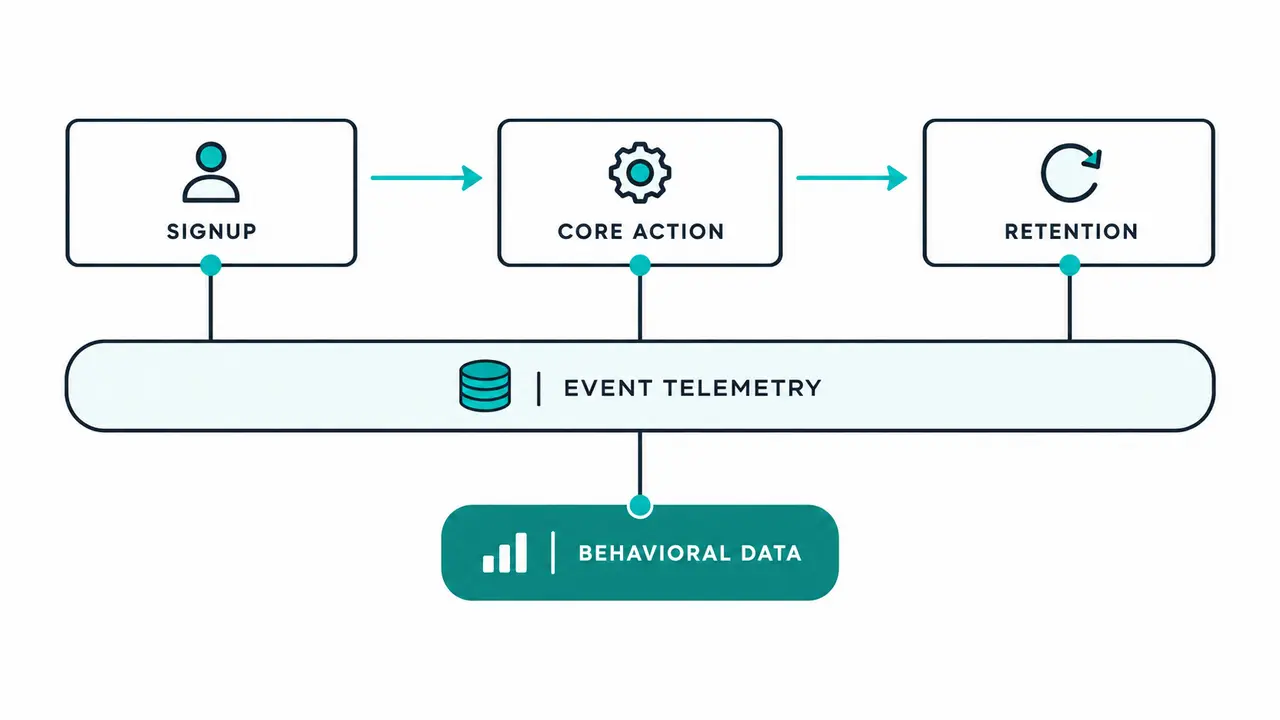
Metrics that matter before product-market fit
Launching an uninstrumented application is the software equivalent of flying blind in a storm. If your engineers cannot monitor flow completions and drop-off rates alongside API latency spikes, you will learn nothing from your release. Product teams frequently skip telemetry specs to meet arbitrary delivery dates, only to spend weeks arguing about user sentiment during post-launch reviews. You must treat analytics events as first-class architectural scope. Build a compact tracking taxonomy that follows each user from signup through starting and completing the core action, and that also records error events and abandonment points. Connect these triggers to tools like PostHog or Mixpanel, pairing behavioral telemetry with operational error monitors like Sentry. Prioritize engagement metrics such as time to complete the core action and task success rates, and watch repeat usage within seven days. Hard data settles roadmap debates instantly, turning ambiguous user impressions into concrete engineering tickets for the following iteration.
Manual operations can be the most efficient MVP feature
An early-stage healthcare startup wanted to build an automated machine learning categorization engine before onboarding ten clinics. Building that pipeline would have required four months of data engineering. Instead, their engineers built a clean intake screen connected to an internal queue, where clinical staff manually verified incoming records for the first ninety days. That decision preserved engineering capital while validating customer demand within three weeks. You should write code only for tasks that humans cannot execute behind the scenes during early validation. Concierge onboarding, human-in-the-loop classification, and manual database configurations let you test market appetite without burning sprint velocity. To run this well, write an operational runbook that sets triage response times and role responsibilities and spells out error escalation procedures. This manual approach is a bad idea when your core business hypothesis depends on real-time execution speeds or automated hardware responses.
Team setup that keeps decisions fast and rework low
Bloated teams kill velocity far more effectively than technical debt. Engineering progress halts when seven different stakeholders must sign off on everything from database migrations to button copy and error notifications. A fast-moving initiative needs a compact delivery unit, with one decisive product owner and one senior technical lead working alongside two full-stack developers and one dedicated QA specialist. The product owner retains absolute authority over scope boundaries and trade-offs. The technical lead owns all architectural decisions, code quality gates, and deployment pipelines. Keep approval latency low by maintaining a simple decision log in Confluence to record the rationale behind every resolved trade-off. Running a weekly live demo against objective acceptance criteria replaces lengthy status reporting with demonstrable progress. Large consultancies drown early-stage builds in project managers and governance committees. We keep teams lean and colocated, ensuring engineers receive instant answers to edge-case questions without sitting idle across multi-day approval delays.
Sprints only work when you protect focus and shorten feedback loops
Why do two-week sprints frequently collapse into disorganized mini-waterfall cycles? Teams commit to oversized user stories that linger in code review for five days, leaving QA testing crammed into the final hours before deployment. You avoid this trap by slicing functional requirements into thin vertical increments that traverse the entire stack from database to interface in forty-eight hours. Daily fifteen-minute standups should focus strictly on active blockers, code review bottlenecks, and third-party dependency delays. Ship functional increments behind feature flags every week so real users can interact with working software before the sprint ends. When founders withhold feedback until a sprint conclusion review, teams waste subsequent days rewriting completed code. Shortening the cycle between development and real user feedback keeps delivery predictable. Building large batches that fail late in the development cycle destroys engineering momentum and blinds leadership to technical realities.
When the MVP is done and what to do next
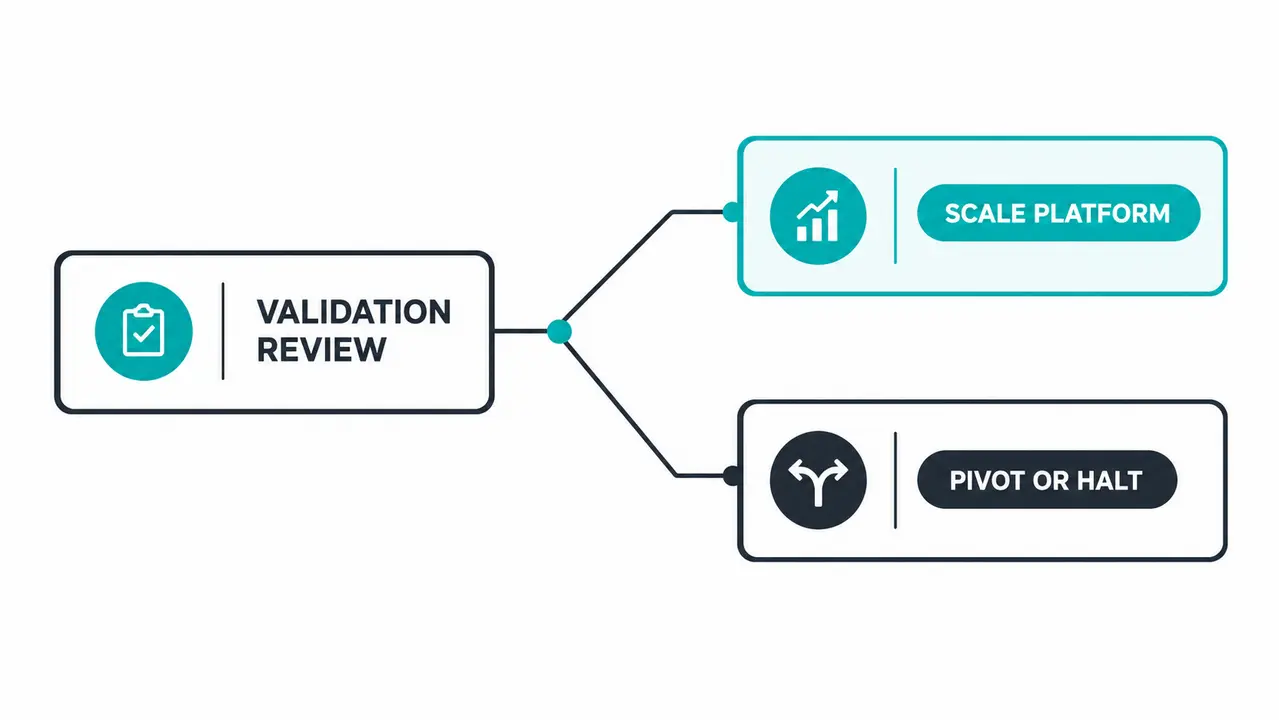
An MVP is complete the exact moment it answers the core decision question with data your leadership trusts. Reaching that finish line means objectively reviewing usage telemetry, qualitative user interviews, and system stability under real-world loads. When the evidence confirms that users regularly complete the primary loop and derive tangible value, your organization can graduate from experimental builds to comprehensive product development services to scale the platform. If the data reveals users abandoning the workflow at step one, you pivot the interaction model or shut the project down before burning more runway. Document these findings in a post-launch review covering resolved hypotheses, behavioral metrics, and outstanding technical debt. Continuing to attach features to an early build without establishing a fresh validation hypothesis is how teams end up with accidental monoliths. Stop building and review the hard numbers before you commit to a path forward.
Common failure modes in lean MVP development
Most failed MVPs do not collapse from flawed programming. They fail because teams optimize for internal stakeholder applause rather than actual user adoption. Product managers frequently cut instrumentation to meet artificial launch dates, leaving the company completely blind to drop-off points. A classic failure occurs when early adopters churn immediately on their second visit, leading leadership to conclude the market has no interest when users simply hit a broken session token. Other teams over-engineer complex microservice architectures for hypothetical traffic spikes, exhausting their budget before acquiring a dozen accounts. Neglecting release verification and basic deployment hygiene causes early software to crash in front of initial design partners, permanently burning market trust. Treating complex third-party enterprise integrations as simple weekend tasks introduces crippling delays. Without telemetry tied directly to your user journey, you will never see the friction points that kill customer retention.
Frequently asked questions
How long should a lean MVP take to build?
Duration depends on architectural dependencies and external integrations rather than arbitrary calendar rules. Most teams target timeboxed execution windows of six to ten weeks to maintain urgency and prevent scope creep. If your initial build cannot produce measurable user data within three months, your core loop is too complex.
What is the difference between lean MVP development and agile development?
Lean development defines what specific hypothesis you must test to minimize business risk. Agile development provides the project management framework for how your engineering team executes sprints and deploys code. Lean acts as the strategic filter that prevents agile teams from efficiently building the wrong software.
Should you build the MVP with the same stack you will scale on later?
Select the stack that minimizes iteration time unless your product faces immediate real-time or hardware constraints. Rebuilding a validated product in a specialized language later is manageable, but burning capital on complex scaling architectures before finding market demand kills ventures early.
How do you handle QA for an MVP without slowing down delivery?
Focus test automation entirely on your primary user flow and critical transactional endpoints rather than chasing full test coverage. Automate smoke tests in your continuous integration pipeline to catch regressions, leaving secondary visual polish to rapid post-release bug fixes.
What artifacts should you share with investors or early customers?
Present your one-page decision memo, live event tracking dashboards, and your post-launch review summary alongside the working software. Demonstrating a structured methodology for measuring user retention and technical validation proves engineering discipline far more effectively than a static slide deck.
Return to the MVP decision memo before adding scope
Pull out the one-page decision memo your team drafted before writing the first line of code. Name the precise new hypothesis that justifies pulling your engineers away from stabilizing the existing core workflow. Efficient engineering means ruthlessly protecting that completed transaction loop and rejecting any feature request that fails to produce fresh behavioral evidence. What single critical workflow will your team instrument and evaluate during your next iteration?
Pressure-test your MVP scope
Bring us the hypothesis and the workflow. We’ll help you rank the risks, cut the scope honestly, and instrument the loop that decides what you build next.
About Sentice

Sentice is a boutique software engineering partner founded in 2013 by Roni Levi and Martin Petkovic, now headquartered in Skopje, North Macedonia. Rather than supplying individual developers, we build embedded teams that blend with a client’s culture, tech stack and goals, working together from a single office under our own technical leadership. We deliver dedicated software engineering teams, end-to-end software solutions, product development, and system and embedded engineering, and we act as technical advisors across the full development lifecycle, from specification and architecture through development, testing and support. We use AI coding tools across every project, and we help clients integrate AI into their own products through chatbots, MCP services, connected application layers and workflow automation. Some of the clients we started with more than a decade ago are still building with us today.
Email: info@sentice.com · Phone: +389 70 307 837