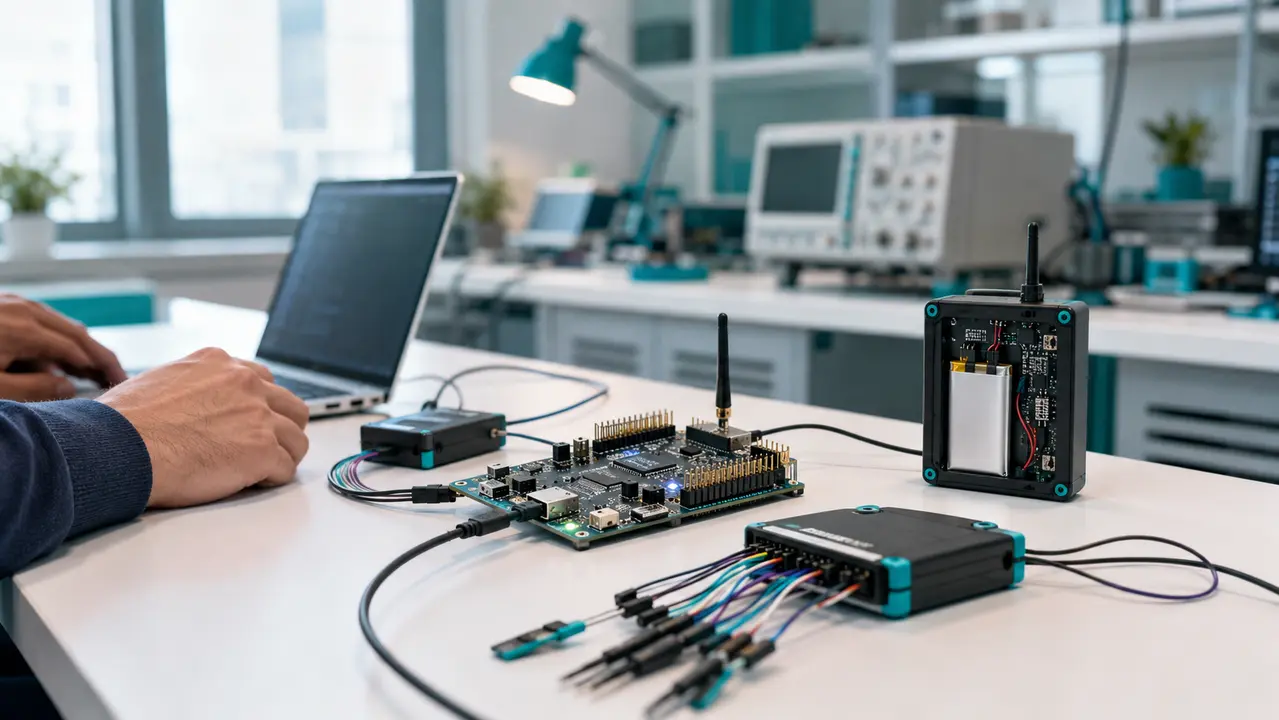
Your demo worked perfectly on the office desk. The device connected in nine seconds, the dashboard rendered, the alert arrived. Then you shipped two hundred units, and within three weeks the support queue filled with devices that would not provision, batteries that died in eleven days, and firmware that bricked itself during an update over a hotel WiFi network. Nothing in the demo predicted any of it.
That gap is what this article is about. Not the gap between good and bad code, the gap between a system that works in a controlled environment and one that survives contact with real users, weak signal, and cold weather. Below, we’ll walk through the device side, device management, connectivity, provisioning, OTA updates, security, testing, observability, and the engagement models, so you can evaluate any IoT development services proposal against what actually fails in the field.
Reading time: 13 min
Key points
- Evaluate IoT development services as one coherent system, from sensor to admin console, not as separate tickets for firmware, an app, and a backend.
- Most schedule risk sits in the firmware, and device management must be designed before the first unit ships, not added after the fact.
- The engagement model determines your risk more than the tech stack does: ask who owns the architecture, release management, and the 2 a.m. on-call.
- Demand operational artifacts, documentation, and rollback procedures as part of the definition of done, or you are renting your own product.
Table of contents
IoT development services as a system not a feature list
Evaluate IoT development services as the delivery of one coherent system, not as separate tickets for firmware, an app, and a backend. The Internet of Things fails at the seams between layers, and connected devices are a single integrated system whether your vendor treats them that way or not. A stable mobile app cannot compensate for fragile provisioning. A beautiful cloud backend cannot compensate for power management that drains a battery in a week.
Draw the system boundary explicitly. It starts at the sensor, runs through the microcontroller and its firmware, across whatever transport layer you chose, into the message broker, through the rules engine, out to alerting, and ends at the admin console where your support team works. Every one of those hops is a contract. Every contract is a place where two teams who never speak to each other can make incompatible assumptions.
Treat the system as one deliverable and you prevent the failure mode we see most often in inherited projects: unpredictable field behavior, updates that cannot be shipped safely, and observability that tells you nothing when a customer calls.
What changes when you move from demo to field deployment
The demo ran on a bench with a power supply, strong WiFi, and one user who happened to be the engineer who built it. The field has none of that. Power constraints change your duty cycle assumptions, which changes your radio usage, which changes your latency budget. Signal degradation turns your clean request-response protocol into a retry storm. Users press buttons you never documented, install devices in basements, and unplug the gateway to charge their phone.
Field conditions do not add requirements. They replace the requirements you wrote. Budget for that replacement before you commit to an architecture, because power, connectivity, and user behavior decisions made in week two are the ones that cost the most to reverse at month eighteen.
Where teams underestimate the device side
Most of your schedule risk sits in the firmware, not the dashboard. We have watched teams spend six weeks polishing a React dashboard while the firmware schedule quietly slipped by four months. The device side is where physics lives: power, timing, memory, and hardware variance.
Brownouts during flash writes corrupt your filesystem. Clock drift breaks TLS handshakes because the certificate looks expired to a device that has drifted forty seconds. Sensor calibration drifts with temperature. Watchdog resets fire at 3 a.m. for reasons no one can reproduce. These are not exotic edge cases, they are Tuesday.
The artifacts that determine whether you survive Tuesday are the board support package decision, the real-time operating system choice, the quality of the vendor drivers, and the logging strategy you can actually read over a serial console in the field. This is why deep hardware expertise matters in firmware development, and why our system and embedded engineering practice treats the BSP and RTOS decisions as architecture decisions, not setup tasks. The failure mode you are preventing is “works on my desk” firmware that fails under vibration, cold, or a weak signal, and ships anyway because the deadline said so.
The cloud is not the product if device management is missing
A connected product becomes operable at scale only when device identity, provisioning, configuration, and lifecycle management are designed before the first unit ships. The dashboard is the visible tenth of the product. Device management is the submerged part that determines whether your support team survives the first thousand units.
Define the device lifecycle states explicitly: manufactured, claimed, provisioned, active, quarantined, and retired. Each transition needs an owner, an audit entry, and a recovery path. Fleet operations require bulk actions, staged rollouts, and audit logs, because configuration drift across five hundred devices is not fixable one SSH session at a time.
Without this, the failure mode is manual per-device fixes, support escalations that take days, and configuration changes nobody can trace back to a decision. Building comprehensive IoT solutions that span the entire lifecycle is exactly what our end-to-end software solutions work covers, because a device management layer designed after the fact is a rewrite, not an addition.
Choosing what runs on device versus in the cloud
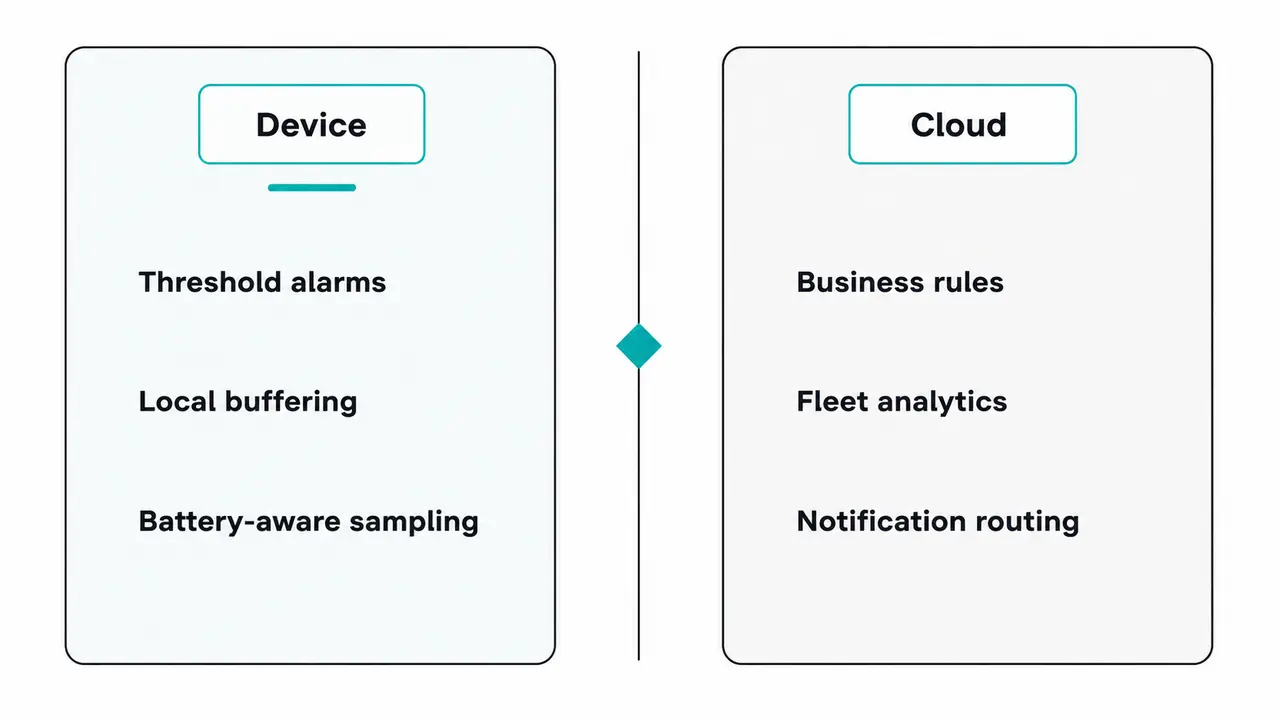
Put latency-sensitive, safety-critical, and connectivity-dependent logic on the device. Put fleet-wide policy, analytics, and orchestration in the cloud. The verdict sounds simple. The execution is where teams hurt themselves, because every function you push to connected devices increases update risk and slows your iteration speed.
A threshold alarm for a temperature sensor belongs on the device, so it still fires when the network is down. The rules that decide what that alarm means belong in the cloud, so you can change them without a firmware release. Model updates for predictive maintenance run centrally. Battery-aware sampling logic runs locally, because only the device knows its own power budget.
Your constraints are the battery budget, CPU, memory, bandwidth cost, and privacy requirements. A medical device with patient data on it has different privacy constraints than a soil sensor, and those constraints should drive the partition before performance does. Push everything to the cloud and the product dies without connectivity. Push everything to the device and every business rule change becomes a firmware release, with all the risk that carries.
A simple decision table for partitioning responsibilities
Use this table to force the conversation with your team before the architecture hardens.
| System function | Device | Cloud |
|---|---|---|
| Data ingestion and buffering | Local buffer, retry queue | Ingest, deduplicate, persist |
| Business rules | Threshold alarms, offline fallback | Policy, pricing rules, orchestration |
| Predictive maintenance | Feature extraction, anomaly hints | Model training, fleet analytics |
| User notifications | Not applicable | Routing, escalation, delivery |
Connectivity decisions that lock in your architecture
Connectivity is an architectural constraint, not a procurement detail. The protocol you choose shapes your power budget, your payload size, your latency ceiling, and your failure handling, and it does all of this before you write a line of application code.
Bluetooth Low Energy to a phone gateway gives you cheap hardware and no infrastructure, at the cost of depending on a user’s phone being present and an app staying alive in the background. WiFi direct gives bandwidth and eats battery. Cellular gives independence and adds a per-device subscription plus certification requirements. LoRaWAN gives you kilometers of range and a payload measured in tens of bytes, which means your telemetry schema and your OTA strategy are both constrained on day one.
Intermittent networks are not an error condition, they are the normal condition. Your messaging layer needs idempotent operations, bounded retries, and deduplication, because a device that re-sends the same reading four times after a tunnel is behaving correctly. The failure mode you are preventing is the expensive one: choosing a protocol that forces you to redesign provisioning and over-the-air updates eighteen months in, after fifty thousand units carry the old assumption in their flash.
The provisioning flow that survives real users
Provisioning is the first thing your customer touches and the last thing most teams design. Treat it as a secure, recoverable user journey with clear ownership transfer, not as a hidden engineering script someone runs over USB.
The flow has steps, and each one is a place a user can get stuck. Device identity creation at manufacture. Claim codes or QR scanning to bind the device to an account. Mutual authentication so the device knows it is talking to your backend and the backend knows which device it is talking to. Initial configuration. Confirmation the user can see. Rollback when any step fails.
Decide upfront who can claim a device, how a device gets re-homed when it is sold or returned, and what happens when the user types the WiFi password wrong three times. That last one generates more support tickets than every other issue combined in most consumer deployments we have seen. Without a designed flow, the failure mode is support tickets where devices are stuck in a half-provisioned state and the only fix is a factory reset, which the customer cannot perform and your support team cannot do remotely.
OTA updates as a product capability not a panic button
Over-the-air updates are a core capability, not an emergency tool you bolt on when there is a bug. If your OTA story is “we will figure it out after launch,” you do not have an OTA story, you have a future incident.
The mechanics that make OTA safe are known and boring, which is exactly why skipping them is inexcusable. A and B partitions so a failed update falls back to the previous image. Signed images so a compromised server cannot push arbitrary code. Version pinning so you know exactly which firmware each device runs. Rollout rings and canary fleets so the first hundred devices absorb the failure before the first hundred thousand do.
Operationally you need update telemetry, failure reasons reported by the device, and remote recovery paths for devices that fail mid-update. The failure mode you are preventing is the emergency update that bricks a cohort and creates an incident larger than the bug it was meant to fix. We have inherited codebases where the OTA mechanism itself was the single most dangerous component in the system, untested and unmonitored, holding the bricking risk for the entire fleet.
A security baseline that buyers can actually implement
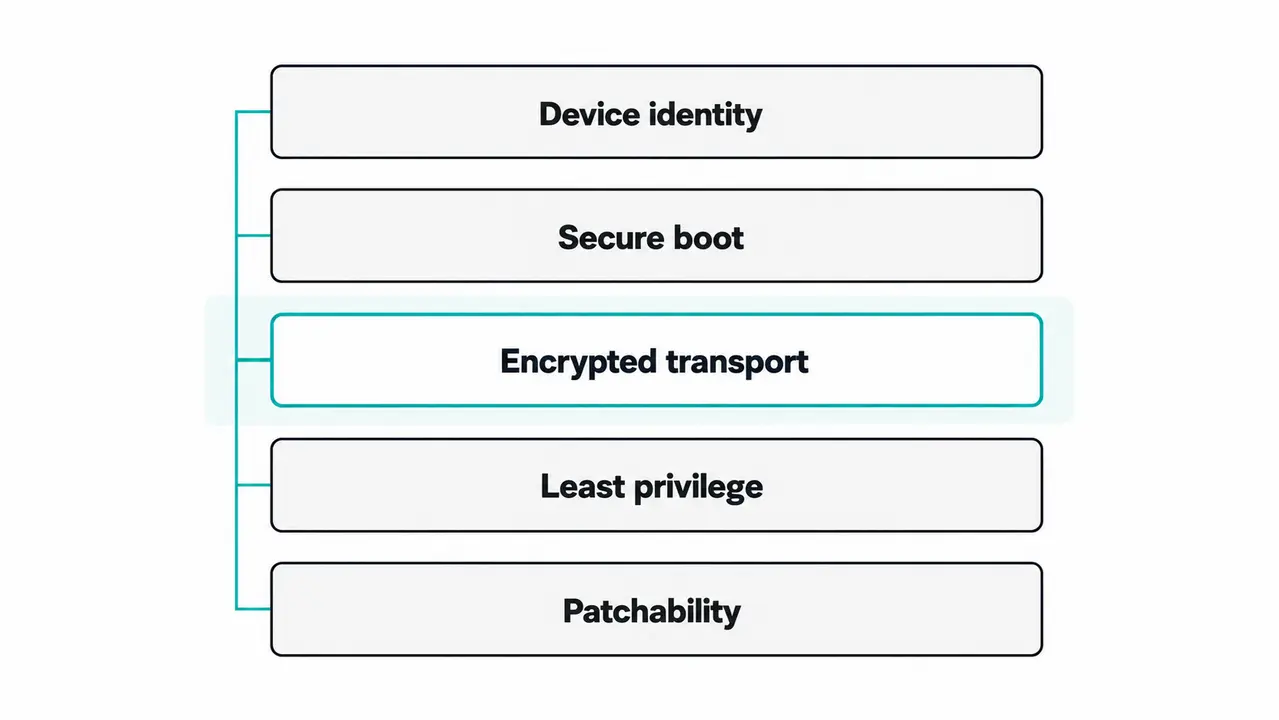
IoT security becomes manageable when you reduce it to a baseline: per-device identity, secure boot, encrypted transport, least privilege, and patchability. Everything beyond that is a roadmap, not a launch requirement.
The baseline has specifics. Per-device credentials, never a shared firmware secret. Certificate rotation with a defined schedule and a defined process. Secure element optionality, so your hardware revision can add one without a protocol redesign. A secrets handling policy that covers manufacturing, because the factory is where credentials leak.
Build your threat model around four categories: physical access to the device, network attackers, compromised mobile apps, and backend credential leaks. Each needs a different control, and pretending one control covers all four is how teams get breached. Aligning your baseline security controls with recognized national standards, such as the frameworks published by security baseline frameworks from NIST, gives you a defensible position when an enterprise buyer runs their procurement checklist.
The counter-case matters too. Perfect security that blocks shipping is a failure. Ship the baseline, publish the roadmap, and let your buyers see the plan.
Data design that does not drown your team
Start with the operational questions you need to answer, then design telemetry, events, and storage around those questions. Teams that start with “let’s collect everything and analyze later” end up with a cloud bill that funds a small country and dashboards nobody opens.
The questions are concrete. Is the device healthy? Is the battery trending toward failure within thirty days? Are connectivity failures clustered by region or firmware version? Which sensor readings are anomalous against the fleet baseline? What is the success rate of the last OTA rollout, broken down by hardware revision?
Answering them requires event schemas defined before the first device ships, sampling rates that reflect the question rather than the sensor’s maximum rate, retention policies that distinguish telemetry from events, and PII boundaries drawn explicitly. The failure mode is predictable and expensive: high cloud spend on data nobody queries, noisy dashboards that hide the signal, and the one metric your support team actually needs missing because nobody asked them. Ask them. It costs an hour and saves a quarter.
Testing strategy when hardware is scarce
Hardware is always scarce. The next board batch is six weeks out, the current revision has three units, and two of them are on a customer site. Your testing strategy has to keep velocity with that constraint, which means a layered approach: simulation, hardware-in-the-loop, and a controlled device lab.
The highest-leverage artifacts are contract tests for the device-cloud protocol, golden devices that represent each hardware revision, and fault injection for packet loss, latency, and connection drops. Run the firmware in CI with reproducible toolchains, because a firmware build that only compiles on one engineer’s laptop is not a build, it is a liability.
Version your test fixtures alongside your firmware, so a test failure means a regression, not an environment difference. The failure mode you are preventing is the late discovery of integration bugs after a hardware batch is built, when the fix requires a board respin and the schedule slips by a full manufacturing cycle. That is the most expensive bug class in this field, and it is almost entirely preventable with a protocol contract test that runs on every commit.
What to automate first for the highest reliability gain
If you can only automate two things, automate the device-cloud contract tests and the provisioning flow. These two paths carry the majority of field failures we see in inherited fleets. A contract test suite catches protocol drift the moment it appears, before it ships inside a firmware image. An automated provisioning test that walks the full journey, from claim code to first telemetry, prevents the single most common support category in consumer deployments.
Automated regression suites for these two flows prevent the failures your customers actually notice. Everything else can wait a sprint.
Observability that connects device logs to user impact
You need end-to-end traceability from a device event to a backend action to a user-visible outcome. Without that chain, every field issue becomes an archaeology project, and archaeology does not scale with fleet size.
The mechanics are correlation IDs carried from the device through the broker into every backend log line, structured logs instead of free-text printfs, metrics for reconnect loops, and standardized OTA failure codes the device reports when an update does not take. A device that reconnects forty times an hour is telling you something. A metric that surfaces it on a fleet dashboard turns that signal into a decision.
Operationally, define the workflows before the incident: triage, quarantine for misbehaving devices, remote diagnostics, and incident timelines that stitch device and backend events into one narrative. The failure mode you are preventing is the “cannot reproduce” loop, where support escalates to engineering, engineering asks for logs, the logs lack the correlation ID, and the ticket ages out unresolved while the customer churns. That loop is a design failure, not a staffing failure.
The week a senior leaves mid integration
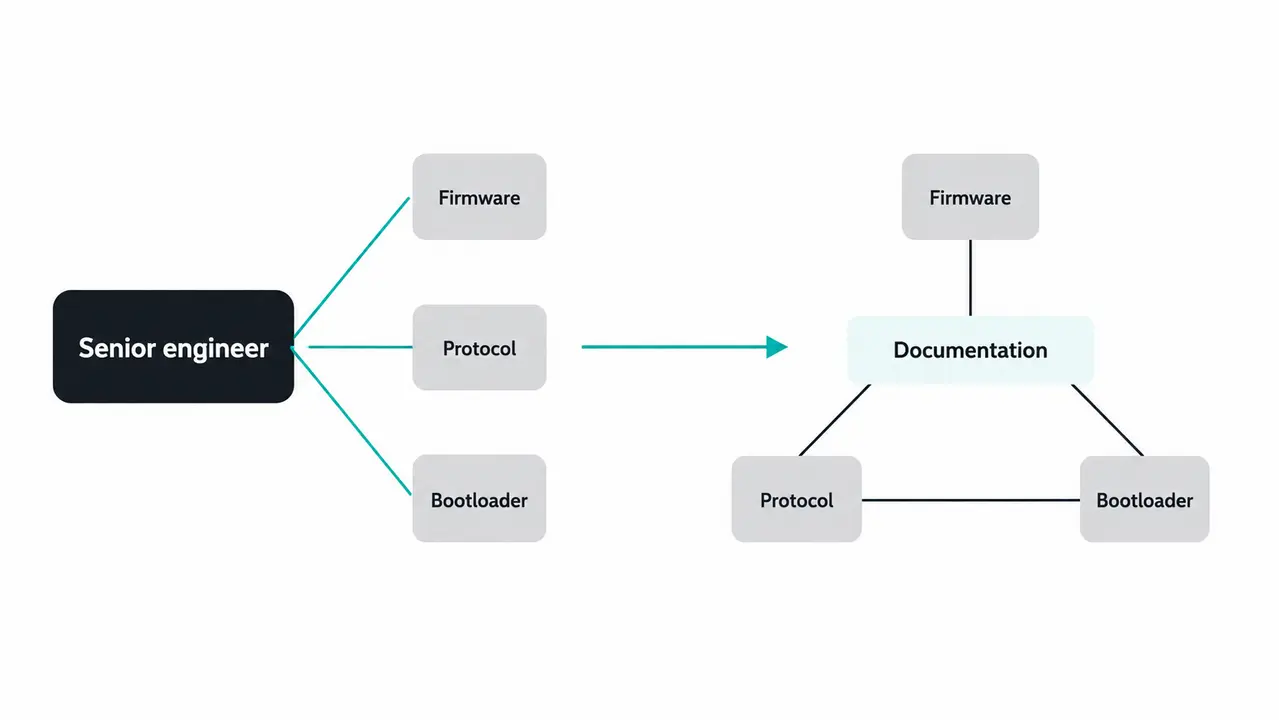
IoT programs break when knowledge lives in one engineer’s head. The senior embedded engineer who knows why the watchdog timeout is set to eight seconds, why the third hardware revision needs a different bootloader, and which broker quirk the retry logic works around is a single point of failure with a resignation letter in his backpack.
The service you buy must include documentation and ownership boundaries from the first sprint. That means architecture decision records, interface specs, device protocol docs, runbooks, and manufacturing handoff notes. Not documentation as a final-phase deliverable that never arrives, documentation as a definition of done.
Reduce the bus factor with a code ownership map, pairing on critical paths, review rules that require a second reader on protocol changes, and onboarding checklists that get tested every time someone new joins. If you want to measure whether this works, track your delivery before and after documentation improvements using software delivery performance metrics. The failure mode is stalled releases and risky hotfixes shipped by whoever remains, and it arrives exactly when you can least afford it.
Deliverables that make an external team safe to work with
The safest IoT engagement produces reusable assets you can operate and extend without the original team. Working code is the entry fee. The assets around the code are what determine whether you own the product or rent it.
Insist on a repo structure a new engineer can navigate in a day, build instructions that work on a clean machine, threat model notes, test plans, OTA playbooks covering the rollback path, and a documented device lifecycle state machine. These are not nice-to-haves. They are the difference between a partner and a dependency.
The definition of done for every milestone should include docs, telemetry, and rollback procedures. If a story closes without them, it is not done, it is deferred with interest accruing.
The counter-case is the vendor that delivers working code with no operational artifacts. Six months later you cannot update the firmware without them, cannot diagnose a field issue without them, and cannot leave without a rebuild. That is long-term dependency dressed up as delivery, and it is the most common complaint we hear from teams arriving with inherited IoT codebases.
How the three engagement models compare
The engagement model determines your risk more than the tech stack does. A mediocre stack with clear ownership beats a great stack with three teams pointing at each other.
Staff augmentation gives you hands and no architectural ownership. Speed of integration is its strength, and when evaluating how quickly embedded teams integrate, our dedicated software engineering teams model shows what a culture-aligned team achieves, working from one office under your practices from week one. A dedicated embedded team gives you ownership of a subsystem and shared responsibility for its interfaces. An end-to-end product squad gives you ownership of the whole system boundary, from firmware through cloud to the admin console, with one accountable architect.
Ask three questions before choosing. Who owns the architecture? Who owns release management? Who is on-call when a field issue lands at 2 a.m.? If the answers are unclear, the model does not matter.
The verdict: an end-to-end squad is weaker when your internal team already has strong embedded leadership and only needs extra hands, because unclear decision rights create friction that costs more than the capacity adds. Sentice runs all three models, and we turn away end-to-end engagements when the client’s own leadership is already strong enough.
Why in-house hiring stalls at scale
Hiring stalls because a connected product needs a rare blend: embedded firmware, cloud backend, mobile, test automation, and DevOps, coordinated by a system architect who has shipped hardware before. Each specialist takes months to find, and the integration cost grows with every one you add.
Count the roles across the lifecycle. Firmware engineer, backend engineer, mobile engineer, QA engineer with hardware-in-the-loop experience, DevOps, plus whoever coordinates manufacturing, certification, and factory provisioning. That last role has no job title at most startups and lands on the CTO by default.
The hidden bottleneck is review capacity. Senior reviewers and system architects become the queue every pull request waits in, and adding junior hires makes the queue longer, not shorter. The market reality makes this worse: enterprises across Europe report persistent hard-to-fill ICT vacancies, and embedded specialists sit among the hardest roles to recruit.
The verdict: in-house hiring is weaker for teams that need a first production release quickly and do not yet have a proven architecture and release process. Hire in-house for the second product, once the first one taught you what you actually need.
Where outsourcing models break engineering quality
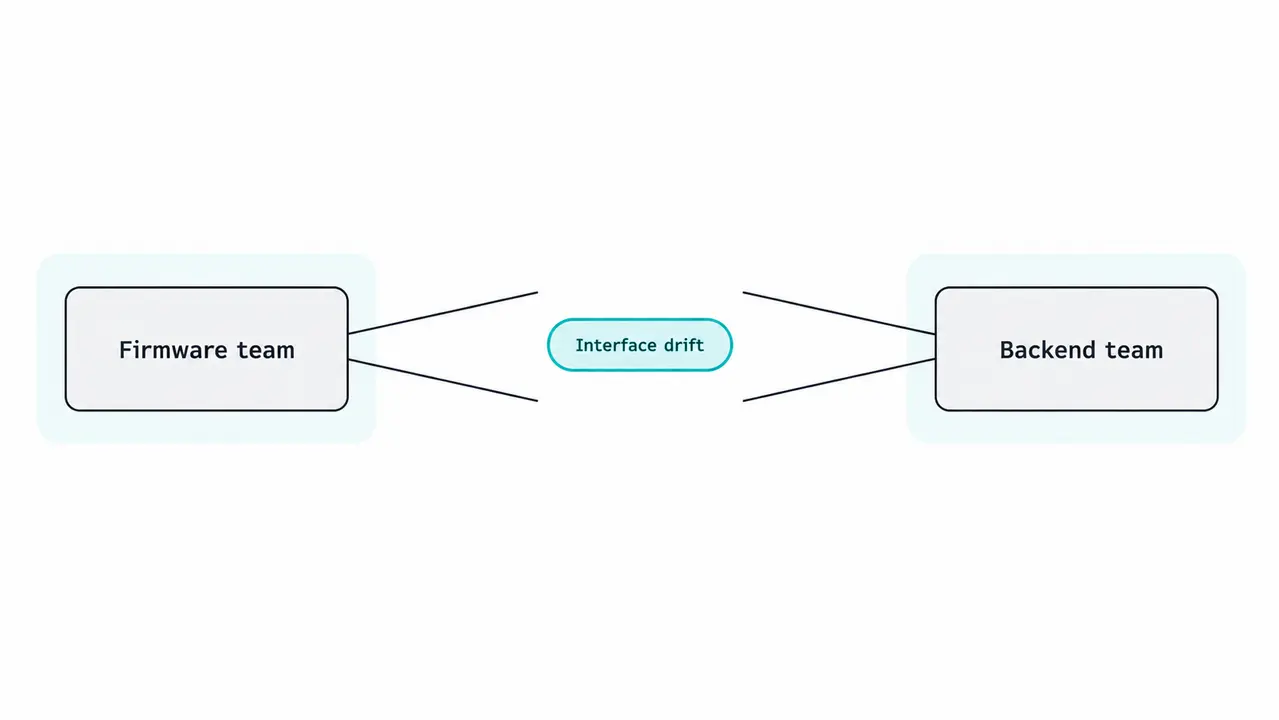
Outsourcing fails when the vendor is optimized for throughput of tickets rather than system reliability, ownership, and long-lived maintainability. Ticket throughput is measurable and easy to invoice. Reliability is neither, so it is what gets sacrificed first.
The symptoms are recognizable within a month of engagement. Shallow discovery that never asks about hardware revisions. No test strategy in the plan. No operational runbooks in the deliverables list. Estimates that assume the happy path and treat intermittent connectivity as an edge case rather than the operating condition.
The deeper mismatch is structural. Firmware and cloud must evolve together, with shared interface contracts and disciplined versioning, or the two sides drift apart silently until a field failure exposes the gap. A vendor structure that separates the firmware team from the backend team, with no single architect accountable for the boundary, guarantees that drift.
The verdict: low-context outsourcing is weaker for connected products, because interface drift and field failures compound over time. What costs you a week to fix at month two costs a fleet recall at month twenty-four.
Recognizing when it is time to rebuild parts of the stack
A rebuild becomes the right move when the cost of adding one feature includes touching every layer, or when field reliability work consumes most of your sprints. Both conditions are measurable, and both get ignored for too long because the rebuild feels like admitting a mistake.
The anchor signals are specific. Protocol changes that break backward compatibility with devices already in the field, because the protocol was never versioned. OTA updates you cannot perform safely, which freezes your firmware at a version with known bugs. Inconsistent device state, where the backend and the device disagree about what the device is. Support teams unable to diagnose issues because the observability was never designed, only accumulated.
The approach is surgical, not wholesale. Isolate the seams, introduce compatibility layers at the protocol boundary, and migrate by device cohorts so a failure affects a bounded set. Rebuild the seams, keep the stable interior.
The counter-case: if your main problem is missing observability and runbooks, do not rebuild. Instrument what you have first. Half the “legacy mess” diagnoses we see are actually healthy code wearing the scars of zero visibility.
Selecting an IoT development partner without vendor lock-in
Choose a partner that can explain tradeoffs, document decisions, and hand over operational control. A partner that only demos features is showing you the tenth of the iceberg above the waterline.
Run a concrete evaluation. Ask for an architecture walkthrough of a system they shipped, not the one they are pitching. Ask for a sample architecture decision record, and read it: a real ADR names the rejected options and the reasons. Ask for their test approach, their OTA strategy, their security baseline, and their device lifecycle design. Vague answers on any of these five predict vague delivery.
Then ask for a plan for your first 90 days and a list of the artifacts you will own at day 30. If the day 30 list contains only code, you are renting your own product.
The failure mode you are preventing is dependency on proprietary glue code and undocumented pipelines, the kind that makes leaving more expensive than staying indefinitely. A partner confident in their work makes leaving easy, which is exactly why you stay.
Frequently asked questions
What is the difference between an IoT platform and an IoT product?
A platform is infrastructure you build on: device registries, message brokers, rule engines, and dashboards. A product is the whole system your customer buys, including the device, the firmware behavior, the provisioning journey, and the support workflow. You can buy a platform. You still have to design the product, and most differentiation lives in the parts the platform does not provide.
Do we need a gateway device or can devices connect directly?
It depends on power and payload. Battery-powered sensors with small payloads usually need a gateway or a phone to reach the internet, because direct cellular connectivity costs power and money per device. Mains-powered devices with WiFi can connect directly. Decide based on the power budget and the per-device connectivity cost, not on which architecture looks cleaner on a slide.
What is the minimum viable device management feature set?
Per-device identity with credentials, a claim and provisioning flow, remote configuration, a firmware version inventory, and the ability to quarantine a device. Everything else, including staged rollouts and bulk actions, can follow once the fleet passes a few hundred units. Without those five, every field issue becomes a manual intervention.
How do we support multiple hardware revisions without rewriting everything?
Version your protocol and your firmware update mechanism from the first release. Keep revision-specific code behind a hardware abstraction layer, and maintain golden devices for each revision in your test lab. The teams that struggle are the ones where revision handling was added retroactively, after revision three shipped with assumptions baked in from revision one.
What should we log on the device versus in the cloud?
On the device, log events that explain its own behavior: boot reasons, connectivity attempts, OTA outcomes, and battery health, with a bounded local buffer. In the cloud, log every message received with a correlation ID, every configuration change, and every backend action. Keep raw sensor telemetry separate from events, with different retention policies, or your storage costs will dominate your infrastructure bill.
How do we plan for manufacturing and factory provisioning?
Decide before the production run whether credentials are injected at the factory, at first boot, or at claim time. Factory injection requires a secure process at the contract manufacturer and an audit trail. Write manufacturing handoff notes that specify test fixtures, golden units, and firmware flashing procedures, because the factory will not read your codebase, they will read your documentation.
The next step is a scoped technical discovery
Start with a short discovery that produces a system boundary, a device lifecycle, and a release plan you can execute. The outputs should be an architecture sketch, interface contracts, a provisioning flow, an OTA plan, a test strategy, and an initial backlog sized to a first field pilot. Demand these artifacts from any IoT development services engagement before a line of production code is written. Can your current architecture survive the first thousand devices in the field?
Scope your system before you write code
Tell us about your roadmap and we will map the system boundary, device lifecycle, and release plan your connected product needs.
About Sentice

Sentice is a boutique software engineering partner founded in 2013 by Roni Levi and Martin Petkovic, now headquartered in Skopje, North Macedonia. Rather than supplying individual developers, we build embedded teams that blend with a client’s culture, tech stack and goals, working together from a single office under our own technical leadership. We deliver dedicated software engineering teams, end-to-end software solutions, product development, and system and embedded engineering, and we act as technical advisors across the full development lifecycle, from specification and architecture through development, testing and support. We use AI coding tools across every project, and we help clients integrate AI into their own products through chatbots, MCP services, connected application layers and workflow automation. Some of the clients we started with more than a decade ago are still building with us today.