
Your senior engineer resigns on a Tuesday, four weeks into a platform migration that touches eleven services. The migration does not pause for a job posting. An on-demand development team is most valuable in exactly this window, when a roadmap-critical initiative loses capacity and the business cannot stop delivery to recruit for three months. The instinct under pressure is to throw whatever hands you can find at the backlog and patch through the deadline. That instinct is what turns a migration into a two-year debt sentence. The first week is about stabilization, not velocity. You need a minimum viable shape, typically a tech lead who can make architectural calls, one senior individual contributor who can ship safely, and a QA or SDET if the stack carries test debt. Patch speed without that shape is how the migration debt compounds.
Reading time: 12 min
Key points
- An on-demand team is a pre-formed engineering capability that ships inside your SDLC, your repository, your CI pipeline and your review rules.
- The minimum viable shape for week one is a tech lead, one senior engineer and a QA or SDET; anything less buys hands, not delivery.
- The real difference between engagement models is where responsibility sits, not who writes the code or what the day rate is.
- Exit planning starts in week one; documented components make scaling down administrative instead of archaeological.
Table of contents
The week a senior leaves mid-migration
An on-demand development team earns its cost in the gap between losing capacity and replacing it. Define the minimum roles for week one before you interview anyone. A tech lead to own decisions the departed engineer used to make. One senior individual contributor to carry code through your pipeline without supervision. A QA or SDET if the migration touches data integrity or release automation. Anything less than that trio and you have bought hands, not delivery.
The failure mode is predictable. A patch ships fast, another follows, and six months later your internal engineers are untangling shortcuts taken by people who no longer answer emails. We have inherited those codebases. The cleanup costs more than the original migration would have. Stabilize first, then scale, and make sure whoever joins in week one can explain why each patch exists.
What an on-demand development team actually is in practice
It is a pre-formed, quickly startable engineering capability that plugs into your software development lifecycle and ships production changes under your standards. That last clause is the whole definition. The work shows up in your backlog, gets committed to your repository, passes your continuous integration pipeline, and merges only after your code review rules say yes. A scalable team does not arrive with its own Jira instance and its own branching conventions that you discover in week three.
There is a clean counter-case. If you want a fixed deliverable, minimal involvement, and no ongoing maintenance, a project model fits better. Buy the outcome, accept the handoff boundary, and do not pay for integration you will not use. The on-demand model only pays off when the team is inside your SDLC, writing code you will still own in two years.
Where teams confuse flexible staffing with delivery ownership
Flexible staffing solves capacity. It does not automatically solve leadership, product context, or quality gates, and pretending otherwise is the most expensive assumption in this space. The ownership artifacts must exist regardless of engagement model, and they must be yours, not the vendor’s. A Definition of Done that states what production-ready means. Architecture Decision Records so decisions survive personnel changes. A release checklist. An incident response loop with a named owner at 2 a.m.
Without those artifacts, external engineers become ticket executors. They close what is written, no more, and the gap between the ticket and the product outcome belongs to nobody. We have seen augmentations fail with excellent engineers attached, purely because the client expected the vendor to supply accountability along with headcount. No vendor can. Accountability lives in your artifacts or it lives nowhere.
The decision criteria technical leaders use when hiring capacity fast
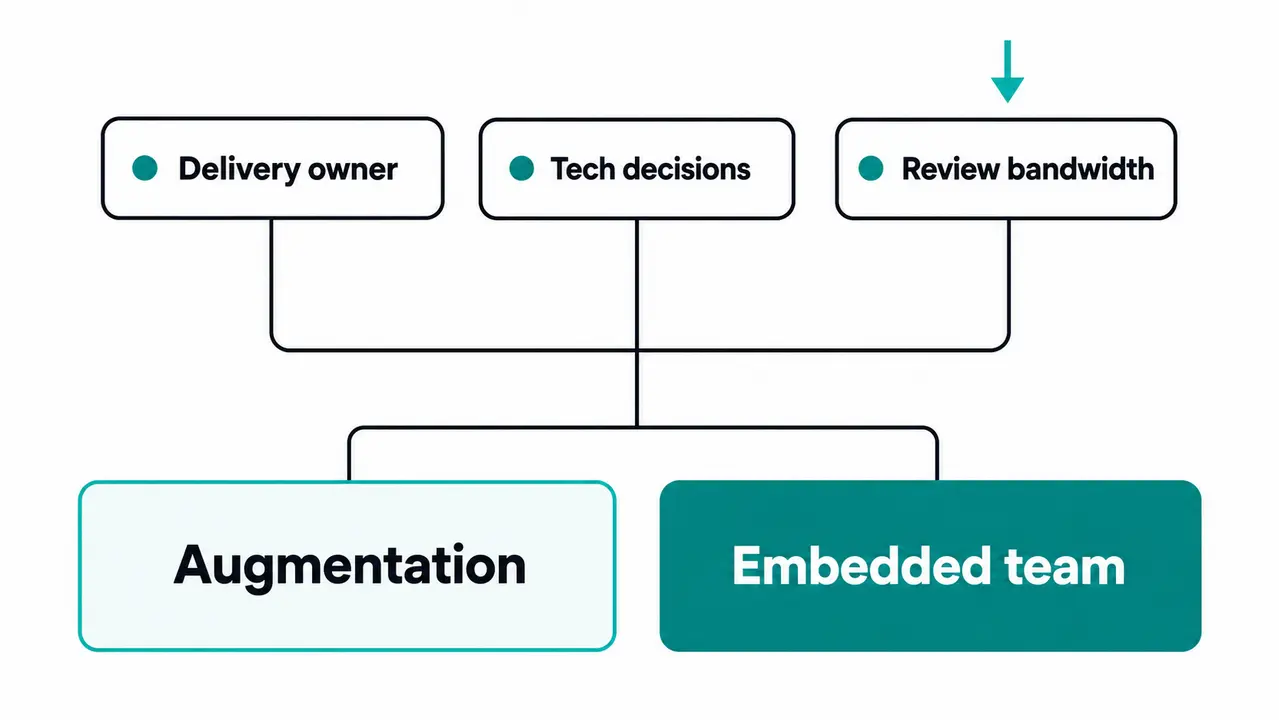
Strip the decision down to three questions. Who owns delivery? Who owns technical decisions? How much internal bandwidth do you have for onboarding and code review? The answers determine the model, not the marketing material.
Here is the honest threshold we use with clients. If your tech lead can spare five to eight hours a week for direction and review, augmentation can work, because someone internal is steering the ship in real time. Below that bandwidth, you are not augmenting, you are abdicating, and you need embedded leadership instead, which is where dedicated software engineering teams carry technical ownership and continuity as part of the model rather than as an add-on. There is a counter-case too. If your scope is entirely stable and fully specified, project outsourcing avoids paying for leadership you genuinely do not need.
Why in-house hiring stalls at scale
Hiring is the slowest way to add near-term delivery capacity, because the bottleneck is not headcount budget. It is sourcing, evaluation, and onboarding, in that order. Each stage consumes the scarcest resource you have, which is senior engineering time.
Write out your onboarding checklist and look at what it costs. Domain walkthroughs, two to three hours per session. Environment setup and access provisioning, days of waiting on IT tickets. Coding standards documentation, if it exists. Release process training. Multiply that by every candidate who starts and does not stay. Then add the interview loop itself. The steady growth of ICT specialists across the EU, tracked by Eurostat, highlights how intense the competition for this talent has become, stretching internal hiring timelines even further. The failure mode is quiet and lethal. Your leads spend more time interviewing candidates than reviewing pull requests, and the roadmap stalls in the name of fixing capacity.
Staff augmentation as a control-first model
Staff augmentation fits when you want direct management control and your internal product and engineering leadership is already strong. In this model, temporary developers are individuals who join your standups, your planning sessions, and your retrospectives, and take tasks directly from your leads. They use your tooling, your conventions, your review process. Nothing about your org chart changes except headcount.
The model has one requirement people skip over. Your leads must actually lead. Augmented developers waiting days for an internal decision, a design sign-off, or access to a staging environment produce the saddest graph in engineering, and the vendor gets blamed for low velocity that was never theirs to control. If decision latency inside your company exceeds a day or two, fix that first or pick a model with embedded leadership. Augmentation amplifies the management you already have. It cannot manufacture management you lack.
Dedicated teams when continuity matters more than headcount
A dedicated team is strongest when you need a stable group that builds product context over months and carries a meaningful slice of the roadmap. The composition we keep returning to for startups is a tech lead, two to five engineers, a QA or SDET, and optionally a delivery lead who shields the engineers from status theater. That shape survives contact with an evolving product.
The counter-case matters. For a tiny, fully specified one-off build, a dedicated team is overhead in search of a purpose, and a project engagement wins. For a product still finding its shape, continuity is the feature. Context compounds. An engineer who has shipped six releases in your codebase makes decisions a newcomer cannot, and re-creating that context costs far more than keeping it. This is the core of how we build teams at Sentice, culture-aligned, long-lived partnerships with technical leadership included as a feature rather than billed as overhead.
Project outsourcing for tightly scoped outcomes
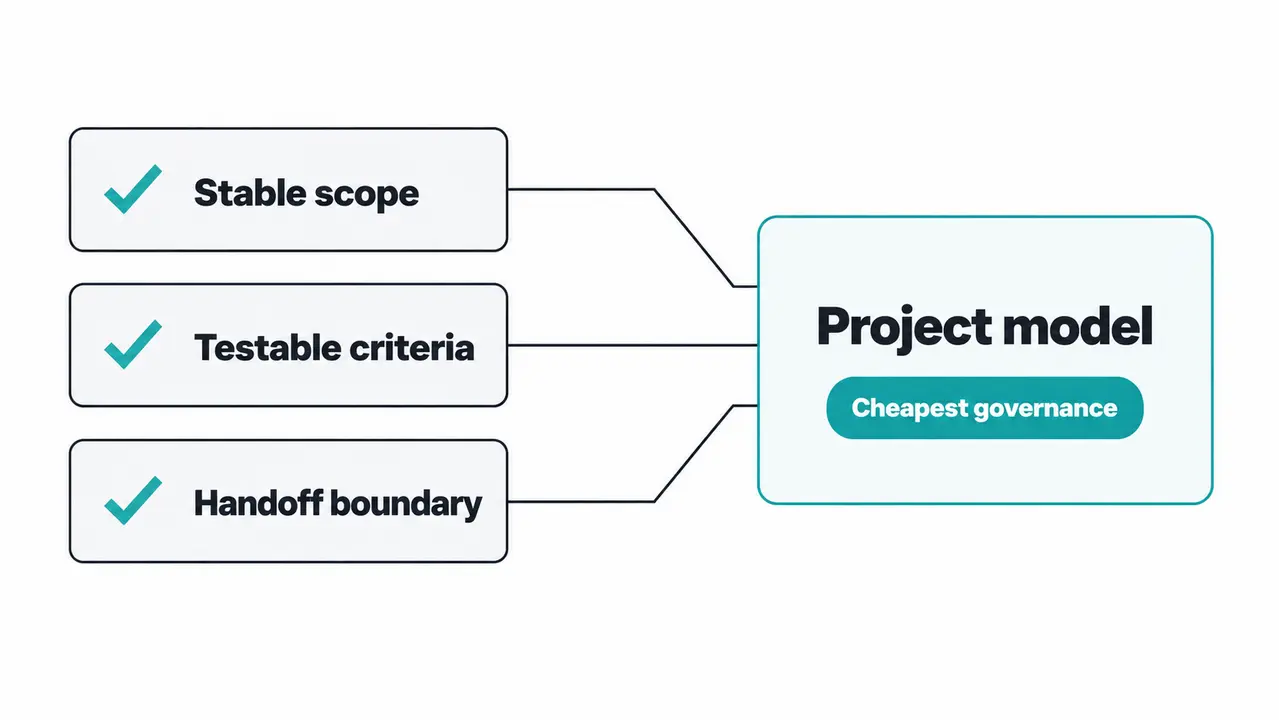
Project outsourcing works when three conditions hold. The scope is stable. The acceptance criteria are testable. You can tolerate a handoff boundary at the end. Get all three and it is the cheapest governance model you can buy, because the vendor absorbs the management overhead you would otherwise supply.
The inputs determine the outcome. A specification document that a stranger could implement from. A test plan. An acceptance harness, ideally automated, that settles disputes with a green build instead of an argument. A change control process for when reality disagrees with the spec. Miss those inputs and scope drift sets in, and drift in a project model becomes renegotiation. The failure mode is structural, not moral. The vendor measures success by ticket closure, your product keeps evolving, and every evolution becomes a change order. Scope volatility and project outsourcing are a bad marriage. Do not arrange it.
How the three engagement models compare
The real difference between the models is not who writes the code. It is where responsibility sits across planning, architecture, QA, release, and post-release support. Flexible staffing decisions usually go wrong because teams compare day rates instead of responsibility allocation, then discover the gap six weeks in when an incident lands and nobody knows who owns it.
| Criterion | Staff augmentation | Dedicated team | Project outsourcing |
|---|---|---|---|
| Backlog ownership | Your internal leads | Shared, embedded tech lead | Vendor against the spec |
| Who merges PRs | Your reviewers | Embedded lead plus your reviewers | Vendor internally |
| Who runs QA | You | Team QA or SDET | Vendor test plan |
| Incident ownership | You | Shared rotation | Vendor during warranty |
| Best fit | Strong internal leadership | Evolving product, low internal bandwidth | Stable, testable scope |
Two mismatches account for most failures we see. Choosing project outsourcing for volatile scope, and choosing pure augmentation when internal bandwidth for direction is already near zero.
Recognizing when you need a scalable team instead of a single hire
Diagnose the constraint before you shop for capacity. If throughput is blocked across multiple workstreams at once, a scalable team beats a single senior hire every time, because coordination and review load scale with the number of workstreams, not with the number of engineers. One hire added to four stalled streams becomes a fifth bottleneck.
Run a simple capacity map. Count your active repositories, your deployables, and your on-call rotations, and note where items queue. Four repos with weekly deploys and one internal reviewer is a team problem. That reviewer is your bottleneck, and adding juniors underneath them makes it worse. The counter-case is equally clean. If exactly one niche skill is missing, say a kernel driver or a BLE stack, hire the single specialist and stop reading procurement articles. Team solutions to individual skill gaps waste money in both directions, on overhead and on idle capacity.
Where teams underestimate onboarding
Onboarding is not a welcome call. It is a system that determines whether an external group becomes productive in days or stalls for weeks, and most companies have never written it down. The test is simple. Could a competent engineer ship code on day two using only written material, with no meetings beyond introductions?
For most teams the answer is no, and the missing assets follow a pattern. A first PR path, meaning a documented, deliberately small change that touches the whole pipeline from clone to deploy. Local development setup documentation that someone re-verifies quarterly, because environment docs rot fastest. Runbooks for the things that wake people up. An architecture map that shows the boundaries and the historical accidents. The failure mode is assuming a kickoff meeting replaces all of this. Context delivered verbally evaporates. Context written into the repo compounds across every future engineer, internal or external, and it is the cheapest velocity investment you will ever make.
The first ten working days with an external engineering group
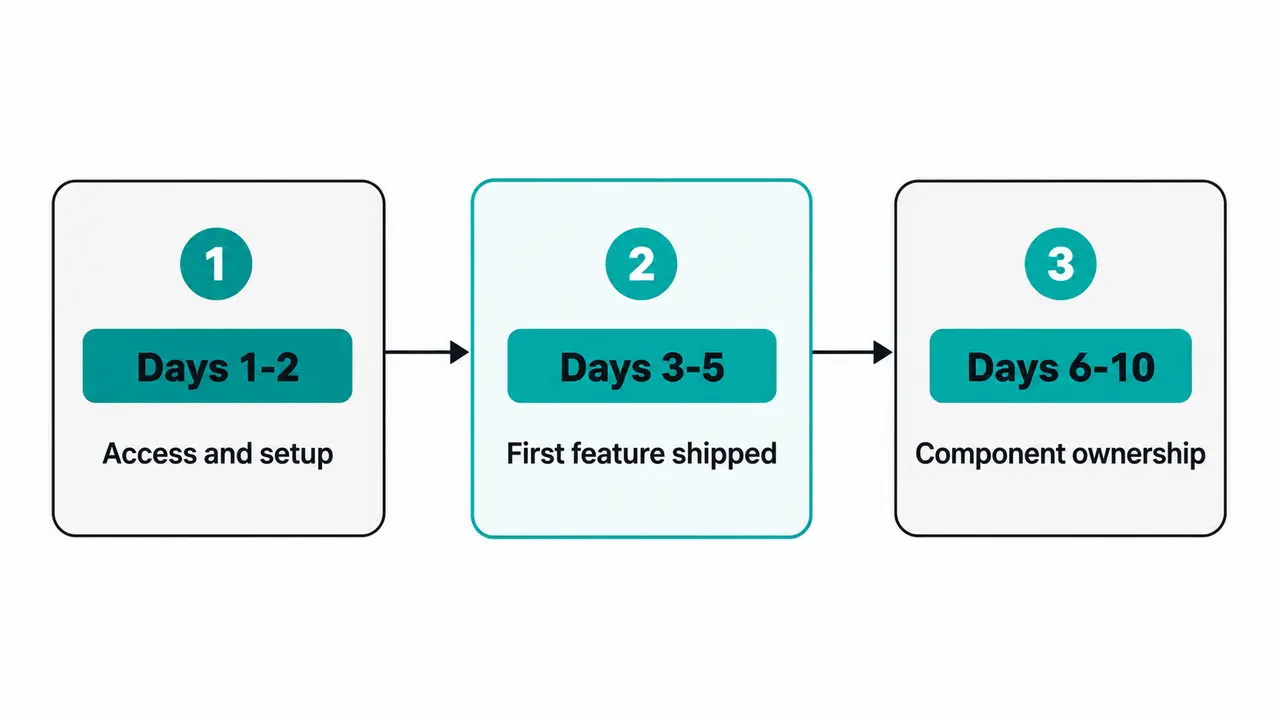
A structured first ten days de-risks delivery by proving integration, quality gates, and decision paths before you scale headcount. Treat it as a paid trial with real stakes. Days one and two cover access provisioning, repository tours, and the local setup path. If setup fails on day two, you have learned something worth the entire fee.
Days three through five, one small feature goes all the way through your pipeline, branch, PR, review, CI, staging, production. Real scope, real stakes, small blast radius. Days six through ten, the group takes ownership of a component, writes its first Architecture Decision Records, and joins the release rotation. By day ten you know their PR quality, their communication cadence, and how fast decisions travel. The failure we keep seeing is scaling to six engineers before the first deploy. Six people discovering your process mismatch in week two costs six times what one person discovering it in week one costs.
Keeping code quality stable with temporary developers
Quality does not stay stable because you hired careful people. It stays stable because the system enforces it, and temporary developers should hit the same gates your permanent ones do. Mandatory linting and static analysis in CI. Branch protection that blocks merges without review and green checks. Review ownership that is named, not implied. A Definition of Done that includes tests, documentation, and observability. The NIST Secure Software Development Framework is a practical baseline for these controls, covering code review practices, build integrity, and vulnerability handling in a form you can map onto your pipeline directly.
When quality enforcement lives in the pipeline rather than in code review arguments, temporary engineers cannot degrade it even if they try. There is a counter-case. Early prototypes can run with lower rigor, but only with explicit boundaries in writing and a cleanup plan with dates. Vague permission becomes permanent debt.
Security and access boundaries that do not slow delivery
The fear is that external engineers with fast access expand your attack surface. The reality is that unmanaged access does, and managed access does not slow anyone down when it is designed correctly. Least-privilege IAM roles provisioned through Terraform or your equivalent, so access is code, reviewable and reproducible. Separate environments, with production access granted per need and per role. Secrets management instead of credentials in Slack threads or a shared vault file. Short-lived credentials that expire instead of accounts that outlive engagements.
The hidden liability in fast staffing is rarely exotic. It is the shared admin password from 2019, the laptop nobody manages, the service account with write access to production that someone created during a crunch. External engineers following good access hygiene are a smaller risk than internal shortcuts you already tolerate. Audit both. Then decide who gets keys.
Embedded and system work changes the staffing math
Embedded and system-level development is a different discipline from web and API work, and generic on-demand developers without embedded verification experience are the weaker option for device work. The coupling to hardware constraints, toolchain quirks, and certification requirements changes which roles you need and which artifacts the team must produce. A build engineer who owns the cross-compilation toolchain. A test harness that runs against real targets. Hardware-in-the-loop setups so regressions surface before field deployment instead of after. Traceability from defect to requirement, because auditors and certification bodies will ask.
Skip those specialties and you get firmware that works on the bench and fails in the field. We staff this work differently at Sentice, and our system and embedded engineering practice exists precisely because bolting generalists onto device projects reliably disappoints. The counter-case holds for pure application layers around the device, where generalists are fine.
Communication patterns that keep distributed teams unblocked
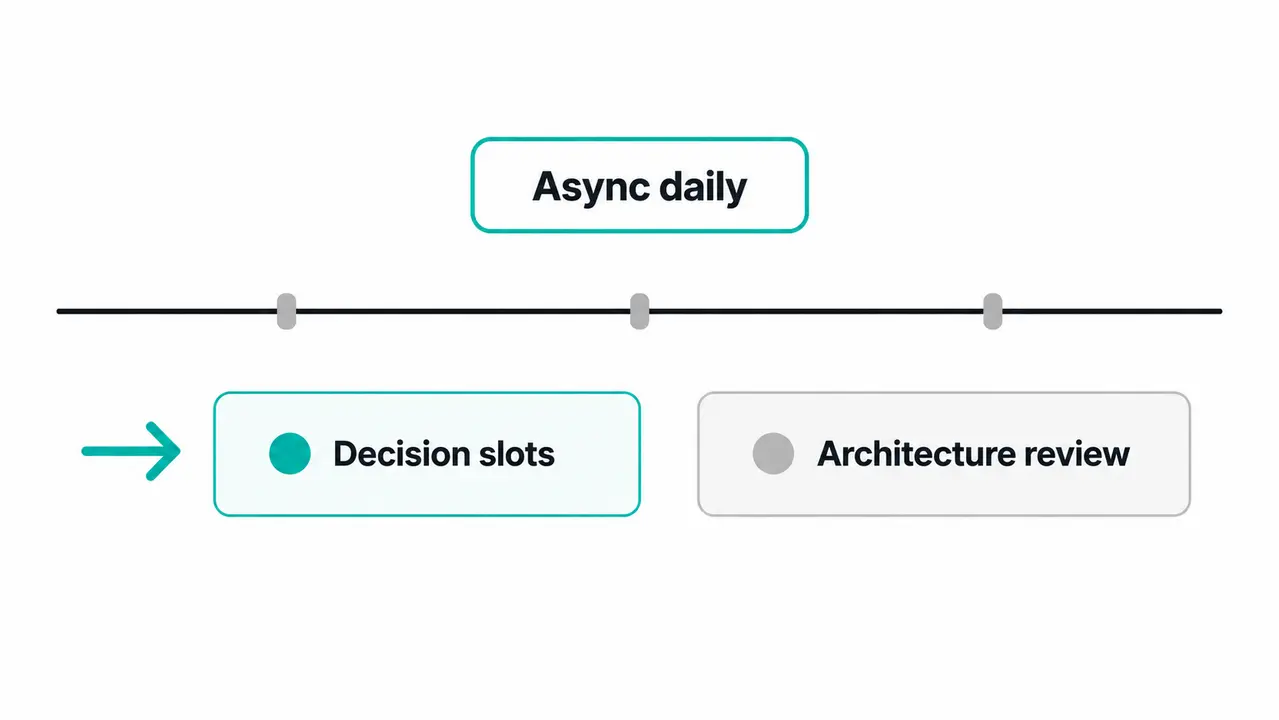
The goal is fewer meetings and faster decisions, and you get there through explicit ownership and written context, not through more synchronous time. Define the operating cadence in writing before the engagement starts. Daily async updates in a channel, three sentences, what shipped, what is blocked, what is next. Two fixed weekly decision points where open questions get resolved, not a rolling conversation that never lands. One architecture review slot per week for anything cross-cutting. An incident review loop that produces a written postmortem rather than a blame session.
Most blocks in distributed work are not timezone problems. They are undefined decision paths. Work waits on one internal stakeholder because nobody wrote down who decides, and the stakeholder did not know they were the bottleneck. Name the decider for every class of decision, from API changes to dependency upgrades, and the timezone gap shrinks to a scheduling detail.
Measuring success without vanity velocity metrics
Story points measure planning consistency, not delivery. Lines of code measure nothing worth managing. The metrics technical leaders actually accept are lead time to production, change failure rate, mean time to recovery, review turnaround time, and escaped defects found by users. Together they tell you whether the external group is shipping safely, shipping fast, or shipping the appearance of both.
Early in an engagement, before the data is trustworthy, qualitative signals carry more weight. Are the pull requests readable, or do they dump two thousand lines with a one-line description? Does the team raise risks proactively, or do you discover them at demo time? A group that flags a risky dependency in week two will behave better under pressure than one that hits every sprint number in month one. If you want a framework for scaling delivery without metric drift, our piece on how to grow your tech team without losing speed or quality covers the full measurement stack.
Exit planning so you do not lose product knowledge
An external team is only truly flexible if you can scale down without creating a knowledge cliff, and exit planning starts in week one, not in the final month. The artifacts that make an exit clean are the same ones that make daily operation clean. Component ownership docs naming who knows what. Runbooks for every recurring operational task. An architecture map current enough to onboard the next person. A release playbook covering the steps nobody remembers under pressure.
The failure mode is a vendor departure that leaves your internal team inheriting an unowned, undocumented mess. We have watched internal engineers spend a quarter reverse-engineering systems an external group built and never explained. Put the exit artifacts into the Definition of Done from the start, every component documented as it is built, and scaling down becomes an administrative event instead of an archaeological dig. Any partner who resists that standard is telling you something. Listen.
Scope the team before you need it
Tell us about your roadmap and the capacity gap you are staring at, and our engineers will help you map the right engagement model in a single conversation.
Frequently asked questions
What is the minimum viable size for an on-demand development team?
Three people is the practical floor for owning a roadmap slice, a tech lead, one senior engineer, and a QA or SDET. Below that, you have bought individual capacity that still depends on internal leadership for every decision. Two engineers can work for a well-scoped feature stream, but one engineer alone is an augmentation, not a team, and should be managed as such.
How do you handle time zone overlaps with a scalable team?
Target three to four hours of shared working time per day for reviews, pairing, and decisions, and let everything else run asynchronously through written updates. Teams in Central Europe working with US East Coast clients get a natural afternoon overlap. The overlap hours should be reserved for decisions, not status meetings, which is what the async channel is for.
Can an on-demand team take over a legacy codebase safely?
Yes, with conditions. The first two weeks go to characterization, reading code, tracing data flows, and writing missing runbooks, before any feature work starts. You should also budget internal time from someone who knows the historical accidents. A team that starts shipping changes into a legacy system in week one without characterization is accumulating risk you will pay for later.
What happens if an augmented developer does not meet expectations?
A reputable partner replaces the engineer quickly, typically within two to four weeks, and the transition includes a handover from the outgoing person. Put the expectation criteria in the contract upfront, review cadence, PR quality, response to feedback, so the conversation is factual rather than adversarial. What you should not accept is paying a learning curve twice for the same seat.
Who handles the procurement and legal onboarding for temporary developers?
In augmentation and dedicated team models, the vendor handles contracts, employment, equipment, and local compliance, and your side covers a master services agreement plus access provisioning. Security addenda, IP assignment, and data processing terms belong in the master agreement, not negotiated per engineer. Ask for the vendor’s process before signing, because a slow procurement path on their side delays your start date.
The gap between now and your next hire
Your next capacity gap will arrive the same way the last one did, mid-migration, mid-quarter, without a hiring budget ready. Map your decision criteria before you seek capacity, because who owns delivery and who owns technical decisions will shape the outcome more than any rate negotiation. Choosing the right engagement model is what keeps the roadmap moving through the transitions that stall most teams. So answer one question before you open a req. Will your next capacity gap be solved by adding hands, or by adding an embedded team?
About Sentice

Sentice is a boutique software engineering partner founded in 2013 by Roni Levi and Martin Petkovic, now headquartered in Skopje, North Macedonia. Rather than supplying individual developers, we build embedded teams that blend with a client’s culture, tech stack and goals, working together from a single office under our own technical leadership. We deliver dedicated software engineering teams, end-to-end software solutions, product development, and system and embedded engineering, and we act as technical advisors across the full development lifecycle, from specification and architecture through development, testing and support. We use AI coding tools across every project, and we help clients integrate AI into their own products through chatbots, MCP services, connected application layers and workflow automation. Some of the clients we started with more than a decade ago are still building with us today.