
Managing engineers across time zones fails for mechanical reasons, not cultural ones. The spoken agreement that nobody wrote down, the review that waits overnight, the status meeting that eats the only overlap window your teams share: each one converts distance into delay. This article treats distributed team management as a system design problem, the same way you would treat service boundaries in a codebase. Below, we cover the overlap window, async communication, response time rules, ownership models, review latency, meeting hygiene, security, and the metrics that expose time zone friction before it eats a release.
Reading time: 12 min
Key points
- A 3 to 4 hour overlap window is the scarce resource; spend it on design debates and unblocking, never on status reads.
- Context trapped in chat evaporates; decisions, interfaces, acceptance criteria, and handoff notes must live in durable writing.
- Review latency is the cheapest metric to fix and the most expensive to ignore; a two-day queue can triple cycle time.
- Measure flow metrics like cycle time and escaped defects, not hours logged or message volume.
Table of contents
Distributed team management is a system design problem
Managing a distributed development team works when you treat communication, ownership, and decision flow as an engineered system with explicit interfaces. Most teams treat them as culture. Culture does not survive a nine-hour time offset. Physical distance turns small ambiguities into 24-hour delays, and a one-line clarification asked at the wrong moment costs you a full day of an engineer’s calendar.
Picture a firmware change that requires a cloud API update and QA validation. The firmware engineer, the backend engineer, and the QA lead agree on a call. By the next overlap window, two of them have implemented conflicting versions of the same agreement. Nobody lied. Nobody was careless. The spoken contract had no written interface, so each side filled the gap with its own assumptions.
Two loops break first in this scenario. The decision loop, where a question waits overnight for an answer. The feedback loop, where a wrong assumption survives until integration. Sentice approaches cross-functional delivery by defining these loops explicitly before scaling them, the same way you would define service boundaries before splitting a monolith. Virtual collaboration without explicit interface definitions drifts. It always drifts in the direction of whoever last spoke.
The overlap window is your scarce resource
Pick a predictable overlap window and protect it strictly for work that cannot happen asynchronously. For large time offsets, a 3 to 4 hour overlap is a standard operating choice. It is enough for one real design debate and one unblocking session. It is not enough for both of those plus a status meeting, and that arithmetic is where most teams fail.
The overlap belongs to design debates, incident triage, unblocking, and pairing on complex diffs. Status reads and ticket narration do not belong there. When you spend the window reading a board aloud, you have zero hours left for the collaboration that justified the window in the first place, and your engineers start staying online outside their local working hours to compensate.
One regional team we work with runs a four-hour overlap against a US East Coast client. The recurring status call sat inside it. Moving status to a written channel recovered roughly an hour of pairing time per engineer per day, and evening logins stopped within two weeks.
| Work type | Overlap window | Async channel |
|---|---|---|
| Design debate | Yes | Not applicable |
| Incident triage | Yes | Parallel chat channel |
| Unblocking a stuck engineer | Yes | Tagged ticket comment |
| Status update | Not applicable | Written daily note |
| Ticket narration | Not applicable | Board and links |
Async communication fails when context is trapped in chat
Async communication scales only when the durable record lives in tickets, docs, and decision logs. Transient chat messages feel fast and destroy remote team management effectiveness over time, because the context they carry evaporates with the scroll. A message thread is a conversation, not a record.
Maintain a decision log page per subsystem, linked from both the repository README and the issue tracker project. Each entry captures the architecture choice, the tradeoffs considered, and the rollback plan. It takes fifteen minutes to write and saves the next engineer a day of archaeology.
The failure mode is predictable. A new engineer joins, asks the same question that was answered in a chat thread three months ago, nobody can find it, and work forks from a stale assumption. The rework lands in the review queue a week later disguised as a “misunderstanding.”
Write down four things every time, without exception: decisions, interfaces, acceptance criteria, and handoff notes. If a decision cannot be found in writing within two minutes, treat it as not yet made.
Response time expectations prevent silent escalation
Define response time by work type so engineers stop guessing when to interrupt and when to wait. Without explicit rules, every engineer invents a personal policy, and those policies conflict. One person pings immediately. Another waits a full day out of politeness while a blocker quietly matures into a crisis.
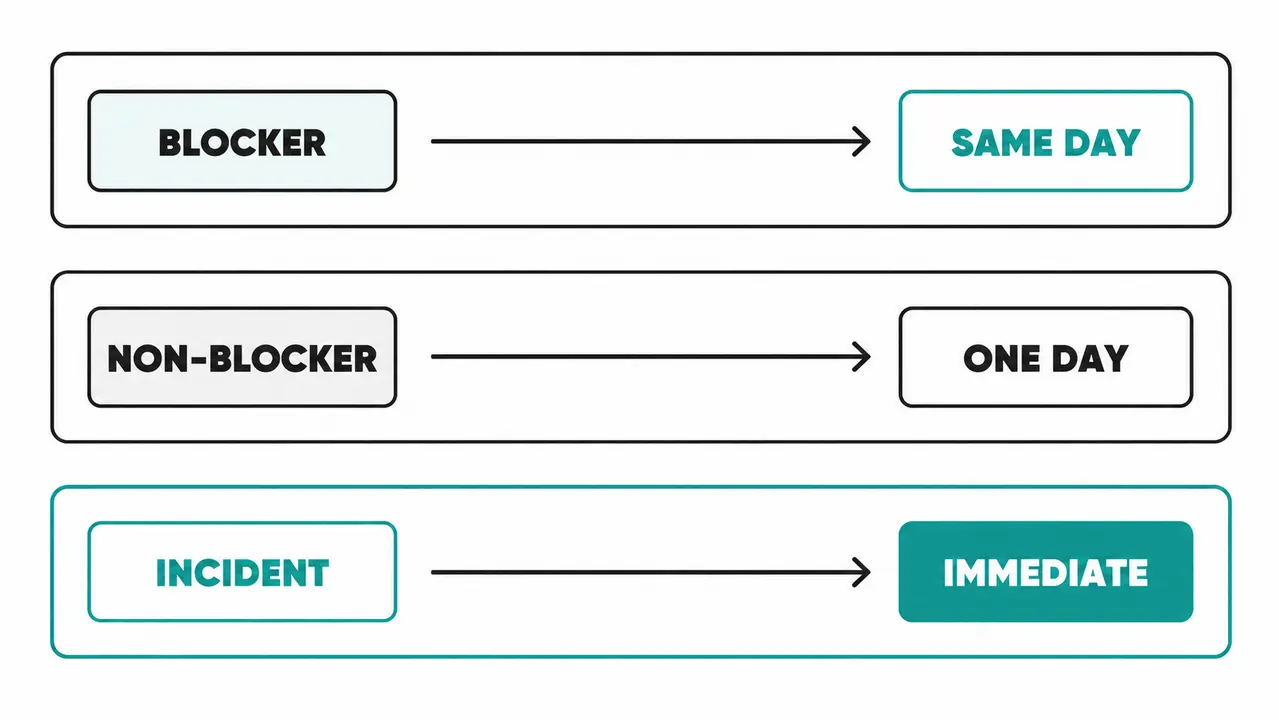
A workable baseline looks like this. Same-day response for anything tagged as a blocker during overlap. One business day for non-blockers. Immediate response for production incidents, with a paging tool like PagerDuty in the loop. Back the rules with a tag taxonomy in the tracker and in chat, so urgency is signaled by a label rather than by exclamation marks.
The failure mode shows up as everything feeling urgent. People stay online late scanning channels, sleep quality drops, and review quality drops with it. Clear expectations reduce anxiety across time zones because everyone knows what silence means. Silence means the other person is working, not ignoring you.
Tiny teams with full overlap can stay informal longer. The pattern still breaks at scale, usually around the point where a third time zone joins.
Ownership beats coordination in distributed execution
Distributed teams move faster when one engineer or one small pod owns a deliverable end-to-end. Define a single directly responsible individual per deliverable and per interface. Two names on a deliverable means nobody is accountable, and accountability gaps across time zones cost a day each instead of an hour.
A concrete slice: a driver update, the integration test that validates it, and the release note, owned as one unit by one engineer. Compare that to splitting the same work across a driver specialist, a test specialist, and a documentation owner. Each handoff creates waiting time between phases, and each wait happens overnight.
Splitting work by components creates hidden queues. A firmware team finishes its sprint and waits on a cloud team that has not started. Both look busy in their own boards. The release date slips anyway, because the queue was invisible to everyone holding a calendar. End-to-end ownership works best in pod structures, which is how we organize our dedicated software engineering teams, so each pod carries a feature from design through release rather than handing fragments across the map.
Ticket quality is the multiplier for async velocity
An ambiguous ticket is not a minor annoyance. It is a day of delay wearing a costume. The question that could have been answered in thirty seconds gets asked at the end of someone’s day, sits unread for sixteen hours, and the engineer who asked it has moved on to context-switching overhead in the meantime.
Use a ticket template that forces the writer to include the why, the scope boundaries, acceptance tests, relevant logs, reproduction steps, an owner, and a rollback path. Attach screenshots, traces, and expected behavior in one place. A ticket that requires the assignee to hunt for context across three tools is a ticket that will bounce.
Back the template with a definition of ready that engineers actually follow. Specify the minimum fields and name who enforces them, usually the tech lead during refinement. Enforcement is the unpopular part. A definition of ready that nobody enforces is decoration, and decoration is worse than nothing because it creates the illusion of a process.
Code review queues are where distributed teams lose days
You cannot manage a distributed development team without actively managing review latency. Reviews are the one work item where an overnight wait is structurally guaranteed, because review depends on a second person’s attention arriving at exactly the right moment. That moment is rarely shared across time zones.
Set a review service level objective, such as first response within one overlap window. Support it with reviewer rotation so no single reviewer becomes a bottleneck, small diffs that are actually reviewable in one sitting, pre-submit checks in CI that filter mechanical issues, and clear ownership for risky areas of the codebase.
Run the compounding math. A two-day review queue means your pull request waits two days, your fixes wait two more, and a third iteration puts a one-week feature at ten working days. Three review cycles at that latency triple your cycle time without a single line of code changing quality. Review latency is the cheapest metric you can fix and the most expensive one to ignore.
Meetings should exist to make decisions, not to share updates
Keep a minimal meeting set and force every meeting to produce a written artifact. A meeting that ends without a decision log entry, an updated ticket, or an updated runbook has converted shared calendar time into private knowledge held by whoever attended. Everyone who was asleep gets nothing.
A set that works looks like this. Weekly planning in overlap. A short daily async standup update in writing. A biweekly demo, recorded. Ad hoc design reviews scheduled in overlap when a written proposal stalls. Everything else is a candidate for deletion, and most of it deserves deletion.
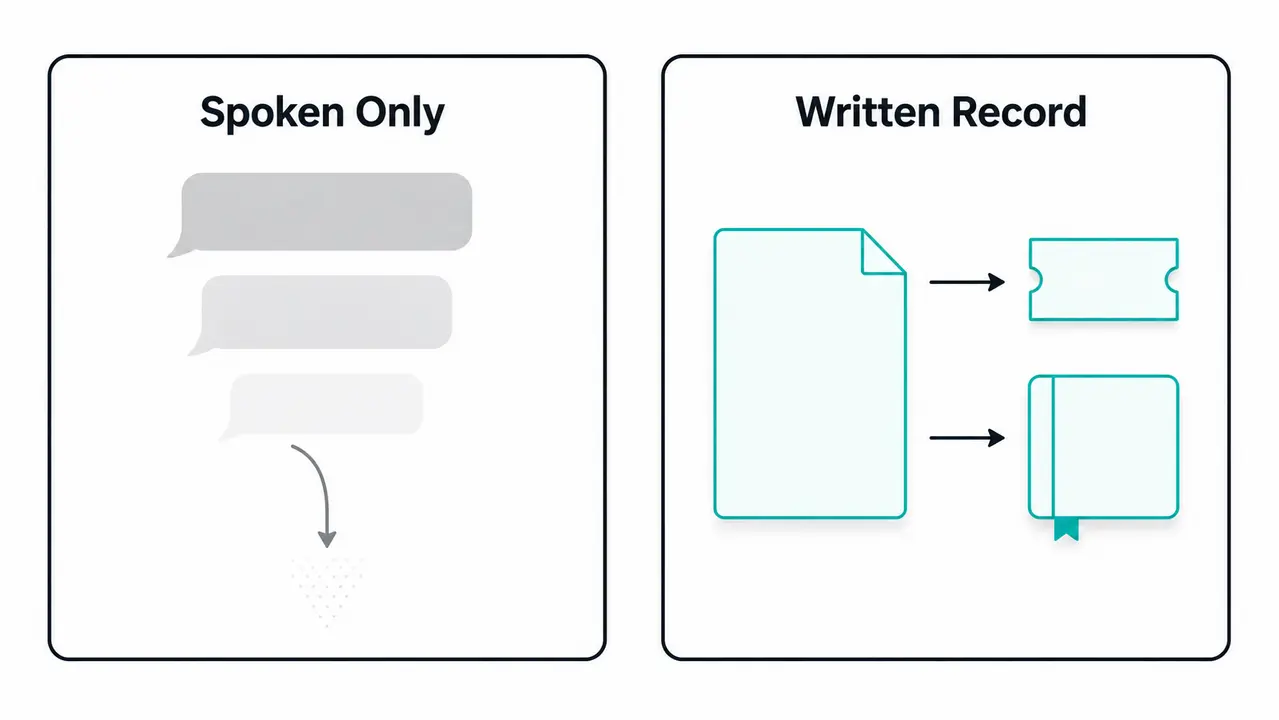
The failure mode is information dying in a call. The firmware team and the cloud team verbally align on a telemetry change on Tuesday. The engineer who needs the detail was asleep, reads a vague summary on Wednesday, guesses wrong, and the mismatch surfaces in integration eleven days later. Spoken updates without written records do not just lose information. They manufacture rework.
Written design reviews reduce time zone debate
Use lightweight written design proposals so feedback arrives asynchronously without blocking the build. A one to two page design note with goals, non-goals, interfaces, risks, and a test plan lets three reviewers in three zones respond within a day instead of finding a slot on a shared calendar two weeks out.
A typical case is an embedded to cloud contract change. The proposal describes the new payload, the versioning approach, and the migration for existing devices. Reviewers comment in writing, the author reconciles conflicts, and implementation starts from a stable target instead of a verbal sketch.
The failure mode without this artifact is late discovery. An interface mismatch surfaces during integration, when both sides have already built against their own assumption, and the fix now costs two reworks instead of one edit to a document. Hardware and cloud integration demands rigorous written contracts, which is the standard we hold in our system and embedded engineering practice, where a wrong pin mapping discovered late costs physical cycles, not just git reverts.
Require a live design review for security decisions, safety implications, performance budgets, and irreversible architecture choices. Everything else can be settled in writing.
Cross-team interfaces need explicit contracts
Virtual collaboration improves when you treat interfaces like products, with versioning, tests, and named owners. An interface between two teams sitting in different time zones is a trust boundary, and trust boundaries need contracts rather than goodwill.
Concretely, implement API schema versioning with a tool like Swagger, enforce hardware abstraction boundaries in the firmware layer, and run integration tests against the real contract in continuous integration on every merge. A firmware telemetry schema and a cloud ingestion pipeline are a contract between two teams, and that contract should fail a CI build when violated, not fail a Friday deployment.
The failure mode without contracts is silent breakage. A small change on one side breaks downstream teams, who find out hours later when their dashboards go quiet or their integration suite runs red. By then the offending change has merged, and rolling it back costs a second deployment. Explicit contracts convert that discovery from hours of confusion into a failed check within minutes of the push.
Onboarding is where distributed teams reveal their real process
If a new engineer cannot ship a small change in the first week, your team is missing documentation, access paths, or ownership clarity. The new hire is not the problem. The new hire is the diagnostic. Every gap they hit is a gap your existing team has been routing around from memory.
Use a 30-60-90 onboarding plan, a buddy system with a named peer, a starter task scoped for the first week, and an access checklist that covers repositories, CI, environments, and the device fleet. The starter task matters more than anything else on the list, because it forces every part of the path from clone to production to actually work end to end.
The failure mode compounds quietly. A new hire waits for answers, confidence drops, questions become rarer precisely when they should be constant, and ramp time stretches from one month to three. Structured onboarding in distributed environments matters more than in co-located ones, and the 2024 Stack Overflow Developer Survey offers a useful picture of how developers actually work and what they expect from their tooling and documentation as they join new environments.
Remote pairing works when hardware access is designed in
For embedded and device-adjacent work, remote collaboration depends on reliable remote access to test setups and repeatable environments. A pair programming session dies the moment one participant cannot see the device, flash it, or reproduce the failure. Software pairing is a solved problem. Hardware pairing is an infrastructure problem you have to build.
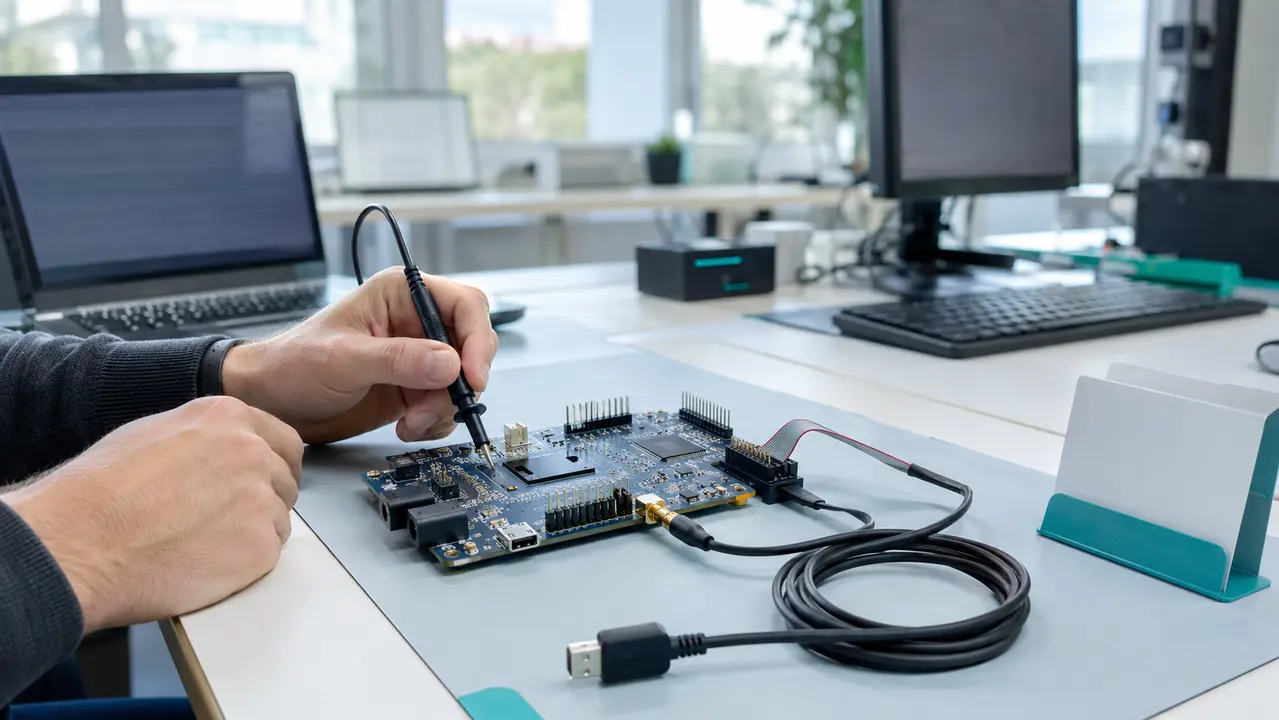
The toolkit is known. Shared lab rigs reachable over VPN. Remote flashing from a jump host. Streaming logs into a shared channel. Reproducible build containers so both sides run identical toolchains. Add a hardware booking calendar so two engineers never fight over the same board, and a standard debug capture bundle that packages logs, firmware version, and environment state into one archive.
The failure mode is a location becoming the bottleneck because only they can validate on-device. Every release then queues behind that office’s working hours, and your distributed team is distributed in name only. Standardize log formats, capture scripts, and explicit ownership of lab uptime. Lab infrastructure deserves an on-call rotation just like production does.
Async status updates should be structured, not chatty
A structured daily update replaces standup without losing visibility. Three lines per person, covering shipped, next, and blocked, with links to pull requests and tickets. Nothing else. The format matters because it is scannable by a team leader in ninety seconds across three time zones, and because the word “blocked” in a predictable location becomes a trigger for action rather than a buried confession.
Extend the same discipline to handoffs. An end-of-day handoff note for cross-time-zone work states what changed, what is in flight, and what the next region should pick up first. Written at 18:00 local time, read at 09:00 on the other side, it replaces the interruption that would otherwise happen at 22:00.
Long chat threads hide the real state. Forty messages of back-and-forth contain one decision and thirty-nine words of noise, and the decision has no link, no ticket, and no owner. Early-stage teams with large overlap can keep live standups if they enjoy them. The written record still matters, because the person who was absent will search for it later. Async communication only works when the artifact survives the conversation.
Trust is built with predictable delivery and visible work
Distributed teams avoid micromanagement when work is visible by default and outcomes are agreed upfront. Nobody micromanages a team whose progress they can see. Micromanagement is usually a symptom of blindness, not of character, and the fix is visibility rather than lectures about autonomy.
Use outcome-based goals per quarter, a demo cadence that forces shipping, and clear definitions of done attached to every deliverable. A weekly demo with a recorded walkthrough serves both the attendee in Sydney and the executive who watches at midnight in San Francisco. The recording is not a courtesy. It is the mechanism that makes one demo serve four time zones.
The failure mode is leaders starting to manage presence because progress is unclear. Activity indicators, green dots, message counts. Measuring outcomes instead of presence is the better track, and the Accelerate State of DevOps 2024 report makes the case for tracking delivery performance measures like lead time and deployment stability over surveillance-adjacent signals.
Others monitor hours. You should be monitoring shipped outcomes. The first builds resentment, the second builds a business.
Cultural differences show up as engineering risk
Differences in directness, escalation, and disagreement norms affect technical outcomes, not just team atmosphere. A team member raised in a high-context communication culture may read a blunt code review comment as a personal attack, while the reviewer intended it as ordinary Thursday behavior. The same review lands twice, once as text and once as insult.
The deeper risk is silence in decisions. In some professional cultures, publicly disagreeing with a senior engineer is close to insubordination, so the objection that would have saved a sprint stays unspoken. You get silent implementation of a bad decision because nobody challenged it live, and the cost surfaces at integration as rework.
Establish explicit norms for dissent, review feedback, and raising blockers. One rule that travels well: disagree in writing, with a proposed alternative attached. The written form removes the face-loss dimension, and the required alternative converts complaint into contribution. Remote team management means defining these interaction rules explicitly, because remote team management removes the hallway context where informal norms normally spread.
Security and access control get harder when the team is global
Distributed development requires tighter identity, access, and secret-handling hygiene, because your perimeter is now people and devices in a dozen locations instead of one office network. The VPN-and-firewall model assumes a building. Your team no longer has one.
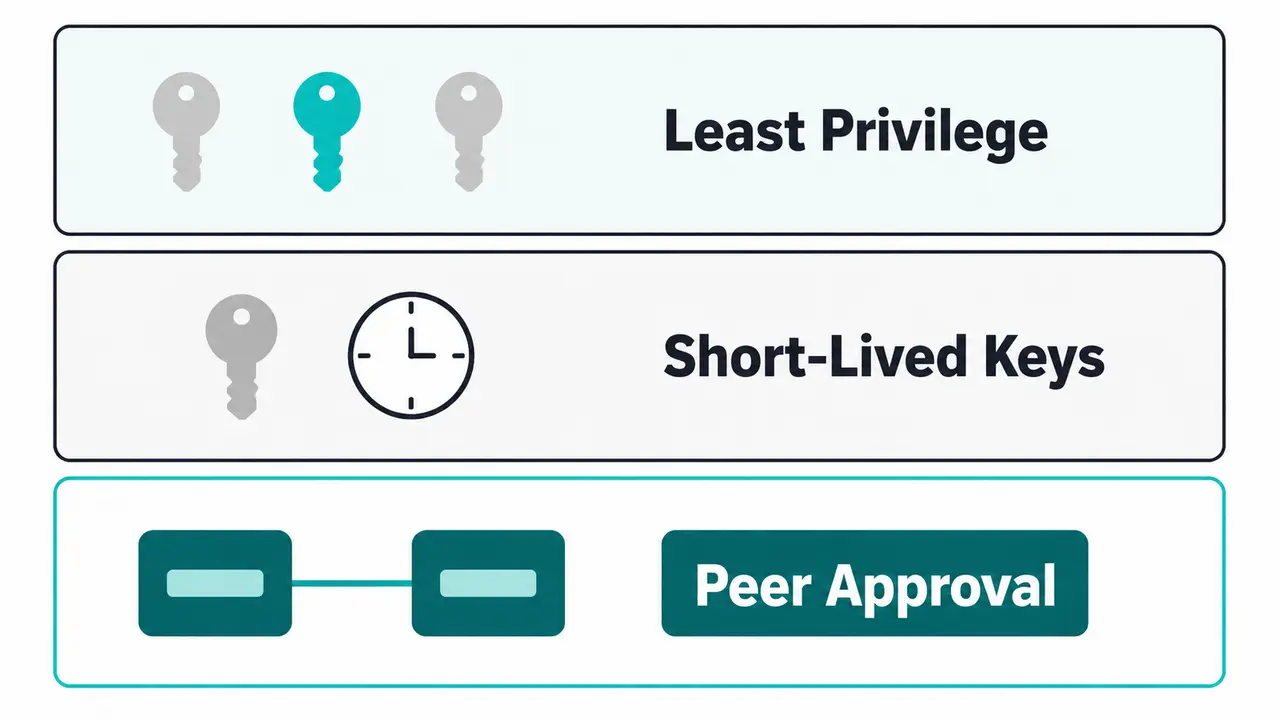
Apply least privilege as a default, use short-lived credentials that expire rather than shared long-lived keys, and audit access to repositories, CI systems, and device fleets on a schedule. Separate production access from development access entirely, and require peer approval for sensitive actions like key rotation and production deployments. The approval step costs minutes. The absence of it has cost companies their incident postmortems.
The failure mode is credential sprawl. Shared passwords in a chat thread, an access grant issued for a one-week task in March and still active in October, a lab machine with a default password reachable from a home network. Ad hoc grants never get revoked because nobody owns the revocation. The Secure Software Development Framework from NIST lays out a practical set of practices for exactly this, and it is worth handing to whoever owns your access review.
Metrics that reveal distributed team health
Track flow and quality metrics that expose time zone friction instead of vanity productivity measures. Lead time, cycle time, review latency, reopened tickets, escaped defects, and handoff count per feature tell you where the machine is slowing down. Hours logged and message volume tell you who is performing busyness.
Treat time-to-first-response on pull requests as a leading indicator of delay. It moves days before your cycle time does, which gives you time to fix the bottleneck before it eats a release. A reopened ticket rate that climbs on cross-team features points at contract drift, not at engineer competence.
The failure mode is measuring the wrong thing and getting exactly what you measured. Teams tracked on hours produce hours. Teams tracked on message volume produce messages. Neither produces software.
A weekly dashboard a CTO can review in ten minutes carries five numbers: median cycle time, median review latency, reopen rate, escaped defect count, and handoff count per shipped feature. Review it every Monday, ask one question per number, and act on the worst trend rather than the worst value.
Is your distributed setup ready for the next region?
If your review latency or handoff count already worries you, talk it through with engineers who run cross-time-zone delivery every day.
Build the system before you scale the team
Return to that firmware change waiting on a cloud API update, and notice that the delay was never about distance. It was about the absence of a written contract between two teams. You can have distributed scale or you can have speed, but you cannot have both without a designed operating system underneath them. Ask yourself directly whether your current engineering norms would survive a 24-hour communication delay tomorrow morning. If the answer worries you, review your expansion approach through scaling smart, a strategic guide on in-house expansion and outsourcing partnerships, before you add the next region to your org chart.
Frequently asked questions
How do you rotate meeting times fairly across regions?
Alternate the recurring meeting time by quarter, or share the burden deliberately so the same region is not always taking the early or late slot. Publish the rotation schedule a quarter ahead so people can plan their lives around it. Fairness here is a retention issue, not a scheduling nicety.
What is the minimum meeting cadence that actually works?
A weekly planning sync, a biweekly demo, and structured async standups cover the minimum viable coordination for a team spread across two to three zones. Design reviews run ad hoc in overlap when written proposals stall. Everything beyond that set should justify its existence quarterly.
How do you handle incidents when the on-call team is asleep?
Use a follow-the-sun rotation, or set up compensated on-call for the awake region to take the first pass with a documented escalation runbook. The awake engineer stabilizes, the owning team resolves during their morning. What matters is that the first responder has the access and the authority to act rather than merely observe.
What should be written down versus discussed live?
Write down decisions, interfaces, and status updates. Discuss live only genuinely ambiguous design choices and situations where an engineer is blocked and the unblocking requires back-and-forth. If a live discussion produces a decision, the meeting is not finished until that decision exists in writing.
How do you measure productivity without micromanaging?
Measure cycle time and deployment frequency, not screen time or keyboard activity. Those two numbers capture delivery speed and shipping cadence while leaving individuals free to work how they work. Add review latency and escaped defects and you have a health picture that requires no surveillance at all.
How do you onboard a senior engineer when the team is asleep?
Provide a comprehensive starter task scoped for week one, recorded architecture overviews instead of live walkthroughs, and a 48-hour first response service level for questions routed through a designated buddy. The senior hire will forgive a slow answer that arrives on schedule. What they will not forgive is silence with no expected arrival time.
About Sentice

Sentice is a boutique software engineering partner founded in 2013 by Roni Levi and Martin Petkovic, now headquartered in Skopje, North Macedonia. Rather than supplying individual developers, we build embedded teams that blend with a client’s culture, tech stack and goals, working together from a single office under our own technical leadership. We deliver dedicated software engineering teams, end-to-end software solutions, product development, and system and embedded engineering, and we act as technical advisors across the full development lifecycle, from specification and architecture through development, testing and support. We use AI coding tools across every project, and we help clients integrate AI into their own products through chatbots, MCP services, connected application layers and workflow automation. Some of the clients we started with more than a decade ago are still building with us today.