
Two teams ship to the same service for six weeks. One merges behind a feature flag, the other changes the shared schema on a Friday afternoon. Nothing dramatic happens. Then a routine deploy breaks checkout, nobody can say who owns the migration, and the incident channel goes quiet while both teams wait for the other to speak first. That is what integrating an external development team actually looks like at the start. Not a skills gap. A coordination tax, paid in review delays, unclear ownership, and duplicated work. The engineers on both sides are usually good. The structure around them was never designed.
Reading time: 12 min
Key points
- Integration failures are usually structural, not technical: missing product context, undefined decision rights, and unstated working norms.
- Choose an integration model, embed, dedicated squad, or specialist extension, before choosing tools or onboarding cadence.
- One accountable internal sponsor with named decision owners is the minimum structure an external team needs to work.
- Measure the first 30 days on independence and judgment, not tickets closed, and keep knowledge transfer continuous to prevent vendor dependency.
Table of contents
The integration problem is rarely technical first
When an external engineering team fails to gel with yours, the root cause is almost never code quality. It is missing product context, undefined decision rights, and unstated working norms. Skilled engineers with the wrong assumptions will ship confidently in the wrong direction, and confidence makes it worse.
The coordination tax shows up early. Reviews sit in queues because nobody knows whose approval matters. Two people build the same thing because ownership of a service boundary was never written down. A pull request gets contradictory feedback from two internal leads, and the external engineer picks the wrong one to satisfy.
Cultural integration in engineering means shared standards and shared accountability. Not a kickoff dinner. Not a virtual coffee. When both teams answer to the same definition of done and the same engineering standards, they operate as one unit. Sentice has spent more than a decade learning that the hard part of any engagement is the first six weeks of alignment, not the code.
Choosing an integration model before you choose tools
Pick your structure first. Everything else, from tooling to onboarding cadence, follows from it. You have three real options. You embed external engineers into existing squads. You stand up a dedicated development team with its own backlog. You buy a specialist team extension for a narrow skill gap.
The right choice maps to your actual constraint. Missing QA capacity and overloaded tech leads point toward embedding, because the constraint is attention, not headcount. A parallel roadmap slice with a clean service boundary points toward dedicated software engineering teams, because the constraint is throughput. A missing SRE or firmware specialist points toward extension, because the constraint is a skill.
Verdict: embedding wins for tight product iteration. Dedicated squads win for parallel delivery with clear interfaces. Specialist pools are weakest for core product work. Every handoff between a specialist and a product squad adds ambiguity, and ambiguity compounds weekly.
Where teams underestimate onboarding
Most team onboarding plans cover accounts, repositories, and a VPN config. Then they stop exactly where the hard part begins. Tooling access takes two days. Transferring product judgment and engineering taste takes weeks, and it is the part that decides whether the engagement works.
Engineering taste is specific. It is your error budget posture, your backward compatibility rules for a public API, your testing discipline around flaky integration suites, your release hygiene on a Friday. An engineer who joins without those defaults will make reasonable decisions that violate all four.
We have watched a capable team build features cleanly and break operability completely, because nobody handed them the runbooks or explained the on call expectations behind them. Frame onboarding as capability transfer with milestones, not a day one checklist. If you cannot name what judgment you expect the new engineers to demonstrate by week four, your onboarding plan is a login sheet.
The minimum internal ownership you need for an external team to work
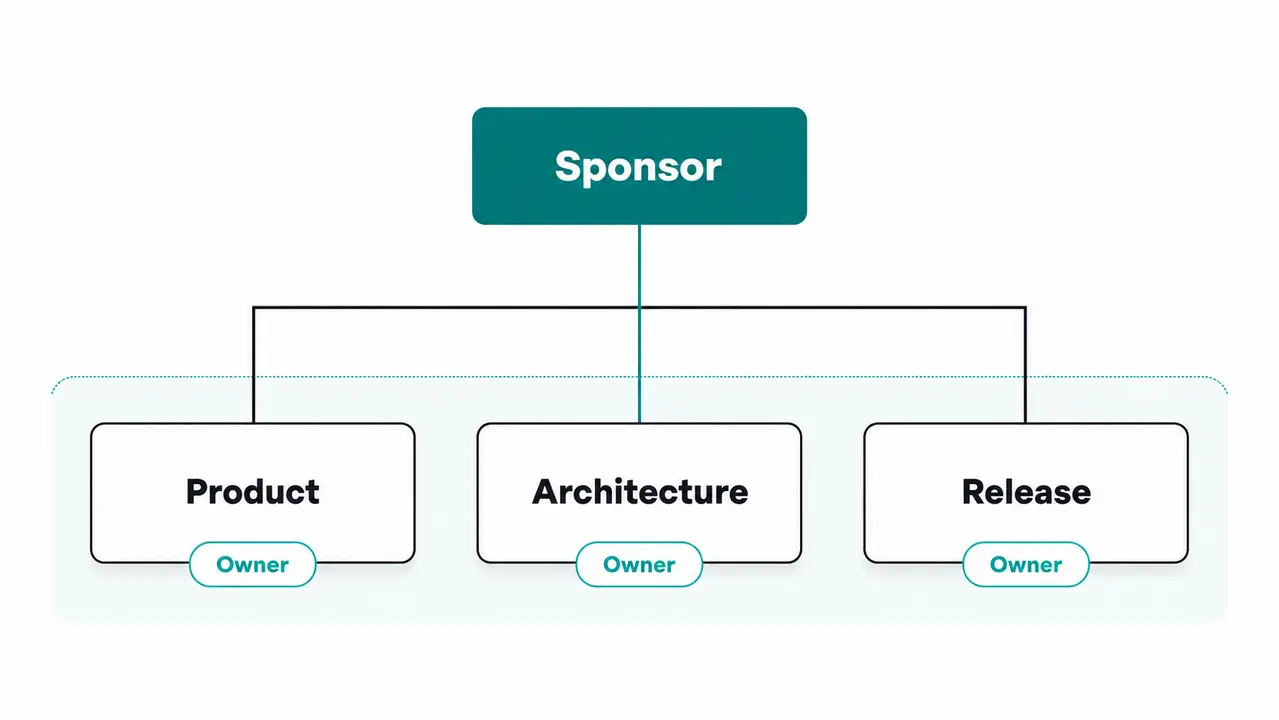
You need one accountable internal sponsor who owns outcomes, full stop. Below that person, you need named owners for product decisions, architecture decisions, and release decisions. Not committees. Named people.
The sponsor has four jobs: unblocking access before it blocks anyone, resolving priority conflicts within a day, protecting focus time from meeting sprawl, and enforcing engineering standards when a deadline tempts someone to skip them. It is a real role that costs several hours a week, and pretending it is ceremonial is how engagements stall in week three.
“Everyone owns it” produces the exact failure you hired to avoid. Reviews go slow because everyone assumes someone else will look. Feedback contradicts itself because two leads read the same ticket differently. Decisions get re-litigated in every thread. That is integration paralysis, and it looks identical to an underperforming external team even when the external team is fine.
Decision rights map for a mixed team
Put the ownership in writing before the first sprint. A simple RACI mapping keeps external engineers from guessing who has final say.
| Decision | Accountable | Consulted | Informed |
|---|---|---|---|
| Product scope and priority | Internal product owner | External team lead | All engineers |
| Architecture and tech choices | Internal tech lead | External senior engineers | Sponsor |
| Security exceptions | Internal security owner | Tech lead | Sponsor |
| Release approval | Release manager | Feature engineers | Both teams |
Pre onboarding assets that cut ramp time in half
External engineers ramp fastest on a small set of high signal artifacts. Not a wiki dump. Eight documents, each answering one question the new engineer would otherwise ask in Slack.
The set: an architecture overview, a service boundary map, a local dev setup guide that actually runs, a staging environment strategy, a CI pipeline overview, a release checklist, incident management notes, and current runbooks. Engineering enablement is mostly the discipline of keeping those eight artifacts true. Assign each one an owner and put it on a quarterly review cadence, or your new hires will inherit a Confluence space that describes a system you retired a year ago.
Then add a first week tasks list that validates the environment end to end. Clone, build, run tests, deploy to staging, roll back. If that chain breaks anywhere, you want to know on day two, not week three when the first real ticket hits the queue.
Access and security that still lets people ship
Security hygiene for outsourced developers is a solved problem with three rules. Least privilege access, time bounded credentials, and a staging environment that contains no production data. Anything beyond that is theater.
In practice: repository permissions scoped per team, secrets in a vault rather than a shared spreadsheet, MFA on every surface, VPN for internal systems, and audit logging turned on before the first login. The NIST Secure Software Development Framework is a solid reference for mapping these practices into your SDLC without inventing policy from scratch.
The failure mode runs the other direction too. Denied access does not stop work. It pushes work into shadow workflows, code pasted into chat, credentials shared over DM, fixes made directly in production consoles. Tier access by role and by surface area, grant the minimum that allows delivery, and review the tiers monthly. Slow access approvals cost you a day. A shadow workflow costs you an audit.
Onboarding week one that produces real commits
Week one should end with merged changes in a low risk area. That single outcome validates your tooling, your review flow, and your definition of done in one pass. Weeks of orientation without a commit teach you nothing about whether this contractor onboarding will work.
Pick starter work that is real but bounded. A small bug fix. A test coverage improvement on a flaky module. An internal API cleanup. A feature flag guarded change that ships dark. Each one exercises the full pipeline from branch to staging without betting the product on it.
Run a fixed day by day cadence. Day one, environment setup. Day two, pairing with an internal engineer. Day three, first pull request. Day five, first deploy to staging. Without that cadence, sprint velocity quietly decays while everyone waits for the ramp that was never scheduled. The calendar is the forcing function.
A first PR checklist that avoids rework
The first pull request sets the baseline for your code review process, so make the baseline explicit. Formatting checks pass. Tests cover the changed behavior. Observability hooks exist where the change touches a request path. Backward compatibility is addressed or explicitly waived. The reviewer expectation is written in the PR description, not implied. Five items, checked before review is requested, and the first PR becomes a teaching artifact instead of a negotiation.
The cultural integration that matters in engineering
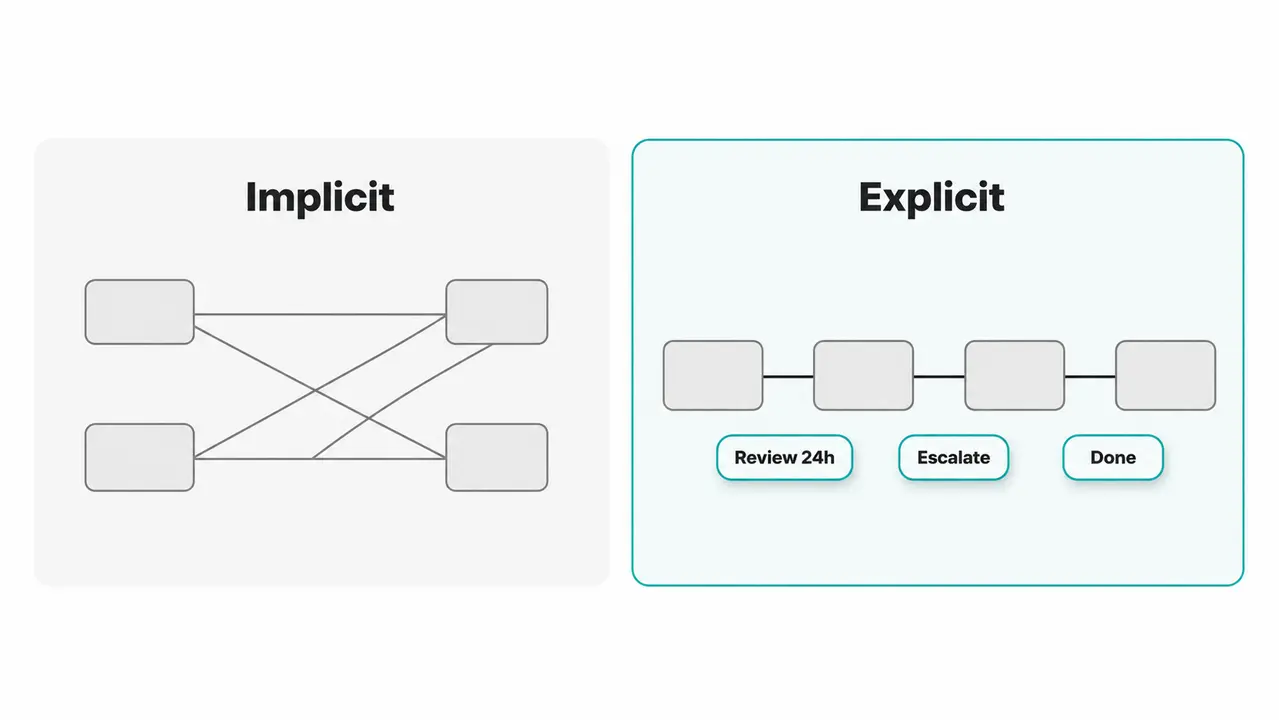
Engineering culture is the set of defaults your team runs on when nobody is watching. How you communicate, what quality bar you hold, when you escalate. External engineers do not absorb these defaults by proximity. They need them stated.
Spell out the norms that actually cause friction. What goes in a ticket and what goes in a thread. When a written update is enough versus when a call is required. How to disagree with a tech lead without a three day email chain. How to escalate a blocker, and to whom. What done means before a ticket moves.
Then make it measurable. If the norm is a 24 hour code review turnaround, say so and enforce it. If the incident channel expects a response within 15 minutes during business hours, write that down. Explicit cultural alignment produces fewer surprises, fewer meetings, and faster decisions. Cultural integration in engineering teams that leaves norms implicit produces the opposite, quietly, for months.
Communication design for distributed teams
Distributed engineering works when communication routes are predictable. Not when there are more meetings. Every meeting you add to compensate for unclear writing is a tax on both teams.
Build async first. Daily written updates, a decision log that anyone can read without asking, architecture decision records stored next to the code, and release notes written by whoever shipped. Reserve synchronous time for what genuinely needs it: planning, refinement, and incident review. The OECD’s work on bridging talent shortages in tech documents why distributed engineering keeps expanding, and the trend only raises the premium on written communication.
Teams that default to ad hoc calls are weaker, permanently. Knowledge stays trapped in private conversations and leaves when people rotate off. Define a minimum time zone overlap for the core hours that matter, and a fallback protocol, usually a decision template in writing, for when overlap is near zero.
Code review and merge ownership that prevents bottlenecks
Treat your review queue like a production system. It has load, it has latency, and when it fails, everything downstream stalls. Manage it with explicit targets and shared responsibility across internal and external engineers, because a queue only one side maintains will always back up.
Set service level targets by change type. Documentation and config changes get reviewed within a working day. Feature code within two. Anything blocking a release jumps the queue. Rotate reviewers weekly so no single engineer becomes the merge gate, and put a recurring review first block on calendars. Two hours, protected, twice a week. That one habit protects sprint velocity more than any process document.
The anti pattern to kill early: only internal leads can approve changes. It feels like control. It is a bottleneck, and when you integrate external developers at any real scale, it caps your throughput at the review bandwidth of two or three people.
When to require two approvals
Dual approval is worth the latency on high risk surfaces only. Authentication and authorization changes. Payment flows. Data migrations that touch customer records. Embedded firmware updates where a bad build means a device recall. Everything else ships with one qualified approval. Two approvals on low risk changes trains everyone to ignore the rule.
Shared definition of done across internal and external work
One definition of done, applied to both teams, or you get split brain. One side ships fast. The other side cleans up the residue, grows resentful, and starts quietly lowering its own bar to match. The second order effect hits about two months in, when quality arguments replace delivery arguments in every retro.
The shared standard needs teeth. Tests written and passing. Security checks run, not skipped. Observability hooks in place for anything user facing. Documentation updated in the same PR. A rollout plan and a rollback plan attached before merge.
We have seen the gap close a production incident. A feature passes QA cleanly, ships, and nobody can tell whether it is being used because no metrics were ever emitted. Paste this into every ticket template: “Done means tests green, security scan clean, metrics emitted, docs updated, rollout and rollback plan attached.” Short, checkable, identical for both teams.
Integration milestones for the first 30 days
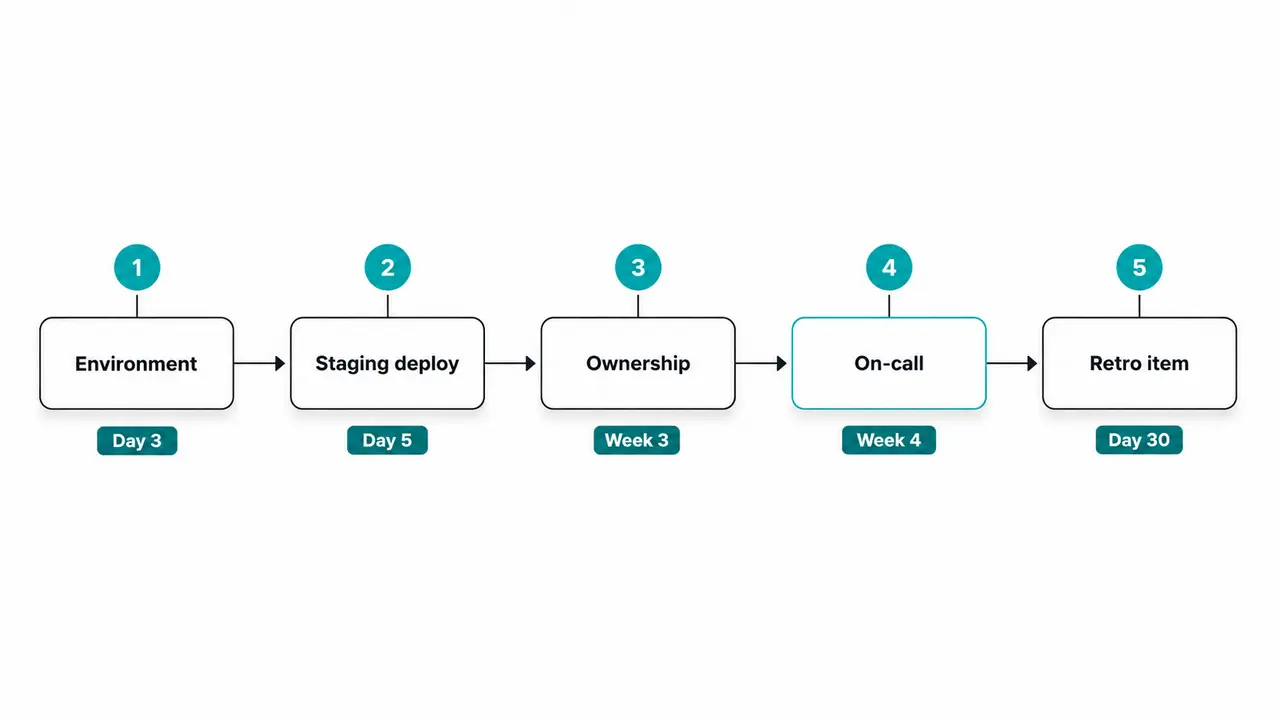
Measure the first month on independence and judgment, not hours logged or tickets closed. Those vanity numbers tell you the team is busy. They tell you nothing about whether the integration is working.
Good integration milestones look like this. Environment set up without help by day three. First deploy to staging by day five. A small service surface owned end to end by week three. On call shadowing completed by week four. One retro item led, from problem to agreed action, by day thirty. Each milestone tests a different capability, and a miss tells you exactly what to fix.
Review them in a weekly sponsor check in, fifteen minutes, same slot every week. The point is catching drift early. A team that misses the staging deploy milestone in week one and gets a pass will miss the ownership milestone in week three, and by then the recovery conversation costs ten times more.
Signals that the team is still not integrated
Five warning signs, and you rarely see just one. Repeated rework on the same changes. Priorities that stay unclear after planning. Pull requests stuck in queue past your review targets. A meeting load that climbs every sprint. Defect rates rising in areas the external team touches. Two or more of these together at the 30 day mark means the integration failed structurally, and no amount of extra hours fixes a structural failure.
Keeping architecture coherent while you scale capacity
Architecture survives capacity scaling when the constraints are explicit and enforced mechanically. Service contracts the CI can verify. API versioning rules that fail the build when broken. Lint rules and dependency boundaries wired into the pipeline rather than written in a doc nobody re-reads. Firmware interface specs with the same standing as API contracts.
Choose your enforcement weight deliberately. An architecture review board fits organizations with many teams and slow moving, high consequence systems. A lightweight ADR review, one hour, two senior engineers, decision recorded, fits almost everyone else. The full board applied to a five person startup is process cosplay.
What fails is architecture by tribal knowledge. It works while your senior engineers have slack, and collapses precisely when you integrate remote developers, because that is the moment tribal knowledge gets load tested by people who never absorbed it. Write the constraint down, wire it into the pipeline, and let the robots enforce it.
Handling embedded and systems work with external engineers
Embedded integration demands rigor that web teams sometimes forget exists. Hardware access becomes a scheduling problem. Builds must be reproducible, which means pinned toolchains, pinned SDK versions, and a flash procedure someone documented before the person who knew it left.
The non negotiables for this context: hardware in the loop testing wired into CI, firmware signing keys managed like production secrets, version pinning enforced by the build, and lab access granted with the same tiering you apply to production systems. Sentice handles this class of work through System and embedded engineering, where firmware interface specs and test rigs are treated as first class deliverables rather than internal artifacts.
Physical devices are always scarce. Simulate them. QEMU for the boot path, a mocked sensor bus for the driver layer, a golden path repository containing the exact build and flash steps validated weekly. When you integrate third party developers onto an embedded codebase, environment drift is the silent killer, and the golden path repo is the vaccine.
When a dedicated external squad beats staff augmentation
A dedicated squad wins when four conditions hold. You can define a stable roadmap slice measured in months, not sprints. The work sits behind a clear service boundary. A product owner has real availability, meaning hours per week, not a name on an org chart. A defined release process exists that the squad can own. Under those conditions, the external team takes a slice end to end and your internal leads stop being the constraint.
Staff augmentation fails when internal leadership bandwidth is low, which is usually exactly when companies reach for it. Augmentation assumes someone internal is directing traffic. If nobody has the hours, you have bought capacity with no one to steer it.
A nearshore team model is also weaker when the work is deeply cross cutting. Work that touches five services and requires constant internal context switching punishes any external structure, and punishes dedicated squads hardest. If you are weighing the models against each other, our strategic guide for in-house expansion and outsourcing partnerships covers the tradeoffs in more depth than this section allows.
The trial sprint that reveals integration risk early
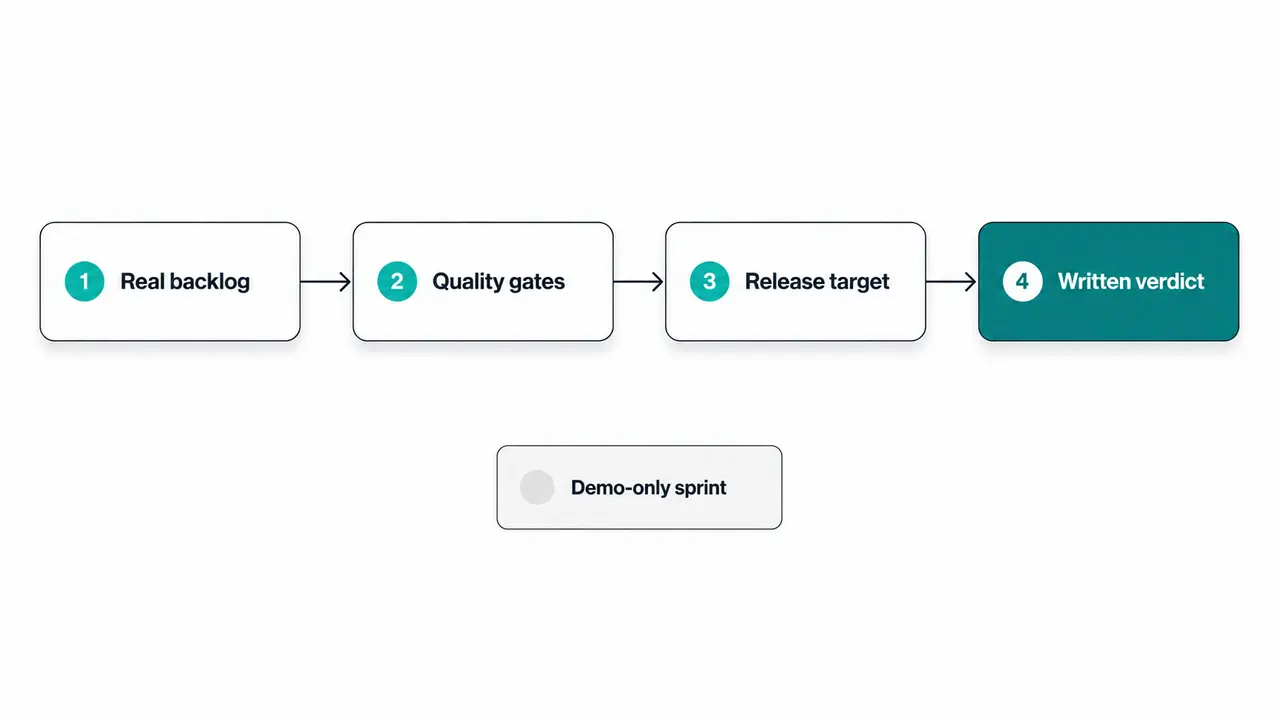
A trial sprint that only measures coding speed tells you almost nothing. Any competent team can demo well for two weeks. What you want to test is the collaboration mechanics, and those only surface under real conditions.
Give the trial sprint real inputs. A small backlog with acceptance criteria written to your normal standard, your actual quality gates, and a release target dated before the sprint ends. Then evaluate the things that predict the next twelve months. Were the questions asked early and in the right channel, or late and in a panic? Was the first pull request reviewable, or a rework generator? Did the team push back on anything, which is a healthy sign, or silently absorb contradictory direction, which is not?
Close with a retro in a fixed format: what worked, what broke, what changes before the next sprint, go or no go. A written verdict. The trial sprint validates your integration playbook before you commit to a long engagement, and a no go at week two costs you a sprint. A no go at month four costs you a quarter and your team’s patience.
Preventing vendor dependency through knowledge transfer
Dependency on a vendor is not caused by the vendor. It is caused by the absence of structured knowledge transfer, and it builds quietly while delivery looks healthy. You notice it the day a critical fix waits on one person’s availability.
Making transfer continuous beats making it a phase. Pair on non trivial changes. Rotate ownership of services and runbooks across the internal and external line. Internal engineers review external pull requests and external engineers review internal ones, both directions, from week one. Demos alternate between the two teams.
Require an ADR for any decision that outlives the quarter, stored in the repository where the code lives, not in a wiki that drifts. Then define an exit readiness check, run annually. Can you build, deploy, and roll back every service the external team touches, using only internal engineers and your documentation? The check is not adversarial. It is operationally prudent, and it keeps your external team onboarding checklist from aging into a liability. Onboard external engineers with the assumption that the engagement ends, and it usually never needs to.
The context is not static. The number of ICT specialists in the EU continues to grow, which means the pool you draw external capacity from keeps deepening, and dependency is a choice rather than an inevitability.
Frequently asked questions
How long should onboarding take for an external team?
Expect environment and tooling access inside the first week, merged changes by day five, and independent ownership of a small surface by week four. Full judgment transfer, where the team makes product calls you would have made yourself, takes about two months. If you are still explaining your error budget posture at week eight, the onboarding design failed, not the engineers.
What is the minimum documentation set before they start?
Eight artifacts: architecture overview, service boundary map, local dev setup guide, staging environment strategy, CI pipeline overview, release checklist, incident management notes, and current runbooks. Each one needs a named owner. Everything else can be written just in time during the first sprint.
Should external engineers join on call rotations?
Not in the first month. Start with shadowing in weeks three and four, then add them to the rotation once they have owned a production surface through at least one release. Excluding them permanently is the bigger mistake. On call is the fastest way to absorb operational context, and a team that never shares it never becomes one team.
How do we handle IP and repo access in practice to integrate an outsourced team?
Put IP assignment in the master services agreement before the first commit, not after. Grant repository access through an organization account tied to the vendor’s contract, not personal accounts, so access is revocable in one action. Keep secrets in a vault with per team scopes. Log the audit trail from day one. If offboarding requires more than a single access revocation, your structure is wrong.
What if the internal team resists working with external engineers?
Treat it as information, not obstruction. Resistance usually traces to a specific fear: slower promotion paths, review burden falling on internal leads, or a bad past experience with an agency that shipped and vanished. Address the mechanism behind each fear, in that order. Cross team collaboration improves fast when internal engineers see external code held to the same bar and external engineers reviewing their work with the same care.
How do we measure integration success without vanity metrics?
Four signals, reviewed monthly: median review turnaround for external authors versus internal authors, defect rate in surfaces the external team touches, the number of decisions re-litigated after being made, and how often external engineers escalate blockers to the right person on the first try. Convergence between the two teams on all four is the real measure. Ticket counts and velocity charts tell you nothing about integration.
The next step after you pick a model
Choose one product surface, assign a single internal sponsor, and run a two week integration sprint with explicit decision rights and a shared definition of done. Speed comes from clarity, never from adding headcount to an ambiguous delivery workflow. Go back to those two teams shipping to the same service with different assumptions, and ask yourself the question that would have prevented the whole incident: can you name your owners for product, architecture, and release decisions today, without checking a document?
Run your integration sprint with an embedded team
Tell us which product surface you want to test, and we will scope a two week integration sprint with named decision rights and a shared definition of done.
About Sentice

Sentice is a boutique software engineering partner founded in 2013 by Roni Levi and Martin Petkovic, now headquartered in Skopje, North Macedonia. Rather than supplying individual developers, we build embedded teams that blend with a client’s culture, tech stack and goals, working together from a single office under our own technical leadership. We deliver dedicated software engineering teams, end-to-end software solutions, product development, and system and embedded engineering, and we act as technical advisors across the full development lifecycle, from specification and architecture through development, testing and support. We use AI coding tools across every project, and we help clients integrate AI into their own products through chatbots, MCP services, connected application layers and workflow automation. Some of the clients we started with more than a decade ago are still building with us today.
Get in touch at info@sentice.com or call +389 70 307 837