
Your roadmap slipped three weeks, and nobody wrote a line about it in the retro. The review queue is eleven PRs deep, two of them owned by the only senior who understands the billing service, and the hiring funnel produced one offer that was declined. This is the point where most CTOs decide to hire external software developers, and it is also the point where the decision is made badly, because urgency substitutes for preparation. The talent exists. Eurostat counted 10.45 million ICT specialists employed in the EU in 2025, and that number keeps growing, so scarcity is rarely the real constraint. What fails is the operating model around the external engineers. This article is about that operating model, the parts you control before the first external engineer touches your repository.
Reading time: 12 min
Key points
- Capacity, not talent scarcity, is the usual constraint: the EU employed 10.45 million ICT specialists in 2025 and demand in the senior tier still outpaces supply.
- A dedicated team beats ad hoc contractors for core product work because the team, not a rotating individual, absorbs your conventions.
- Measure external developers on outcomes such as cycle time, review latency and escaped defects, never on hours tracked.
- Your organization should own source control, pipelines, cloud accounts and monitoring from day one, so leaving a partner never requires a migration project.
Table of contents
When external developers are the right move
The choice to hire external software developers makes sense when delivery is blocked by capacity or missing expertise, and the work in question can be defined as outcomes rather than open-ended exploration. A platform rewrite with a stable internal tech lead is a good fit. A mobile client that needs a burst of senior UI work for one quarter is a good fit. An embedded firmware milestone that requires a specialist in a specific RTOS is a good fit.
The decision trigger worth watching for is a roadmap slip driven by a review queue rather than unclear product direction. If your engineers know exactly what to build and simply cannot get it through the pipeline, capacity is the problem. If the product direction itself is contested, external talent cannot fix that. Bringing in outside developers to compensate for missing product decisions produces churn, rework, and a search for a scapegoat three months later. The macro context confirms the capacity squeeze: Eurostat reports the number of ICT specialists in the EU continues to grow, reaching 5.0% of total employment in 2025. Demand is growing faster than supply in the senior tier.
The week a senior leaves mid milestone
Imagine this scenario. Your senior engineer owns the build pipeline, the release signing, and two critical services. On Tuesday they resign, with four weeks left on a milestone that was already tight. There are no runbooks. The deployment procedure lives in their head and in a Slack thread from March.
The primary risk here is not the lost coding output. It is continuity of context, and it gets worse the moment you bring external engineers into a vacuum. They will attach themselves to your remaining senior, who now splits time between delivery, answering questions, and interviewing replacements. That person becomes the bottleneck for everything.
Before adding external engineers to a team in this state, require three artifacts: an ownership map saying who is accountable for each service, a service inventory with dependencies and data stores, and a release checklist someone other than the departing engineer can execute. Build those first, even if it costs two days. External developers can recover lost velocity. They cannot reconstruct context that was never written down.
Choosing between contractors a dedicated team and a project partner
Three engagement models dominate, and they differ more in operations than in headcount. Pick contractors for narrow, scoped execution where you already know the design. Pick a dedicated team for sustained capacity that shares your standards over multiple quarters. Pick a project partner for end-to-end delivery ownership under your direction, where the partner carries planning, QA, and documentation obligations.
The table below compares how the models split responsibility.
| Dimension | Contractors | Dedicated team | Project partner |
|---|---|---|---|
| Planning and backlog | You own all of it | Shared with your lead | Partner drives, you steer |
| QA process | You provide it | Team builds it with you | Partner owns it |
| Architecture decisions | You make them | Shared, your lead holds veto | Partner proposes, you approve |
| Documentation ownership | Ad hoc | Part of definition of done | Contractual deliverable |
Our verdict for core product work: ad hoc single contractors are the weakest option, because integration overhead compounds with each additional person. A model like dedicated software engineering teams keeps standards consistent because the team, not a rotating individual, absorbs your conventions. Reserve contractors for isolated spikes and migrations.
Where teams underestimate onboarding
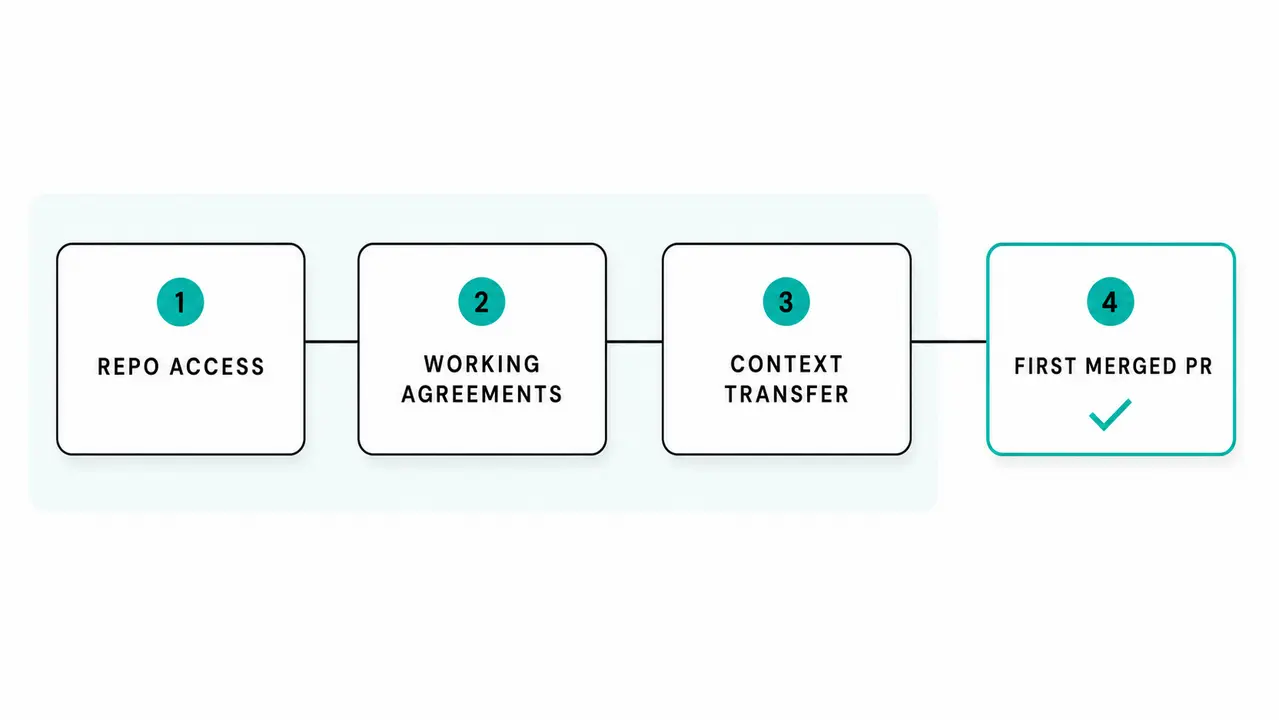
Most onboarding failures trace to one assumption: that onboarding equals access provisioning. Create the accounts, hand over the README, done. Onboarding is context transfer plus working agreements, and the access part is maybe a fifth of it.
Day one for an external engineer must include repo access, a local dev setup that actually runs, CI visibility, your coding standards, the branching strategy, the definition of done, and an escalation path naming a real person. If any of those is missing, the engineer will invent their own version, and you will discover it in code review two weeks later.
Set a first week deliverable that proves the loop works end to end. A small production-safe change behind a feature flag, plus a short architecture note on the module touched. When we onboard engineers at Sentice, that first merged PR is the real interview, because it exercises setup, review, conventions, and communication in one motion. Skip it and external developers code in isolation, then collide with internal conventions during review. The collision is expensive and the resentment is mutual.
What you need documented before you bring anyone in
You do not need perfect documentation. You need the minimum artifacts that let a new engineer make safe changes without breaking production or asking your staff twenty questions a day.
The baseline set is short. An architecture diagram covering services and data stores. Environment setup steps that someone has actually followed recently. A test strategy saying what is unit tested, what is integration tested, and what is manual. A release process written down as steps. A list of system owners with names, not team aliases.
For embedded work, add the specifics that only your team knows: a hardware revision matrix, the pinned toolchain version, the flashing procedure, and how to reproduce a field issue on the bench. One client of ours spent the first sprint of an engagement building exactly this document set, and it repaid itself within a month because two subsequent engineers started from paper instead of archaeology. Without it, external developers spend the first two weeks rediscovering tribal knowledge, and your seniors pay the tax in interruptions.
A practical vetting process that predicts real performance
Interviews measure interview fluency. Algorithm puzzles measure algorithm puzzles. Neither predicts how an engineer behaves inside your repository, your review culture, and your ambiguity. The best predictor we have found is a short paid trial on your stack, with your standards, evaluated by your engineers against a written rubric.
Keep the trial between two and four hours. A code review exercise on a real, representative pull request. A small bug fix with tests required. An instrumentation task adding metrics to an existing service. All three work, and all three produce artifacts you can compare across candidates.
The rubric matters more than the task. Score clarity of tradeoffs, test discipline, communication in PR comments, and the ability to follow existing conventions without being told. Weight the last one heavily. A candidate who leaves the codebase more consistent than they found it is worth three who write brilliant isolated patches. Trial-first hiring prevents the classic failure: a smooth talker who cannot work inside constraints, discovered six weeks in.
Defining scope to prevent hidden work from external developers
Scope expressed as a feature request is not scope. “Add export to the reporting module” could mean a week or a month depending on assumptions about format, pagination, permissions, and performance. Scope must be expressed as acceptance criteria plus integration constraints, written before the first commit.
Make the definition of done explicit and non-negotiable: tests included, observability included, documentation updated, and a rollout plan attached. For an API change, the definition of done includes a backward compatibility strategy and a deprecation note for existing consumers. No exceptions for deadline pressure, because deadline pressure is exactly when the shortcuts that hurt are taken.
The failure mode here has a specific shape. The external team delivers what looks like finished work, the demo passes, and then your internal engineers spend three hardening sprints adding error handling, contract tests, and monitoring that the estimate never counted. The work was not finished. It was demo-ready. Those are different things, and the difference is where hidden cost lives.
Keeping architecture coherent across internal and external engineers
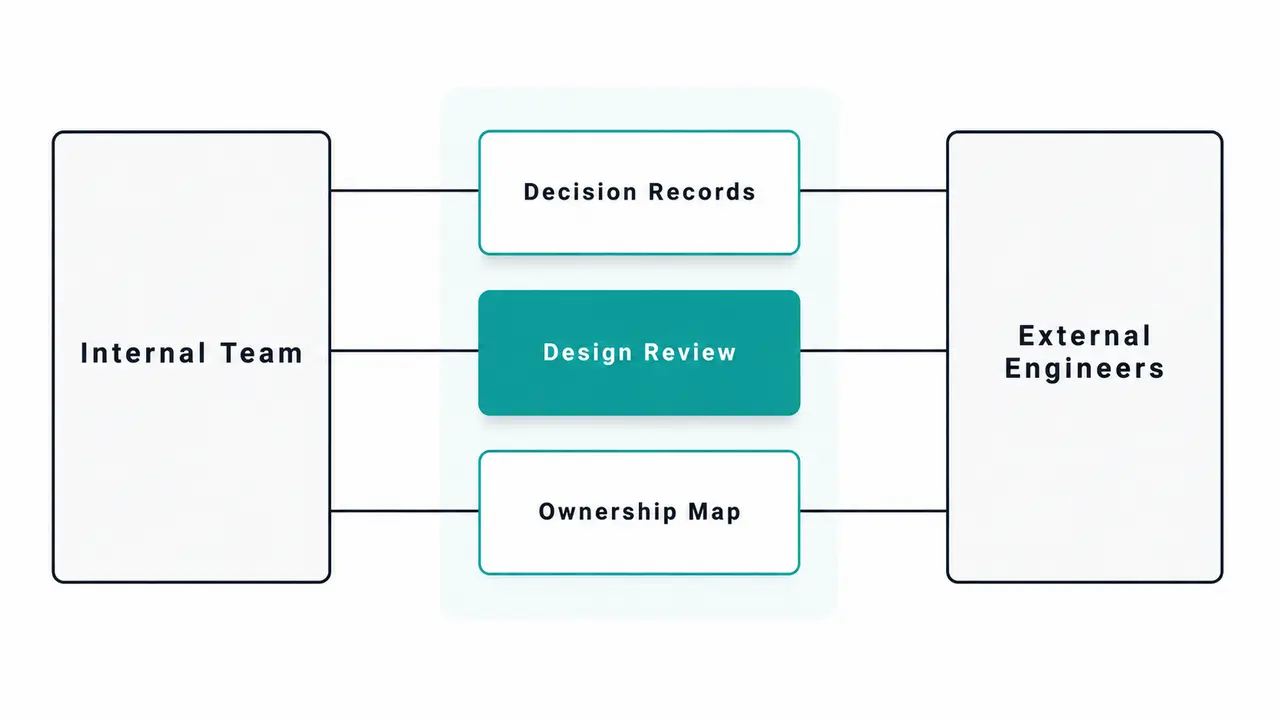
Architecture drifts when decision rights are unclear. An external engineer hits an ambiguity, makes a reasonable local choice, and six months later you have three serialization patterns across the same domain. The fix is not more upfront design. It is explicit, recorded decision rights plus shared rituals.
Three artifacts do most of the work. Architecture decision records, kept short and numbered, so every significant choice is written with its context and consequences. A weekly design review that external engineers attend as participants, not observers. Ownership boundaries per service, so everyone knows who to consult before touching billing versus touching the notification layer.
In hardware-linked products, add one rule: interface contracts between firmware and cloud must be versioned and tested, the same way you version an API. We have seen a project where firmware and the cloud backend each shipped a “compatible” protocol revision, defined independently, and the integration test only existed on paper. Parallel implementations and inconsistent patterns are the predictable result of skipping the rituals, and maintenance overhead grows with every divergence you tolerate.
Security and access control without slowing delivery
The instinctive response to external engineers is either wide-open access for speed or lockdown that makes them file tickets to read logs. Both fail. Contract developers stay productive with least privilege when environments, secrets, and approvals are designed before day one rather than bolted on after an incident.
The working set is small. Separate dev and prod access, with prod granted per need and audited. Short-lived credentials instead of long-lived keys. A managed secret store rather than a shared credentials file. Mandatory code review for sensitive modules, meaning the auth layer, payment flows, and anything touching customer data. One operational rule carries most of the weight: no direct production changes without an internal approver, ever.
For a baseline framework, the NIST Secure Software Development Framework (SP 800-218) maps the access and security controls that apply to every contributor, internal or external. The failure mode it prevents is quiet: over-granting access to move fast, then spending months finding and revoking what accumulated. Least privilege is cheaper than cleanup, every time.
IP ownership and deliverables that hold up after the engagement
Legal ownership and operational ownership are two different things, and teams regularly secure the first while losing the second. Your contract says all work product is assigned to you. Six months later nobody on your team can build the firmware from source, the deployment scripts live in someone else’s CI account, and the only documentation is a stale Confluence page.
Protect both layers. On the legal side: work product assignment language, confidentiality terms, a defined open source policy so license compliance is decided before a dependency lands, and explicit deliverables listed in the contract, including runbooks and diagrams. On the engineering side, demand reproducible builds, dependency lockfiles committed to the repo, and a handover checklist that a future engineer could follow cold.
The test is simple. The week the engagement ends, could a competent internal engineer clone the repo, run the build, deploy to staging, and find the answer to “why does this exist” in a written artifact? If the answer is no, you own the code legally but cannot operate it. That gap is where engagements quietly fail after they end.
Communication patterns that keep external talent aligned
More meetings do not produce alignment. Shared cadences and written interfaces do. The pattern that works is almost always the same four elements, tuned to your team rather than copied from a playbook.
A daily async standup in one channel, written, so anyone can reconstruct the last two weeks of decisions by scrolling. A weekly demo of working software, not slides. Sprint planning with named owners per item. A single backlog that both internal and external engineers pull from, because two backlogs means two priorities and endless negotiation.
Define response time expectations in writing: blockers acknowledged within an hour during overlapping hours, code reviews returned within one business day, and an explicit rule for what justifies interrupting someone directly. The failure mode this prevents is asymmetric silence. External talent waits on feedback while your internal team assumes progress is happening, and both sides discover the gap at the demo. We have watched a two-week stall originate from one unanswered architecture question in a channel nobody was watching.
Measuring success without tracking hours
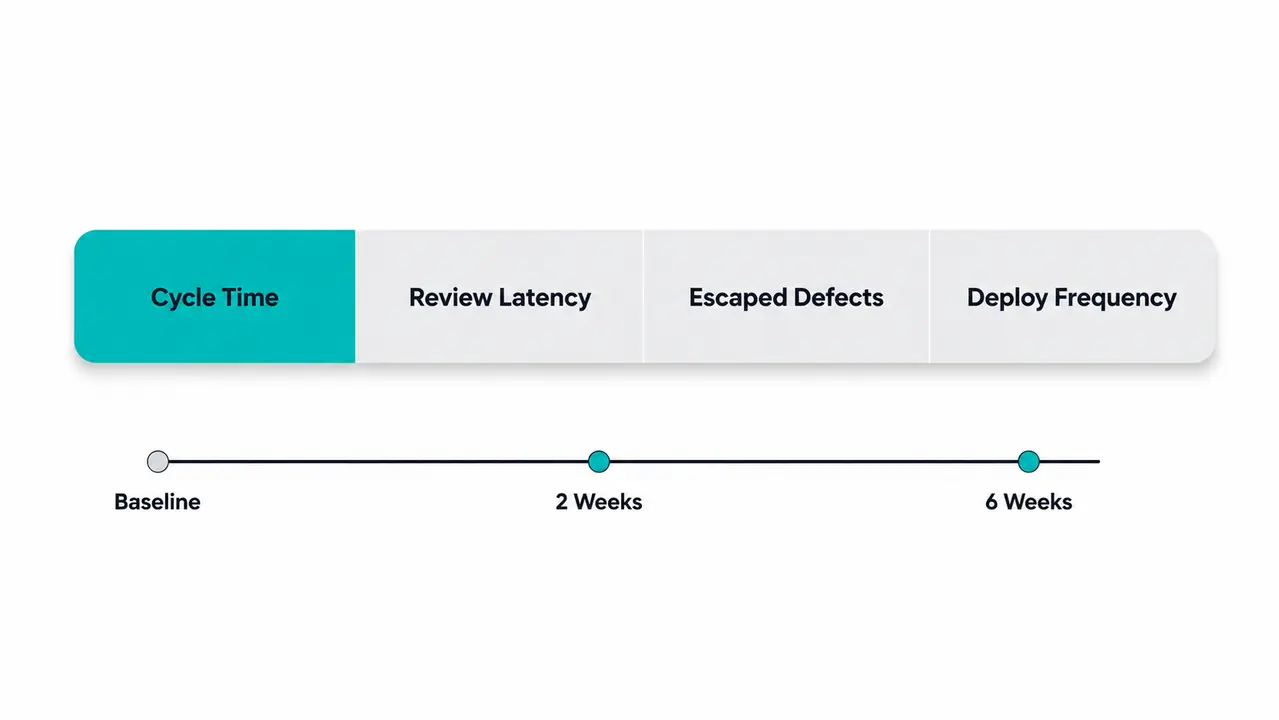
Hours tracked tell you presence. They tell you nothing about whether the roadmap moved or risk went down. Measure external developers on outcomes, using the same engineering metrics you already use internally, so the comparison between internal and external contribution is honest.
The metrics that matter: cycle time from commit to production, PR review latency, escaped defects found after release, test coverage movement in critical modules, on-call noise volume, and deployment frequency. These map directly to the framework the industry has converged on. The DORA software delivery performance metrics define change lead time, deployment frequency, failed deployment recovery time, change fail rate, and deployment rework rate, and they work identically for a distributed team.
One discipline makes the numbers meaningful. Set the baseline before the engagement starts, then review at two weeks and again at six. Two weeks tells you whether onboarding worked. Six weeks tells you whether throughput actually improved. Judging an engagement in week one measures your onboarding process, not the engineers.
AI assisted development and external team integration
AI coding tools are now part of every team we run, internally and with clients, including Claude Code, Cursor, and Codex in daily use. The question is not whether external developers use them. It is whether the usage reinforces your standards or erodes them. AI helps when it applies your linting, your tests, and your patterns. It hurts when each contributor prompts their own style and the tool amplifies the inconsistency across every file it touches.
Set three rules. Generated code meets the same linting, testing, and security checks as human-written code, with no waivers. Prompts that include proprietary context stay inside approved tools and approved accounts, never pasted into a consumer service. And define the split explicitly: AI for scaffolding, boilerplate, and mechanical refactors. Humans for design decisions and every review.
The failure mode is seductive because output speed goes up immediately. Fast output that increases review burden is a net loss, and the interest compounds. Reviewers burn out, weak code slips through, and eighteen months later your codebase reads like five people’s autocomplete histories taped together. Standards, applied uniformly, are the antidote.
External developers in embedded and hardware linked products
Web augmentation is forgiving. Embedded is not. When the deliverable is firmware that runs on physical devices in the field, you need tighter definition of interfaces, a real test strategy, and a plan for lab access before the first external engineer starts, because iteration cycles are measured in hardware availability, not refresh rates.
Four anchors define readiness. A hardware availability plan, including how many units the external team gets and when. A simulator strategy so most development does not block on physical boards. A firmware update and rollback process that is tested, not theoretical. And logging designed for field diagnostics, because you cannot attach a debugger to a device in a customer’s warehouse.
Integration must be validated across the whole chain: every firmware change is tested against cloud ingestion and the mobile app’s expected behavior, not just against the simulator. This is the territory where system and embedded engineering discipline matters most, and where the standard failure shows up. A firmware milestone that passes locally and fails on real devices costs a hardware spin or a field recall. Neither is recoverable on the original schedule.
Avoiding vendor lock in while still moving fast
Lock-in rarely arrives through contracts. It arrives through infrastructure. The external partner sets up the repositories under their organization, the CI pipelines under their accounts, the cloud subscriptions under their billing, and within a year leaving them means a migration project bigger than anything they built.
The rule is blunt. Your organization owns source control, build pipelines, cloud accounts, signing keys, and monitoring, from day one. External developers contribute inside your system, with your accounts, under your access controls. This costs a small amount of setup time at the start and buys you the freedom to change partners, resize the engagement, or bring the work in-house without a rewrite.
Require documentation as a contractual deliverable, not a courtesy. Runbooks, architecture records, and setup instructions live in your repos, updated as part of the definition of done. There is a real contrast here between the locked-in vendor model and a transparent partner model like end-to-end software solutions delivered inside the client’s own infrastructure. One makes departure expensive. The other makes it boring. Boring is what you want when the relationship is good, and invaluable when it is not.
Red flags during the first 30 days
Missed deadlines in month one are usually an onboarding problem, and onboarding problems are fixable. The signals that predict real trouble look different. Watch for review friction, unclear ownership, and repeated rework instead.
Specific patterns to act on: pull requests that ignore your conventions after being told twice. No tests added, ever, regardless of the definition of done. Defensive or evasive communication in review threads. The same requirement misunderstood three times in a row, which points at a comprehension gap rather than a documentation gap. Poor incident hygiene, meaning the engineer disappears when something breaks instead of engaging. One of these is a conversation. Three is a trajectory.
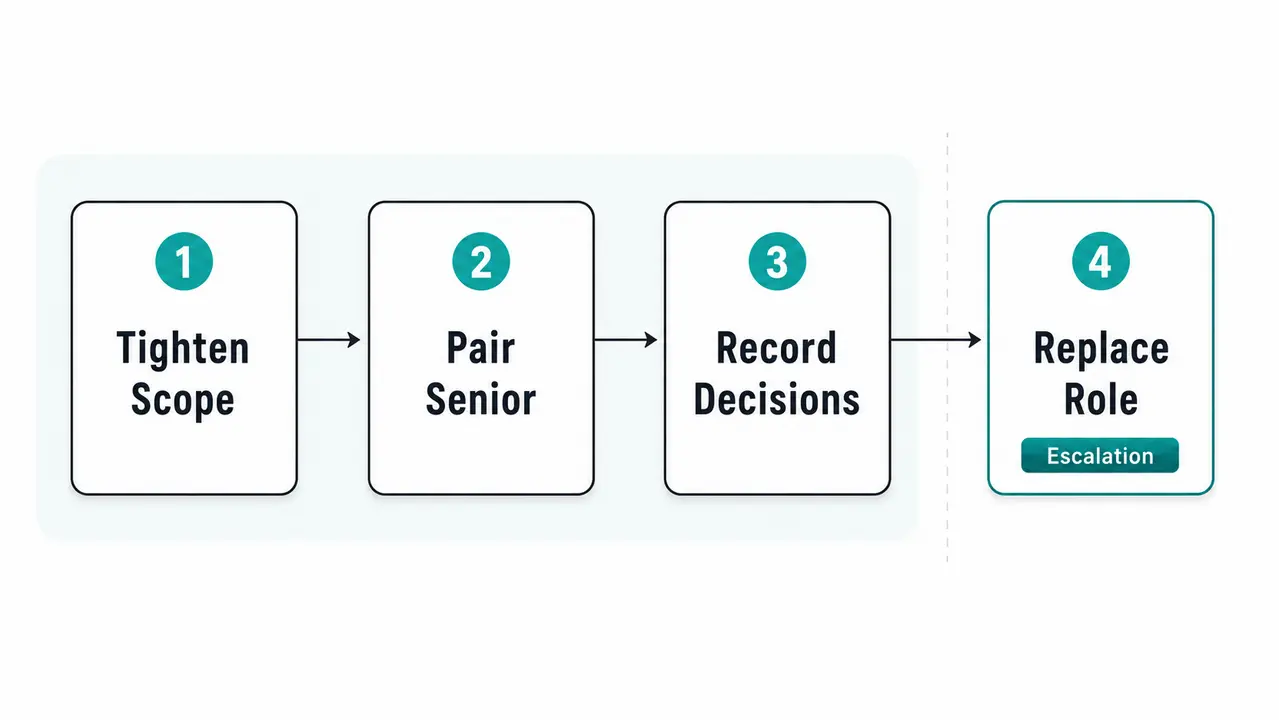
The corrective playbook, in escalating order: tighten the scope to a single module until quality stabilizes. Pair the external engineer with a strong internal senior for one sprint. Enforce architecture decision records on every non-trivial change so disagreements get resolved in writing. And if none of it moves the needle in two weeks, replace the role. Tolerating small quality issues feels diplomatic. It is not. Every week you wait, the systemic problem gets more expensive and the honest conversation gets harder.
A 48 hour plan to start an external engagement cleanly
You can start cleanly in two days. Not two weeks of procurement theater, two working days of preparation that removes the usual first-sprint chaos.
Day one is infrastructure and ownership. Provision repo access and the dev environment, and verify a fresh clone actually builds. Deliver the coding standards document, even a rough one. Groom the top of the backlog so the first week of work is unambiguous. Assign a single internal owner who holds review and decision authority. Without that named person, decisions will route to whoever answers fastest, which is how architectural drift begins.
Day two is the operating model, agreed in writing. Run a kickoff with an architecture overview from your tech lead. Agree on the definition of done, confirm the review SLA in both directions, and schedule the first demo for a fixed date, roughly one week out. If you are using a leasing model, check that the lease terms map to these operational expectations, because a contract promising full-time presence means nothing if the SLAs and ownership rules are missing. A slow start burns trust early and creates pressure to cut corners. Two disciplined days prevent the month of drift.
Frequently asked questions
These are the decision points that come up once the engagement is actually running.
How long should a trial period be for external developers?
Two to four hours for a code review exercise or a small bug fix with tests, evaluated by your engineers against a written rubric. Longer trials mostly measure stamina, not skill.
Who should manage external developers, engineering or product?
Engineering manages the technical integration, standards, and review process. Product owns backlog priorities and acceptance criteria. Splitting it any other way produces engineers who code well against the wrong goals.
What is the minimum overlap needed across time zones?
Three to four hours of overlapping business hours covers live design reviews, pairing sessions, and unblocking tasks. Everything else works asynchronously if the written communication discipline is in place.
Can external developers own production on call?
Internal staff should retain primary on-call duty. External developers work well as secondary escalation contacts during their working hours, with documented runbooks so their escalation is useful rather than noisy.
What should be included in a handover at the end of the engagement?
Updated architecture diagrams, current runbooks, dependency lockfiles, and a recorded session walking through the build pipeline and deployment process end to end. Verify a fresh clone builds before the last day.
How do you handle disagreements on architecture decisions?
The internal tech lead holds the final decision right. Record the disagreement and the resolution in an architecture decision record so the reasoning survives the people.
Your next step after you decide to hire external software developers
Write the one-page engagement brief, pick the first week deliverable, and assign a single internal owner for reviews and decisions. Sentice can evaluate that brief with you and tell you honestly whether the scope fits an external team. External talent amplifies your operating model, it does not replace it. If you cannot name that internal owner right now, pause and fix the internal bottleneck first.
Tell us about your roadmap
Bring us your engagement brief and we will tell you honestly whether the scope fits an external team.
About Sentice

Sentice is a boutique software engineering partner founded in 2013 by Roni Levi and Martin Petkovic, now headquartered in Skopje, North Macedonia. Rather than supplying individual developers, we build embedded teams that blend with a client’s culture, tech stack and goals, working together from a single office under our own technical leadership. We deliver dedicated software engineering teams, end-to-end software solutions, product development, and system and embedded engineering, and we act as technical advisors across the full development lifecycle, from specification and architecture through development, testing and support. We use AI coding tools across every project, and we help clients integrate AI into their own products through chatbots, MCP services, connected application layers and workflow automation. Some of the clients we started with more than a decade ago are still building with us today.