
A development team is a system before it is a group of people. When throughput drops while headcount rises, the problem is rarely effort, it is structure: unclear ownership, undefined interfaces, and feedback loops nobody designed. This article treats team formation as system design and walks through the decision sequence, from the delivery shape you should plan for, through ownership, onboarding, review policy and testing, to the three capacity models you can combine. By the end you will know which bottleneck to remove first and which engagement model fits your current pressure.
Reading time: 10 min
Key points
- Treat team formation as system design: decision rights, interfaces between people, and feedback loops, not a hiring plan.
- Name one accountable technical owner before your second hire; contested decisions get made quickly and in writing.
- Under delivery pressure, pure in-house hiring is the weaker option because time-to-productivity is capped by recruiting and onboarding lead time.
- Track lead time, deployment frequency, change failure rate, restore time, review queue time and escaped defects, and read trends, never targets.
Table of contents
A development team is a product system not a hiring project
Two senior engineers ship fast. They share one branch strategy, review each other’s pull requests within the hour, and release whenever the build is green. Then a third engineer arrives. Reviews queue behind meetings. Nobody is sure who owns the staging environment. The release step that used to take ten minutes now waits a day for the one person who knows the deploy script. Throughput drops while headcount rises, and the graph of velocity looks like a mistake.
It is not a mistake. It is the system telling you something. When you set out to learn how to build development team structures that hold, the answer is not a hiring plan. Treat team formation as system design. You are designing decision rights, interfaces between people, and feedback loops, the same way you would design a service architecture. Seats are just one component.
Start with three artifacts. A written ownership map. A definition of done. A single backlog with one prioritization authority. Everything else is downstream.
Start with the delivery shape you need in six months
Most teams hire for the sprint they are in. They need a React engineer this month, so they hire a React engineer, and three months later they rebuild the org chart because the product now has an integration problem nobody owns. We have watched this loop run for two consecutive years at companies that should have known better. Hiring for today’s bottleneck guarantees you rehire for tomorrow’s.
Design for the team you are becoming, then back into the first hires and the minimum process that supports that trajectory. If six months out you expect two squads, the move from one squad to two needs explicit boundaries, shared platform rules, and a release cadence both teams can rely on. Those agreements are cheaper to draft now than to negotiate during a quarter-end crunch.
Use a simple planning lens. Map your product lines, your components, and your deployment units. Where those three views disagree, you have found the seam where your future second team will split, and where your first hires should concentrate.
Signals you are about to outgrow a single team
Standups crossing thirty minutes, review queues lasting a day, and two engineers waiting on the same environment are the early signals. A backlog where every item touches three people is the late one.
The first non negotiable is one technical owner
Before your second hire, name one accountable technical owner. This person can still code daily, and probably should. What they own is the final call on standards, interfaces, and technical tradeoffs. Without that call, you get design-by-committee: two engineers pick different serialization approaches, a third invents a fourth folder structure, and every review becomes a negotiation with no referee.
The owner’s job is not to make every decision. It is to make the contested ones, quickly, in writing, so the team stops relitigating them. Give the role three lightweight instruments. Architecture decision records, so choices survive attrition and memory loss. An RFC process where anyone can propose, but one person decides. A weekly technical review slot, thirty minutes, where the contested calls get made instead of festering in comment threads.
Teams skip this because it feels bureaucratic at four people. It is one page and one meeting. The alternative is review deadlock at eight people, which costs a week per decision.
Define the product boundary before you define roles
Role design is downstream of the product boundary. Decide first what you build, what you integrate, and what you refuse to own. Only then can you know which skills you actually need on payroll.
Take a system we know well: an embedded device, a mobile app, and a cloud service. If you build all three, you need firmware, mobile, and backend disciplines, plus someone who understands the seams. If the device comes from a partner and you own only the cloud and the app, your profile changes completely, and the integration surface becomes your highest-risk code. Where that boundary sits changes the entire hiring list, and teams that skip the question end up hiring a full-stack team for what is actually three different disciplines wearing one job title.
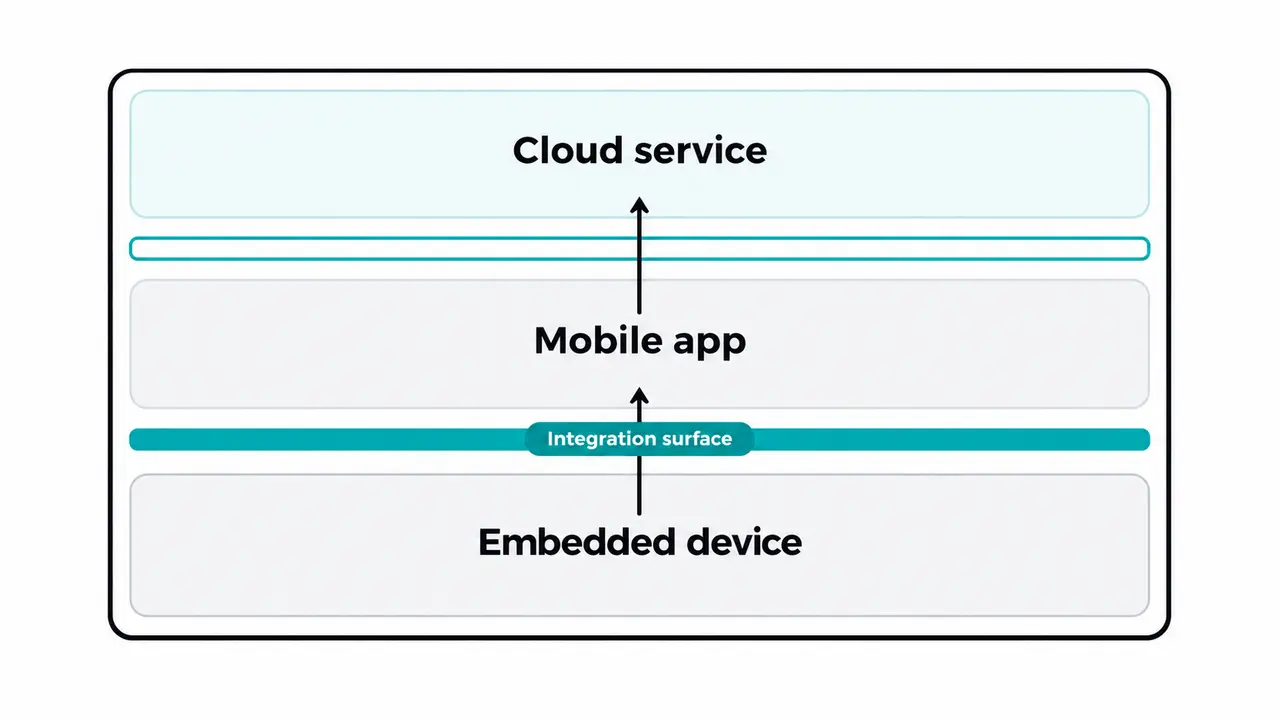
Integration surfaces deserve their own inventory: APIs, hardware interfaces, data pipelines, compliance constraints. When hardware dependencies dominate your risk, our system and embedded engineering work covers how to structure that ownership so firmware does not become a black box inside someone else’s roadmap.
Minimum viable team for an MVP that must survive production
If the MVP is a demo that will be thrown away, one strong engineer and a Friday deploy are fine. If it must live, if real users and real data land on it, the minimum team is a small cross-functional core that can build, test, and release repeatedly without heroics. The distinction matters more than the headcount.
The lean nucleus is a tech lead, one to three engineers aligned to your main risk area, and a test-minded engineer embedded early rather than a QA function bolted on later. “Test-minded” is a mindset hire, not necessarily a title. On their first week they should be wiring the CI pipeline, automated smoke tests, a release checklist, and observability basics: structured logs, error tracking, one alert that pages a human.
The counter-case is real. Throwaway prototypes can skip all of it. Just be honest about what happens when the prototype becomes the product. You pay the migration tax, usually around two to four months of refactoring done under feature pressure, and that tax is where most “quick MVPs” actually die.
Hiring sequence that reduces coordination overhead
Hire to remove the biggest constraint in the system, not to maximize coverage of every role on an org chart. Hiring developers in the wrong order creates coordination overhead that costs more than the missing skill ever did.
The sequence that holds up under pressure is technical owner first, then a product-facing engineer who can translate roadmap into implementation, then a test-minded engineer who hardens the loop. Specialist roles come last, once the loop is stable enough to absorb them. The two classic failure modes sit on either side of this path. Too many juniors with no mentorship bandwidth, and they plateau while your seniors burn out reviewing. Too many specialists with no integration glue, and each ships excellent work that never quite connects.
Consider firmware. Your embedded specialist is blocked because there is no test harness and no hardware access process, and every verification cycle means booking a board from another team. That is a system constraint, not a skills gap. We cover the full sequencing logic in how to grow your tech team without losing speed or quality.
Role clarity that prevents the slow bleed of ownership
Write down, for each subsystem, who owns decisions, who owns execution, and who owns run-time outcomes. These are three different jobs, and the slow bleed starts when they are assumed to be the same person by default and nobody by design.
The instrument is an ownership map, one row per component. For each component list the code owner, the on-call owner, the reviewer group, and the escalation path. Keep it in the repository, next to the code it describes, and update it in the same pull request as ownership changes. A map in Confluence that nobody maintains is worse than no map, because it lies with authority.
The failure mode this prevents is “everyone owns it” decaying into “nobody owns it,” which is most dangerous in systems that span embedded devices and cloud services. Device firmware fails at 3 a.m. and the cloud team assumes the hardware team is on it. Anchor the map with CODEOWNERS rules in GitHub or GitLab, a designed on-call rotation, and a single incident postmortem template so every failure produces the same artifact.
Where teams underestimate onboarding
Onboarding is not HR orientation. It is controlled exposure to your architecture, your tooling, and your real production constraints, sequenced so a new engineer learns the system boundaries before they ship something that crosses one. Treat it as an engineering deliverable with a spec, or it defaults to a laptop, a Slack invite, and good luck.
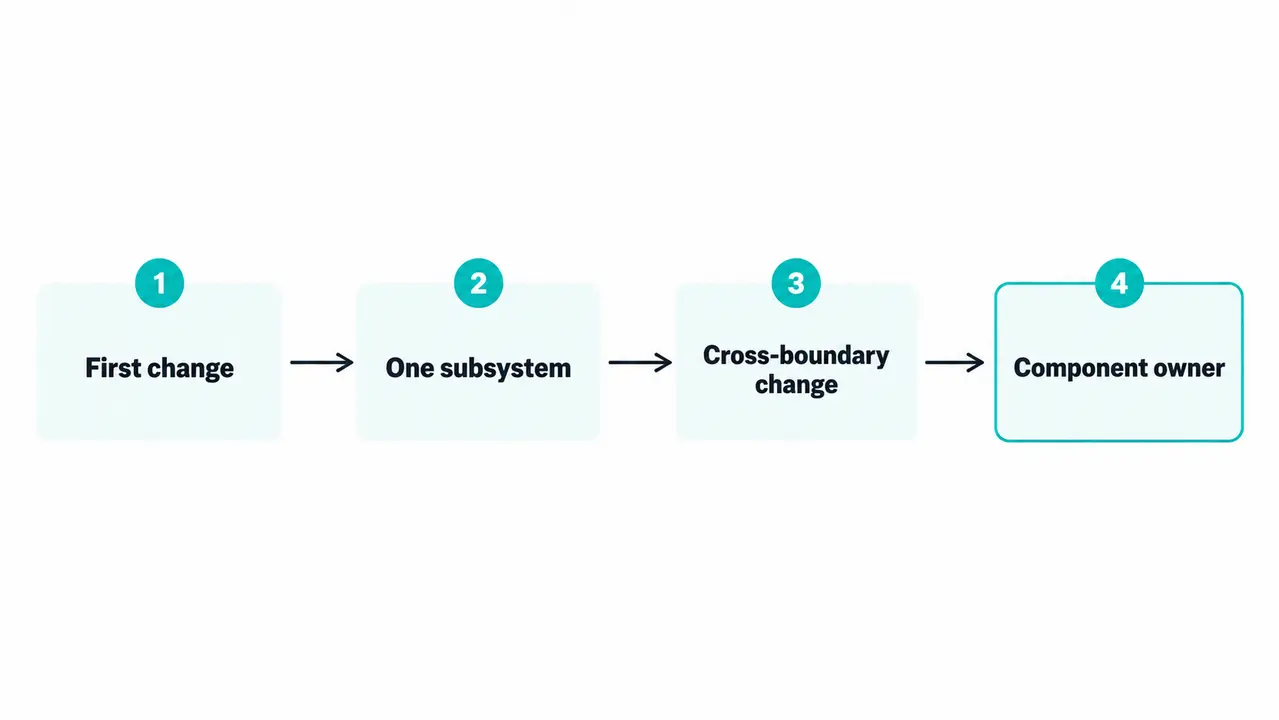
Structure it as a 30-60-90 day path with concrete engineering outputs. Week one, a safe first change shipped to production behind a flag, no matter how small. Day thirty, a feature delivered inside one subsystem with review. Day sixty, a change that crosses a subsystem boundary. Day ninety, ownership of a component on the map. Three artifacts make this repeatable: a newcomer environment script that provisions a working stack in one command, a curated codebase tour, and the first-week safe change task defined in advance.
Research on onboarding tasks treats exactly this mechanism as the lever, structured task assignment as a way to lower the barriers newcomers face (Wellhausen and editors). The failure it prevents is expensive: new hires shipping late and risky because nobody taught them where the system ends.
A lightweight R and D setup that scales past ten engineers
By R&D setup we mean something specific: the set of repeatable engineering decisions that covers branching strategy, review policy, release cadence, and quality gates. Ten engineers cannot hold these in their heads. Past that size, undocumented decisions are not decisions, they are preferences that diverge per person.
The minimum set of agreements is short. Trunk-based development or short-lived branches, merged within two days. A code review SLA, typically first review within one business day. A definition of done that includes tests and documentation. A release train on a fixed cadence, weekly is usually enough, so integration happens on a schedule instead of on courage.
For quality gates, use a published baseline rather than inventing your own. The NIST Secure Software Development Framework defines a core set of secure development practices that slot into any SDLC (NIST SP 800-218). Adopt the practices that fit, cite the standard in your engineering handbook, and move on.
What these agreements prevent is the familiar endgame: “works on my machine,” long-lived branches, and integration hell the week before launch.
Code review throughput is a leading indicator of team health
Watch your review queues. If they grow while headcount grows, delivery slows and quality drops at the same time, and most dashboards will not show you why. Review throughput is a leading indicator. Cycle time and defect counts are lagging ones.
Track two numbers weekly: median time to first review, and median time to merge. At small-team scale, aim for first review inside four working hours. When that number stretches past a day, three things follow. Seniors become bottlenecks and stop coding. Juniors stop learning because feedback arrives too late to shape their work. Risky changes pile up in a queue, and when they finally merge, they merge unreviewed in spirit.
The fixes are mechanical. Rotate reviewers so no single approver is a dependency. Enforce a small pull request policy, roughly under 400 lines of change. Pair on complex changes instead of annotating them to death.
When to mandate approvals and when to trust ownership
Mandate two approvals for code that touches money, auth, or the release pipeline. Trust a single owner review, or self-merge with automated checks, for everything else. Governance belongs where failure is expensive.
Testing strategy that matches the risk profile of your system
Pick your tests based on failure cost and change frequency, not ideology. The test pyramid is a heuristic from web development, and it translates badly to systems where the most expensive failures happen in hardware or at the device-cloud boundary.
For embedded paths where failure is expensive, hardware-in-the-loop tests on the critical paths are worth their setup cost, which is real: expect weeks of engineering to stand up a rig. Use simulators for fast iteration on everything else, and contract tests on device-cloud APIs so the mobile team and the firmware team discover interface drift in CI rather than in the field. The stack we recommend to most teams: smoke tests on every merge, nightly integration runs, and one reproducible test environment that any engineer can spin up from a script.
Two failure modes bracket this. Brittle end-to-end suites nobody trusts, so failures get skipped instead of fixed. Or no integration coverage at all until a late-stage integration week, which is where schedules die. Both come from the same mistake: choosing tests by belief instead of by risk.
Remote and distributed teams need explicit operating agreements
Distributed delivery works when communication paths and decision-making are designed, and fails when they are assumed. The default state of a distributed team without agreements is silent divergence: two locations, two understandings of the architecture, discovered during an incident when the second team’s assumptions become visible in production.
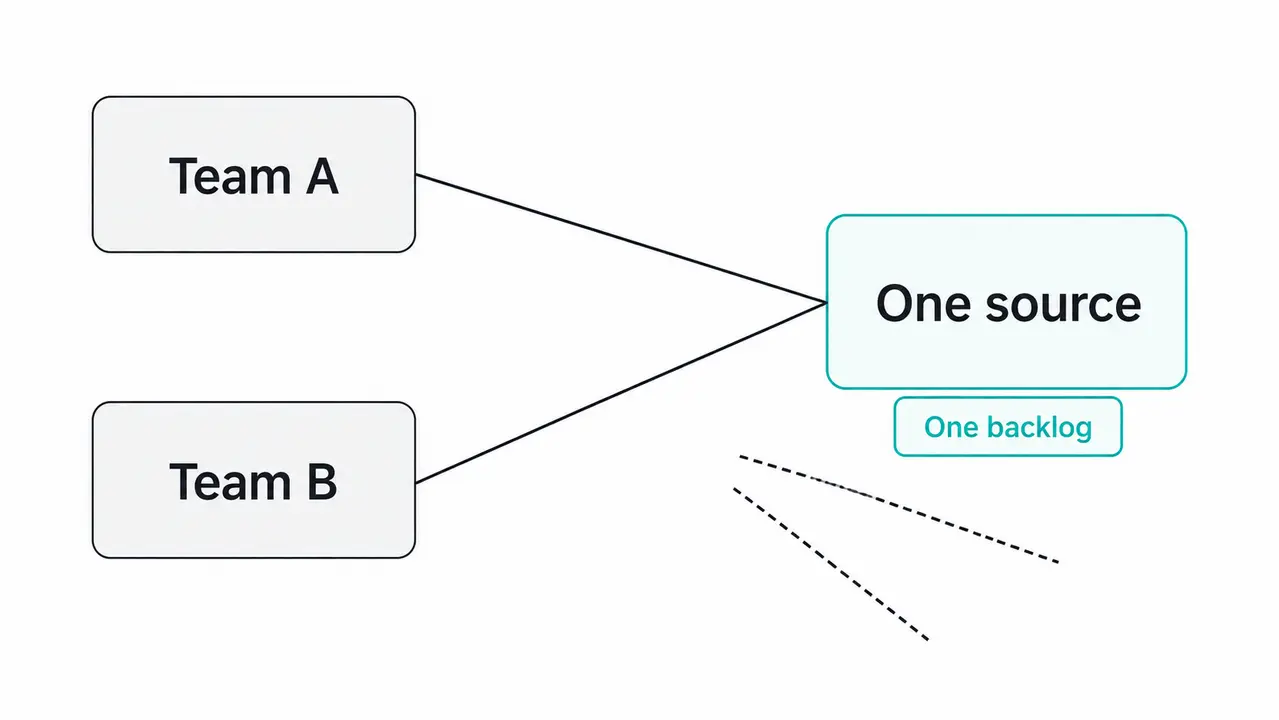
The agreements are unglamorous and they work. A meeting cadence, short and fixed. Written updates replacing status meetings, daily or twice weekly, in a shared channel. Escalation rules that name who is called, in what order, within what timeframe. Documentation norms, in particular a single source of truth for architecture diagrams that lives in the repository and changes through review.
Add a shared definition of ready, so work entering the backlog means the same thing in every location. When we run distributed engagements at Sentice, the one-document rule is the first thing we impose: one architecture source, one backlog, one place where decisions land. Teams that keep per-location wikis are keeping two futures and delaying the choice between them.
Three engagement models for building capacity
Capacity comes from three sources: in-house hiring, embedded dedicated teams, and specialist contractors. Each one changes who controls delivery, how fast you ramp, and how much context survives a year. Frame it as an operator decision about control and continuity, not a procurement question.
Four questions separate the models cleanly. Who writes requirements? Who owns QA? Who owns the release? Who answers the incident page at 2 a.m.? In-house hiring maximizes control and pays for it in recruiting lead time. An embedded team trades some hiring control for speed and can retain context for years when managed as one team. Contractors give you elasticity on bounded tasks and the least continuity on anything long-lived.
| Dimension | In-house hiring | Embedded dedicated team | Specialist contractors |
|---|---|---|---|
| Ramp time | Months, recruiting on critical path | Weeks, team arrives formed | Days to weeks per person |
| Context retention | Highest, if you retain people | High, with stable team composition | Lowest, ends with the engagement |
| Delivery management | Entirely yours | Shared or yours, defined up front | Yours, always |
| Best fit | Steady long-term core growth | Speed plus continuity under pressure | Bounded, well-specified tasks |
The verdict: none of these wins on all four questions. Pick the model that answers your current bottleneck, and expect to run two of them at once.
Why pure in house hiring stalls under delivery pressure
When your timeline is tight, hiring alone rarely creates capacity fast enough. Recruiting and ramp-up sit on the critical path, and that path is measured in months. A senior hire who signs in week six and reaches real productivity in week fourteen has not helped the release that was due in week eight.
The concrete version of this trap: you need a second squad by next quarter, and you cannot pause roadmap work to build the hiring machinery. Writing the job spec, screening, running technical interviews, all of it consumes the exact senior engineers who should be shipping. You end up choosing between the roadmap and the recruiting pipeline, every week, and both lose.
The market does not make it easier. In 2024, more than 10 million people were employed as ICT specialists across the EU, representing 5.0% of all employed people (Eurostat), and every one of them is being recruited by someone. Under high urgency, pure in-house hiring is the weaker option, because time-to-productivity is capped by recruiting and onboarding lead time no matter how good your process is.
Where contractors and freelancers break down for core product work
Freelancers are effective for bounded tasks. A migration script, a performance investigation, a design spike with a written deliverable. Core product work is a different animal, and it breaks down for three reasons: fragmented ownership, unpredictable availability, and integration drift across modules that each contractor left slightly different from the last.
The bus factor is the sharpest version. One freelancer holds the deep knowledge of the billing module, their contract ends, and the next person spends a month reconstructing intent from code. Standards fragment the same way. Contractor A favored one error handling pattern, contractor B another, and your codebase now carries both forever.
If you use contractors for anything that will live more than a quarter, require three things in the contract itself: adherence to your coding standards, participation in your review rules as a reviewer and a reviewee, and documented handover as an exit criterion, not a courtesy. Payment tied to handover changes behavior more than any wiki page.
For long-lived, high-context systems, ad hoc freelancers are the weaker option. Continuity and shared architecture discipline do not survive that model, and the gap shows up exactly when the system gets hard.
When an embedded dedicated team model is the pragmatic middle
An embedded dedicated team is the pragmatic middle when you need continuity and speed but want product direction and decision authority to stay inside your company. The model is operational, not contractual. Embedded means one shared backlog, shared ceremonies, shared tooling, and one quality bar applied to every line, regardless of whose payroll wrote it.
The failure it prevents is the classic outsourcing story: an external team ships features that do not fit the architecture, ignore operational constraints, and leave your on-call engineers holding the pager for code they have never read. That failure comes from a boundary drawn around the external team. The embedded model erases the boundary instead of managing it.
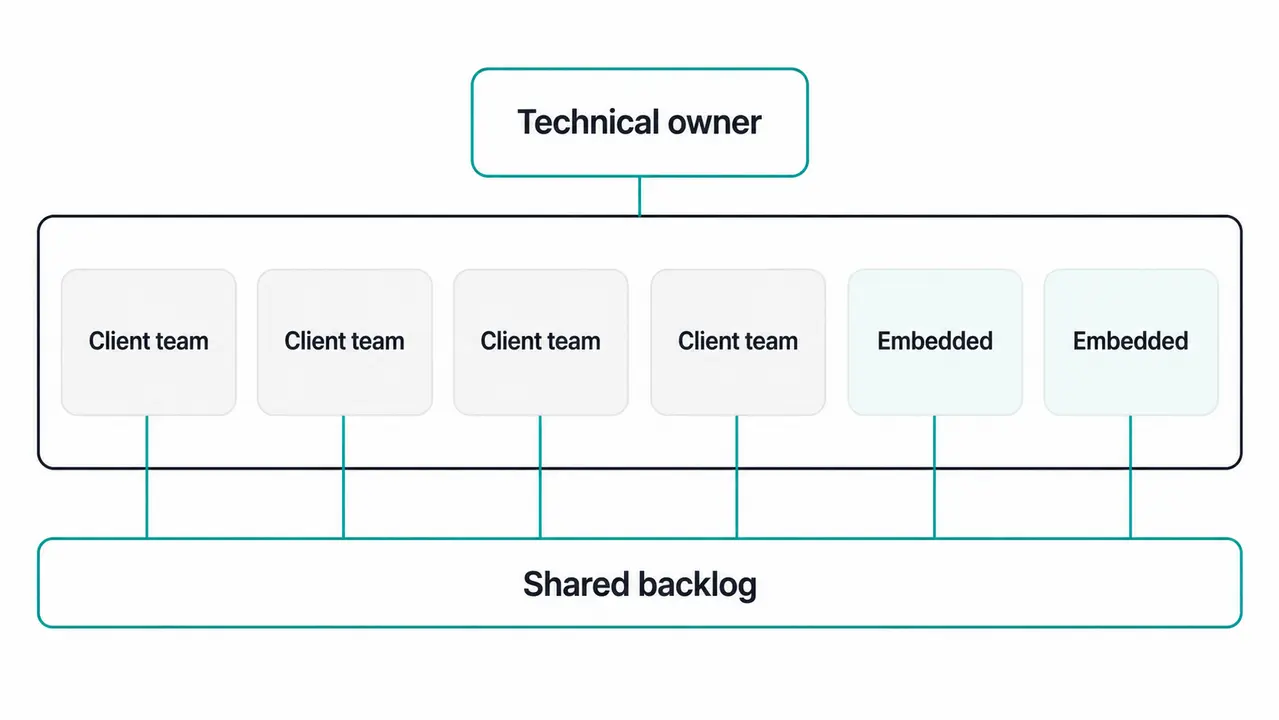
Two conditions make it work. The external engineers sit inside your engineering org chart for the duration, following your review rules and your definition of done. Your technical owner keeps the final call on architecture. When Sentice runs dedicated software engineering teams, that is the operating rule: one team, explicit ownership, integration from day one. Under scaleup constraints, an embedded team managed this way is the stronger option, because it buys speed without renting out your architecture.
Need a second squad faster than hiring allows?
Tell us about your roadmap and we will map an embedded team shape to the bottleneck you are facing right now.
Metrics that show whether the team is actually forming
Track delivery flow and quality signals that reflect system health, not vanity output. Velocity and story points tell you how busy the team is. They tell you nothing about whether the team you are building actually works.
The six metrics that do: lead time from commit to production, deployment frequency, change failure rate, mean time to restore, review queue time, and escaped defects found by users instead of your tests. Review queue time is the early warning. Escaped defects is the verdict on your quality investment. Together they describe a system, which is what you are building.
Use them without gaming by reading trend lines, never targets. The moment a metric becomes a target, it stops being information. Pair every trend review with a retrospective that asks what the numbers cannot: what is slow that does not show up yet?
The failure mode is familiar and expensive. The team optimizes story points per sprint while production stability quietly degrades, and the degradation surfaces two quarters later as an incident review nobody enjoys.
Frequently asked questions
How many engineers should be on one team before splitting into two squads?
Somewhere between seven and nine. Below seven, a split usually creates two under-staffed teams that coordinate more than they build. Past nine, communication overhead grows faster than output. Split when the backlog naturally divides along component or product lines, not when a calendar says so.
When should you hire QA versus making developers own testing?
Make developers own automated tests from the first commit, and hire a dedicated QA engineer when manual exploration, test environment design, or certification requirements become a standing workload. A QA hire who only executes scripted checks is waste. A QA hire who designs the test strategy your developers implement is leverage.
What should a VP Engineering do differently from a tech lead in a small org?
The tech lead owns technical decisions. The VP Engineering owns the delivery system: hiring sequence, process agreements, capacity model, and the interface between engineering and the rest of the company. Below roughly fifteen engineers, one person can hold both roles, but only if the technical-owner duties are explicit rather than assumed.
How do you keep architecture consistent across multiple teams without heavy governance?
Use one shared definition of done, architecture decision records for every significant choice, and a short weekly technical forum where contested calls get settled. Governance by document beats governance by committee, because documents can be ignored until they matter and committees cannot.
What is the fastest way to reduce onboarding time without lowering standards?
Script the environment so a new hire gets a running stack on day one, and pre-define a safe first change they can ship in week one behind a feature flag. Both remove waiting, which is where most onboarding time actually goes. Standards stay untouched because the first change is small by design.
Your next team decision should remove one bottleneck this month
Pick one bottleneck and fix it end to end before you add another seat. Publish the ownership map this week, set the review SLA and put it on the wall, or ship the onboarding checklist so the next hire stops being an experiment. Any of the three costs an afternoon and changes what your team is by next month. Which one is slowing you down right now?
About Sentice

Sentice is a boutique software engineering partner founded in 2013 by Roni Levi and Martin Petkovic, now headquartered in Skopje, North Macedonia. Rather than supplying individual developers, we build embedded teams that blend with a client’s culture, tech stack and goals, working together from a single office under our own technical leadership. We deliver dedicated software engineering teams, end-to-end software solutions, product development, and system and embedded engineering, and we act as technical advisors across the full development lifecycle, from specification and architecture through development, testing and support. We use AI coding tools across every project, and we help clients integrate AI into their own products through chatbots, MCP services, connected application layers and workflow automation. Some of the clients we started with more than a decade ago are still building with us today.
Get in touch: info@sentice.com | +389 70 307 837