
Your strongest engineer is now your slowest release path. Every architecture decision waits for her. Every pull request sits in her queue. The backlog ages while the roadmap does not, and the review queue grows faster than any single person can clear it. This is the moment when a dedicated software development team stops being an option worth considering and becomes the only model that matches the shape of the problem. Global software spending keeps climbing year over year, and your hiring plan was not built for that curve. Rotating contractors make it worse. Every rotation resets context, and every reset lands on the same bottleneck engineer who was supposed to be relieved. Below, we’ll map the signals that a dedicated team fits, compare the four engagement models side by side, and outline the governance, onboarding and quality gates that decide whether the engagement actually works.
Reading time: 11 min
Key points
- A dedicated team fits when delivery demand stays steady for multiple quarters and internal hiring cannot keep pace without dropping your quality bar.
- The dedicated model beats project outsourcing whenever scope evolves, because learning compounds instead of resetting around every change request.
- Staff augmentation fails without an internal management layer, because the constraint is usually leadership throughput, not typing capacity.
- Most dedicated team failures trace back to unclear decision rights, not skill gaps, and a two-page charter written before day one prevents them.
Table of contents
The moment your roadmap outgrows your hiring plan
A dedicated team fits when delivery demand stays steady for multiple quarters and internal hiring cannot keep pace without dropping your quality bar. The signal is rarely dramatic. It shows up as a review queue that grows by ten PRs a week, as a backlog where the oldest item is now four months old, as release dates that slip two sprints in a row because one senior engineer is the only approver on the critical path.
Contractors plugged into that gap make the arithmetic worse, not better. Each new contractor needs three weeks of context before they produce anything, and the context transfer itself consumes the very engineer you are trying to unblock. A stable dedicated team breaks that loop because the learning compounds instead of evaporating.
Dedicated teams are a delivery ownership model not a staffing shortcut
The model means accountability for outcomes, not the supply of committed developers. An exclusive dev team, in operational terms, means named individuals, a stable allocation, shared rituals, and shared code ownership. The same faces in your sprint planning every week, with their names on the git blame and their reputations attached to the release.
The boundary matters. You own product direction and priorities. The partner owns day-to-day delivery operations and continuity. That boundary gets written down before day one, in a team charter, a RACI matrix, and a definition of done that both sides signed. Without those documents you have bought hours, not delivery. The partner ships code, the invoice arrives, and nobody owns the outcome. We have inherited codebases built exactly that way, and the archaeology is never fun.
Where the dedicated team model beats project outsourcing
Project outsourcing optimizes for a one-time handoff. The dedicated model wins when scope evolves and learning needs to compound across iterations. Consider a platform refactor that starts with a clean estimate and uncovers unknown dependencies in week three. The service layer secretly reads from a legacy reporting database. Two mobile clients depend on a response shape nobody documented.
Under fixed-scope outsourcing, each discovery becomes a change request, a negotiation, and a revised acceptance criteria document. The incentive structure punishes honesty about what the code actually does. Under a dedicated team, the discovery becomes a Tuesday conversation and a replanned sprint.
The verdict is not close. Continuous product development requires a stable team that stays through discovery, build, and stabilization. Project outsourcing resets context and incentives around every change, and the team leaves at handoff with everything it learned.
Why staff augmentation breaks down without an internal management layer
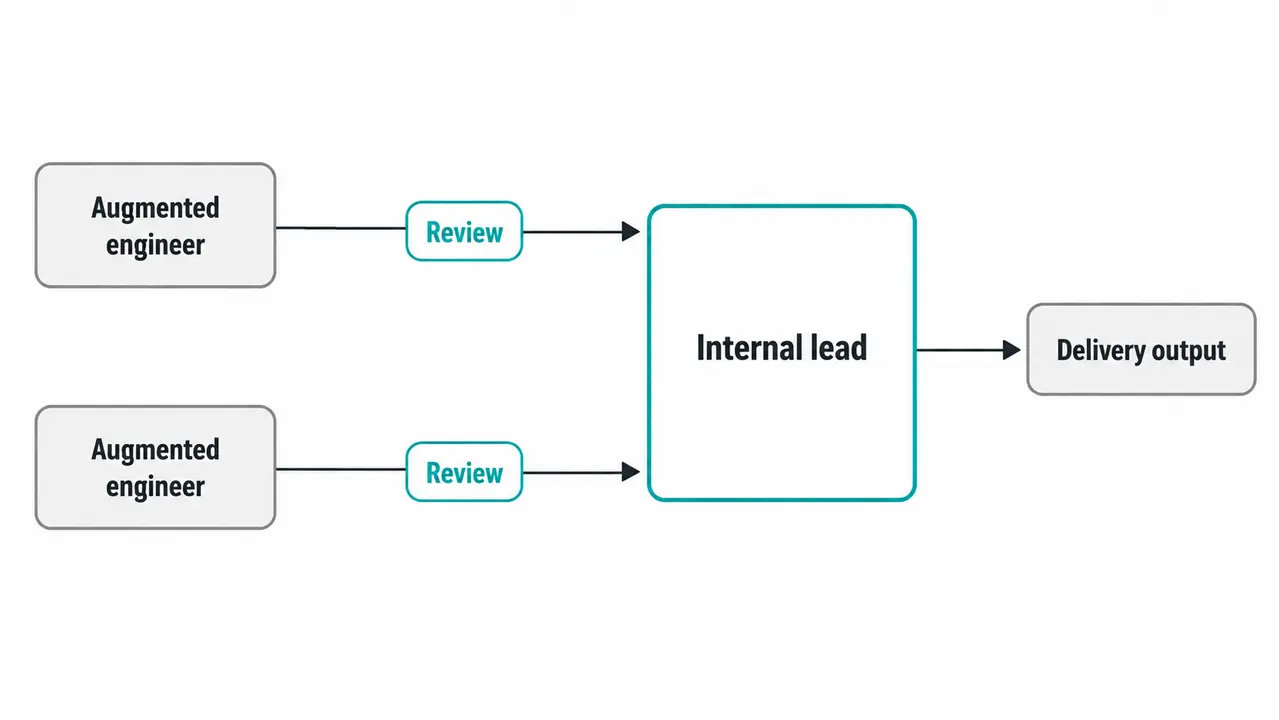
Staff augmentation fills specific skill gaps well. It fails when your internal team lacks the bandwidth to onboard, shape tasks, review code, and coordinate delivery. The hidden work is substantial: ticket definition precise enough to work from, architecture guardrails, review throughput, release coordination, and participation in incident response.
We have watched the pattern play out with two augmented engineers who shipped code steadily while the internal lead became the integration bottleneck. Every merge waited on her review. Every deployment needed her coordination. The team nominally grew by two and the delivery rate stayed flat, because the constraint was never typing capacity. It was leadership throughput.
Augmented staff without a management layer operate in isolation, and isolation produces integration debt and delayed releases. If your internal team cannot absorb the management overhead and still ship on time, augmentation is the weaker model. Full stop.
How in house hiring compares when speed and continuity both matter
In-house hiring is the strongest option for long-term core IP ownership. It is also slow to scale and prone to delivery gaps during exactly the roadmap windows where you cannot afford them. Time-to-hire for a specialized role varies from six weeks to six months. The onboarding ramp adds another two to three months before full productivity. Every vacant week compounds into delivery unpredictability.
Picture hiring an embedded systems engineer while your hardware milestones are fixed by a supplier contract. The board does not move because your recruiter has not closed the req.
The hybrid reality works better for most scaleups. A dedicated team bridges the capacity gap now while your internal pipeline catches up, and boutique partnerships accelerate tech team growth precisely because they compress that bridge from quarters to weeks. In-house hiring alone cannot protect short-term capacity spikes where a missed release window costs more than late headcount.
The engagement models side by side in one operating table
Buyers usually choose a model by looking at initial capacity alone. The table below compares the four models on the dimensions that actually decide the outcome eighteen months later.
| Dimension | Dedicated team | Staff augmentation | Project outsourcing | In-house team |
|---|---|---|---|---|
| Who manages delivery | Shared, partner owns execution | You own it fully | Vendor owns scope | You own it fully |
| Architecture decisions | Joint, documented | You own fully | Vendor owns within scope | You own fully |
| Change requests | Replanned in sprint | Re-tasked ad hoc | Contractual, slow | Replanned freely |
| Onboarding effort | Moderate, once | High per person | Low for you, high risk | High but compounding |
| Continuity risk | Low with named roster | High, people rotate | High after handoff | Lowest |
| Quality controls | Partner gates plus yours | Yours only | Vendor-defined | Yours only |
| Best for | Multi-quarter product scaling | Known skill gaps | Fixed-scope projects | Core long-term IP |
The pattern across the rows is simple. If your priorities will shift and your architecture will evolve, you need a model with high change tolerance and low continuity risk. Only two columns qualify, and only one of them is available next month.
Need capacity before your next roadmap review?
Tell us about your delivery gaps and we’ll map which engagement model fits your roadmap, with a named roster and a written charter before anyone signs.
The roles you actually need in a dedicated software development team
A dedicated team is credible when it covers engineering leadership, implementation, and quality gates. Developers alone do not make a team. The baseline shape is a tech lead or engineering lead, two to six engineers, explicit QA ownership, and DevOps or platform support where your stack requires it.
Two questions define the structure. Who approves code review merges? Who signs off on a release? If the answers are “everyone” or “whoever is around,” you have a group of developers, not a team. The tech lead owns merge authority and release sign-off, with the authority delegated, not diffused.
Teams without a designated QA owner or engineering lead drift across releases. Nobody notices on release one. By release six, the regression count tells the story. When the roles work together across discovery, build, and stabilization, you get end-to-end product development instead of a feature factory that hands quality problems downstream.
Onboarding is a systems problem not a calendar event
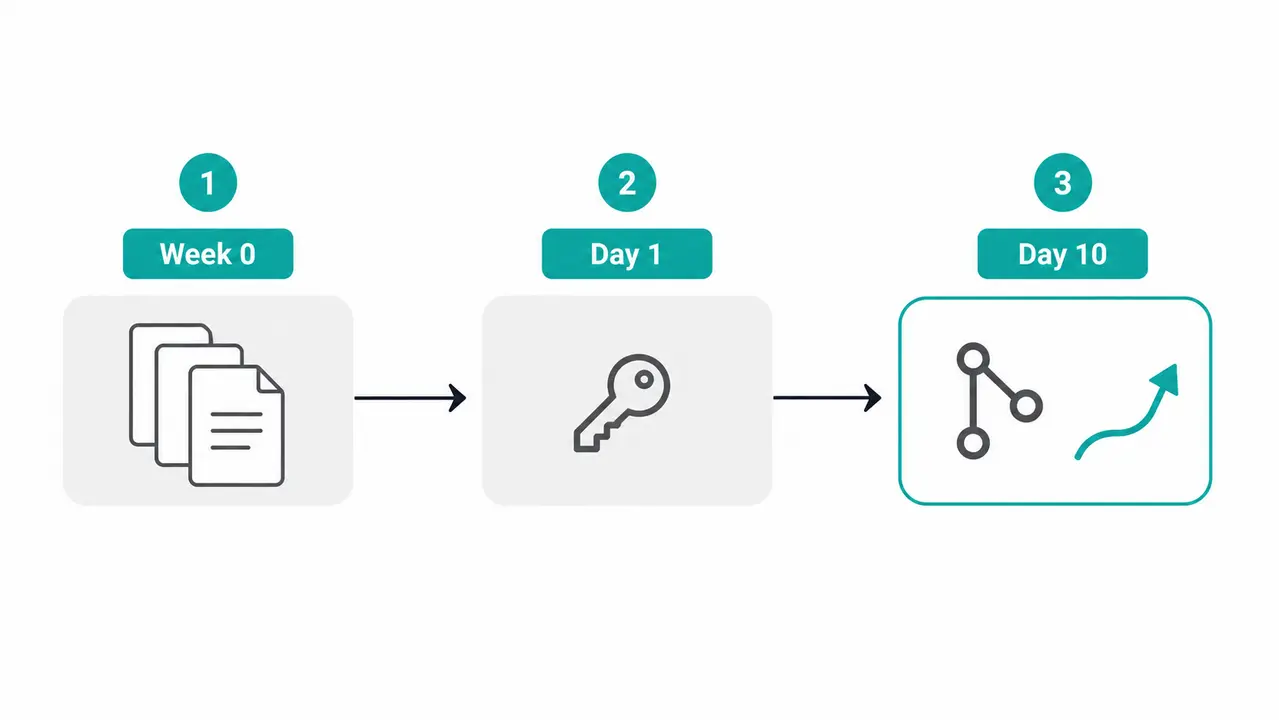
Onboarding succeeds when you treat it as building an internal platform for knowledge transfer. The required assets are concrete: an architecture overview, a repo map, runbooks, environment setup instructions, the test strategy, incident history, coding standards, and architecture decision records. Each one is a document that exists before the first engineer logs in, not a conversation that happens after.
Set a hard target for the first ten business days. A running dev environment, first merged PRs, and a release path rehearsal. If day ten arrives without a merged PR, the blocker is almost always access provisioning or a missing runbook, and both were fixable in week zero.
Without a structured packet, the first month becomes an exercise in waiting for credentials and extracting tribal knowledge over chat. That month is the most expensive one in the engagement, because you are funding full capacity for near-zero output. Additional research is needed from neutral sources on industry-standard onboarding metrics before publishing specific benchmarks.
Where teams underestimate governance and decision rights
Most dedicated team failures trace back to unclear decision rights on architecture, priorities, and quality gates. Not skill gaps. Not effort. Ambiguity about who decides.
A lightweight governance cadence prevents it. Weekly delivery sync, biweekly sprint rituals, monthly roadmap review, quarterly tech strategy. Attach a RACI to the decisions that actually burn money when they go wrong: who can merge to main, who approves schema changes, who cuts a release, who owns incident communications.
The failure mode has a name inside every delivery organization that has lived through it: two leads, two directions. Your internal lead and the partner’s lead each assume control, and they discover the conflict in a priority dispute three sprints in. The fix is appointing one engineering lead as the seam between your product context and the execution team, with the decision rights written down before the first sprint.
Communication that scales across time zones and disciplines
A dedicated team works best with written-first communication and predictable sync points. Not constant meetings. The practices that hold up across time zones are async standup notes, decision logs, PR templates, release notes, and sprint goals captured in writing in Confluence or your wiki of choice.
The meeting set stays small: backlog grooming, sprint planning, demo, retro, and an architecture review when a change warrants one. Everything else is a document.
Teams that rely on meetings develop what we call the “we only align in sync” problem. Coordination works while everyone shares office hours, then collapses the moment an engineer sits two time zones away. For cross-discipline work, interface contracts and scheduled integration checkpoints are the only reliable mechanism. An embedded team and a cloud team that share a Swagger spec and a weekly integration checkpoint will outperform two teams that share a standing call.
Code quality stays stable when you standardize the gates
Quality holds when it is enforced by gates, not by trust. The specific gates are linting, unit tests, integration tests, static analysis, a code review policy, branch protection, and a definition of done strict enough to bite. PR review SLAs belong in the engagement charter, with minimum reviewer counts and a hard rule against direct commits to main.
A dedicated team runs these gates inside its own workflow while aligning with your existing internal standards. If your internal team enforces coverage thresholds in GitHub Actions, the dedicated team’s pipeline enforces the same thresholds on the same branches. If your static analysis runs SonarQube, it runs for everyone.
Quality drift happens when teams rely on individual vigilance instead of automated enforcement. Release one looks clean. Release eight carries the drift of a hundred small exceptions, each reasonable on its own. Branch protection and policy-as-code in your CI are how a partner’s output stays indistinguishable from yours.
Security and IP control depend on access design
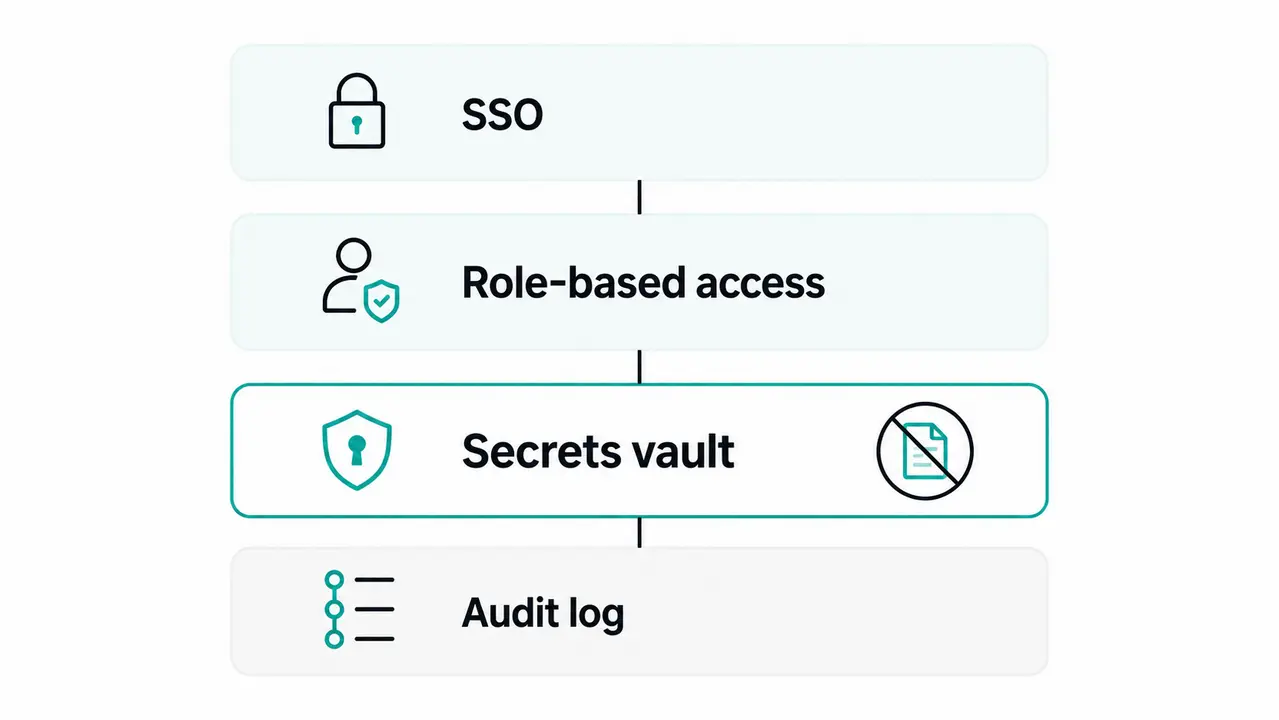
Security in a dedicated model is a function of least-privilege access, auditability, and clean separation of environments. The controls are standard and non-negotiable regardless of where the team sits: SSO, role-based permissions, secrets management through a vault rather than a shared credentials file, separate staging and production environments, and logging of privileged actions.
Process anchors carry equal weight. Secure SDLC checkpoints inside the pipeline, a dependency update policy that patches known CVEs on a schedule, and incident handling expectations defined before the first incident, not during it.
The failure mode is shared credentials and invisible changes. When multiple entities touch one codebase and privileged actions leave no trail, you have a compliance exposure that no contract clause repairs after the fact. Design the access model at engagement start, review it quarterly, and treat the audit log as a first-class artifact.
Embedded and system software work changes the team shape
If your product includes embedded or system-level components, the dedicated team must carry hardware-aware workflows and integration discipline. A standard web squad shape will not hold. You need hardware-in-the-loop testing, a firmware release process with a real versioning strategy, and explicit interface contracts between device and cloud.
The roster shifts accordingly. An embedded engineer, a test engineer who owns the HIL rig, a build and release owner, plus backend support for the cloud side of the interface. Each role exists because the release physics differ from pure software.
Skip the coordination and you get the “software team ships, device team blocks” failure. The backend outpaces firmware validation, the API drifts from the firmware version in the field, and the release train stalls in integration. This is why system and embedded engineering demands coordinated release planning across both sides of the device boundary from sprint one.
What you should see delivered in the first 30 days
The first month proves integration, cadence, and quality gates. Not maximum feature throughput. If someone shows you a burndown chart full of story points at day 30 and no merged code on main, the engagement is measuring the wrong thing.
Expect these deliverables: an onboarding completion checklist, a first production-safe change, CI pipeline alignment, initial backlog refinement, and a risk register with named owners. One end-to-end slice shipped behind a feature flag, plus a documented release procedure someone has actually rehearsed.
The negative signals are equally specific. No merged PRs by day 30. Unclear ownership when you ask who approves a release. Repeated environment blockers with no escalation. Vague reporting. Any two of these mean the engagement is already failing, and the conversation to have is about the operating system, not the velocity. Early velocity is a vanity metric. Early integration and a predictable release path are the real proof.
KPIs that reflect engineering reality instead of vanity velocity
Track metrics that show flow, quality, and predictability. Story points measure effort spent, not value delivered, and they are trivially inflatable.
Flow metrics include cycle time, PR review time, deployment frequency, and lead time for changes. Quality metrics include escaped defects, change failure rate, rollback frequency, and incident count tied to specific releases. Predictability metrics include sprint goal hit rate, scope churn between planning and demo, and adherence to work-in-progress limits.
Velocity-only tracking produces the “we feel busy but nothing ships” problem, which masks a bottlenecked pipeline behind a healthy burndown. The fix is structural, not motivational. Ask for a weekly one-page delivery report that puts these metrics beside the top two delivery risks, with owners and dates. If your partner cannot produce that report from its own records in week six, the delivery instrumentation does not exist.
The most common failure modes and how to prevent them
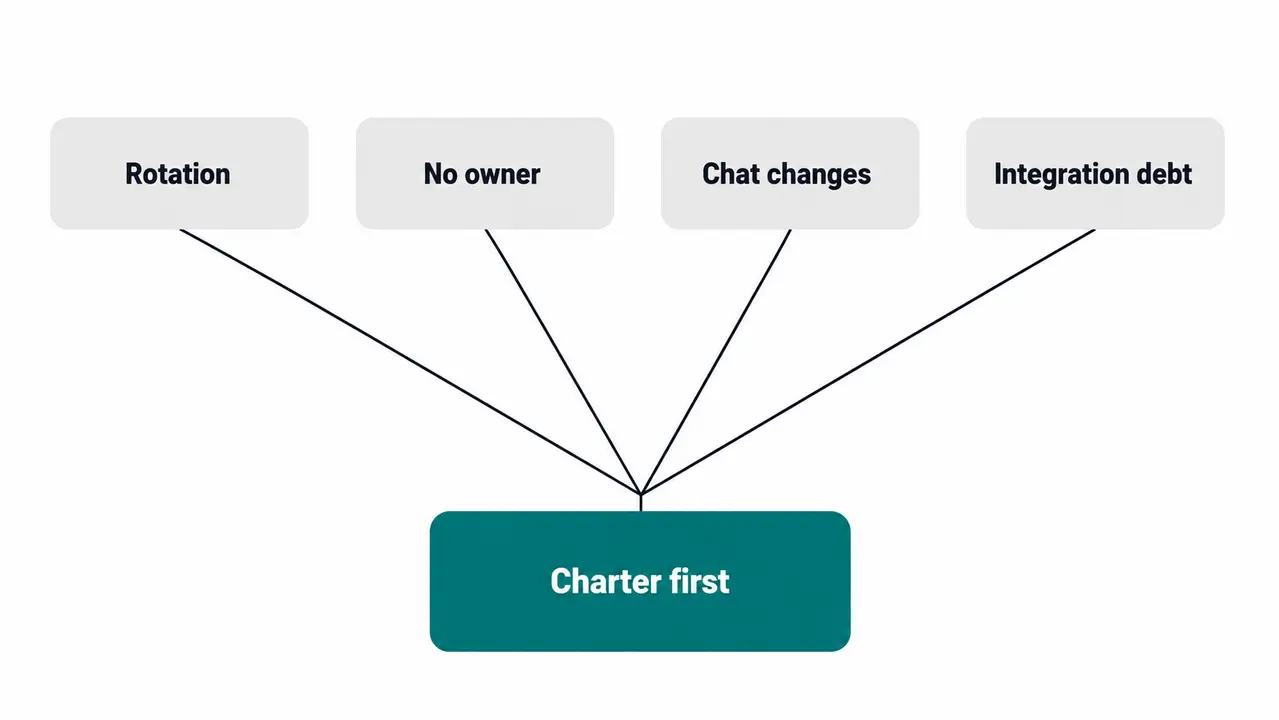
Dedicated teams fail in repeatable ways. The same five, almost every time.
Rotating people presented as dedicated is the first, and the fix is a named roster in the contract plus a continuity plan covering vacation, illness, and attrition. The second is no single technical owner, solved by appointing a tech lead with merge authority before sprint one. The third is roadmap changes arriving through chat, prevented by intake criteria that force every change to enter through the backlog, sized and prioritized. The fourth is no release discipline, answered by a release checklist and a tested rollback plan, both rehearsed. The fifth is integration debt, held down by scheduled integration milestones that force the components together before the endgame.
All five trace to the same root. The engagement started without a two-page charter agreed before day one, covering ownership, decision rights, and gates. Write the charter first. Everything else follows from it.
How to evaluate a partner without relying on marketing proof
Evaluate the operating system, not the case studies. Ask for a sample onboarding plan, a sample weekly report, a code review policy, an incident postmortem template, an escalation path, and the staffing continuity approach. These artifacts either exist or they get invented on the spot, and you can tell the difference in about ninety seconds.
Insist on talking to the proposed tech lead, not only sales. Run a thirty-minute architecture discussion on your actual domain and watch how the person reasons about tradeoffs under imperfect information.
Polished case studies get partners selected whose day-to-day execution never matches the deck. Sentice operates as a boutique partner providing engineering leadership plus execution, and the same standard applies to us. Ask any partner, including us, for the operating artifacts. The ones worth engaging hand them over without hesitation, because the artifacts are the delivery.
Frequently asked questions
Is a dedicated team basically outsourcing?
No. Traditional outsourcing is project-based and transactional: a scope, a price, a handoff. A dedicated team is an integrated extension of your internal staff, with shared goals, shared rituals, and continuity across quarters. The team stays through discovery, build, and stabilization rather than leaving at handoff.
Do I need a product manager if I hire a dedicated team?
The dedicated team can provide a product manager to run discovery and backlog grooming. You still own the overarching product vision and priority calls, because strategy cannot be delegated to people closest to the tickets. Alignment on business direction stays with you; execution of that direction can sit with the team.
Can I start with two committed developers and scale to a full squad?
Yes, starting small is a viable approach and often the right one. Document a scaling plan before you start, including when engineering leadership and QA gates get added. The plan should trigger those additions at defined complexity points, not after the first quality incident forces them.
What should I track weekly to know it is working?
Four signals cover it: merged PRs, cycle time, deployment frequency, and a clear written update on the top two delivery risks with owners. A partner that reports these four from its own instrumentation every week is running a real delivery process.
How do I know the team is actually dedicated and not split across clients?
Require a named roster in the contract, track allocation percentages in the weekly report, and hold the partner to the agreed capacity. If a named engineer’s allocation drops below the committed level for two consecutive weeks, that is a contractual conversation, not a scheduling footnote.
Who owns the code and the repository when the engagement ends?
You do, from the first commit. The repository, the documentation, the runbooks, and the architecture decision records should live in your systems under your access control throughout the engagement. A clean exit is a rehearsed handover of credentials and knowledge, never a data transfer negotiation.
The next step after you map your delivery gaps
The bottleneck engineer from your opening scenario does not need another contractor rotated in beside her. She needs the bottleneck removed permanently, which means a partner with a named roster, written governance, and standard quality gates before anyone signs. Ask one question of your current model: do you own the outcomes, or just the hours? Decide based on the operating system you need, not the headcount you want. If you want a second opinion on that decision, book a free consultation and we’ll pressure-test it with you.
About Sentice

Sentice is a boutique software engineering partner founded in 2013 by Roni Levi and Martin Petkovic, now headquartered in Skopje, North Macedonia. Rather than supplying individual developers, we build embedded teams that blend with a client’s culture, tech stack and goals, working together from a single office under our own technical leadership. We deliver dedicated software engineering teams, end-to-end software solutions, product development, and system and embedded engineering, and we act as technical advisors across the full development lifecycle, from specification and architecture through development, testing and support. We use AI coding tools across every project, and we help clients integrate AI into their own products through chatbots, MCP services, connected application layers and workflow automation. Some of the clients we started with more than a decade ago are still building with us today.