
You sit in a sprint review with two senior engineers who disagree on basic architecture. The iOS specialist wants SwiftUI, while the Android lead pushes Jetpack Compose. Your roadmap lists eight critical customer features that must ship before quarterly investor updates, but your budget supports only three full-time mobile developers.
Splitting that headcount across two distinct platform codebases guarantees delayed releases and drifting feature sets. Choosing the right mobile foundation settles whether your engineering team spends the next year building product value or constantly reconciling platform discrepancies.
This guide covers when a shared codebase pays off and where it becomes the wrong constraint, how React Native, Flutter and Kotlin Multiplatform compare on the dimensions that matter and how evaluation practices such as scoring sheets and two-week spikes turn the framework choice into an engineering decision rather than a trend call.
Reading time: 16 min
Key points
- Cross-platform development succeeds or fails on the shape of your product roadmap, not on framework popularity, and the call belongs to your CTO and lead engineers.
- React Native fits JavaScript teams that own native bridges, Flutter fits teams that need one rendering model, and Kotlin Multiplatform shares logic while keeping native UI.
- A two-week spike that builds one critical user journey with your hardest native SDK is the cheapest way to validate the choice before committing the roadmap.
- Native module ownership, testing depth and decoupled release trains decide delivery predictability more than the framework itself.
Table of contents
Cross-platform app development is a product strategy rather than a framework choice
Cross-platform app development succeeds or fails based on product roadmap shape rather than framework popularity. This architecture decision belongs to your CTO and lead engineers working against concrete operational metrics. That group must evaluate release cadence and crash-free session rates while enforcing strict feature parity targets.
The core distinction is operational.
One team can ship a shared experience across both operating systems, whereas two separate platform tracks drift apart over time. The fundamental product question is whether platform customization represents your core value, or whether release velocity and identical user behavior drive your market traction. Aligning framework selection with your broader product development roadmap prevents expensive technical rewrites after launch. Some teams choose a framework to solve an immediate hiring crunch, but practical leaders pick an architecture that protects their delivery calendar. Treating the decision as a recruiting shortcut usually ensures that platform limitations end up dictating your product strategy.
The moment cross-platform pays off in a startup roadmap
A unified codebase pays off when an early company requires rapid feature expansion across both stores simultaneously. Consider a ninety-day roadmap specifying customer onboarding alongside payment processing and event analytics. Building dual native implementations cuts engineering velocity in half while demanding duplicate quality assurance verification for every sprint. A single codebase allows one team to ship shared business logic and validate it against common acceptance criteria.
We formalize this evaluation using a one-page roadmap impact sheet that catalogs incoming capabilities alongside their platform parity requirements. That document estimates the delivery delta between unified code and dual native construction before leadership commits budget. According to Grand View Research, the global IT services outsourcing market reached USD 797.4 billion in 2025 as organizations prioritized delivery efficiency. Duplicating standard business logic across separate native repositories wastes capital and creates continuous regression overhead. Young companies gain market traction by validating ideas quickly rather than maintaining parallel codebases.
Where cross-platform becomes the wrong constraint
Cross-platform tooling turns into a recurring performance tax when your core value relies on deep mobile operating system integrations. Products requiring low-latency audio pipelines or continuous Bluetooth Low Energy communication push non-native runtimes beyond their designed limits. We evaluate this boundary through native dependency density, which tallies the critical platform SDKs and custom bridge modules needed in your initial releases. If more than three primary user workflows require custom platform bridges during release one, you should reconsider this technical path.
When native dependency density passes that threshold, cross-platform architecture shifts development friction rather than eliminating it. Your engineers spend more time maintaining custom bridges than creating user value. Teams that ignore these platform edges often ship a compromised initial release that drops animation frames and drains device batteries.
User retention collapses when hardware interactions stutter.
Fighting framework constraints rarely succeeds when the host operating system already provides the exact primitives your application needs.
Three different tradeoffs separate hybrid apps from cross-platform and native apps
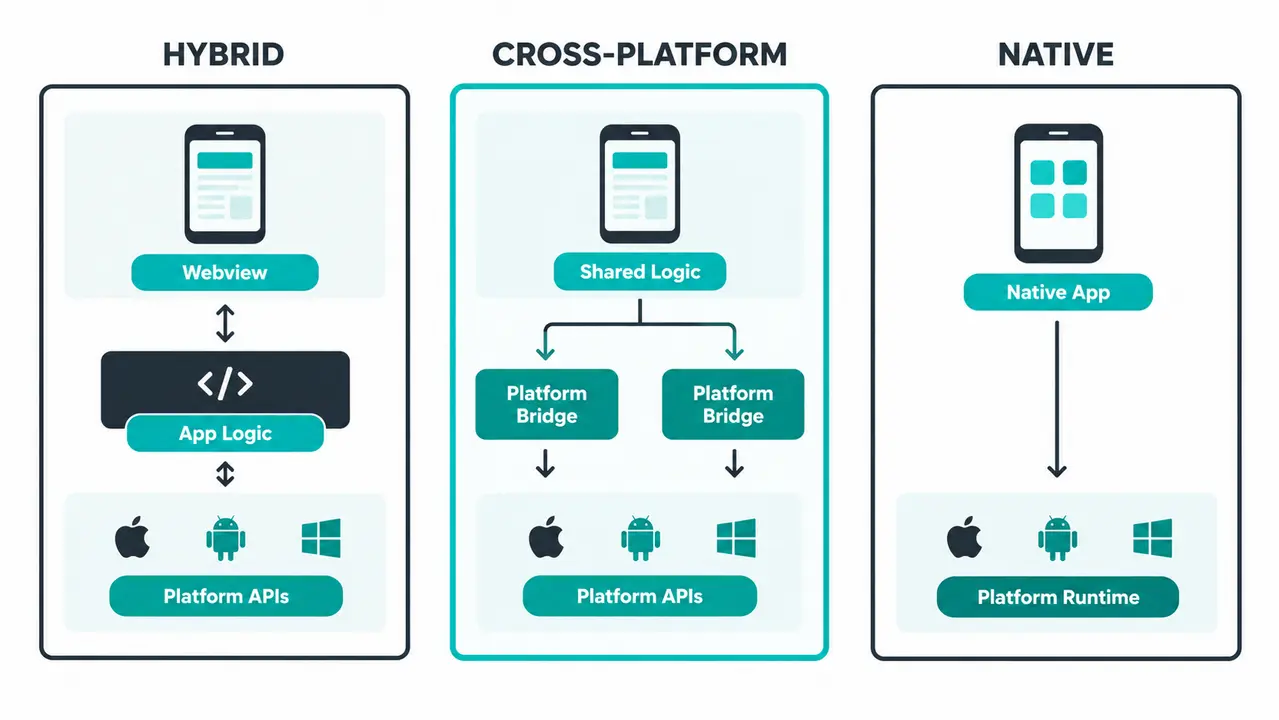
A hybrid app packages web interfaces inside a native webview container, whereas cross-platform frameworks render native-like interfaces from a shared codebase, and native development targets platform SDKs directly. These engineering choices establish permanent boundaries around execution speed and interface fidelity. Teams frequently confuse these categories when reviewing vendor proposals. Webview shells struggle with gestures and touch latency. Bridge-based architectures manage message serialization, while custom rendering engines bypass native platform widgets entirely.
Buying a webview implementation for a product that demands direct hardware integration leads to an immediate rewrite.
The decision shortcut that misleads teams
The slogan promising to write once and run everywhere is marketing fiction rather than an engineering specification. Real acceptance criteria demand measurable benchmarks, such as cold starts under two seconds and zero dropped frames during scrolling, along with automated integration pipelines and reproducible local builds. Teams that rely on optimistic vendor claims without verifying local compilation scripts spend their first sprint resolving environment failures instead of writing application features.
React Native fits teams that want a JavaScript product loop with native escape hatches
React Native provides rapid UI iteration for teams that maintain strong JavaScript capabilities and accept the responsibility of building custom native bridges. Working within this ecosystem means managing bridge serialization while profiling thread utilization during continuous framework upgrades. Operating successfully requires an escape hatch plan as an explicit engineering document. That protocol identifies which engineers write Kotlin or Swift wrappers while defining review standards whenever an operating system update breaks an existing bridge.
Assuming a project requires zero platform code leads to blocked sprints when your first proprietary hardware SDK arrives. React Native is weaker than Flutter when consistent rendering behavior across diverse devices with minimal platform variance is your top priority. Teams that prepare for native bridge ownership ship dependable applications without hitting unexpected platform dead ends. If your engineers understand native mobile foundations, React Native accelerates UI delivery significantly.
Flutter works best when you want a single rendering model and tight UI control
Flutter delivers visual consistency because its graphics engine draws every pixel directly rather than delegating UI construction to underlying operating system widgets. Teams that build on Flutter’s single rendering model avoid the visual fragmentation that often plagues multi-platform software. We protect rendering stability by instituting a strict UI performance budget as a mandatory project artifact. That specification establishes sixteen-millisecond frame time thresholds alongside automated profiling runs on low-end Android hardware and older iOS devices.
This unified rendering approach eliminates subtle layout drift between mobile platforms during extended development cycles. Failing to establish visual controls early results in a steady accumulation of layout defects across different screen resolutions. Flutter is weaker than React Native when your organization is deeply invested in React web patterns and prioritizes sharing component logic between browser and mobile environments. Dart requires dedicated training, but its graphics engine protects your design system from host fragmentation.
Kotlin Multiplatform is the pragmatic middle ground for native UI with shared logic
Kotlin Multiplatform offers an effective engineering compromise by preserving native user interfaces while centralizing core business logic inside a shared repository. Your mobile engineers construct platform interfaces using SwiftUI and Jetpack Compose, while networking clients, authentication state and caching rules live entirely in shared Kotlin modules. This clear separation reduces rewrite risk because domain logic compiles into native binaries that your team tests in isolation. Native interface construction ensures full compliance with platform accessibility guidelines and operating system permission flows.
Selecting an all-in-one cross-platform UI engine when your application primarily requires shared correctness forces unnecessary rendering compromises on your mobile screens. Kotlin Multiplatform is weaker than full cross-platform UI frameworks when the primary business objective is having one team deliver a shared interface at high speed with minimal platform code. When authentic native platform fidelity is mandatory, sharing backend data contracts delivers substantial speed without degrading interface quality.
The decision matrix technical leaders actually use
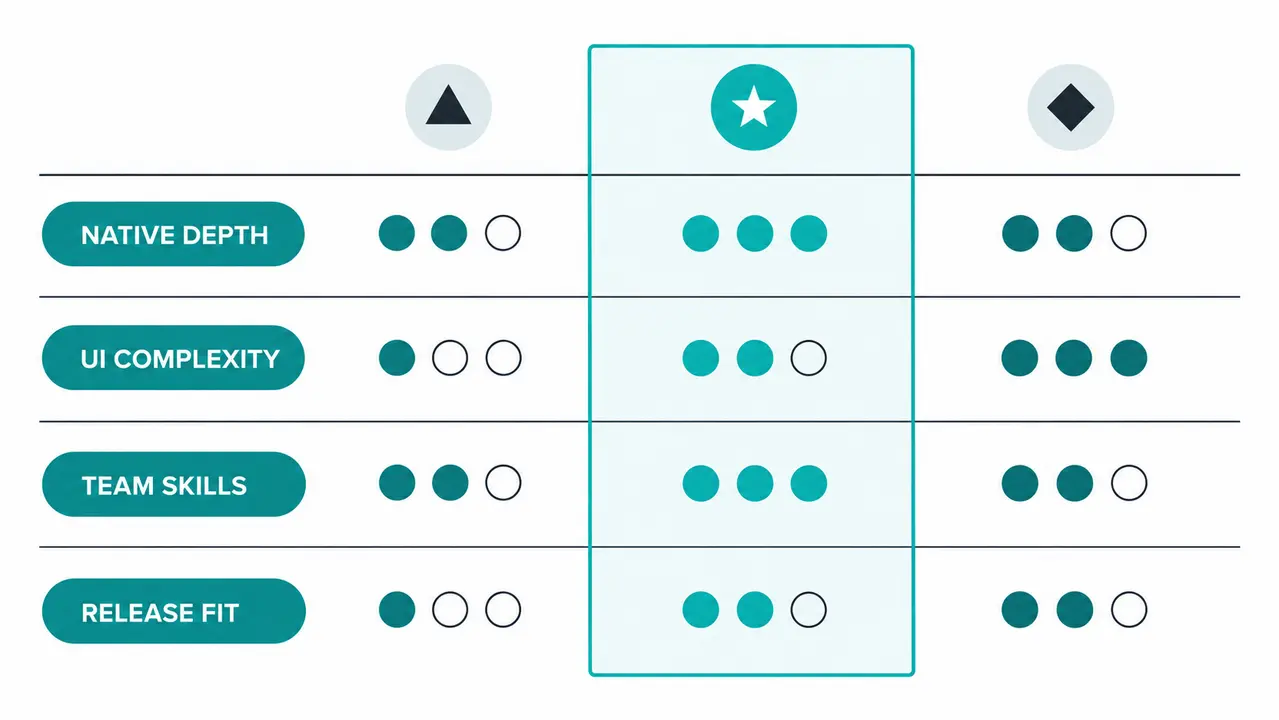
Engineering leaders evaluate mobile architecture by scoring technical requirements against measurable organizational constraints rather than conference trends. We recommend adopting a standardized one-page scoring sheet completed by the mobile lead and reviewed by the CTO before committing resources. That framework evaluates options on a five-point scale across native API depth and interface complexity alongside team competencies and release operations fit. A top score of five on native API depth indicates that the framework provides direct hardware interfaces without requiring custom bridge development.
The six criteria and what to measure
Objective scoring demands concrete proxies rather than subjective preferences. Count the proprietary native SDKs, then measure offline data synchronization rules and background execution demands across platforms. Selecting an architecture based on developer sentiment creates severe delivery friction during your first production release. Teams that ground architectural decisions in operational data avoid mid-project platform migrations completely. Documenting these metrics before development begins helps build consensus across product and engineering departments.
The two-week framework spike that prevents a one-year mistake
Committing to a mobile architecture without empirical validation invites technical disaster. The most reliable mechanism to evaluate a candidate framework is a time-boxed two-week spike that builds a critical user journey end-to-end while integrating your most complex native hardware SDK. This initiative requires a balanced squad featuring your mobile lead alongside both platform engineers and quality assurance support. The team must deliver an architecture blueprint and an automated integration pipeline alongside a runtime profiling snapshot and a prioritized risk register. Selecting a framework based on marketing demos without testing complex native SDK integrations guarantees unpleasant surprises in production.
Spike acceptance criteria that are hard to game
A successful spike satisfies rigid operational criteria rather than subjective impressions. Local developer environments must be set up with a single terminal command and no undocumented manual steps. The automated continuous integration pipeline must compile release builds for both platforms without manual intervention. Application navigation must execute deterministically while cold start latency remains under two seconds on test devices.
Jank and startup time block apps more often than raw performance does
General business software rarely fails due to raw computation throughput, but users immediately punish visual jank and sluggish launch intervals. Perceived slowness clusters around cold starts and fast list scrolling, as well as complex layout transitions and heavy image rendering. We mandate a concrete performance test plan executed against low-end Android hardware populated with worst-case production data payloads. That protocol measures time to first visual paint and scroll frame rates on a hundred-item virtualized list while tracking background application resumption.
Profiling must capture precise metrics during cold starts and push notification deep-linking sequences. Skipping continuous device profiling until launch week creates catastrophic release delays when low-end handsets fail to maintain sixty frames per second. Discovering rendering bottlenecks through negative app store reviews forces hasty architectural refactoring under immense pressure.
Benchmarking real devices early keeps runtime performance predictable and prevents emergency code rewrites.
Measuring these hardware limits across every release ensures that user experience remains snappy regardless of client device specifications.
Native modules decide your ceiling on device features
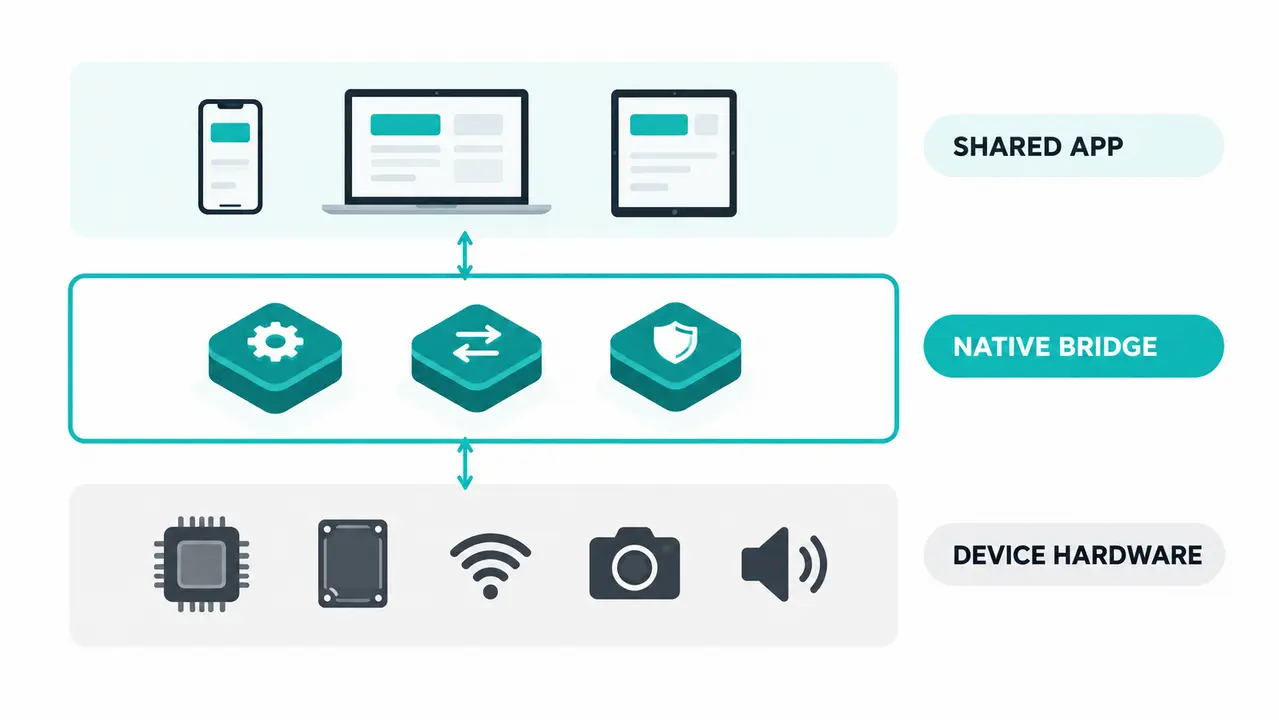
Cross-platform initiatives maintain predictable release velocity only when engineering organizations establish native module ownership from the initial sprint. When no internal developer owns low-level platform code, complex native software development kits quickly become insurmountable delivery bottlenecks. We establish a formal native module ownership rule across our engineering engagements. That specification identifies the developers responsible for writing platform wrappers and managing specialized code reviews while tracking operating system deprecation notices.
Device integrations such as Bluetooth Low Energy communication, background geofencing, and custom camera pipelines frequently require native intervention. Relying passively on unmaintained open-source bridge libraries leaves your product roadmap vulnerable to upstream neglect. When an operating system point release breaks an unmaintained wrapper, an internal team incapable of forking and patching that native code faces an indefinite release freeze. Active ownership of native code turns platform constraints into manageable engineering tasks.
Testing and QA strategy changes more than teams expect
A shared codebase accelerates feature development, but it never eliminates platform-specific quality assurance. Teams must establish a layered testing pyramid with shared unit tests for domain logic, integration suites for local data layers, and targeted platform interface checks. Automated smoke tests must execute against a real device farm covering at least five distinct hardware profiles across iOS versions and Android vendor skins. Release gates require strict crash-free session thresholds alongside feature flagging infrastructure that supports immediate rollbacks within a single release cycle.
Assuming an approval pass on iOS guarantees stability on Android leads to releasing critical defects that only trigger on custom manufacturer skins.
What to standardize across platforms
Effective quality assurance requires strict alignment across shared telemetry conventions. Standardize analytics event names and application error taxonomies alongside network logging formats and feature flag naming rules. Harmonizing these operational contracts ensures that testing telemetry remains comparable and debuggable across diverse client environments.
App store releases and hotfixes need an explicit operating model
Shipping from a single codebase accelerates feature delivery while inadvertently binding your platform release cycles together. Without deliberate operational decoupling, a rejection from Apple reviewers freezes Android deployments, or an Android-specific crash stalls iOS updates. We establish a predictable two-week release train cadence centered on a firm weekly code freeze. That process cuts platform-specific release candidates and initiates a staged rollout spanning seventy-two hours on each store.
Operating this pipeline requires an explicit hotfix protocol that defines who can authorize a fix, which smoke checks are mandatory, and how branches are managed. If Apple initiates an extended review delay, the Android pipeline proceeds independently on its staged release trajectory. Coupled release branches represent a severe operational flaw that prevents rapid deployment of emergency fixes. Maintaining independent release artifacts from a shared repository ensures that review friction on one platform never paralyzes your overall release cadence. Automating build pipelines helps emergency patches clear internal verification within hours rather than days.
Architecture that keeps cross-platform codebases maintainable
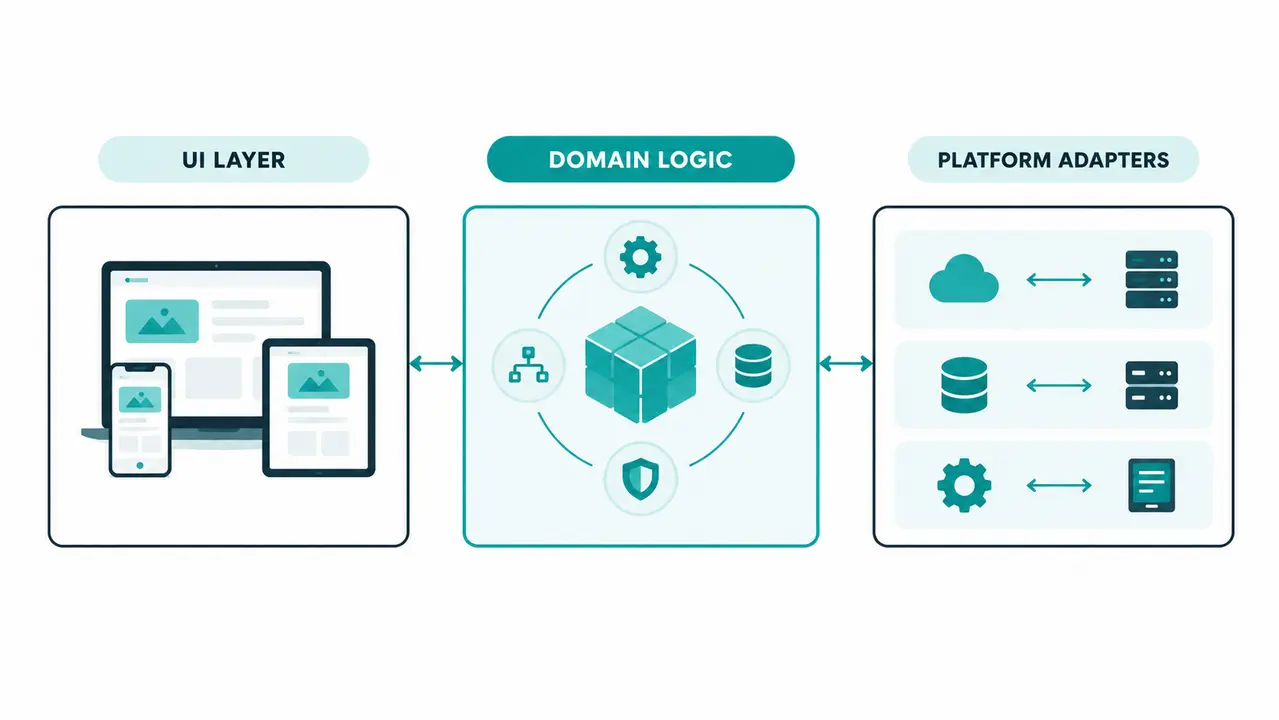
Architectural sustainability requires rigid isolation between user interface elements and domain logic while abstracting underlying platform adapters. Building reliable end-to-end software solutions requires architectural discipline from day one. We enforce this boundary using a formal module map that isolates domain entities and data persistence while placing UI widgets behind strict public interfaces. Platform services governing secure storage and hardware permissions sit behind abstract adapters rather than leaking direct operating system calls into shared files. Creating an undisciplined monolith where native SDK calls intertwine with shared domain rules prevents clean framework upgrades.
When to split shared and platform code on purpose
Engineers should split platform code intentionally whenever operating system conventions diverge. Isolate platform implementations for system accessibility, back-stack navigation conventions, and native privacy dialogs. Preserving native user expectations around system navigation takes precedence over maximizing shared code volume. Maintaining deliberate structural boundaries protects your codebase from future framework obsolescence.
Migration paths that do not burn the roadmap
Migrating an existing mobile product succeeds when engineering leadership isolates a single application boundary rather than commissioning a wholesale rewrite. The lowest-risk strategy introduces the new cross-platform framework exclusively for incoming greenfield features. The next safest progression migrates an isolated user journey such as account settings, followed by sharing lower-level networking and domain logic. A complete application rewrite represents the riskiest path and should only occur when legacy maintenance costs demonstrably exceed new construction overhead.
Critical state continuity must remain intact throughout any incremental migration. User authentication sessions, push notification device tokens, and local database records must transition without forcing customer re-authentication or losing user state. Committing your entire team to a complete rewrite halts customer-facing feature delivery for months. Teams that attempt full rewrites frequently deliver replacement versions that lack essential capabilities present in the original software. Incremental migration validates framework performance under real production conditions before committing your primary product workflows.
Team composition that makes cross-platform delivery predictable
Cross-platform projects fail when organizations assume framework familiarity replaces native platform engineering expertise. Sustainable engineering requires cross-platform specialists paired with at least one senior engineer who understands iOS internals and one who understands Android architecture deeply. Balanced dedicated software engineering teams need platform depth alongside cross-platform skills to maintain velocity when frameworks encounter operating system limitations.
Core platform knowledge remains mandatory for handling store compliance audits and integrating proprietary native software development kits while resolving operating system deprecation notices. Onboarding requires automated local initialization scripts, explicit module ownership registries, and troubleshooting runbooks for standard native build failures. Relying on a lone framework developer creates a fragile single point of failure where one native build issue blocks your entire release train. Distributing native expertise across the squad ensures continuous delivery when low-level technical challenges arise. Engineers who understand native build tools configure continuous integration pipelines that run reliably without manual developer workarounds.
What technical leaders should ask a delivery partner before committing
Technical leaders must evaluate prospective engineering partners on their operational rigor rather than superficial framework enthusiasm. Ask directly about their framework evaluation methodology and native module ownership policies, as well as their testing depth and long-term upgrade practices. Demand concrete artifacts before signing, including a two-week spike plan and an architecture blueprint, as well as an automated integration pipeline template and an incident response runbook. Beware of partners that offer evasive explanations regarding native bridge maintenance or display portfolios filled with interactive demos lacking verified production app store links.
Many consultancies hand off code nobody has vetted.
Our engineers run production release trains from one shared office. Selecting a vendor that prioritizes prototype aesthetics over operational resilience guarantees that your internal team will inherit unmaintainable native crashes during your first major production deployment. A partner must prove they can debug low-level operating system faults before you entrust them with your core product roadmap.
Run the spike before you commit the roadmap
A two-week spike that builds one critical user journey with your hardest native SDK is the cheapest validation this decision gets. Our engineers run those spikes, and the release trains behind them, alongside internal teams.
Choosing between React Native and Flutter for a commercial product
Selecting between React Native and Flutter requires aligning framework architectural trade-offs with your engineering strengths rather than generic industry recommendations. Choose React Native when your organization maintains substantial JavaScript expertise and intends to build custom native modules as the software matures. Select Flutter when strict interface consistency across devices and a single graphics rendering engine represent your top architectural priorities.
React Native is weaker when rendering consistency and frame rate predictability across diverse Android hardware are critical product requirements. Flutter is weaker when your team’s primary engineering muscle resides in modern React web patterns and leadership wants shared component logic across web and mobile platforms. Picking a framework based on third-party blog endorsements rather than internal engineering skills introduces severe organizational friction. The following comparison outlines framework recommendations across critical delivery dimensions.
| Evaluation Criterion | React Native Recommendation | Flutter Recommendation | Verdict |
|---|---|---|---|
| Team Skills | Best for web React teams | Requires Dart language adoption | React Native |
| UI Fidelity | Relies on native platform components | Pixel-level control via direct rendering | Flutter |
| Native SDK Depth | Mature bridge ecosystem with escape hatches | Platform channels with manual maintenance | React Native |
| Upgrade Tolerance | Frequent dependency reconciliation required | Predictable updates via engine stability | Flutter |
| Debugging Workflow | Chrome dev tools and Flipper integration | Dart DevTools and widget inspection | React Native |
Grounding your selection in real delivery capabilities ensures that your engineers spend their time building product value rather than fighting language syntax.
Frequently asked questions
Is cross-platform app development safe for a production product with paying users?
Yes, provided your engineering team validates complex native integrations during an initial spike and manages automated release pipelines. Production risk stems from unverified hardware integrations rather than framework limitations. Reliability is defined by test automation, crash telemetry, and rollback capabilities.
How does a hybrid app differ from a cross-platform app?
A hybrid app executes web interfaces inside a native webview, which restricts animation performance and hardware access. Cross-platform frameworks render native UI components or draw directly to the screen via a dedicated graphics engine. This architecture delivers superior responsiveness and closer hardware integration.
Can a cross-platform app use Bluetooth, background tasks, and push notifications reliably?
Yes, but each capability requires a native wrapper module that someone on your engineering team must actively maintain. Reliability depends on your team’s ability to debug native code when an operating system update alters background execution rules. Validate these hardware integrations before committing your product roadmap.
What is the fastest way to validate a framework choice before committing the roadmap?
Run a two-week technical spike that builds one critical user journey end-to-end and integrates your most demanding native SDK. Deploy the resulting build through automated continuous integration to internal test devices. If the spike fails its acceptance criteria, changing direction early is far cheaper than abandoning a multi-month project.
How do teams handle app store review delays when iOS and Android share a codebase?
Maintain decoupled release branches even when developers work in a shared repository. Cut independent release candidates and execute staged store rollouts separately. Establish a hotfix protocol that allows one platform to deploy critical updates without waiting for the other store to finish its review.
Should we migrate an existing native app to cross-platform or start cross-platform from day one?
If an existing native application runs successfully in production, migrate an isolated feature or shared business logic module first while keeping the primary interface intact. Greenfield products should begin with cross-platform architecture when roadmap velocity and platform parity outweigh deep operating system differentiation. Match your technical architecture to your business roadmap rather than forcing an immediate rewrite.
The decision is already on your roadmap and needs an owner
Your CTO and mobile engineering leads already face this architecture decision whether it appears on your planning calendar or hides inside delayed sprints. Cross-platform architecture purchases release velocity and feature parity at the expense of deep platform customization, and teams that define that trade-off early ship without surprises. Sentice partners with startups and scaleups to execute two-week technical spikes and maintain complex native modules alongside internal product teams. Which constraint on your immediate roadmap can your team not afford to compromise, release velocity or deep platform integration?
Pressure-test your mobile architecture
Name the constraint that dominates your roadmap, release velocity or deep platform integration, and get a straight read on the trade-offs against your team’s actual skills.
About Sentice

Sentice is a boutique software engineering partner founded in 2013 by Roni Levi and Martin Petkovic, now headquartered in Skopje, North Macedonia. Rather than supplying individual developers, we build embedded teams that blend with a client’s culture, tech stack and goals, working together from a single office under our own technical leadership.
We deliver dedicated software engineering teams, end-to-end software solutions, product development, and system and embedded engineering, and we act as technical advisors across the full development lifecycle, from specification and architecture through development, testing and support. We use AI coding tools across every project, and we help clients integrate AI into their own products through chatbots, MCP services, connected application layers and workflow automation. Some of the clients we started with more than a decade ago are still building with us today.
Email: info@sentice.com | Phone: +389 70 307 837