
You sit in a sprint kickoff with three engineers and twelve weeks of runway left in the bank. Two developers want to build the new product on Rust with an event-driven architecture, while your lead backend engineer pushes for a modular Python service. The whiteboard shows complex microservices and distributed caching layers for a product that currently has zero active accounts.
This technical fork ruins early startups every single quarter.
An MVP is not a smaller version of your five-year product vision. Your stack exists to test a specific customer behavior before payroll drains your treasury. Choosing tools based on hypothetical scale or developer novelty burns engineering capacity on unread logs and unvalidated schemas. This guide settles how engineering leaders select pragmatic stacks that ship next month and survive the pressure of user feedback.
Reading time: 12 min
Key points
- The right MVP stack is the smallest one that lets your team ship and learn from real users.
- The fastest stack is the technology your engineers can already deploy and debug under pressure.
- A modular monolith with PostgreSQL remains the strongest default for early validation.
- Keep structural commitments shallow until user retention justifies permanent plumbing.
Table of contents
The meaning of best technology for an MVP
There is no universal best technology for an MVP. The right choice is always the smallest stack that lets your team ship and learn from real users without operational drag. Technical leaders often mistake architectural purity for product progress. In an early release, best simply means minimizing the calendar days between your initial commit and your first validated customer insight.
You are not building a miniature version of a ten-year platform. You are running an evidence-gathering exercise under tight capital constraints. Every technical choice must prioritize reversibility and team throughput over raw benchmark performance. When an architecture takes three weeks to modify after user interviews, it has failed your business. Engineering leadership requires a repeatable selection process rooted in fast cycles rather than conference talk trends. Focus your capacity on validating user demand before you solve problems created by massive scale.
The fastest stack is the one your team can operate
The fastest technology for your MVP is the stack your engineers already know how to deploy and debug under pressure. Novelty carries compounding costs that early ventures cannot afford. When a team adopts an unfamiliar language during a sprint, pull requests linger in review while production incidents become dangerous mysteries.
Operating a stack means your team manages deployments and database migrations without external guidance. Your developers must also configure authentication and database backups independently. If an engineer cannot trace a failing background worker within ten minutes, the tooling has outpaced the team. Switching languages is justified only when your current environment lacks libraries essential to the business. Otherwise, everyday familiarity remains your greatest delivery asset. Competitors chase novelty, while we measure throughput. Choose your baseline around current staff strengths and customer demands rather than conference keynotes. Team fluency prevents the operational confusion that kills early product momentum.
The MVP stack has one job, which is supporting a full user journey
Your MVP stack exists to support one complete user journey from onboarding to value delivery. Picking tools for an imagined backlog creates dead code before you find paying customers. Build only what is needed for a user to register an account and extract core value. If payment processing or data export is essential to the transaction, include it. Everything else belongs in future quarters.
Each journey dictates completely different architectural trade-offs. An asynchronous document parser runs comfortably on background workers and basic relational storage. A real-time collaboration canvas demands persistent websocket connections and low-latency state synchronization. Building multi-tenant real-time messaging for a product that only requires daily batched reports wastes precious engineering weeks. When you center architecture on a single customer pathway, scope reduction becomes automatic. Technical decisions simplify as soon as unneeded paths disappear from your launch criteria.
A stack selection checklist that fits a two-week decision window
A practical technology decision should take days rather than months. When technical leaders deliberate endlessly between comparable frameworks, analysis paralysis delays customer validation. Your evaluation should fit within a strict two-week window where you document trade-offs and commit.
Capture these decisions in a one-page stack decision record owned by your tech lead and reviewed by the CTO. That document evaluates core constraints including target client platforms, offline requirements, and internal team capabilities. Omit speculative discussions about supporting ten million users or squeezing five milliseconds out of database queries. Framework popularity debates belong on community forums, not in startup architectural planning. Once your constraints are documented, pick the simplest compliant options and freeze the selection. The table below illustrates how product constraints establish immediate technical boundaries.
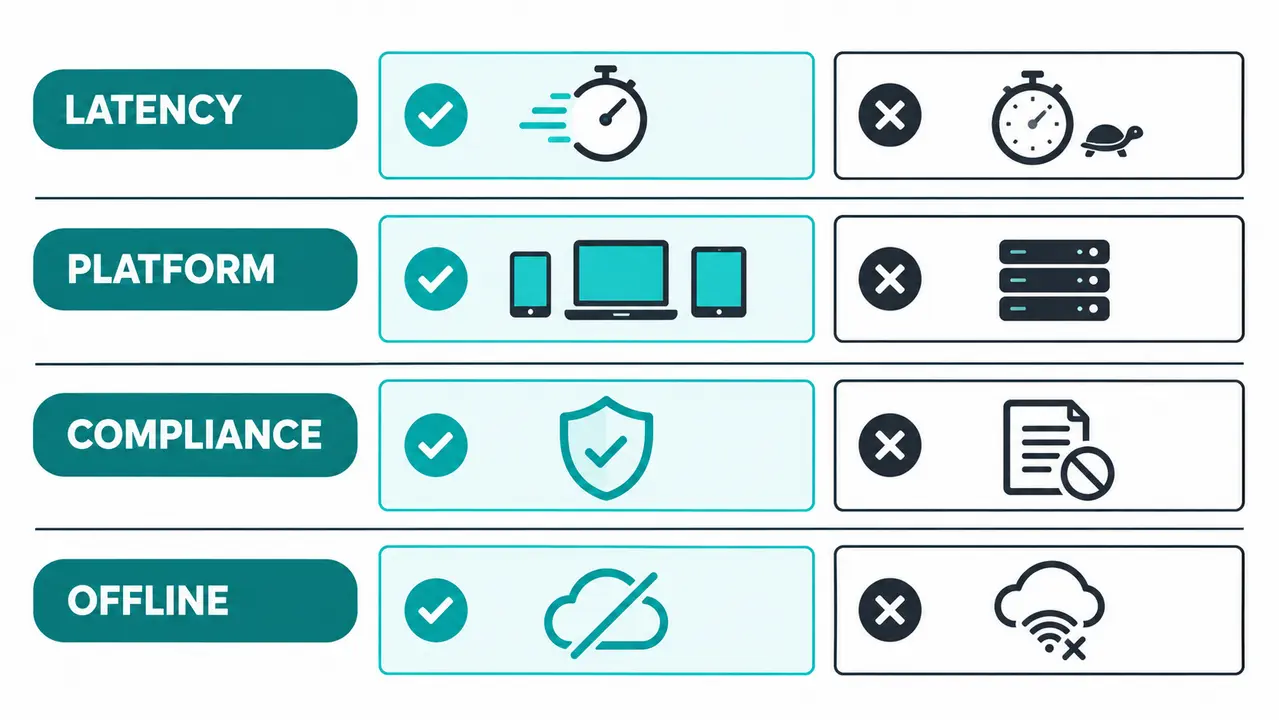
| Constraint | Baseline Choice | Rejection Trigger |
|---|---|---|
| Latency tolerance | Standard REST API | Hard real-time audio or interactive canvas |
| Platform scope | Single responsive web application | Device sensor integration or local hardware storage |
| Compliance scope | Managed relational database with encryption | Explicit on-premise deployment mandates |
| Offline support | Browser local storage caching | Conflict resolution across multiple disconnected field devices |
Where teams lock in too early
Most architectural regret originates from premature lock-in across database schemas and infrastructure topology. When developers design rigid database schemas before clarifying user workflows, every product adjustment requires risky migration scripts that engineers avoid. Custom authentication built from scratch creates another trap, because home-grown session handling and permission hierarchies consume weeks of maintenance without offering competitive value.
Infrastructure creates the heaviest trap.
Deploying Kubernetes clusters or multi-region routing for unreleased software wastes engineering hours on networking rather than product discovery. Apply the reversibility test to every architectural decision during sprint planning. If your team cannot replace or unwind a technical choice within two two-week sprints, it is too rigid for an early MVP. Spending your initial development cycles rebuilding foundational infrastructure diverts vital attention away from customer workflows. Guard your iteration speed by keeping structural commitments shallow until user retention justifies permanent plumbing.
Boring technology wins when you have zero users
Mature and predictable technology wins when an application has zero active users. Choosing boring tools minimizes operational unknowns and protects your delivery schedule from unexpected framework defects. Boring software means battle-tested libraries and a wide talent pool of available developers.
When you build on experimental libraries, your engineers spend sprint capacity debugging third-party memory leaks rather than refining user onboarding. Selecting established technologies is fundamentally an exercise in operational risk management. An exception applies only when a modern managed service eliminates an entire discipline of internal development. Adopting a managed identity service or a hosted database eliminates hundreds of operational hours, making that modern dependency worthwhile. Otherwise, novel runtimes add friction to routine tasks. You cannot afford to troubleshoot runtime oddities while hunting for product-market fit. Save technical experimentation for phases where core product demand is already proven.
A default web MVP stack that keeps iteration tight
For a standard web application, the most reliable baseline pairs a mainstream frontend with a proven backend and a relational database. A dependable combination uses TypeScript with Next.js or Python with Django, paired with PostgreSQL hosted on managed cloud infrastructure. This setup allows your developers to share data contracts across the application while using off-the-shelf authentication services.
Relational databases like PostgreSQL remain the optimal default for early products. They enforce schema constraints and handle transactional records cleanly without requiring secondary data pipelines. Operationally, you must establish separate staging and production environments with fully automated deployment scripts from the first sprint. Manual server configuration introduces silent bugs that break release cadence. This stack represents the strongest default for B2B SaaS validation because it balances hiring accessibility with dependable performance. It leaves your engineering roadmap focused entirely on customer problem solving.
Mobile MVPs succeed when the offline story is decided upfront
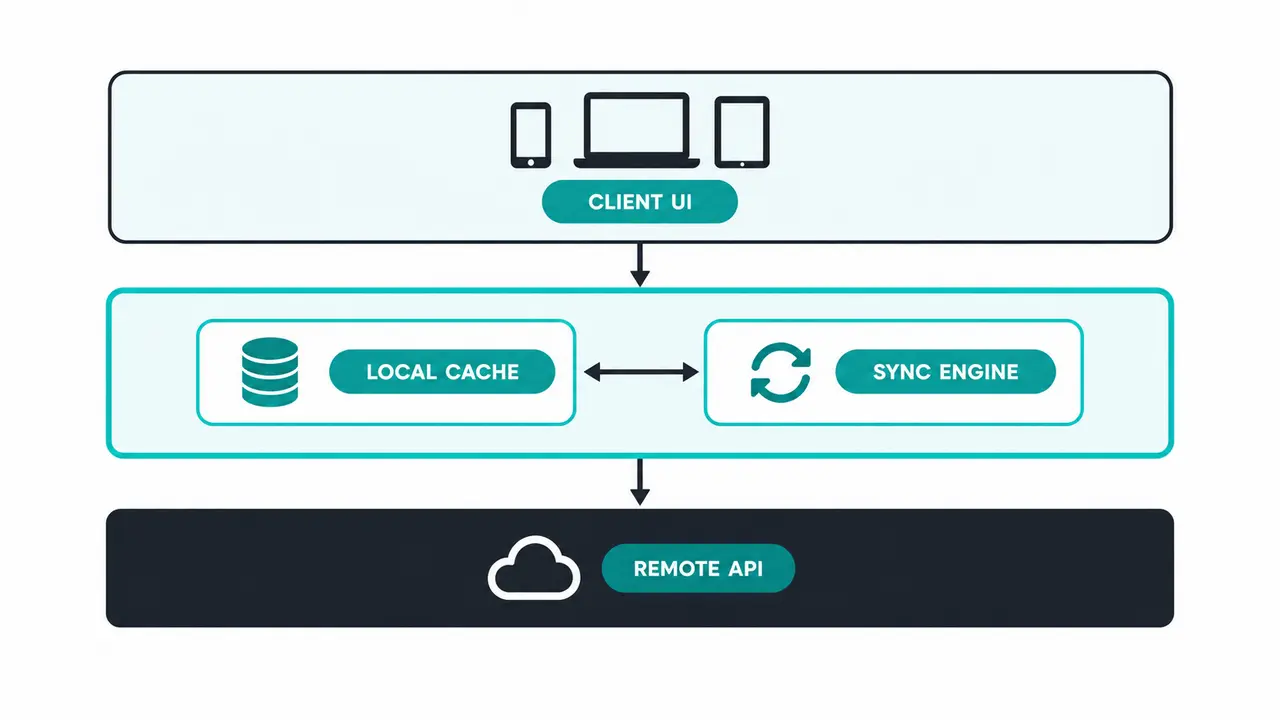
Mobile architecture decisions must center on offline capabilities and app store deployment cycles rather than visual design preferences. Discovering three sprints into development that your mobile application must store complex local state or sync transactions offline will derail your entire launch plan. Your technical choices must account for push notification infrastructure and store approval lead times.
The choice between native code and cross-platform frameworks depends on your product differentiators. Frameworks like React Native or Flutter provide rapid iteration across both major mobile ecosystems from a single codebase. Cross-platform frameworks are weaker when your product relies on low-level Bluetooth communication or intensive device sensors. Native development in Swift and Kotlin is weaker when your immediate commercial priority is rapid user experimentation across both operating systems. Decide your offline synchronization model during week one so your mobile architecture never blocks feature releases.
AI-core MVPs need a stack that makes evaluation repeatable
Building an AI-centered product requires repeatable evaluation and clear boundaries between business logic and model calls. Rapid proof-of-concept demos often look impressive in meetings, but they collapse when users provide unstructured input. Without structured evaluation pipelines, changing a system prompt to fix one edge case silently damages three other customer workflows.
Your MVP stack must include a curated evaluation dataset along with fallback mechanisms for model timeouts. A stack optimized purely for frontend velocity is weaker than an architecture built for systematic evaluation and observability. If your developers cannot benchmark the accuracy impact of a model parameter change across fifty historical queries, you cannot reliably improve your product. Treat prompt templates and context retrieval configurations as version-controlled software assets. Measurable evaluation pipelines turn unpredictable machine output into a dependable commercial tool.
Hardware-adjacent MVPs change the stack decision
When your product integrates physical hardware or connected sensors, standard web development conventions break down quickly. Intermittent network connections and constrained memory require resilient communication protocols. Validating an attractive dashboard while the underlying device integration remains unstable produces false confidence that evaporates during customer deployments.
At Sentice, our engineers approach hardware constraints by prioritizing simulated device endpoints and automated protocol test rigs before building outward-facing dashboards. Your MVP architecture must define clear messaging protocols like MQTT and binary payload formats early. Teams that rely solely on standard web abstractions discover too late that device latency and dropped packets corrupt backend state. A pure web stack is weaker when physical device behavior dictates core user satisfaction. Investing early in automated telemetry and mock device harnesses protects your team from catastrophic field failures during early customer trials.
Rapid prototyping tools that produce usable evidence
Using rapid prototyping tools gives engineering teams the speed needed to gather direct customer evidence before committing capacity to production code. These tools must serve user validation rather than please internal executives with slick interactive presentations. Clickable wireframes in Figma validate navigational logic, while lightweight landing pages test customer willingness to pay before backends exist.
Others treat prototypes as disposable toys, but we treat them as instruments for customer discovery. The boundary between prototype assets and production code must remain clear to every team member. A clickable interface reveals whether a user understands your core value proposition, but it cannot test database integrity or security boundaries. Mistaking positive stakeholder reactions for validated customer engagement leads teams to scale the wrong architecture prematurely.
Discard your prototypes once they have answered specific behavioral questions.
Building production applications directly on top of temporary wireframe mocks creates fragile architectures that collapse under initial customer usage.
Sequencing no-code, low-code and custom code
Engineering leadership requires sequencing development technologies across the product lifecycle rather than debating an absolute choice between visual builders and custom software. Start with interactive mockups during initial discovery to confirm whether customers understand your value proposition. Once user demand is clear, deploy low-code tools like Retool for administrative dashboards and manual data operations.
Reserve custom programming for the specific customer-facing workflows that deliver your product value. Building custom administrative tooling before your back-office procedures stabilize wastes valuable sprint hours that belong on user features. Visual builders struggle when your architecture requires granular row-level security or custom data transformations. Writing custom code prematurely wastes engineering capital when the primary business workflow remains unproven. The table below outlines how pragmatic teams sequence development approaches as operational requirements mature over time. Graduating between these phases ensures that your team writes custom code only where differentiated functionality demands it.
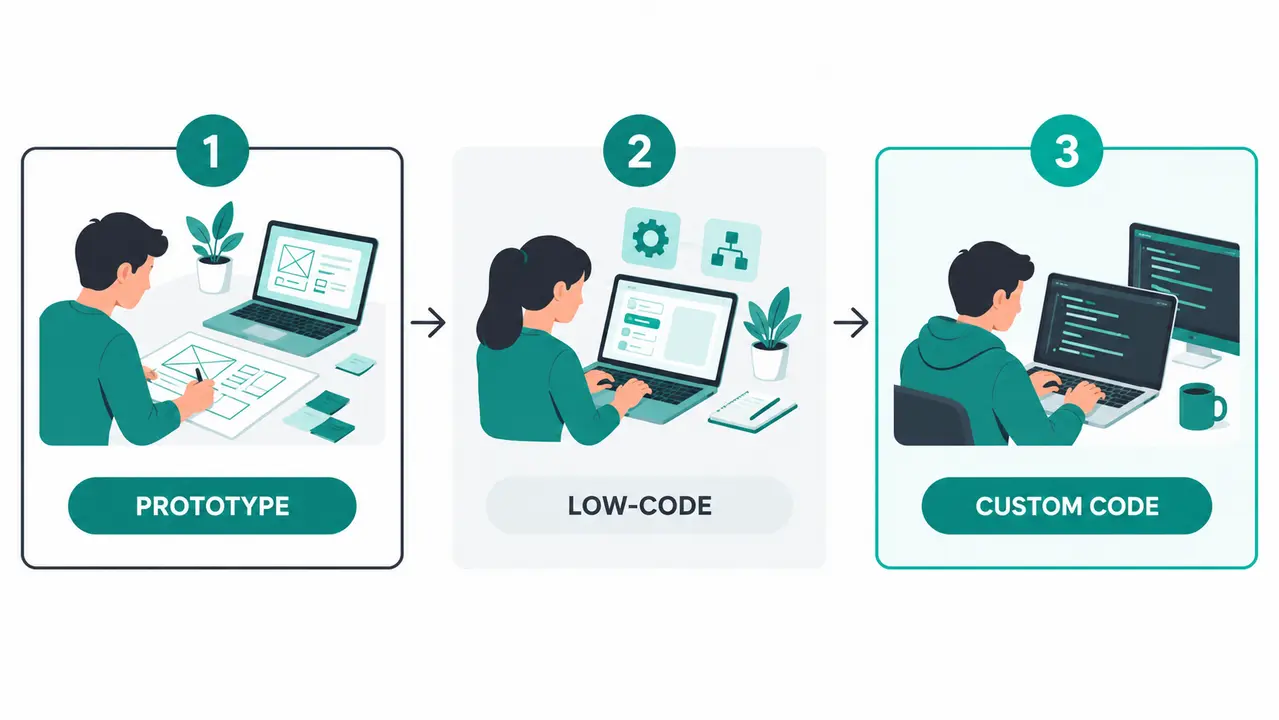
| Development Approach | Ideal Application | Primary Constraint |
|---|---|---|
| Throwaway Prototype | Initial customer demand and workflow discovery | No production data persistence |
| Low-Code Platform | Internal administrative operations and back-office review | Limited permission hierarchies |
| Custom Code Base | Proprietary customer value delivery and core transactions | Requires ongoing engineering maintenance |
Tech stack selection for MVPs with a small engineering team
Small engineering groups succeed by limiting their architecture to a minimal footprint of runtimes and external dependencies. A team of three to five developers cannot maintain multiple programming languages without suffering from severe context switching and fragile knowledge silos. Standardize on one backend language and one automated deployment pipeline.
Every added runtime introduces separate dependency vulnerabilities and on-call rotation overhead. Startups pay a heavy distributed systems tax when they split early codebases across microservices without the operational headcount to support them. If your current roster struggles with maintenance overhead, integrating dedicated software engineering teams can expand delivery capacity without fracturing your technical standards. We assemble focused units that embed directly into your established repositories and operational workflows. Protect your core engineers by keeping technical boundaries consolidated until team expansion makes architectural separation sustainable.
Monolith first is still the default for MVP architecture
A modular monolith remains the most effective architectural pattern for early-stage software development.
When user requirements shift weekly, altering internal code boundaries inside a single deployable unit is significantly cheaper than coordinating breaking changes across distributed services. Organizing a codebase into distinct internal modules provides architectural discipline without the networking overhead of separate remote procedures.
A pragmatic modular monolith relies on a single code repository and one reliable deployment pipeline. Building distributed microservices to solve team communication problems before you have multiple engineering teams creates artificial operational friction. Distributed architectures require distributed tracing and complex network retries that drain sprint throughput. Large vendors promote sprawling microservices, while we build modular monoliths that ship. Microservices are structurally weaker during early validation unless your business model requires strict physical data isolation or specialized asynchronous hardware compute. Consolidating your application logic within one structured codebase protects your iteration cadence while product requirements continue to evolve.
The data layer decision that causes the most rework
Choosing your initial database engine requires disciplined pragmatism because data migrations become exponentially harder once customer information enters production. You should adopt an established relational database by default unless an extraordinary access pattern demands an alternative structure. Relational engines enforce transactional integrity and provide reliable schema migration tooling that prevents silent corruption during frequent feature releases.
Document stores and non-relational databases often tempt founders with promises of flexible schemas. That perceived flexibility quickly turns into unstructured data debt, pushing complex validation logic directly into application code where edge cases multiply unnoticed. Alternative storage engines excel in narrow domains like high-throughput telemetry streams or dedicated vector retrieval. Relational databases remain the strongest foundation for B2B applications because predictable reporting and clean financial auditing are mandatory for business survival. Niche databases introduce operational vulnerability unless your primary value proposition directly relies on their specialized indexing capabilities.
Authentication and permissions are part of the MVP technology choice
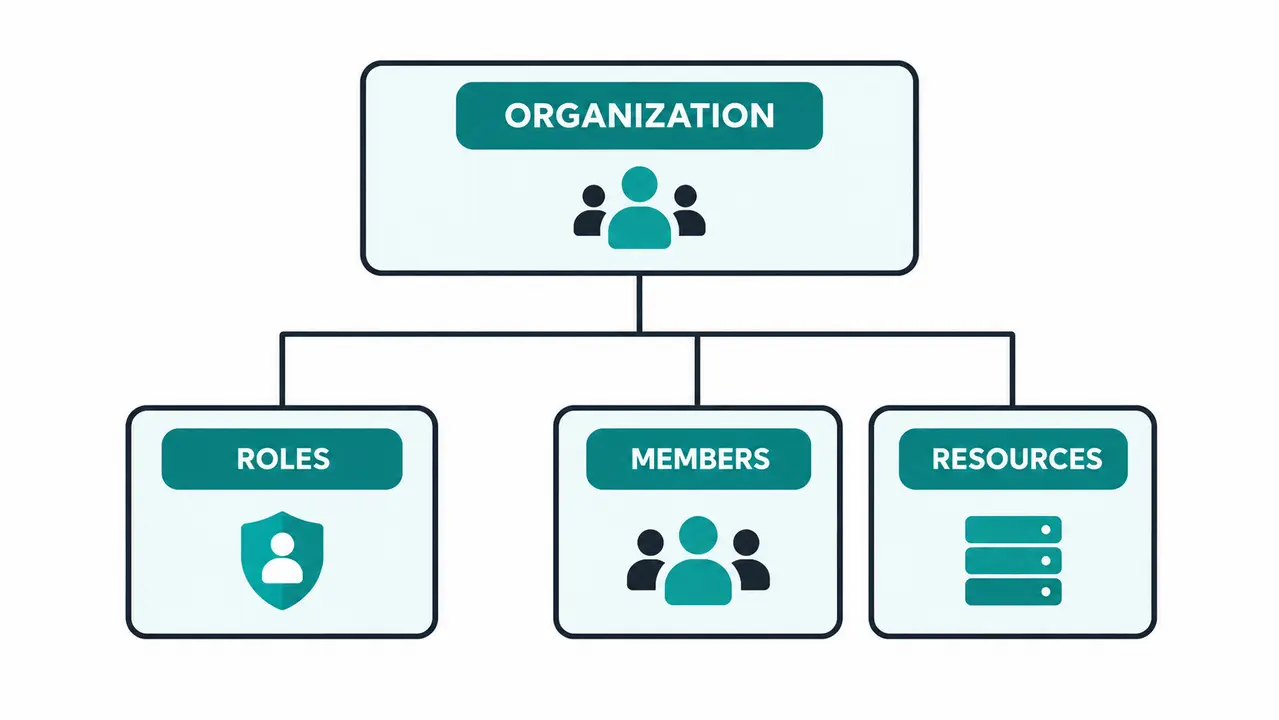
Authentication architecture is an essential structural decision rather than a routine onboarding task. Your initial stack must implement a permission model that mirrors how your target customers purchase and manage software. If you sell to corporate departments, your system requires multi-tenant organizations and teammate invitations from day one. Postponing organization-level tenancy requires painful database refactoring later when enterprise prospects request team access.
Rely on proven identity providers rather than implementing custom password hashing or session management. Aligning your early identity architecture with established frameworks like OWASP SAMM ensures you build secure authorization boundaries without wasting months on custom security protocols. User records and access control lists embed deeply across every API endpoint you expose. Refactoring insecure authentication patterns after onboarding commercial accounts introduces severe compliance liabilities. Build simple role-based controls using managed identity tooling today, while deferring complex enterprise federation until signed contracts require it.
Operational readiness that does not slow the MVP down
An early product requires a practical operational baseline so engineers can resolve production failures without bureaucratic overhead. A failure on a Friday afternoon turns into a customer disaster when your application lacks centralized logs or a documented rollback script. Minimum operational readiness means every engineer can inspect exceptions and revert bad releases within minutes.
Automating routine operations is essential given the competitive pressure on engineering talent. Eurostat reported that ICT specialists represented 5.0% of total EU employment in 2025, with annual growth slowing to 2.6% between 2024 and 2025. Following established practices from the NIST SSDF framework allows small teams to secure their release pipelines without sacrificing delivery speed. Through end-to-end software solutions, Sentice handles early deployment pipelines and operational telemetry so founding teams can focus on commercial validation. Automated operational safeguards protect early customer trust while keeping your internal engineering overhead manageable.
Frequently asked questions
Should an MVP be scalable from day one?
An MVP should prioritize rapid learning and user validation over hypothetical day-one scale. Designing for massive traffic before validating product demand wastes valuable capital on unused distributed architecture. Build your initial release on simple components that handle immediate customer volume reliably while keeping operational overhead low.
What is the fastest way to build an MVP?
The fastest path combines the stack your current developers know best with managed cloud infrastructure. Relying on familiar programming languages prevents onboarding delays, while third-party authentication and hosted databases eliminate hundreds of setup hours. Avoid experimental tools during early delivery sprints.
Which backend is best for MVP development?
A mainstream language ecosystem like Python, Node.js, or Go provides the best balance of speed and stability. These runtimes offer battle-tested libraries, comprehensive documentation, and broad developer talent pools. Select the runtime your team operates most comfortably rather than chasing marginal performance gains.
Which database is best for an MVP?
PostgreSQL is the recommended default for most early applications due to its strict schema constraints and predictable transactional behavior. It supports complex relational data alongside JSON document storage, accommodating evolving models without requiring secondary databases. Migrations remain structured and dependable as your application expands.
Is it difficult to switch tech stacks when going from an MVP to a scaled version?
Switching stacks is expensive and painful, which is why choosing mature, reversible technology early is so important. Decoupling business logic from framework code and maintaining clean relational data structures minimizes the pain of future migrations. Most successful platforms optimize their original stack rather than executing complete rewrites.
When to ship and what to leave behind
You stand at the whiteboard with your engineering team and limited runway to prove commercial value. You cannot optimize for rapid customer learning and theoretical platform scale simultaneously. Choose the smallest stack that lets your engineers deploy today without unnecessary infrastructure baggage. What single customer journey will your stack support next week?
Scope your MVP stack with senior engineers
Walk through your stack decision from monolith boundaries to database and authentication choices with a team that ships MVPs across web, mobile, AI and embedded products.
About Sentice

Sentice is a boutique software engineering partner founded in 2013 by Roni Levi and Martin Petkovic, now headquartered in Skopje, North Macedonia. Rather than supplying individual developers, we build embedded teams that blend with a client’s culture, tech stack and goals, working together from a single office under our own technical leadership. We deliver dedicated software engineering teams, end-to-end software solutions, product development, and system and embedded engineering, and we act as technical advisors across the full development lifecycle, from specification and architecture through development, testing and support. We use AI coding tools across every project, and we help clients integrate AI into their own products through chatbots, MCP services, connected application layers and workflow automation. Some of the clients we started with more than a decade ago are still building with us today.
Email: info@sentice.com · Phone: +389 70 307 837