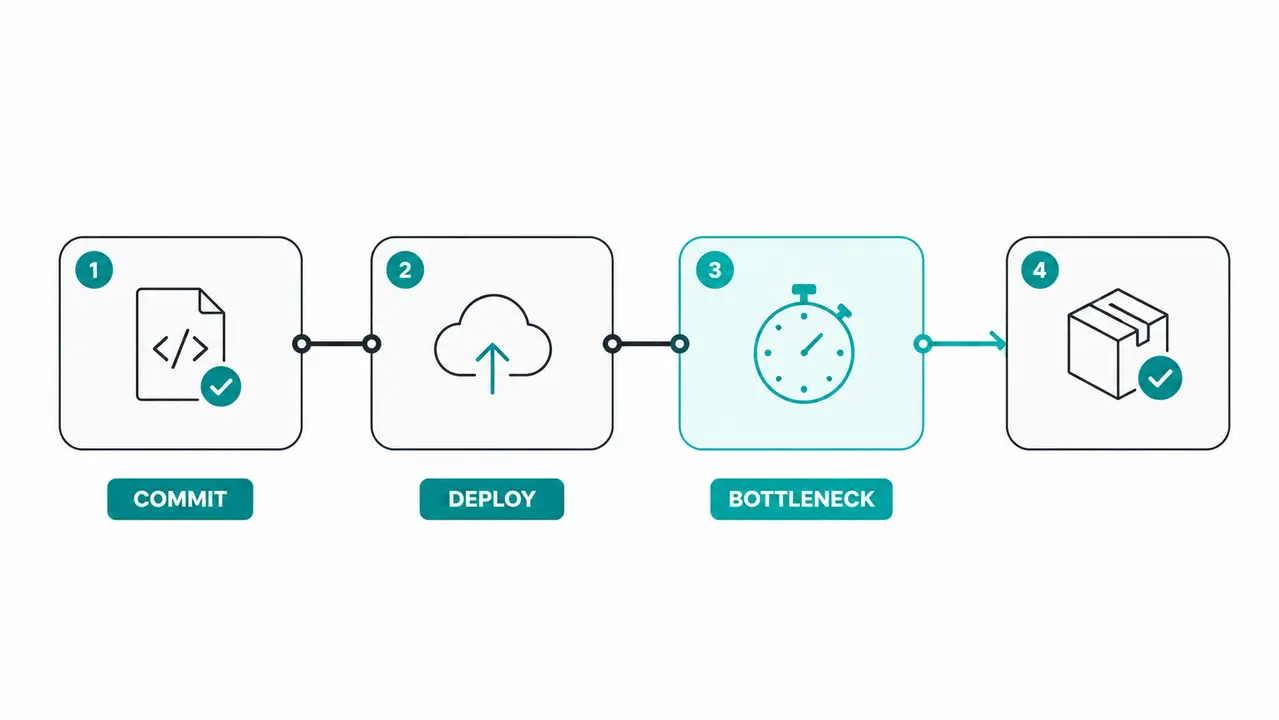
Your most senior engineer spent last Tuesday not writing features. She spent it nursing a flaky staging environment, hand-holding a deploy that failed twice, and answering a Slack thread about why production logs disappeared. That is the moment most startups discover they have a DevOps problem. Not during a planning session. During a bad week.
The pattern is remarkably consistent. A team of six ships fast because everything lives in one repository and one person knows how it all fits. Then services multiply, environments drift apart, and every release becomes a small negotiation with the infrastructure. Headcount grows. Delivery slows anyway.
Below, we unpack the signals that show DevOps work has become the constraint, what a first month should actually produce, the deliverables that separate real DevOps from tool installation, and how to choose between consulting, embedded, and managed engagement models.
Reading time: 12 min
Key points
- DevOps services earn their cost when environment drift, fragile releases, and operational load keep senior engineers out of product work.
- Real DevOps delivers operating artifacts, runbooks, and knowledge transfer, not just installed tools with a demo pipeline.
- Consulting, embedded, and managed models are three different purchases, and choosing the wrong one wastes a quarter.
- Measure any engagement with the four DORA metrics against a baseline taken before it starts.
Table of contents
When DevOps services become the bottleneck you cannot ignore
DevOps services earn their cost when delivery speed is constrained by environment drift, fragile releases, and operational load that keeps your senior engineers out of product work. The signal is rarely dramatic. It shows up as release windows that stretch from an hour to a day, hotfixes applied by hand because the pipeline cannot be trusted, and a staging environment that behaves nothing like production.
We have watched this pattern repeat across many scaleups. Shipping fast initially is easy because complexity has not arrived yet. Then a second service appears, then a third, then a message queue nobody documented. Manual hotfixes replace automated processes one by one, quietly. Six months later the team is larger, releases are slower, and incidents are more frequent. Scaling headcount without scaling delivery safety produces exactly that outcome.
There is a counter-case worth naming. If your team ships daily with zero manual interventions and complete rollback confidence, you do not need an external intervention yet. Spend the budget on product.
What DevOps services should change in the first month
The first month is not a toolchain rebuild. It is the establishment of a stable delivery baseline with clear ownership, repeatable environments, and measurable release health. Anything more ambitious tends to produce motion without progress.
Concretely, the month should produce four artifacts. A current-state map of your cloud infrastructure, including which environments exist, which are stable, and which are quietly rotting. A prioritized backlog of platform work ranked by how much engineer time each item is currently wasting. A definition of done for platform changes, so “the pipeline works” stops being a matter of opinion. And a hardening path for one functioning CI pipeline, from commit to deploy, that engineers actually trust.
The failure mode here is spending budget on a tool migration while existing pipelines remain broken. We have inherited engagements where a Kubernetes migration was half-finished and the team still could not deploy on Fridays. The baseline assessment exists to prevent exactly that.
If you already run a mature platform team, the first month shifts to targeted gaps like observability or release controls instead.
The deliverables that separate real DevOps from tool installation
Anyone can install Terraform, GitHub Actions, and Grafana in two weeks. Real DevOps solutions deliver operating artifacts your team can run independently after the engagement ends, not just configured tools with a demo pipeline.
The difference shows up in the deliverables list. A reference architecture that explains why each component exists. Environment promotion rules that state who can deploy what, where, and under which approvals. On-call playbooks per critical service, with first-response steps an engineer at 3 a.m. can follow. A golden path service template that gives every new service logging, alerts, and a deployment pipeline on day one.
Tool installation leaves you with a polished pipeline nobody understands. That creates permanent vendor dependency, which suits the vendor far more than it suits you. Others install tools and bill for the hours. We hand over the operating model, the runbooks, and the knowledge transfer, because an engagement that ends in dependency is a failed engagement.
One screening question exposes this early. If a provider only lists tools they install and never mentions runbooks or ownership transfer, the engagement lacks operational maturity.
CI CD that engineers trust under pressure
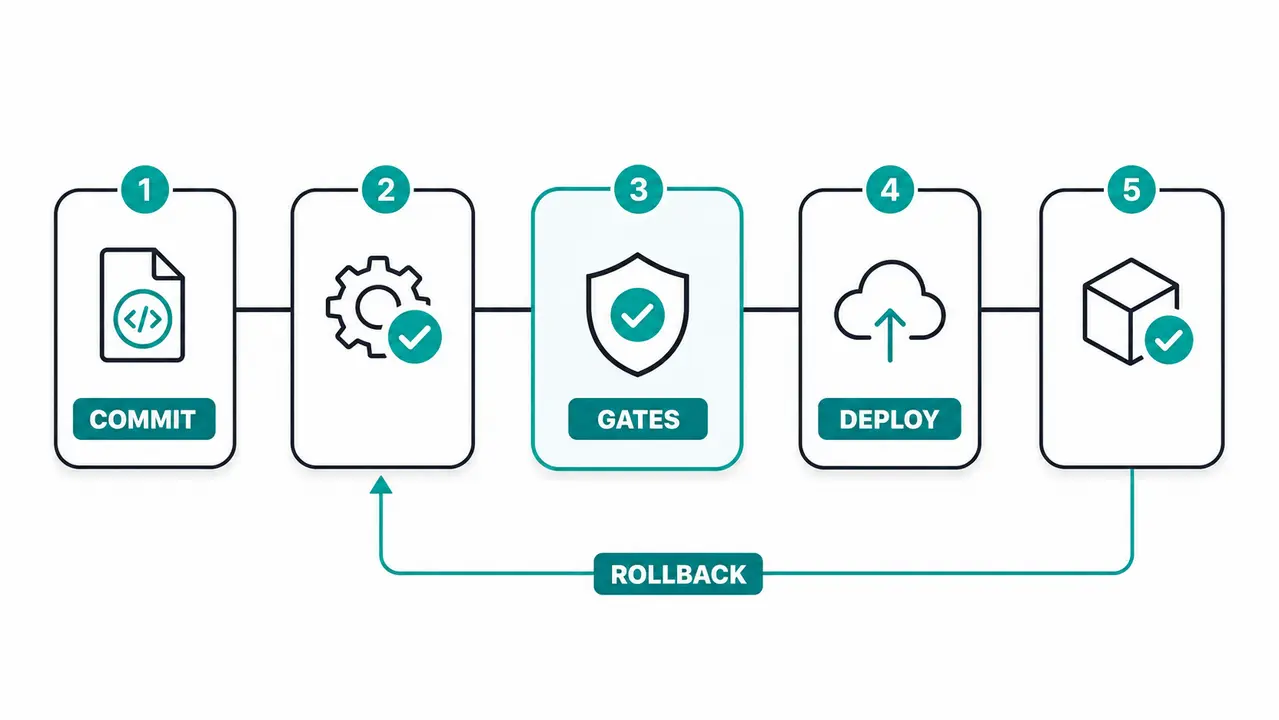
A functional CI/CD system lets engineers predict outcomes precisely. They know what merges, what deploys, what rolls back, and what blocks a release. Trust in a pipeline is not a feeling. It is the absence of surprises under pressure.
In practice this means quality gates matched to risk levels, built on GitHub Actions or GitLab CI. A documentation change should not pass through the same gauntlet as a payment flow change. Canary deployments, where the blast radius justifies them, catch regressions on 5% of traffic before they reach everyone.
The failure mode is the green pipeline with broken production. It happens when CI and production lack parity, or when manual steps live between the pipeline and the deploy button. Engineers then learn to distrust green, which is worse than having no pipeline at all, because they stop reading the signals entirely.
Release controls that reduce rollback time
Rollback time is the metric that separates confident teams from hesitant ones. Define rollback criteria before the deploy, not during the incident. Keep versioned artifacts so any release can be redeployed identically. Test the rollback path per service, in staging, on a schedule. A team that has rehearsed the rollback deploys without hesitation. A team that has not treats every release as irreversible, so it releases less.
Infrastructure as code that survives team turnover
Infrastructure as code delivers value only while it stays readable, reviewable, and tied to a change process that prevents drift. The moment one person becomes the only safe operator of the repository, you have rebuilt the tribal knowledge problem in a newer tool.
Use Terraform modules with strict code review rules, documented environment bootstrapping, and clear state management conventions. Anyone on the team should be able to open a plan, read it, and reason about the blast radius. That is the entire point of expressing infrastructure as code.
Set a minimum standard for any production IaC repository. Naming conventions for resources, so nobody guesses what “prod-2-final” is. Module boundaries that mirror team boundaries. Mandatory plan reviews before every apply. Secrets handled outside state, never inside it.
The failure mode we keep inheriting is a Terraform repository only one person can apply safely. When that person resigns, the repository freezes. Teams then hand-edit consoles to keep shipping, and drift makes the code worse than useless, because it now lies about the infrastructure.
Kubernetes and container platforms that do not require heroics
Kubernetes reduces operational risk through standardization and planned upgrades. It adds complexity for its own sake when adopted as a status symbol. The CNCF annual survey reports that production use among container users has hit 82% in 2025, which means running it safely is now the operational bar, not an experiment you run to look modern.
A responsible Kubernetes scope covers the cluster baseline, ingress, autoscaling, and upgrade runbooks, typically on EKS, GKE, or AKS with Helm for packaging and Argo CD for GitOps delivery. The upgrade runbooks matter more than the initial cluster. Kubernetes releases three minor versions a year, and an unpatched cluster becomes a security liability within two quarters.
There is an honest counter-case. If your product is early and architecturally simple, a managed PaaS remains the stronger option until operational need justifies Kubernetes. The migration path from PaaS to Kubernetes is well-trodden. The reverse migration, unwinding a badly run cluster under incident pressure, is not.
Observability that answers engineering questions fast
Observability succeeds when it shortens diagnosis time. It fails when it generates dashboards nobody reads. The difference is consistent signals across services, not volume of instrumentation.
The practical stack is OpenTelemetry for instrumentation, Prometheus for metrics, Grafana for visualization, a tracing backend, and structured logging everywhere. The tooling matters less than the conventions. Every service emits the same correlation identifiers. Every alert links to the trace, the logs, and the dashboard in one click.
Enforce structured logging conventions across all new services as a merge requirement. An alert that says “error rate up” sends an engineer digging. An alert that carries the request ID, the affected endpoint, and the tenant count starts the diagnosis two steps ahead.
The failure mode is the alert storm followed by the ninety-minute incident call spent guessing at root causes, because services tag differently and nothing correlates. We have sat in those calls. They are expensive, and they are almost entirely preventable with consistent tagging decided early.
Incident response that reduces repeat pages
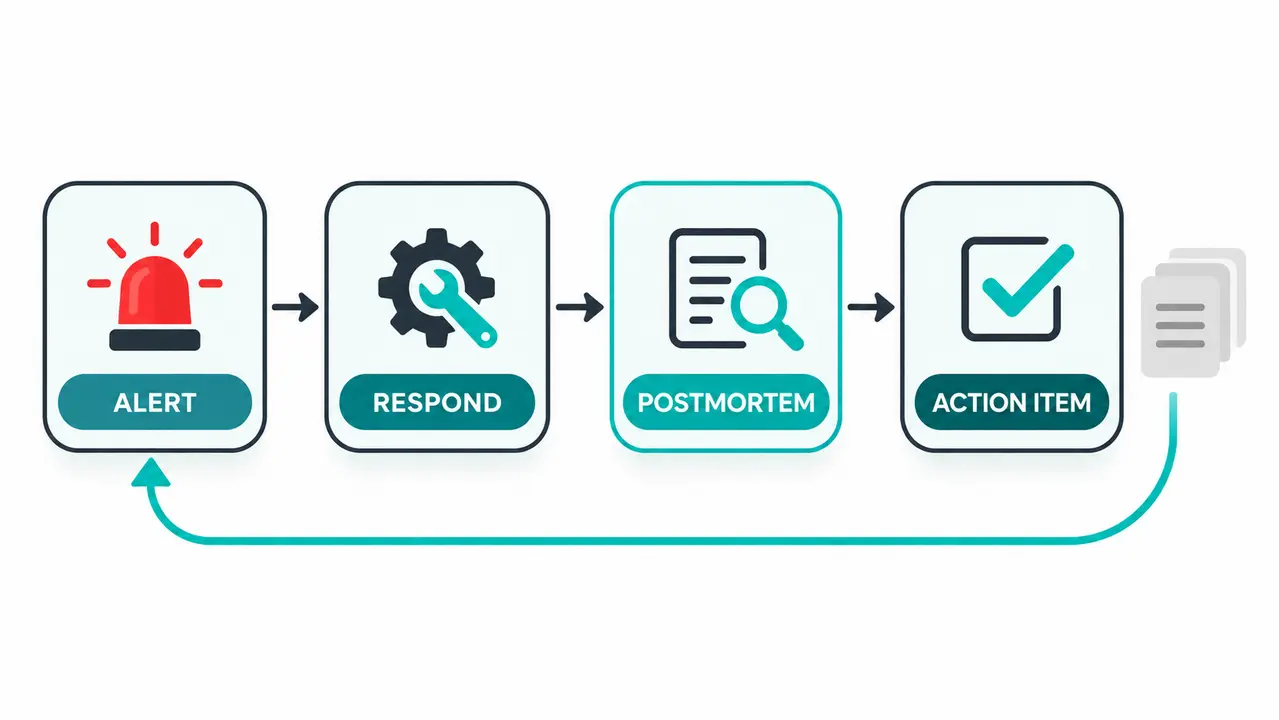
A DevOps engagement should leave you with an incident system that improves over time. Without one, the same incident pages you every two weeks wearing a slightly different hat, because the systemic root cause never gets addressed.
The artifacts are unglamorous and essential. An incident checklist so the first ten minutes follow a known sequence instead of improvisation. A communications template for status updates to stakeholders. An escalation path naming who is called, in what order, after how long. A postmortem document standard with action items that carry owners and deadlines.
Design the on-call rotation deliberately. Paging rules should route critical issues to the right responder immediately while suppressing the noise that burns people out. A rotation where nobody sleeps is not a rotation. It is a resignation letter on a delay.
The test of a mature incident process is simple. Pull the last ten incidents and check how many produced a closed action item that prevented a recurrence. If the answer is zero, your incident process is a journal, not a system.
SLOs and error budgets as a shared contract with product
SLOs and error budgets turn reliability into a negotiated, measurable agreement between engineering and product. Google’s SRE guidance frames the error budget as the mechanism that balances reliability against the pace of innovation, and that framing is the part most startups miss.
Take a 99.9% availability target. That is roughly 43 minutes of allowed downtime a month, an error budget you spend with every incident and every risky deploy. Burn rate alerts tell you when you are spending it too fast. When the budget is gone, feature releases pause and reliability work takes priority, by prior agreement rather than by argument.
Run a monthly review with product and engineering in the same room. Product sees what the reliability cost of the roadmap actually is. Engineering stops being the team that just says no.
The failure mode this prevents is the unspoken expectation. Product assumes four nines because nobody ever stated otherwise. Engineering assumes shipping features matters more. The friction surfaces as escalation, not as a data-driven decision, and both sides lose.
DevSecOps that fits how engineers actually ship
DevSecOps works when security checks function as fast feedback loops inside the developer workflow, with clear ownership of what each check means. It fails when security arrives as a late-stage gate that freezes releases and teaches engineers to route around it.
The scope is concrete. Secrets management so credentials never live in repositories. Dependency scanning, container scanning, and IaC scanning running directly in pull requests, with results in minutes rather than hours. The NIST Secure Software Development Framework describes this integrated approach as a core set of practices for mitigating software vulnerability risk across the SDLC, and it is a reasonable baseline to hold any partner to.
Speed is the whole game. A container scan that returns in three minutes changes the commit. A scan that returns the next day changes nothing, because the code has already merged and moved on.
The failure mode is predictable. Late gates create release freezes. Release freezes create workarounds. Workarounds bypass the security policy entirely, which is a worse outcome than having no policy.
Platform engineering and the golden path approach
Platform engineering shifts DevOps work from fixing pipelines to building a product for internal developers. The platform team’s customer is your engineering team. The product is the paved road those developers ship on.
The core artifact is the golden path. A service scaffolding command that generates a new service with logging, metrics, alerts, and a deployment pipeline already wired. Self-service environments a product engineer can spin up without filing a ticket. Standardized logging and tracing because the template shipped with them, not because someone remembered to add them in week three.
There is a counter-case, and it matters. If you run fewer services with low operational complexity, heavy platform work slows you down unnecessarily. Platform engineering pays off when the third team starts duplicating the same setup work by hand.
Because the platform underpins everything from first commit to production observability, it belongs in a broader delivery context. Our end-to-end software solutions work treats the platform as part of the entire product lifecycle rather than a standalone project, which is how golden paths stay aligned with what the product actually needs next quarter.
The week a senior leaves and only they know the deploy process
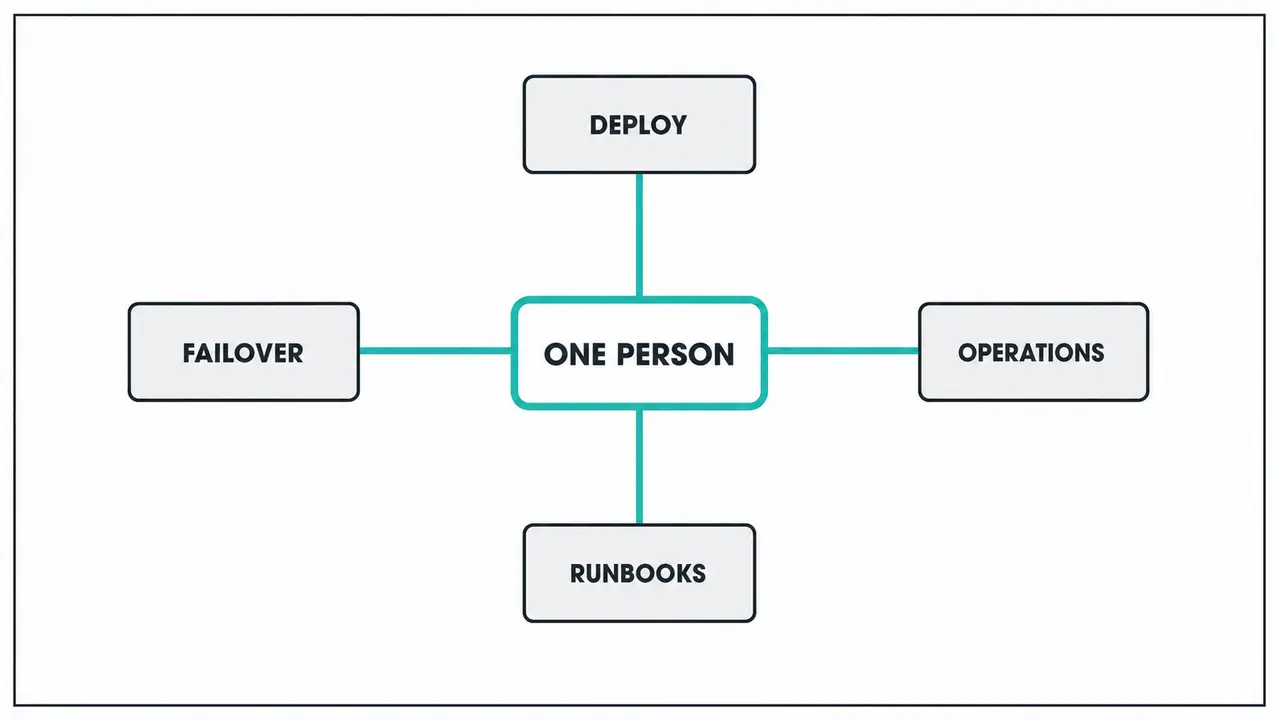
Every scaleup has a version of this week. The senior engineer who knows the deploy process, the database failover sequence, and the one load balancer quirk hands in a notice. Delivery relies on tribal knowledge, and tribal knowledge just booked a start date somewhere else.
When that is your situation, prioritize documentation, access hygiene, and repeatable operations over new tooling. A new tool does not help when the problem is that knowledge lives in one head. The artifacts you need are runbooks per critical service, break-glass access procedures written down and tested, and an onboarding checklist a new engineer can follow without asking questions.
Set a hard standard for the outcome. Any new engineer should be able to ship a compliant change to production within their first week using only documented procedures. If that sentence sounds impossible for your team, that is your roadmap for the next quarter.
The failure mode is operational paralysis during vacations, attrition, or incident spikes. Concentrated knowledge is a single point of failure wearing a friendly face.
Choosing between consulting, embedded, and managed DevOps
The right engagement model depends on what you are actually buying. A defined build outcome, temporary capacity, or ongoing operational ownership are three different purchases, and choosing the wrong one wastes a quarter.
Map the scenario to the model. A CI/CD or cloud migration with a clear end state fits project-based consulting. Stabilizing a team that is underwater fits an embedded engineer working inside your rhythms, the model behind our dedicated software engineering teams, where the engineers follow your practices and your communication style from week one. Ongoing on-call responsibility and infrastructure ownership fit a managed arrangement.
The failure mode is choosing project work for a recurring operational load. The project ends, the operational load does not, and you buy the same project again in eight months with no handoff plan. When the work is continuous, the engagement structure has to be continuous too.
How the three engagement models compare
A direct comparison clarifies what you buy in terms of outcomes, ownership, and the path to independence. The table below maps the three models across the dimensions that actually decide the purchase.
| Dimension | Consulting (project) | Embedded engineer | Managed DevOps |
|---|---|---|---|
| Best trigger | Migration or build with a defined end state | Team underwater, temporary capacity gap | Recurring on-call and operational load |
| Artifacts delivered | Architecture, pipelines, runbooks, handoff docs | Sprint output inside your team | Continuous operations, incident response, reporting |
| Ownership after 90 days | Fully yours, transfer is contractual | Shared with your team leads | Retained by the provider |
| Main risk | No internal owner ready to receive it | Permanent dependency on borrowed capacity | Knowledge never lands internally |
Note the ownership row, because it decides everything downstream. Project work ends at delivery. Embedded work integrates with your team rhythms until the capacity gap closes. Managed work retains operational responsibility by design. A provider who cannot name the exit criteria, or the internal owner taking over, has not thought past the invoice.
Not sure which model fits your situation?
Tell us where your delivery process hurts and we will map it to the right engagement shape, with the exit criteria named up front.
What to ask before you give anyone access to production
Treat a DevOps partner the way you would treat a privileged operator inside your own company. Access scope, auditability, and change control need to be explicit from day one, not negotiated during the first incident.
The controls are standard and non-negotiable in any serious engagement. SSO for all access. Least privilege as the default posture. Break-glass procedures for emergencies, with automatic expiry. Logging on every privileged action. An approval flow for production changes. An infrastructure change process where every modification ships as a reviewed pull request.
Sentice works this way with client production systems, and we hold ourselves to the same standard we recommend you hold us to. If a partner resists auditability, that resistance is the answer to your question.
The failure mode is silent change. An untracked infrastructure modification at 2 a.m. that nobody can explain two weeks later, discovered during an incident review when the timeline does not reconstruct. Accountability without an audit trail is a rumor.
Measuring success with delivery and reliability metrics
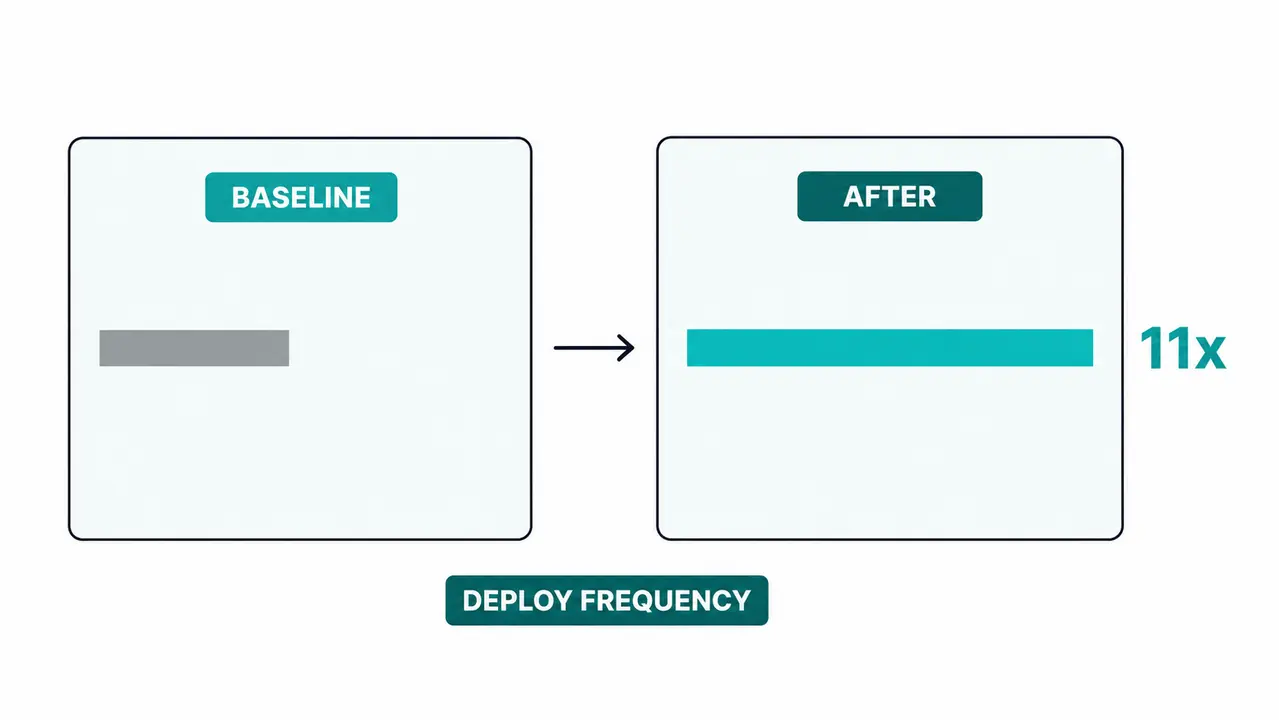
Measure any DevOps engagement by outcomes that map to shipping and stability, validated by a small set of metrics your team cannot game. The industry standard is the DORA set. Deployment frequency, lead time for changes, change failure rate, and time to restore service. Four numbers, tracked monthly, honest by construction.
Take a baseline before the engagement starts. If deployment frequency was twice a month and is now eleven times a month, the engagement worked. If lead time dropped from nine days to one, it worked. If the numbers did not move, the engagement produced activity, not delivery, regardless of how many pipelines were built.
The vanity metrics to refuse are the obvious ones. Number of pipelines created. Number of tools installed. Number of dashboards. None of these reflect whether your team ships faster or sleeps better.
Review the four metrics with the same seriousness you review revenue. They are the leading indicators of everything else your engineering organization produces.
Where DevOps services fail in startups and scaleups
Most DevOps engagements do not fail on technology. They fail on ownership. The provider optimized tools instead of transferring knowledge, shipped changes without documentation, and built a platform your team cannot operate without calling them.
The common patterns are easy to list because we keep inheriting them. Kubernetes over-engineered for a product serving four thousand users, with three people who understand the cluster and none of them on your payroll. Incident processes that consist of a Slack channel and hope. Repositories with no naming conventions, no plan reviews, and state files passed around like contraband.
The weakest engagement is the one that cannot explain how your team becomes independent. Ask that question in the first meeting and listen for a specific answer with dates and named artifacts.
Before signing anything, review the provider’s client success stories and look specifically for evidence of independent handoffs. Proof that previous clients took over and kept shipping is worth more than any capability deck.
Recognizing when it is time to bring DevOps in house
Bring DevOps in house when platform work becomes a continuous product with a clear roadmap, stable funding, and internal leaders who own reliability as their actual job description. Before that point, an internal hire usually becomes a lonely engineer doing tickets in a corner.
The signals are observable. Multiple teams shipping daily. Infrastructure changes every week rather than every quarter. Sustained on-call load that justifies a dedicated platform backlog with a product owner. When those conditions hold, the platform team stops being overhead and starts being leverage.
Prepare the transition deliberately. Name the internal leaders before the external partner leaves. Establish the SLO review cadence and put it on the calendar. A transition that starts the week the contract ends has already failed.
The counter-case is real. If the work remains episodic and the expertise highly specialized, a partner with a defined operating boundary remains the better fit. Not every company needs a platform team, and pretending otherwise is how good engineers end up bored and gone.
Frequently asked questions
What is the difference between DevOps consulting and managed DevOps?
DevOps consulting delivers a defined outcome, such as a CI/CD migration or an infrastructure rebuild, and ends with a documented handoff. Managed DevOps retains ongoing operational responsibility for your infrastructure, including on-call and incident response. Choose consulting when you have a clear end state and an internal owner ready to receive it. Choose managed when the operational load is continuous and you do not want to staff it.
Do we need DevOps or SRE?
DevOps focuses on delivery flow, automation, and the toolchain that moves code to production. SRE focuses on reliability metrics, error budgets, and incident performance. Growing scaleups usually need both disciplines integrated, because shipping faster without measuring reliability just produces faster incidents.
What should a DevOps team deliver in the first 30 days?
Four things. A current-state map of your environments and pipelines. A prioritized backlog ranked by wasted engineer time. One hardened path to production that engineers trust. Basic incident runbooks for your most critical services. Anything beyond that in month one is probably motion.
Which DevOps tools matter most for a startup?
A version control system, a CI/CD pipeline, Infrastructure as Code, and a centralized logging stack. Those four cover the delivery and diagnosis fundamentals. Specialized tools like service meshes or progressive delivery platforms can wait until the fundamentals are boring.
How do you measure DevOps success?
Use the DORA metrics. Track deployment frequency, lead time for changes, change failure rate, and time to restore service, monthly, against a baseline taken before the engagement started. If those four numbers do not move, nothing else the engagement produced matters.
When should we move from a consultant to an internal platform team?
Move when platform work becomes a continuous product with stable funding and internal leaders who can own reliability full-time. If the work is still episodic, staying with a partner is usually the better economic and organizational decision.
What happens to documentation and access if the engagement ends?
A well-structured engagement ends with documentation already living in your repositories, runbooks in your wiki, and access transferred through your own identity provider. If the documentation lives on the provider’s systems, that is a problem to raise in week one, not in the final month.
Your next step toward delivery independence
Your senior engineer is going to spend next Tuesday somewhere. The choice in front of you is the one this whole article has circled. Shipping speed and operational stability trade against each other only when neither is engineered. Walk your current release process against the artifacts described here, the runbooks, the golden path, the rollback test, and mark honestly which ones exist and which are still tribal knowledge. Then answer one question before anything else. Who owns your deployment process next week if your most senior engineer is unreachable?
Let’s scope your team
Bring us your release process and your last ten incidents. We will tell you which model fits and how your team becomes independent of it.
About Sentice

Sentice is a boutique software engineering partner founded in 2013 by Roni Levi and Martin Petkovic, now headquartered in Skopje, North Macedonia. Rather than supplying individual developers, we build embedded teams that blend with a client’s culture, tech stack and goals, working together from a single office under our own technical leadership. We deliver dedicated software engineering teams, end-to-end software solutions, product development, and system and embedded engineering, and we act as technical advisors across the full development lifecycle, from specification and architecture through development, testing and support. We use AI coding tools across every project, and we help clients integrate AI into their own products through chatbots, MCP services, connected application layers and workflow automation. Some of the clients we started with more than a decade ago are still building with us today.
Contact us at info@sentice.com or call +389 70 307 837.