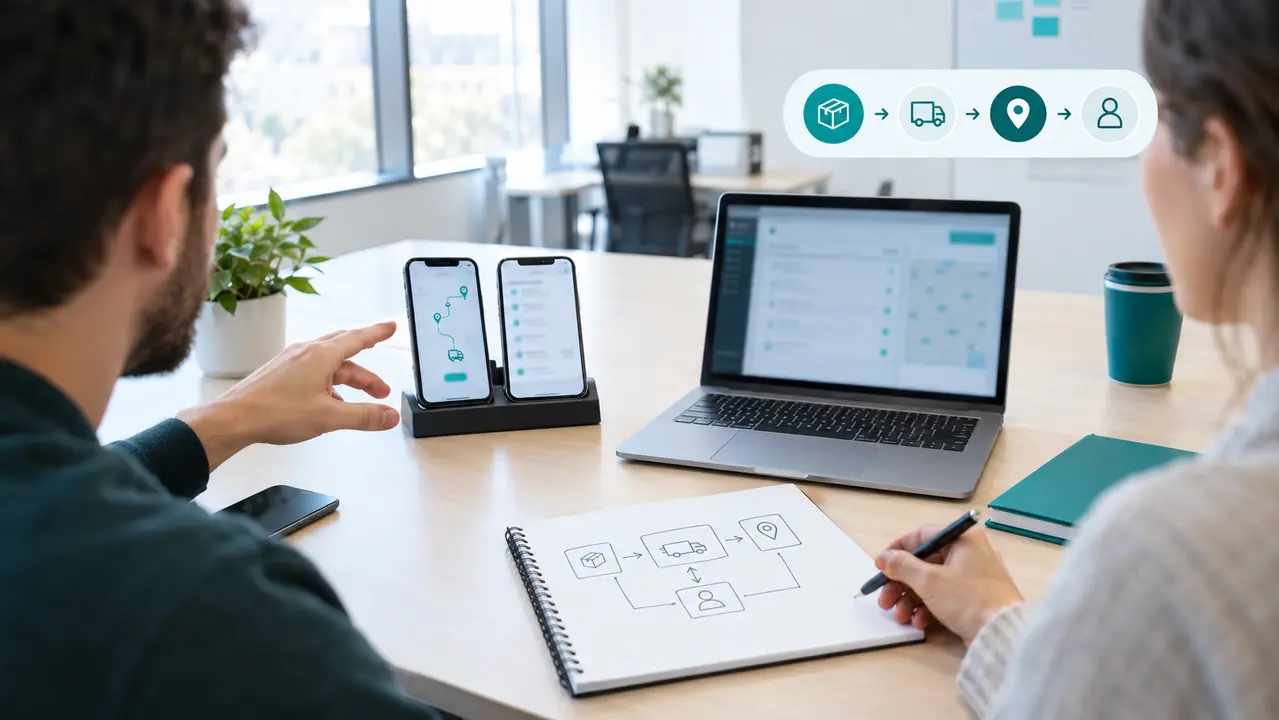
The beta demo ran for forty minutes without a crash. Two weeks later, in the field, the same build lost a technician’s completed job report because the sync layer had never been tested against a dispatcher editing the same record from the web console. Nobody wrote a bad line of code. The engagement simply never produced the artifacts that would have surfaced the conflict. This is how most mobile projects fail, and it has nothing to do with screen design. Below, this guide walks through the artifacts, architecture constraints, and delivery practices that separate a real mobile engineering engagement from a UI build, so you can evaluate your next partner against evidence instead of portfolios.
Reading time: 11 min
Key points
- A serious mobile engagement produces six artifacts before shipping: a requirements document, an architecture sketch, a test plan, a release checklist, a runbook, and analytics integration.
- Constraints dictate the architecture, never the reverse: offline needs, data jurisdictions, SSO, and hardware access must be documented before a framework is chosen.
- Offline-first is an architecture with explicit conflict resolution rules, not a caching toggle.
- Evaluate partners by requesting sample artifacts from real projects, not portfolios.
Table of contents
Defining mobile application development services for technical buyers
When you buy mobile application development services, you are not buying screens. You are buying a complete delivery capability that spans discovery, engineering, QA, release, and post-launch operations. Most mismatches between buyer and app development company start here: the vendor quotes a coding task, and you needed a system that survives roadmap changes and scaling pressures.
A serious custom app development engagement produces six core artifacts before anything ships. A product requirements document. An architecture sketch. A test plan. A release checklist. A runbook. Analytics integration. If a prospective partner cannot name these unprompted, they have quoted you a UI build and labeled it a delivery.
Your delivery risk sits in the seams between those artifacts, not in the code itself. Ask for all six in the first scoping call.
Architecture constraints before interface design
Mobile projects derail in a predictable order. The team commits to a UI framework, produces visual deliverables, wins internal approval, and only then discovers that the app must run offline for field staff, store regulated data on European servers, authenticate through the corporate single sign-on, and read from a peripheral over Bluetooth. The stack chosen for its animation library cannot handle any of it.
Document the constraints first. Offline-first requirements. Regulated data storage jurisdictions. SSO integration points. Hardware access and background task needs. Integration boundaries with your existing systems. Each one eliminates or validates technology choices before anyone writes a line of Kotlin or Swift.
The verdict is blunt: constraints dictate the architecture, never the reverse. Teams that pick a framework first end up rewriting navigation, persistence, and half the data layer after the first beta, when integration realities surface. That rework costs more than the discovery work that would have prevented it.
Discovery artifacts that derisk week two engineering
A competent partner leaves discovery with outputs that make engineering predictable. Vague requests become recorded decisions. Scope becomes boundaries with acceptance criteria attached. The plan becomes a thin vertical slice that touches every layer of the system in the first sprint, so integration risk surfaces in week two instead of month four.
Require five specific things before engineering starts. A prioritized backlog. An event and data model draft. An API contract outline. Nonfunctional requirements covering latency, offline behavior, and device targets. A release plan for internal builds, so your stakeholders see working software on real devices early. When the transition from discovery to engineering is handled this way, end-to-end product development becomes a continuous line instead of a handover between people who never speak.
Discovery without artifacts is a workshop. It produces slides, not predictability.
A decision log that survives stakeholder churn
Maintain a living document that records every architectural and product decision in a numbered format, accessible to all stakeholders. When a new VP joins the project in month three and questions the sync architecture, the log answers in seconds. Teams without one relitigate solved problems on a monthly cycle.
Designing user experience for business workflows
B2B and internal tool UX succeeds on task completion under real conditions, not on app store aesthetics. Your sales rep opens the app in a basement with two bars of signal and a customer waiting. Your field technician wears gloves and works in direct sunlight. That is the environment your design must survive.
Script usability testing with timing metrics for these scenarios. Field workers with intermittent connectivity. Sales workflows where the customer record is only partially synced. Approval flows that must work when the backend is slow to respond. Measure time-to-complete-task, not satisfaction scores from people sitting in a conference room on office Wi-Fi.
Business tools prioritize operational reliability over visual delight. An app that looks perfect in a demo but blocks necessary actions because role-based access was designed late is a failed app, whatever the pixel density of its illustrations.

Native and cross platform architecture decisions
Choosing between native iOS, React Native, and Flutter for mobile solutions depends on three things: performance needs, platform-specific feature depth, and your team’s ability to maintain the codebase for years. Map the decision to staffing reality. A shared codebase written in React Native lets your web engineers contribute, but onboarding them still costs weeks, and platform-specific API access still requires native knowledge at the edges.
The failure mode is choosing a shared codebase for a use case that needs heavy background processing, strict compliance posture, or custom hardware integration. Those demands push you toward native whether the budget likes it or not.
The verdict we apply: cross platform is the default for business logic, and native is justified for performance-critical or hardware-dependent features. Splitting the app, native modules inside a cross platform shell, is often the honest answer.
| Decision factor | Cross platform (React Native, Flutter) | Native (iOS, Android) |
|---|---|---|
| Best fit | Business logic, the default choice | Performance-critical or hardware-dependent features |
| Staffing | Lets your web engineers contribute, but onboarding still costs weeks | Platform-specific API access requires native knowledge at the edges |
| Failure mode | Chosen for heavy background processing, strict compliance, or custom hardware integration it cannot handle | Higher maintenance burden across two codebases |
| Honest middle ground | Splitting the app: native modules inside a cross platform shell | |
Backend API contracts as mobile deliverables
Mobile apps fail at data, identity, and integration points. The UI layer almost never breaks the build. The backend does, which means API design must be explicitly scoped inside the mobile delivery engagement rather than assumed to live somewhere else.
Require versioned APIs, so an old app build keeps working against a new backend. Rate limits, documented and tested. Idempotency handling for retry logic, because mobile networks drop requests mid-flight. Audit logging for regulated actions. A staging environment that mirrors production, including realistic data volumes and latency.
Treat the API contract as a joint deliverable owned by both mobile and backend engineers. When the contract is a markdown file nobody updates, the mobile team gets blocked in the final build phase by unstable endpoints and undocumented behavior changes. We have watched a three-week buffer evaporate in four days that way.
Offline data synchronization architecture
Offline-first is an architecture, not a caching toggle. It requires clear data ownership, explicit conflict resolution rules, and a sync strategy you can test deterministically. Local persistence with queued writes, background sync on connectivity restore, and analytics that capture sync failures in production.
The canonical failure: a technician completes a job offline, the sync fires at 6 p.m., and a dispatcher edited the same job from the web console at 5:40. Without a documented conflict policy, last-write-wins silently destroys one of those edits, and nobody notices until a customer complains. Define the policy per entity. Some records favor the field. Some favor the office. Some require human merge.
If your app genuinely requires constant connectivity, keep local caching simple. A read-through cache with a clear error state beats a sync engine you do not need, and the reduced complexity pays off in every release after.
Authentication and authorization models
Authentication choices drive navigation structure, data access patterns, and auditability. In enterprise contexts, SSO integration and role-based access are first-class architectural requirements, not features to schedule for version two.
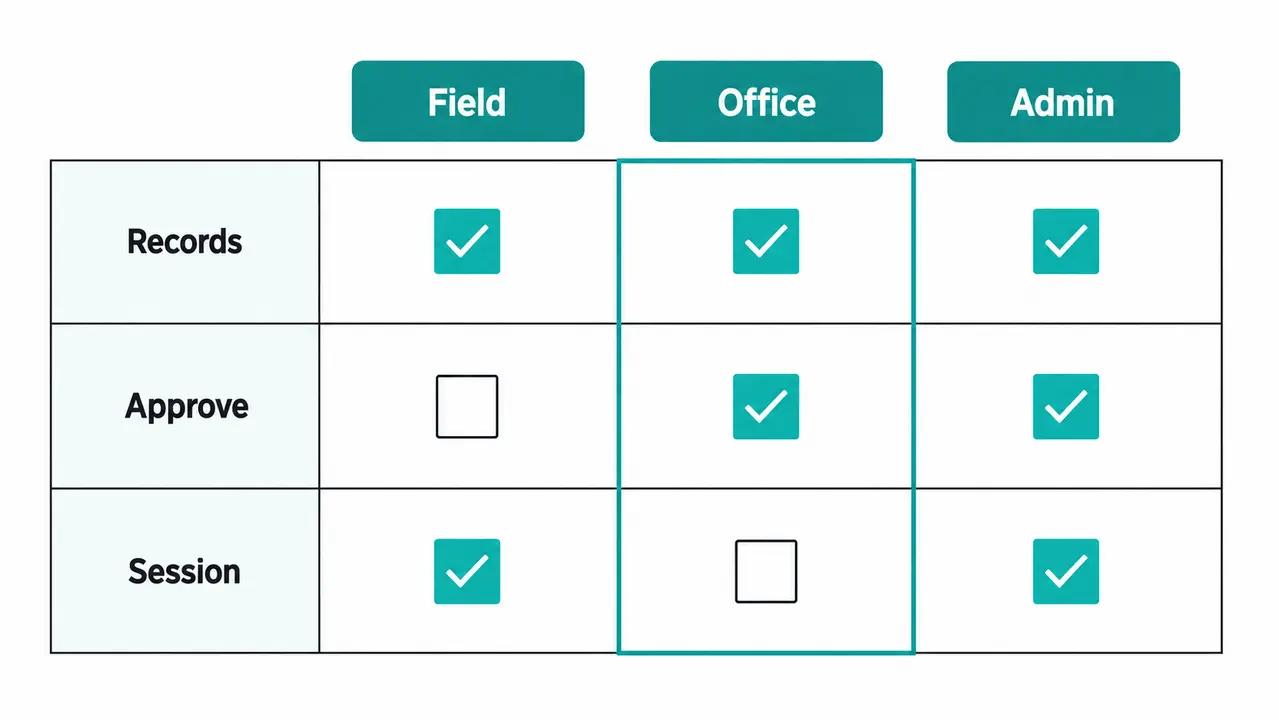
Define roles and authorization rules in a simple matrix early. Who sees which records. Who can approve. What happens when a session expires mid-task. Whether devices must be enrolled and revocable, which matters when a phone is left in a taxi. A one-page matrix agreed in week one prevents months of ambiguity.
The “we will add roles later” approach becomes a complete rewrite of data access patterns, because the first version hardcodes assumptions about a single user type into every query and every screen. Authorization logic must be designed into the core data model, not bolted on after launch. Retrofitting it costs more than building it in.
A practical authorization model for mobile clients
Implement token-based access control scoped to specific user roles. Use scoped JSON Web Tokens that carry only the permissions the client needs for the current context. Over-privileged tokens leak sensitive data onto a device you do not control, and a lost phone becomes an incident.
Security verification standards for mobile
Mobile security improves when teams verify against a known checklist instead of improvising one per project. The OWASP MASVS gives you a verification baseline, and the companion Mobile Security Testing Guide supplies the test techniques. Bake both into the continuous delivery process so checks run on every build, not once per quarter.
For organizations that need an established anchor for secure development practice, the Secure Software Development Framework from NIST describes a core set of practices that integrate into each phase of the lifecycle. Additional research needed from neutral sources on specific mobile penetration testing tools.
The failure mode is scheduling a security review in the final week. Insecure local storage and broken auth flows found at that point block the release, and the fix window is measured in days. Verification that runs continuously costs hours; verification that runs once costs the launch date.
Mobile QA as an integrated delivery system
QA that exists as a phase before deployment produces “works on my phone” releases. QA that exists as a system produces releases you can trust on a Friday afternoon. The difference is structure, not effort.
The system has four layers. Unit tests for business logic, especially sync and conflict resolution. Integration tests that validate the app against the API contract, so backend changes break the build instead of the user. UI smoke tests covering the critical paths, login, core workflow, data submission. Manual exploratory testing on physical target devices, because emulators hide real performance and real touch behavior.
Gate releases on crash-free session rates and startup time budgets. A threshold of 99.5 percent crash-free sessions is a defensible floor for internal tools, higher for customer-facing products. QA is a continuous system of checks integrated into the pipeline, not a phase, and teams that treat it as a phase ship their bugs to production and discover them through support tickets.
Release engineering and store deployment
A reliable partner treats CI, code signing, store submission, and staged rollout as core engineering work. Administrative overhead is what you call it when nobody owns it, and nobody owning it is how signing keys end up on one laptop belonging to a contractor who left in March.
Require automated builds from day one. Environment configuration managed outside the codebase. Secrets handled through a proper vault, not a properties file in git. Internal distribution via TestFlight and Firebase App Distribution so stakeholders test real builds weekly. Staged rollout percentages for production releases. A documented rollback plan, written before you need it.
Release engineering must be owned by the engineering team. Handed off to an external administrator or a marketing contact, it produces urgent hotfix delays measured in days while someone hunts for the keystore password. We have seen a one-line crash fix take nine days to reach production for exactly this reason.
Post launch operations and app maintenance
Once users install the app, the work changes shape. Mobile application development services that end at the store submission leave you with a system nobody is watching, and mobile ecosystems do not hold still. iOS and Android ship major releases annually, deprecate APIs, and change store policies on their own schedule, not yours.
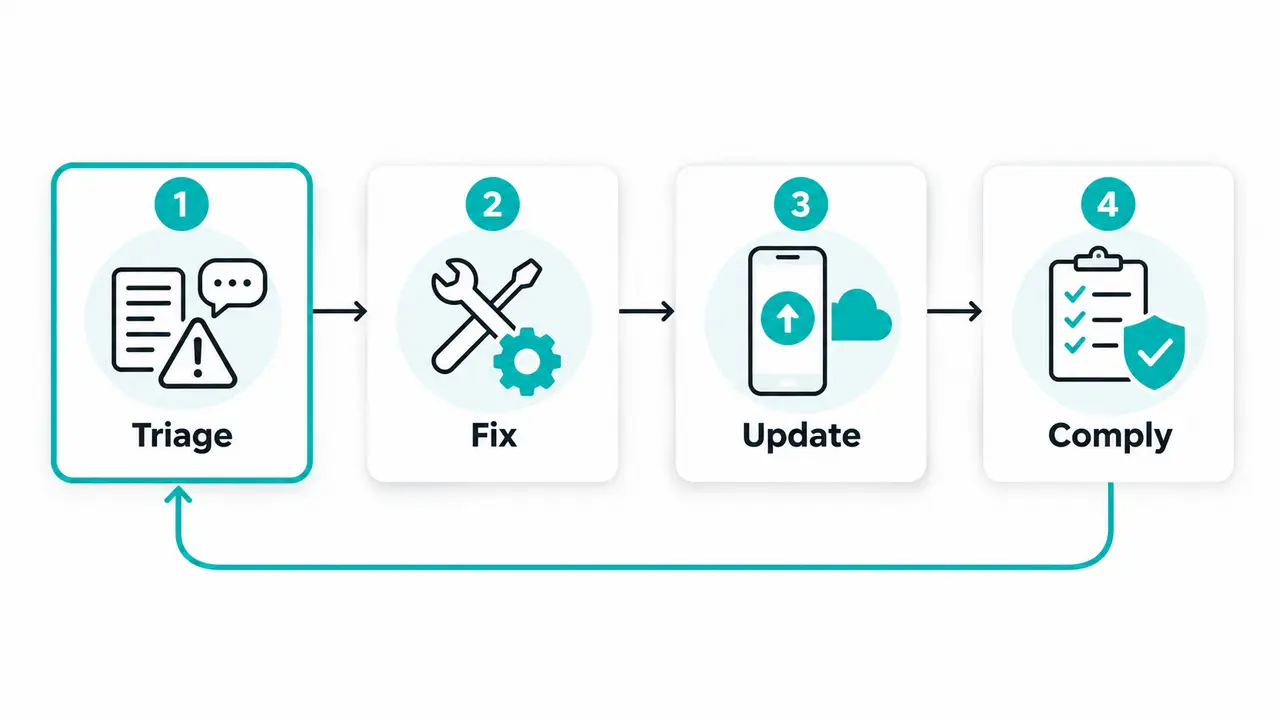
An operations plan defines a triage workflow for incoming crash reports and user feedback, conceptual bug fix SLAs tied to severity, a schedule for dependency updates, and a process for store compliance changes. Without one, app health degrades quietly. A library update breaks a background task, an OS change kills a permission flow, and usage decays for weeks before anyone opens the dashboard.
Budget for operations at planning time, not at renewal time. A rough rule from our delivery experience: expect maintenance to consume a meaningful fraction of the original build effort per year, concentrated around OS release windows.
Production telemetry and crash monitoring
Without telemetry, every prioritization argument is anecdote against anecdote. Instrumentation must capture crashes, performance, and key funnel events tied to your actual business workflows, so the data answers operational questions instead of vanity ones.
Four components cover it. Crash reporting with symbolicated stack traces. Performance traces for startup time, screen transitions, and API call latency. Structured logs that support debugging a specific user session. Product analytics events tied to user actions, so you can see that field technicians complete the job form in 90 seconds while office users abandon it.
The blind spot this prevents is specific: login drop-offs caused by one OS version go unnoticed for weeks because the aggregate numbers look acceptable. Segment telemetry by OS version, app version, and device class from the start. Define a minimal event set and resist over-collection, because every tracked field of sensitive user data complicates your compliance reviews and your GDPR posture.
Ecosystem friction and device fragmentation
Store review cycles, device fragmentation, and OS changes create delivery drag that generic roadmaps ignore. Apple review can take anywhere from hours to days, and a rejection over a policy interpretation resets your launch week. Plan for it instead of being surprised by it.
Maintain a pre-submission checklist covering the policies that actually cause rejections: account deletion flows, privacy manifests, data collection disclosures, payment rules. Maintain a device coverage list based on your active user base statistics rather than global market share, because your enterprise fleet of three-year-old Android devices matters more than the newest flagship. For European user bases, digitalisation in Europe data from Eurostat provides regional context on device and connectivity adoption.
The failure mode is a launch week surprise: a rejection on day one, or a crash affecting one device class that testing never covered. Both are calendar events you can see coming.
In house team building limitations
Building an internal mobile capability stalls for a structural reason. The moment you commit to a mobile product, you need iOS skills, Android skills, backend capacity, QA with device expertise, and release engineering, all at once. Hiring curves do not align. Your Android hire starts in month one and waits four months for a backend counterpart.
The sharper bottleneck is the senior hire. One experienced mobile engineer becomes the single point of failure for architecture decisions, code review, hiring interviews, and mentoring. Their vacation becomes your roadmap risk. When a team lacks a mobile bench, every delivery problem routes through one person, and that person burns out or gets poached, because the market for senior mobile engineers is not soft.
Companies that hit this wall usually explore how boutique partnerships accelerate tech team growth as an alternative to sequential hiring. The right model depends on how much technical ownership you want to retain internally, and that question deserves an honest answer before the first offer goes out.
Embedded engineering team boundaries
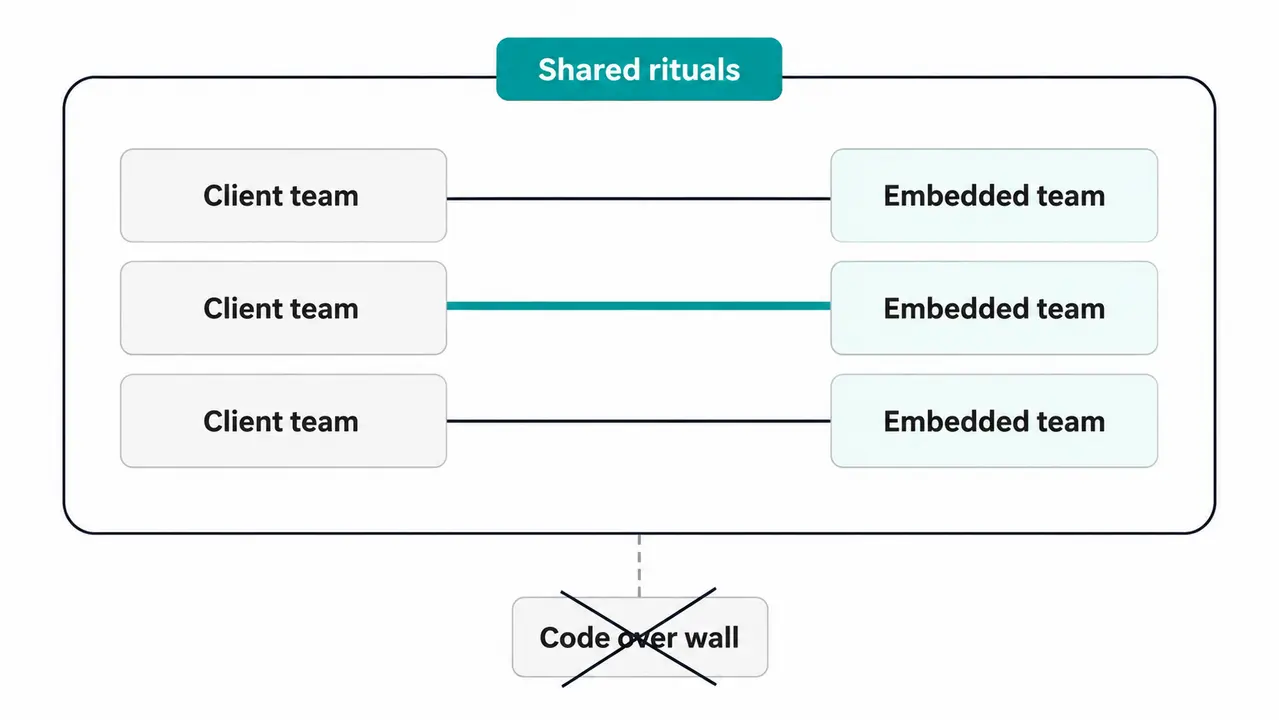
An embedded model succeeds when the partner’s engineers operate inside your rituals and your quality bar. They join your standups, follow your branching strategy, and own components end to end. It fails when the partner builds in isolation and throws code over a wall, which is the failure you are trying to avoid by not outsourcing in the first place.
Define the boundaries before work begins. The definition of done, including test coverage expectations. Code review rules and who approves what. Branching strategy and release ownership. Without these, you get code isolation: the partner ships mobile while your internal team struggles with backend integration, and every release becomes a negotiation.
This is the model Sentice runs for scaleups that need dedicated software engineering teams. The engineers sit together in one office, work as one unit inside your practices, and transfer knowledge continuously rather than at contract end. Others simply supply developers. We become part of your delivery system.
Need a mobile team that ships artifacts, not promises?
Tell us about your roadmap and we will walk you through the discovery artifacts, API contracts, and release engineering we would put in place for your build.
Bounded project delivery models
A bounded project model works best for well-defined builds with stable requirements, known integrations, and a clear acceptance test plan. A field data collection app with a fixed API, a defined user role set, and a compliance deadline fits. A product whose roadmap changes monthly does not, and forcing it into fixed scope produces either change-request warfare or silent scope erosion.
Tie milestone definitions to measurable outputs. Beta in the hands of twenty named testers. A store-ready build passing the full test plan. Monitoring live with crash reporting verified in production. Milestones measured in artifacts survive stakeholder scrutiny. Milestones measured in hours burned do not.
For smaller organizations, the ISO/IEC 29110 Series offers lifecycle profiles scaled to very small entities, a useful reference point for what “enough process” means before enterprise ceremony creeps in. Strict boundary definitions prevent scope creep in evolving products.
Evaluating technical delivery capabilities
You cannot evaluate a delivery system from a portfolio. Portfolios show screenshots, and screenshots are the output of design tools, not of engineering. Evaluate the system directly by asking for sample artifacts from real projects.
Five requests cover the ground. An architecture diagram with the reasoning behind the stack choice. A test strategy document. A release checklist actually used on a store submission. An incident postmortem template, ideally a completed one. A coding standards document that engineers actually follow. A partner who cannot produce these has never run a disciplined delivery, whatever the case studies claim.
The strongest signal is a short paid discovery or technical workshop. Two weeks of working with a team on real constraints tells you more than ten sales calls. Judge the clarity of the decisions produced. Were tradeoffs named? Was anything ranked and a loser identified? Teams that hedge every choice during evaluation will hedge every choice during delivery.
Frequently asked questions
Do mobile application development services include UI design and product discovery?
They must include both. Design without discovery produces unvalidated UI, and discovery without design produces requirements nobody can visualize. Ask whether the partner runs both inside one engagement or hands off between them.
Should we build the backend first or the mobile app first?
Build them concurrently with an API contract as the boundary. The contract lets mobile teams work against mocks while backend engineers implement, and integration happens continuously instead of in a painful final phase.
What is the difference between mobile app development and mobile app maintenance services?
Development builds the system. Maintenance sustains it against ecosystem changes: OS updates, deprecated libraries, store policy shifts, and device fragmentation. A system that ships without a maintenance plan starts decaying on launch day.
Do app development services include backend APIs and admin panels?
They should. A mobile client is useless without the backend that serves it and the admin tools that manage its content and users. Confirm the scope explicitly, because many vendors quote the client only and leave integration as your problem.
What should be included in QA for a mobile app?
Automated tests at the unit and integration level, a device coverage strategy based on your actual user base, and release gating tied to crash-free session rates and startup time budgets. Manual exploratory testing on physical devices completes the picture.
Who owns the code and the repository during and after the engagement?
Agree on this in writing before the first commit. Your repository, your infrastructure, your IP, with the partner working inside your accounts. If the engagement ends, everything, including documentation and pipeline configuration, stays with you.
Choosing the right engineering capacity model
Evaluate your next mobile build as a system delivery, not a screen delivery. Audit your partner’s ability to produce discovery artifacts, API contracts, and release runbooks before committing to any timeline. The tradeoff you are choosing between is a vendor who builds to a mockup and an engineering team that builds for production reality. Do you want a fragile app that looks great in a demo, or a resilient system that handles your enterprise workflows?
Scope your mobile build with engineers who plan for production
Bring us your constraints, from offline requirements to SSO, and we will map the architecture and delivery artifacts your project needs.
About Sentice

Sentice is a boutique software engineering partner founded in 2013 by Roni Levi and Martin Petkovic, now headquartered in Skopje, North Macedonia. Rather than supplying individual developers, we build embedded teams that blend with a client’s culture, tech stack and goals, working together from a single office under our own technical leadership. We deliver dedicated software engineering teams, end-to-end software solutions, product development, and system and embedded engineering, and we act as technical advisors across the full development lifecycle, from specification and architecture through development, testing and support. We use AI coding tools across every project, and we help clients integrate AI into their own products through chatbots, MCP services, connected application layers and workflow automation. Some of the clients we started with more than a decade ago are still building with us today.
Get in touch: info@sentice.com | +389 70 307 837