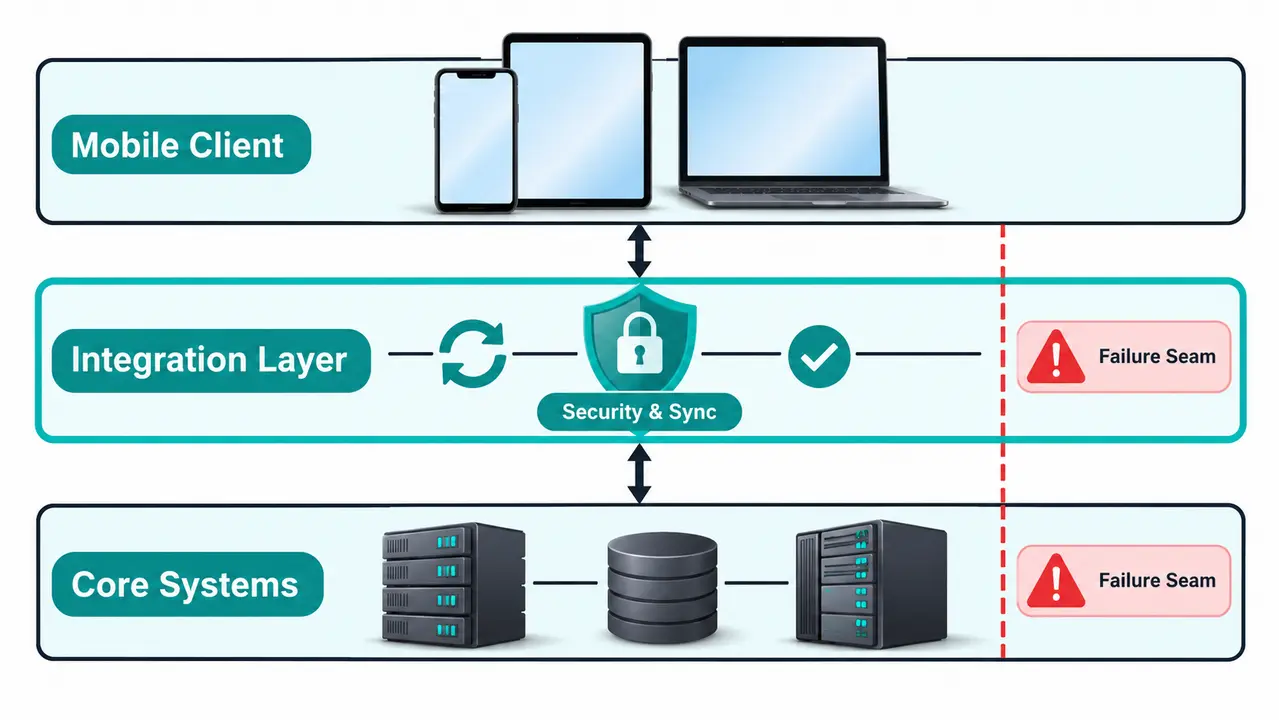
Enterprise mobile app development forces a reckoning with operational reality long before users install the first build. Success never depends on screen transitions or visual polish. It depends on the seams between systems where identity protocols, data contracts, and offline reconciliation rules collide. Many teams treat this work as a front-end sprint. They assemble attractive Figma prototypes, wire up a mock backend, and celebrate a smooth internal demo.
Rollout is where that illusion collapses.
Authentication passes cleanly in a staging tenant, yet fails immediately under enterprise conditional access policies that demand compliant hardware certificates. Field teams attempt offline inventory updates, but conflicting sync transactions quietly overwrite customer orders in SAP. You face stalled adoption and urgent executive escalations because integration, device enrollment, and audit requirements were omitted from initial discovery. This guide operates as a peer-to-peer technical memo to expose those hidden failure points before your team writes production code. The sections below move from identity and device policy through product shape and offline synchronization to backend contracts and security, then release management and testing, and close with the discovery deliverables and team topology that hold delivery together.
Reading time: 13 min
Key points
- Enterprise mobile success is decided not in screen design but in the seams between identity, device policy, and audit.
- Cross-platform is the pragmatic default; native earns its place when hardware peripherals, background processing, or hardware-backed security demand it.
- Offline-first is not a retrofit but a data model decision built on local storage, mutation queues, and idempotent endpoints.
- Contract-first API specifications and real discovery artifacts remove the unknowns that stall enterprise rollouts.
Table of contents
The enterprise bar is set by identity, device policy, and audit
Enterprise requirements start with identity boundaries and evidentiary proof rather than feature lists. Your architecture must verify who accesses data, evaluate device compliance posture, and retain immutable audit trails for every state change. Single sign-on serves as the gateway to conditional access rules and device trust verification.
Security teams reject releases when operational telemetry is missing. Auditors expect structured access logs, administrator action records, and data export events before granting production clearance. When teams postpone these requirements, security reviews become brick walls that delay rollouts by months.
Security review prompts that surface early
Prepare documented mechanisms for local data encryption, key rotation cycles, and root detection. Compile your third-party SDK inventory with exact permission scopes during discovery. Treating these requirements as engineering inputs prevents painful architectural refactoring during your compliance audit.
Where teams misclassify the user and pick the wrong product shape
Misclassifying your end users will derail delivery faster than technical debt. An internal business app for field technicians demands mandatory adoption, managed hardware profiles, and resilient offline storage. Technicians cannot abandon the tool when workflows feel clunky, but broken sync routines immediately paralyze regional operations. Field conditions turn minor edge cases into complete workflow blockers.
A customer-facing B2B app introduces entirely different engineering constraints. It requires public app store distribution, consumer-grade interaction design, and account lifecycles tied directly to billing tiers. Partner applications occupy the complex middle ground. They depend on external identity federation, delegated administration portals, and distinct operational support boundaries. Teams that build for internal staff and later attempt to repackage the binary for commercial clients face a structural dead end. Authentication models, compliance logging, and tenant isolation require an expensive rewrite. User classification dictates core architecture and operating models.
Choosing native, cross-platform, or hybrid based on constraints
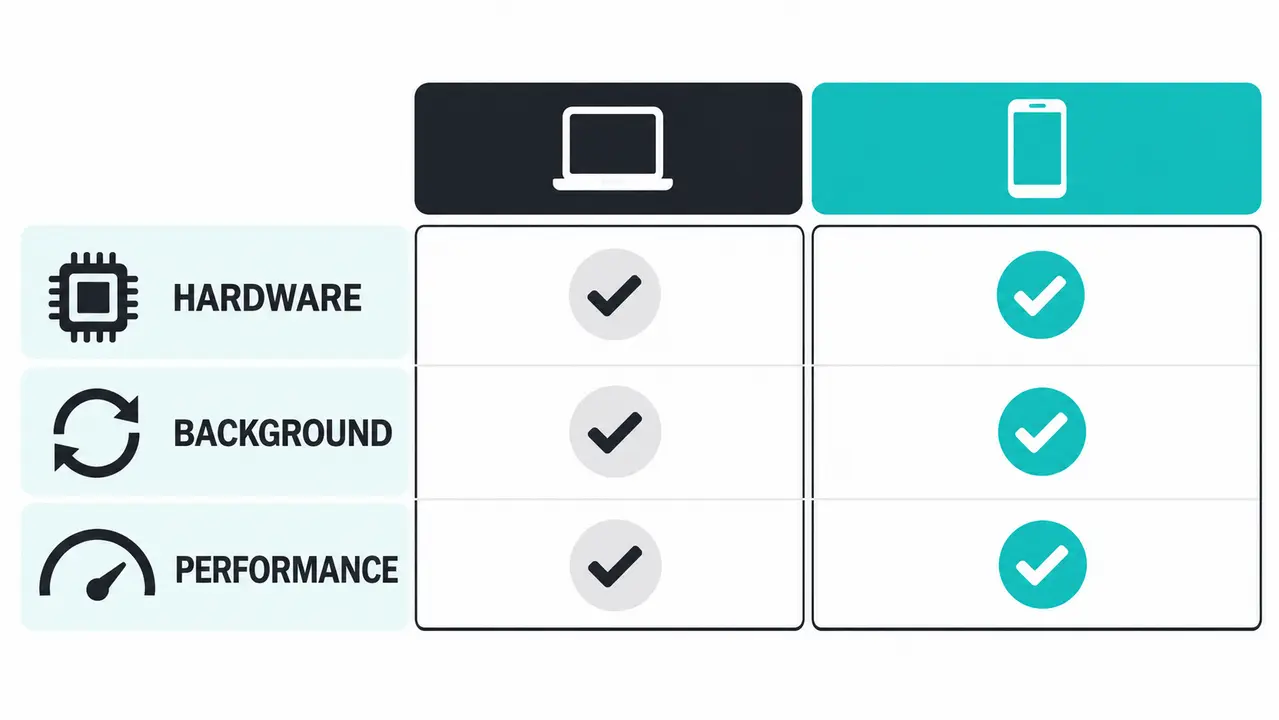
Cross-platform frameworks represent the pragmatic default for enterprise applications. React Native and Flutter consolidate engineering resources across platforms while delivering reliable user interfaces for administrative workflows and transactional forms. Cross-platform code reduces duplicated effort across common business logic. You still need native platform expertise when configuring custom MDM wrappers, background location daemons, and low-level identity provider SDKs.
Native development earns its investment when physical hardware integration dictates operational success. Teams that build scanning-intensive warehouse apps or continuous Bluetooth Low Energy telemetry tools hit performance ceilings on cross-platform abstraction bridges. Choosing cross-platform purely for initial velocity creates catastrophic delays when sprint four uncovers a low-level peripheral dependency. Start with cross-platform unless hardware hooks, background processing limits, or strict platform cryptographic APIs force native development.
A decision rubric technical leaders can defend
Evaluate technical requirements against concrete architectural boundaries before committing engineering capacity. Review the verified tradeoffs across runtime requirements and device interfaces.
| Constraint category | Cross-platform default | Native requirement |
|---|---|---|
| Hardware peripherals | Standard camera captures and basic GPS queries | Continuous BLE telemetry and high-speed barcode optics |
| Background tasks | Periodic background sync and basic push handlers | Persistent geofencing and audio stream processing |
| Security boundaries | Keychain storage and standard biometric prompts | Hardware-backed keystores and custom security chips |
| Performance targets | Standard transactional forms and inventory lists | Real-time charting and intensive local image manipulation |
Building around SSO without turning auth into a permanent fire drill
Authentication is an evolving architectural subsystem rather than an off-the-shelf SDK integration. Enterprise identity providers enforce dynamic conditional access rules, device compliance checks, and variable session lifetimes that alter client runtime behavior without warning. Engineering teams that wire up a basic OAuth authorization code flow against an unmanaged staging directory regularly fail in production. Enterprise tenants block embedded webviews, demand system browser brokering, and revoke refresh tokens when devices fall out of compliance.
You must define edge-case authentication flows before sprint planning begins. Your technical documentation must detail silent token refresh cycles, biometric unlock boundaries, and re-authentication behaviors following extended offline intervals.
Pre-sprint documentation that prevents rework
Publish your sequence diagrams covering proof key for code exchange implementations, custom deep link return paths, and token lifecycle rules before coding starts. Define explicit error codes so helpdesk engineers can diagnose directory policy blocks quickly. Architectural clarity here prevents emergency redesigns during customer onboarding.
MDM and MAM change what your app is allowed to do
A corporate mobile solution must execute within the operational boundaries established by enterprise fleet management tools. Device profiles alter operating system behavior by restricting clipboard sharing, forcing traffic through micro-tunnels, and injecting client certificates.
Apps that function flawlessly on consumer hardware break on managed fleets when policies prohibit external storage or block third-party keyboards. You must ingest runtime settings through managed app configuration dictionaries rather than hardcoded environment properties.
Distribution and revocation as first-class requirements
Internal distribution bypasses public store review queues by routing builds through private enterprise catalogs. Plan selective wipe routines that purge cached records when employees leave the company, keeping personal photos intact. Define clear verification signals before deploying policy updates to active field devices.
Offline-first is a data model decision rather than a toggle
Bolting offline support onto an existing client architecture never works.
If your database schemas and mutation queues assume persistent connectivity, retrofitting a local cache creates duplicate writes and silent data loss. Offline-capable applications merely show stale read-only screens when connectivity drops. True offline-first systems allow workers to create complex work orders in subterranean utility vaults and synchronize state hours later without manual intervention.
This operational capability requires local SQLite storage paired with an append-only mutation queue and idempotent server endpoints. Two field engineers will inevitably edit the same record simultaneously while disconnected. Without explicit domain resolution rules, your backend will overwrite critical field changes.
Conflict resolution and local data boundaries
Define conflict resolution models at the attribute level using deterministic field merging or server-managed revision tokens. Enforce strict local storage limits and prune completed transaction logs to preserve device performance. Audit trails must capture original offline generation timestamps alongside server ingestion records.
Sync breaks when the backend is not designed for mobile realities
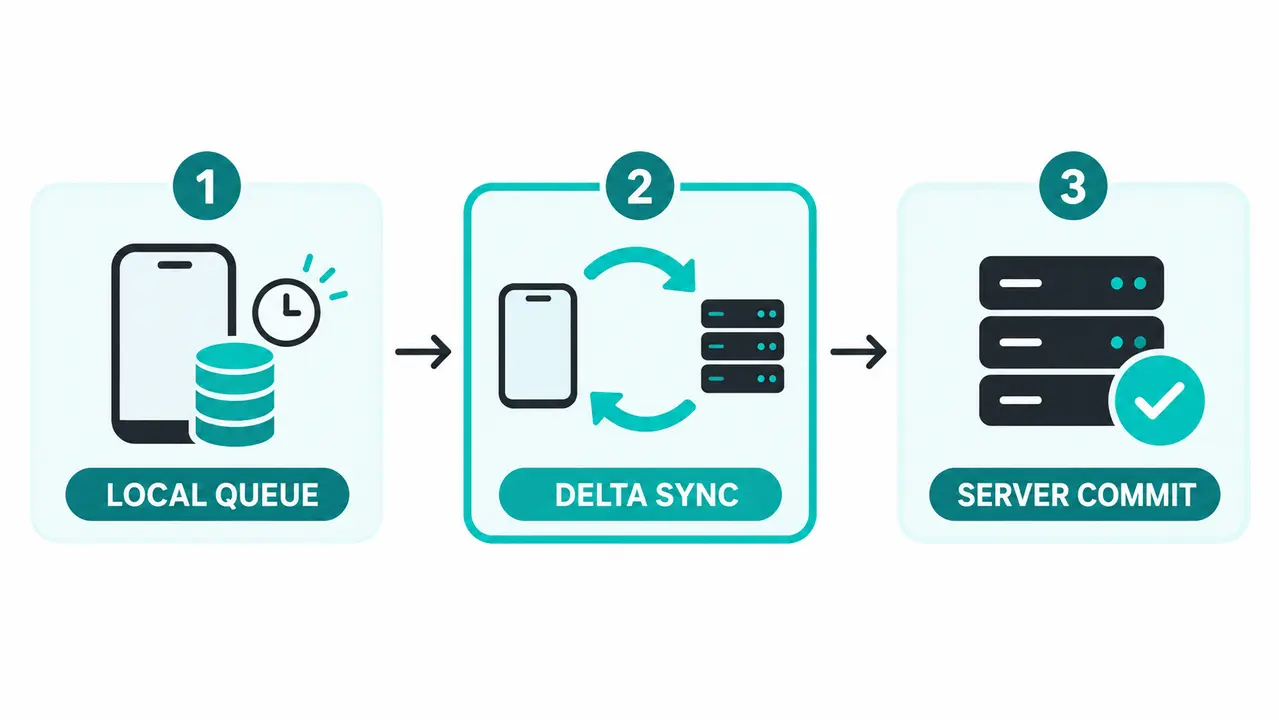
Mobile synchronization disintegrates when server APIs treat field devices like internal microservices. Office network assumptions crumble when field workers drive through remote valleys with packet loss and intermittent cellular handoffs. Naive clients facing dropouts retry large payloads aggressively, triggering cascading server traffic spikes that mimic a distributed denial of service attack. Your backend must treat network disruption, client timeouts, and partial payload delivery as standard operating conditions.
Traditional REST endpoints returning bloated JSON objects exhaust mobile battery and bandwidth budgets. Modern synchronization relies on delta endpoints that return only entity state changes since the client’s last sync cursor.
Backend patterns that survive field conditions
Build idempotent write endpoints accepting unique client mutation tokens to prevent duplicate record creation during retries. Replace aggressive background polling loops with lightweight WebSocket events or silent push notifications that signal available updates. Ensure backend reconciliation engines log both local device timestamps and final server commit times.
The facade layer that keeps mobile from coupling to legacy systems
Coupling a mobile client directly to legacy enterprise systems creates operational paralysis. When field apps query core mainframes or brittle enterprise resource planning databases without an intermediary, backend latency freezes mobile interfaces. Any minor schema adjustment in the core database forces an immediate emergency binary update through review queues. Legacy databases were designed for stable local networks rather than intermittent cellular connections. A dedicated facade layer isolates client engineering from backend debt.
Our engineering teams structure end-to-end software solutions by placing an API gateway between mobile clients and existing enterprise systems. The facade aggregates disparate endpoints, normalizes cryptic legacy errors, and strips unnecessary database fields before transmitting payloads over mobile networks. It handles token verification, response caching, and client rate limiting without polluting the underlying system of record.
Ownership boundaries for the facade layer
Clear technical boundaries prevent the integration facade from becoming an unmaintainable secondary monolith. Enforce these explicit responsibilities across mobile and backend teams during technical discovery.
| Architecture responsibility | Owned by facade layer | Owned by system of record |
|---|---|---|
| Protocol translation | Converts SOAP and XML to mobile JSON | Not applicable |
| Data validation | Validates basic request schema shapes | Enforces core enterprise business rules |
| Error handling | Normalizes stack traces into client codes | Generates raw database exception logs |
| Traffic management | Enforces client rate limits and caching | Manages database connection pools |
Data contracts that stop integration work from becoming endless rework
Integration velocity collapses when mobile developers build against shifting backend assumptions.
Undocumented object fields, inconsistent null value handling, and unpredictable pagination structures turn sprint reviews into debugging sessions. Without binding interface agreements, a routine backend database migration silently crashes mobile clients across your active user fleet. Enterprise mobile engineering requires a strict contract-first workflow where API specifications govern development across teams.
Mobile and backend leads must sign off on comprehensive OpenAPI specifications before either team writes functional code. These documents serve as living governance artifacts, defining exact property types and explicit backward compatibility windows. They eliminate speculative coding and clarify data boundaries.
Contract-first workflow
Generate automated mock servers directly from interface schemas on day one of development. Run consumer-driven contract tests inside your continuous integration pipelines to catch breaking payload alterations before pull requests merge into shared staging environments. This testing regime eliminates unexpected integration surprises during release stabilization.
Security architecture that survives real devices and real attackers
Treating mobile security as a pre-launch penetration testing checklist guarantees costly release delays. Enterprise mobile security requires comprehensive defense across device hardware, client sandboxes, and cloud APIs. To structure these defenses, engineering organizations align delivery with the Secure Software Development Framework from NIST, embedding vulnerability mitigation practices into daily development cycles. Zero trust principles dictate that mobile clients remain inherently untrusted execution environments.
Store authentication tokens and sensitive configuration exclusively within hardware-backed keychains and secure enclaves. Verify transport layers using deliberate certificate pinning policies while stripping private personal data from telemetry payloads before transmission. Device compromise detection signals must trigger immediate session revocation.
Third-party SDK governance and secrets handling
Never compile static API credentials or cryptographic private keys into application binaries. Audit all third-party analytics and utility libraries quarterly, verifying their network permissions and data collection boundaries against compliance requirements. Security represents a foundational architectural constraint rather than a final gate.
Release management is part of the product for enterprise mobile
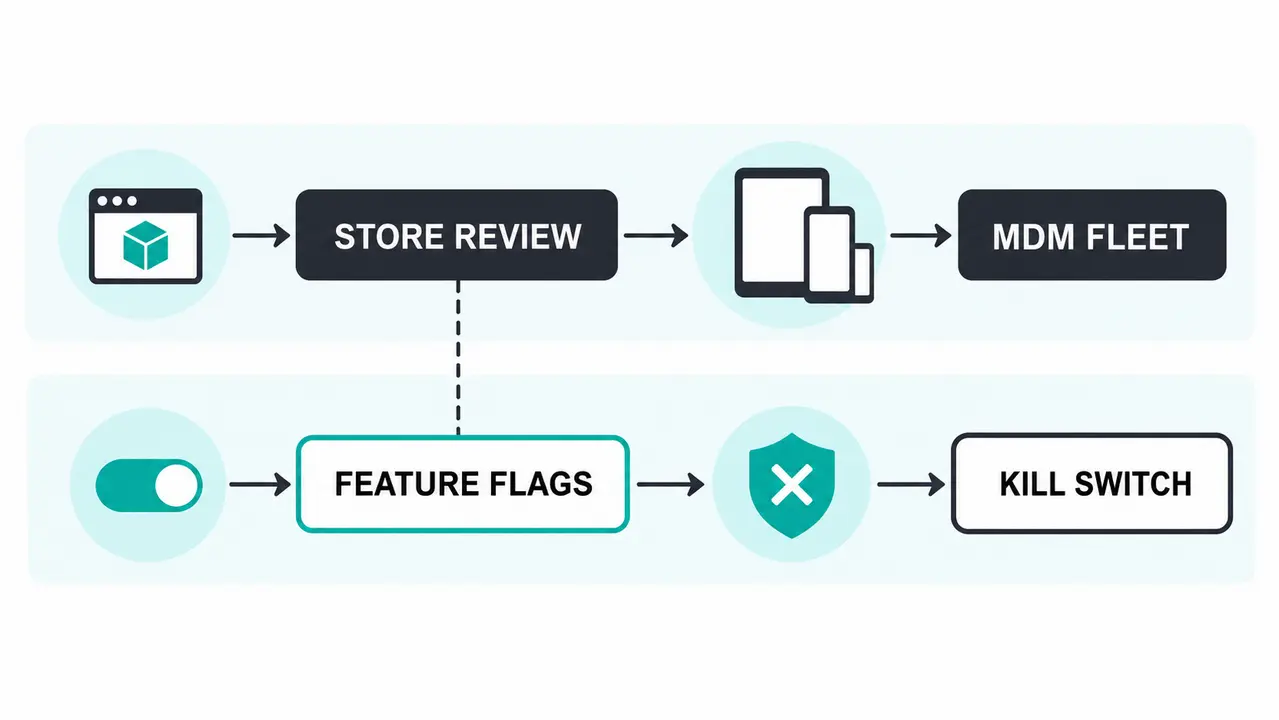
Shipping an enterprise mobile update differs fundamentally from deploying a cloud web service. You cannot simply roll back a corrupted database script or instantly deploy a patch to thousands of field devices. Public app store review queues, enterprise mobile device management distribution cycles, and regional network conditions introduce unavoidable deployment delays. When a critical defect halts field operations, waiting forty-eight hours for binary review creates immense business losses.
Modern enterprise mobility requires resilient operational release infrastructure. You must decouple code deployments from releases using remote runtime feature flags and centralized kill switches. This mechanism allows operators to isolate failing workflows without executing complex rollbacks.
Rollback and incident response planning
Maintain strict backward compatibility in your backend APIs for at least two prior client releases. Document unambiguous incident playbooks with assigned on-call escalation paths, ensuring technical leads can deactivate malfunctioning client modules instantly without issuing emergency binary builds. Staged percentage rollouts protect your operational fleet from widespread regressions.
Testing strategy that reflects device fragmentation and policy variance
Testing an enterprise application exclusively on commercial emulators or unmanaged developer phones exposes organizations to severe deployment risks. Defects in enterprise software rarely stem from simple user interface rendering bugs. They emerge when corporate mobile device management profiles restrict background network transfers, revoke camera permissions, or terminate processes in low-memory states. A small pool of physical devices enrolled in real compliance policies uncovers far more critical defects than hundreds of simulated unmanaged device profiles.
Balance automated testing with targeted exploratory verification. Unit tests validate local data manipulation and business rules, while integration suites verify contract compliance against mocked service endpoints. End-to-end automated smoke tests should run nightly on representative target hardware.
Test matrix dimensions that matter
Construct your physical test matrix around managed device states, fluctuating cellular bandwidth, and low disk capacity. Verify hardware peripheral interactions under authentic field conditions before certifying builds for staging. Real compliance policies surface regressions that synthetic environments miss.
Discovery deliverables that de-risk the first build phase
Skipping technical discovery in the name of agile speed is one of the costliest mistakes in enterprise software delivery.
Teams that rush into sprint execution before defining core integration boundaries quickly find themselves trapped in redesign cycles. Real discovery produces concrete technical artifacts that eliminate delivery unknowns before engineering begins. These deliverables include detailed operational workflow maps, comprehensive role permission matrices, and an explicit offline state specification.
You need a thin architectural blueprint illustrating identity federation, token flows, and gateway communication protocols. Every technical deliverable must resolve an architectural question that would otherwise block an active development sprint. Security teams can then review compliance postures before development starts.
Prioritized backlog tied to business workflows
Organize user stories around business capabilities rather than screen layouts or visual components. Sequence high-risk integration dependencies, authentication pathways, and offline conflict models into the earliest development sprints to validate architecture before scaling team headcount. Stakeholder alignment here protects your budget from expensive mid-project reversals.
Team topology that keeps mobile, backend, and platform work moving
Enterprise mobile initiatives stall when engineering teams operate in organizational silos. If mobile developers and backend engineers work under separate reporting chains without shared accountability, progress degenerates into finger-pointing. At Sentice, our dedicated software engineering teams work as integrated units where cross-functional leads solve integration challenges jointly. A single technical leader must own the end-to-end user journey from mobile interaction to backend database commit.
Clear ownership boundaries prevent costly integration stalemates. When both sides wait for the other to document API expectations, entire sprints vanish without functional progress. Collaborative discovery builds mutual respect across engineering disciplines.
Role boundaries and ownership
Assign clear technical ownership boundaries. The mobile lead governs client architecture and local caching models, while the backend lead directs API contracts and facade translation layers. Platform engineers manage delivery pipelines and enterprise distribution certificates, while the product owner drives business workflow acceptance criteria. Shared accountability across these roles keeps delivery velocity predictable.
Operating model decisions that shape delivery
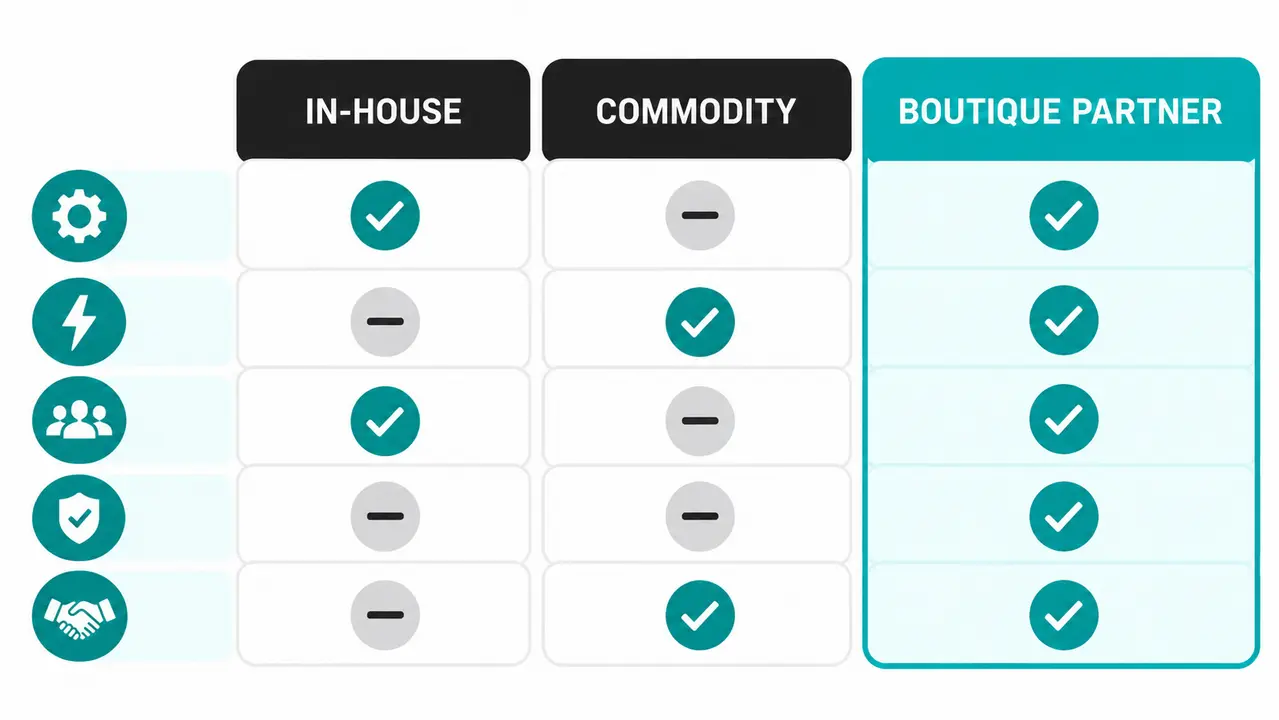
Selecting an operating model requires an honest evaluation of internal technical capabilities. Building entirely in-house grants organizational control, but teams without deep enterprise mobility experience spend quarters struggling with mobile device management wrappers and offline databases as well as identity brokers. Weighing in-house expansion and outsourcing helps technical leaders match capacity models to actual delivery constraints. Traditional commodity vendors often supply disconnected developers who lack architectural depth, while boutique engineering firms provide embedded specialists who integrate with your technical leadership.
Demand demonstrated expertise in enterprise authentication, legacy facade development, and automated testing infrastructure from potential partners. Insist on weekly working software demonstrations and unified code review standards. Choose an embedded partner when legacy complexity outpaces internal capacity, and reserve in-house hiring for long-term operational maintenance. Matching the operating model to your technical gap protects your delivery schedule. Ideological preference should never override the practical reality of execution speed.
Scoping the seams before the first sprint
When legacy complexity outpaces internal capacity, an embedded engineering team can carry the integration seams alongside your own technical leadership, from identity federation and facade design to offline synchronization and contract testing. Tell us what your roadmap demands and we will scope it with you.
Frequently asked questions
Should we build or buy an enterprise mobile app?
Building custom software makes sense when operational workflows are proprietary, integration depth is extensive, or fine-grained user experience control drives business value. Commercial off-the-shelf software suits commoditized administrative workflows where standard capabilities satisfy eighty percent of requirements. Custom architecture ensures full ownership of your data contracts and strategic roadmap.
What timeline should we plan for an enterprise mobile app MVP?
A focused minimum viable product with enterprise authentication, one primary workflow, and dependable offline synchronization typically requires three to four months of engineering. The preceding discovery phase requires four to six weeks to establish API contracts, security approvals, and device management parameters. Rushing discovery often stretches downstream development timelines.
How do you handle BYOD without compromising enterprise security?
Mobile application management establishes an encrypted sandbox that isolates corporate assets from personal applications on employee-owned devices. Administrators enforce data loss prevention controls and execute selective corporate wipes without viewing personal files. Conditional access rules continually evaluate device compliance signals before permitting tokens to query enterprise backends.
What metrics signal a healthy enterprise mobile app after launch?
Maintain a crash-free session rate above 99.5 percent while tracking downward trajectories in data synchronization conflicts. Monitor user task completion duration to validate that field interfaces streamline operational routines. Falling support ticket volumes per active user confirm that authentication lifecycles and connectivity transitions operate without user disruption.
Can low-code platforms handle enterprise mobile requirements?
Low-code platforms accommodate basic internal database lookups and simple administrative entry forms. They fail when workflows demand sophisticated offline synchronization, specialized peripheral connectivity, or custom identity broker federation. Evaluate your required hardware access and data reconciliation depth before accepting low-code architectural constraints.
The seams are the roadmap
The teams that stall at enterprise rollout are the ones that treated mobile development as a user interface project and skipped the seam work. Technical discovery takes weeks, but skipping it costs quarters of emergency refactoring and wasted engineering spend. Have your security leads sign off on an architectural discovery package that defines identity flows, integration contracts, and device management policies before you greenlight your next build phase. If your security team audited your mobile architecture plan today, what critical operational requirement would they uncover that is missing from your documentation?
About Sentice

Sentice is a boutique software engineering partner founded in 2013 by Roni Levi and Martin Petkovic, now headquartered in Skopje, North Macedonia. Rather than supplying individual developers, we build embedded teams that blend with a client’s culture, tech stack and goals, working together from a single office under our own technical leadership. We deliver dedicated software engineering teams, end-to-end software solutions, product development, and system and embedded engineering, and we act as technical advisors across the full development lifecycle, from specification and architecture through development, testing and support. We use AI coding tools across every project, and we help clients integrate AI into their own products through chatbots, MCP services, connected application layers and workflow automation. Some of the clients we started with more than a decade ago are still building with us today.
Email us at info@sentice.com or call +389 70 307 837.