
Week four of your build. The demo works, the stakeholder demo went well, and now the first change request lands. Your engineer opens the codebase and realizes that the workflow logic, the UI state, and the data access all live in the same module, and touching any of it risks breaking the whole thing. Iteration stops. This is the moment most startup MVP efforts quietly die, not at the idea stage and not at the funding stage, but at the fourth or fifth change request.
You are about to make three risk decisions at once. Market risk, execution risk, and architecture risk. MVP development services are worth buying only if they help you manage all three simultaneously, because optimizing for speed alone produces a startup MVP you cannot safely change. We have inherited enough of those codebases to know.
Below, we unpack the three risks, separate prototypes from proofs of concept from MVPs, show what a production-ready minimum actually includes, and outline the engagement model and pre-contract checks that keep your learning loop alive.
Reading time: 12 min
Key points
- An MVP is a portfolio of risks, market, execution and architecture, not just a scope decision.
- Minimum modifies the learning, not the engineering: cut scope until only the hypothesis test remains.
- A production-ready MVP needs logging, metrics, alerting and feature flags from day one, not added later.
- An embedded dedicated team typically preserves iteration speed better than fixed-scope project delivery.
Table of contents
The decision to build an MVP is a risk decision
Most teams treat an MVP as a scope decision. It is better understood as a portfolio of risks you are choosing which ones to retire first. Market risk asks whether anyone wants this. Execution risk asks whether your team can ship it in the window you have. Architecture risk asks whether what you ship can survive the next ten changes. Buying MVP development services is really buying learning speed with a credible technical foundation attached, and the two have to arrive together.
Consider a B2B workflow tool where the primary unknown is who approves what, not how polished the interface is. Your riskiest assumption is the approval chain, so your first release should stress workflow logic and instrumentation, not pixel refinement. Teams that simply ship fast, with no structural discipline behind the speed, end up with codebases they cannot safely modify after week four. Every new insight from users becomes a rewrite. The learning loop you paid for stalls at the exact moment it should accelerate.
Minimum viable product means minimum for learning not minimum for engineering
A minimum viable product is the smallest release that validates one specific hypothesis with real users, with measurable instrumentation built in before launch. The word minimum modifies the learning, not the engineering. You cut scope until only the hypothesis test remains, and you spend engineering effort on the parts that make the test trustworthy.
Before any code is written, define one hypothesis and one success metric. Activation rate, week-four retention, or time-to-value for the first five design partners. Pick one. A team that cannot state its success metric in a single sentence does not have an MVP plan, it has a feature list.
Internal tools are the counter-case worth naming. There, validation is measured by operational adoption and workflow compliance, not revenue. If the operations team abandons the old spreadsheet within a month and the audit trail stays complete, the hypothesis is validated. Same discipline, different instrument.
Where teams confuse prototypes proofs of concept and MVPs
Three artifacts get called the same thing and destroy budgets as a result. A proof of concept reduces technical uncertainty, usually for a technical audience. A prototype reduces workflow uncertainty, usually for stakeholders or test users. A startup MVP reduces market uncertainty through real usage by people who did not build it. Treating a prototype as an MVP is how teams end up demoing a startup MVP that collapses under the first real user load, because it was never built with proper data handling, error states, or concurrency in mind.
Keep expectations aligned with a simple decision table.
| Artifact | Audience | Reduces uncertainty in | Success criteria |
|---|---|---|---|
| Proof of concept | Engineering leadership | Technical feasibility | Named risk proven or disproven |
| Prototype | Stakeholders, test users | Workflow and usability | Users complete the flow without help |
| MVP | Paying or committed users | Market demand | Success metric hits threshold |
The verdict is simple. If your success criteria reference stakeholder reactions rather than user behavior, you are building a prototype. Budget it as one.
MVP development services that technical leaders actually buy
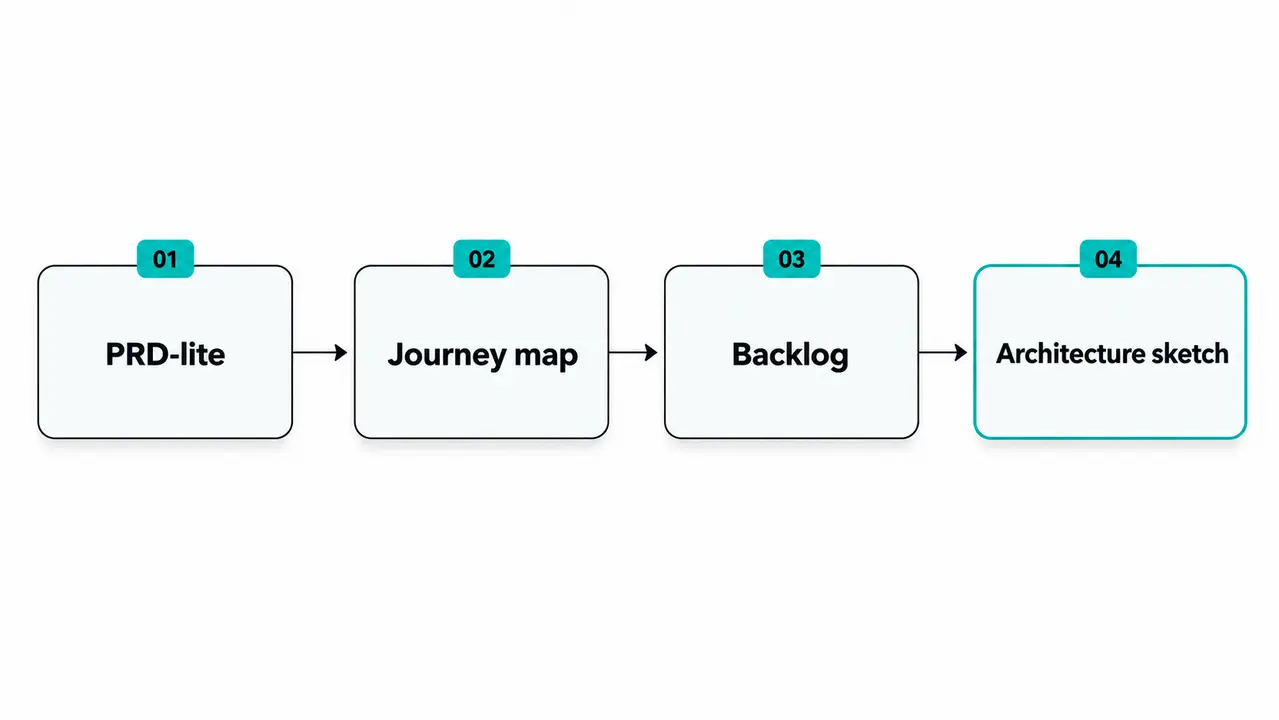
Technical buyers do not pay for code. They pay for a repeatable delivery system that produces trustworthy learning. That system has visible parts. Discovery artifacts that survive the first scope conversation. Senior engineering judgment applied to the architecture before the first sprint. A team that plugs into your existing practices, your standups, your code review standards, instead of running a parallel process you have to translate.
Ask for named artifacts and reject anything vaguer. A PRD-lite of five to eight pages. A user journey map. A backlog where every ticket carries acceptance criteria. A basic architecture sketch showing the domain boundaries and the deployment path. If a vendor cannot produce these before the contract, they will not produce them during delivery.
The failure mode here is throwaway code delivered as a foundation. Six weeks later you discover the codebase cannot accept a second user role without a rewrite. When you need a partner that owns this end-to-end, from discovery through handover, our product development work is structured around exactly that continuity. MVP development services are worth the invoice only when the code they ship is the code you keep.
The scoping workshop is where most MVPs are won or lost
Discovery that ends in a slide deck is not discovery. It has to end with a testable scope and written acceptance criteria, so engineering can execute for weeks without constant reinterpretation. The instrument that produces this is unglamorous. One or two workshops of two to three hours each, with your product lead and an engineering lead both in the room, working through the hero flow and, just as important, the non-goals.
Non-goals are the cheapest scope protection you will ever get. “Single tenant, no roles, no reporting export, no mobile” written on one page saves you three weeks of negotiation later. Product validation starts in that workshop, because the scope you define determines which hypothesis you can actually test.
Skip it and you get the conversation every technical leader recognizes. Week six, someone says “we thought that was included”, and your fixed timeline becomes an open-ended negotiation loop. The workshop is where that sentence gets pre-empted, item by item.
Validation planning needs to be designed into the backlog
Product validation is not a phase that happens after the build. It is a set of planned experiments that live in the backlog alongside the features, each with its own instrumentation ticket and its own user recruitment task. If your backlog has feature epics and no experiment epics, you are building blind.
Use an experiment card for each epic. Four fields, one page. The hypothesis. The target segment. The success signal, expressed as a number you can read from your analytics. And an explicit stop rule, the condition under which you kill the feature rather than iterate on it. Teams that write stop rules make faster kill decisions, because the decision was made before emotional attachment formed.
Regulated and safety-sensitive domains need a different path. You often cannot run public A/B tests on medical or financial workflows, so experiments get simulated with synthetic data or run through design partners under NDA. The discipline is identical. The channel changes.
What a production-ready MVP includes even when scope is tight
Tight scope does not excuse missing guardrails. A production-ready MVP carries logging, basic metrics, alerting, feature flags, and an audit-light event trail from day one. These are not scale features. They are the instruments that make your validation data trustworthy and your deploys reversible. The 2022 Accelerate State of DevOps Report documents the link between observability, continuous delivery, and team performance, based on research across 33,000 professionals (dora.dev).
The teams that plan to “add analytics later” are the teams whose week-one outage destroys early user trust, because they had no alerting and no way to diagnose what happened. Sentry for errors, a metrics dashboard in Grafana, a PagerDuty escalation path, feature flags behind every risky change. That is a two-day setup that protects the entire learning phase.
Security hygiene belongs in the same category. Hashed passwords, least-privilege access, secrets outside the repository. None of it adds a week. All of it prevents the kind of incident that ends a pilot conversation permanently.
The fastest MVP teams separate product code from experiments
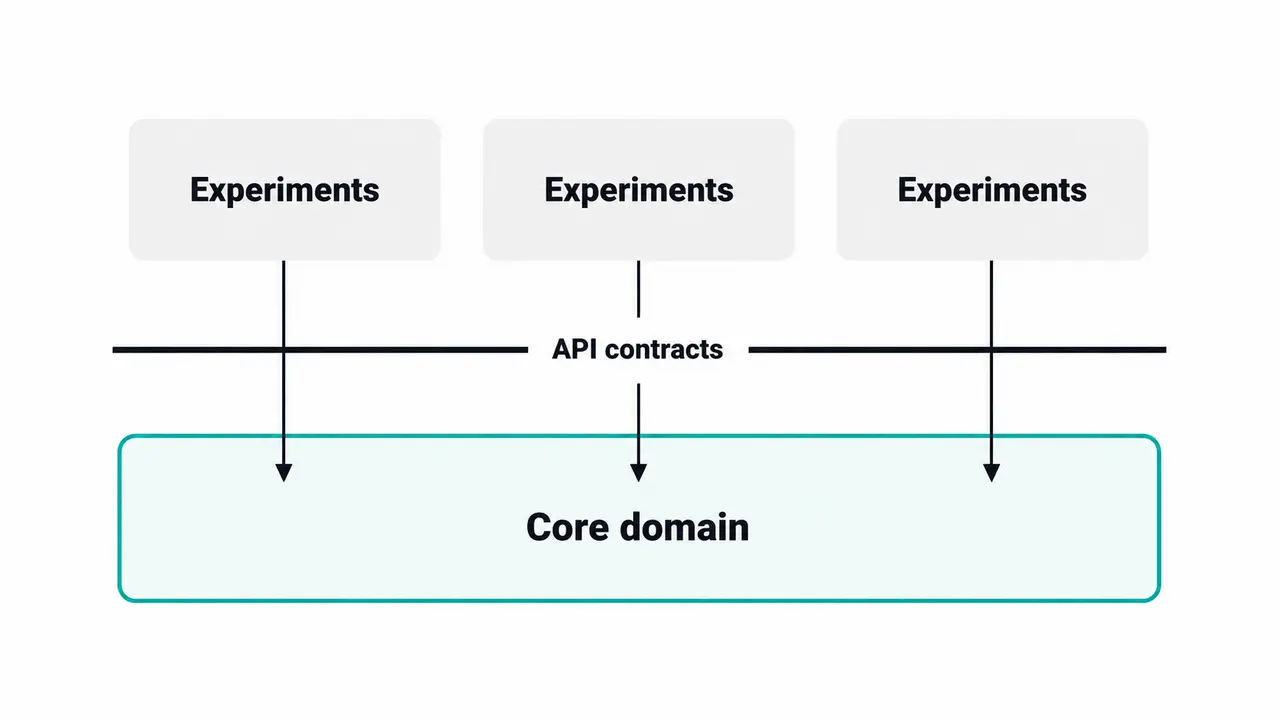
Speed in an MVP does not come from cutting corners. It comes from isolating change. Keep the core domain model stable while allowing rapid iteration in the user interface, the messaging, and the onboarding steps, the places where you expect to be wrong. Modular boundaries and explicit API contracts are what make this possible. Your order state machine stays stable while you run four different experiments on how users create an order.
Teams that skip this separation watch technical debt compound quietly. By week ten the team fears touching the codebase, every estimate balloons, and the iteration speed that justified the MVP disappears. The fix is architectural, not motivational.
Designing the hero workflow as a vertical slice
Choose one end-to-end path that proves value and build it as a vertical slice through every layer, from UI to persistence. A horizontal build, where you finish the data layer then the API then the frontend, defers integration realities to the end and hides the failures you most need to see early. The vertical slice forces the authentication, the data model, the deployment, and the error handling to work together in week two rather than week eight.
Choosing a tech stack that will not force a rewrite at traction
Stack selection for a minimum viable product is an elimination exercise, not an exploration. Reject anything your team cannot operate reliably at 2 AM. Reject anything chosen for novelty or for scale assumptions you have not earned. A stack that needs a dedicated platform engineer before your tenth customer is a liability dressed as ambition.
Run the decision through a checklist of five dimensions. Team familiarity, because ramp time is your scarcest resource. Hosting maturity. Observability tooling that works out of the box. The testing story. And the integration ecosystem, because B2B products live or die on API and webhook support. Node.js with PostgreSQL, or Python with Django, pass all five for most workflow products. So does Golang when your team already thinks in it.
The failure mode is the rewrite after first pilots. The foundation cannot support B2B requirements like roles, permissions, and audit trails, and traction arrives as a forced migration instead of a celebration. Choose for evolvability and the question never comes up.
How no-code and low-code fit into a serious MVP plan
No-code tools earn their place when product risk is high and technical risk is low. You need to learn whether the workflow resonates, and the workflow does not require custom algorithms to test. Airtable with an interface layer, or a workflow platform with forms and automations, can validate demand signals in days.
Watch for the decision triggers that force a move to custom code. Integration depth, when you need to push events into customer systems. Data model complexity, when your entities stop fitting into flat tables. Permissioning, when “who sees what” becomes multi-dimensional. Each trigger crossed moves you closer to a rewrite.
The verdict. No-code is weaker for MVPs that must become the production base of a complex B2B product, and stronger for early demand validation and internal process trials. If the artifact you are building is the product you will still be operating in year two, build it in code from the start.
Embedded and IoT MVPs fail when software and hardware timelines are treated as separate
An IoT MVP has four clocks running at once. Firmware, cloud, manufacturing constraints, and field testing, each on a different cadence, all of them needing to converge before validation data means anything. Treat them as separate projects and you ship devices that cannot report what happened to them, which makes field validation impossible. The hardware works, the software works, and you still learn nothing.
Before any hardware reaches a user, four artifacts must exist. A bring-up plan for each board revision. A test harness that runs the firmware against simulated sensors. A telemetry schema, versioned, so cloud parsing does not break across firmware updates. And an over-the-air update strategy, because a field bug you cannot patch is a field bug you ship permanently.
When a project requires this kind of hardware and software alignment, our system and embedded engineering practice exists for exactly that intersection. The sequencing discipline matters more than the individual skills.
Field telemetry as a validation tool
Log events, not raw sensor streams. A battery voltage reading every second produces noise you will never analyze, while a “battery below threshold” event with a timestamp and device ID produces a decision. Sample sensor data on a schedule, aggregate on the device where you can, and track calibration drift against a known baseline so you can distinguish sensor error from genuine behavior change. Telemetry you cannot act on is overhead.
The week a senior leaves mid-build is when process shows up
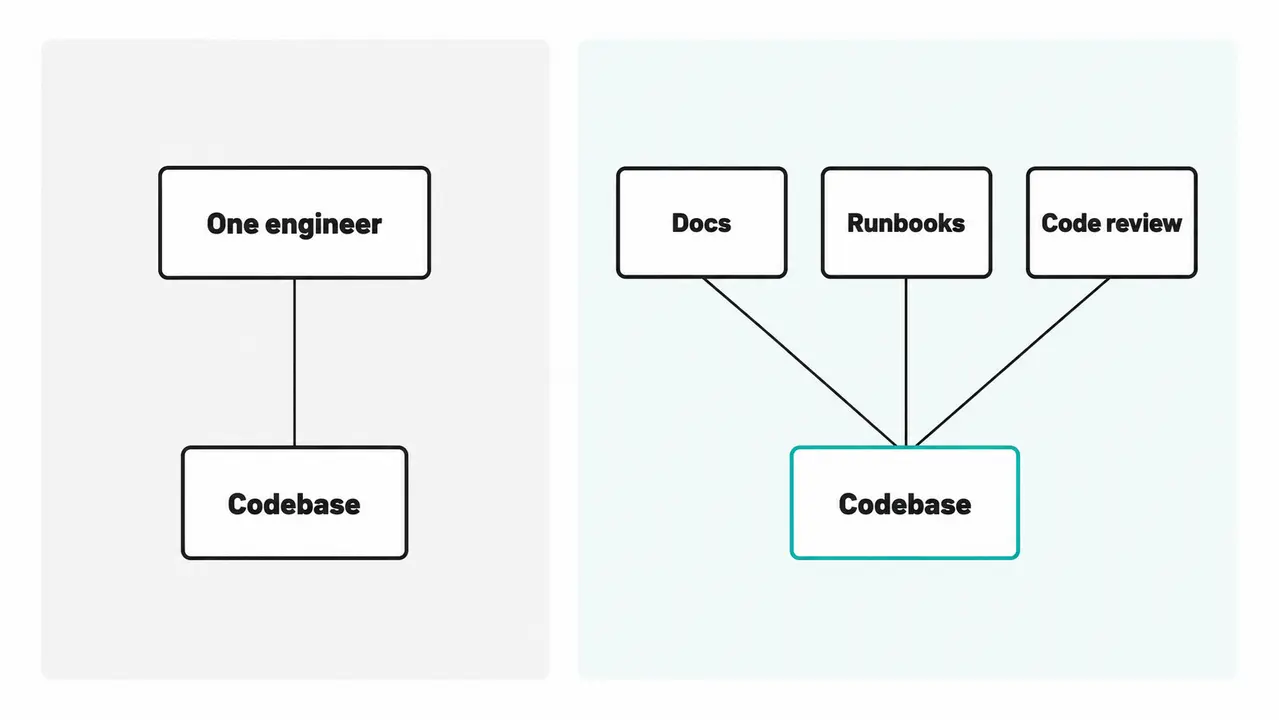
Every MVP plan assumes the team that starts it finishes it. People leave, rotate, get pulled into escalations. The startup MVP that stalls immediately after launch because its key developer departed was fragile long before the departure. Process is what you had instead of luck, and you find out which one you had in exactly that week.
Define “done” to include docs, runbooks, and test coverage on the critical paths, and a new engineer can onboard in two days instead of two weeks. A README that explains local setup. A runbook for the deploy pipeline. Integration tests on the hero flow. None of this is bureaucratic. It is the difference between a staffing change being an inconvenience and being an existential event.
Code review discipline serves the same purpose. When every merge has a second reader, knowledge exists in at least two heads, and the bus factor stops being one.
Engagement models that work for MVP delivery
Whatever model you choose, accountability has to be explicit. Who owns product decisions, who owns technical decisions, and how scope changes get handled, written down before the first sprint. Ambiguity in those three questions converts directly into delay.
Three models dominate. A dedicated team embedded with your rituals, joining your standups and your planning. Project-based delivery with fixed scope, where the vendor owns the whole execution. And a hybrid, discovery first with one team, build with another. Each has a real profile of tradeoffs, and the comparison deserves its own treatment.
For technical decision-makers who can provide weekly product input, our verdict is firm. An embedded dedicated software engineering teams model is typically stronger, because it preserves iteration speed and keeps context inside the team rather than in documents passed between organizations. When the market tells you something surprising on a Tuesday, an embedded team can act on it Wednesday.
How the three engagement models compare
Choose the model that keeps feedback cycles short without creating decision bottlenecks. The tradeoffs become clear once you map them side by side.
| Dimension | Embedded dedicated team | Fixed-scope project | Discovery then build |
|---|---|---|---|
| Client control | High, weekly input | Low, milestone reviews | High in phase one, low in phase two |
| Vendor accountability | Shared with client | Concentrated in vendor | Split across phases |
| Change handling | Continuous, backlog based | Formal change requests | Locked after discovery |
| Best fit | Founders with weekly availability | Fixed budget, stable requirements | Unclear product direction |
The failure mode to avoid is forcing a founder-led product with limited time into a rigid cadence. If your vendor needs a decision and you are in customer meetings all week, every cycle stalls on you. MVP development services should be structured around your actual availability, not the vendor’s ideal process.
What to ask for before you sign
Before signing, demand the artifacts and the operating rhythm that prove the team can scope, ship, measure, and hand over the product without drama. A sample backlog with acceptance criteria on every ticket. An architecture sketch with the domain boundaries drawn. A release plan with named checkpoints. A QA approach that says who tests what and when. Deployment ownership, stated plainly. And an incident handling protocol, because something will break and you want to know the escalation path before it does.
A vendor that hesitates on any of these will hesitate during delivery too. The conversation before the contract is the cheapest simulation of the partnership you will ever get. Run it deliberately.
Reject black box delivery outright. If you cannot assess progress until the final handover meeting, you have surrendered the one control that matters most in a minimum viable product effort, the ability to redirect before the learning window closes.
Scope your MVP before you commit
Bring us your hypothesis and your riskiest assumption, and we will pressure-test the scope, the stack and the validation plan in one conversation.
Signals that an MVP partner will slow you down
The two biggest red flags are process theater and shallow discovery. Lots of slides, few decisions. Unclear ownership, with product and technical responsibility blurred across roles. A definition of done that mentions deliverables and never mentions learning. These patterns are visible in the first two weeks if you look.
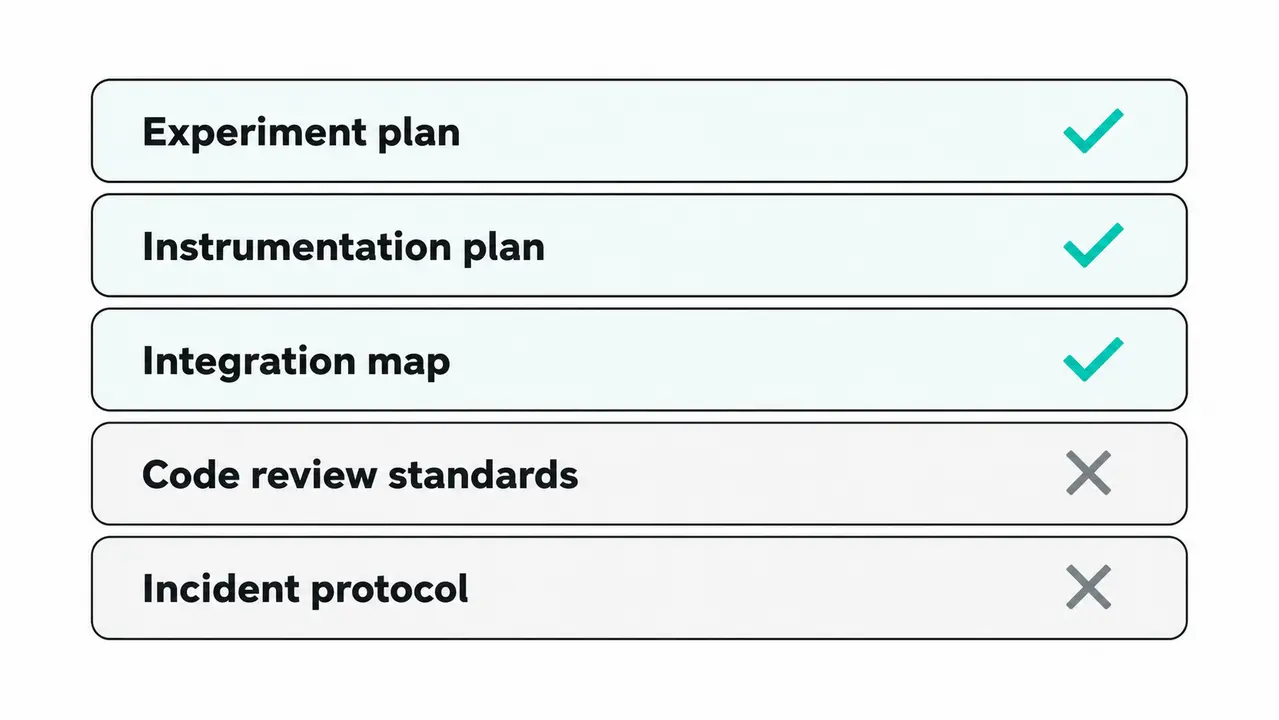
Look for missing artifacts. No experiment plan. No instrumentation plan. No integration map showing which external systems the MVP touches. No code review standards, no staging environment, no incident protocol. Each absence predicts a specific future delay, and the pattern of absences tells you how the team actually works.
Our verdict. A partner unable to describe how learning is measured is weaker for MVP work than one that can detail its first two experiments on a whiteboard. That is the standard we hold ourselves to at Sentice, measurable learning over process theater, because an MVP that ships on time and teaches you nothing has failed at its only job.
Turning MVP results into a roadmap without locking into bad assumptions
Two to four weeks after launch, sit down with the data and conduct a decision review. Not a status meeting. A written learning summary, one page, answering three questions. What did we learn. What does it change. What are we doing about it in the next two sprints. The output is decisions about what to double down on, what to cut, and what to rebuild before scaling.
The failure mode is scaling a leaky funnel and calling it growth. Acquisition numbers look strong, so the team adds marketing spend, while activation and retention quietly say the product does not deliver value yet. The World Bank’s Digital Progress and Trends Report 2025 makes the same argument at the national level, that digital foundations must be strengthened before scaling AI and technology initiatives (documents1.worldbank.org). The principle scales down to your roadmap. Fix the foundation the data points at, then scale.
Write the learning summary before the roadmap. A roadmap built on unexamined assumptions is just the old plan with new dates.
Frequently asked questions
How do you define MVP success metrics for B2B products?
Anchor the metric to the buying process, not the login. Time-to-value for the first workflow completion, weekly active seats against licensed seats, and workflow compliance rate are the three that hold up best. Revenue lags all of them by months in B2B, so treat it as a lagging confirmation rather than your primary signal.
What deliverables should I expect at handover so my team can continue?
A repository with a working CI pipeline, infrastructure definitions in Terraform or equivalent, runbooks for deploy and incident response, API documentation, and a backlog annotated with what was validated and what was not. Add a two-week overlap period where the original engineers answer questions while your team ships a real change. Handover without overlap is a document dump.
How do we handle security and compliance in an MVP without slowing down?
Separate the non-negotiables from the deferrals. Non-negotiables from day one include encryption in transit and at rest, secrets management, least-privilege access, and audit logging on authentication events. Deferrals, decided explicitly and written down, might include SOC 2 certification or full data residency controls. The deferral list is a risk acceptance your leadership signs, not an omission.
What is the typical timeline for a startup MVP before we see real user data?
For a B2B workflow product with a focused scope, plan on eight to twelve weeks to first real usage, with instrumentation live from the first deploy so you collect data from pilot users in week two rather than week twelve. Add two to four weeks if you need design partners recruited before launch. Anything promising meaningful user data in under six weeks usually means the instrumentation was skipped.
How do I run user testing if I do not have traffic yet?
Recruit manually rather than waiting for organic traffic. Ten design partners sourced from your network, your investors’ portfolios, or targeted outreach in the communities where your users already gather will outperform any amount of passive analytics. Run moderated sessions weekly, watch the same hero flow each time, and count where users hesitate. Five sessions per iteration cycle is enough to spot the pattern.
Does outsourcing an MVP mainly save on cost?
Cost does drive a lot of sourcing decisions. Eurostat reports that 34.1% of enterprises that sourced business functions abroad in 2021 to 2023 cited reducing labor costs as a main motivation, and ICT services were the most frequently sourced function at 28.7% (ec.europa.eu). For startups, scope discipline is the real driver. A partner that forces a testable scope saves you more than any rate difference, because the expensive failure in MVP work is building the wrong thing well.
Next steps after your validation sprint
Decide now whether your current architecture supports the scaling phase or whether you need a targeted refactoring sprint before the next feature push. Weigh the cost of pausing feature development for two or three weeks against the risk of accumulating technical debt your team cannot manage under load. Look back at the risk profile you identified before building, and check whether market reality matched your assumptions. Are you prepared to pivot your roadmap based on the actual behavior of your first users?
Turn your results into the next build
Tell us what your first users did, and we will help you decide what to double down on, cut, or rebuild before you scale.
About Sentice

Sentice is a boutique software engineering partner founded in 2013 by Roni Levi and Martin Petkovic, now headquartered in Skopje, North Macedonia. Rather than supplying individual developers, we build embedded teams that blend with a client’s culture, tech stack and goals, working together from a single office under our own technical leadership. We deliver dedicated software engineering teams, end-to-end software solutions, product development, and system and embedded engineering, and we act as technical advisors across the full development lifecycle, from specification and architecture through development, testing and support. We use AI coding tools across every project, and we help clients integrate AI into their own products through chatbots, MCP services, connected application layers and workflow automation. Some of the clients we started with more than a decade ago are still building with us today.