
A spreadsheet lands on your desk with three vendor bids for your mobile roadmap, differing by four hundred engineering days for the exact same wireframe deck. You review the feature lists and see identical line items for authentication, push notifications, and payment processing. None of the proposals specify API error handling, device matrix limits, or offline synchronization behavior. One vendor assumes your backend engineers will write all endpoints by sprint two, while another assumes third-party mock services will carry the frontend past user testing.
Mobile scope variance is rarely about developer typing speed or hourly rates. It stems from conflicting engineering assumptions about system architecture, non-functional requirements, and the true definition of done. This guide establishes a technical framework to evaluate mobile development investments strictly through scope, architectural complexity, and engineering capacity.
Below we’ll unpack the inputs that shape your mobile budget before anyone writes code and the estimation artifacts that make vendor proposals comparable, along with the delivery models that keep scope and quality under your control.
Reading time: 12 min
Key points
- Scope variance between mobile proposals comes from conflicting engineering assumptions about architecture and non-functional requirements as well as the definition of done, not from typing speed.
- Discovery artifacts such as user flow maps and domain models, along with API inventories and risk registers, turn assumptions into verifiable deliverables before development starts.
- A defensible estimate pairs every epic with concrete assumptions, testable acceptance criteria, and a documented definition of done covering error states and accessibility.
- Capacity-based delivery with an embedded team preserves architectural continuity from discovery through post-launch stabilization.
Table of contents
Why mobile development estimates are an engineering problem
Evaluating mobile app development cost by comparing headline estimates produces an immediate blind spot. Engineering hours reflect assumptions about architectural maturity, user edge cases, and post-release support rather than fixed market pricing.
When a proposal presents a low total effort, ask what technical responsibilities it quietly pushes back to your internal team. Incomplete estimates routinely ignore test automation, staging environments, and production store submission cycles.
An actionable estimate pairs every feature epic with concrete assumptions, known technical constraints, and testable acceptance criteria. Without documented acceptance boundaries, a two-week sprint on user profiles can expand into six weeks of custom image caching and session handling.
Treat your initial app investment as a baseline hypothesis that requires validation through engineering discovery. You are buying team focus and the capacity to solve domain problems, not purchasing packaged software off a shelf.
The inputs that determine your development budget before anyone writes code
The shape of your development budget forms long before engineers open their IDEs. Five core inputs dictate early engineering effort. Platform strategy and feature surface area come first, followed by backend integration maturity and security compliance, with architectural uncertainty on top.
Documenting user roles, authorization boundaries, and third-party dependencies establishes the baseline scope required for credible planning. If an app requires fine-grained tenant permissions alongside localized data residency, the underlying domain logic expands significantly.
An internal prototype targeted at a single device fleet can be scoped purely from visual interface mockups. That shortcut collapses for consumer applications facing millions of untrusted clients across unpredictable cellular networks.
Production mobile software demands rigorous state management, offline persistence models, and structured token refresh mechanics. Teams that gloss over these technical prerequisites draft delivery budgets based on graphic design rather than software engineering reality.
Discovery work removes ambiguity before it becomes rework
Discovery is software engineering work disguised as planning. Skipping this phase does not save delivery time because unresolved questions merely travel downstream into active development sprints where code modifications cost far more.
A product brief that states your app will integrate payments looks straightforward on paper. In execution, that single bullet requires selecting a gateway SDK and implementing server webhook listeners. The team must also handle network timeouts and build refund reconciliation flows.
Demanding structured engineering artifacts before development turns assumptions into verifiable deliverables. Your team needs a detailed user flow map, a validated domain model, and an inventory of third-party APIs alongside a technical risk register.
These documents provide the technical boundary conditions that keep your mobile sprints focused on execution rather than speculative design meetings. Discovery establishes whether your planned architecture can actually deliver your business requirements.
Feature scope that looks small but explodes implementation effort
Features in a mobile application multiply system complexity rather than adding to it linearly. A product backlog with ten simple interactions can trigger hundreds of concurrent state permutations across background sync cycles, device rotation, and network drops.
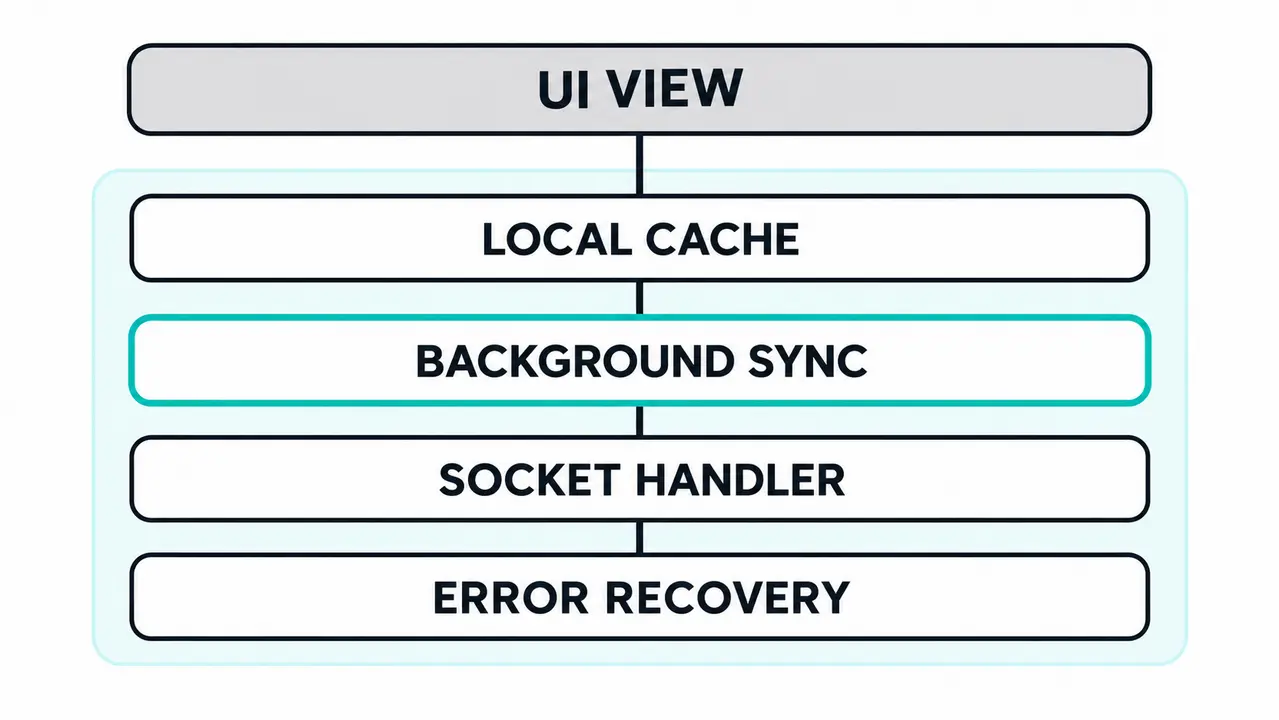
Consider in-app messaging. Building a basic conversation view requires local database caching and optimistic UI updates alongside image compression pipelines. It also demands push notification deep links and socket reconnection routines.
Prevent scope explosions by enforcing a strict definition of done for every user story before estimation begins. That definition must cover error states and empty views as well as screen reader accessibility, dynamic font scaling, and multi-language strings.
Teams that specify only the happy path inevitably ship an unhardened release that fails under real user loads. The resulting stream of emergency crash fixes and hotfixes consumes engineering capacity that was earmarked for subsequent roadmap milestones.
Platform strategy decisions that change the delivery plan
Platform decisions reach far beyond choosing between native Swift and cross-platform frameworks like Flutter or React Native. Your operational strategy must define which operating system versions and tablet form factors you support, how you handle background execution limits, and how your app store deployment pipelines run.
Maintaining separate native repositories for iOS and Android guarantees complete control over platform-specific UI paradigms and hardware access. That independence doubles your API integration effort and requires running two parallel release workflows for every minor update.
Cross-platform toolchains compress shared business logic and UI views into a unified codebase. They still demand native bridges for Bluetooth peripherals, background geolocation tracking, or complex cryptographic storage.
Early choices regarding device coverage directly reshape your entire product development lifecycle. Testing against eight Android manufacturer skins requires different test infrastructure than targeting three modern iPhone form factors.
Backend integrations drive the hidden center of app investment
Production mobile applications function primarily as distributed presentation layers for complex cloud services. The user interface represents only the surface of the build effort, while backend integration architecture absorbs the true core of engineering time.
Before sizing client-side screens, verify the readiness of your API contracts. Engineers must document payload structures and rate limits for every client endpoint, together with pagination standards and idempotency keys as well as server-driven error formats.
When backend teams deliver unstable or poorly documented endpoints mid-sprint, mobile developers spend their days writing throwaway mock services and debugging parsing errors. This mismatch stalls your delivery velocity and forces expensive client refactoring when server schemas change without warning.
Building internal administrative panels, audit logging, and bulk data synchronization tools adds another layer of unavoidable backend work. A mobile application cannot scale smoothly without disciplined backend architecture supporting its data layer.
Data security and privacy requirements reshape architectural scope
Application security cannot function as an optional checklist appended to the final deployment sprint. Security controls and privacy boundaries are fundamental architectural patterns that alter how your team writes local storage routines, logs network payloads, and manages authentication state.
Handling sensitive customer data requires hardware-backed keystores on Android and Keychain services on iOS rather than basic local storage files. Network layers need certificate pinning, token rotation routines, and encrypted database engines like SQLCipher for data at rest.
We follow NIST recommendations from the Secure Software Development Framework Version 1.1 to reduce vulnerabilities across the entire engineering cycle.
Overlooking security requirements creates severe compliance hazards when third-party analytics libraries inadvertently capture personally identifiable information. Remedying architectural privacy flaws after release requires deep structural rewrites of your networking stack and persistent data models.
QA and device coverage targets where optimistic estimates fail
Mobile quality assurance extends far beyond confirming that buttons trigger intended screen transitions. Testing must account for intermittent cellular connections and low-memory terminations by the operating system, as well as push notification payloads that arrive while the app is suspended and the full range of screen geometries.
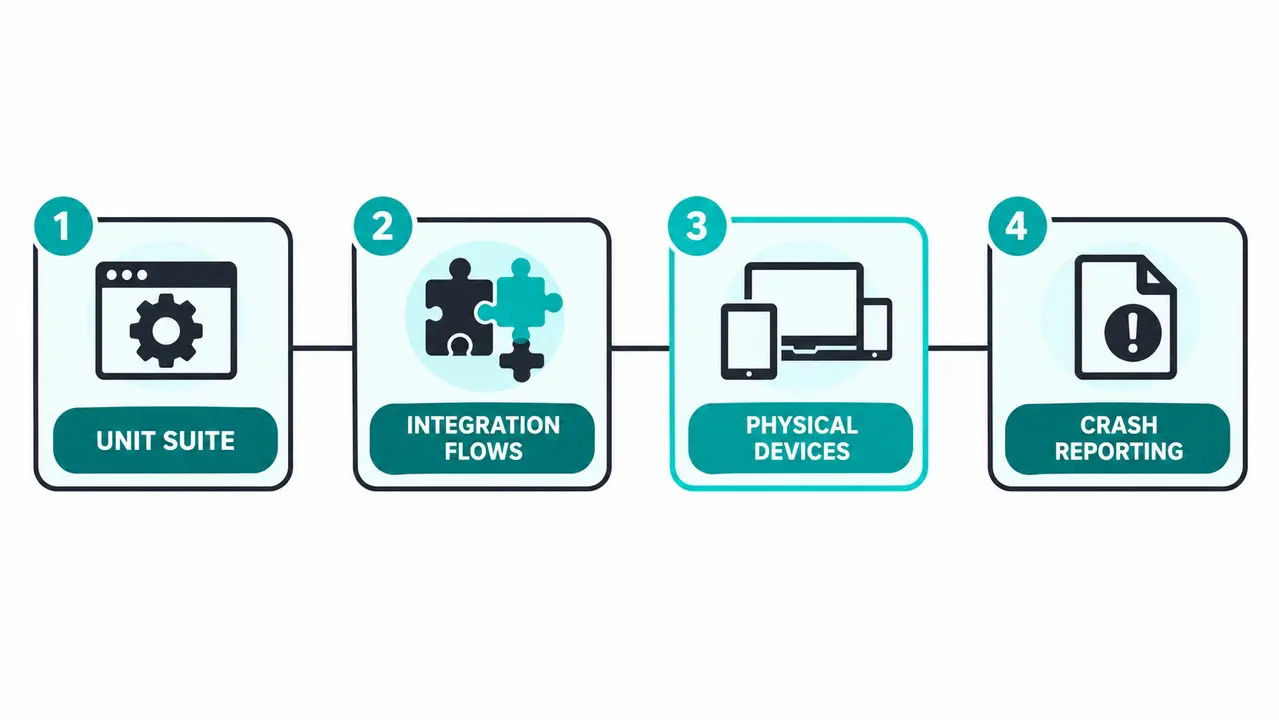
Structuring test documentation around standards like IEEE 829-2008 creates repeatable regression baselines for continuous deployment pipelines. Your team needs automated unit suites, end-to-end integration flows using tools like Maestro or Appium, and crash reporting pipelines.
Distributing staging builds through TestFlight and Firebase App Distribution exposes memory leaks across real physical hardware before public rollout. Emulators help initial interface development, but physical devices reveal thermal throttling and background battery management restrictions.
A disciplined verification strategy separates viable releases from fragile prototypes. Shipping a lean feature set with airtight stability consistently outperforms launching an expansive backlog plagued by unpredictable runtime crashes.
Performance and observability work rarely appears in initial quotes
Optimistic proposals routinely omit the telemetry infrastructure required to operate a production mobile application. Real-time observability demands dedicated engineering tasks for tracing network requests, logging non-fatal runtime exceptions, and tracking screen render latencies across different hardware tiers.
Scoping sessions must define explicit non-functional thresholds. Set hard targets for cold startup durations and round-trip API latency budgets, and define the automated exponential backoff policy and the minimum crash-free session rate.
Operational rigor directly drives sustained delivery success. The DORA research published as the Accelerate State of DevOps 2024 Report shows that operational reliability and disciplined continuous delivery practices reinforce software performance across scaled systems.
When marketing initiatives bring thousands of concurrent users into an unmonitored application, slow backend queries and unhandled rate limits trigger cascading gateway timeouts. Instrumenting your client applications early ensures that production anomalies are identified and resolved before customer churn accelerates.
The week after launch is part of the build cycle
Reaching production status in the Apple App Store or Google Play Store does not mark the conclusion of development. The initial production week serves as an active stabilization phase where real-world network edge cases and hardware oddities surface at scale.
Operating systems will revoke camera permissions, cellular towers will drop websocket handshakes, and specific Android battery savers will kill background data synchronization. Teams must plan for immediate store review iterations, certificate updates, and rapid hotfix deployments.
Establish concrete operational boundaries before deployment day arrives. Define emergency triage response times and configure staged percentage rollouts, automate binary signing, and schedule weekly backlog grooming sessions for incoming user telemetry.
Teams that allocate their entire engineering capacity purely to release day find themselves trapped in technical gridlock. They burn out their engineers addressing urgent live incidents because they treated deployment as an exit rather than a milestone.
Estimation artifacts that make vendor comparisons viable
Reviewing proposals from different engineering partners yields little value when each vendor measures project effort using divergent definitions of delivery. A low figure that omits testing environments and automated pipelines cannot be compared directly against a comprehensive engineering roadmap.
Standardize the artifacts required from prospective teams before evaluating bids. Demand a detailed work breakdown structure with an explicit milestone schedule, and require a documented definition of done and an architectural dependency map backed by a prioritized risk register.
The following evaluation matrix outlines the core documentation artifacts required to validate engineering proposals against real delivery requirements.
| Artifact | Validation criteria | Operational risk if omitted |
|---|---|---|
| Work breakdown structure | Epics broken into testable user stories with explicit state handling | Unchecked scope expansion during development sprints |
| Integration inventory | Documented API contracts with authentication protocols and latency thresholds | Idle mobile engineers waiting on backend endpoint delivery |
| Definition of done | Mandatory unit coverage, automated regression checks, and accessibility compliance | Production releases plagued by unhardened edge cases |
| Release stabilization plan | Dedicated staging buffers, crash triage SLAs, and phased app store rollouts | Emergency hotfix scrambles that derail subsequent roadmap epics |
Proposals that substitute glossy slide decks for concrete technical breakdowns obscure substantial delivery deficits. Insisting on standardized estimation artifacts forces vendors to confront operational complexities before contracts are signed.
Sanity-checking an app estimate in one review meeting
You can test the technical depth of an engineering estimate within a sixty-minute review session. Rather than debating estimated calendar dates line by line, walk the engineering leads through three critical user journeys from cold application launch to error recovery.
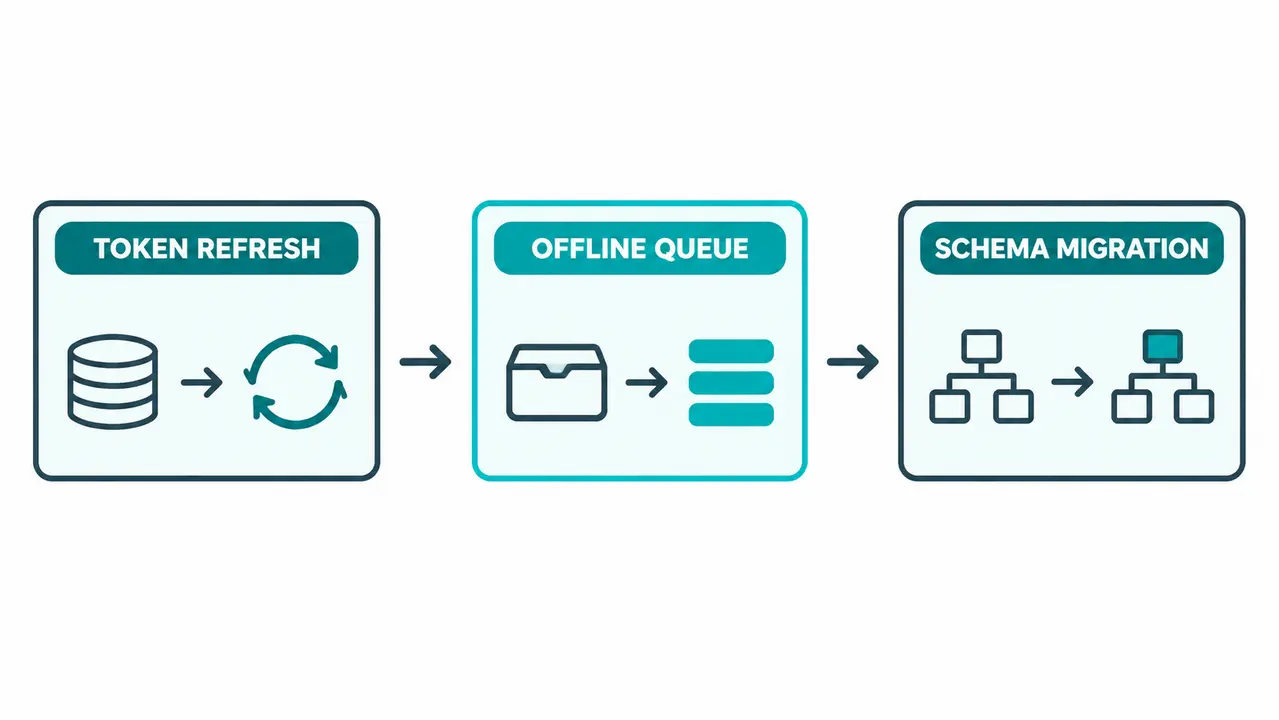
Probe how the system handles expired authentication tokens during a background data upload. Ask where offline user mutations queue when cellular connectivity drops, and examine how client databases reconcile conflicts upon reconnection.
Verify whether the estimate accounts for telemetry logging, internal administrative tooling, and data schema migrations for upcoming feature updates. An estimate that glosses over non-functional requirements assumes ideal network operating conditions that never exist in reality.
If an engineering team cannot articulate the technical tradeoffs and risk drivers behind their task estimates, their numbers represent speculative hopes rather than executable plans. Reject proposals that cannot defend their underlying architectural assumptions.
Fixed scope contracts versus capacity-based delivery
Engagement models shape engineering behavior as much as system architecture. Fixed scope arrangements lock functional requirements, target dates, and team resources into rigid contractual documents before active software development starts.
This model functions adequately for simple integrations with frozen requirements and mature API specifications. In early-stage product development, fixed scope structures transform technical discoveries into contentious change request negotiations that slow delivery velocity.
Capacity-based engineering models assign a stable team of engineers to an evolving backlog prioritized by business value. Your technical leadership retains direct control over sprint backlogs, architectural pivots, and acceptance criteria after reviewing live software increments every two weeks.
The comparison table below details how these two commercial frameworks distribute delivery accountability across core engineering activities.
| Delivery dimension | Fixed scope contract | Capacity-based team |
|---|---|---|
| Requirement changes | Formal change orders requiring timeline renegotiation | Backlog reprioritization managed directly in sprint planning |
| Quality ownership | Vendor targets minimum contractual acceptance criteria | Embedded engineers maintain continuous test automation standards |
| Technical debt management | Deferred until warranty expiration to protect project margins | Refactored continuously within sprint delivery cycles |
| Architecture pivots | Stalled by rigid contractual milestone definitions | Executed smoothly based on early telemetry and user validation |
Choosing capacity-based delivery demands strict prioritization discipline from your product owners. You trade false contractual certainty for the practical flexibility needed to solve real customer problems.
In-house hiring stalls when the roadmap is urgent
Building an internal mobile engineering team from scratch represents a long-term organizational commitment that consumes substantial leadership bandwidth. Sourcing senior mobile specialists, conducting multi-stage technical screenings, and negotiating employment contracts routinely drains four months of calendar time before team members write their first pull request.
Once hired, new personnel require structured onboarding to learn internal deployment tools and establish productive communication norms. If you lack in-house mobile leadership, senior architects must step away from core platform duties to mentor mobile hires and establish development standards.
We compare in-house hiring and outsourcing for situations where delivery deadlines demand immediate execution. Assembling specialists internally carries heavy administrative inertia that delays product launches.
When rapid market validation is your primary operating constraint, deploying a cohesive engineering team with established technical leadership decisively mitigates schedule risk.
Where staff augmentation breaks down for mobile delivery
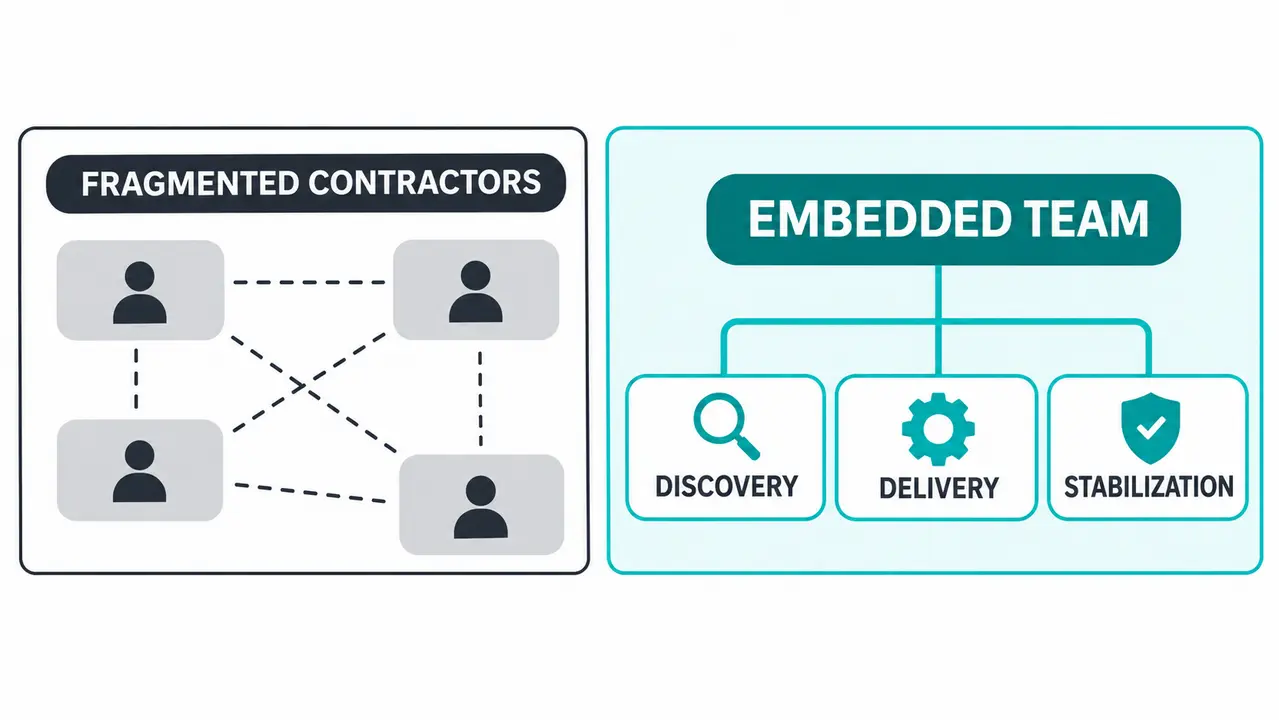
Traditional staff augmentation plugs individual contractors into vacant development seats to accelerate raw feature output. While this model increases daily commit volume, it frequently fragments architectural ownership across disparate individuals who lack deep investment in your long-term product vision.
Contractors focused strictly on closing assigned tickets rarely prioritize end-to-end maintainability, automated test harnesses, or clean documentation. Your internal engineering managers end up absorbing the heavy coordination overhead of running code reviews, resolving merge conflicts, and troubleshooting broken build pipelines.
When augmented developers rotate off the project mid-cycle, they leave behind unowned modules and idiosyncratic patterns that your permanent team must decipher during production outages. Temporary staffing treats engineering as transactional labor rather than a collaborative design discipline.
Individual augmentation creates an illusion of engineering speed while quietly accumulating technical debt. Distributed contractors write code, but cohesive engineering teams build durable software products.
Dedicated embedded teams as a control system for scope and quality
A dedicated embedded team controls development variance by maintaining architectural continuity from initial discovery through post-launch stabilization. The engineers who design the local data caching layer remain directly accountable for production performance when live traffic hits the system.
At Sentice, our engineers work together from a single office location to deliver predictable velocity and unified technical leadership. Our dedicated software engineering teams integrate into your development workflows and adopt your issue trackers, testing standards, and communication cadence from the opening sprint.
Shared physical presence and aligned technical standards eliminate the handoff friction that plagues fragmented contractor groups. Engineers conduct peer code reviews, pair on complex integration obstacles, and document domain knowledge as an explicit project deliverable.
Others simply supply developers, while we become part of your company.
Dedicated teams compound domain knowledge over successive releases far more effectively than transactional staffing arrangements.
Pressure-test your roadmap before you commit
Walk your architecture, integration surface, and delivery constraints past a senior engineering team and get an estimate built on documented assumptions rather than optimistic guesses.
A practical budgeting model built on effort bands and milestone gates
Attempting to lock down rigid app pricing figures before resolving architectural unknowns creates a false sense of operational security. Technical leaders manage mobile investments far more successfully by framing their plans around engineering effort bands, phased milestone gates, and risk contingencies.
Group your roadmap epics into high, medium, and low effort ranges based on architectural complexity. Establish mandatory evaluation gates such as discovery artifact sign-off and backend API schema freezing before allocating engineering capacity to visual development.
Attach explicit time buffers to identified integration risks like legacy identity providers or unproven hardware sensors. If an integration goes smoothly, that reserved capacity immediately rolls into downstream roadmap optimizations.
Committing your entire capital allocation to an inflexible release plan leaves zero room for necessary technical pivots after user testing. Staged milestone budgeting protects your operational flexibility until your core application loop proves its value in production.
Frequently asked questions
What deliverables should be included in a mobile app development estimate?
A defensible estimate must provide a work breakdown structure, an integration inventory detailing API contracts, and an architectural risk register. It should also include an explicit definition of done covering automated testing, device coverage baselines, and release stabilization expectations.
What assumptions should I provide to get a meaningful estimate?
Document your target mobile platforms and user authorization roles, and state your offline operating requirements and how ready your backend APIs are. Stating expected network throughput, data sensitivity tiers, and third-party hardware dependencies prevents vendors from relying on optimistic guesses.
When does cross-platform increase risk instead of reducing it?
Cross-platform frameworks increase engineering risk when your application depends heavily on deep native operating system APIs, proprietary Bluetooth hardware protocols, or custom background processing services. In these scenarios, maintaining custom native bridges introduces coordination bottlenecks that erode the benefits of a shared codebase.
What is the minimum QA bar for a v1 app headed to real users?
A production release candidate requires an automated test suite for critical user flows, centralized crash reporting instrumentation, and structured distribution to a closed beta testing group. The build must also undergo manual regression verification across physical test devices representing target screen sizes and operating system versions.
How do I plan for post-launch work without locking scope too early?
Allocate a dedicated capacity-based stabilization sprint immediately following your store deployment date rather than attempting to predict specific bug counts. Establish a clear incident triage response agreement to prioritize live production anomalies over secondary feature enhancements during the rollout window.
What signals indicate a quote is missing major work?
A quote is likely missing major engineering tasks if it has no line items for telemetry instrumentation and administrative tooling, or if it skips error recovery states and multi-device validation. Proposals that omit staging environment configuration and app store review preparation are ignoring essential operational requirements.
A next step that makes your estimate defensible
Turn your current concept into a concise estimation brief and use it to compel comparable technical proposals. Demand documented assumptions, concrete engineering deliverables, and a verified definition of done tied to system integrations. Treat completed discovery artifacts as an absolute quality gate before approving any development sprint commitments. If an engineering team refuses to validate these technical prerequisites, their estimate is merely speculation rather than an executable delivery plan.
Turn your estimate into a delivery plan
Book a free consultation and take your mobile roadmap through discovery, integration readiness, and release stabilization with engineers who do this every day.
About Sentice

Sentice is a boutique software engineering partner founded in 2013 by Roni Levi and Martin Petkovic, now headquartered in Skopje, North Macedonia. Rather than supplying individual developers, we build embedded teams that blend with a client’s culture, tech stack and goals, working together from a single office under our own technical leadership. We deliver dedicated software engineering teams, end-to-end software solutions, product development, and system and embedded engineering, and we act as technical advisors across the full development lifecycle, from specification and architecture through development, testing and support. We use AI coding tools across every project, and we help clients integrate AI into their own products through chatbots, MCP services, connected application layers and workflow automation. Some of the clients we started with more than a decade ago are still building with us today.
Email: info@sentice.com | Phone: +389 70 307 837