
You open the Google Play Console three weeks after launch and find an Application Not Responding rate climbing past two percent on mid-tier hardware. The screens look sharp in Figma, but users in production are force-closing the app because a background database query locks the main thread during token refreshes.
Mobile delivery fails when executives treat it as visual asset assembly rather than distributed systems engineering.
Android applications execute across thousands of distinct device profiles with aggressive battery management and unpredictable network radios. When an external partner writes screens without establishing memory boundaries or release mechanics, what you end up paying for is an expensive technical rewrite that stalls product roadmaps and burns customer goodwill. This guide outlines how to structure Android engineering so your codebase survives production pressure and team scale.
Reading time: 11 min
Key points
- Android delivery is distributed systems engineering, not visual asset assembly, and skipping architecture upfront leads to expensive rewrites.
- Technical discovery must start with hardware tiers, field network latency, and battery policies before any layout files are configured.
- From sprint one, a serious partner delivers Kotlin coroutines and modular Gradle builds alongside automated Compose testing and Architecture Decision Records.
- Fixed-scope outsourcing consistently breaks for scaleups, while embedded dedicated teams solve capacity without sacrificing code quality.
Table of contents
Android app development services are a product delivery function, not a coding task
Android app development services must function as an integrated product development discipline instead of an outsourced screen factory. When agencies optimize purely for rapid visual output, they produce brittle frontends coupled directly to fragile API assumptions. The app looks complete during weekly client demonstrations, but it lacks structural resilience under unpredictable network conditions.
We demand that any serious engineering engagement establishes clear operational baselines before committing production code. By the end of week two, your partner should deliver a concrete risk register and an initial architecture sketch detailing threading boundaries and dependency injection patterns under offline constraints.
Agencies build what sits inside a ticket, while engineering partners solve the product constraint behind it. Skipping these upfront architectural definitions leaves teams with unstable state management and brittle deployment scripts that break the moment paying customers arrive.
Where Android services usually start and where they should start instead
Most mobile projects kick off with a bloated feature list and a sprint toward visual mockups. That path guarantees expensive technical rework when fundamental platform constraints inevitably surface midway through development.
A disciplined build starts with physical operating constraints rather than user interface components. Your technical discovery must analyze target hardware tiers, field network latency, and battery preservation policies before anyone configures layout files. These physical boundaries determine how local caching and background synchronization should be structured.
A structured discovery workshop should produce validated user personas and critical interaction flows alongside testable acceptance criteria. When engineering teams fail to clarify offline persistence rules during discovery, developers bind screens directly to remote endpoints. Refactoring a network-dependent user interface into an offline-first architecture four months later requires ripping out core data layers and rewriting half the presentation logic.
Architecture must always precede interface design.
What you should expect in a Kotlin-first Android build
Modern native development centers on clean Kotlin implementation backed by structured concurrency. Your engineering partner must build asynchronous flows using Kotlin coroutines and Flow primitives, entirely replacing legacy callback structures and cumbersome RxJava chains. The application structure should enforce modular Gradle builds that isolate feature modules from core infrastructure, preventing compilation bottlenecks as your repository expands.
To verify these architectural boundaries early, request an explicit module map and a documented dependency rule set from your vendor. Each module must maintain strict separation between presentation logic and underlying data repositories.
For small early prototypes, a simpler single-module architecture can suffice if the engineering team documents the future migration roadmap. Introducing complex multi-module hierarchies to a two-screen proof of concept adds unnecessary Gradle build overhead without providing testing benefits. Teams must balance architectural purity against early discovery speed.
Jetpack Compose changes delivery speed and testing strategy
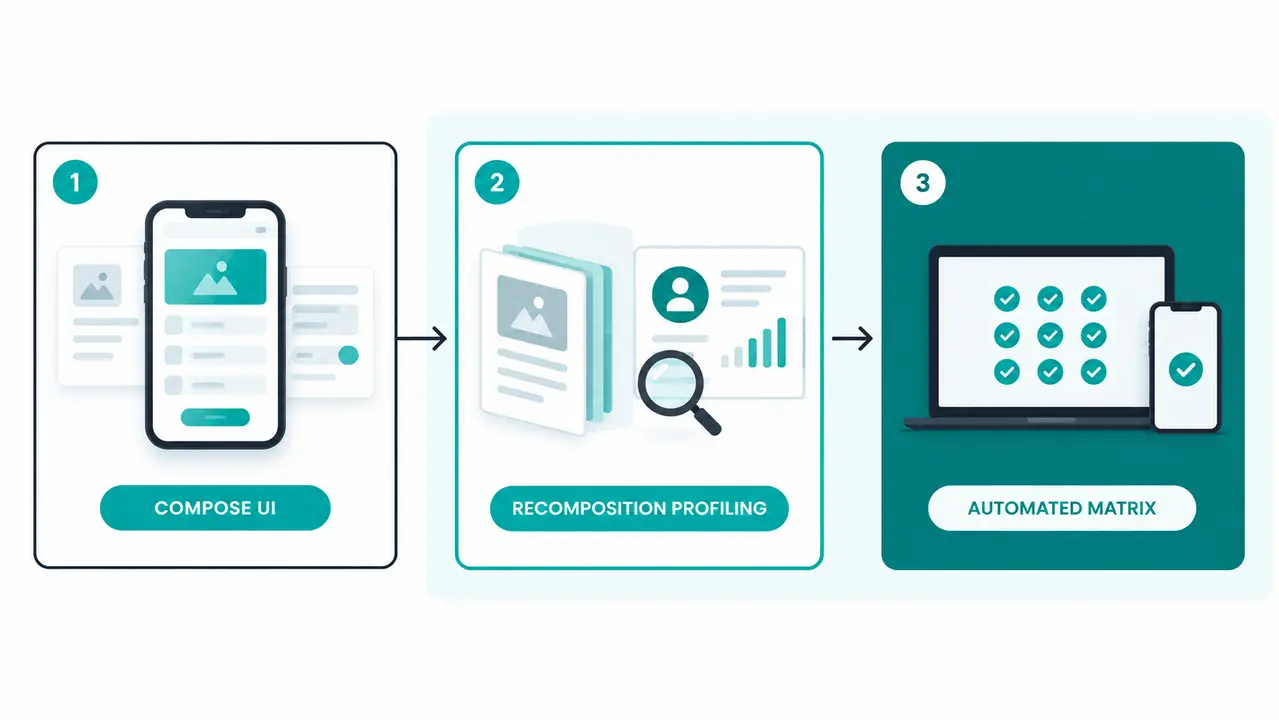
Adopting Jetpack Compose accelerates visual development by eliminating legacy XML layouts and boilerplate view binding. That velocity introduces new quality challenges if your verification practices remain anchored to manual inspection. Declarative UI shifts testing requirements toward automated component previews and Compose UI tests with continuous recomposition profiling.
Weak teams treat device testing as manual screen checking, while mature teams treat it as an automated matrix.
Define an engineering standard where a user interface screen is marked complete only after passing Compose unit tests and strict frame-rendering budgets. Our engineers profile recomposition counts to prevent unneeded rendering passes that drain mobile batteries. Relying entirely on manual testing across varied screen sizes leads to layout clipping and severe UI jank on lower-spec hardware. Automated verification catches visual state regressions immediately upon pull request creation.
Testing must scale alongside design speed.
Android architecture that survives the second team
Great software architecture is defined by how easily incoming engineers can comprehend and safely modify the codebase. A newly onboarded senior engineer should understand the project flow within one working day and ship safe production changes during their first week.
The critical inflection point arrives when a growing scaleup adds secondary squads to an existing codebase. Without rigid architectural boundaries, independent squads collide on shared state, causing delivery velocity to plummet.
Demand that your delivery team maintains an active Architecture Decision Record log alongside automated dependency enforcement rules. These records document why particular design choices were made, preventing future developers from undoing deliberate technical tradeoffs. Neglecting this governance produces monolithic ViewModels and circular dependencies between data layers. When data access is tightly tangled, parallel feature development grinds to a halt as multiple engineers trigger constant merge conflicts in shared classes.
Device fragmentation is a QA and observability problem
Android device fragmentation is not an engineering requirement to support every obscure handheld ever manufactured. It is an operational discipline centered on risk mitigation, structured hardware test matrices, and automated crash observability.
Your mobile partner must establish an automated continuous integration test suite targeting core Android versions and representative chipset architectures. Pair this with a staged rollout protocol and comprehensive crash reporting baselines using tools like Firebase Crashlytics. When teams deploy updates without staged release controls, a single vendor-specific runtime crash can spike across millions of active devices, forcing costly rollbacks and poisoning Play Store review scores.
Managing this operational complexity requires dedicated technical rigor. The global outsourcing services market report from Grand View Research puts the share of the engineering services outsourcing segment at 75.4% in 2025. As companies delegate more engineering workloads to external partners, building institutional QA pipelines and real-time observability standards becomes necessary to protect brand stability.
Google Play release readiness is part of development from the start
Deploying to the Google Play Store is an engineering delivery milestone rather than an administrative checklist handled by marketing staff. A professional technical team must own deployment pipelines and privacy manifest configurations alongside automated store release tracks.
Require your technical lead to implement a comprehensive release protocol owned directly by development personnel. This process must govern internal testing tracks and closed beta rings alongside rapid rollback procedures.
Treating release operations as a secondary task creates disastrous launch delays. Missing data safety disclosures and undeclared location permissions regularly trigger automated Google Play rejections. If your engineering partner does not audit store policies in initial sprints, resolving compliance violations during launch week can delay marketing initiatives by several painful weeks while your build sits in review purgatory. Professional delivery teams test store compliance continuously throughout development.
Security and privacy work best when designed into app flows
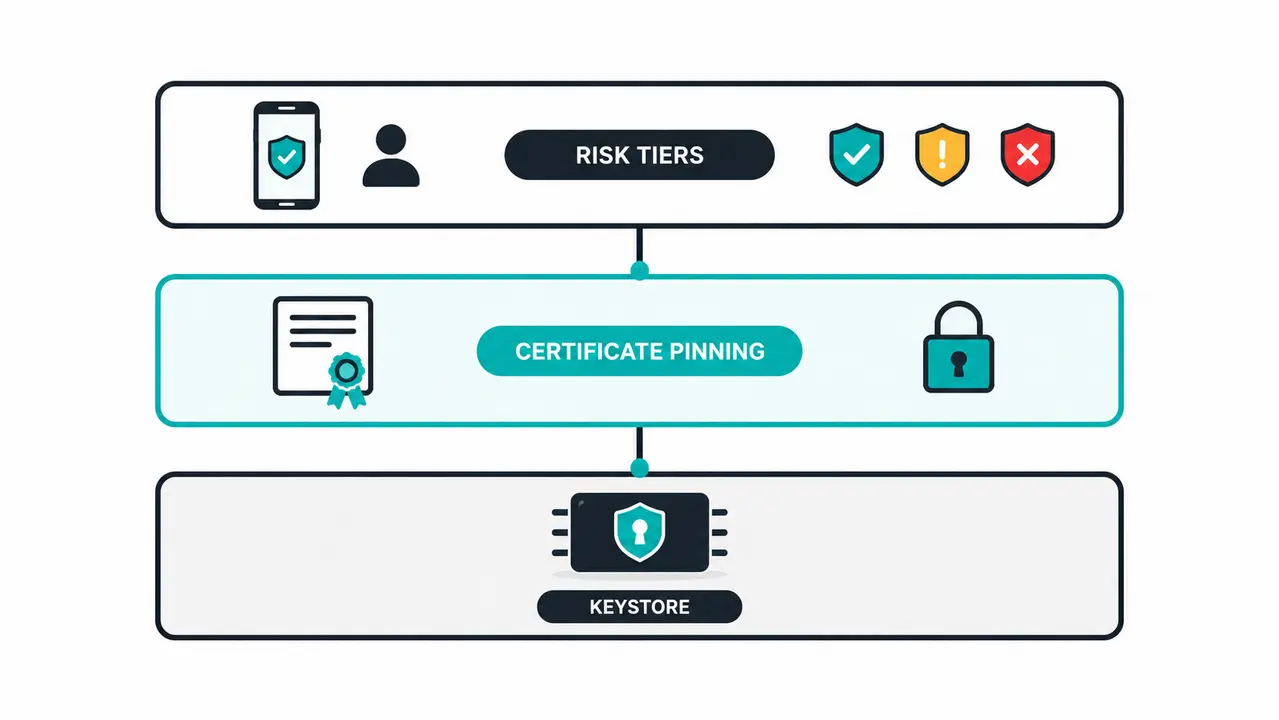
Application security is most effective when integrated directly into user interaction paths and backend communication contracts. Retrofitting security onto a finished mobile application produces brittle authentication patches and awkward user friction. Security decisions must live inside the core architecture from sprint one.
Before coding begins, your development team should run a lightweight threat modeling workshop and establish a concrete secure coding checklist. This baseline defines token storage via Android KeyStore, network communication security through certificate pinning, and proactive data classification to prevent sensitive telemetry leaks.
Security hardening must match operational risk. Over-securing an early prototype with complex biometric verification and encrypted database wrappers burns valuable engineering cycles before achieving product-market validation. Teams should classify application modules into explicit risk tiers, applying strict defense controls to financial transactions while maintaining delivery speed on experimental customer screens. Pragmatic engineering balances threat defense against release speed.
Offline-first and sync are the most underestimated Android features
When an enterprise application operates in warehouses or transit hubs, network connectivity is intermittent at best. In these operational environments, the core engineering challenge is not screen presentation. The real product is reliable local persistence and deterministic conflict resolution mechanics.
Demand that your engineering partner establishes a formal sync specification before designing offline user flows. This document must clearly define local sync states and data freshness expectations between Room databases and cloud endpoints.
Ignoring sync complexity produces silent data loss and duplicate record submissions when field staff transition between offline zones and cellular towers. Warehouse workers scanning inventory will lose critical logs if local write queues overwrite server states without optimistic locking. Rebuilding damaged customer databases after an unhandled sync failure costs far more than implementing proper sync engines upfront. Local persistence requires disciplined transactional design.
Integrations decide your timeline more than UI does
Mobile delivery timelines rarely derail due to interface complexity. Most release schedules stall because backend APIs are unready, authentication edge cases remain unresolved, or third-party SDKs introduce breaking changes.
Your development vendor must define executable API contract tests, mock environments, and a clear external dependency map with assigned engineering owners. Establishing API stubs on day one allows Android engineers to construct complete user flows without waiting on remote server infrastructure.
Ensuring that mobile and cloud engineers collaborate under unified engineering leadership prevents expensive delivery bottlenecks. At Sentice, we align team disciplines through end-to-end software solutions that keep API definitions and client implementations fully synchronized. When mobile developers work in complete isolation from backend teams, they sit idle waiting for endpoint revisions. That lack of coordination produces major integration bugs during final testing stages.
When a Kotlin app is really a system product
Certain Android applications function as interface hubs for connected hardware, biometric sensors, and industrial equipment. These system products require engineering expertise that extends far beyond standard screen layouts and HTTP network calls.
Developing mobile software for connected hardware demands a dedicated integration test plan incorporating physical testing rigs and simulated radio environments. Engineers must thoroughly validate Bluetooth Low Energy pairing states, firmware update transfers, and aggressive operating system battery restrictions that throttle background scanning.
Lab environments rarely match real operating conditions. An application that connects cleanly to a medical monitor in a quiet office can fail completely in an emergency room crowded with competing radio frequencies. When hardware-software coordination is required, partnering with teams experienced in system and embedded engineering prevents expensive deployment disasters. Without specialized hardware testing protocols, unexpected timing glitches and dropped serial packets will render your connected product unusable in customer hands.
Three engagement models and where each one breaks
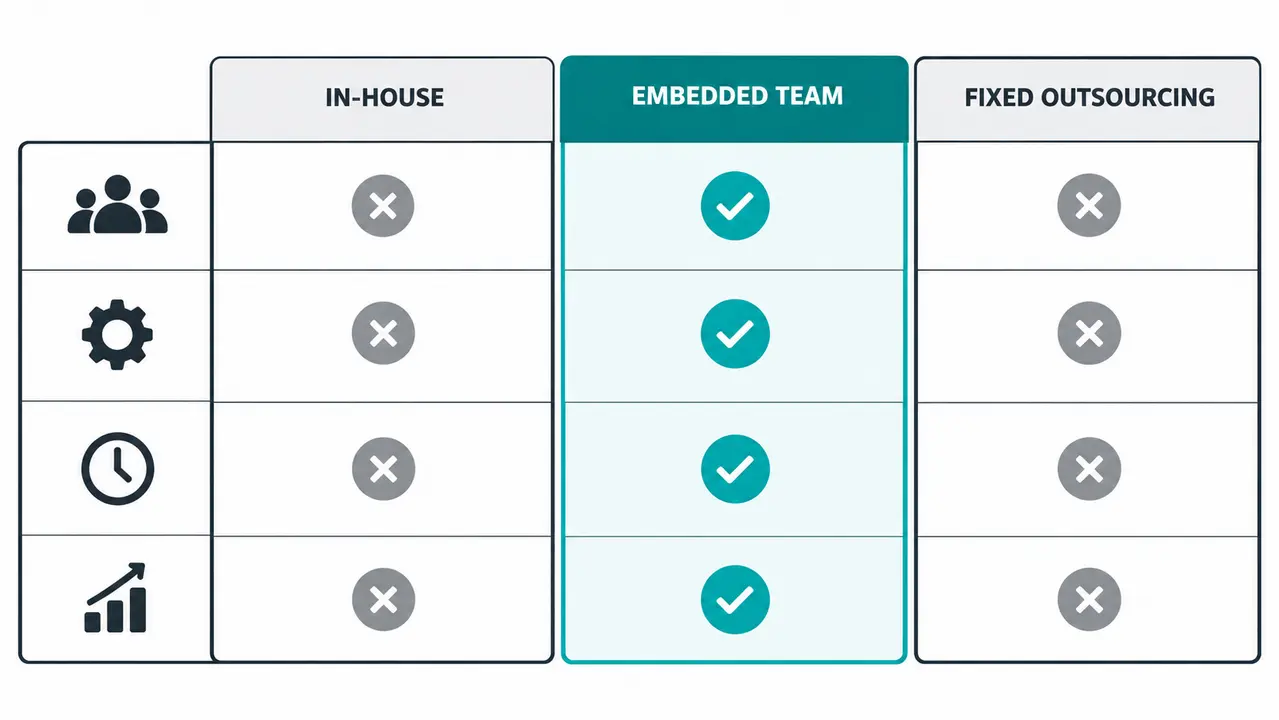
Choosing how to resource your Android development dictates product ownership, velocity, and long-term maintainability. Engineering leaders usually choose between hiring in-house, bringing in embedded partners, or contracting fixed-scope outsourcing.
Most vendors optimize for initial velocity, but serious engineering teams optimize for system survival.
The table below evaluates each delivery model against critical operational dimensions.
| Dimension | In-House Engineering | Embedded Dedicated Team | Fixed-Scope Outsourcing |
|---|---|---|---|
| Roadmap volatility | High adaptability with slow hiring ramp | Immediate adaptability to changing scope | Low flexibility with costly change orders |
| Leadership bandwidth | Requires intensive recruiting and management | Low management overhead with self-directed leads | Moderate overhead focused on milestone disputes |
| Compliance and quality risk | Complete internal control over standards | High control through shared code reviews | High risk of concealed technical debt |
| Long-term ownership | Total institutional retention | Smooth knowledge transfer to permanent staff | Weak documentation and low codebase maintainability |
Fixed-scope outsourcing consistently breaks for scaleups because it optimizes for contract boundaries over product discovery and maintainability. When requirements evolve, traditional vendors bill for revisions instead of strengthening the architecture.
Embedding external engineers solves capacity constraints while preserving code quality. Companies often integrate dedicated software engineering teams to maintain direct architectural control. According to the 2024 Stack Overflow Developer Survey, 42% of developers work hybrid and 20% in person, while 47% work at organizations with fewer than 100 employees.
Need Android capacity that survives production?
Tell us about your target devices, your current stack, and where delivery is slipping. We will map the architecture, testing, and release work your app actually needs before anyone writes a line of code.
How senior Android leadership shows up on day one
A technical lead on an Android project must act as an architectural decision-maker, not an administrative ticket manager. You should observe an engineer who proactively interrogates system boundaries, resolves cross-functional technical blockers, and enforces code standards across every pull request.
From the opening sprint, confirm who owns the technical roadmap and what specific definition of done applies across development branches. A senior tech lead defines branch protection rules, mandates automated static analysis checks, and refuses pull requests that lack adequate test coverage.
Teams that lack decisive technical leadership ship quickly during initial weeks but grind to a halt as architectural shortcuts accumulate. Junior engineers working without senior oversight produce fragmented patterns, inconsistent error handling, and unmaintainable state stores. Correcting these compounding defects later requires painful refactoring that derails scheduled product releases.
Artifacts that reduce risk before the first sprint ends
The most effective way to de-risk an Android engagement is requiring concrete engineering artifacts before completing the initial sprint. Tangible technical deliverables make software quality, architectural scope, and project velocity measurable from the earliest days.
Insist that your delivery team produces a complete sprint zero package. This deliverable must contain an architectural diagram with defined module boundaries alongside an external API dependency inventory. The package also includes a hardware testing matrix and an app release checklist.
Early deliverables create immediate visibility.
When teams build rapid proof of concept prototypes, keeping documentation concise is practical if foundational constraints remain explicit. Omitting structured specifications entirely invites confusion across distributed contributors. Teams that begin writing code without documented interface boundaries create mismatched data models and unverified API assumptions that require extensive rewrites before reaching production. Documented boundaries keep technical execution aligned.
How to evaluate code quality without reading every line
Engineering executives rarely have the bandwidth to review every line of code committed by an external partner. You can evaluate code quality effectively by inspecting automated engineering habits and static analysis reports.
Ask your vendor to present a sample pull request and release notes from a recent deployment. A healthy repository demonstrates focused branch scopes, descriptive commit messages, and automated pipeline passes for tools like Android Lint and Detekt.
Observing how code enters the repository reveals how the software will perform in customer hands. If pull requests are merged without peer review or automated testing, quality problems will surface as angry customer reviews and surging crash logs. Catching defects through disciplined review automation is straightforward. Recovering from public reputational damage after a buggy app release requires months of corrective engineering. Disciplined peer reviews protect production stability.
Maintenance is where Android apps either compound value or compound debt
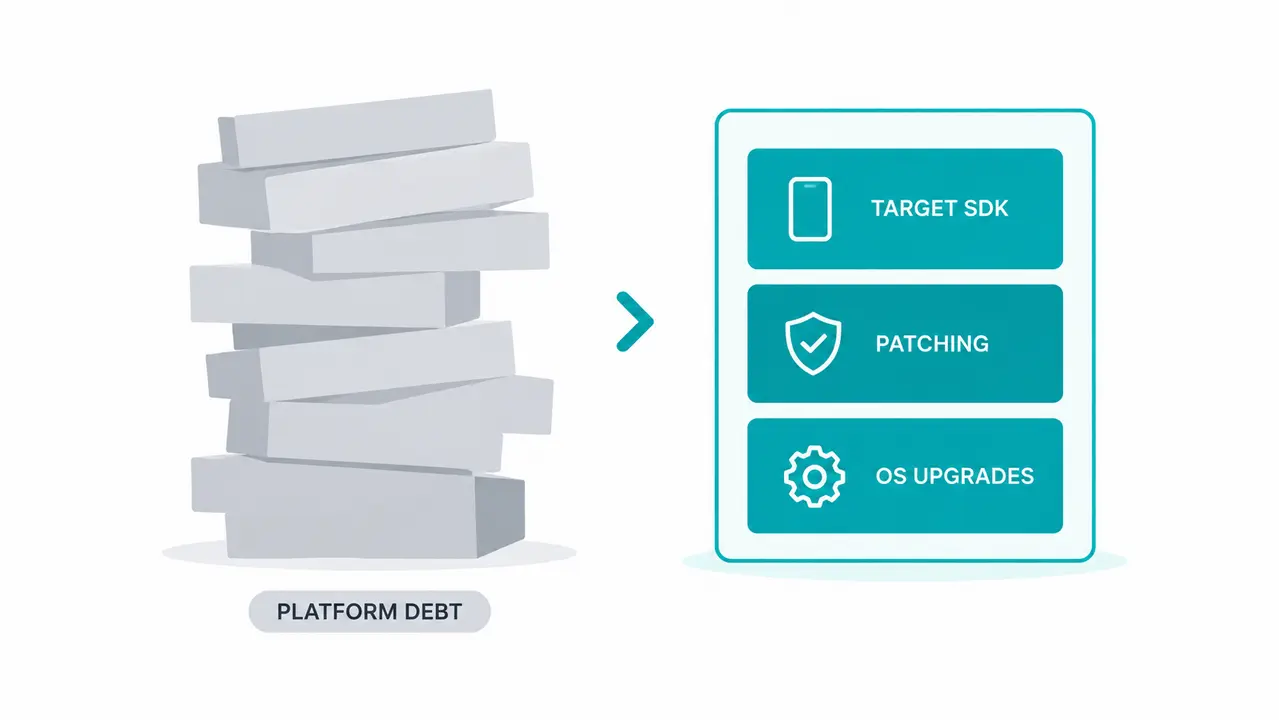
Launching an Android application is the beginning of a continuous lifecycle rather than the conclusion of an engineering effort. Long-term technical value compounds when maintenance is treated as an active operational discipline covering operating system updates and target SDK migrations alongside frame performance tuning.
Your delivery partner must define a predictable operating rhythm for routine maintenance and security patching. Google regularly enforces updated target API requirements to retain Play Store discoverability, while annual Android OS releases introduce background execution limits and permission restrictions.
Neglecting operational updates causes rapid codebase decay. When applications skip consecutive operating system upgrade cycles, third-party libraries become incompatible and security vulnerabilities accumulate across unpatched dependencies. Resolving several years of accumulated platform debt in a panic often requires a dangerous, high-cost application rewrite that pulls development capacity away from strategic business features. Proactive dependency management preserves engineering momentum.
What to ask before you sign with an Android app development partner
Before signing an agreement with an engineering partner, ask direct questions that expose how their developers operate under real delivery constraints. Inquire how the team resolves unexpected API outages and troubleshoots severe production incidents under delivery deadlines.
Insist on reviewing named technical roles and a sample weekly operating schedule before finalizing contracts. Understanding who writes your code and how team meetings operate prevents unpleasant surprises after onboarding begins.
Selecting an engineering vendor based purely on polished sales presentations and attractive portfolio mockups is an expensive mistake. Polished mockups reveal graphic design capability, but they demonstrate nothing about how a team handles concurrency and memory or how disciplined its delivery is. A mature Android engineering partner openly shares architectural practices, explains previous delivery failures, and prioritizes long-term software maintainability over superficial visual promises. Engineering rigor always outlasts cosmetic presentation.
Frequently asked questions
What do Android app development services typically include for a startup MVP?
A complete engagement covers technical discovery and core architecture design, then adds foundational test suites and app store deployment pipelines. Our engineers establish the repository structure, implement critical user flows, and configure continuous integration tools from the initial sprint. This approach ensures your early product tests business viability on stable architecture rather than throwaway code.
Should we choose Kotlin and Compose if we already have a Java app?
You do not need to rewrite an existing codebase to adopt modern Android tooling. Kotlin offers full bidirectional interoperability with Java, allowing teams to build new feature modules in Kotlin and Jetpack Compose alongside legacy screens. Migrating isolated user flows incrementally reduces technical debt without interrupting live business operations.
What causes Google Play submissions to get delayed or rejected?
Most rejections stem from non-compliant privacy policies, unverified permission usage, or missing data safety disclosures in the Play Console. Submissions also stall when builds fail to meet mandatory target API level requirements or crash during automated Google pre-launch testing. Clear release checklists prevent these administrative delays before deployment week.
How do we decide between native Android and cross-platform for a new product?
Native Android is superior when your product requires direct hardware communication, complex background services, or high-performance graphics rendering. Cross-platform frameworks suit straightforward content applications, but they add abstraction layers that complicate device integration. Native Kotlin code ensures long-term platform alignment and eliminates third-party framework upgrade risks.
What should handoff look like if we want our in-house team to take over later?
A clean handover requires comprehensive architectural documentation, runbooks for build environments, and an active transition window with paired programming. Incoming engineers should co-author pull requests alongside the departing team to absorb system context. Sentice engineers build every project so an internal engineering team can assume complete codebase ownership within two weeks.
A practical next step for scoping Android app development services
Treat the opening two weeks of your Android engagement as an intensive risk-reduction phase rather than a sprint for visible screens. Demand early architectural blueprints, a concrete release plan, and an automated testing strategy tailored to your actual target devices. When a prospective technical partner cannot define quality controls before writing code, their promise of delivery speed is an illusion. Base your vendor selection on proven operational discipline rather than polished visual demonstrations.
Let’s scope your Android team
Bring us your target device matrix and your current delivery bottleneck. We will walk through the architecture, testing, and release readiness questions this guide raises before mapping what a senior Android team would own from sprint zero.
About Sentice

Sentice is a boutique software engineering partner founded in 2013 by Roni Levi and Martin Petkovic, now headquartered in Skopje, North Macedonia. Rather than supplying individual developers, we build embedded teams that blend with a client’s culture, tech stack and goals, working together from a single office under our own technical leadership. We deliver dedicated software engineering teams, end-to-end software solutions, product development, and system and embedded engineering, and we act as technical advisors across the full development lifecycle, from specification and architecture through development, testing and support. We use AI coding tools across every project, and we help clients integrate AI into their own products through chatbots, MCP services, connected application layers and workflow automation. Some of the clients we started with more than a decade ago are still building with us today.