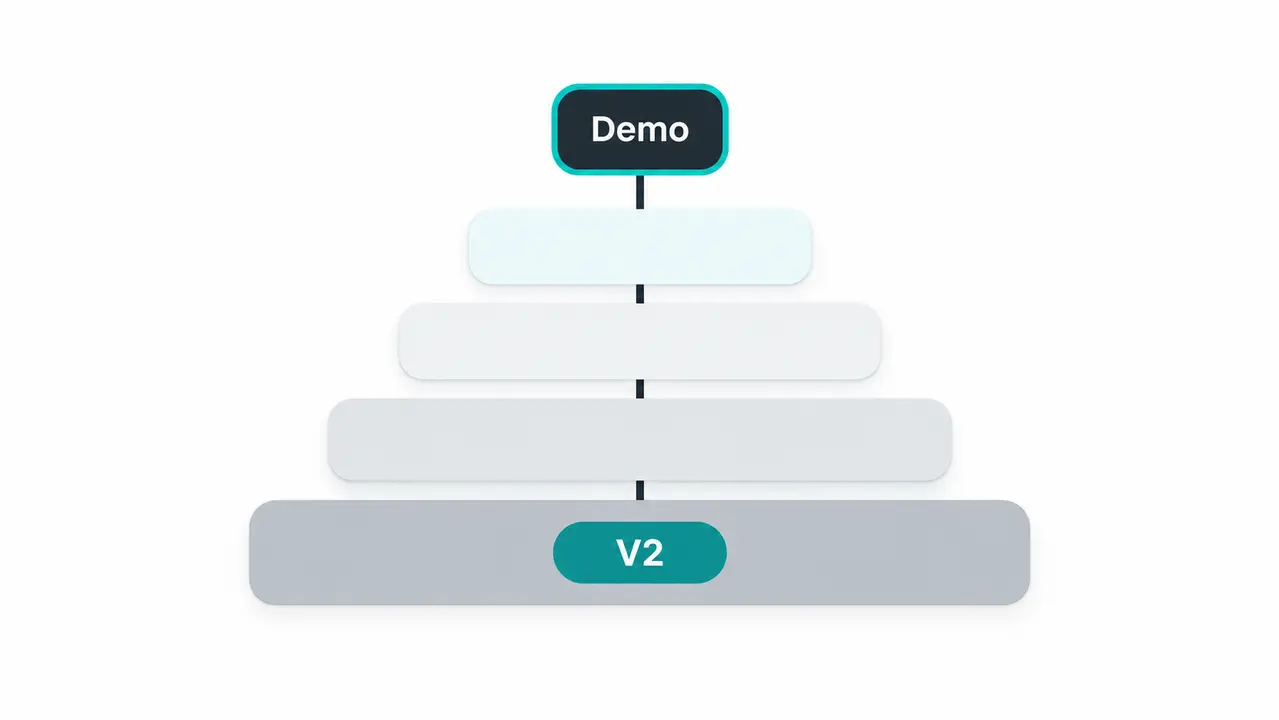
The demo went well. The pilot customer signed. Eighteen months later, the CTO who inherited the codebase opened the deploy script, found four hundred lines of copy-pasted Bash, and realized version two was going to be a rewrite wearing an iteration costume.
Nobody planned it that way. Every individual decision along the way was defensible. Ship the demo, defer the tests, hardcode the tenant, fix it next sprint. The compounding is the problem, and compounding never shows up in a sprint plan.
This article walks through the recurring failure modes one by one, from scope and integration reality to security, QA, metrics and release discipline, and pairs each with a concrete engineering countermeasure.
Reading time: 10 min
Key points
- Treat version one as a learning system with a tightly controlled surface area, not a miniature final product.
- Aim at a specific role with a dedicated budget and a daily workflow, not at a department.
- Keep the minimum technical spine: versioned APIs, environment parity, migrations under version control, structured logging.
- Let decision gates, not feature roadmaps, decide whether version two happens.
Table of contents
When an MVP turns into a slow motion rewrite
Most of the common MVP mistakes we see in B2B products share a single root. Teams treat version one as a miniature final product instead of a learning system with a tightly controlled surface area. The failure mode repeats with mechanical regularity. A CTO inherits a “temporary” codebase with no tests, unclear ownership, and a backlog of quick fixes that make every future change a gamble.
B2B sharpens the problem, because integrations, security, and reliability exist from day one with an enterprise pilot, and they dictate what to avoid during initial scoping whether the roadmap likes it or not.
This article maps each mistake to a concrete engineering countermeasure. No generic startup advice. Every fix here comes from codebases we inherited and deadlines we missed.
The true cost of temporary code
Technical debt compounds when short-term choices lack a documented expiration date. The hardcoded credential was fine for the demo. Six months later it is load-bearing, and the person who wrote it sits on a different project. Write the expiry date down when you take the shortcut, or the shortcut takes the roadmap hostage.
A working definition of minimum that engineers can execute
Minimum is the smallest product slice that can prove or disprove one core user outcome with real usage data. Not internal opinions. Data from a real user completing a real task inside your product.
The slice is a single end-to-end path. A UI or API entry point, business logic, data storage, and a usable result the customer can act on. Build that path and nothing around it.
The trap is building minimum features without a minimum workflow. Five half-finished capabilities do not compose into a product. They compose into a demo that shatters on first contact with a real workday. When the scope argument stalls internally, a product development partner can break the tie, because an external engineering team with no attachment to any feature on the list cuts to the learning outcome faster than anyone with a stake in the answer.
The one question every MVP requirement must answer
Before anything enters the backlog, ask whether it increases validated learning about the core outcome within the next release cycle. If nobody can answer that in one sentence, the requirement is decoration. Cut it.
Where teams build for imagined users instead of a specific buyer
Most failed MVPs were never aimed at anyone in particular. The persona slide says “operations teams,” which is not a buyer. It is a department. Software aimed at a department stalls, because no single person owns the decision to adopt it.
Aim at a specific role with a dedicated budget and a clear daily workflow. A dispatch supervisor at a mid-size logistics company who re-keys shipment data between two systems every morning is a target. “Operations” is a seating chart.
Collect evidence before building. Ten to twenty structured conversations, workflow pain points that repeat across companies, and a clear trigger event that forces adoption. Then define one economic buyer and one daily user, even when they are different people. The buyer signs the contract. The user decides whether the signature meant anything.
Validation theater that produces slides instead of decisions
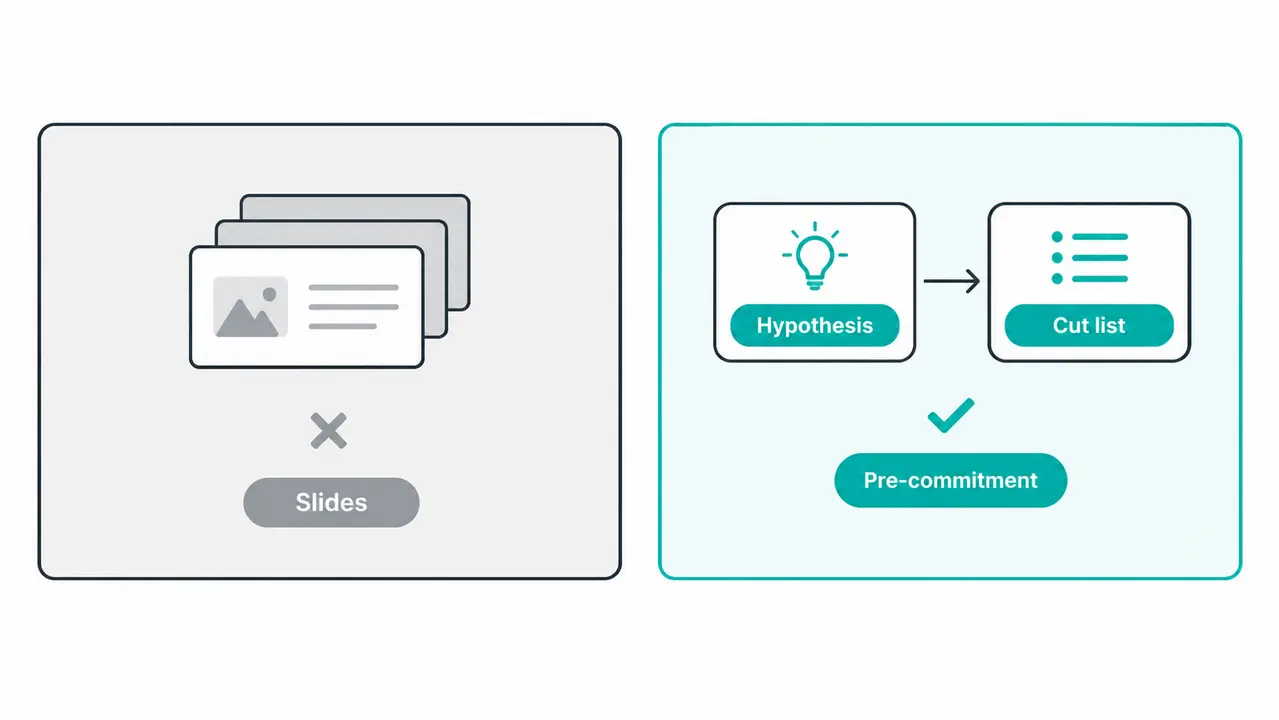
Discovery that ends in a slide deck has failed, even when every insight in it is correct. Insights that never force a scope decision are entertainment. Useful discovery produces a falsifiable hypothesis and a cut list.
Replace feature voting with hypothesis statements. “Cutting purchase order approval from two days to twenty minutes will get procurement leads using the tool without a mandate” is testable. “Users want faster approvals” is not.
Collect pre-commitment signals before writing code. A signed pilot agreement, data access, integration permission, a named internal champion. Then define what would make you stop building. A team that only knows what would make it continue is not validating. It is collecting permission.
A simple hypothesis template for B2B software
For a specific role who struggles with a specific issue, we believe a specific capability will lead to a measurable outcome within a defined time window. Every slot takes a verifiable noun. If the outcome cannot be measured, the hypothesis is a wish with a deadline.
Feature creep that starts in week one
Feature creep is not a discipline problem. It is a requirements hygiene problem, and the trigger is always the same sentence in a design review or an integration planning session. “While we are here, could we also add an export?”
The countermeasure is structural. Lock the version one outcome, publish a strict exclusion list, and tie every change request to the core hypothesis with one rule. If the request does not change what you learn this cycle, it waits.
Engineers pay for scope in a specific currency. Every new feature expands the test surface, increases monitoring needs, and multiplies support load.
A feature that takes four days to build takes a month to own.
A scope boundary document engineers will actually use
One page, pinned in the repository next to the code. In scope, out of scope, assumptions, non-goals, and the single metric that defines success. Treat any pull request that crosses a boundary without a recorded decision as a defect, and review the document whenever the hypothesis changes rather than whenever someone senior asks nicely.
Where teams underestimate integration and data reality
The UI took three weeks. The integration took four months. Anyone who has shipped B2B software recognizes that ratio.
The hard part of most MVPs is data quality, permissions, and system boundaries. Identity and access management, audit logs, ingestion limits on the customer’s API tier, legacy endpoints with undocumented behavior, device telemetry arriving out of order. None of it appears in the mockups. All of it appears in the pilot.
Plan a thin integration path that proves value without the full platform architecture, and define a fallback mode for when the upstream system is down or returns corrupted data. It will do both, usually the week of the demo.
Choosing the thinnest viable integration
Start with one system of record, one data entity, and a single path. Read or write, never both at once. Syncing purchase orders out of the ERP while pushing status updates back in doubles your failure modes before you have a single user. Prove the read path and learn from it. Add the write path in version two, with the scars from version one as your specification.
MVP architecture that cannot survive the second customer
An MVP should be small, not fragile. The wrong shortcuts make iteration slower after launch, the opposite of what an MVP exists to do.
The signs repeat across codebases. No separation of concerns, so a pricing change touches five files. Hardcoded tenant logic, so customer two requires a fork. No database migration strategy, so schema changes happen by hand. Zero observability, so the first bug report comes from the customer instead of your logs.
Right-sized foundations are cheap. Basic modularity, configuration management, and a deployment pipeline that repeats safely without a human typing commands.
Know the difference between temporary code you intend to discard and deliberately minimal design you intend to extend. The first has an expiry date. The second has a documented seam for the extension.
The minimum technical spine worth keeping
Versioned APIs from the first release. Environment parity between staging and production. Database migrations under version control. Structured logging. A test strategy aligned to risk instead of coverage theater.
This spine costs days. Missing it costs quarters.
Pressure-test your version one scope
An embedded engineering team with no stake in your feature list can cut scope down to the learning outcome fast, and stay through delivery.
Security and privacy gaps that block real pilots
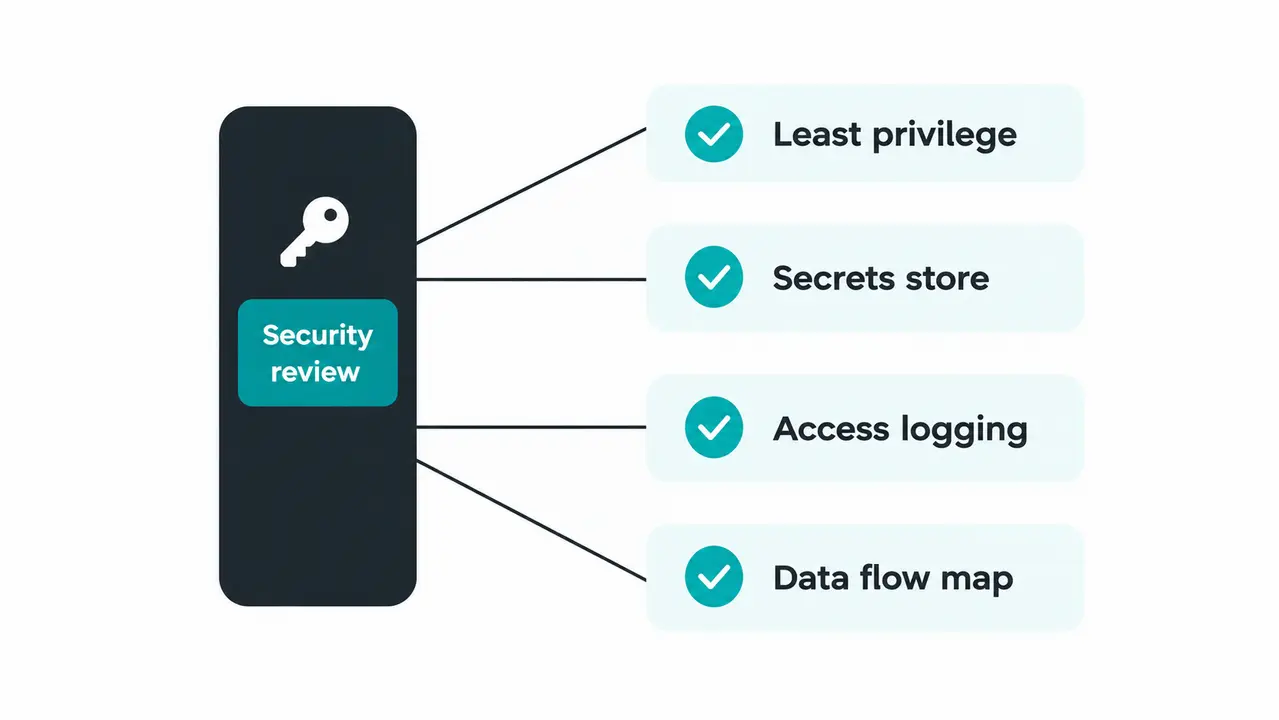
The product worked flawlessly in the demo. The pilot stalled in the security review. In B2B this is the most common way a finished MVP dies, and the blockers repeat with depressing consistency.
Unclear data retention policies. Missing access controls. No audit trail. Secrets committed to the repository because someone was in a hurry on a Friday. Use the OWASP Top 10:2021 as the baseline for addressing common weaknesses during the build, and the NIST Secure Software Development Framework as a practical guide for wiring security practices into the engineering workflow rather than bolting them on afterward.
Pilot-ready security without enterprise overhead
Four things clear most reviews. Least privilege on every service account. Secrets in a managed store, never in source control. Basic logging of authentication and data access events. A one-page data flow diagram showing where customer data lives and who can reach it. Together they turn a security questionnaire from a quarter of back-and-forth into an afternoon.
QA that arrives after the deadline
QA fails in MVPs when it arrives as a phase instead of a filter. The deadline was Thursday, testing started Wednesday afternoon, and what it produced was a schedule problem rather than a quality report.
Shift the target. Test what can break the core hypothesis, plus what can break user trust, and skip the rest with a clear conscience. Contract tests on every integration boundary, smoke tests on the critical user flows, acceptance criteria written as observable and measurable outcomes. “The sync completes within thirty seconds on a thousand records” is a criterion. “It feels fast” is developer intuition.
A lean test matrix for MVP teams
One matrix keeps the argument honest. Rows are risk areas, columns are test types, and every cell is a decision someone will defend.
| Risk area | Unit | Integration | End-to-end | Manual |
|---|---|---|---|---|
| Critical user flows | Optional | Recommended | Required | Required |
| Integrations | Optional | Required | Recommended | Optional |
| Permissions | Recommended | Required | Optional | Recommended |
| Data integrity | Required | Required | Optional | Optional |
| Performance thresholds | Recommended | Optional | Not applicable | Required |
Everything outside the matrix is timeboxed manual exploration, an hour per release. A matrix you can defend in ten minutes beats a forty-page test plan nobody reads.
Metrics that measure activity instead of learning
Can your team name the single learning goal of the current release in one sentence? If not, your analytics is noise and your metric reviews are politics with charts.
Pick one primary metric tied to the core outcome, then two or three guardrail metrics tied to system reliability and user friction. Instrument events that map to workflow steps, not vanity counts. Page views and total logins tell you someone arrived. Step completion tells you whether the work got done.
Set a cadence where the metric forces a decision. Iterate, pivot, or stop. A dashboard that has never ended a single roadmap item is decoration.
From events to decisions in one weekly review
One page, one hour, same slot every week. Build it in Grafana, Metabase, or a shared spreadsheet, because the tool matters far less than the ritual. The page shows anomalies from the guardrail metrics, the top user drop-off step in the workflow, and the next planned experiment. The meeting ends with one of three words written down and owned. Iterate, pivot, or stop.
Feedback loops that only capture opinions
Feedback you cannot tie to observed behavior is opinion with better manners. Useful feedback is anchored to a specific friction point inside the software, and you find it by triangulating three sources.
Session notes show where users hesitated. Support tickets show what they could not finish. Telemetry shows the exact step where the workflow lost them. Ask users what they tried to do and what happened next, in that order, and only ask what they want after you know what they did.
Then triage with a hard rule. Fix blockers to the core outcome first. Defer every preference to a later version, and say so in writing.
A practical feedback taxonomy for MVP triage
Every piece of feedback gets exactly one label before it touches the backlog.
| Category | What it sounds like | Response |
|---|---|---|
| Blocker | “I cannot finish the approval inside the tool” | Fix in this release |
| Workflow friction | “It works, but I switch windows four times” | Evaluate next release |
| Missing capability | “I need export before replacing the old process” | Test against the hypothesis |
| Performance reliability | “It times out on the monthly batch” | Fix against a threshold |
| Nice-to-have | “A dark mode would be nice” | Park until the gate is met |
Labels keep the loudest stakeholder out of the sprint plan. A blocker from a pilot user outranks a nice-to-have from your own board, every single week.
Roadmaps that lock teams into the wrong v2
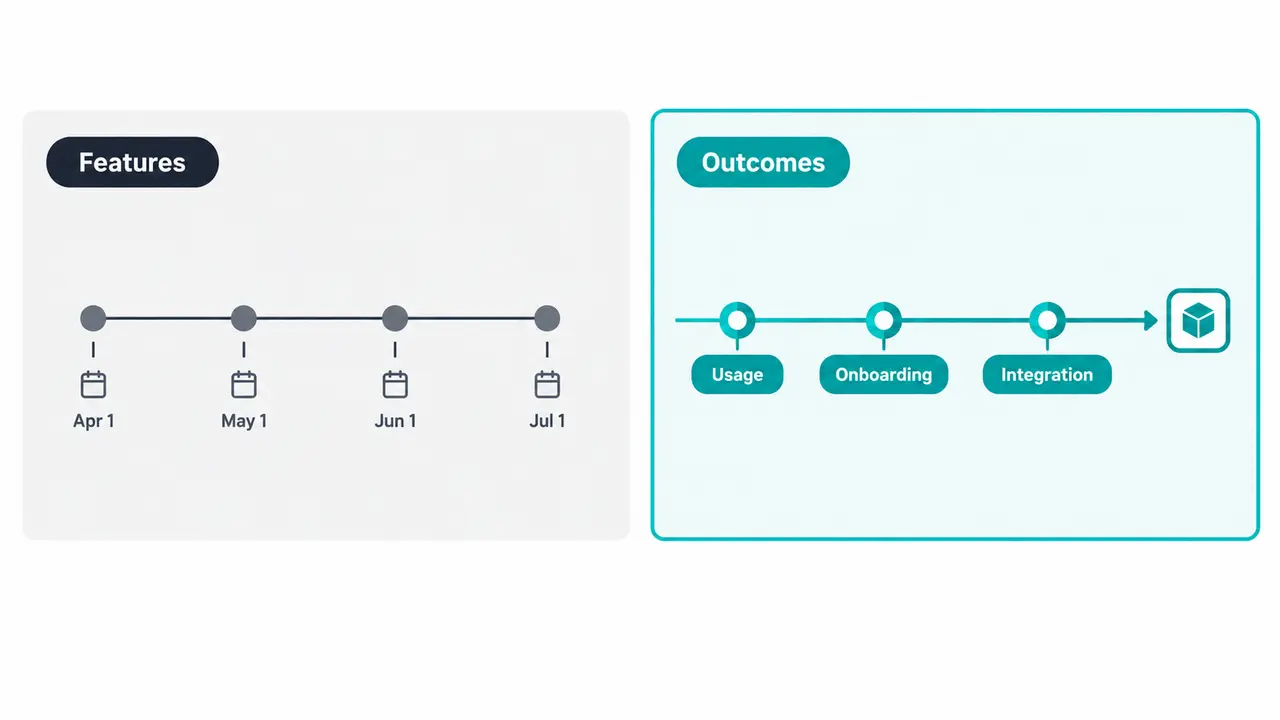
Somewhere in your Confluence there is a v2 roadmap approved before a single user logged in. It is a list of guesses with dates attached, and the dates make guesses feel like commitments the data has not earned.
Replace feature roadmaps with outcome roadmaps. State what must be true after version one to justify version two, and refuse to name features until those conditions resolve. Publish the exclusions too. Stakeholders tolerate a closed door when the door has a written condition for opening.
Decision gates that protect engineering time
Three gates cover most B2B pilots. Repeat usage by the target role across four consecutive weeks. Onboarding that completes without founder assistance. A third-party integration that stays stable through a full billing cycle. Miss a gate and version two waits. Pass all three and the feature conversation starts from evidence instead of enthusiasm.
Team structure that creates handoffs and rework
Watch a fast MVP team for a week and count the handoffs. Discovery hands to engineering, engineering hands to QA, QA hands defects back. Every queue has an owner, and the hypothesis sits in the gaps between them.
Name one owner for the hypothesis and one for release quality, then build a small cross-functional unit around them, with product, engineering, design, and QA working together and direct access to users. Others staff the phases and hand off between them. We structure dedicated software engineering teams at Sentice as one unit that follows your practices from the first week, because a team that never hands off never reworks the handoff.
The minimum set of roles for a pilot-ready MVP
Four people. One tech lead who owns architecture and code quality. One product owner who owns the hypothesis and the backlog. One QA-minded engineer embedded in the squad. One delivery owner who coordinates releases and pilot communication. Fewer and the roles blur. More and the coordination tax starts competing with the build.
Documentation that is missing where it matters
MVP documentation has two jobs. Reduce onboarding time and prevent repeated decisions. Describing every code class accomplishes neither, and it is where most teams spend their writing effort.
Three documents pay off immediately. A system diagram showing services and data flow. An API contract, ideally generated from an OpenAPI spec so it cannot drift from the code. A guide for running the project locally and deploying it. Add a decision log for the architectural tradeoffs version two will revisit, keep all of it in the repository, and update it as part of the definition of done. Documentation that lives in a separate wiki dies the week the wiki password resets.
A documentation set that fits into one sprint
One page for architecture, one page for runbooks, one page for integration notes. Three pages, written alongside the build. We use this exact format at Sentice on pilot projects, and it survives contact with new engineers better than any full documentation suite, for the simplest reason. Three pages get read.
Release discipline that breaks trust with early users
Early adopters forgive the missing feature. They do not forgive the broken promise, and they do not forgive instability dressed up as a release. The pilot user who lost an afternoon to your regression does not read your roadmap. They read their own.
Stage the rollouts. Put feature flags on anything experimental and tell pilot users plainly what is experimental. Define an incident path even with four people on the team. Who responds, how you communicate, and how the failure changes the backlog.
Track reliability issues as first-class backlog items tied to adoption risk, not as chores parked below the feature line.
A pilot communication rhythm that reduces churn
Four artifacts on a rhythm. Release notes with every deploy. A published list of known issues, updated honestly. A dedicated support channel, one Slack channel rather than a shared inbox. A weekly check-in with each pilot champion. Teams that communicate on schedule hear about problems while they are small. Teams that go quiet hear about them at renewal.
The week a senior engineer leaves mid-MVP
The resignation lands on a Tuesday. By Friday you learn that the deployment process lived in one person’s muscle memory, half the credentials were personal accounts, and the reasoning behind three architecture decisions survives only in a Slack thread from month two.
MVPs collapse this way more often than they collapse from competition.
The countermeasures are cheap. Pair on critical paths, keep shared runbooks current enough that a new engineer can deploy from them, and rotate release ownership so no single person is the pipeline. Personnel change is the norm, not the exception, and we wrote a fuller treatment of how to grow your tech team without losing speed or quality when it arrives mid-build.
A two-day continuity test for MVP teams
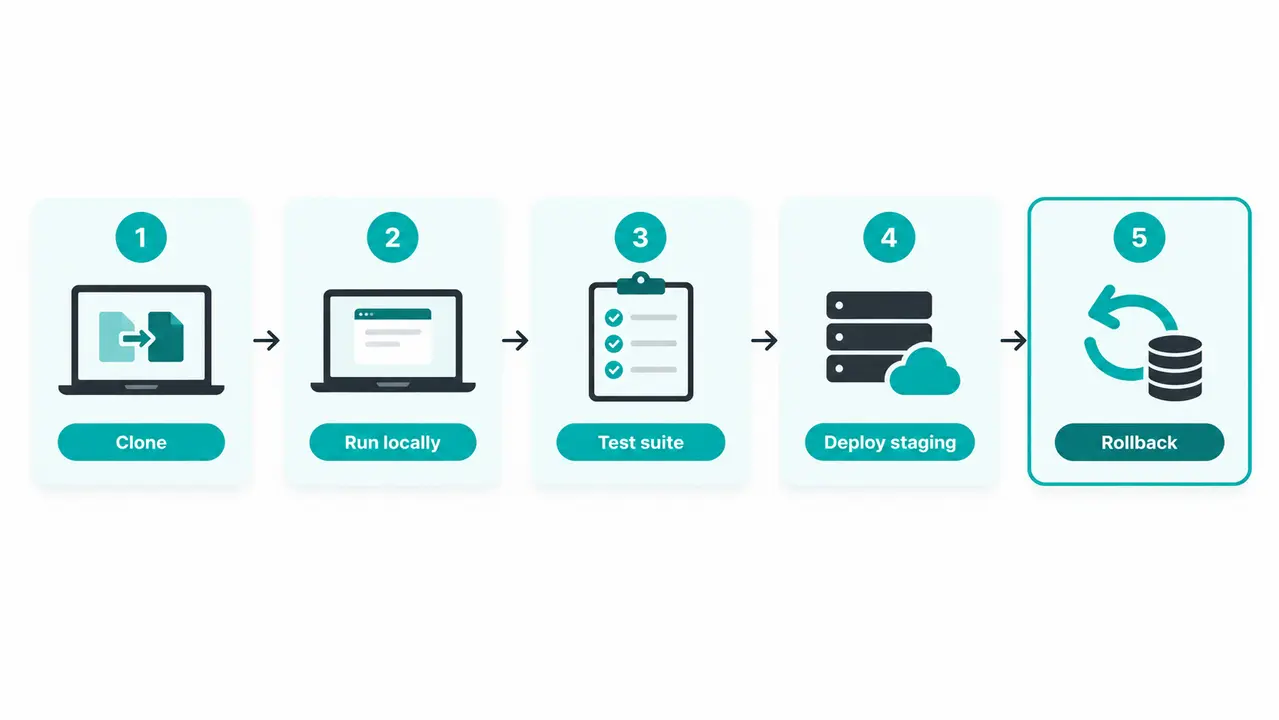
Run it before you need it. Clone the repository, run the project locally, run the test suite, deploy to staging, watch the logs, and execute a rollback. Two days is the budget. Any step that fails, or exists only in one person’s head, marks a continuity gap while it is still cheap to close.
Recognizing when the MVP has done its job
An MVP is complete when it produces a clear decision, not when it reaches feature parity with the incumbent. Parity is a marketing conversation. Decisions are what version one exists to manufacture.
It worked when the target role uses the product consistently without prompting, onboarding repeats without heroics, delivery holds stable, and the willingness to adopt survived contact with procurement. It failed usefully when the non-fit is unambiguous, or when the same friction keeps returning in new forms and no amount of building removes it without changing the core assumption.
Either outcome is a win if you act on it. Iterate on the current path, pivot to a new hypothesis, or rebuild on a stronger foundation. What you must not do is keep building in the absence of a decision, because that is the slow motion rewrite from the start of this article, running exactly on schedule.
Frequently asked questions
How do you balance speed with code quality in an MVP?
Apply the standard we call minimal viable quality. Code must be testable and deployable from the first sprint, and the critical path needs automated coverage. It does not need every edge case handled or every abstraction perfected. Speed and quality trade off at the edges, never at the spine.
What is the difference between an MVP and a prototype?
A prototype is a simulation built to collect feedback on an idea, and it can be a Figma flow or a script over fake data. An MVP is a live product used by real users to collect behavioral data. Prototypes answer whether people understand a concept. MVPs answer whether they will change their workflow for it.
How long should an MVP take to build?
Four to eight weeks for the core slice, treated as a hard timebox. Anything longer and you are building features against assumptions the market has already had time to invalidate. If the honest estimate exceeds eight weeks, the scope is wrong, not the calendar.
How do you handle third-party integrations in an MVP without vendor lock-in?
Put an abstraction layer over the one or two data paths that would genuinely hurt to replace, such as your system of record. Accept direct coupling for non-critical services that are cheap to swap, like email delivery. Full abstraction everywhere is its own form of waste.
Returning the MVP to its original purpose
The CTO in the opening scenario was never choosing between shipping fast and shipping right. The real tradeoff was between a fast learning loop and a brittle codebase, and the team had bought the second while paying for the first. Ask yourself this week whether your current build is generating validated learning or just accumulating technical debt. Then audit the backlog and delete every item that does not serve the core hypothesis.
Tell us about your roadmap
Book a consultation and we will help you scope version one around a decision, not a feature count.
About Sentice

Sentice is a boutique software engineering partner founded in 2013 by Roni Levi and Martin Petkovic, now headquartered in Skopje, North Macedonia. Rather than supplying individual developers, we build embedded teams that blend with a client’s culture, tech stack and goals, working together from a single office under our own technical leadership. We deliver dedicated software engineering teams, end-to-end software solutions, product development, and system and embedded engineering, and we act as technical advisors across the full development lifecycle, from specification and architecture through development, testing and support.
We use AI coding tools across every project, and we help clients integrate AI into their own products through chatbots, MCP services, connected application layers and workflow automation. Some of the clients we started with more than a decade ago are still building with us today.
Email: info@sentice.com | Phone: +389 70 307 837