
The demo works. Sales is booking meetings off it. Then a pilot customer asks for an uptime commitment, and the first honest engineering conversation about scaling begins. Teams that reach this point usually discover the same thing. The MVP was built for learning speed, and everything that made learning fast now has to be re-examined before it can carry real weight. This article is about what changes, in what order, and how to avoid paying for scale you cannot yet use. Below we cover the signals that say an MVP has earned the right to scale, the sequence to follow, and the hardening work that separates a demo from a product.
Reading time: 12 min
Key points
- Scaling an MVP is a change in what the company optimizes for, from learning speed to reliability and coordination.
- Use 60 to 90 days of post-launch retention data before funding growth, and confirm demand before paying technical debt.
- A modular monolith with tight boundaries usually beats a premature microservices migration after MVP.
- Instrument, harden, and document before adding headcount, because knowledge trapped in people does not survive departures.
Table of contents
You are not scaling an MVP you are changing what the company optimizes for
Scaling MVP to full product is not a bigger version of the work you already do. It is a change in what the company optimizes for. During the MVP phase, your single constraint was learning speed, and every shortcut that helped you learn faster was the right shortcut. The moment you scale, reliability, repeatability, and coordination become the constraints, and the same shortcuts start costing you money.
The clearest trigger is when a second function depends on your roadmap. When sales commits to a customer date, when support promises a fix, when ops schedules a rollout around your release, you have crossed a line. The product is no longer an internal experiment. It is infrastructure for other people’s commitments, and it has to behave like it.
The expensive mistake here is adding headcount and infrastructure while the core workflow and value proposition are still unstable. More engineers on an unstable product multiply the instability. We have inherited those codebases more than once, and the cleanup always costs more than the scaling did.
The signals that say your MVP earned the right to scale
Watch for one pattern above all. A consistent core use case repeating across different customers, with retention behavior that is not explainable by novelty. If five different companies in different industries use the product the same way and keep using it after the first month, you have signal. If usage spikes after launch events and decays without them, you have noise dressed as signal.
Use 60 to 90 days of post-launch data as the minimum window. Anything shorter is weather, not climate. The trap is a board deck built on three exciting weeks.
The counter-case matters just as much. High signup rates combined with low activation rates indicate a product problem, not a scaling problem. Fix the core loop before you fund growth. Teams that scale on this pattern spend the next year adding infrastructure to a funnel that leaks at the top.
Where teams confuse early traction with product-market fit
The most common post-MVP error is treating a small set of enthusiastic early users as proof that the broader market will behave identically. It will not. Early users are self-selected, high-context, and forgiving in ways the market is not. They chose you because your rough edges matched their appetite for risk.
Look at what is holding your retention numbers up. Founder-led onboarding and white-glove support are temporary scaffolding. They inflate retention by substituting your personal effort for product capability, and the numbers they produce cannot survive contact with a customer who found you through a search result.
The failure mode is predictable. Teams with inflated retention build enterprise features, layered architecture, and a sales motion before the core value loop repeats without manual intervention. Then the founder stops doing onboarding calls, activation drops by half, and nobody can explain why. The explanation is that the product was never carrying the load by itself.
A scaling sequence that avoids burning months on the wrong work
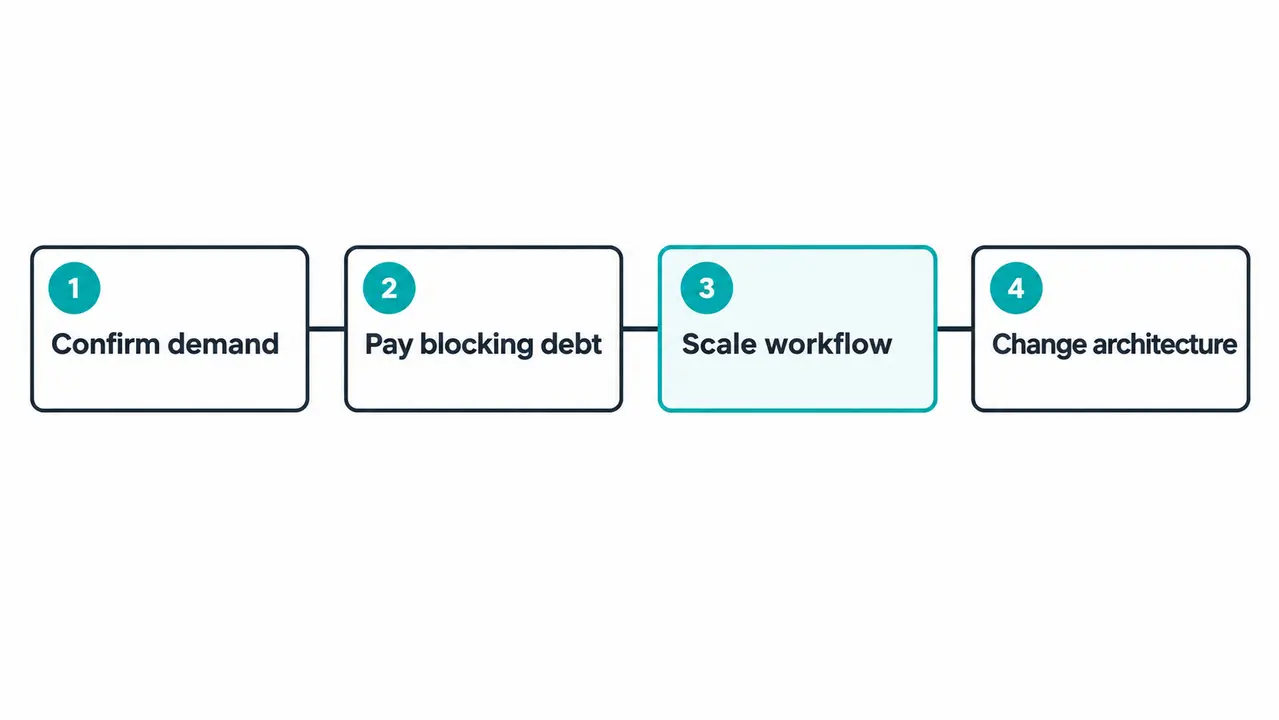
There is a reliable sequence for MVP evolution, and it holds across industries. Confirm demand first, with real retention data from a window long enough to trust. Pay the technical debt that blocks shipping second, and only what blocks shipping. Scale the workflow third, meaning the core path customers actually use. Change architecture last, and only when a specific, measured bottleneck proves it necessary.
Teams get in trouble by running these stages simultaneously. Refactoring while scaling infrastructure while adding features multiplies risk across every axis at once, and when something breaks you cannot tell which change caused it.
Treat debt items as discrete sprint-sized deliverables with a clear definition of done, never as vague refactoring tasks that sit in the backlog for quarters. “Replace the ad-hoc CSV export with a queued job” ships. “Clean up the data layer” does not. The sequence is the difference between months of compounding progress and months of sideways motion.
The MVP hardening checklist that engineering leaders actually use
Hardening means three things. Making failures visible, making releases repeatable, and making changes safe, all before you add more surface area to the application. You are preparing the product to be operated, not just demonstrated.
The minimum production readiness bar is short. Error monitoring in place, so a failing checkout is an alert rather than an angry email. Structured logging, so a production issue can be investigated without grep-ing through raw text. A basic load test against realistic traffic patterns. An incident runbook draft, even a rough one, so the first 2 a.m. page does not require improvisation.
We structure this work inside a structured product development process at Sentice, because hardening done ad hoc always gets deprioritized the moment a feature request arrives. Hardening done as a planned phase with named deliverables survives contact with the roadmap. Scaling usage while flying blind on reliability metrics does not end well. It ends with unpredictable outages and a customer base that remembers every one of them.
Technical debt triage that protects roadmap velocity
Treat technical debt as risk inventory, not as a moral failing. Pay down only what blocks the next stage of learning or revenue. Ignore what offends engineering aesthetics, because aesthetics are not a budget line.
A simple triage system works better than a backlog full of good intentions. Categorize every debt item by what it actually threatens.
| Debt category | Detection signal | Appropriate response |
|---|---|---|
| Customer-visible risk | Bugs escaping to production on the same path repeatedly | Pay immediately, next sprint |
| Developer-time tax | Simple changes taking days instead of hours | Schedule when the tax exceeds one day per change |
| Scalability ceiling | Load tests showing failure well below projected traffic | Pay before the growth campaign, not after |
| Security exposure | Unmanaged dependencies, secrets in code, missing access controls | Pay immediately regardless of roadmap |
Some debt is acceptable and even strategic. A crude internal admin tool behind a stable interface costs nothing if nobody depends on its internals. Isolation is the criterion, not elegance.
The architecture decision most teams get wrong after MVP
The wrong move after MVP is almost always architectural overreaction. A full rewrite, or a premature migration to microservices, justified by engineering discomfort with the current codebase rather than by any measured constraint. Both freeze feature delivery for months while re-building problems that were already solved.
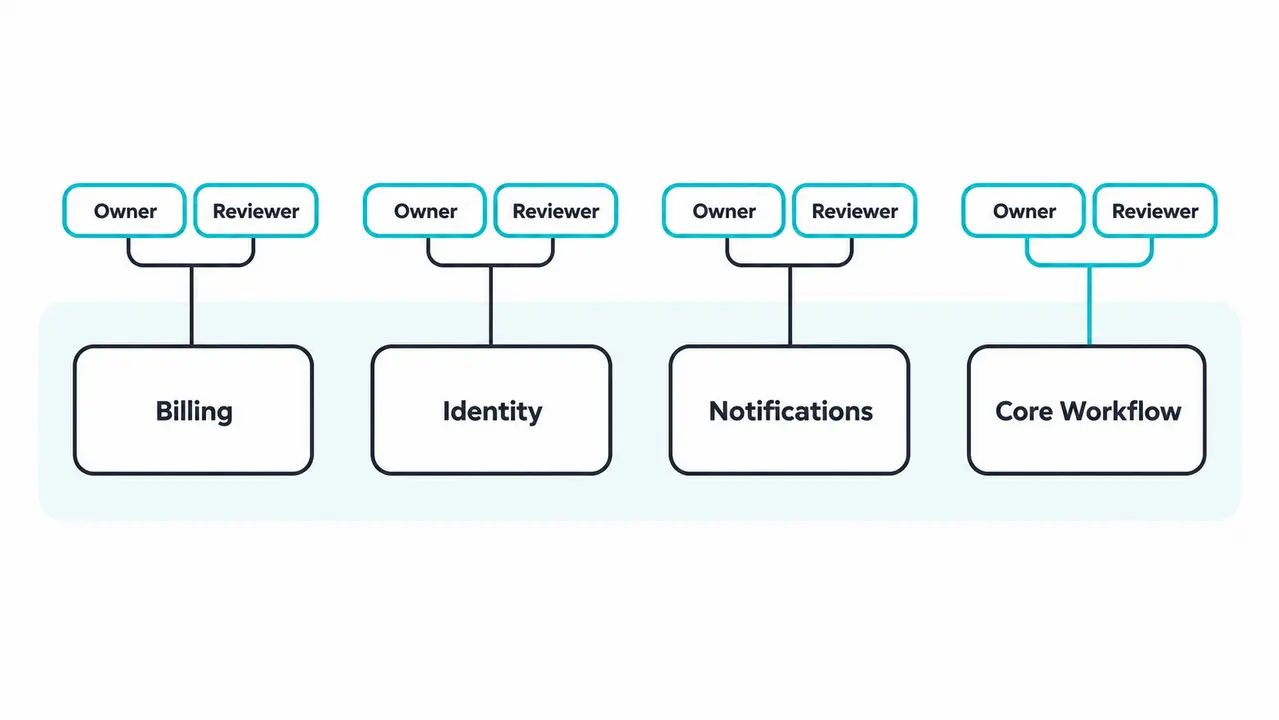
The right move is usually tightening boundaries inside the existing codebase. A modular monolith structured by business capability, billing, identity, notifications, core workflow, gives you most of the isolation benefits of microservices with none of the distributed-systems tax. You get deployable clarity, testable modules, and the option to extract a service later if a specific bottleneck demands it.
The rewrite temptation is strongest when the original authors have left and the code feels illegible to whoever inherited it. That is a documentation problem wearing an architecture costume. Fix it with tests and decision records, and the rewrite urge usually subsides within a quarter.
When the monolith stops being the problem and the bottleneck becomes coordination
At a certain team size, shipping slows down and everyone blames the codebase. The codebase is rarely the culprit. The bottleneck has moved to coordination, to merge conflicts, review queues, and the sixteen conversations required to change one shared file.
The diagnostic is simple. If your team spends more time waiting than building, the monolith is not your constraint. Your ownership model is. People cannot make decisions when nobody is sure who owns what.
The fix is an ownership map. A single page listing every service, module, and subsystem, with a named owner and a named reviewer for each. When an engineer wants to change the notification module, the map says who to talk to. When a production issue hits the billing service, the map says who gets paged.
Without that map, rising headcount produces falling throughput. Every new engineer adds coordination cost to everyone else, and merge conflicts become the tax you pay for not deciding who owns what.
The release process that separates a demo from a product
A demo works because someone prepared it. A product works when nobody is preparing anything. The difference is a predictable release train with rollback paths, environment parity, and a clear definition of what can ship without heroics.
The concrete stack matters less than the discipline, but the concrete stack helps. Trunk-based development, so there is one source of truth and no quarter-long branches. Feature flags, so incomplete work ships dark and activates when it is ready. Staged rollouts, so a bad release reaches 5 percent of users instead of all of them. Release notes discipline, so support knows what changed before customers ask.
There is a legitimate counter-case. Very early B2B pilots can ship faster with less process, provided the blast radius is strictly controlled and customers know they are on the bleeding edge. The mistake is keeping that posture after the customer count makes it a lie.
Observability that answers the questions your future customers will ask
Instrument the core workflow so you can prove reliability, performance, and usage outcomes without guessing. Your future enterprise customers will ask for uptime figures, latency percentiles, and incident history, and “we think it is fine” is not an answer that closes deals.
Track the golden signals on every critical path, latency, traffic, errors, and saturation, alongside product events for activation and retention. The pairing matters. Infrastructure metrics tell you the system is healthy. Product events tell you it is useful. A system can be perfectly healthy while nobody completes the workflow it exists to support.
The failure mode arrives quietly. Without telemetry, the roadmap gets hijacked by production incidents, because every unexplained outage becomes a week of investigation instead of a fifteen-minute dashboard check. We have seen teams lose entire sprints to a single undiagnosed database saturation event that one well-placed metric would have caught in advance. Instrument first, scale second.
Security and privacy work that cannot wait until enterprise deals
Security maturity starts during the scaling phase because that is when the attack surface expands. New integrations, new roles, new data volume, new engineers with production access. Every one of them widens the surface, and none of them waits for your procurement conversation.
The starting set is modest and non-optional. Least privilege access, so the intern cannot delete the production database. Secrets management, so credentials stop living in Slack threads and environment files committed by accident. Dependency scanning in CI, so a known-vulnerable library is a build failure rather than a quarterly surprise. A basic threat modeling workshop, so the team has actually discussed what an attacker would target.
Practices aligned with the NIST Secure Software Development Framework cover most of the avoidable incident classes and are worth reading before you build your own list from scratch (Source: https://csrc.nist.gov/pubs/sp/800/218/final). Regulated domains, healthcare especially, require earlier formalization than general SaaS. If you are in one, security is not a scaling-phase task. It was a design-phase task, and you are already late.
Data model decisions that become expensive to change later
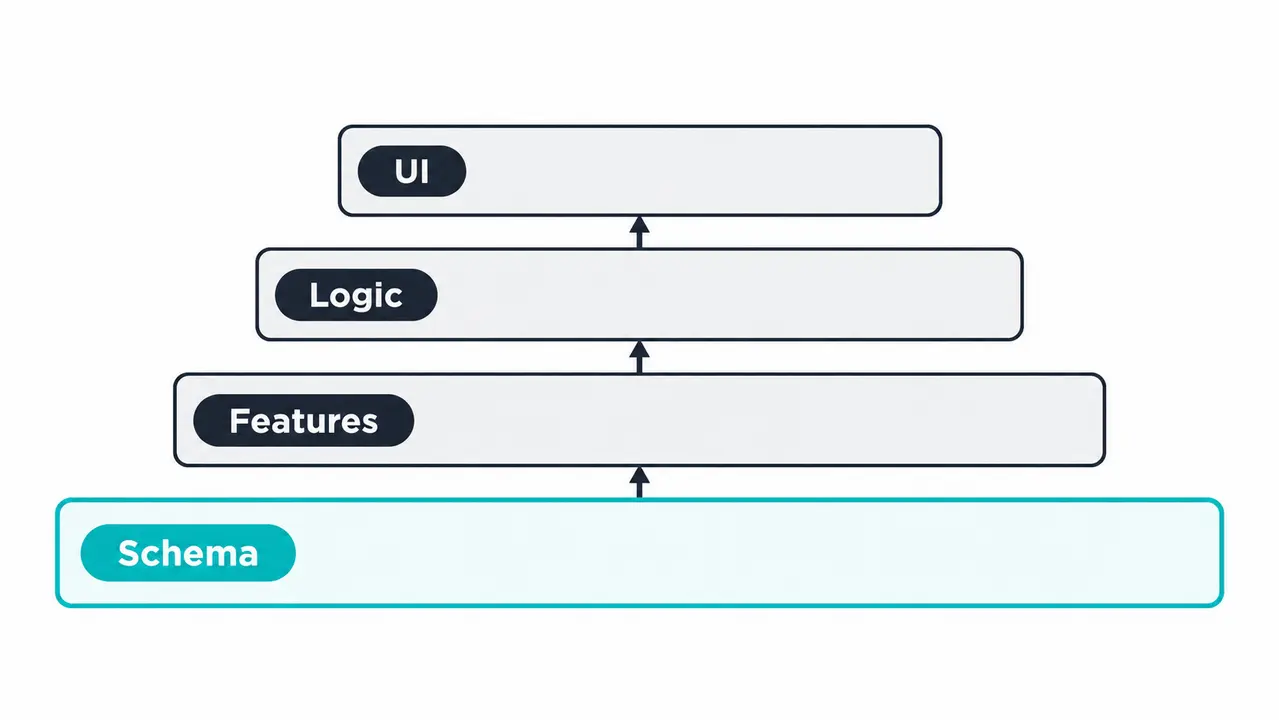
The data model is the product. The code can be refactored incrementally, the UI can be redesigned quarterly, but a schema decision compounds over time because every new feature builds on it. Requirements engineering guidance such as IEEE 29148 exists precisely because some decisions are one-way doors, and schema is the largest of them (Source: https://standards.ieee.org/ieee/29148/6937/).
Scaling fails on data when early shortcuts collide with new requirements. The single-tenant table that cannot support the enterprise customer’s request for isolation. The denormalized report view that breaks when the CFO asks for an audit trail. The free-text field that once held a name and now holds a name, a title, and a comma-separated list of permissions.
Establish four strategies early in the scaling phase. Tenant isolation, even if you only have one tenant today. Data migration, with a tested path from every schema version to the next. Backfills, so historical data matches new structures. Idempotent writes, because retries arrive with scale whether you plan for them or not.
Scaling quality without building a test pyramid nobody maintains
Quality scales when tests target the highest-risk behaviors and when the team agrees, in writing, on which critical paths must never break. That agreement is the foundation. Without it, every engineer writes tests for whatever they personally fear, and coverage becomes an accident rather than a strategy.
The practical shape is narrow. Contract tests for integrations, because integration boundaries are where MVPs rot first. Smoke tests for core flows, run on every deploy. A small set of end-to-end tests, no more than a dozen, covering the paths that generate revenue. Static analysis gates in CI, because catching a null dereference before merge costs nothing.
The failure mode is the flaky pipeline. When a test fails intermittently, engineers rerun it until it passes, and within a month the entire suite is treated as advisory. A red build that everyone ignores is worse than no build at all, because it manufactures false confidence. Delete flaky tests the day they flake, and fix the race they exposed.
The week a senior engineer leaves mid-transition
Run this test on your own team this week. If one departure could stall your scaling effort, the product is still in MVP mode, regardless of what the roadmap says. The knowledge is trapped in people rather than in artifacts, and people are the least durable storage medium you have.
The artifacts that matter are four. Architecture decision records, so the reasoning behind the queue choice survives the person who made it. Runbooks, so the incident path is documented and not remembered. An onboarding checklist, so a new engineer reaches first commit in days rather than weeks. A how-to-ship document, so the release process is a procedure rather than a tribal ritual.
We treat this as a prerequisite for effective technical team expansion, because adding engineers to a knowledge-trapped team increases the load on the very people whose departure you fear. The senior engineer spends their onboarding hours answering questions instead of shipping, and the risk compounds instead of diluting.
Need senior capacity for the hardening phase?
If your scaling window is shorter than your hiring pipeline, an embedded senior team can carry the hardening, observability and release work in parallel.
Team scaling without breaking engineering standards
Standards hold through a period of team growth when you define a small number of them and enforce them through automation rather than meetings. A standards meeting attended by fifteen engineers is a status ritual. A linting rule is a standard.
Pick the enforcement tools that remove human judgment from the routine cases. Automated linting and formatting, so style is never a review comment. CI gates, so a failing test blocks the merge without a discussion. A code review rubric, so reviewers evaluate against shared criteria instead of personal taste. A definition of done, enforced by rotating tech leads so it does not become one person’s hobbyhorse.
Keep the non-negotiable list short, five items at most. Standards that number in the dozens get ignored wholesale, and then you have neither compliance nor goodwill.
There is a carve-out. Early-stage spikes and exploratory work can bypass standards entirely if they are explicitly labeled, time-boxed, and isolated from the main codebase. Exploration dies when you make it carry production weight.
Product scaling that keeps the MVP focus intact
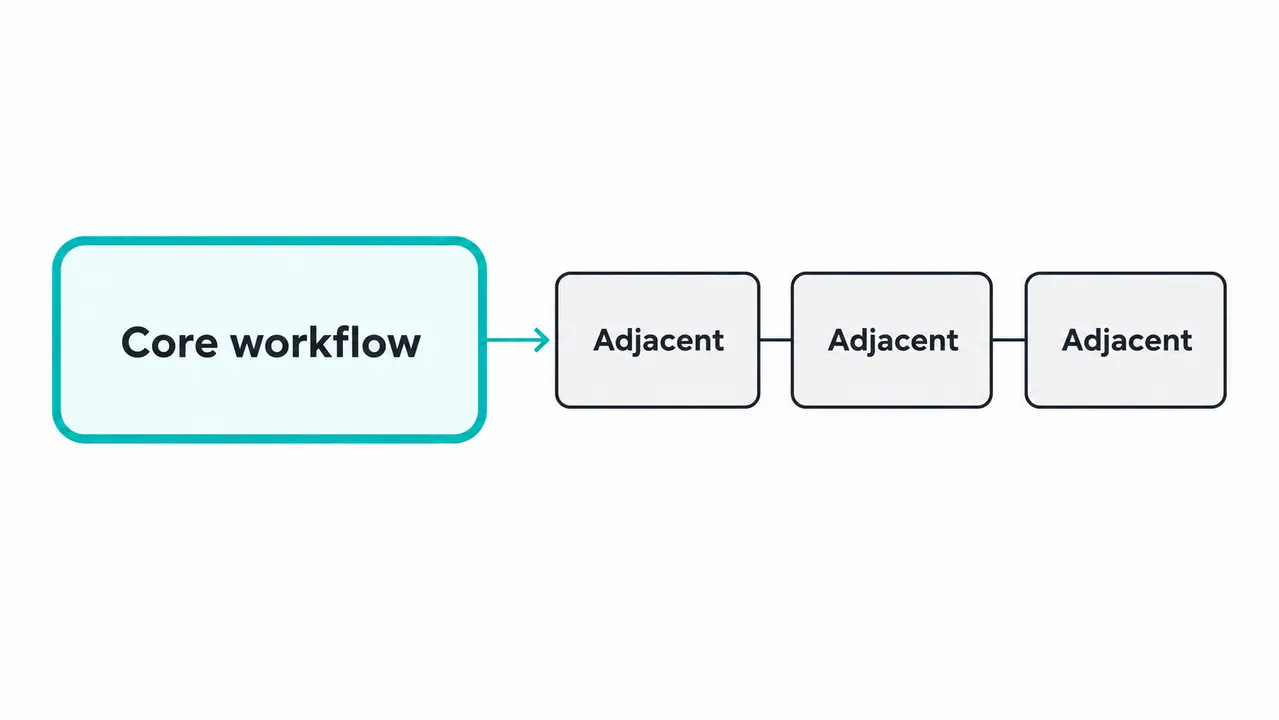
Product scaling works when the full product grows by deepening the core workflow first, then expanding to adjacent workflows. The alternative, adding disconnected features to satisfy individual deal requests, is how a focused product becomes a mediocre platform.
Map your expansion decisions to real evidence. Activation paths, drawn from where customers actually succeed rather than where you wish they did. Retention drivers, the specific behaviors that separate customers who stay from customers who churn. Expansion hooks, the points where existing customers asked for more of the same rather than something new. Anchor all three in deal language from discovery calls, because customers describe adjacency in their own words and those words are more reliable than your roadmap instincts.
Roadmap bloat is the quiet failure. Each disconnected feature increases system complexity without proportionally increasing customer value, and the complexity is permanent even when the feature is abandoned. Every feature you ship is a feature you maintain.
Growth strategy that matches the post-MVP reality
Your growth strategy scales when acquisition and onboarding are repeatable without founder intervention. Before that point, growth spending amplifies a leaky funnel rather than a working machine. Global software spending reached USD 675 billion by 2024 with projections close to USD 679 billion by 2027, which means your customers are being courted by everyone else building in the same market (Source: https://www.wipo.int/en/web/global-innovation-index/w/blogs/2025/global-software-spending). Undisciplined growth is expensive at that level of competition.
Build the operational link between growth and reliability. In-product guidance, so onboarding does not consume founder hours. Support playbooks, so the second support hire performs like the first. A sales engineering feedback loop, so what sales promises and what engineering ships stay synchronized.
Hardware-connected products follow a different curve. Growth may be constrained by manufacturing and field rollout cadence rather than software adoption, and planning around the software alone will mislead you. Teams handling embedded and IoT system builds face this constraint earliest and feel it longest.
Frequently asked questions
Do we need to rebuild our MVP to scale it?
Almost never. The working business logic in your MVP is the hardest thing you own, and a rebuild throws it away to solve problems that tighter module boundaries would fix at a fraction of the cost. Rebuild only when the original technology choice itself is the constraint, such as a platform that cannot support your required scale or integration model. Write down the specific constraint first. If you cannot name it precisely, you do not have one.
What should we standardize first, infrastructure or process?
Process, because infrastructure decisions made without a stable process get remade every time the process changes. Standardize your release path, review rubric, and definition of done first, typically within one or two sprints. Infrastructure standardization then follows a known workflow instead of fighting one. The exception is security basics, secrets management and access control, which belong in place before either.
When do microservices make sense?
When a specific module has scaling or deployment needs that diverge sharply from the rest of the system, and you can name the divergence. A reporting module that needs its own database, a real-time component with different availability requirements. Extracting one service from a well-structured modular monolith is a bounded project. Rewriting the whole system as microservices because a conference talk was compelling is a two-quarter stall.
How do we scale an MVP when we have both firmware and cloud?
Coordinate the release cadences explicitly, because firmware updates reach the field slower and less reversibly than cloud deploys. Treat the device API as a contract with versioning and a deprecation policy, and never let a cloud change assume a firmware version that is still rolling out. Design the cloud side to tolerate a range of firmware versions, since field devices will run a mixture for longer than you expect.
How do we know we are scaling too early?
Two reliable indicators. Retention that depends on manual intervention, founder onboarding or white-glove support, means the core loop is not self-sustaining. And a roadmap driven by individual deal requests rather than a repeated pattern across customers means demand is not yet confirmed. If either is true, additional engineers and infrastructure will increase your costs faster than your learning.
Your next scaling decision should be a single written bet
Write a one-page scaling brief. Name the one constraint you believe will block the next stage, the evidence for it, the sequence you will follow, and what you will deliberately not do this quarter. Then fund only the work that removes that constraint. Pick your bottleneck this week and commit to it.
About Sentice

Sentice is a boutique software engineering partner founded in 2013 by Roni Levi and Martin Petkovic, now headquartered in Skopje, North Macedonia. Rather than supplying individual developers, we build embedded teams that blend with a client’s culture, tech stack and goals, working together from a single office under our own technical leadership. We deliver dedicated software engineering teams, end-to-end software solutions, product development, and system and embedded engineering, and we act as technical advisors across the full development lifecycle, from specification and architecture through development, testing and support. We use AI coding tools across every project, and we help clients integrate AI into their own products through chatbots, MCP services, connected application layers and workflow automation. Some of the clients we started with more than a decade ago are still building with us today.