
You have the deck, the two-sided vision, and a roadmap with ninety-three tickets. Six weeks later you have profiles, search filters, a polished onboarding wizard, and zero completed transactions. That is the moment most platform MVPs die, and it is entirely preventable, because the failure was designed in at the scope table, not discovered in the market.
The teams that get this right build something smaller and stranger than a trimmed-down product. They build a transaction machine. Below we unpack what a platform MVP actually validates, where two-sided complexity breaks teams, and the concrete decisions that keep scope tight without stalling learning.
Reading time: 12 min
Key points
- A platform MVP validates a repeatable exchange between two participants, not a reduced version of the final product.
- Liquidity, measured as time-to-match, match rate, and repeat completion, is the real KPI, not signups.
- Manual ops is a strategic scope decision and the fastest route to a live exchange.
- Build thin vertical slices that each complete a measurable part of the exchange end to end.
Table of contents
A platform MVP means validating an exchange not shipping a smaller product
An MVP for platform businesses is not a reduced version of the final product. It is the smallest build that completes a real exchange between two participants and produces evidence that the exchange repeats. That distinction changes everything downstream, from your backlog to your analytics.
When our teams at Sentice scope a platform build, we start by mapping the exchange in one sentence: who provides what, to whom, and what closes the loop. Then we define six to ten analytics events covering the transaction, from listing created to match requested to completion confirmed. If an event does not trace back to the exchange, it does not ship.
The failure this prevents is the one we described above. Teams build user profiles and a beautiful interface with no reliable transaction path, and the product dead-ends the moment real users arrive with real intent.
The first scope decision is what you will do manually
Before writing a single user story, decide which parts of the operation humans will perform. Manual vetting of providers. Manual payout processing. Manual matching, even, in the first weeks. This is a scope control mechanism, and it is the single fastest way to reach a live exchange.
Draft a week one ops runbook before the first sprint. It assigns an owner and a response time to every manual step: provider vetting within 24 hours, payouts processed every Tuesday, dispute response within one business day. A runbook turns vague intentions into measurable commitments.
The alternative is building a full admin system before you have met a single real operational edge case. You will guess wrong, build the wrong controls, and burn weeks that should have gone to the matching logic.
Manual ops is a strategic decision. Treat it as one, review it deliberately, and automate only what real volume proves needs automating.
Where platform MVPs collapse under two-sided complexity
Launching two full experiences at once is the most common structural mistake in platform engineering. Supply, demand, and trust each need their own validation loop, and running three loops in parallel with a small team means none of them close.
The fix is variance reduction. Restrict the launch to one geography, one category, or even one neighborhood. A dog-walking platform that launches in two postal codes learns faster than one that launches nationally, because every variable except the one you are testing stays constant.
The failure mode is ugly and predictable. You onboard 20 providers in week three, but only 3 respond within the promised SLA. The 17 silent providers destroy the trust of your first buyers, and those buyers never come back to give you a second chance. You did not have a demand problem. You had a concentration problem you disguised as a growth win.
Liquidity is the real KPI and it is measurable early
Signups are a vanity metric for platforms. Liquidity is the real one, and you can measure it before you have any scale worth the name.
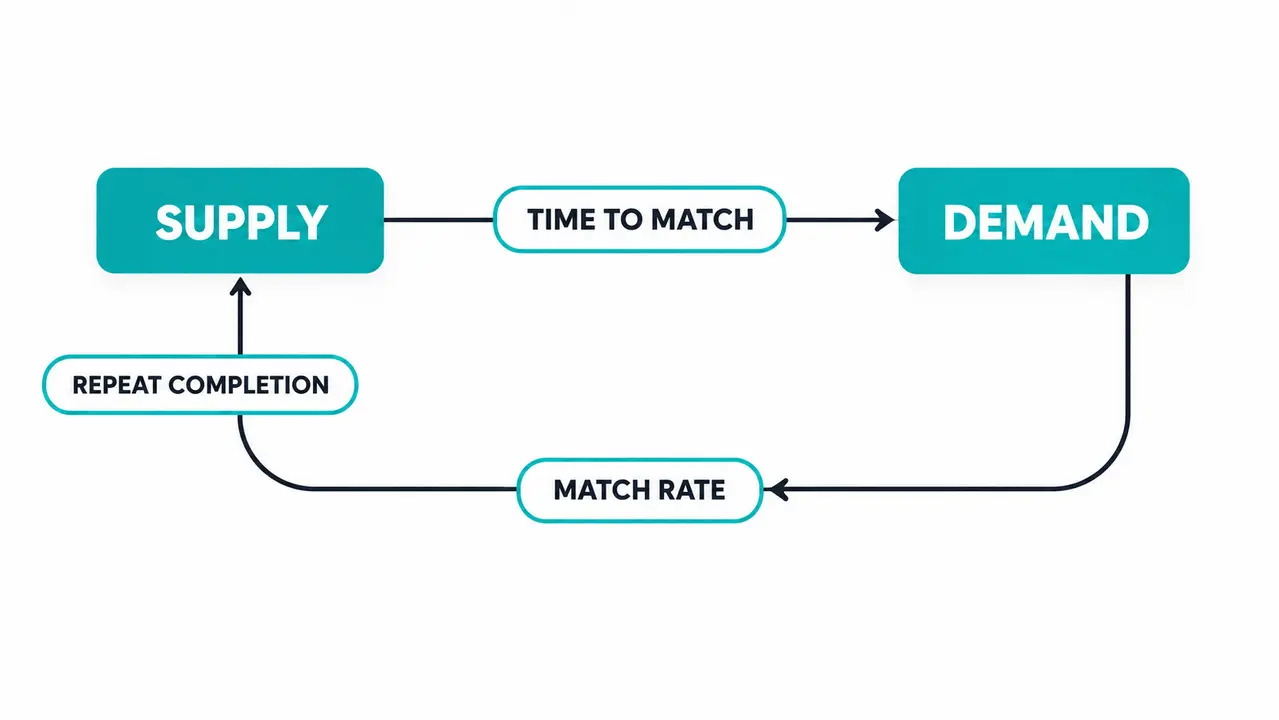
Track three numbers for a single segment: time-to-match, match rate, and repeat completion rate. Time-to-match tells you whether your supply is responsive. Match rate tells you whether your matching logic works. Repeat completion tells you whether the exchange was worth repeating, which is the only question that matters.
Set internal thresholds in advance. A match rate of 40 percent by week two and 60 percent by week six for your chosen segment gives the team a pass or fail condition instead of an endless gray zone.
Building these metrics takes real engineering capacity, and the pool is tight: Eurostat reports that the number of ICT specialists in the EU continues to grow. Budget for instrumentation as a first-class feature, not a cleanup task after launch.
A platform prototype is for comprehension an MVP is for behavior
A platform prototype tests whether users understand the workflow. An MVP tests whether they will complete real work under real constraints. Confusing the two is the most expensive sequencing error in platform delivery, because it sends engineering into a build before the value proposition is even legible.
The prototype phase should cost you design hours and a handful of moderated sessions, not sprints. Before any engineering work begins, establish a strict exit criteria checklist. If the prototype does not pass, iterate on the prototype. Engineering does not start until comprehension is proven.
The failure this prevents is quiet and large: spending three months building an MVP for a value proposition users did not understand in a two-week prototype phase. We have inherited codebases from exactly this mistake, and the salvage cost always exceeds the original build cost, because the ambiguity is baked into the data model.
Prototype exit criteria that reduce rework
Five criteria cover it. The user can explain the value proposition in their own words without prompting. The user finds the primary action without assistance. The user completes the demo flow end to end. Every objection raised during sessions is captured, categorized, and either addressed or consciously accepted. Every data field the flow requests has been validated against what users actually know and can provide.
The minimum feature set for a marketplace MVP is smaller than teams expect
A marketplace MVP needs exactly four capabilities: create a listing, discover a listing, transact, and complete with basic accountability. Everything else, including reviews, referrals, messaging, and multi-currency support, is a hypothesis you have not yet earned the right to test.
Use story mapping to isolate the spine. Lay out the full user journey, then cut every step that is not required for the exchange to complete. What remains is usually four to six critical paths, not ninety tickets. Teams that approach product development with this discipline routinely ship in half the time they originally estimated, because the estimate was for a product, not an MVP.
The overbuild failure is seductive. Reviews feel essential because every mature marketplace has them. Build them before you have real failure cases, and you will build the wrong review system, then rebuild it after your first genuine dispute teaches you what reviews are actually for.
Trust and safety starts as workflow design not policy pages
Nobody reads your terms of service. Trust is built through constraints and verification steps embedded directly in the user flow, not through policy text nobody opens.
Start with a simple abuse taxonomy. List the realistic threats for your exchange: fake providers, payment fraud, off-platform circumvention, spam listings, harassment. Map each threat to a specific product control or operational control. Verified phone number for fake providers. Escrow-style release for payment fraud. Visible platform value for circumvention.
Each control should add friction exactly where the threat lives and nowhere else.
The failure mode is retention collapse. Fraud and spam hit early users, those users churn, and the word spreads faster than any marketing you can buy. In-flow friction at the right moment is cheaper than a damaged reputation, and in a platform’s first months the reputation is the entire asset.
The smallest trust stack that still works
Three buckets cover the minimum. Prevent, using verification steps such as confirmed email, phone, and a government ID check for providers handling money or entering homes. Detect, using structured logs and alerts on anomalous behavior, such as a provider completing transactions three times faster than the segment median. Respond, using a refund and dispute runbook with a named owner and a committed response time. Every bucket needs at least one live control before launch, and each control needs a test to prove it fires.
Payments belong in the MVP only when money is the product
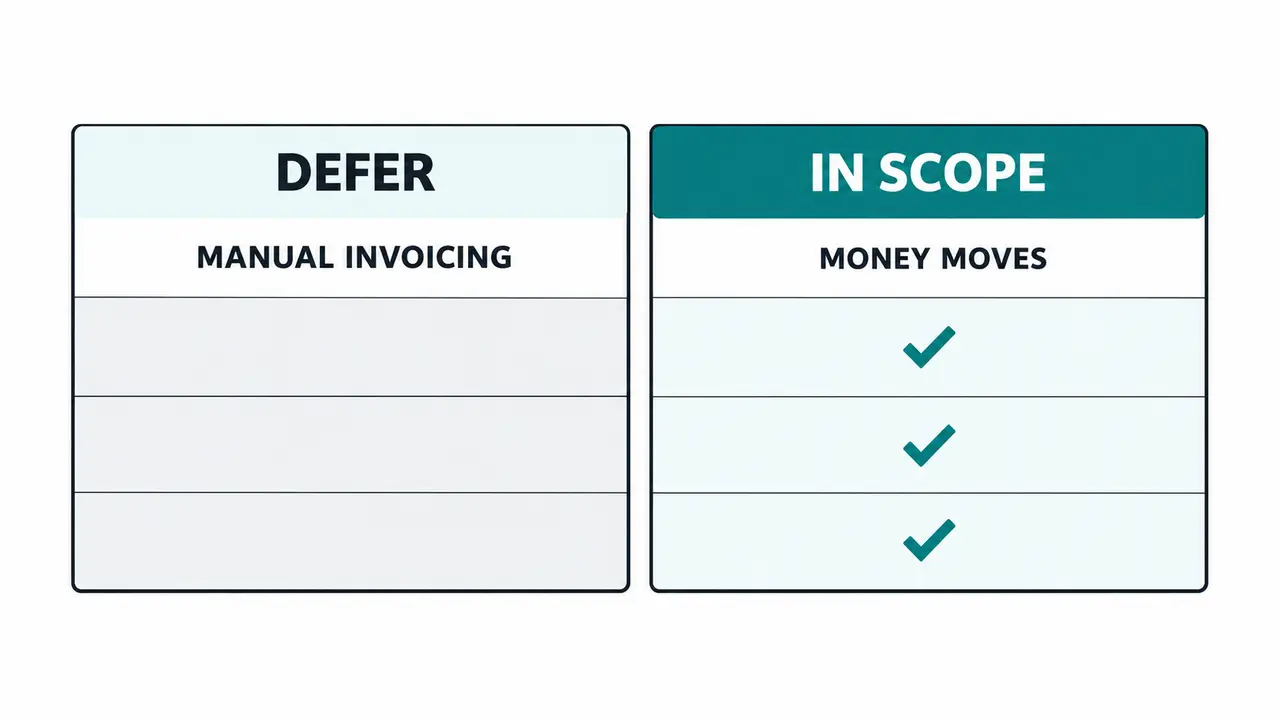
There is one honest test for whether to build payments into the MVP. Is payment completion the core proof of value for your platform? If the transaction only counts when money moves through the system, payments are the product and belong in scope. If the exchange can stabilize with manual invoicing, they do not.
When you do build payments, define the risk scenarios before integration: refunds, chargebacks, partial fulfillment, and the split-payout case where the platform takes a fee. Each scenario needs an owner and a resolution path, because payment providers will not design your dispute policy for you.
Teams that integrate complex gateways too early delay the launch of their core matching logic by weeks or months, all for a feature a spreadsheet and a Tuesday invoice run could have covered. Defer payment automation until the core exchange logic is stable and boring. That is the verdict, and the exceptions are rare enough to name individually.
A SaaS MVP is one workflow a platform MVP is two workflows that meet
A SaaS MVP validates repeated use for one user type. A platform MVP validates coordination between two user types who want different things from the same transaction. Treating platform planning as simple SaaS delivery is how experienced teams end up under-scoped and surprised.
Document the conflict explicitly in your product requirements document. Buyers want speed, instant availability, and low commitment. Providers want control over scheduling, pricing, and which jobs they accept. Every matching rule you design is a decision about whose preference wins, and if the PRD does not state it, engineers will resolve the conflict by accident.
Delivering these full workflows, with trust, ops, and matching layered on top of each other, is exactly the kind of scope where end-to-end software solutions earn their keep, because the seams between the two sides are where the delivery risk concentrates and where fragmented ownership shows first.
| Aspect | SaaS MVP | Platform MVP |
|---|---|---|
| What it validates | Repeated use for one user type | Coordination between two user types who want different things from the same transaction |
| Number of workflows | One | Two, and they meet |
| Planning risk | Treating it as simple SaaS delivery leaves teams under-scoped and surprised | Delivery risk concentrates in the seams between the two sides, where fragmented ownership shows first |
| What the PRD must state | The repeated-use workflow for the single user type | The conflict between buyer and provider preferences, so engineers do not resolve it by accident |
Choosing which side to build first depends on who feels pain today
Build the side with motivated early adopters and an urgent, budgeted pain. Not the side that is easier to build. Not the side with the larger long-term market. Urgency with a budget attached is the only reliable predictor that a first cohort will actually transact.
Run a 30-day side simulation before building anything. Your internal team acts as the counterpart: if you build for demand first, your team manually sources and vets supply behind the scenes, using spreadsheets and phone calls. Thirty days of simulated operations tells you the real response times, the real edge cases, and whether the demand side converts when supply exists.
Building both sides simultaneously fails because neither reaches liquidity. The exchange stalls on an empty market, and the team cannot tell which side is broken. One side, deliberately simulated, gives you a controlled experiment instead of a coin flip.
Side-first patterns that work in practice
Three patterns cover most launches. Concierge demand means the team fulfills demand manually while the supply side is a private operation, which validates willingness to pay first. Curated supply means hand-recruiting a small, verified provider pool and restricting demand to a waitlist, which validates exchange quality first. A single-tenant platform-in-a-box means building the whole workflow for one anchor customer who pays for exclusivity, which validates the business model first. Pick the pattern that matches where your urgency lives, and hold it for at least one full transaction cycle before switching.
Web-first MVPs reduce risk when the platform is still moving
Default to web-first while onboarding and admin workflows are still changing weekly. A responsive web app ships fixes in minutes. A native app ships fixes after a review queue you do not control.
Choose mobile only when the core action fails without mobile-native capabilities. Gig response SLAs measured in minutes, where a push notification is the difference between a matched job and a lost buyer. Scanning capabilities, barcode or document capture, that a camera web view cannot deliver reliably. Location tracking in the background. If none of these describe your primary action, mobile is a liability at this stage.
We have watched teams wait two weeks for an app store approval while iterating on an onboarding flow that needed four revisions in ten days. The verdict is simple. Choose web-first unless the primary action genuinely fails without mobile-native capabilities, and when in doubt, the doubt itself is your answer.
The data model is the platform and it needs early discipline
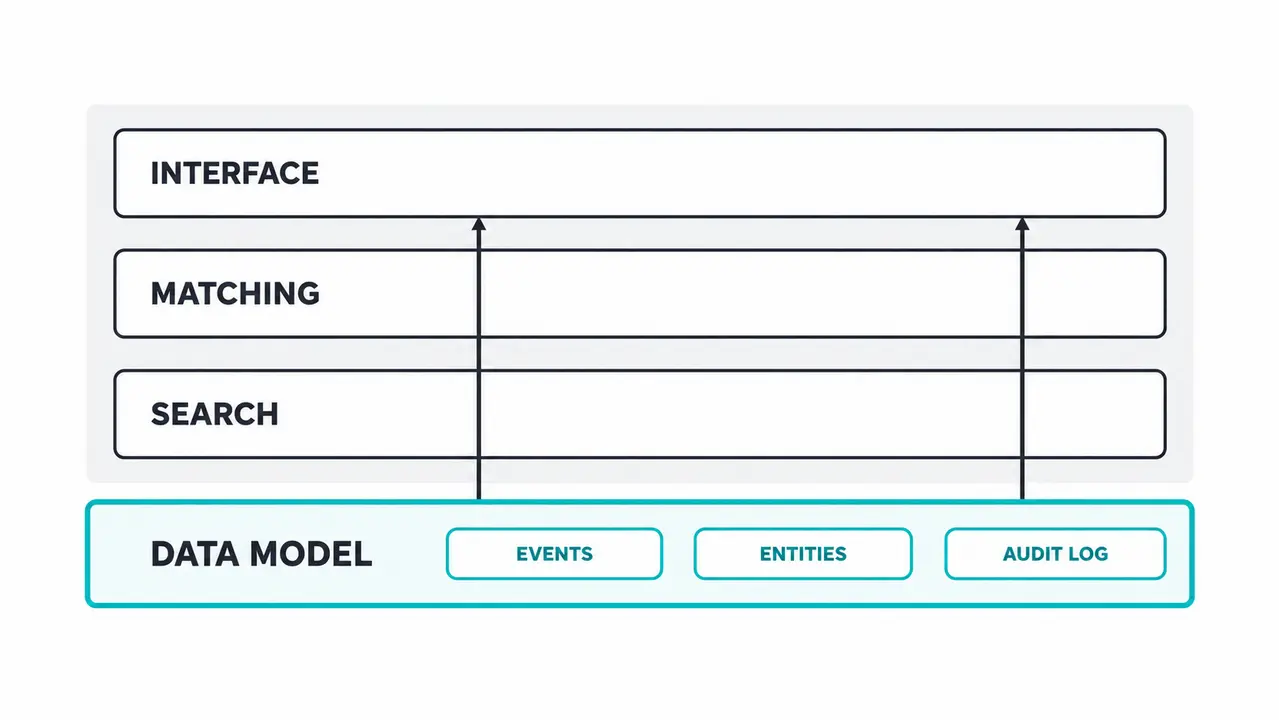
A platform’s data model is the platform. The UI is a skin over entities and relationships, and the model you ship first will constrain your matching, your search, and your audit trail for years.
Treat the first version as stable enough to support three things without constant migrations: search across listings, matching between the two sides, and auditability of every state change. Define an event schema and an audit log requirement from day one, written into the API contract so it survives team turnover. When a dispute lands in month three, the event timeline is the only honest record of what happened.
The failure mode is a rebuild. Core entities left ambiguous, “user” doing double duty for buyer and provider, listing conflated with availability, force a rewrite of the matching algorithm after launch. That rewrite costs more than the discipline ever did, and it happens while live users are waiting on fixes.
Admin tooling is part of the MVP because ops is part of the product
The minimum admin panel supports four functions: user management, listing moderation, transaction visibility, and basic issue resolution. Skip any one of them and your ops runbook becomes a lie by week two.
Define the specific admin actions before building. Suspend a user. Edit or remove a listing. View a timeline of events for a single transaction. Issue a manual refund or credit. Each action maps to a line in your runbook, and the runbook tells you the response time the tooling must support.
The failure arrives in week three, when a dispute lands in support and no single source of truth exists for the engineering team to investigate. Reconstruction from raw database queries takes days, the customer waits, and the ops team quietly loses faith in the tooling. Ship the admin panel with the MVP, ugly is fine, absent is not.
Where teams underestimate onboarding and activation
Onboarding is not a form. It is a sequence of commitments, each one tied to reaching the first successful exchange, and for a two-sided platform you need two sequences, not one.
Instrument drop-off at every step. Provider document upload, availability setting, first listing. Buyer search, first request, payment commitment. Run a weekly review with the product and engineering leads, and treat any step losing more than a fifth of users as a defect, not a design preference.
The bar is rising. Eurostat’s interactive publication on the digitalisation of European businesses tracks how quickly digital expectations are climbing across sectors, and your early users judge your onboarding against every polished consumer product they touched that week. Activation stalls when required steps are unclear or simply too long for providers who signed up during a lunch break.
A platform MVP still needs production basics to avoid false negatives
An MVP must be reliable. Performance problems and security gaps block users, and blocked users look identical to absent demand. The most expensive wrong conclusion in platform building is calling a market failure when the real problem was an unstable system dropping requests.
Define launch readiness as an engineering-owned checklist. Error monitoring with Sentry or an equivalent. Basic service level objectives for the transaction path. A rollback plan for every deploy. The checklist is short, and it is not optional.
Reliability matters even more when the platform touches sensitive domains. Our work on IoT and healthcare platform success stories shows what production discipline buys you: users who trust the system enough to come back, which is the entire point of an MVP.
The minimum reliability checklist for an MVP
Eight items cover the floor. Monitoring with dashboards on the transaction path. Alerting that pages a human when matching fails. Structured logging with request IDs for every event. Automated backups with a tested restore. A rollback plan rehearsed before launch, not after the first incident. Permissions reviewed so no admin route is publicly reachable. Data validation on every write to core entities. And a named incident owner, a specific person with a phone number, for launch week.
The build plan that keeps scope tight without stalling learning
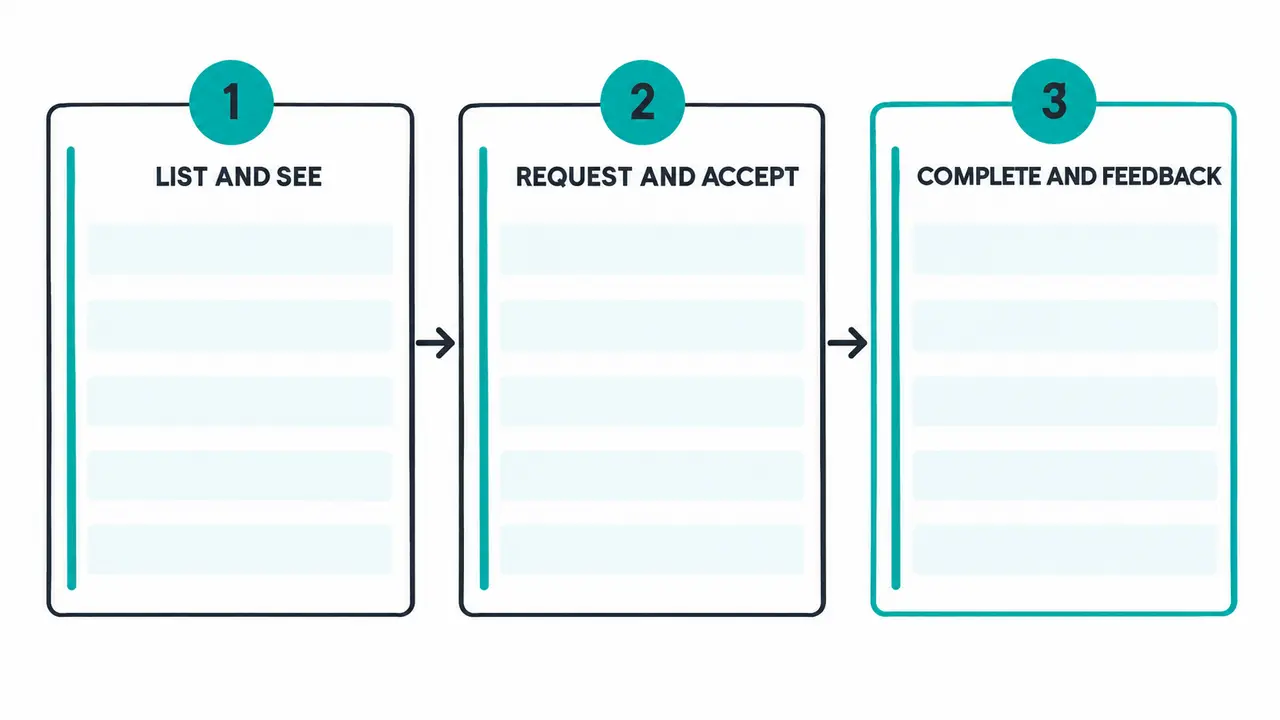
Build the MVP as a sequence of thin vertical slices, where each slice completes a measurable part of the exchange end to end. Slice one: a provider can list and a buyer can see it. Slice two: a buyer can request and a provider can accept. Slice three: completion and feedback capture. Each slice touches every layer, from database to UI, and each one produces evidence.
Run two-week increments. Every increment ends with a demoable outcome and an analytics review that includes the QA and DevOps leads, not just product and engineering. The QA lead knows where the edge cases hide, and the DevOps lead knows whether the instrumentation actually fires.
The alternative is the horizontal build: all profiles, then all search, then all messaging, with no real user action for months. It feels productive and produces zero validated learning, which is the one outcome an MVP exists to prevent.
MVP success criteria should be written before the first sprint
Define success as observable behavior and operational feasibility, never as feature completion, and write it down before development starts. A success criterion nobody wrote down is a debate waiting to happen in week eight, when the team is tired and the pressure to declare victory is highest.
Create a one-page MVP scorecard. It holds your liquidity thresholds, your completion rate target for the first cohort, your ops response times, and the conditions under which you would stop or pivot. Review it weekly with product and engineering together, and let the scorecard, not the loudest voice in the room, settle the pass or fail question.
Without it, the MVP drifts into a full platform build, because “one more feature” always sounds reasonable in isolation. The market pressure is real: the Eurostat digitalisation report for 2025 documents how fast European businesses are moving on digital channels, and proving platform value quickly is now table stakes.
The next step is a scope workshop that produces buildable artifacts
Treat the platform MVP as an engineering and operations system, not a UI milestone. Align on the exchange, the manual ops plan, and the MVP scorecard in a single workshop, then turn that alignment into a thin-slice backlog with instrumentation baked into every slice. Build the smallest version that completes the exchange twice with real users, without heroics. Everything else can wait, and most of it should.
Scope your platform MVP with engineers who have shipped them
Bring your exchange definition and your roadmap. We will help you cut it down to the slices that produce evidence first.
Frequently asked questions
Can we launch a platform MVP without reviews?
Yes, and most early platforms should. Replace reviews with provider verification, curated supply, and visible accountability signals inside the workflow itself, such as response times and completion counts. Reviews only carry weight once transaction volume makes them statistically meaningful.
What is the difference between an MVP and a pilot for a platform?
A pilot is a controlled rollout to a defined cohort that proves operational readiness under known conditions. An MVP is the smallest product that generates validated learning from real, unconstrained usage. You can pilot an MVP, but the two answer different questions.
How do we avoid building platform infrastructure too early?
Start with one exchange, one segment, and one set of roles. Generalize only after the same exchange has repeated across multiple cohorts without manual heroics. Infrastructure built before repetition is guesswork with a deployment pipeline.
What should we document before engineering starts?
Four artifacts are enough. A one-page exchange definition, a roles and permissions matrix, the core entity model, and the week one ops runbook. Anything longer usually means the scope conversation is not finished.
When is it time to rebuild the MVP into a real platform?
Rebuild when three conditions hold at once: the exchange repeats predictably, the ops load is predictable enough to cost automation accurately, and product constraints genuinely justify the investment. Missing any one of the three means you are optimizing a guess.
Who should own the scorecard during the build?
Joint ownership between product and engineering works best, with one named referee, usually the CTO or the delivery lead, who breaks ties. A scorecard owned by a single function gets ignored by the other one the moment pressure arrives.
About Sentice

Sentice is a boutique software engineering partner founded in 2013 by Roni Levi and Martin Petkovic, now headquartered in Skopje, North Macedonia. Rather than supplying individual developers, we build embedded teams that blend with a client’s culture, tech stack and goals, working together from a single office under our own technical leadership. We deliver dedicated software engineering teams, end-to-end software solutions, product development, and system and embedded engineering, and we act as technical advisors across the full development lifecycle, from specification and architecture through development, testing and support. We use AI coding tools across every project, and we help clients integrate AI into their own products through chatbots, MCP services, connected application layers and workflow automation. Some of the clients we started with more than a decade ago are still building with us today.