
The demo went fine. Then a stakeholder asked which assumption the release had actually tested, and the room went quiet. We have sat in that room more than once, usually about eight weeks after a scope conversation where “MVP” meant “everything we could fit before the board meeting.” The product shipped, the usage dashboard filled up, and nobody could say whether the riskiest bet had paid off. That failure is almost never an engineering failure. It starts earlier, in the way features get defined. Teams argue about screens and priorities before anyone has written down what the release is supposed to learn. Fix the definition and most of the downstream arguments shrink to a manageable size. Below, we’ll unpack how to anchor an MVP in its riskiest assumption, define features as capabilities rather than screens, draw scope boundaries that hold, and run prioritization and scope reviews that stop creep in real time.
Reading time: 11 min
Key points
- An MVP feature definition is done only when engineering, QA and the business can each work from the same document.
- Start from the riskiest assumption, not from the product vision trimmed to fit a timeline.
- Define features as capabilities with observable results, never as screen names.
- A one-page boundary document with an explicit out-of-scope list, defended in a weekly review, is what keeps the release date intact.
Table of contents
What an MVP feature definition must accomplish for engineering
An MVP feature set is fully defined only when three different groups can each do their job from the same document. Engineering can build it without inventing missing decisions. QA can test it without chasing clarification through Slack threads. The business can measure whether the release proved the riskiest assumption. If any of the three fails, the definition is not done, no matter how polished the deck looks.
In practice, knowing how to define MVP features means producing three distinct outputs before a line of code gets estimated: a single learning goal written in one sentence, one primary user journey, and a bounded scope list with explicit exclusions. The exclusions matter more than the inclusions, because they are what every later argument gets measured against.
Anchor all of it in a one-page MVP scope document, a thin product requirements document, and clear acceptance criteria per capability. The alternative is a smaller version of a full product that generates ambiguous data and teaches you nothing.
Starting from the riskiest assumption instead of the biggest idea
Most MVP scoping starts from the product vision and works downward, trimming features until the timeline fits. That direction produces a smaller version of the full product, not a minimum viable product. The features end up chosen for completeness rather than for learning, and the release answers no question cleanly.
Work in the opposite direction. List the assumptions that kill the company if they turn out false: users will switch their existing workflow, the data you need is actually available, the integration is technically feasible at acceptable latency. Rank them by how much damage a wrong answer does. The riskiest one becomes the learning goal, and the minimum viable product features are the smallest set of capabilities capable of falsifying it.
Write the goal as a single hypothesis sentence, formatted plainly: “We believe X user will do Y because Z.” If you cannot fill in that sentence, you are not ready to define features. Every capability that does not touch the hypothesis is decoration around an untested core.
The one user journey that earns the right to exist
An MVP should contain exactly one end-to-end journey that delivers a real outcome for a specific user. The edges of that experience can stay manual, handled over email or by a founder doing the work by hand. End-to-end means the full sequence exists: an entry point, a core action, delivery of the result, and a defined way to recover when something fails. A journey that stops at “user clicks the button and then we figure it out” is not end-to-end, and it will produce exactly that ambiguity after launch.
Standard B2B user journey mapping patterns give you a concrete shape to copy: invite a teammate, connect a data source, run the first job, view the result. Four steps, one outcome, one measurable funnel.
Two-sided networks are the exception. They may need two journeys, supply and demand. Even then, pick one primary learning goal, because measuring both halves at once tells you nothing about either.
Turning user problems into feature candidates without brainstorming noise
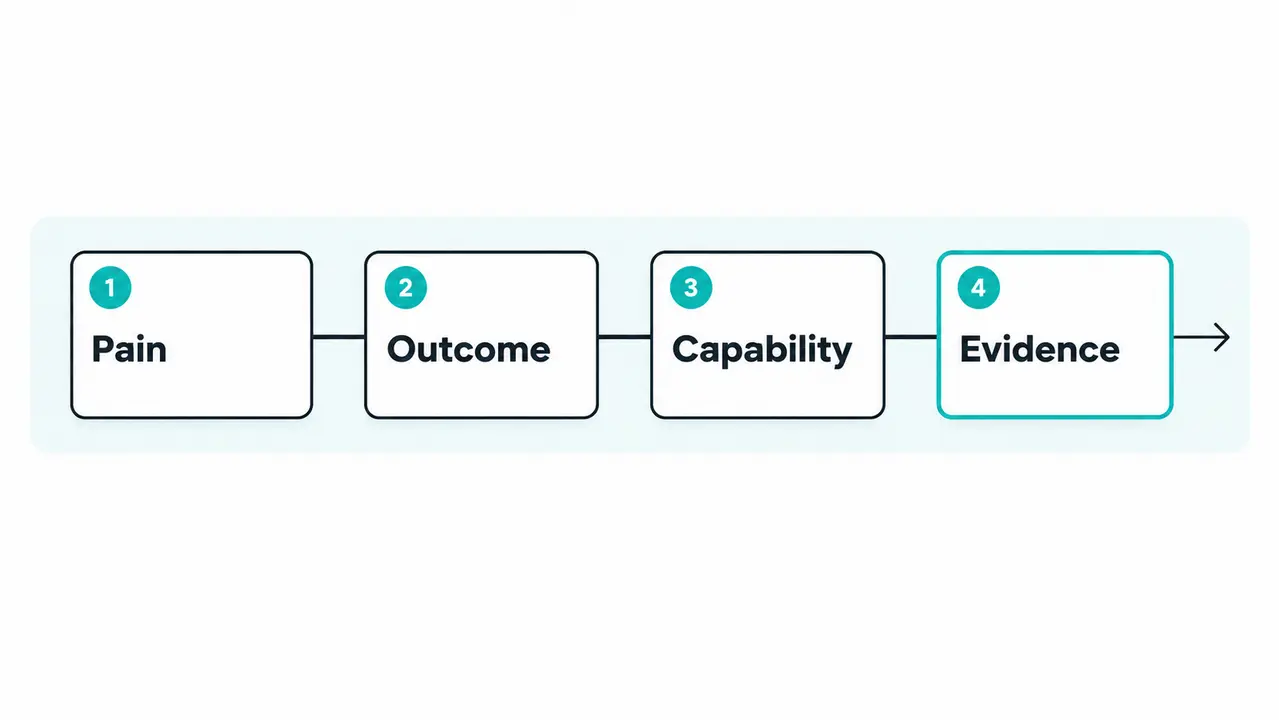
Discovery interviews produce pages of notes, and the standard next step is a brainstorming session that converts those notes into opinions. The loudest voice in the room ends up shaping the backlog. That is the discovery-to-delivery handoff failing quietly, and it happens because nobody defined a translation method.
Use a mechanical one instead. Take a pain statement from the interview notes. Define the desired outcome the user described in their own words. Specify the minimal capability that produces that outcome. List the evidence you would need to confirm the capability worked. Four steps, no opinions required. This is where discovery vs delivery stops being a slogan and becomes a worksheet.
Structure every feature candidate the same way: a specific user can complete a specific task and receive a specific result under known conditions. “Analysts can export a filtered report as CSV with the fields they named in interviews” is a candidate. “Better reporting” is a wish. Feature prioritization applied to wishes produces noise, and the roadmap inherits it.
The minimum lovable path versus the minimum viable path
Teams argue about whether an MVP needs polish without defining what the polish is for. The distinction that settles it is measurement, not aesthetics. A minimum viable path proves the core value proposition. A minimum lovable path reduces friction enough that users actually complete the journey and generate feedback you can trust. If users abandon at step two because the onboarding is hostile, you learn nothing about the value proposition, only that your funnel is broken.
Apply lovable standards selectively. Self-serve onboarding and low-touch B2B products, where activation is the primary learning metric, usually need the friction removed. A concierge MVP does not, because a human walks each user through the rough parts by hand. Sales-led pilots and internal tools sit in the same category.
The verdict is simple. Add lovable elements only where UX friction directly blocks the measurement you need. Polish everywhere else is spending validation budget on appearance.
Defining MVP features as capabilities not screens
The fastest way to break an engineering estimate is to hand the team a list of screens. “Dashboard” looks like one feature. Underneath it sits a data model, permissions logic, aggregation queries, performance tuning, and event tracking, each of which is a separate engineering decision hiding behind a single noun. Requirements gathering done in UI language guarantees the estimate is wrong in one direction only: down.
Write capabilities instead. Capabilities are actions with observable results. “Export a report to CSV with defined fields” tells engineering what data must exist, what the output contract is, and what QA will check. “Audit log records changes to entity rules with actor and timestamp” tells them the event schema up front. Screen names tell them nothing.
When teams later scale these capabilities into a full product, many rely on end-to-end product development to keep the architecture coherent. The failure this prevents is expensive: data structures emerging in week six that force a rebuild of everything built in weeks one through five.
Where teams accidentally build infrastructure instead of an MVP
Engineering teams overscope MVPs through good intentions, not laziness. Multi-tenancy feels like an obvious requirement. A generalized workflow engine feels like saving future effort. A custom analytics dashboard feels like the instrumentation the team will need anyway. Each one is a platform investment disguised as a feature, and each one adds weeks before the first user sees anything.
Recognize the traps by their shape: anything built for users who do not exist yet. Choose engineering-friendly alternatives deliberately. Hard-coded onboarding paths instead of a configurable engine. Two user roles instead of a permissions framework. One integration instead of an adapter layer. Off-the-shelf telemetry from your cloud provider instead of a custom pipeline.
Teams that keep this discipline often use dedicated software engineering teams precisely because an embedded team that owns the delivery date will push back on platform work that does not serve it. One counter-case: regulated or safety-critical environments require baseline controls early. Tighten those, keep the product scope narrow anyway.
A practical definition of MVP scope boundaries
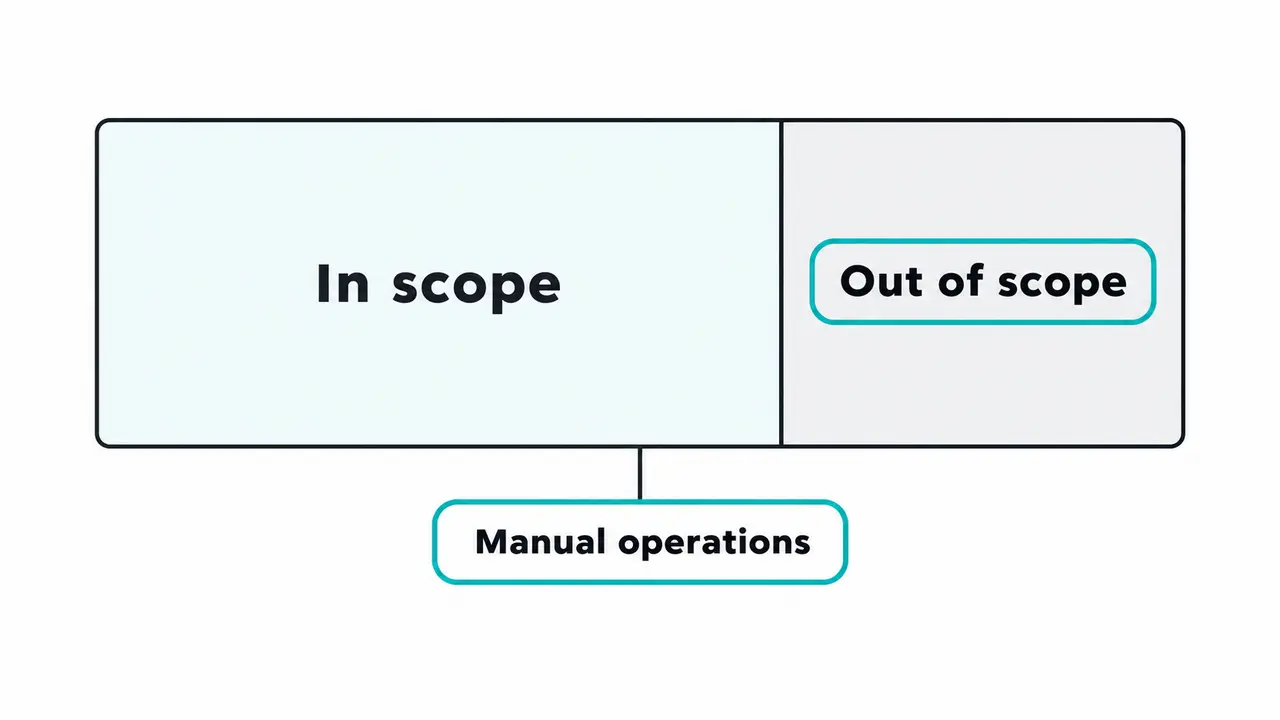
MVP scope is not a list of features. It is a boundary document, and its job is to state three things: what is in the build, what is out of the build, and what processes stay intentionally manual. The manual section is the one teams skip, and skipping it is what turns scope creep into a debate rather than a decision.
Keep it to one page. Seven sections are enough: persona, core journey, in-scope capabilities, out-of-scope list, manual operations, assumptions, success metrics. The MVP scope document should be readable in five minutes by someone who has never attended a planning meeting, because that person will eventually be your newest engineer.
The out-of-scope list does the heavy lifting. Review it in every planning session, out loud. A thin slice with a defended boundary survives contact with stakeholders. A feature list without one accumulates “small improvements” silently until the release date moves and nobody can name the decision that moved it.
Prioritizing features with a two-gate test
Forget must-have versus nice-to-have for a moment. Those labels measure importance, and importance is exactly the wrong axis for an MVP. The right axis is necessity, tested through two gates applied in order.
Gate one: can the user reach the desired outcome without this feature? If yes, the feature is out. Gate two: can the team validate the learning goal without it? If yes, the feature is out again, even if it passed the first gate. A feature belongs in the MVP only if it fails both gates, meaning the journey breaks without it and the measurement breaks without it.
The table shows how common requests typically land.
| Requested feature | Gate one, journey blocked | Gate two, measurement blocked | Verdict |
|---|---|---|---|
| Email notifications | No | No | Post-MVP backlog |
| Admin panel for user management | No | No | Post-MVP backlog |
| Core workflow execution | Yes | Yes | In MVP |
| Instrumentation events for key steps | No | Yes | In MVP |
| Advanced filters on results view | No | No | Post-MVP backlog |
Stakeholder popularity confers no pass through either gate. Popular requests that fail move to the backlog with a date, which is what makes the rejection survivable politically.
Using MoSCoW without letting Must become everything
MoSCoW prioritization fails in MVPs for a predictable reason. Every stakeholder labels their own preference as Must, because Must is the only category guaranteed to ship. Six weeks later, Must contains forty items and the acronym has added nothing.
Constrain the category instead. Must means the user journey physically breaks without the feature. Not important, not strategically valuable, not requested by the CEO. Broken. Tie every Must item to the learning goal in writing, next to the item itself. If the tie cannot be written, the item is a Should.
Define Won’t with equal precision. Won’t means explicitly excluded from this release, named in the boundary document, with a review date. A vague “later maybe” is where scope creep hides, because nobody ever argues against later. One useful pattern from engineering culture is the walking skeleton: build the thinnest end-to-end path first, then thicken it. The skeleton defines your Must list for you.
RICE scoring that does not collapse under guesswork
RICE scoring multiplies reach, impact and confidence, then divides by effort. With no users, reach is a guess, impact is a guess, and confidence is optimism wearing a number. Teams run the arithmetic anyway and treat the output as evidence. It is not evidence. It is opinion with decimal places.
You can still use it honestly. Estimate reach from pilot commitments in the sales pipeline, signed design partner counts, or internal dogfooding cohorts. Score impact against the learning goal rather than business value in the abstract. Treat the Confidence metric as a forcing function: anything below high confidence becomes a candidate for a prototype or a discovery spike, not a build task in the MVP.
Sequence matters more than the scoring itself. Set the MVP boundary first, using the two-gate test and the hypothesis. Run RICE during backlog grooming on the post-MVP list, where it ranks validated work instead of inventing a fake boundary. Used in that order it earns its place. Used first it replaces the boundary decision with arithmetic.
Writing product requirements that engineering can estimate
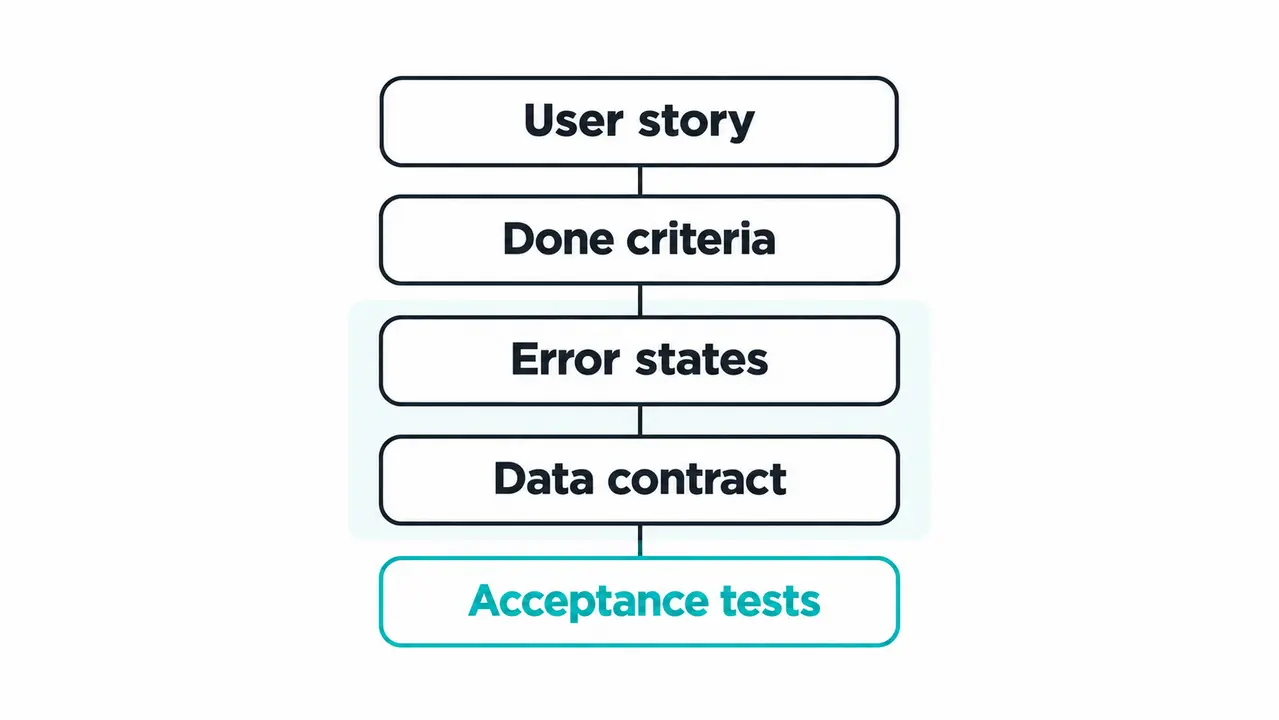
A requirement is estimable when an engineer can size it without a follow-up question. Most MVP requirements fail that test. “Users can manage their profile” is not a requirement, it is a topic. The estimate it produces is a placeholder that will be revised twice.
Each capability needs a specific package: a user story, a definition of done, the error states, the data inputs and outputs, the permissions model, the performance envelope, and the observability events the feature must emit. That last item is the one teams forget, and its absence is why post-launch analysis stalls. Write acceptance criteria as testable statements that a QA engineer can execute without asking anyone anything. “Given a CSV with three malformed rows, the import succeeds for valid rows, logs the failures with reasons, and shows a summary” is executable. “Import handles errors gracefully” is not.
The mindset to kill is “we will figure it out in development.” Development figures it out at the schedule’s expense, every time.
The MVP requirements stack that prevents rework
One giant PRD is where MVP requirements go to die. It becomes the document everyone quotes and nobody reads, versioned in filenames, contradicted in meetings. A small stack of focused documents with named owners works better, because ownership is what keeps a document current.
The stack needs six artifacts: the one-page scope, the journey map, the prioritized backlog, the API and data contracts, a test plan outline, and an instrumentation plan. Product owns the scope and the metrics. Engineering owns the contracts and any architecture notes. QA owns the test strategy. When each document has one owner, disagreements surface as document conflicts rather than hallway arguments.
The API and data contracts deserve special mention, because they are the artifacts most often deferred. Agreeing on schemas for the three or four core entities in week one, even roughly, in Swagger or a shared Confluence page, removes the single largest source of mid-build rework. Very small teams can merge the stack into one file, but keep the same sections or details will quietly vanish.
Instrumentation that makes MVP learning unambiguous
An MVP without instrumentation is a release without evidence. You will ship it, users will use it, and six weeks later the team will hold a meeting where three people interpret the same ambiguous signals in three contradictory ways. We have watched that meeting. Nobody enjoys it.
Write the event tracking plan before the build starts, not after launch when retrofitting events means another deploy cycle. Define three to five key metrics tied directly to the user journey: activation rate, time-to-first-value, journey completion rate, a retention proxy, and error rate on the core path. Then specify the events themselves, with names and properties, in the instrumentation plan. Something like “job_completed” with properties for duration, input size, and success status.
Map the funnel on paper: invited, signed up, connected source, ran first job, viewed result. Five steps, each with a validation threshold set in advance. Thresholds set before launch are validation metrics. Thresholds set after launch are rationalizations.
Handling integrations and data dependencies in MVP scope
Integrations are where MVP scopes quietly double. Every stakeholder names a different system the product “obviously” needs to connect to, and each one carries auth flows, edge cases and rate limits that nobody scoped. The rule that holds: an integration belongs in the MVP only when the core outcome cannot be delivered without it and it cannot be safely simulated.
Climb an options ladder for data dependencies. Mock data first, for internal testing. CSV import second, which validates the data shape with real user files. One real integration third, the one your design partner actually uses. A broader ecosystem is a v1 problem, not an MVP problem.
For whichever integration makes the cut, define one happy path and one failure path: auth expiry, missing required fields, rate limiting. Three half-working integrations destabilize the system and block learning. One integration executed well beats them all. When hardware or low-level components are involved, system and embedded engineering constraints often dictate what integration is even possible, so check before the scope document promises it.
The security and access baseline that keeps MVPs shippable
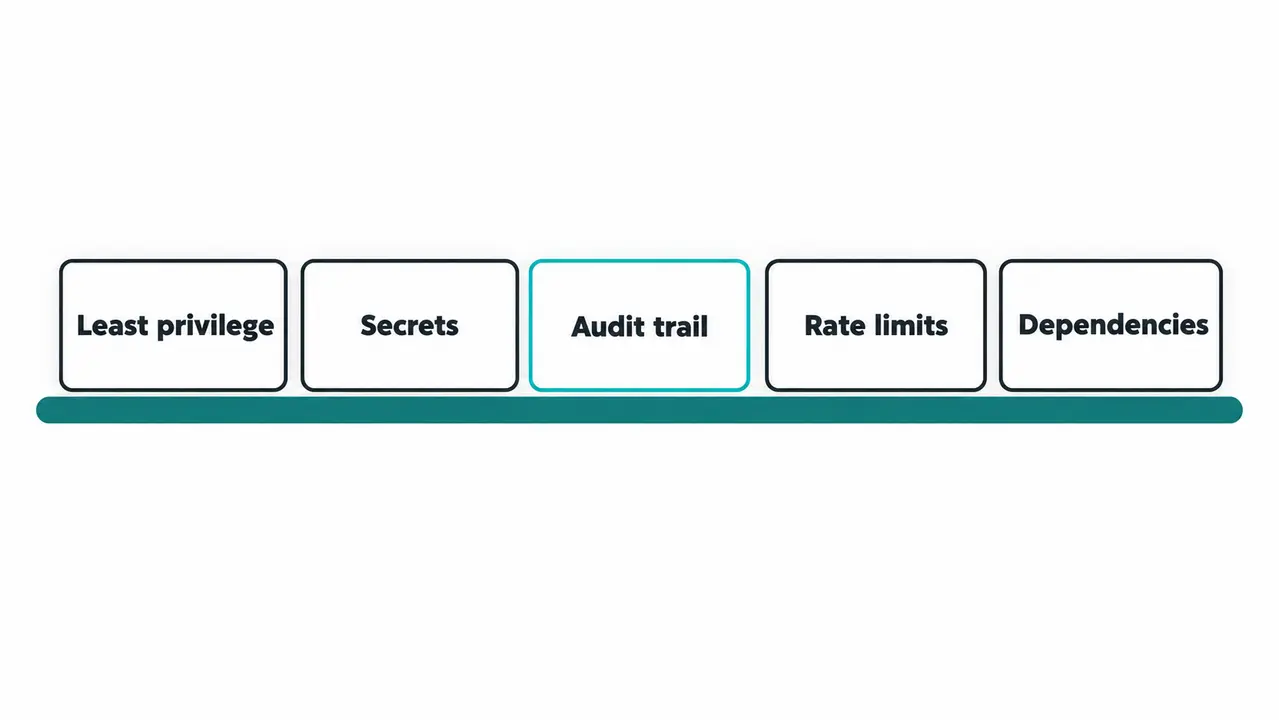
“It’s just an MVP” has excused more security debt than any other sentence in software. An MVP does not mean ignoring security. It means selecting the minimum controls that match the deployment context and the risk profile, and writing them into the non-functional requirements early rather than discovering them in the enterprise security questionnaire later.
A workable B2B security baseline: least-privilege roles, secure secrets handling with no credentials in the repository, an audit trail for key actions, basic rate limiting on public endpoints, and dependency hygiene in the build pipeline. Define environments, the access model, and logging requirements during architecture, not during the pre-launch panic.
The buyer context matters here. A significant portion of B2B targets are large enterprises with strict baseline requirements, and large enterprises are just 0.2% of EU businesses while generating 51.3% of net turnover, according to Eurostat. If your MVP touches sensitive data or critical systems, tighten the baseline further. Keep the product scope narrow regardless.
Running MVP scope reviews that stop creep in real time
Scope creep does not arrive as a big request. It arrives as five small ones, each defensible on its own, each approved in a hallway because a meeting felt excessive for something so minor. By the time anyone measures the total, the architecture is bent and the release date has moved twice. Scope control has to be a cadence, not a virtue.
Run a recurring scope review, weekly, thirty minutes, with four people: product owner, tech lead, QA lead, and a business owner. Every new request gets forced through two questions: does it serve the learning goal, and is it inside the boundary document. Requests that fail either go to a parking lot backlog with a named review date.
The parking lot is what makes the cadence politically durable. Stakeholders accept deferral far more easily than rejection, and the review date makes deferral real rather than a polite burial. What the meeting actually protects is the release date, which is the one commitment nobody can renegotiate quietly.
Need an embedded team that holds the boundary with you
If your MVP scope keeps growing faster than your team can defend it, a short conversation about how embedded engineering teams handle scope discipline is a low-cost place to start.
Frequently asked questions
How many features should an MVP have?
The absolute minimum required to test the single riskiest assumption and complete one user journey. For most B2B products that lands somewhere between three and seven capabilities. If you cannot count them on your fingers with fingers left over, you are probably building v1.
What is the difference between an MVP and a prototype?
A prototype tests a concept or a design without writing production code. It can be a Figma flow, a clickable mock, or a script that fakes the backend. An MVP is a live, deployed product that real users operate, testing actual behavior and willingness to pay the cost of using it.
Can an MVP be internal only?
Yes, if your internal team genuinely represents the target user and the learning goal concerns workflow validation rather than market demand. An internal MVP can prove that the core workflow works at acceptable speed and effort. It cannot prove that external users will adopt it.
What if stakeholders disagree on must-haves?
Force each proposed feature to map to the learning metric in writing. If the feature does not move the metric, it goes to the post-MVP backlog regardless of who proposed it. The two-gate test works here because it removes the argument from seniority and relocates it in the hypothesis, which everyone already agreed to.
When should you stop MVP and start v1?
Stop once the riskiest assumption is validated or falsified with clear data against thresholds you set before launch. That can take six weeks or six months depending on the sales cycle. Start v1 planning from the results, not from the feature list you originally deferred.
What is the difference between an MVP and a minimum marketable feature?
An MVP validates the core hypothesis with whatever polish level the measurement requires. A minimum marketable feature takes a validated capability and adds just enough reliability, documentation and polish to make it sellable to a broader audience. One answers a question, the other closes a deal.
The next step after the feature list is frozen
Freeze the boundary document and convert the chosen capabilities into strict acceptance criteria. Schedule a short planning workshop with engineering and confirm the architecture, the test strategy and the instrumentation plan in that one session. Write the out-of-scope list on the wall of the room where you build. Review it before the first commit, not after the first slip.
About Sentice

Sentice is a boutique software engineering partner founded in 2013 by Roni Levi and Martin Petkovic, now headquartered in Skopje, North Macedonia. Rather than supplying individual developers, we build embedded teams that blend with a client’s culture, tech stack and goals, working together from a single office under our own technical leadership. We deliver dedicated software engineering teams, end-to-end software solutions, product development, and system and embedded engineering, and we act as technical advisors across the full development lifecycle, from specification and architecture through development, testing and support. We use AI coding tools across every project, and we help clients integrate AI into their own products through chatbots, MCP services, connected application layers and workflow automation. Some of the clients we started with more than a decade ago are still building with us today.
Questions about scoping your MVP? Reach us at info@sentice.com or call +389 70 307 837.