
Most MVP estimates die in week three, not because the engineering was wrong but because nobody counted the waiting. Teams plan sprints the way they plan code, and then the calendar fills up with everything that is not code. A request for API credentials sits unanswered. A compliance review lands late. The app store rejects the first submission. Here is the honest arithmetic from our delivery experience: a realistic MVP timeline for most teams lands between 6 and 12 weeks, and the difference between the two numbers is almost never engineering speed.
Reading time: 9 min
Key points
- A usable release to real users takes 6 to 12 weeks, calculated as 3 to 6 two-week sprints plus release readiness work.
- The fastest MVPs validate one high-risk decision rather than the full product vision.
- Integrations are the most common reason MVPs miss their dates, and decision latency on the client side can add weeks.
- A defensible timeline is a range with named assumptions, risks, dependencies, and decision points, never a single date.
Table of contents
A realistic MVP timeline for most teams lands in 6 to 12 weeks
If you are searching for how long to build MVP, the direct answer is that a usable release to real users takes 6 to 12 weeks, once scope is tight and decisions are fast. Calculate it as 3 to 6 two-week sprints for build work, plus release readiness activities on top. Those activities are not optional padding. Store submission loops, monitoring setup, and production hardening consume real calendar time, and they sit outside every sprint plan that only counts feature stories.
Teams that expect a few weeks of development duration without accounting for organizational drag are the teams that report their MVP is “almost done” for three months. Scope that quietly grows from one workflow to four, plus a stakeholder review loop that runs weekly instead of daily, will push a 6-week plan to 12 without a single architectural surprise. Time to market depends as heavily on release readiness as on build speed.
The fastest MVPs validate one decision not the whole product vision
An MVP moves fastest when it is designed to validate one high-risk assumption rather than represent the full product roadmap. Pick a single decision and design everything around it. Willingness to pay is one. Workflow adoption in a target department is another. Integration feasibility with a customer’s legacy ERP is a third. If you are building hardware, signal quality from the sensor might be the entire question.
Consider a B2B workflow MVP that supports one persona, one happy path, and one reporting view. That is a 6-week product. Add a second persona and the same validation now requires role-based behavior, two onboarding flows, and twice the acceptance testing. The timeline roughly doubles and you learn the same single thing.
The failure mode is a polished product that answers no specific question. It looks like progress in demos, and it multiplies the timeline with every feature that does not serve the core decision.
Where teams underestimate time is everything around the code
Non-coding work regularly determines the calendar time of an MVP timeline. Waiting for API credentials from a partner. Acceptance criteria that nobody wrote down. A compliance review that starts in week five instead of week one. An app store submission that bounces twice. None of these appear in a sprint plan built from user stories, and all of them consume weeks.
The most common self-inflicted wound is testing on the last day of the sprint. Bugs surface Thursday, fixes land Friday, and the sprint review demos a build nobody has verified. The next sprint starts with a backlog of unverified work and the schedule slips one sprint at a time.
The control that works is a definition of done per story that includes test evidence and acceptance checks before the sprint closes. When a story cannot move to done without a passing smoke run and a sign-off against written criteria, the drag moves inside the sprint where you can see it and manage it.
A simple scope model that turns requirements into weeks
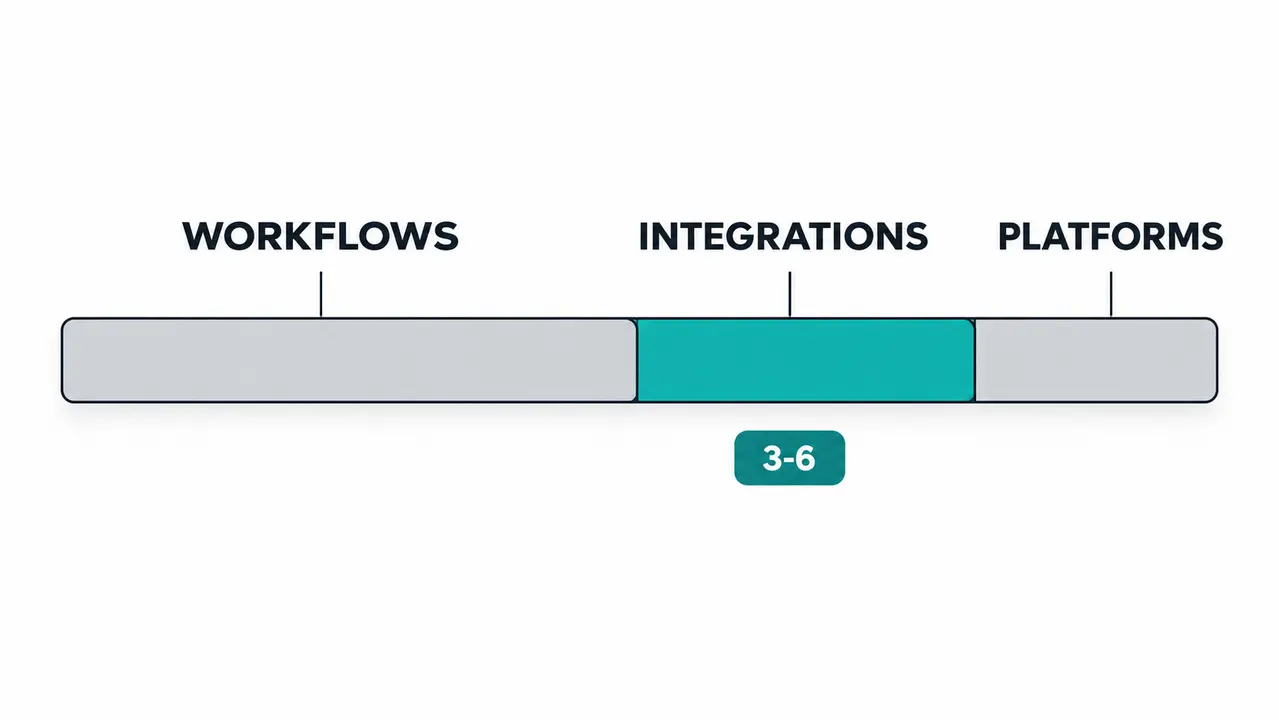
You can estimate development duration without story-point theater by counting three things: workflows, integrations, and platforms. Each core workflow decomposes into a set of user stories that fit inside a sprint. Each integration adds discovery work plus failure handling, usually two to four stories you did not write down initially. Each platform adds UI work and a QA matrix that grows the testing surface geometrically.
Here is the sanity check we apply before committing to any plan. If the roadmap needs more than 6 sprints, it is drifting toward a version one product instead of an MVP, and someone should cut scope before kickoff rather than after the second missed sprint.
Turning user stories into a sprint plan
Organize stories as vertical slices rather than technical layers. One slice delivers a demoable increment, a thin path through the workflow that a user could actually click end to end. A slice that produces a database schema and an API with no UI demonstrates nothing and validates nothing. Demoable increments keep the team moving because every sprint review answers the only question that matters, which is whether the thing works in front of a human.
Discovery is the timeline multiplier you control before kickoff
A short structured discovery phase reduces build time by preventing stalls, rework, and late architecture pivots. Discovery is the cheapest timeline lever you have, because a week of clarification before kickoff costs a fraction of a mid-build pivot caused by an assumption nobody tested. Define its outputs explicitly: a problem statement, a primary persona, a workflow map, a ranked risk list, a system context diagram, and integration notes covering every endpoint you intend to touch.
Plan for 3 to 10 working days for most MVPs. Extend toward the longer end when hardware, regulated data, or complex domains are involved, because the unknowns there are structural rather than cosmetic.
What ready for sprint one looks like
Ready means engineering can start building the first morning without asking questions whose answers take a week. The artifacts are small and specific: a one-page scope document naming the single decision the MVP validates, a workflow map with the happy path and two named edge cases, environment and repository access confirmed, and a signed-off integration list with owners. A one-page scope document that unblocks engineering immediately beats a forty-page specification that arrives in week three.
Decision latency on the client side can add weeks
Slow feedback and unclear ownership routinely add more calendar time than engineering complexity. This is uncomfortable for leadership to hear, but it shows up in nearly every delayed project we review: the team was never the bottleneck. The bottleneck was a scope question that sat in an inbox for nine days.
The fix is structural. Name a single product owner with a 24-hour response time for scope cuts and acceptance calls. One person, one channel, one day. Committees are slower than any codebase.
The failure mode when this is missing is a definition of done that keeps moving while the team keeps polishing features that were already acceptable. Technical leadership owns keeping acceptance criteria stable and unblocking decisions quickly. Others treat the product owner as a status role. We treat it as the throttle on the whole timeline.
Integrations are the most common reason MVPs miss their dates
Third-party and legacy integrations create unknowns that only surface once you hit real endpoints with real data. The documented sandbox behaves one way, the production tenant behaves another, and the difference is where schedules go to die. Typical integration risks include poor documentation, authentication edge cases, rate limits that the sandbox never enforced, sandbox gaps that hide whole workflows, and data mapping conflicts between your model and theirs.
Count your integrations honestly. One planned integration often becomes three when you add identity, billing, and notifications. Teams budget for the payment gateway and forget that login, email delivery, and error alerting are integrations too.
Spike early, define fallback behavior for every external dependency, and mock the system wherever learning does not depend on the real endpoint. A mocked integration you can control is worth more to a sprint plan than a real one that fails unpredictably.
The integration spike that saves a sprint
Before scheduling integration stories, run 1 to 3 days of focused investigation per dependency. The spike has one job: prove the riskiest claim. Authenticate against the real endpoint, push a representative payload through, and confirm the response shape matches the documentation. Write down what you found and what broke. If the spike fails, you have changed the plan with three days of cost instead of three weeks of rework inside a sprint.
The MVP timeline changes when hardware is part of the product
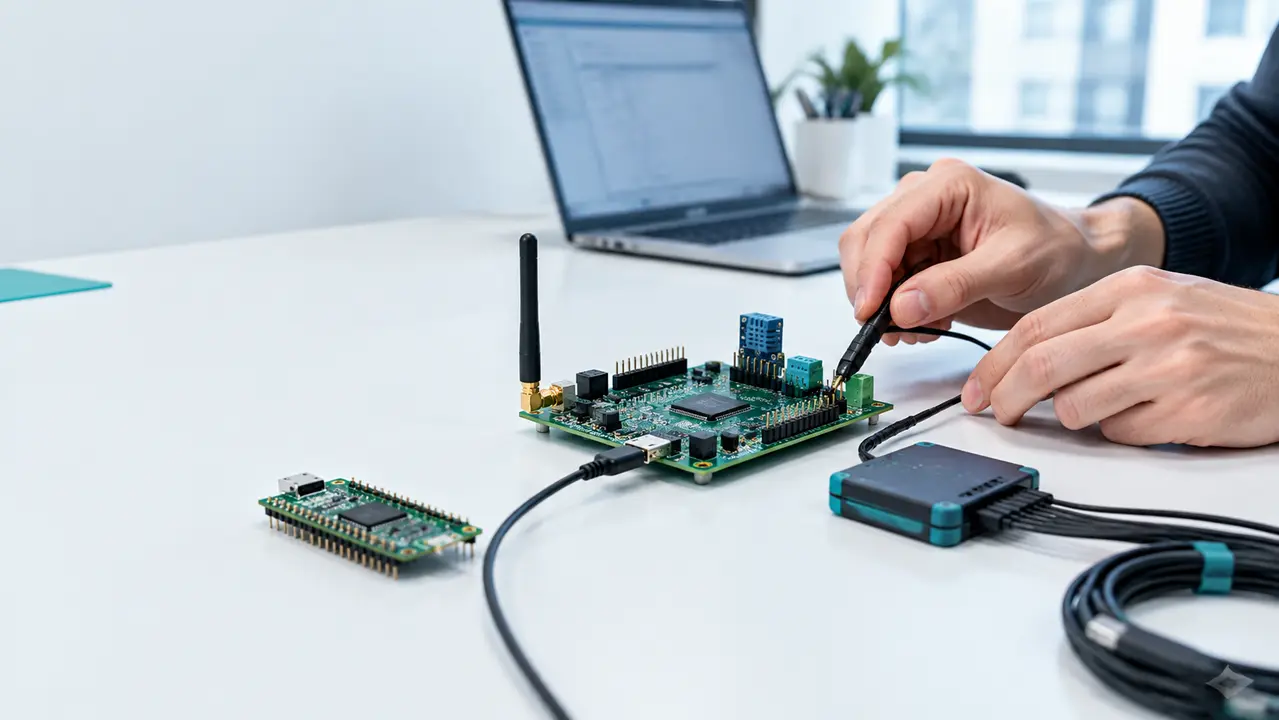
Hardware dependencies add lead times, test cycles, and cross-discipline coordination that software-only MVPs never face. Boards have procurement lead times. Firmware revisions arrive on someone else’s schedule. A sensor that works on the bench can fail across a temperature range or a battery voltage curve you did not test. None of this compresses because a sprint is two weeks.
Plan for an explicit hardware-software integration test window, and build a fallback path using simulators so software work never blocks on physical availability. The software team should be able to develop and test against a simulated device for weeks before the first board arrives.
For CTOs and Heads of R&D, the real requirement is a single integrated plan across disciplines, where firmware milestones, hardware revisions, and software sprints appear on one timeline. Our System and embedded engineering work exists precisely because cross-discipline coordination fails when each team keeps its own calendar.
Mobile MVPs slow down at release readiness not feature coding
Mobile MVP timelines slip because of device coverage, store review cycles, and production hardening, not because the screens were hard to build. The QA matrix alone is a planning item: OS versions, physical device tiers, permission flows, offline behavior, and push notifications across both states. A web team moving to mobile routinely underestimates this matrix by a factor of several.
Allocate explicit time for store submission and rejection loops. A review cycle can take days, and a rejection for a missing privacy disclosure or a broken sign-in flow resets the clock at the worst possible moment.
The mitigation that consistently improves time to market is shipping one platform first. iOS first if your audience skews toward paying B2B users, Android first if reach matters more. The alternative failure is familiar: developers finish coding, and the team cannot release the application to anyone.
Web MVPs move fastest when you reuse solved components
Web MVPs ship faster when you avoid rebuilding commodity systems. Authentication, roles and permissions, payments, email delivery, file storage, feature flags, analytics, and logging are solved problems with mature vendors and established libraries. Teams spend weeks on non-differentiating plumbing instead of building the core workflows that justify the product’s existence.
The tradeoff is real: vendoring identity or payments buys speed today at some cost in future flexibility, and occasionally a migration later. Apply a strict rule for the MVP stage and prefer reuse. If the component does not encode your competitive advantage, buy it or adopt it. You can revisit the decision with real usage data, which is the entire point of the MVP. Our End-to-end software solutions engagements apply this rule early in discovery, because the fastest architectural decision is not writing the code at all.
Rebuilding an auth flow you have built five times before is engineering comfort, not engineering value.
AI features can compress or explode the schedule depending on what you ship
AI can speed delivery when it replaces manual workflows, and it can add evaluation, safety, and reliability work that dominates the timeline. The distinction that matters is architectural. An AI feature acting as a UI helper, such as summarizing a record or drafting a message, sits at the edge of the product and inherits the reliability of a deterministic core. An AI feature acting as a core decision engine, such as approving a claim or routing a request, carries the whole burden of correctness.
For anything beyond the helper pattern, monitor dataset readiness, prompt design, offline evaluation sets, human-in-the-loop review, latency budgets, and cost controls. Each one is a workstream, not a story.
The failure mode is predictable and expensive. The demo works perfectly on three curated examples, and production fails within a week due to drift, hallucinations, or missing guardrails. The demo was never the product.
A two-track plan keeps design and engineering from blocking each other
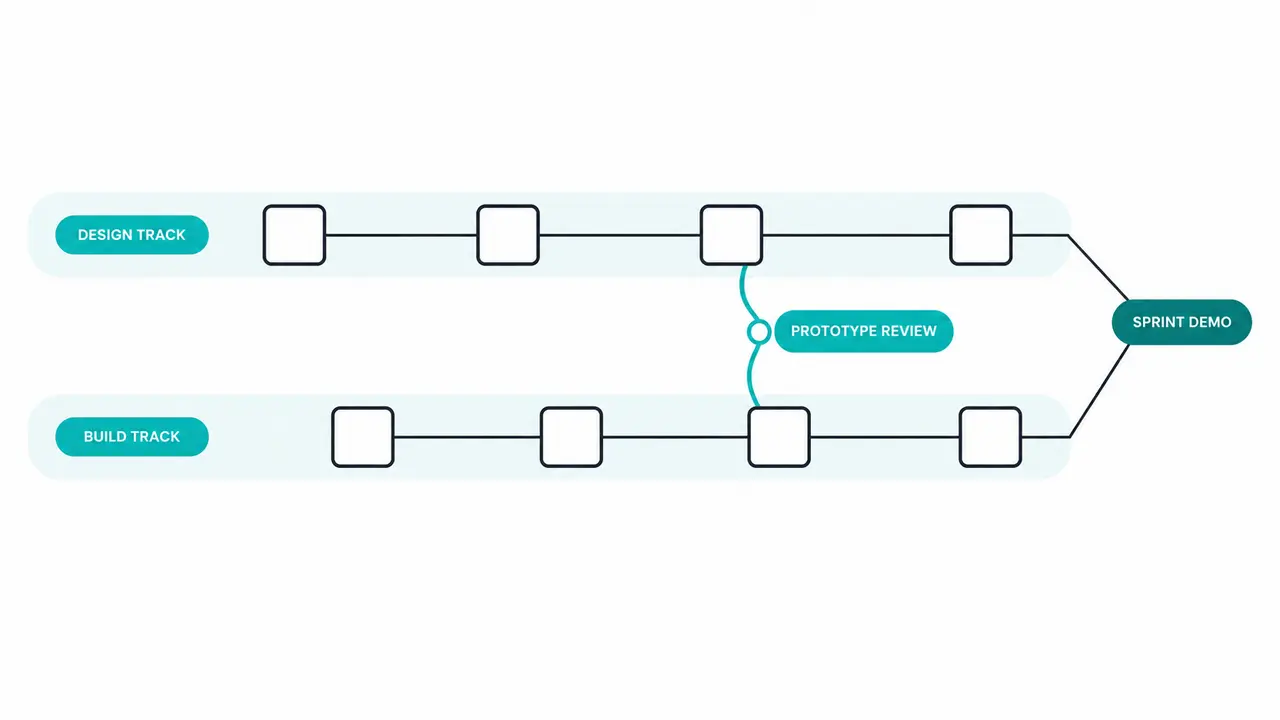
Parallelizing discovery and build work reduces idle time when the team works in vertical slices anchored on a stable core workflow. Design stays one sprint ahead while engineering builds validated slices. A weekly prototype review keeps the conversation concrete, and the sprint demo confirms what shipped. Neither track waits for the other to finish, because neither track needs the other to finish.
The failure mode this prevents is the large design handoff that arrives late and changes everything the engineering team already built. That single event can erase two sprints of work, and it happens most often when design is contracted as a phase rather than run as a track.
When dual-track is a bad idea
Sequential planning is safer when compliance requirements are heavy or the UI is contractually fixed. Medical interfaces with mandated layouts, regulatory label requirements, or accessibility conformance levels that are auditable per screen do not benefit from parallel exploration, because the exploration space is closed. In those cases, finish the specification, review it, and build exactly to it. Speed comes from the absence of ambiguity, not from parallelism.
QA is not a phase at the end it is a delivery system
MVPs ship on time when testing is built into each sprint and release criteria are explicit from day one. The minimum viable QA package for an MVP is small but non-negotiable: smoke tests over the core loop, a regression set covering the primary workflow, basic security checks aligned with the OWASP Top 10, and monitoring readiness so the first real users do not become your error-detection system.
The failure mode is a last-week bug avalanche. Testing deferred to the final sprint produces an unstable launch candidate, an emergency stabilization sprint, and a release that slips exactly when visibility is highest.
Ownership matters here. The engineering lead should own a release candidate checklist, and the release is not ready until every line on it passes. Others treat QA as a department. We treat it as a property of the delivery pipeline itself.
The definition of MVP done should be written before sprint one
You avoid endless polish by defining what done means in measurable terms tied to the learning goal, and by writing it down before the first sprint. Good done statements are concrete. Users complete the intake workflow end to end without assistance. The system captures the data needed to compute the activation metric. Support can resolve reported issues from logs alone within one business day.
Each of those is testable, and none of them mentions polish. Acceptance criteria per story and a launch checklist must exist before development begins, not be reverse-engineered in week six from what happens to be finished. For teams that want formal grounding, the IEEE 29148 standard for systems and software engineering requirements is a useful reference for what well-formed acceptance criteria look like.
Without a written finish line, stakeholders keep adding nice-to-have items, because from inside the build everything looks almost done.
Scope creep is usually a governance problem not a planning problem
MVP scope grows when there is no explicit cut rule and no owner empowered to say no in real time. The original plan was fine. The governance around it was absent. Every addition arrived with a reasonable-sounding justification, and no single person was accountable for weighing it against the release date.
Adopt a cut rule and publish it. If a feature does not change what you learn in the next release window, it moves out. That sentence, agreed to by leadership before kickoff, does more for schedule integrity than any estimation technique.
Maintain a not-now backlog with rationale for every cut item. Written rationale reduces the political pressure to relitigate decisions, because the answer to “why isn’t this in” is a document rather than a person’s opinion. The alternative is the familiar outcome: the timeline doubles while the team believes they are almost done.
When your MVP estimate is really a hiring and onboarding estimate
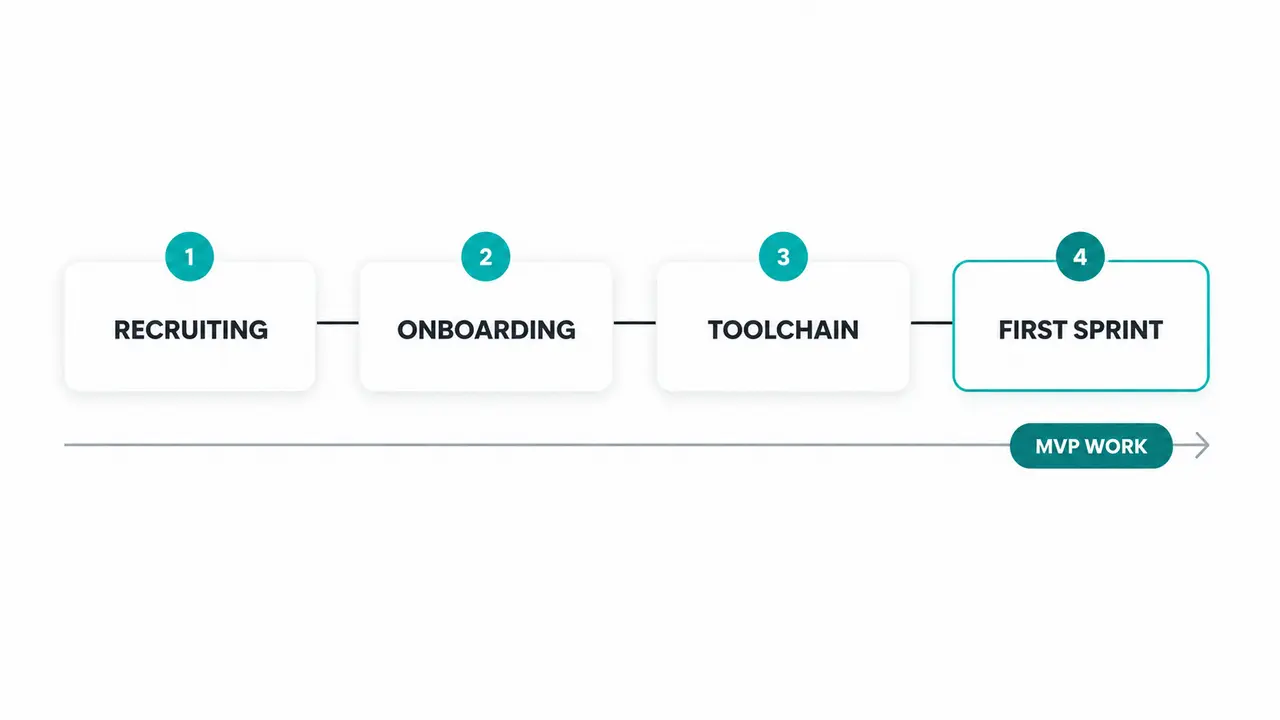
If you are building with a new in-house team, the calendar includes recruiting, onboarding, and team formation before a single user story starts. Engineering effort and time to market are different numbers, and conflating them is how a “three-month MVP” becomes seven months of calendar time. Recruiting runs its own weeks, then onboarding, then toolchain setup, then the first sprint where the team is still forming norms and producing at partial velocity.
Leadership expects sprint output while the team is still learning each other’s review habits and setting up CI. That gap, not laziness, is the source of most first-quarter disappointment.
Onboarding delays apply across regions and labor markets, so the advice is location-agnostic. Where a team cannot wait for local hiring cycles, Dedicated software engineering teams offer an alternative formation model, with an existing team that already works as a unit joining your delivery on short notice.
Need capacity before your hiring cycle can supply it?
Tell us about your roadmap and we will help you scope the team and the timeline together.
A timeline you can defend uses ranges and explicit assumptions
A credible MVP timeline is a range with named assumptions, risks, and decision points, never a single date. A single date is a promise, and promises made before integration testing are guesses wearing a suit. The defensible version of the same plan looks different, and this is the shape we recommend:
| Element | Example | What happens if it is missing |
|---|---|---|
| Assumption | Payment sandbox credentials available by sprint two | Hidden wait time silently consumes the buffer |
| Risk | Legacy ERP data format unknown until first real payload | Rework lands mid-build instead of at a planned spike |
| Dependency | Test hardware units arriving by week four | Software team blocks or builds blind against simulators late |
| Decision SLA | Product owner responds to scope questions within 24 hours | Decision latency accumulates unmeasured across sprints |
Create a one-page timeline contract from these elements and share it with every stakeholder. The document converts the timeline from a promise into a planning tool, which is all it ever was.
Frequently asked questions
Can an MVP be built in 4 weeks?
Yes, when three conditions hold at once. The scope is one workflow, integrations are minimal, and decisions come back same-day. If any of those conditions is missing, 4 weeks produces a prototype or a partial release, and calling it an MVP sets up the wrong expectations with stakeholders.
How many sprints should an MVP take?
Commonly 3 to 6 two-week sprints for a first real release, plus release readiness work on top of the build sprints. If your plan needs more than 6 sprints, treat that as a signal you are planning a version one product and cut scope before kickoff.
What is the difference between an MVP and a prototype in timeline terms?
A prototype proves an idea in days, usually with throwaway code and no real users. An MVP validates a business model with real users over weeks, which means production concerns like security, monitoring, and support readiness are in scope from the start.
How many developers do you need to build an MVP?
A typical team is 2 to 4 engineers plus a designer and a product owner. Below two engineers you lose the ability to review each other’s work. Above four, coordination overhead starts eating the velocity you added, unless the scope genuinely spans multiple platforms.
What should be done before the first sprint so the team does not stall?
Complete a short discovery, set up environments and repository access, secure API credentials from every third party, and write acceptance criteria for the first slice of stories. Each of these is a day or two of work before kickoff, and each one prevents a multi-day stall inside sprint one.
Where the 12 weeks actually go
Map your current feature list against the one-decision validation rule this week and see what you can cut today. A 6 to 12 week timeline only holds when you protect the scope and enforce decision latency rules from day one. You are trading feature completeness for actual market feedback, which is the only trade an MVP exists to make. Are you building a product to learn from, or a product to hide behind?
About Sentice

Sentice is a boutique software engineering partner founded in 2013 by Roni Levi and Martin Petkovic, now headquartered in Skopje, North Macedonia. Rather than supplying individual developers, we build embedded teams that blend with a client’s culture, tech stack and goals, working together from a single office under our own technical leadership. We deliver dedicated software engineering teams, end-to-end software solutions, product development, and system and embedded engineering, and we act as technical advisors across the full development lifecycle, from specification and architecture through development, testing and support. We use AI coding tools across every project, and we help clients integrate AI into their own products through chatbots, MCP services, connected application layers and workflow automation. Some of the clients we started with more than a decade ago are still building with us today.
Get in touch: info@sentice.com | +389 70 307 837