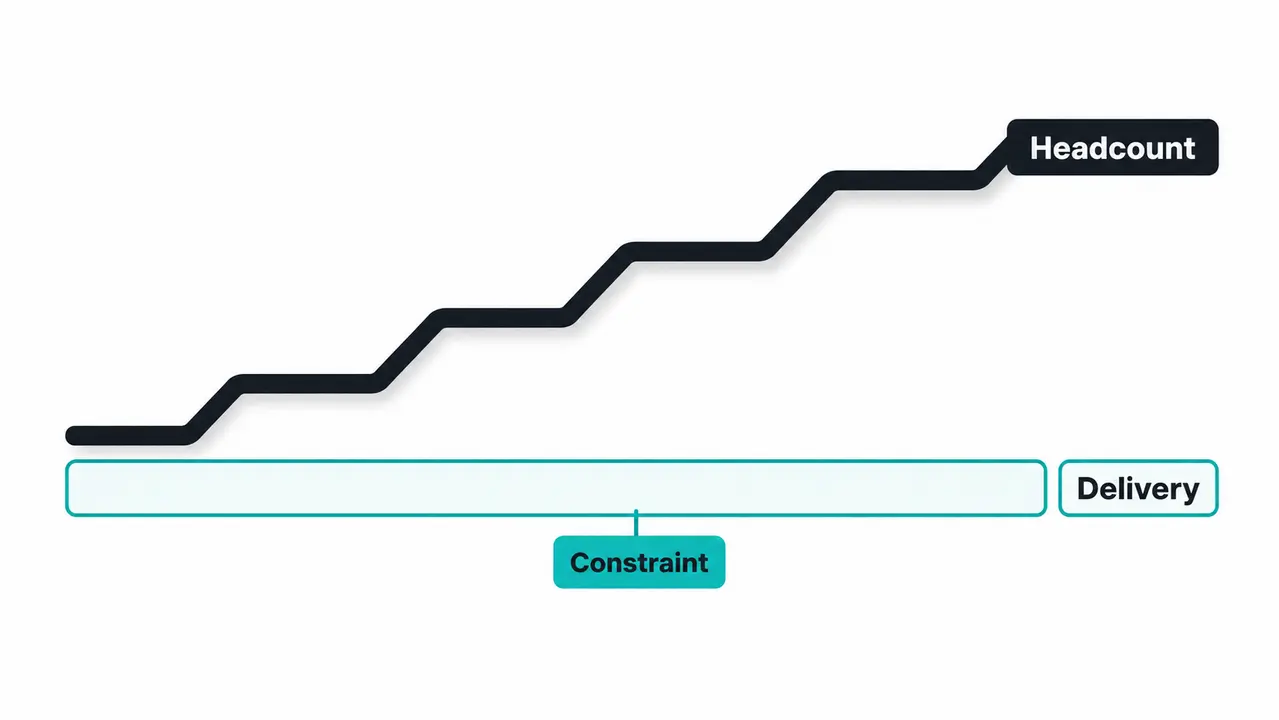
You approved eight requisitions in January. By April the team is larger, payroll is larger, and the release train is moving at the same speed it moved in December. This is the most common scaling failure we see, and it is almost never a hiring failure. It is a capacity failure that hiring cannot fix, because the constraint lives somewhere else: in the review queue, in the flaky pipeline, in the one engineer whose sign-off everything needs.
This guide walks through how to diagnose the real constraint, prepare your team for growth, and choose between in-house hiring, staff augmentation, and outsourced delivery on the merits. Below, we unpack the signals that show readiness, the onboarding and review mechanics that keep throughput rising, and the hybrid staffing pattern that scales fastest in practice.
Reading time: 12 min
Key points
- Scaling succeeds when delivery capacity per week rises, not headcount; diagnose where work waits before hiring.
- A velocity dip that recovers in six to eight weeks is normal; a plateau means something structural broke.
- PR review latency is the silent scaling tax; if a quarter of PRs wait more than a business day, hiring deepens the constraint.
- For work coupled to evolving context, augmentation inside your team beats outsourced delivery every time.
Table of contents
Scaling is a capacity problem before it is a hiring problem
When a team doubles and weekly throughput stays flat, the instinct is to hire again. The correct response is to find where work waits. Scaling a software development team works when you increase delivery capacity per week, not headcount. If completed, merged, released work does not move, the bottleneck is coordination, review latency, or environment instability, and engineering capacity planning means diagnosing that before signing another offer.
The diagnosis is mechanical. Track the time work spends waiting in each stage: product discovery, engineering, QA, release, operations. In our experience the queue hides in plain sight. A pull request sits three days awaiting review. A CI run fails intermittently and everyone re-runs it. Nobody is sure who owns the payments module, so two people discuss it for a week. That is hidden work in progress, and it scales with the team unless you remove it.
Embedded systems add a constraint that hiring cannot touch. When verification depends on physical hardware and lab access, ten more engineers produce ten more people waiting for the same test bench. Expand the testing environment first, or the new engineers become an expensive queue.
The week velocity drops after a hiring wave
A velocity dip after rapid scaling is not a failure. It is physics. New people ask questions, senior people answer them, and the output curve bends down before it bends up. The pattern to watch is duration and shape. A dip that recovers in six to eight weeks is normal onboarding friction. A dip that flattens into a plateau means something structural broke.
Usually the structure that broke is the senior layer. Three new hires arrive, and your best engineer stops writing code and becomes human CI: reviewing every PR, answering every architecture question, unblocking every environment issue. Meanwhile work fragments across initiatives that were never fully defined, so the new hires cannot tell what done means. Now imagine that same senior engineer resigns mid-migration, three months in, while the new hires are still learning the codebase. That team does not recover in eight weeks. It plateaus for a quarter.
Plan for the temporary slowdown deliberately. Give someone explicit ownership of onboarding. Rotate review duty so no single senior carries the whole queue. Protect maker time on calendars. Team growth that is planned absorbs the dip; team growth that is improvised converts it into the new baseline.
Signals you are ready to scale the team
Not every team that needs more output is ready to expand capacity. Readiness is observable, and you can audit it in an afternoon. Sprints end with predictable outcomes, not heroic ones. CI is stable enough that a red build means a real defect. Coding standards exist in writing, a code ownership map exists, and the product backlog changes monthly rather than daily. When those signals hold, adding engineers multiplies throughput. When they do not, adding engineers multiplies chaos.
The single strongest signal is what happens to your seniors. If a newcomer joins and the team absorbs them without turning your staff engineer into full-time support, the system has slack. If every hire costs you your best engineer’s output for two months, you are not ready, regardless of what the roadmap says.
Embedded systems need one more check before scaling. Does the embedded software development workflow have test harnesses available for every new engineer? Is there a simulation strategy so most work does not need hardware? Is hardware-in-the-loop access planned and scheduled? Extreme requirements churn is the other disqualifier. If the product backlog rewrites itself weekly, scaling amplifies rework, not throughput. Fix the churn first.
Where teams underestimate onboarding
Most companies treat onboarding as a documentation problem. It is a production system, and it needs owners, timelines, and acceptance criteria like any other system. An onboarding plan with no named owner produces the outcome we see repeatedly: a new hire ships low-impact changes for a month because nobody is accountable for their ramp, and critical knowledge stays locked in the heads of the people who were already there.
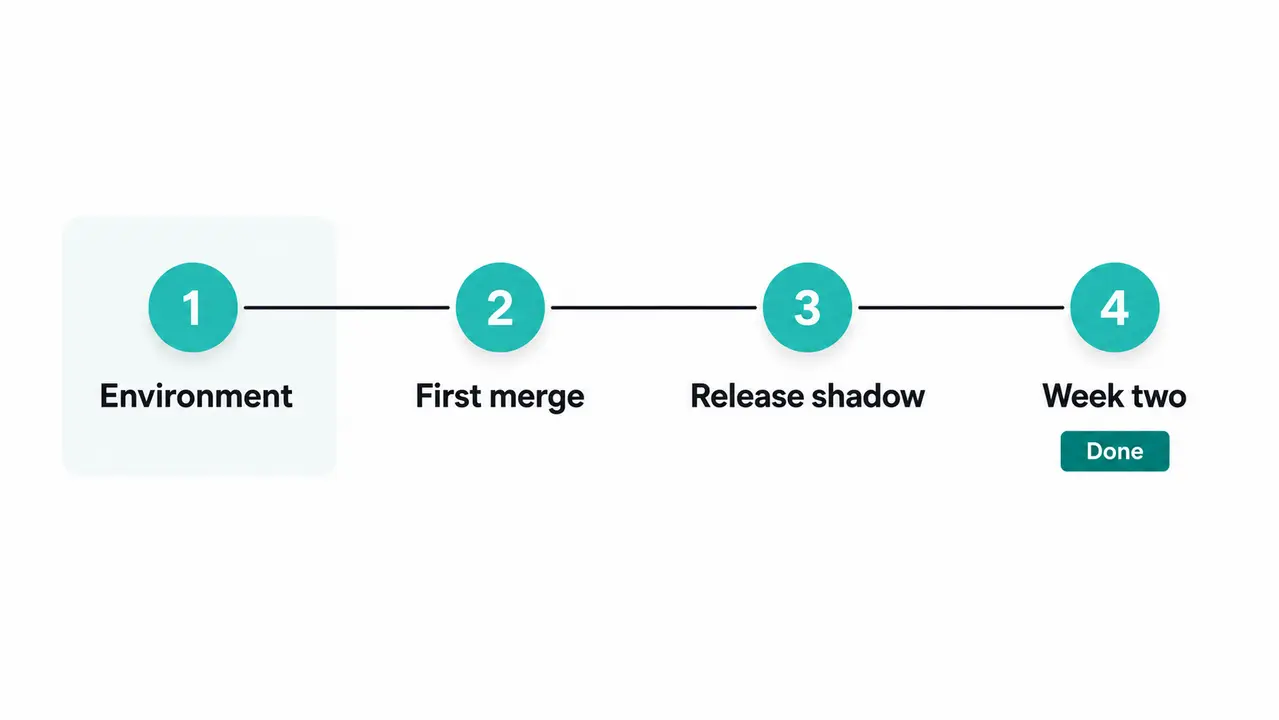
Set targets you can verify. For a senior hire, environment setup should take hours, not weeks, which means the setup script and credentials exist before day one. First merged change within the first week, even if it is a log line. First release participation or on-call shadow by the end of week two. If those milestones slip, the plan is broken, not the hire.
The onboarding artifacts that prevent tribal knowledge lock-in
Two artifacts do most of the work. The first is a curated set of starter tickets, real changes of increasing scope, tagged and pre-approved as safe ramp work. The second is a current architecture map, one page per service or subsystem, showing boundaries, data flow, and the failure modes that have already bitten someone. A first-week checklist and a runbook for the three most common operational issues complete the set. Curate them once per quarter. Stale artifacts are worse than none, because they teach wrong answers confidently.
A buddy system that does not consume the whole team
The buddy model works when it rotates. Assign each new hire a buddy for two weeks, then rotate the next hire to a different buddy, and cap any engineer at one buddy assignment per quarter. Pairing the new hire with the same staff engineer every time reproduces the human CI problem. Spread the load, and the buddy role stays a two-hour-a-day commitment instead of a full-time job that silently kills the buddy’s own delivery targets.
What to standardize before you add more engineers
Standardize the interfaces between people, not the people. That means code review expectations, a written definition of done, a branching strategy, and release mechanics. Those four are the minimum viable standards for a growing team. PR size norms keep changes reviewable. Review SLAs, even loose ones like one business day, keep the queue from silently growing. Automated checks catch what humans forget. Trunk-based branching with short-lived branches removes merge conflicts as a coordination cost. Someone owns incident response by name.
Embedded systems add their own layer. Firmware versioning, reproducible builds, and dependency pinning are what let five engineers work on the same device without stepping on each other. Teams that skip this standardization in system and embedded engineering end up unable to reproduce last month’s release, which turns every field defect into an archaeology project.
The counterweight matters as much as the standards. A four-person team crushed by heavyweight process ships slower than a four-person team with none. The goal is removing ambiguity that creates rework, not building bureaucracy. If a standard does not prevent a specific rework scenario, delete it.
The org design shift from one team to multiple squads
The move from one team to several succeeds when each squad owns an outcome and has a clear boundary. It fails when you copy the org chart onto the codebase and hope. Engineering org design is really boundary design, and the boundaries can follow several axes: domain, platform, component, or customer journey. The wrong axis is the one that maximizes handoffs, because every handoff is a queue, a meeting, and a chance for context loss.
Team topology thinking helps here, but the principle is older than the vocabulary. Align team boundaries with architectural boundaries. If one squad owns the service and another owns its database schema, every schema change is a negotiation.
Embedded products complicate the split. Firmware, mobile app, and backend squads must all coordinate around a hardware release, and that coordination needs a single named integration owner plus a shared integration cadence, weekly at minimum during a device launch. The failure mode is predictable. Shared components that no squad owns become bottlenecks, and parallel development stalls while everyone waits on the component nobody is accountable for.
Choosing boundaries that reduce cross-team handoffs
Run a simple exercise before you split. List the twenty changes your team made last month and mark which would have required two squads. If more than a third cross the proposed boundary, redraw it. Boundaries drawn around data ownership or communication paths in the code, not around skill labels, are the ones that survive contact with a real backlog.
PR review queues become the silent scaling tax
Review is the limiting reagent of a growing team. Eight engineers can review each other’s work casually. Twenty cannot, and the queue shows up in the metric nobody tracks: average time from PR opened to merged. Start measuring it this week, along with the percentage of PRs waiting more than one business day. If that percentage climbs past a quarter of all PRs, review is your constraint, and hiring more engineers makes the queue longer, not shorter.
The fixes are known and mechanical. Smaller PRs, enforced by a soft cap of around 400 changed lines. Code ownership rules so the right reviewers are assigned automatically. Reviewer rotation so the load spreads. Pairing on risky changes instead of reviewing them after the fact. Automated checks handling everything a machine can handle, so human reviewers spend attention on design and intent.
Drive-by reviews are the trap. When a reviewer lacks context on a large, unbounded change, they rubber-stamp it, and the quality cost surfaces later as a production regression. A smaller PR with an engaged reviewer beats a large one with three bystanders. CI reliability underwrites all of it, since a flaky pipeline forces re-runs and erodes trust in green builds.
Adding a platform team only works with a tight charter
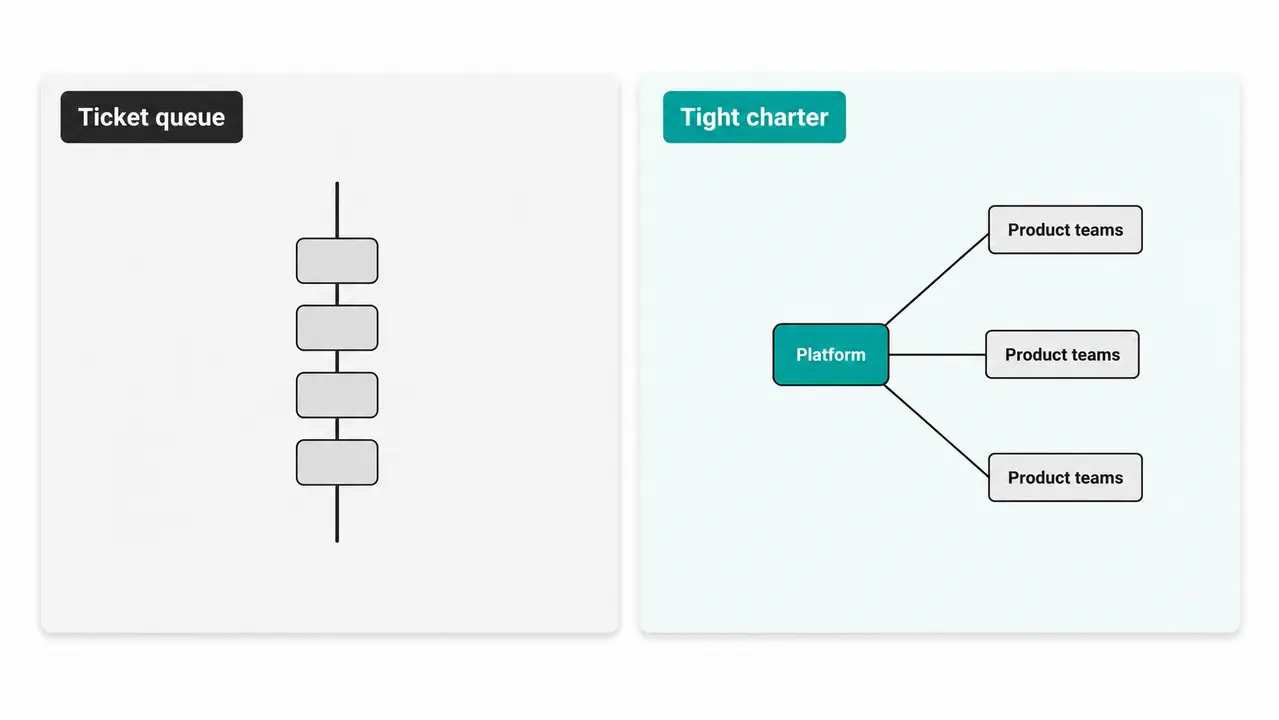
A platform team earns its existence by owning developer experience outcomes: CI reliability, environments, paved roads. It fails when it becomes a ticket queue that product teams petition for favors. The difference is the charter. Write it down, make it narrow, and tie it to measures the product teams can feel.
A good charter covers pipelines, project templates, an observability baseline, internal libraries, and golden paths for common tasks. Success looks like reduced lead time, fewer flaky builds, and environment provisioning that takes minutes instead of a week of Slack threads. Platform engineering without those measures drifts toward building tools nobody adopts.
The failure mode is ownership creep. If the platform team owns everything, product teams lose autonomy and every feature waits on a central queue. In embedded contexts the charter gets more specific: toolchains, cross-compilation infrastructure, device flashing automation, and lab scheduling. Those four remove the daily friction that otherwise eats an embedded team’s capacity. Keep the charter tight, review it every six months, and push decisions back to product teams wherever the platform does not need to own them.
In-house hiring stalls when interviews are not engineered
Hiring slows down at scale for reasons that have nothing to do with the talent pool. The interview loop is inconsistent, senior engineers spend unbounded hours on unstructured conversations, and nobody can articulate what signal a hire decision actually rested on. To grow a development team on a schedule, the hiring process itself needs engineering.
A structured loop has four parts. A role scorecard written before the first interview, listing the specific signals you are hiring for. Calibrated interviewers who agree on what a strong answer sounds like. A work sample aligned to your actual stack, not abstract puzzles. A decision debrief where each interviewer states explicit signals, pro and con, before anyone sees anyone else’s verdict.
The counter-case is what happens without it. Every team invents its own bar, quality becomes uneven by interviewer, and you cannot tell whether a rejected candidate was weak or merely interviewed by the wrong person. The external pressure is real. Korn Ferry’s talent shortage study projects 85.2 million unfilled jobs by 2030 across the economies analyzed, with technology among the affected sectors. In a market like that, an unengineered hiring loop does not just miss candidates. It misses delivery windows.
Staff augmentation succeeds when ownership stays internal
Augmentation works when external engineers join your existing teams under your technical leadership. Your backlog, your definition of done, your release process. Being embedded in the workflow is not a slogan. Operationally it means dedicated software engineering teams that work from your repositories, run against your CI, join your standups, and carry the same on-call expectations where the role calls for it, with code ownership boundaries documented like any internal engineer’s.
The integration plan matters more than the sourcing. We typically structure the first two weeks as paired delivery on real tickets, then transition to independent ownership of a bounded component with its own review path. That sequence builds context fast and gives you an early, honest signal on both sides.
The failure mode is structural. Treat augmenters as a separate team, give them a separate backlog and a separate branch strategy, and you have built handoffs into your own org. Every interface between “our team” and “their team” becomes a place where work waits and blame lands. Ownership stays internal, or the model fails.
Outsourcing delivery breaks down when interfaces are vague
Outsourcing whole modules fits a specific shape of work: stable requirements, clear acceptance tests, limited coupling to the rest of the system. Port an existing protocol to a new platform, build a well-specified integration, automate a documented process. When the work matches that shape, outsourcing is a legitimate way of expanding engineering capacity without expanding headcount.
It breaks when the work depends on evolving product decisions or deep system context. You cannot write an acceptance test for a feature whose definition changes every sprint, and a vendor who cannot see your production telemetry will optimize for the spec rather than for reality.
Embedded work is the hardest case to outsource cleanly. Hardware variance across device revisions, timing constraints, and integration testing against physical units resist upfront specification. The vendor marks the work done. It does not integrate. Your internal team spends a cycle reworking it, and the “capacity” you bought was negative. Rank the options honestly: augmentation inside your team beats outsourced delivery for anything coupled to evolving context, every time.
The hybrid model that scales fastest in practice
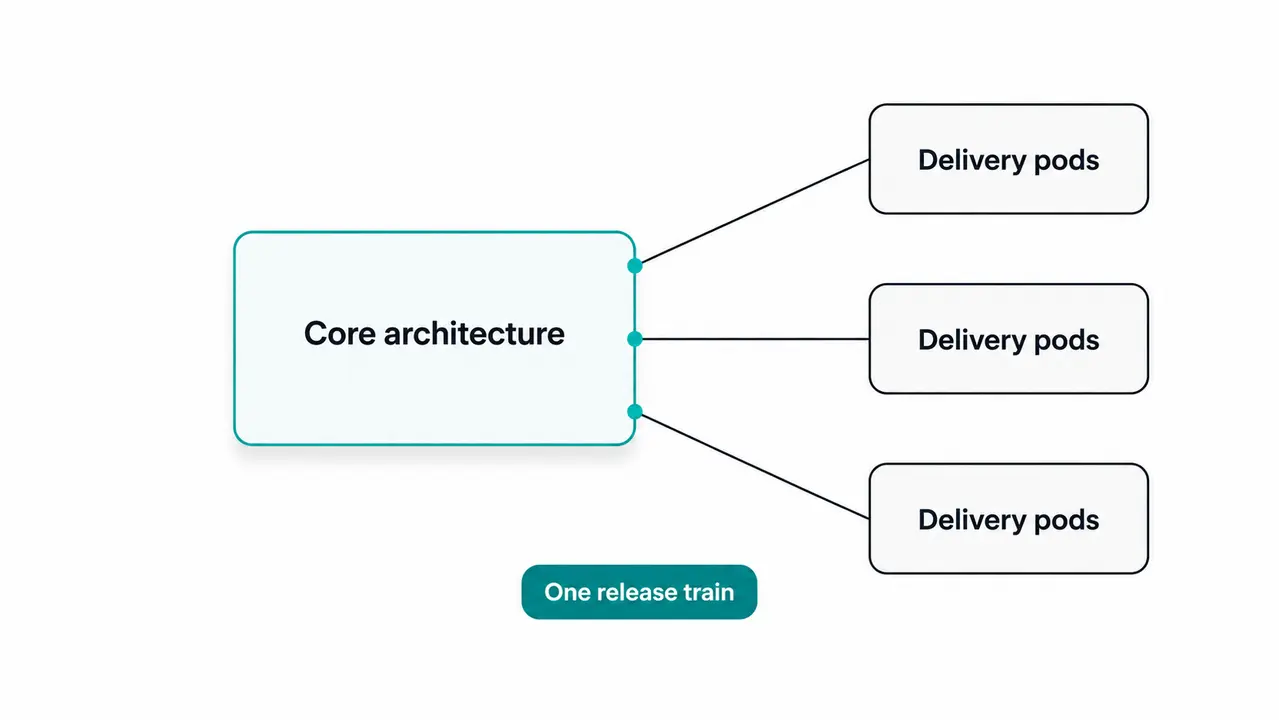
Across the engagements we have run since 2013, one pattern consistently outperforms both pure models for scaling agile teams: core architecture and product ownership stay internal, and external capacity accelerates execution inside those boundaries. Internal leaders own the architecture, the roadmap, and the quality bar. External engineers fill delivery pods aligned to domains, shipping against the same standards.
Governance is what keeps the hybrid honest. Shared engineering standards documented once and applied to everyone. A weekly architecture sync where boundary decisions get made explicitly rather than in pull requests. A single release train, so there is never a “vendor release” and an “internal release” to reconcile.
The embedded variant of this model has a bright line. Safety-critical decisions and anything hardware-coupled stay with the core team. External capacity goes to tooling, test automation, and feature work where the blast radius of a mistake is bounded. Teams that respect the line scale fast. Teams that blur it, by outsourcing the bootloader or the update mechanism, rediscover why the line existed.
Communication load grows faster than headcount
Ten people share one communication channel, and it mostly works. Twenty people share a hundred and ninety, and it stops working without design. Communication becomes the main cost of scaling past that threshold, and engineering leadership at that size is mostly about replacing meetings and hallway decisions with written artifacts.
The mechanisms are lightweight by design. Decision records, one page, written when a choice is made, so the reasoning survives the reorg. Lightweight RFCs for changes that cross team boundaries. An ownership map that answers who to ask without a Slack broadcast. A weekly cross-team integration checkpoint, timeboxed to thirty minutes, that replaces the constant ambient pings.
The failure scenario is two squads changing the same API in parallel, each with valid reasons, and integration breaking because nobody owned the interface contract. That bug costs more than every document you will ever write. Cross-team dependencies are managed in writing or discovered in production. If you want to go deeper on this, our earlier piece on how to grow your tech team without losing speed or quality covers the meeting-reduction side in detail.
Keeping architecture coherent while teams ship in parallel
Architecture stays coherent when you define guardrails, enforce interface contracts, and leave a fast path for exceptions. Guardrails are concrete: service boundaries, versioning rules, backward compatibility requirements, and shared libraries with named maintainers. The embedded equivalents are HAL boundaries, a firmware update strategy, and compatibility matrices across device versions, so a change merged against firmware 2.3 does not silently break 2.4 hardware.
Without guardrails you get architecture by merge conflict. Decisions happen implicitly inside pull requests, one PR at a time, each locally reasonable. Six months later the system has three serialization conventions and nobody can say why. System stability degrades not through one bad decision but through a thousand unrecorded ones.
Guardrails need an exception path or teams route around them. The path should be an RFC plus one approver, with a response measured in days. A guardrail with a month-long exception process is not a guardrail; it is an obstacle, and engineers treat obstacles as problems to route around.
Lightweight architecture governance that does not turn into a committee
Governance that works is mostly automated. Contract tests in CI verify that service boundaries and API versions hold on every merge, which converts most architecture review into a pipeline stage. Lightweight RFCs handle the remainder: a one-page proposal, a comment window of a few days, one named decision-maker. We have seen teams run this with a single weekly one-hour review slot and nothing more. The moment governance needs a standing committee with regular attendees, it has already failed.
Quality scales through automation, not heroics
At small scale, a sharp engineer catching defects before release is a workable quality strategy. At scale it is not, because defects scale with output. Quality has to move left into automated tests, CI gates, and reproducible environments, or your defect curve tracks your shipping curve. Test automation at the right layers, unit tests for logic, contract tests for boundaries, integration tests for critical flows, static analysis in the pipeline, and release smoke tests, is what lets twenty engineers ship as safely as five did.
Over-testing is the counter-case worth naming. Blanket coverage requirements on low-risk code slow delivery and buy nothing. Prioritize tests that protect critical paths and integration points, and let a marketing page have thin coverage.
For embedded, the automation stack looks different. Hardware-in-the-loop tests, simulators for the majority of development work, and deterministic builds you can reproduce byte for byte. Standards bodies have converged on the same conclusion for security specifically: the NIST Secure Software Development Framework defines secure development practices as pipeline stages rather than review meetings. Integration testing done continuously, not at the end, is the whole game.
Measuring scaling with delivery and reliability signals
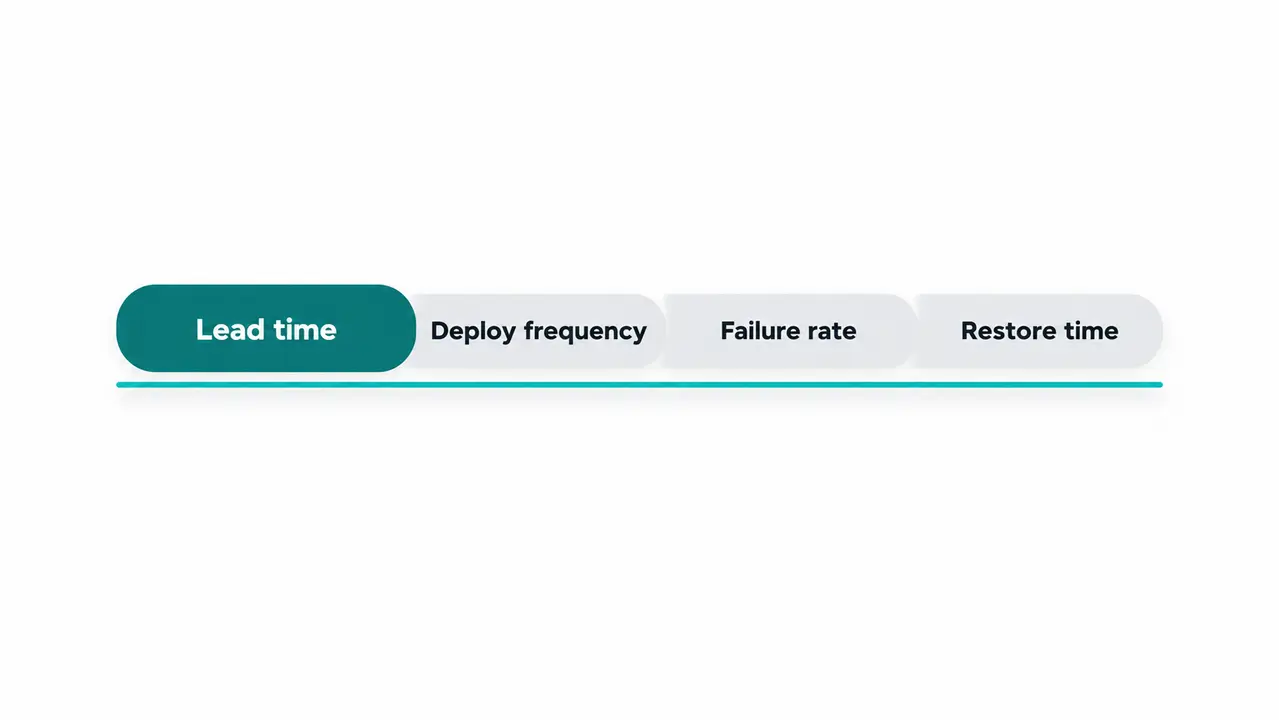
Use a small set of operational metrics that reflect flow and stability, review them weekly, and resist adding more. Lead time for changes, deployment frequency, change failure rate, mean time to restore, PR cycle time, and build stability. The DORA Accelerate State of DevOps Report 2023 validates lead time, deployment frequency, and change failure rate as the core reliability signals, and its findings tie these measures to organizational performance rather than engineering vanity. Read trends over months, not single weeks, and segment by team. One squad with a lead time triple the average has told you exactly where your bottleneck lives.
Story points do not belong on this list. Measuring only velocity hides coordination cost and rework, and a team can hit every sprint commitment while delivery capacity stands still. In embedded organizations, add firmware release process measures: time from merge to device update shipped, and rollback duration when an OTA release goes wrong.
The review discipline matters as much as the metrics. A weekly thirty-minute look at trend lines, with one action item per anomaly, beats a quarterly dashboard nobody reads.
Protecting senior engineers from becoming the bottleneck
Scaling fails quietly when your senior engineers become the approval layer for every decision. The symptom is a calendar with no free blocks and a review queue with their name on every item. The fix is deliberate distribution of ownership, and it starts with documented standards, because a written standard answers questions that would otherwise go to a person.
The tactics are concrete. Delegation through code ownership so module decisions land with module owners. Mentoring blocks on calendars, bounded, so teaching is scheduled rather than interrupt-driven. A rotating integration captain duty, weekly, so release coordination knowledge spreads instead of pooling. In embedded teams, designate owners by name for the toolchain, device bring-up, and release packaging, including hardware in the loop testing infrastructure, so that knowledge is never trapped in one head.
Safety-critical areas are the legitimate exception. Keep a tighter review gate there, and automate everything around it so the gate is narrow and fast. Without delegation everywhere else, seniors burn out and resign, and the context that leaves with them costs more than the hiring wave that caused the problem.
Choosing between in-house, augmentation, and outsourcing
The three capacity models are not interchangeable, and choosing wrong costs a quarter. This comparison reflects how the models behave once the engagement is running, not the sales pitch at signing.
| Dimension | In-house hiring | Staff augmentation | Outsourced delivery |
|---|---|---|---|
| Ramp time | Two to five months including hiring | Two to four weeks | Weeks, but integration adds months |
| Code ownership | Fully internal | Fully internal | Sits with the vendor |
| Roadmap control | Direct | Direct | Through contracts and specs |
| Works best for | Core architecture, long-term bets | Expanding delivery inside your process | Stable, well-specified modules |
| Works worst for | Urgent capacity needs | Absent internal technical leadership | Evolving product context |
The verdict is straightforward. If the work is your product’s core and the context is evolving, keep it internal or augment. If it is bounded and stable, outsourcing is defensible. The expensive mistake is matching the model to the budget line instead of the work.
Frequently asked questions
How big should a software team be before splitting into multiple teams?
Around eight to ten engineers is the practical ceiling for a single team, past which coordination cost grows faster than output. Size matters less than readiness: if a split would create handoffs on more than a third of recent changes, the boundary is wrong even at twenty people. Split along architectural seams when the pain appears, not by a headcount calendar.
What is the fastest way to add capacity without losing code ownership?
Staff augmentation inside your existing team structure. External engineers work from your repositories under your review process, and ownership of the codebase never leaves your organization. Ramp time is measured in weeks because there is no vendor codebase, vendor pipeline, or vendor definition of done to negotiate.
How do you integrate external engineers into on-call and incident response safely?
Start with shadow rotations. The external engineer observes two full on-call cycles, paired with an internal engineer, before taking primary duty, and always with an internal escalation contact. Give them runbooks for the top recurring incidents before the first rotation, not during it. After two clean cycles as secondary, they carry the pager like anyone else.
What should a two-week onboarding plan include for a senior engineer?
Environment setup scripted before day one, a first merged change in week one, starter tickets of increasing scope, an architecture map, and a rotating buddy with bounded hours. By the end of week two they should have participated in a release or shadowed on-call. The acceptance criteria are the merged change and the release participation; everything else supports those two.
How do you prevent cross-team dependencies from slowing delivery?
Write interface contracts and put contract tests in CI, so boundary changes fail loudly and early rather than at integration. Keep a weekly cross-team checkpoint, timeboxed, for anything the contracts cannot resolve. When a dependency blocks a squad for more than two sprints running, the ownership boundary itself is the defect and should be redrawn.
How do you scale a team down without losing knowledge?
Run downsizing as the mirror of onboarding. Require every departing engineer to update the ownership map and runbooks for their modules, and have a staying engineer own a handover PR series that touches each system the departing engineer maintained. Rotate augmented capacity down gradually, one pod at a time, so continuity holds. Teams that only plan for growth lose their architecture to attrition.
Your next scaling move should remove one constraint
Pick the single constraint currently limiting throughput and design the scaling step around it. If review is the constraint, fix review mechanics before you approve a single requisition. If environments or lab access are the constraint, invest in reliability and automation first. Scale the system, then scale the team.
Let’s scope your team
Tell us where your delivery is stuck and we will help you map the constraint and size the right next step.
About Sentice

Sentice is a boutique software engineering partner founded in 2013 by Roni Levi and Martin Petkovic, now headquartered in Skopje, North Macedonia. Rather than supplying individual developers, we build embedded teams that blend with a client’s culture, tech stack and goals, working together from a single office under our own technical leadership. We deliver dedicated software engineering teams, end-to-end software solutions, product development, and system and embedded engineering, and we act as technical advisors across the full development lifecycle, from specification and architecture through development, testing and support. We use AI coding tools across every project, and we help clients integrate AI into their own products through chatbots, MCP services, connected application layers and workflow automation. Some of the clients we started with more than a decade ago are still building with us today.