
The standup runs eleven minutes and covers two different backlogs. Your internal engineers are arguing about a sprint commitment the external team never agreed to. Somewhere between the kickoff deck and the third sprint, the “one team” became two teams sharing a Slack channel. That is the moment most hybrid delivery arrangements fail, and it happens long before anyone writes bad code.
The failure is structural, not personal. Two teams with two definitions of done produce integration work nobody scheduled. The fix is a set of decisions made before the first sprint, and this article walks through each one, including the ones that reveal you should not use this model at all.
Reading time: 14 min
Key points
- A hybrid team needs one backlog, one Definition of Done, and one release process. Duplicating any of them means two teams, not one.
- Ownership assigned by outcome, with a named DRI for architecture and release readiness, is what prevents the seam failures nobody owns.
- The first two weeks decide time to value: access, environments, and a day-one production change through the full pipeline.
- Onboarding time to first production change is the metric that shows whether knowledge is compounding or you are renting hands.
Table of contents
Hybrid development team model in one operating definition
A hybrid development team model is a single delivery team split between internal engineers and an external embedded group, working from shared rituals and one quality bar, with ownership boundaries written down instead of assumed. The minimum ingredients are one backlog, one Definition of Done, and one release process. If any of those three is duplicated, you do not have a hybrid team. You have two teams sharing a vendor invoice.
The distinction matters because the failure shape is predictable. Without shared rituals, work moves by tickets tossed over a wall, and the wall grows taller every sprint. When the external side runs its own backlog, you get the vendor black box, where the internal team cannot explain what shipped or why. One backlog and one release pipeline are what make the model a team rather than a staffing arrangement. Everything else in this article is scaffolding around those three artifacts.
The decision that makes hybrid work or fail
Hybrid teams succeed when ownership is assigned by outcome rather than by task, and one side stays accountable for integration and what the software actually does in production. The practical version is two named people. One Directly Responsible Individual for architecture, one for release readiness. Names, not committees. A committee owns nothing.
The gap that kills these arrangements is subtle: you own requirements, the vendor owns delivery, and nobody owns the seam between them. Integration bugs, contract mismatches, and release surprises all land in that seam, and both sides can honestly claim they delivered what was asked. If you cannot provide a stable product owner and a stable technical owner, do not start. A different engagement model, one where the vendor carries the whole outcome, is safer than a hybrid arrangement with an empty seat at the top. That sounds like a hard line. It is. We have watched the alternative play out more than once, and the pattern never surprises us the second time.
Where a mixed team beats pure in-house hiring
A mixed team earns its keep when you need specialized execution capacity now and product context must stay close to your customers. The textbook case is a scaleup running a platform migration alongside steady feature delivery. Your internal engineers hold the tribal knowledge of the legacy system. The external group brings the migration muscle and the patterns from having done it before. Feature velocity never drops to zero, which matters when your sales team is still committing to dates.
Pure hiring fights three headwinds here. Recruiting lead time for senior engineers runs in months, the seniority mix you can actually hire is uneven, and every new hire drains your existing seniors into onboarding duty instead of delivery. A mixed team bypasses some of that. What it does not do is replace engineering leadership. If your leadership layer is thin, hybrid amplifies the thinness, because more engineers means more decisions per week, not fewer. The model adds capacity to a functioning system. It cannot build the system.
When a combined workforce is the wrong tool
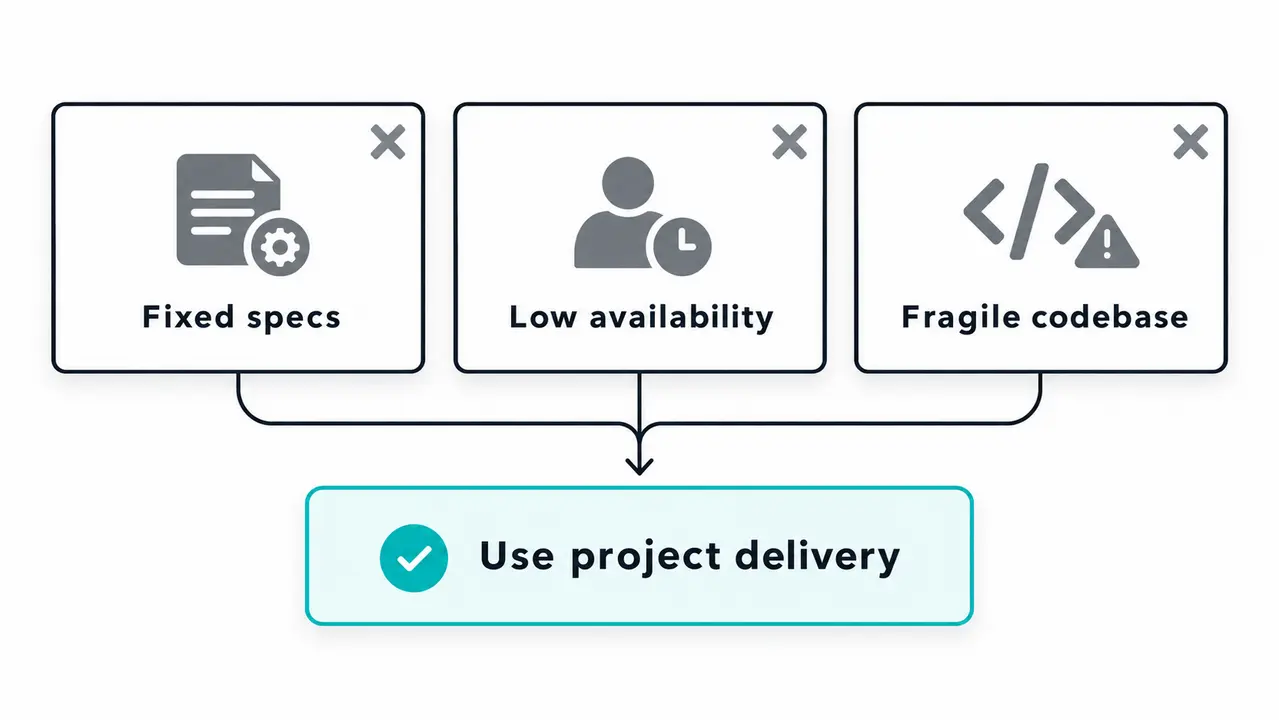
Some work should not be hybrid. Fully spec-driven work with hard external sign-offs, like compliance documentation for a regulated market, has no iteration loop for a blended team to exploit. The requirements are fixed, the acceptance is fixed, and the coordination overhead buys nothing. Stakeholders who cannot commit to weekly involvement are a second blocker. External engineers end up blocked in queues while your internal team becomes the decision bottleneck, and everyone’s cycle time degrades together.
Fragile codebases are the third case. If the system cannot absorb new engineers without breaking, scaling the team scales the churn, not the output. There is a version of this we see often: a team wants to add five people to a monolith with no tests and no environments, believing capacity is the constraint. The constraint is the platform. Use project-based delivery for well-defined modules in that situation, or spend a quarter stabilizing internally first. Both are slower on paper and faster in reality.
The boundary map every blended approach needs
Before the first sprint, write one page answering six questions. Who decides product priorities? Who owns architecture? Who holds the security posture? Who administers CI/CD? Who answers the 3 a.m. page? Who approves taking on technical debt? That page is your boundary map, and the absence of it produces a specific disease called shadow architecture: the internal team designs one thing, the external team builds another, and production runs both.
Pair the map with a decision log for irreversible choices, the ones involving data models, third-party dependencies, and public contracts. Reversible decisions can live in pull requests. Irreversible ones need a written record that outlives the people who made them.
Without the map, the default pattern emerges on its own. Your internal team owns the roadmap, the external team owns product slices, and every integration becomes a negotiation. The map is cheap insurance. A day of writing prevents months of reconciling contradictory patterns across services, which is where unblended attention actually goes when nobody drew the line.
Roles that should stay close to the business
Four roles belong inside your walls no matter how strong the external team is. The product owner, because prioritization is a customer-context job. An architect or staff engineer, because system-level tradeoffs compound. The security decision-maker, because risk appetite is a business call. And the release owner, because shipping is the moment of maximum exposure. These people carry the context that drives long-term Product development initiatives, and context does not transfer through tickets.
The counter-case deserves honesty. If the external team includes strong technical leadership, that leadership is an asset, and you should use it. Use it inside clear decision authority, not beside it. Two confident architects without a stated tiebreaker produce split-brain architecture, where each side politely builds its own version and the divergence surfaces in integration, months late. Name who decides. Let the other side argue hard, then commit. We would rather work under a decisive internal architect who sometimes overrules us than in the ambiguity that precedes every design dispute.
Choosing between embedded team, staff augmentation, and project outsourcing
Three engagement models, three different jobs. Pick an embedded team when you want outcome ownership: a group that holds a product slice end to end and answers for it in production. Pick staff augmentation when you need specific seats filled and your own management is strong enough to direct them daily. Pick project outsourcing for bounded deliverables with stable requirements and a clear acceptance event. When the goal is a hybrid model specifically, embedded or Dedicated software engineering teams are the stronger building block, because they own a slice end to end rather than a set of hours.
Pure staff augmentation deserves a warning. It looks like the cheapest option and often carries the highest hidden cost, because every management task lands on your leads and every integration risk lands on your review queue. Control, continuity, onboarding load, and accountability differ sharply across the three models.
How the three engagement models compare
The table below is the short version of the decision.
| Dimension | Embedded team | Staff augmentation | Project outsourcing |
|---|---|---|---|
| Control | Shared, you hold direction | Full, you direct daily | Limited to acceptance criteria |
| Continuity | High, same team over quarters | Low to medium, seat-based | Low, ends at delivery |
| Onboarding load | Medium, once per slice | High, per person | Low, vendor absorbs it |
| Delivery accountability | Shared outcome ownership | You own the outcome | Vendor owns the deliverable |
| Integration risk | Low with one pipeline | High, review queue grows | High at handover |
The interpretation is simple. If the row that worries you is integration risk, augmentation is the weakest choice. If the row that worries you is control, outsourcing is.
The first two weeks that decide time to value
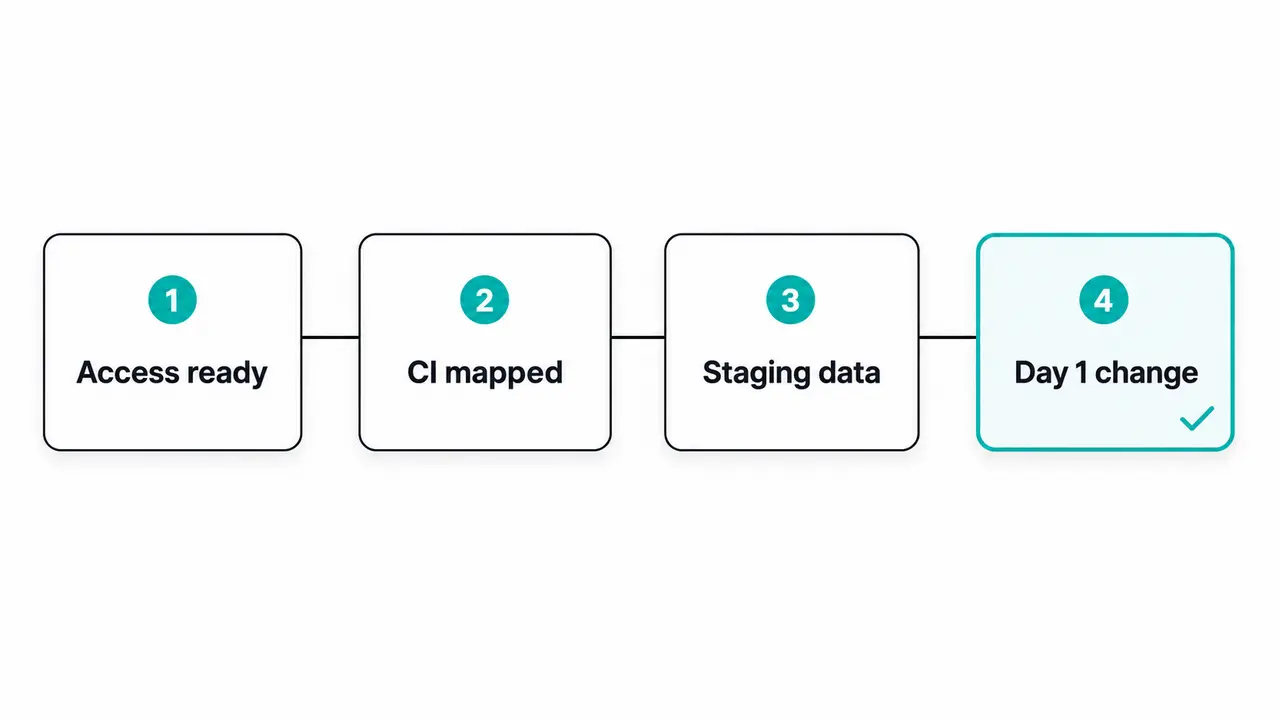
Time to value in a hybrid engagement is decided in the first two weeks, and it is decided before the external engineers write a line of code. Fast teams treat onboarding as an engineering deliverable with an owner, a checklist, and a definition of done, exactly like a feature. Slow teams treat it as an email thread about credentials.
The checklist is concrete. Repository access provisioned through your SSO before day one. CI permissions mapped to the team, not requested after arrival. A staging environment with realistic data approaches, because synthetic fixtures hide the bugs that matter. Runbooks, local dev setup instructions, and a branching strategy written down somewhere other than one engineer’s memory.
The failure mode is the two-week stall. New engineers idle while tickets bounce between IT, security, and a lead engineer who is on vacation. The sprint burns, nothing ships, and the retrospective blames the model. Require one Day 1 deliverable instead: a small, production-safe change pushed through the full pipeline by every new engineer. If that change cannot happen on day one, you found your bottleneck on day one. That is the point.
Onboarding artifacts that reduce senior engineer interruption
Ask yourself what your senior engineers spend their time on during an expansion. If the answer is answering the same five questions in chat, your documentation layer is a person, and people do not scale. Write down the minimum context instead: an architecture overview, a service ownership map, Architecture Decision Records for the choices that shaped the system, and a “first five pull requests” checklist that walks a new engineer through the codebase by doing.
The industry data supports the instinct. The 2024 Stack Overflow Developer Survey shows how heavily professional developers rely on internal documentation and clear onboarding material to ramp up on unfamiliar code, and legacy codebases are exactly where that reliance concentrates.
There is a counter-case. If your codebase changes daily with no stable patterns, documentation rots faster than you can write it. In that situation, prioritize platform hygiene first. Stabilize the patterns, then document them. Documenting chaos just preserves the chaos in writing.
One backlog and one Definition of Done
A hybrid team runs on a single backlog with one prioritization mechanism, and a Definition of Done that applies to every ticket regardless of who picked it up. This sounds obvious and is violated constantly, usually politely. The external team gets a “their side” board. Requirements flow into it, finished features flow out of it, and the internal team discovers at integration time that Done meant something different over there.
Shared sprint planning is the mechanism. One planning session, one estimation scale, one acceptance criteria format. If the external engineers estimate in story points and your team estimates in days, you have two teams with a shared calendar and nothing else.
Define Done beyond code. A ticket is not finished when the tests pass. It is finished when monitoring covers the new behavior, the runbook is updated, and the rollback path has been verified. Without that extension, external engineers “finish” tickets that create downstream integration and reliability work for your internal engineers, and the model quietly converts one team’s velocity into the other team’s debt.
Code review and merge rights in a blended team
Give external engineers real merge responsibility inside guardrails, or the model underperforms. Real responsibility means an external engineer can merge a change in their owned area without waiting for an internal approver. Guardrails mean the platform enforces the standards, not a gatekeeper. Use a CODEOWNERS file so the right reviewers are assigned automatically. Protect the main branch. Require status checks. Set a review SLA, and treat a breach like an incident.
The failure mode is arithmetic. A team of eight generating twenty pull requests a day, routed through two internal reviewers, builds a review queue. When that queue hits two days, the sprint stops being development and becomes waiting for approvals. Velocity drops, the model gets blamed, and the actual cause was a policy decision made in week one.
Here is the honest counter-case. If you cannot grant meaningful merge rights for a given area, whether for regulatory or trust reasons, do not pretend the hybrid model covers that area. Cut the scope or change the engagement model. A two-tier team, where one tier reviews and the other waits, corrodes both the throughput and the working relationship.
Architecture decisions without split brain
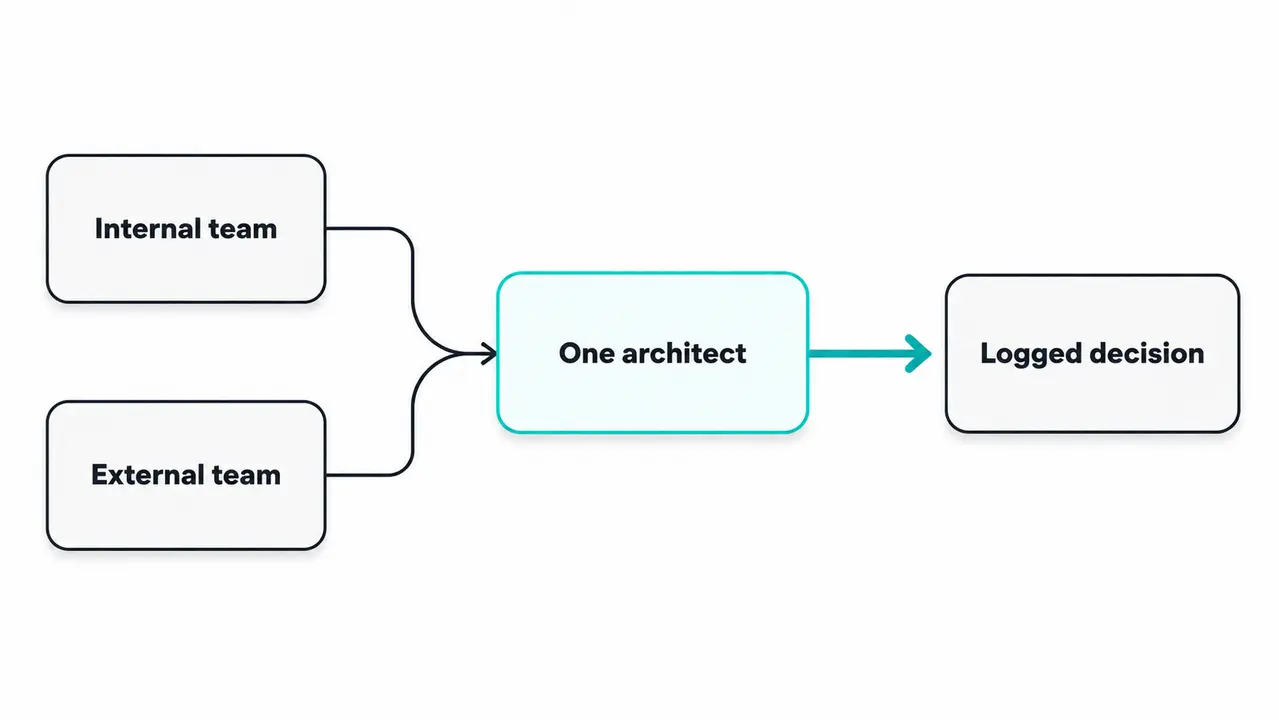
Architecture stays coherent across a blended team when three things are true. Decisions are logged, patterns are explicit, and one person is accountable for cross-cutting consistency. The tooling is modest. An ADR template in the repository, a monthly architecture review with both sides present, reference implementations for the common cases, and shared lint rules that make the default path the easy path.
What you are preventing is depressingly familiar to anyone who has inherited a fast-growing system. Two web frameworks. Three authentication flows. A service that speaks REST, a service that speaks gRPC, and a data contract that matches neither. None of it was incompetence. Each choice was locally reasonable and globally incompatible.
The mechanism that prevents this is a paved road: a standard service scaffold with observability wired in, a golden path for new components. A paved road guides external engineers without dictating every line of code, and it lets your architect spend review time on the exceptions instead of the defaults. Deviation is allowed. Deviation requires an ADR.
Time zones, handoffs, and the real meaning of overlap
Chase predictable overlap, not 24-hour development. The round-the-clock model that sold well in outsourcing brochures optimizes for the appearance of continuous progress and pays for it in integration risk, because every handoff is a chance to drop context. Fewer handoffs beat more handoffs, almost always.
The practical setup is a fixed two-hour daily overlap window. Standup happens inside it. Pairing and unblocking sessions happen inside it. Everything else defaults to asynchronous: decisions go in the decision log, demos get recorded, and questions wait for the window instead of interrupting someone’s deep work at 10 p.m. local time.
The failure pattern is handoff ping-pong, where a task crosses three time zones in a day and gains a misunderstanding at each border. You will recognize it when a ticket’s comment thread has four participants, none of whom have been online at the same time. If the product genuinely requires constant real-time collaboration, like rapid product discovery with a designer in the loop, restructure the work into independent slices or prioritize colocated overlap. More hours on a clock rarely fix a problem that is actually about joint attention.
Quality ownership across a combined workforce
Quality improves when the people who write the code also own its behavior in staging and production. That sentence sounds like a platitude until you see the alternative: an external team hands over “tested” code, an internal team deploys it, defects appear, and both sides have a defensible story about whose job quality was. Blame cycles are the tax on undefined quality ownership.
Make it structural instead. Set explicit test pyramid expectations, so nobody ships a service with only end-to-end tests. Add contract tests at every service boundary, because that is precisely where two-team work integrates badly. Give the external team error budget targets tied to the components they own, and make the numbers visible to everyone.
The strongest version includes on-call. External engineers participating in rotations, weighted to the risk profile of their owned components, changes behavior upstream. People who will be paged for a failure write different code than people who will not. If a vendor resists on-call participation for code they own, treat that as the signal it is.
Security and access without slowing delivery
Security in a hybrid team is an access design problem and a workflow design problem, solved with least privilege and automated controls rather than manual gates. The stack is known. SSO for identity. Role-based access scoped to repositories and environments. A secrets manager instead of credentials in chat. Dependency scanning in the pipeline, plus checks for known web application risks. Aligning external engineer obligations with established frameworks, like the NIST Secure Software Development Framework and the OWASP Top 10, gives both sides one vocabulary instead of two policies.
The failure mode is self-inflicted. Over-restrict access until engineers cannot run a local test or see a staging log, and they will find a way around the controls, because shipping is their job and the control is in the way. A personal SSH tunnel around your perimeter is worse security than the access you refused to grant. Design the path of least resistance to be the secure path, and audit the trail it leaves.
Embedded and system software work in a hybrid model

Hybrid models work well for embedded and system software under two conditions: interfaces are explicit, and integration environments exist. Hardware constraints amplify every coordination mistake, because a wrong assumption that costs an afternoon in a web service costs a firmware reflash cycle or a field failure in a device fleet. Complex System and embedded engineering needs shared release milestones and stable integration rigs to scale at all.
The toolkit reflects that. Hardware-in-the-loop testing so firmware changes validate against real peripherals. Versioned interfaces between firmware, cloud backend, and mobile app, so three teams can move without breaking each other. Reproducible toolchains, because “works on my machine” is intolerable when the machine is a build server flashing a thousand units.
The counter-case is blunt. If you cannot provide stable integration rigs or simulators, adding engineers increases churn instead of throughput. Invest in the test infrastructure first, then scale the team onto it. We would rather deliver the rig than the headcount, and so would you in month six.
Metrics that show whether the blended approach is compounding
Track flow and quality metrics that reveal whether knowledge is compounding in the combined team, and ignore vanity throughput. The set that works: cycle time, review queue time, change failure rate, escaped defects, and onboarding time to first production change. That last one is the compounding indicator. When the tenth engineer reaches their first production change faster than the third did, the system is learning. When it stays flat or rises, you are renting hands instead of building a team.
Watch for the combination, not the individual numbers. Improving cycle time alongside a rising change failure rate means the team is shipping faster and breaking more, which is not speed. It is deferred cost with a delivery date.
Set expectations for the beginning. Early onboarding can temporarily worsen every metric in that list, and a leader who panics at sprint three makes structural changes at exactly the wrong moment. Give the model a stabilization window of three sprints before reading the trend line.
Exit readiness and knowledge retention by design
A healthy hybrid model is designed so your product becomes more maintainable if the external team rotates or exits entirely. Not because exits are expected. Because the artifacts that make exit safe are the same artifacts that make daily work smooth. Runbooks that a new engineer can follow at 2 a.m. An ownership map showing which team holds which component. Recorded architecture walkthroughs, so the reasoning behind the system outlives the people who built it.
Test the design quarterly with a re-onboarding exercise. Have an engineer who joined recently, internal or external, attempt to ship a small change using only the documentation. What they cannot find is your retention debt, itemized for free.
The failure mode is quiet accumulation. Knowledge lives in private chats, in one engineer’s head, in a vendor wiki nobody exported. Nobody notices until a rotation, and then the discovery is expensive. If a new engineer cannot ship safely within two weeks using existing documentation, redistribute knowledge now. Not at the end of the engagement. Now.
Frequently asked questions
Who owns the code and the repository when the engagement ends?
You do, and that should be true from day one, not at exit. The external team works inside your repositories, under your SSO, with your branch protection and audit trail. Nothing of consequence should live in a separate vendor-controlled system, because anything that does is a hostage negotiation you have already lost.
How long does onboarding take before the team produces real output?
Expect a small production change in week one and full-ticket throughput by sprint three. That timeline holds only if onboarding artifacts, access, and environments were prepared before arrival. With preparation, the stabilization window is short. Without it, you are looking at a month of half-idle engineers.
What happens when a key external engineer rotates off the team?
The engagement contract should require notice and a documented handover, but the real protection is architectural. If knowledge is spread across runbooks, ADRs, and code ownership rather than concentrated in one person, a rotation is a staffing event. If it is concentrated, a rotation is a project risk. The quarterly re-onboarding test tells you which one you have.
How do we scale down without leaving holes in ownership?
Plan the scale-down at the same time you plan the scale-up, component by component. Each external-owned slice needs a named internal counterpart or a documented handoff target before the team shrinks. Reverse the onboarding checklist and you have your scale-down checklist.
How is a partner evaluated before signing?
Ask for a sample ADR, a runbook, and a Definition of Done from a previous engagement. A team that cannot produce those artifacts within a day does not operate with the discipline the hybrid model requires. Also ask what happens on their side when an on-call page fires at 3 a.m.
The next step is a boundary workshop, not a kickoff call
Before any code, run a half-day workshop whose outputs are the ownership map, the onboarding checklist, the Definition of Done, the review policy, and the first-sprint scope. Our team at Sentice uses exactly this format to align delivery mechanics first, because artifacts settled in week one prevent disputes in month six. Hybrid buys speed and flexibility only when the governance is explicit. Skip the workshop and you are choosing the wall, whether you meant to or not.
Let’s scope your team
Tell us about your roadmap and we will map ownership, onboarding, and delivery mechanics with you in a single working session.
About Sentice

Sentice is a boutique software engineering partner founded in 2013 by Roni Levi and Martin Petkovic, now headquartered in Skopje, North Macedonia. Rather than supplying individual developers, we build embedded teams that blend with a client’s culture, tech stack and goals, working together from a single office under our own technical leadership. We deliver dedicated software engineering teams, end-to-end software solutions, product development, and system and embedded engineering, and we act as technical advisors across the full development lifecycle, from specification and architecture through development, testing and support. We use AI coding tools across every project, and we help clients integrate AI into their own products through chatbots, MCP services, connected application layers and workflow automation. Some of the clients we started with more than a decade ago are still building with us today.