
Your roadmap has been clear for two quarters and the sprint board still says otherwise. Tickets spill over every cycle, your senior engineers spend Thursdays in interviews instead of code review, and the hiring pipeline promises a mid-level backend engineer sometime next quarter. This is the point where most product leaders start asking about software outsourcing services, usually with a deadline breathing down their neck and a budget conversation pending. The question is rarely whether external engineering capacity can help. The question is which shape of it fits your team, your codebase, and the amount of control you are actually willing to trade for velocity. Get that wrong and you buy six months of churn. Get it right and you add a delivery engine that outlives the roadmap that justified it. Below, we’ll define software outsourcing services in plain terms, compare the three engagement models side by side, and walk through the working agreements, quality gates and exit planning that keep an external team inside your engineering system.
Reading time: 13 min
Key points
- Sustained sprint spillover across 3 to 4 cycles signals structural understaffing, not bad management, and that is the moment external capacity becomes rational.
- Software outsourcing services resolve into three models: staff augmentation, a dedicated team, and project based delivery, and picking the wrong one causes most delivery pain.
- For evolving products, a dedicated team with a stable partner-side tech lead usually offers the best balance of continuity and control.
- Security, IP and exit planning are operational controls in tooling, access and review gates, not contract phrases.
Table of contents
Software outsourcing services in plain terms for product teams
Software outsourcing services are external engineering capabilities you plug into your product delivery, from a single specialist to a full cross-functional team that ships and maintains production code. The scope can be a new product module, an integration layer between your billing system and a payment provider, test automation for a release train that keeps slipping, or embedded firmware with a cloud companion. What you are buying is delivery capacity that behaves like part of your system, not a body count.
The failure mode is treating this as just getting developers. Engineers dropped into your workflow without integration into your planning, review, and release process produce code that technically works and organizationally drifts. Six months later you own a subsystem nobody inside understands. When you outsource software development, you are contracting for outcomes inside your engineering system, and the contract has to say so.
The three outcomes buyers actually want
Strip away the vendor language and buyers want three things. Predictable throughput, meaning sprint commitments that hold without heroics. Codebase continuity, meaning the people who wrote the module are either still on it or handed it off deliberately. Shared ownership, meaning the external team flags architectural problems instead of quietly coding around them. Most disputes trace back to one of these three being implied but never written down.
Where software outsourcing fits in the broader IT outsourcing landscape
Software development outsourcing is one slice of the IT outsourcing market, and a large one, but it behaves differently from helpdesk contracts or infrastructure management. Grand View Research put the global IT services outsourcing market at USD 744.6 billion in 2024. The number matters less than the composition. Most of that spend buys standardized, repeatable services. Custom engineering is none of that, because it touches your product IP, your architecture, and the maintainability of a codebase you will still be shipping from in three years.
That difference demands explicit ownership boundaries. Architecture decisions, security sign-off, and release management must remain distinguishable responsibilities, even when the external team executes most of the work. A generic IT outsourcing company optimized for commodity contracts will apply standardized governance to custom work, and the mismatch shows up as weak review gates and expectations nobody wrote down. Treat custom engineering as its own category with its own rules.
The moment internal hiring stops matching the roadmap
Outsourcing becomes rational when hiring lead time and onboarding drag make your roadmap slip even though priorities are clear. You know the situation. The backlog is prioritized, the specs exist, the only missing input is engineering hours, and your recruiters are competing with every other scaleup for the same mid-level Golang and Node.js engineers.
Define a capacity gap concretely: sustained sprint spillover across 3 to 4 cycles, with the same tickets rolling forward each time. That pattern means your team is structurally understaffed, not badly managed. One spillover cycle is noise. Four is a signal.
The hidden bottleneck is senior bandwidth. Your staff engineers spend a day a week interviewing and another day onboarding each new hire, which is capacity pulled directly from delivery. We have watched teams hire their way into slower release trains for two consecutive quarters before anyone named the cost. If you are weighing expansion paths, our strategic guide to in-house expansion and outsourcing partnerships covers the decision in depth.
What you can outsource without losing product ownership
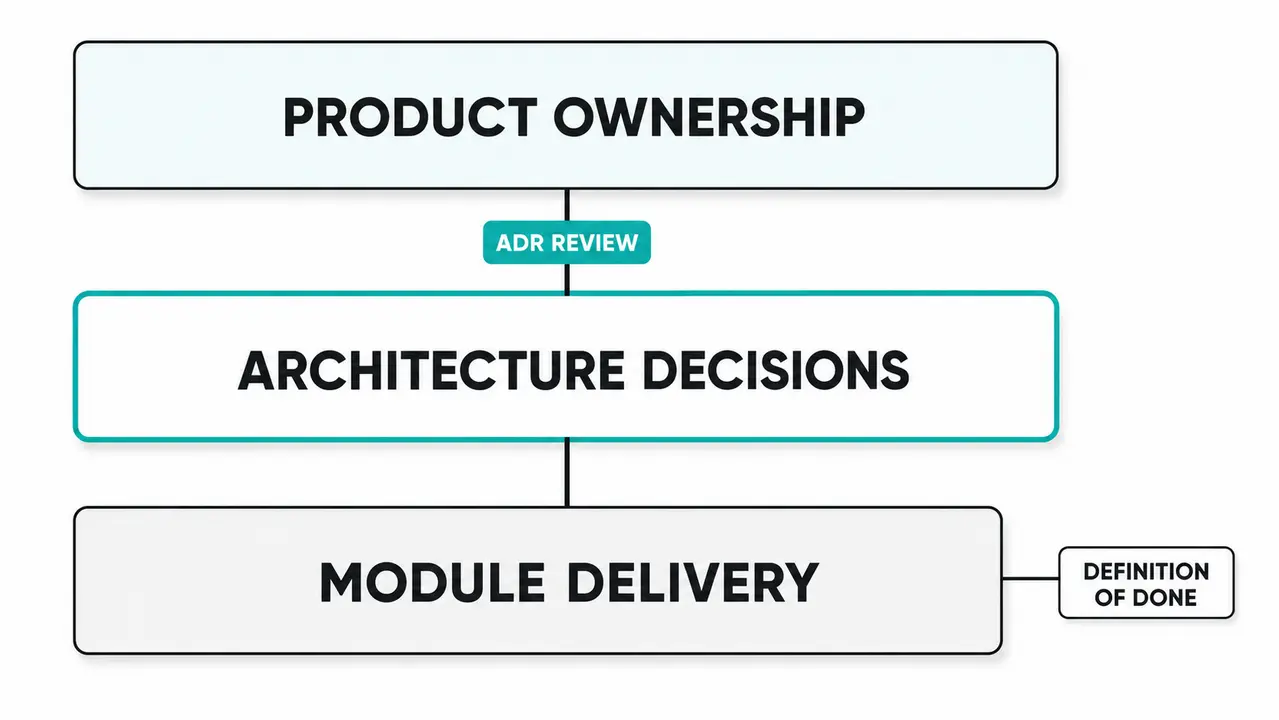
You can outsource delivery and even module ownership while keeping product ownership in-house. The mechanism is explicit decision rights plus enforced engineering standards. A written architecture decision record process, where every significant choice lands in an ADR your internal leads review, keeps the external team inside your technical direction. A strict definition of done, covering tests, documentation, and observability, keeps their output inside your quality bar.
Software development outsourcing fails on ownership when the external team makes unilateral architectural decisions. A partner that picks a message broker, a data model, or a framework without internal review is deciding what your maintenance costs look like for years. You will live with that choice long after the engagement ends.
Subsystems with hard technical edges are the safest starting point. Embedded firmware paired with its cloud companion is a classic case, and our system and embedded engineering work follows exactly this boundary: the partner owns the module, you own the architecture.
Engagement models that show up under software outsourcing services
Most software outsourcing services resolve into three engagement models, and choosing the wrong one causes the majority of delivery pain. Staff augmentation adds engineers inside your team. A dedicated team runs as a semi-autonomous unit with its own cadence. Project based outsourcing contracts a bounded deliverable with a formal handover. Each model answers three questions differently: who runs sprint planning, who owns delivery management, and how knowledge is retained when people rotate.
Teams pick models on perceived cost and then discover the real tradeoff is continuity versus bounded scope. A fixed-price contract looks disciplined until requirements shift in week three and the renegotiation starts. A dedicated team looks open-ended until you realize you wanted a fixed deliverable with a clean exit. The model has to match how your product actually changes, not how you wish it did.
The control triangle of scope, speed, and ownership
Think of every engagement as a triangle with scope, speed, and ownership at the corners. Fix two and the third is dictated. Lock scope and deadline, and ownership of tradeoffs shifts to the vendor, who will cut where you cannot see. Lock scope and ownership, and speed becomes the release valve. Lock speed and ownership, and scope must flex, which is exactly why dedicated teams run on evolving backlogs rather than fixed specifications.
Staff augmentation when you already have strong technical leadership
Staff augmentation works best when you have clear internal leadership, stable engineering practices, and a need for extra hands or niche skills inside your existing team. Your tech lead runs sprint planning, your standards apply, and the augmented engineers slot into your workflow like a strong contractor would.
Prepare properly and it moves fast. An onboarding packet, repo access from day one, written coding standards, and a named internal tech lead accountable for outcomes are the minimum. Without that named lead, augmented engineers go idle or misdirected within two weeks, because nobody inside has the bandwidth to direct them.
This is the weaker option when internal leadership is thin or the work requires end-to-end ownership. Augmenting a team that cannot absorb and direct new engineers just moves the bottleneck. You pay for capacity you cannot consume.
Dedicated team model for evolving products that need continuity
The dedicated team model fits products with changing requirements, where continuity and shared ownership matter more than locked scope. Operationally, dedicated means a stable sprint cadence, a demo rhythm you can plan around, and a stable tech lead on the partner side who stays with your product across quarters. Our dedicated software engineering teams run on exactly this structure, and the stability of that tech lead is the single strongest predictor of whether the engagement compounds knowledge or leaks it.
The failure mode is treating a dedicated team as temporary staffing. Pull engineers off and rotate them through as priorities shift, and you lose the accumulated context that made the team fast. Teams that outsource software development this way often discover their velocity curve peaked in month six and has been declining since, with nobody able to say why.
The counter-case: if your requirements are genuinely stable and the deliverable is bounded, a dedicated team is more structure than you need.
Project based outsourcing for bounded deliverables and clean interfaces
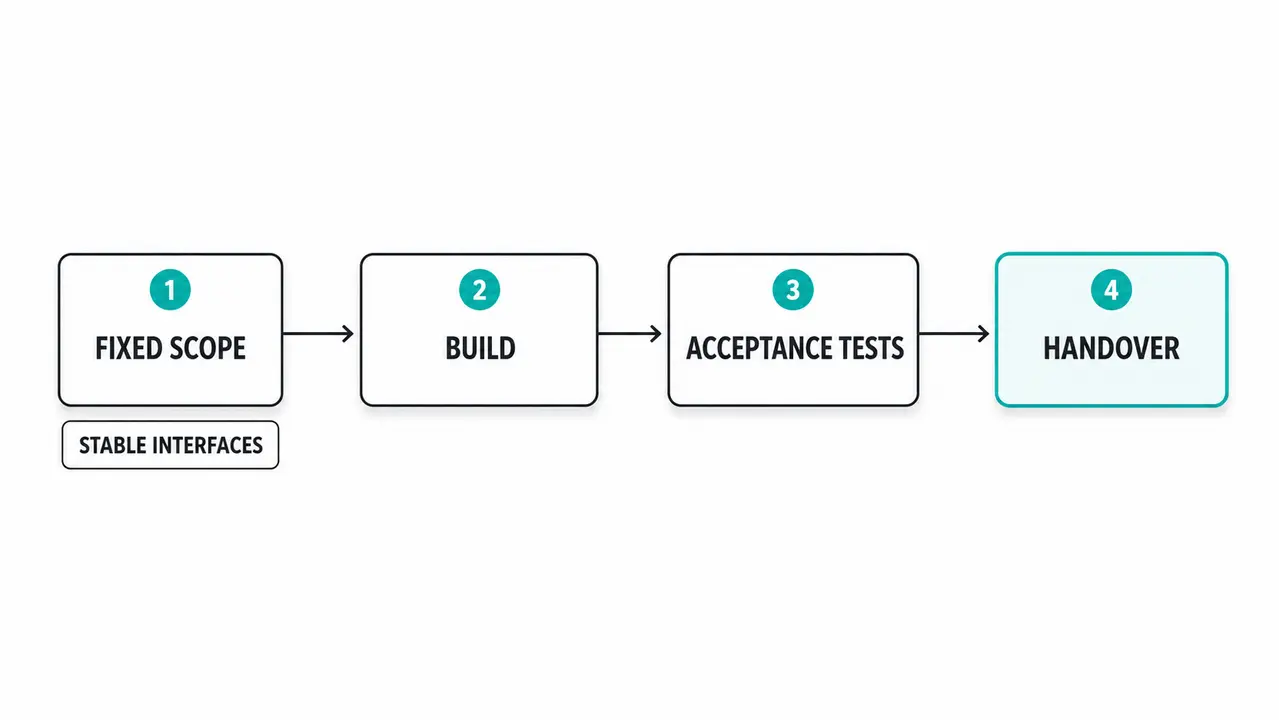
Project based outsourcing can work when the deliverable is tightly bounded, the interfaces are stable, and you can accept a formal handover. Think a data migration tool, a white-label mobile client against a frozen API, or a proof-of-concept that will be rebuilt internally if it proves out. The requirements are acceptance tests, interface contracts, and a hard definition of what done means in production, not in a staging environment.
Requirements drift is what kills fixed-scope arrangements. Every change triggers renegotiation, timelines slip, and the vendor starts cutting quality in the places your acceptance tests do not cover. Software development outsourcing on a fixed scope is a bet that you specified everything correctly up front, and product teams rarely do.
It is the weaker choice for core product development where requirements evolve weekly. There the fixed scope works against you, and the handover you accepted as a formality becomes a knowledge transfer project of its own.
How the three engagement models compare
Compare the models on three questions: who owns delivery management, how change is handled, and how knowledge stays in the codebase. The matrix below shows how the answers diverge.
| Dimension | Staff augmentation | Dedicated team | Project based |
|---|---|---|---|
| Change tolerance | High, your backlog governs | High, joint planning governs | Low, change requests govern |
| Onboarding load | On you, continuous | Front-loaded, then stable | Low until handover |
| Governance overhead | High internal management | Moderate, shared ceremonies | High contract administration |
| Continuity risk | High, people rotate freely | Low, team persists | High after handover |
| Integration depth | Deep, inside your team | Deep, parallel team | Shallow until delivery |
One assumption to kill early: no model scales indefinitely without adjusting governance. A five-person augmented pod runs fine on informal coordination. At fifteen people, the same informality produces silent quality decay, because review gates designed for one team are carrying three.
The verdict for startups and scaleups
For scaleups needing sustained velocity, dedicated teams usually offer the best balance. Augmentation depends on internal leadership you probably cannot spare, and fixed scope fights an evolving product. A dedicated team with a stable partner-side lead gives you continuity without consuming your seniors, and it scales up and down without renegotiating a specification.
Let’s scope your team
Tell us about your roadmap and your current capacity gap, and our engineers will map which engagement model fits your product before you commit to anything.
Vendor selection signals that matter to engineering leaders
The strongest selection signals are operational, not marketing. You want evidence of how the team actually works, how quality is enforced, and how knowledge is retained. Ask for a sample onboarding plan and a sample weekly status format before you sign anything. A team that cannot produce those two artifacts in a day does not have them, and that tells you everything.
Dig into engineering practice directly. Who reviews code, and what makes a PR approvable? What does their CI pipeline gate on? What happens when a build breaks at their end of the day? In software development outsourcing, the answers to those questions predict your experience better than any case study.
The polished pitch deck is the trap. Vendors who win on presentation and lose on code review norms deliver misaligned standards that surface three months in, when the first difficult refactor lands. We evaluate partners the same way we evaluate engineers: on the work, shown, not described.
The discovery phase that prevents expensive rework
A short discovery phase reduces risk by aligning on architecture, constraints, and acceptance criteria before velocity becomes the metric. Timebox it to 1 to 3 weeks depending on system complexity, and demand explicit deliverables: an architecture sketch, a risk register, and a written list of acceptance criteria for the first increment. If the partner cannot commit to those artifacts, they cannot commit to the build either.
Skipping discovery produces the build first, integrate later pattern, and that pattern blows budgets. The team ships confidently for six weeks, then the first integration attempt surfaces an assumption about your data model or your auth flow that invalidates a third of the work. Every experienced engineering lead has a story like this. The ones who outsource software development with a discovery phase have fewer of them.
The counter-case is trivial work. If the deliverable is a landing page against a stable API, a week of discovery is ceremony, not diligence.
Where teams underestimate onboarding
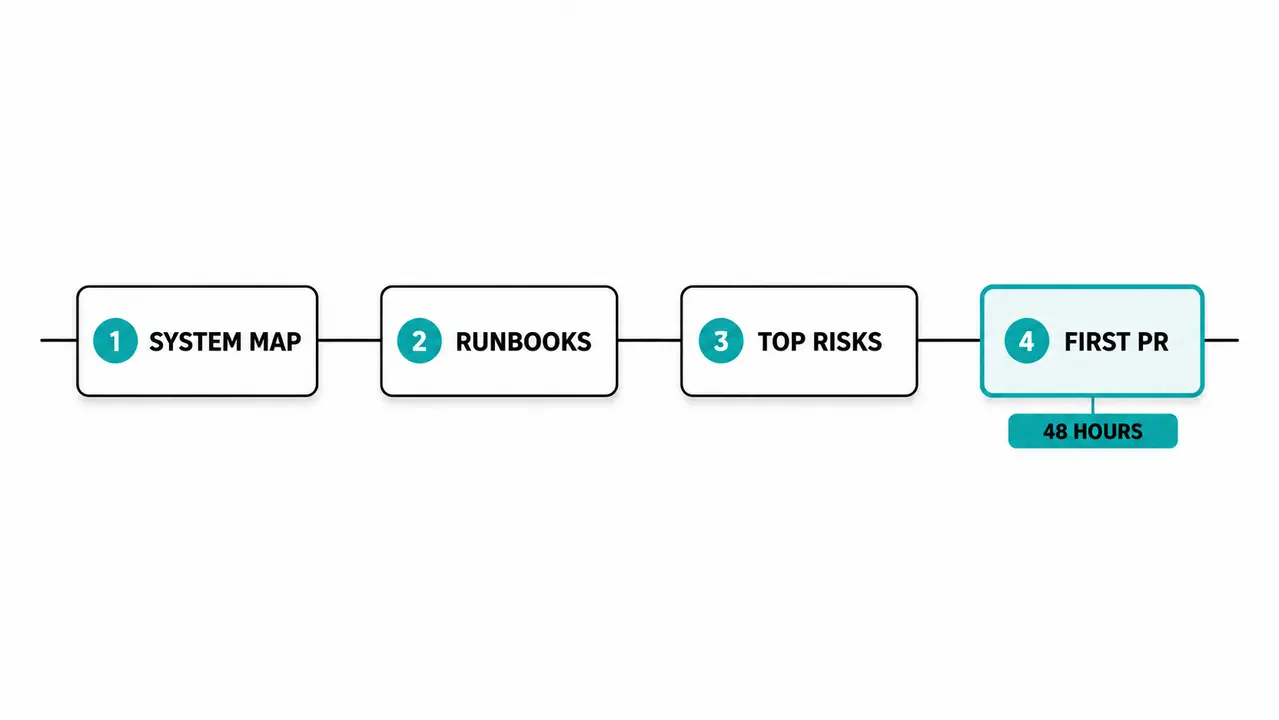
Onboarding fails when it is treated as access provisioning. Repo access, a Slack invite, and a Jira account are logistics. Real onboarding is a structured transfer of system context and decision history: why the billing module is split, why you chose event sourcing, which parts of the codebase are load-bearing and which are scheduled for deletion. When you buy software outsourcing services, you are buying the speed of that transfer, and its quality is a joint responsibility.
Two artifacts fix most of it. A first-week checklist covering the system map, key runbooks, and the current top three technical risks. And a first PR in 48 hours goal, small but real, a bug fix or a logging improvement, so the new engineer touches your review pipeline before touching your architecture.
Be honest about your side. If the codebase is undocumented and unstable, onboarding will be slow regardless of vendor quality, and no partner can fix that in week one.
Working agreements that keep delivery predictable
Clear working agreements prevent the two breakdowns that erode outsourced delivery: silent drift, where the team slowly diverges from your standards, and constant escalation, where every minor decision lands on your desk. Put the agreement in writing and attach a RACI matrix covering product decisions, architecture, QA, DevOps, and release approvals. Ambiguity in those five rows is where weeks disappear.
Define the communication contract with the same precision. Which channel for blockers, which for decisions, and what response window each carries. An undefined response expectation turns a blocked engineer into a two-day delay, because the question sat in the wrong channel overnight. Any competent IT outsourcing company will propose a structure here; the good ones let you shape it to your existing rhythm instead of imposing theirs.
Review the agreement quarterly. Teams change, scope changes, and an agreement nobody has reopened in a year is an agreement nobody follows.
Security and IP controls that belong in the engagement
Treat security and IP protection as operational controls, not contract phrases. The NDA is a legal instrument; the repository access policy is the control. In software development outsourcing, protection lives in tooling, access, and review gates, and it needs to be specified at the engineering level.
The baseline list: a secure development workflow aligned with a recognized secure software development framework such as NIST SP 800-218, least privilege access to repos and environments, strict separation of development, staging, and production, and documented offboarding steps that revoke access the same day an engineer rotates off. Ask how secrets are handled in CI. Ask who can merge to the release branch. The answers should be immediate.
Relying solely on an NDA while leaving repository access open is uncontrollable risk. A signed document does not stop an over-broad service account, and it does nothing for the contractor whose laptop holds a production database dump from a debugging session six months ago.
What to put in an SLA without turning engineering into ticket theater
An SLA should measure reliability of collaboration and delivery health, not raw output metrics that teams can game. When you contract for software outsourcing services, measure the things that actually predict outcomes: severity levels with expected response windows for blockers, defect severity handling with resolution expectations, and a monthly review cadence where delivery health is examined against DORA-style metrics like change lead time and change fail rate.
What destroys these agreements is vanity metrics used as a contractual weapon. Lines of code, story points completed, hours logged. Teams optimize to the metric, the metric improves, and the codebase rots. Morale follows quality downward, and your best engineers on both sides start looking elsewhere.
The counter-case matters too. An SLA with no teeth is theater in the other direction. One page, five measurable commitments, and a monthly meeting that can actually change something.
Keeping code quality high across a distributed team
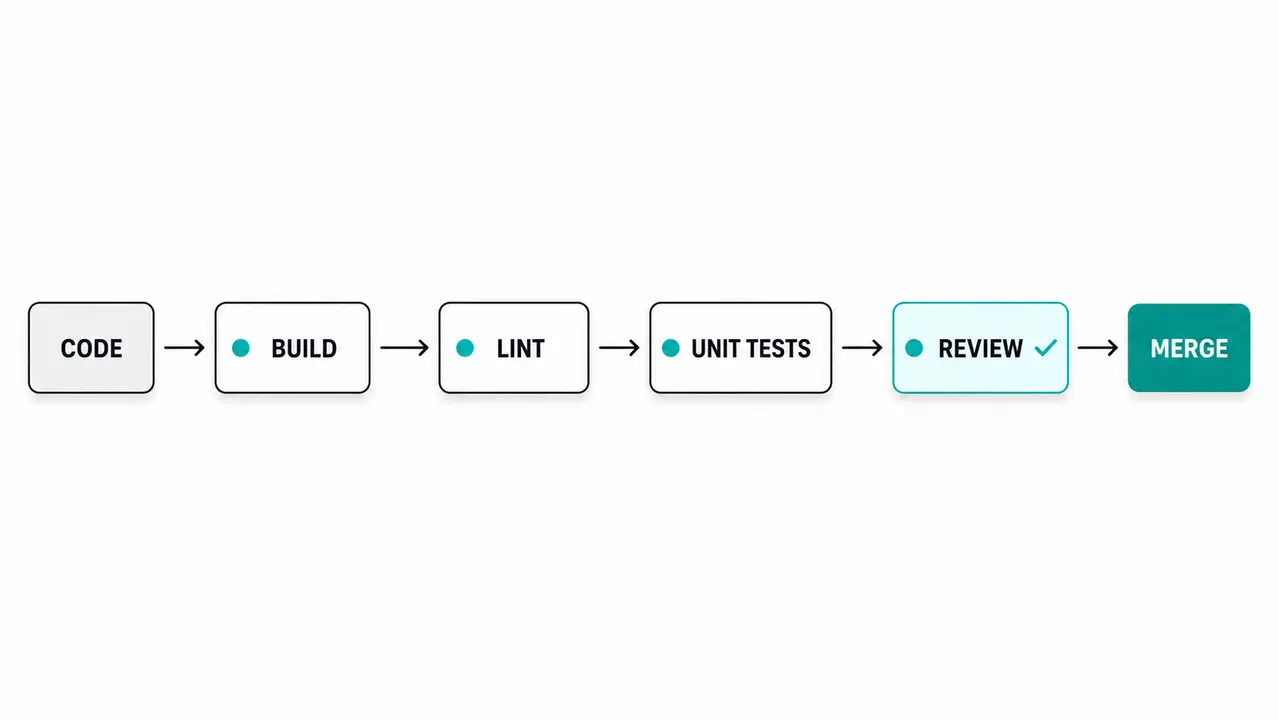
Quality stays high when standards are enforced in the pipeline and in reviews, not in after-the-fact QA cycles. The enforcement stack is unglamorous and effective: branch protections that block direct pushes to main, required reviewers on every PR, CI gates that run linting, static analysis, and the test suite, and a shared definition of done that includes tests and documentation. GitHub Actions or GitLab CI running the same gates for internal and external engineers removes the entire argument about whose code passes.
The failure mode is quiet bypass. Remote engineers skip static analysis locally because the pipeline is slow, warnings accumulate, and two quarters later you own a brittle codebase where nobody refactors anything. When you outsource software development, the pipeline is the constitution. It applies identically to everyone, and it never negotiates.
The smallest quality bar that still works at speed
The minimum viable bar is four gates: build passes, lint clean, unit tests pass, one qualified reviewer approves. Add integration tests on merge to main and a required owner for every module. That is enough to keep velocity. Anything lighter and drift starts within a sprint; anything heavier and engineers start routing around the process, which is worse than having no process at all.
AI assisted development without losing accountability
AI tools can increase throughput in outsourced delivery when human accountability for design, security, and correctness stays explicit and usage is governed by policy. We use Claude Code, Cursor, and similar tools inside our own engineering work, and the productivity gain is real. The governance is what makes it safe.
Three controls cover most of the risk. A written AI usage policy stating which tools are approved and for what. Code review expectations that treat AI-generated changes exactly like human-written changes, with the same scrutiny on the same reviewer queue. And strict rules on secrets and customer data, because pasting a production credential into an external tool is a data breach regardless of intent.
Skip the oversight and the failure modes are specific: sensitive data leakage through prompts, and hallucinated code entering production because nobody felt accountable for a change they did not write. In software development outsourcing, the policy has to bind the external team contractually, not just culturally.
Exit planning that avoids vendor lock in by default
A clean exit is designed from day one, through documentation, shared ownership, and predictable knowledge transfer. The practices are simple and rarely followed: a monthly bus factor review asking who could take over each module if the partner disappeared tomorrow, rotating ownership so the same engineer is not the only person who understands the billing service, and a final handover checklist agreed before the engagement starts rather than negotiated during the wind-down.
Watch for the warning sign. A vendor that resists transparency, keeps documentation thin, and lets silos form around its key people is making itself expensive to replace, and that is a delivery risk you are carrying, not a loyalty benefit. Any IT outsourcing company that objects to a bus factor review is telling you how it intends to retain your business.
The exit you can execute is also your strongest negotiating position while the engagement is healthy.
Frequently asked questions
Is software outsourcing services the same as staff augmentation?
No. Staff augmentation is one specific model where external engineers work inside your existing team. Software outsourcing services is the broader category, which also includes dedicated teams that run with their own cadence and project based delivery against a fixed scope.
How long does it take to onboard an outsourced team into an existing codebase?
A structured onboarding takes 1 to 2 weeks for a well-documented codebase with current runbooks and a system map. Complex or legacy systems can take up to 4 weeks, mostly spent reconstructing decision history that was never written down.
What should we prepare before talking to an outsourcing partner?
Three artifacts: a prioritized backlog with the first quarter of intended work, architectural guidelines covering your stack and constraints, and a decision rights matrix stating who approves product, architecture, and release decisions. A partner worth hiring will ask for all three in the first call.
Can we outsource embedded development and cloud development together?
Yes, and partners with cross-domain capabilities often handle both better than two separate vendors, because the hardest bugs live at the boundary. The requirement is strictly defined interface contracts between the embedded and cloud components, versioned and tested against.
How do we handle time zones without slowing delivery?
Agree on a mandatory overlap window of 3 to 4 hours for ceremonies, blocker resolution, and joint review, then shift everything else asynchronous. Written decisions in a shared channel beat hallway conversations that half the team never heard.
What is the minimum internal team we need to succeed with outsourcing?
At least one internal product owner and one internal technical lead. The product owner keeps priorities honest, the technical lead governs architecture and standards. Below that, external capacity has nobody to answer to and drifts within weeks.
The next step before you talk to any vendor
Write down your decision rights, your engagement model preference, and the first 30 days of expected outcomes, on one page. Pick one pilot scope that touches production in a controlled way, a module, an integration, a real deliverable with real users. Use that pilot to validate working rhythm, quality gates, and ownership boundaries before you commit budget to scale. If those three hold, scaling the relationship becomes an execution problem, not a gamble.
Get in touch
If you already know your capacity gap, book a free consultation and we’ll pressure-test your engagement model choice against your roadmap in one call.
About Sentice

Sentice is a boutique software engineering partner founded in 2013 by Roni Levi and Martin Petkovic, now headquartered in Skopje, North Macedonia. Rather than supplying individual developers, we build embedded teams that blend with a client’s culture, tech stack and goals, working together from a single office under our own technical leadership. We deliver dedicated software engineering teams, end-to-end software solutions, product development, and system and embedded engineering, and we act as technical advisors across the full development lifecycle, from specification and architecture through development, testing and support. We use AI coding tools across every project, and we help clients integrate AI into their own products through chatbots, MCP services, connected application layers and workflow automation. Some of the clients we started with more than a decade ago are still building with us today.