
The sprint review ran twenty minutes over because half the stories spilled again, and after everyone left the call your tech lead told you what you already knew. There is no hiring plan that fixes this before the next two quarters of commitments come due. That is usually the week leaders start asking about offshore, and it is also the week most of them make the most expensive mistake in the process. They shop for bodies instead of designing an operating model. The engineers arrive, the onshore team keeps every architectural decision to itself, and eighteen months later the offshore group still cannot ship a release without a meeting. We have built and run dedicated offshore development teams since 2013, and the pattern that separates the teams that compound from the teams that churn is not talent. It is ownership, cadence, and explicit process, decided before the first sprint. Below, we’ll unpack the real trigger signals for offshore, the difference between offshore, outsourcing, and staff augmentation, and the operating model decisions that decide whether an offshore team compounds or churns.
Reading time: 14 min
Key points
- Offshore teams succeed when they own outcomes, not tasks: a real service boundary, on-call duty, and release notes.
- Offshore, outsourcing, and staff augmentation answer different questions, and confusing them is the most correctable procurement mistake.
- The Linux Foundation found 64% of organizations spend more than four months filling an open position, so local hiring rarely fixes a slipping roadmap in time.
- Write the operating model, ownership, cadence, quality gates, and decision rights, before the first sprint.
Table of contents
Offshore development teams work when ownership is real
A dedicated offshore development team succeeds when it owns outcomes, not tasks. The distinction sounds soft until you see it fail. A team that receives tickets will optimize for closing tickets. A team that owns a service boundary will optimize for the service working in production at 2 a.m.
Make the ownership structural. Assign the international team a specific service boundary, put its engineers in the on-call rotation, and require them to write the release notes. Release notes are the small test that catches everything else. A team that cannot explain what shipped and why it matters has not been given real ownership, no matter what the contract says.
The failure mode this prevents is the familiar one. All architectural context stays trapped with the onshore group, work gets thrown over the wall, and the offshore developers become expensive implementers who cannot be trusted with a decision. That arrangement costs more than the headcount suggests, because every piece of work crosses a wall twice.
The moment a roadmap starts slipping is when leaders consider offshore
Extending capacity through offshore outsourcing becomes attractive when local hiring cannot keep pace with delivery commitments. The trigger signals are consistent across companies we have worked with. Repeated sprint spillover. Cycle times rising quarter over quarter. Platform work, the migrations and infrastructure projects that never win the prioritization fight, stalled indefinitely. None of these mean your team is weak. They mean demand outran the local talent supply, which is a structural problem, not a performance problem.
The Linux Foundation’s 2024 Tech Talent Report found that 64% of organizations spend more than four months to fill an open position, with average time to hire for front-end and back-end developers at 5.5 months. That is the real counterfactual to offshore ramp-up time.
One honest counter-case. If your product direction is unstable week to week, offshore developers will not fix that. They will amplify the operational churn, because every pivot resets context for more people across a larger distance.
Offshore, outsourcing, and staff augmentation are not interchangeable
Buyers fail when they use these three terms as synonyms, because each one describes a different answer to the same question. Who owns the outcome? Offshore describes location. Outsourcing describes a transfer of responsibility for a result. Staff augmentation describes capacity added under your existing operating model, where the engineers sit inside your process and your management structure.
Map each model to who owns architecture, who owns QA gates, and who makes release decisions before you sign anything. If those three rows are blank in the agreement, you have bought ambiguity.
Our verdict lands like this. Fixed-scope outsourcing fits a contained rebuild with a stable specification, a website migration or a legacy module rewrite. Team extension fits a living product where you retain operating control and want offshore software development capacity that behaves like your own engineering group. Choosing the wrong shape for the work is the most common and most correctable procurement mistake we see.
Dedicated team, project delivery, and BOT models lead to different outcomes
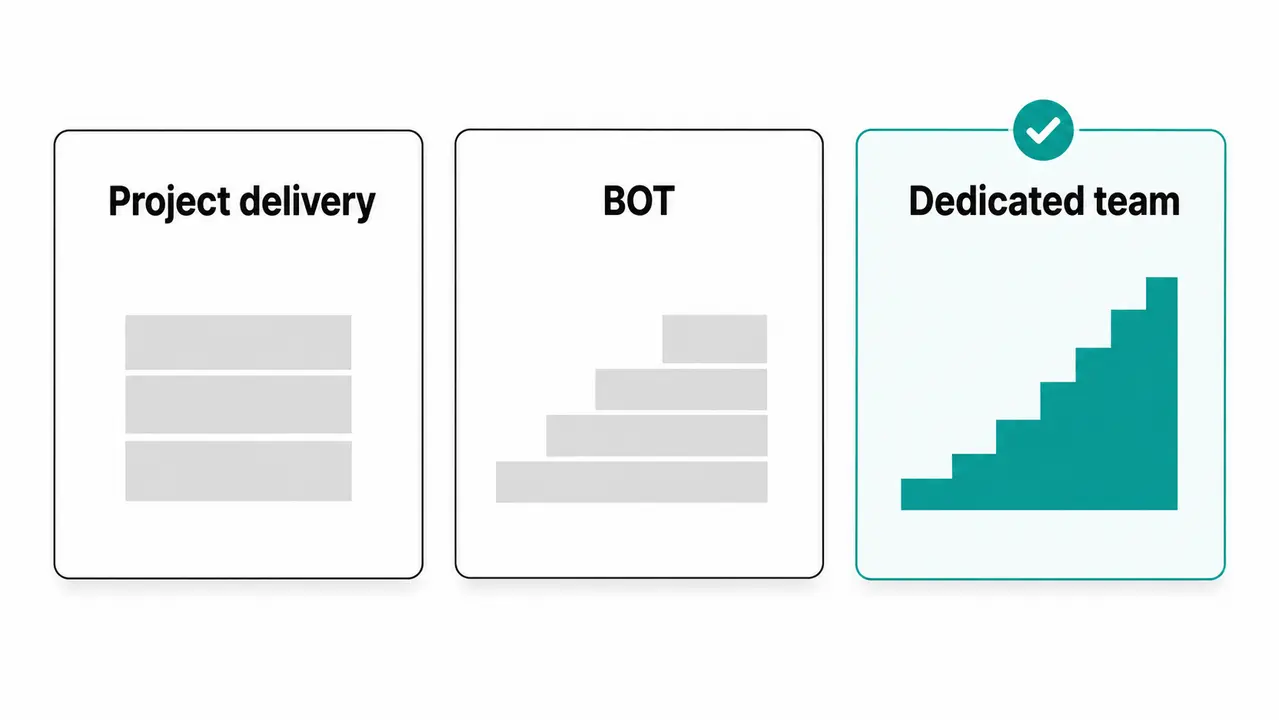
Your engagement model determines whether you get compounding product knowledge or repeated ramp-up cycles. A dedicated development team embedded in your product accumulates domain context that makes every sprint cheaper than the last. Project delivery resets that knowledge at every contract boundary. A Build-Operate-Transfer model sets an explicit end state where the offshore development center becomes your own legal entity, staffed, governed, and operating independently.
This table compares the three on the dimensions that actually decide the outcome.
| Dimension | Dedicated team | Project delivery | BOT |
|---|---|---|---|
| Product knowledge | Compounds over time | Resets per contract phase | Compounds, then transfers |
| Ramp-up cycles | One, at the start | Repeated | One long ramp |
| Governance burden on you | Moderate, ongoing | Low between phases | High, front-loaded |
| Best fit | Long-lived product | Contained rebuild | Long-term local presence |
For startups and scaleups building a long-lived product, the dedicated team model is stronger than project delivery, because knowledge retention matters more than any one-time deliverable. That is the same reasoning behind our own dedicated software engineering teams service, which exists precisely because project handoffs kept destroying value for product companies.
What BOT changes in governance and documentation
A BOT model forces you to formalize processes early, because the offshore development partner must eventually operate independently of the people who built the process. This is the model’s real cost and its real benefit. You pay in documentation discipline for years, and you get an entity that survives personnel changes on both sides.
From day one, introduce strict code ownership rules, detailed runbooks for every operational procedure, and architecture decision records for every significant technical choice. Treat those artifacts as the product of the engagement, not as overhead attached to it.
The failure mode this prevents is quiet and expensive. Knowledge silos accumulate around a few long-tenured engineers, the transfer date arrives, and the “operate” phase turns out to be impossible because nothing was ever written down. The transfer slips, the price rises, and the governance burden lands on your side after all.
When project delivery is the weaker choice
Project delivery resets product knowledge at the end of every contract phase. Watch what happens when a new vendor or team takes over a mature codebase. The first six weeks are archaeology. Someone reads the CI pipeline to understand what it was supposed to catch. Someone else rediscovers why the billing service has that strange retry logic. The ramp-up cost is paid again, in full, by people who have no memory of the original tradeoffs.
That is acceptable once, for a contained rebuild with a frozen specification. It is a tax when applied to a product that evolves continuously.
Choose project delivery for isolated, well-bounded work. A mobile app rewrite, a data migration, a performance overhaul. For continuous product evolution, it is the weaker model, and the vendor’s own incentives make it weaker, because re-scoping a finished phase pays better than maintaining stable velocity.
Where teams underestimate onboarding
Onboarding is the transfer of product context, quality standards, and decision rights. It is not granting tool access and holding a kickoff call. Teams that treat it as an administrative step spend the next two quarters paying for that assumption, because distributed engineering amplifies every gap in shared context.
Design the first two weeks deliberately. Require small pull requests that touch core architectural patterns, so the offshore software team learns how your codebase actually behaves instead of reading about it. Pair that with a domain glossary, so that “customer,” “account,” and “subscriber” mean the same things to everyone, and runbooks for the systems the team will own.
The failure mode this prevents is the one that kills velocity quietly. The offshore team waits for an answer on every minor issue, questions queue behind time zones, and a one-day task becomes a three-day task. That is not an offshore problem. It is an onboarding problem wearing an offshore costume.
A two hour overlap window can be enough with the right cadence
Time zones are manageable when the team designs for asynchronous execution and reserves overlap time for decisions, not status updates. A remote product team with two hours of daily overlap can move faster than a co-located team with weak written communication habits, because the constraint forces discipline.
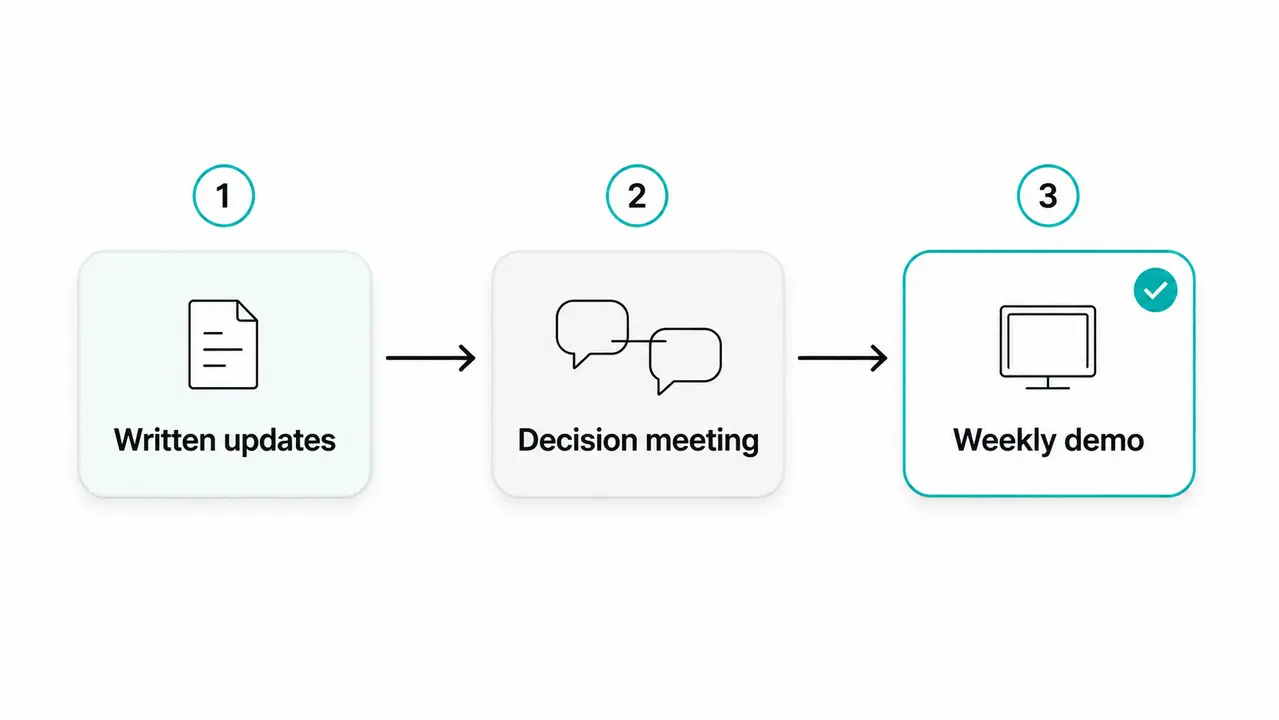
A cadence that works in practice looks like this. Daily written updates posted before the overlap window, in the team channel, answering what shipped, what is blocked, and what decision is needed. A twice-weekly decision meeting inside the overlap window, agenda built from the blocked items. A weekly demo of working software. To manage an offshore team well is mostly to protect this cadence from erosion, because the first thing that slips under deadline pressure is the demo, and the demo is where problems surface.
One counter-case. Incident-heavy systems, payment processing or real-time infrastructure, need real-time overlap and synchronous support rotations. A standard feature squad does not.
The offshore tech lead is the highest leverage role
A strong offshore technical lead reduces coordination load on your onshore leaders and creates a single accountable owner for code quality. This is the one role where compromising on seniority costs you the most, because every other decision routes through it.
The lead owns service boundaries, so the question of who changes what has an answer. The lead manages review gates, so quality does not depend on your onshore engineers volunteering. The lead conducts technical planning and handles escalation triage, so a production page at midnight has a decision-maker on the right continent.
The failure mode this prevents is precise. Without an offshore engineering team lead with real authority, your onshore tech lead becomes the bottleneck for every minor architectural decision, and the extension you bought to relieve pressure on that person instead doubles their queue. We interview hard for this role and staff it before staffing the team around it, because a strong lead makes average engineers better and nothing else on the org chart does that.
Team composition should match the work, not a generic pod template
The right offshore development team structure depends on whether you are building new product, stabilizing a platform, or scaling delivery across multiple squads. Most vendors quote a standard pod before understanding the work, and the standard pod is usually wrong.
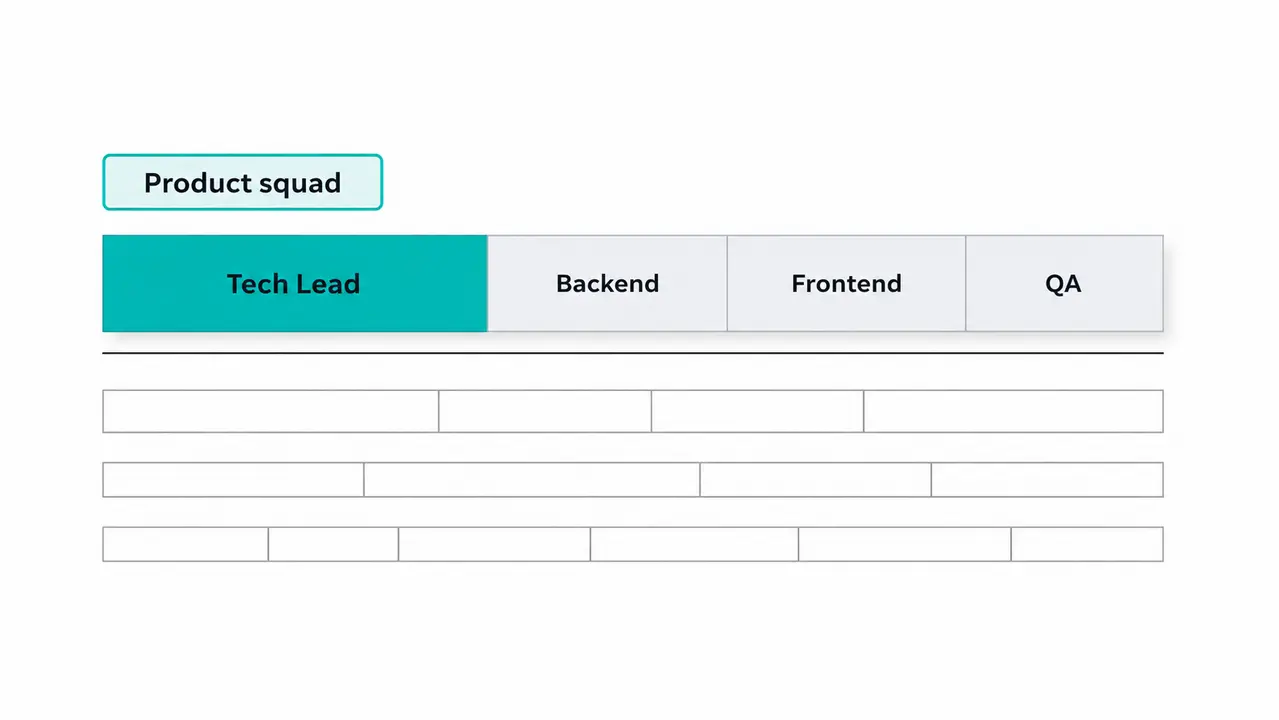
Three compositions we actually build. A product squad for net-new features, with a tech lead, two backend engineers, a frontend engineer, and QA automation. A platform pod for stabilizing work, weighted toward backend and DevOps, owning CI, infrastructure, and internal tooling. An embedded systems pod for firmware and device work, with engineers spanning firmware, hardware-adjacent backend, and test automation, the profile behind our system and embedded engineering work for clients in logistics and connected devices.
A basic setup of three developers and a project manager is the weakest option for complex systems. It has no technical ownership and no quality gates. It suits a marketing site. It does not suit your platform.
Code quality stays stable when review gates are explicit
Quality comes from enforced review gates, shared standards, and fast feedback loops that apply equally to onshore and offshore code. The rules are simple and they only work when they are mechanical. Every pull request gets reviewed. CI must pass. No merge without green checks and one approving reviewer. Linting and test coverage expectations live in the pipeline, not in a wiki page nobody rereads.
The 2024 DORA report found that a 25% increase in AI adoption is associated with a 7.5% increase in documentation quality and a 3.4% increase in code quality, but also an estimated 1.5% decrease in delivery throughput and a 7.2% reduction in delivery stability. The lesson for an offshore development team is that tooling changes shape the system, and process discipline is what keeps the shape stable.
The failure mode to prevent is parallel standards, where offshore code is treated as lower trust and rushed through approvals while onshore code gets careful review. That split corrodes both sides. It also tells your offshore engineers exactly how little they are trusted, and they act accordingly.
Security and IP protection live in process, not paperwork
Security for offshore teams is mostly about access control, environment design, and auditability. The contracts matter, but a signed NDA has never stopped a leaked credential. What stops incidents is boring and operational.
Implement least privilege access through single sign-on, so joining and leaving the team is a group membership change rather than a password handover. Enforce strict device policies. Keep secrets in a managed vault, not in environment files in a repository. Route production access through break-glass workflows with time-boxed approval and a written reason, so every access to customer data leaves a trail.
Your offshore development partner should propose most of this before you ask. If the security conversation at the vendor is entirely about legal documents and never about PagerDuty access policies, that tells you where their maturity actually sits.
One counter-case. Early prototypes can accept lighter controls if they run isolated against anonymized data, and demanding bank-grade process on a proof of concept just slows discovery.
Documentation that prevents rework is small and maintained
High-value documentation is short, current, and tied directly to how the team works daily. The opposite of that is the wiki graveyard, thousands of words written during a kickoff and never updated, actively misleading anyone who reads it.
Four artifacts carry most of the value in a global delivery model. Architecture decision records, one page each, capturing what was chosen, what was rejected, and why. Runbooks for every operational procedure, so on-call does not depend on memory. An onboarding checklist that an extended engineering team can execute without your involvement. A service ownership map that answers, for every service, which team deploys it and who gets paged when it fails.
The rule that keeps them alive is attachment to change. Every significant change updates the relevant document, as part of the definition of done, not as a favor.
The failure mode this prevents is tribal knowledge trapped with one onshore engineer who becomes a single point of failure, takes vacation, and stalls two teams on two continents.
Communication norms decide whether the team feels like one company
Culture problems show up as execution problems, so the fix is rarely a team-building event. It is written norms that make collaboration predictable across an international team. When nobody has to guess how fast an answer will come or how disagreement is expressed, the culture takes care of itself.
Define a response SLA for questions, something like one working day for anything blocking and faster through the escalation path. Set rules for disagreeing in design reviews, so a junior engineer offshore can challenge an onshore architect’s approach without it becoming an incident. Assign ownership of meeting notes by rotation, so documentation work does not fall to whoever is most junior or most remote.
One practice earns its place every time. A weekly demo open to product and support, not only engineering, in the spirit of genuine global development rather than a status ritual. Support hears what is coming before customers feel it. Product catches the silent failure where an issue surfaces late because nobody owned the channel between teams.
When offshore teams should own a module end to end
End-to-end ownership works when boundaries are clear and the offshore group can deploy, monitor, and support what it builds. It fails when ownership is nominal, a team “responsible” for a service it cannot ship without onshore approval at three checkpoints.
To make it real, assign a service boundary and give the dedicated offshore team everything inside it. Service level objectives it is accountable for. Dashboards it builds and watches. Alert routing that pages the right on-call engineer. Incident playbooks it maintains and rehearses. A product engineering partner should ask for exactly this structure, because a team that cannot see production cannot own quality.
The counter-case matters as much as the rule. Shared ownership across many repositories without clear boundaries produces friction on every release, two teams negotiating over the same deploy pipeline, and delayed releases where each side assumes the other is handling the rollout. One boundary, one owner. That sentence prevents more offshore conflict than any contract clause.
Vendor selection fails when evaluation stops at resumes
Choosing an offshore development partner is less about individual CVs and more about operating model maturity and long-term retention. Every vendor can produce impressive resumes. Far fewer can show you how they run a sprint, and that gap is where engagements go wrong.
Ask for artifacts instead of promises. A sample onboarding plan for a new client. Example sprint artifacts, a real backlog with real refinement. An anonymized pull request review workflow that shows who reviews what and how fast. An incident postmortem template, ideally with a filled-in example, because the postmortem reveals more about engineering culture than any interview.
The 2024 Stack Overflow Developer Survey reported that 42% of developers work hybrid and 20% in-person, which makes the technical environment and tooling a vendor provides a first-order factor in retention, not a perk. The failure mode to prevent is falling for a strong sales motion backed by weak delivery governance, and artifacts are how you see through the motion.
A pilot should prove integration, not just output
A pilot succeeds when it proves the team can work inside your SDLC, ship to your environments, and communicate risks early. Delivering a standalone demo proves almost nothing, because a demo never touches the hard parts. It does not exercise your review gates, your staging environment, or your release approvals.
Run a 4 to 6 week pilot with one production-adjacent feature, a shared backlog, and a shared definition of done. The feature should require the offshore development team to open a real pull request, pass your CI pipeline, and deploy through your actual release process. That is the difference between testing output and testing integration, and it is the same standard we apply when scoping pilots for clients evaluating our end-to-end software solutions, because a pilot that bypasses your pipeline teaches both sides the wrong habits.
Watch one thing above all. How early does the team raise the first risk? A pilot where nothing goes wrong is a pilot that was too easy.
Global development works best with a single source of truth
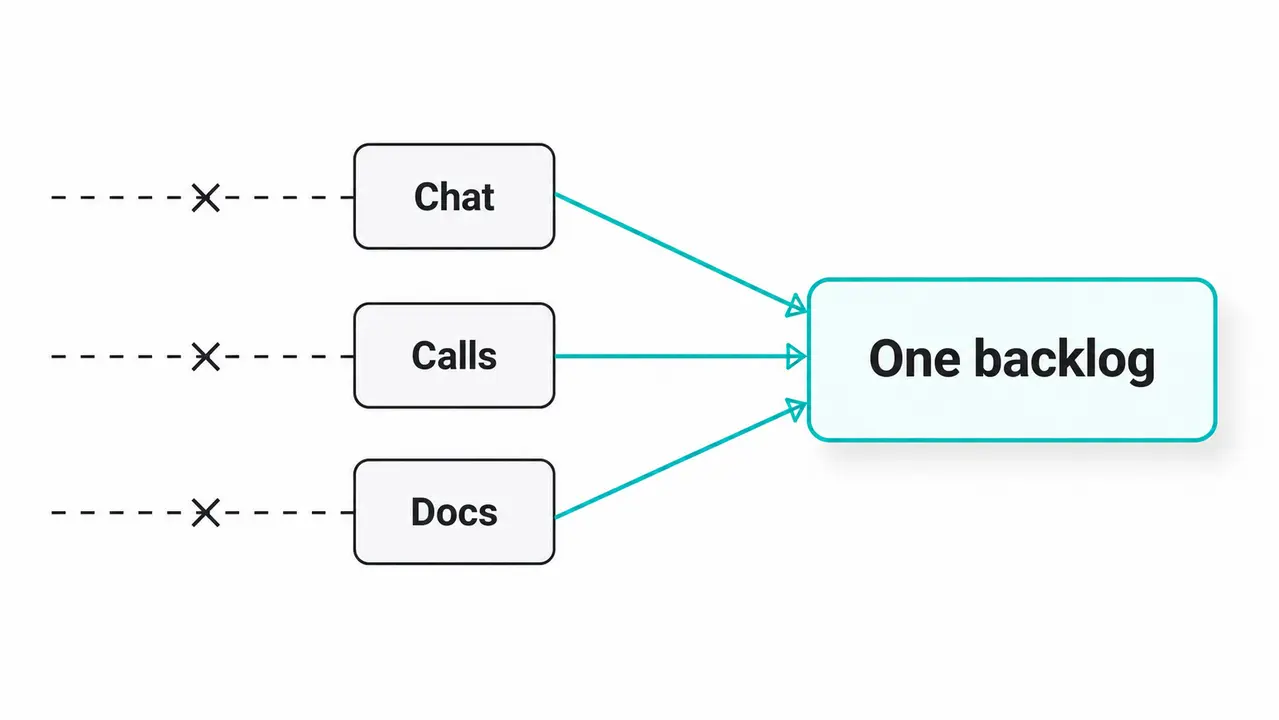
Distributed execution becomes chaotic when requirements, decisions, and progress live in multiple places. The tell is subtle at first. A decision made in a video call, summarized differently in a chat thread, and recorded nowhere that either team will find it in three months. Global development does not fail because people are far apart. It fails because the record of what was agreed lives in one person’s memory.
Maintain one backlog, one RFC process, one incident tracker, and one documentation home for all engineering tasks and decisions. When a decision is made in a meeting, it is not a decision until it is written in the shared system. That rule feels bureaucratic until the first time it saves a week of rework.
The failure mode this prevents is duplicate work and conflicting priorities across locations. Two engineers on two continents building overlapping solutions for the same problem is expensive. Discovering it after both shipped is worse, because now someone has to unwind production code.
Recognizing when offshore is the wrong move
Offshore is a poor fit when the organization cannot provide stable priorities, fast decisions, and clear technical direction. The model extends your engineering capacity. It does not extend your decision-making capacity, and an extended team with no one deciding anything is just a larger queue.
Do not extend if you have no product owner with real availability, because every prioritization question becomes a two-day round trip. Do not extend while the architecture is in flux, because the offshore team will either freeze while waiting for direction or build the wrong thing confidently. Do not extend on a weak CI pipeline, because every handoff across distance multiplies the cost of a broken build.
The counter-case is honest and worth stating plainly. In a pre-product-market-fit company changing direction weekly with no discovery discipline, in-house focus beats offshore outsourcing until the operating fundamentals exist. Adding distance to chaos does not produce scale. It produces distributed chaos.
Frequently asked questions
How long does it take for an offshore team to become autonomous?
Plan for 3 to 4 months for full context absorption. The first month covers tooling, domain language, and architectural patterns. Autonomy on real decisions, where the team chooses an approach and informs you rather than asking, typically settles in the third or fourth month if onboarding was deliberate. Teams onboarded with small pull requests into core code get there faster than teams onboarded through documentation alone.
What should be in an offshore team charter?
Three things at minimum. Decision rights, meaning which technical and product decisions the team makes alone and which escalate. Escalation paths, with named people and expected response times for both directions. Quality gates, covering review requirements, CI expectations, and the definition of done. A one-page charter with those sections prevents most of the friction that offshore developers and their onshore counterparts experience in the first quarter.
How do you handle holidays across countries?
Maintain a shared calendar combining both countries’ public holidays, visible to everyone, and adjust sprint capacity planning around it rather than discovering gaps mid-sprint. A dedicated development team in a country with several consecutive holidays should plan a lighter sprint that week, with agreed coverage for on-call. The calendar is a one-time setup that pays for itself every quarter.
What is the minimum viable documentation set to start?
A domain glossary defining the business terms engineers will misinterpret otherwise. An architecture overview, a few pages, covering the main services and how data flows between them. A definition of done that both locations share. Everything else can be built as the engagement runs, but these three need to exist before the first sprint, because they are the documents a new engineer needs on day one.
Who owns architecture decisions in a dedicated team model?
Joint ownership, split by altitude. Your onshore architect owns boundaries, the interfaces between services, technology selection, and cross-cutting constraints. The offshore technical lead owns implementation decisions inside those boundaries, including patterns, libraries, and internal design. Writing that split into the charter prevents both duplicated deliberation and drift, and it gives the offshore development team a real stake in the architecture rather than a spectator role.
How do you keep knowledge from concentrating in one person?
Mandate pair programming on complex changes and rotate code review assignments so no single engineer is the permanent gatekeeper of a subsystem. Combine that with rotating on-call, which forces breadth across the services a team owns. When one person holds all the context for a component, that person’s vacation becomes your delivery risk, and their resignation becomes your incident.
The next step is a written operating model before the first sprint
If you want an offshore development team to feel like part of your company, write the operating model before the first sprint. Define ownership, cadence, quality gates, and decision rights in plain language, on one page. Use a short pilot to validate integration under your real constraints. Scale only what stays predictable.
Let’s scope your team
Tell us about your roadmap and we’ll help you design the ownership, cadence, and quality gates before the first sprint.
About Sentice

Sentice is a boutique software engineering partner founded in 2013 by Roni Levi and Martin Petkovic, now headquartered in Skopje, North Macedonia. Rather than supplying individual developers, we build embedded teams that blend with a client’s culture, tech stack and goals, working together from a single office under our own technical leadership. We deliver dedicated software engineering teams, end-to-end software solutions, product development, and system and embedded engineering, and we act as technical advisors across the full development lifecycle, from specification and architecture through development, testing and support. We use AI coding tools across every project, and we help clients integrate AI into their own products through chatbots, MCP services, connected application layers and workflow automation. Some of the clients we started with more than a decade ago are still building with us today.