
Your senior engineer has spent eleven hours this week in interviews. The roadmap says two quarters. The requisitions have been open for most of that time already. Nothing about this is unusual, and that is exactly the problem: the bottleneck is not ideas or budget, it is time-to-staff and continuity, and hiring locally cannot fix either one fast enough to match the release cadence you promised the board.
This is the point where a remote software development team stops being a compromise and becomes the rational choice. The failure mode to avoid is the one most teams fall into: patching the gap with ad hoc contractors, one per quarter, each with their own standards, until the codebase is a patchwork that slows every future release. If your lead time to fill a role exceeds your planned release cadence, the decision has already made itself. Below, we unpack the trigger conditions, the differences between team models, the operating practices that keep a distributed engagement healthy, and a 30 day launch plan you can hold any partner to.
Reading time: 9 min
Key points
- If requisitions stay open for two consecutive quarters or lead time to fill exceeds your sprint cadence, staffing, not engineering, dominates your delivery risk.
- Staff augmentation caps out after the first few hires because review queues and decision turnaround, not headcount, become the constraint.
- A dedicated team is defined by named roles, stable allocation and planned transitions; missing any one of those means you have a staffing contract.
- Flow metrics such as lead time for changes and change failure rate predict delivery; story points measure activity.
Table of contents
The moment hiring locally stops matching the roadmap
The trigger conditions are specific and measurable. You have a multi-quarter roadmap committed to stakeholders. Your backlog grows faster than it closes. Your senior engineers spend more cycles interviewing than building. Any one of these is survivable. All three together mean your delivery risk is dominated by staffing, and no amount of local recruiting fixes that inside your release window.
The concrete signal is time. If requisitions have been open for two consecutive quarters, or if your average lead time to fill exceeds your sprint cadence, the roadmap is already slipping. Every week you wait compounds it.
Contractors feel like the fast answer. They are the expensive one. Three independent contractors produce three coding styles, three sets of assumptions, and zero shared context, and eighteen months later your team is paying down that fragmentation instead of shipping. A stable remote software development team prevents that fragmentation before it starts, because the same named group builds context release after release.
Distinguishing distributed team models and expectations
Remote, distributed, and dedicated are not synonyms, and most disappointment in this market traces back to treating them as if they were. A remote team works offsite but can be tightly coupled to your process. A distributed team spans multiple locations and time zones, which makes coordination the core engineering problem you design around. A dedicated team is a stable, named group with a fixed composition that builds product context over months and years.
Dedicated has a precise meaning. Named roles. Stable allocation. Planned transitions when someone rolls off, with overlap and handover, rather than rotating bodies through your backlog. If any of those three are missing, you do not have a dedicated team, you have a staffing contract.
The failure mode is predictable. You sign for a dedicated team, and what arrives is ad hoc staffing under a dedicated label. Your internal leads spend their days coordinating strangers instead of building. Expectations were misaligned at the signature, not at the first missed sprint. Ask the question before signing: who exactly is on the team, and what happens when one of them leaves.
Where teams underestimate onboarding
The biggest early risk is not technical skill. Most experienced remote developers can write the code. What they cannot do is guess your architecture, your deployment topology, or how decisions actually get made in your organization. Missing context, not missing capability, is what burns the first month.
Treat onboarding as a deliverable with named artifacts. An architecture overview. A repository map covering services, ownership, and where new work lands. Access to staging on day one. Written coding standards. A short document on how decisions are made and who makes them. Without the last one, every technical question routes to a person instead of a process.
Require a written onboarding plan for the first ten working days, with specific access requests, a target date for the first pull request, and a first production-safe change. If the partner cannot produce this document before the engagement starts, that tells you what the first month will feel like.
Skip this and you get the human API pattern. One internal engineer becomes the interface for every question, bottlenecks all progress, and burns out inside a quarter. We have inherited engagements where that single person leaving would have halted two workstreams. Onboarding artifacts are insurance against exactly that.
Designing an operating model around decision rights
Most failed engagements do not fail on code quality. They fail on accountability gaps. Someone asks who approved the deployment, and the answer is everyone and no one. You can prevent this entirely by defining decision rights before the first sprint, and the instrument does not need to be elaborate.
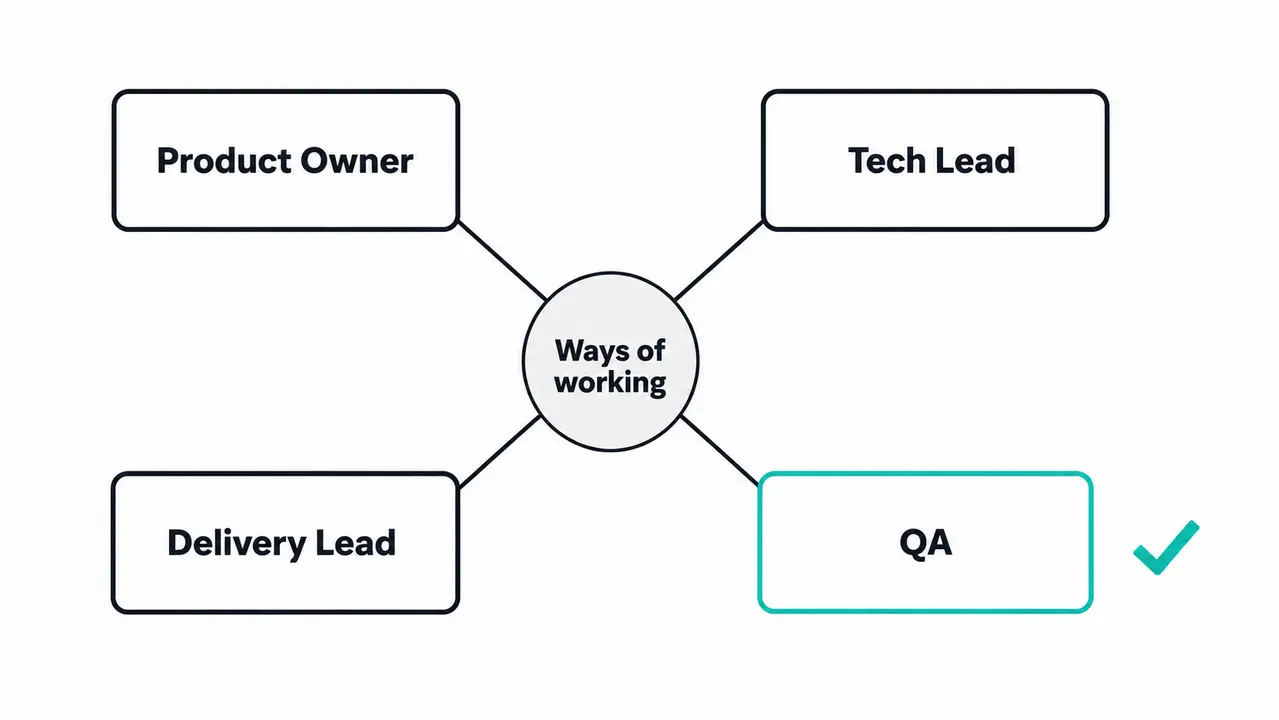
A lightweight RACI is enough. The product owner owns priorities and acceptance. The tech lead, internal or from the remote delivery team, owns architecture guardrails and technical standards. The delivery lead owns cadence, ceremonies, and forecasting. QA owns release criteria and can veto a deployment. Four roles, four owners, no ambiguity.
The anchor is a one-page ways of working document, signed by both sides before coding begins. It fits on one page precisely because it must be read, not filed. It covers decision rights, escalation paths, meeting rhythm, and what happens when two leads disagree.
Without it you get the pattern every CTO recognizes from painful experience. A release slips, and the post-mortem finds that your internal team assumed the partner would manage integration, the partner assumed you would, and both were reasonable assumptions. Everyone was supporting. Nobody was responsible. That document exists to make that conversation impossible.
Engagement models and the tradeoffs they lock in
Most buyers choose between three models, and the choice determines who carries management load, who absorbs change, and who owns continuity. Staff augmentation puts individuals into your process and day-to-day management on you. A dedicated managed team, where the dedicated development team model includes a partner-side lead handling staffing and internal operations, leaves you managing outcomes while the partner runs the team. Fixed-scope outsourcing prices a specification and penalizes deviation from it.
The verdict on fixed scope is blunt. It is the weaker model for an evolving product, because it monetizes change requests and rewards spec gaming, the practice of delivering exactly what was written rather than what was needed. If your roadmap has volatility, and most do, fixed scope converts that volatility into invoices.
This comparison is where the decision actually lives:
| Dimension | Staff augmentation | Dedicated managed team | Fixed-scope outsourcing |
|---|---|---|---|
| Day-to-day management | You own it fully | Partner owns internal cadence | Partner owns everything |
| Change tolerance | High, you direct it | High, via backlog | Low, penalized contractually |
| Continuity of context | Depends on you | Partner guarantees it | Ends at delivery |
| Roadmap control | You keep it | You keep it | Largely ceded |
| Fit for evolving products | Moderate, caps out | Strong | Weak |
Match the model to roadmap volatility, not to headline cost. The cheapest model on paper is rarely the cheapest one at month nine.
Why staff augmentation breaks down after the first few hires
Staff augmentation works for targeted gaps. Two added engineers who slot into an existing team, take tickets from your backlog, and follow your review process genuinely add capacity as an engineering team extension. The first few hires feel great. Velocity rises. Then you add a fourth, a fifth, a sixth, and throughput stops improving.
The reason is that augmentation scales bodies while your internal team scales nothing. Every added engineer produces more pull requests, and your leads review them. Every added engineer needs architectural decisions, and your leads make them. The review queue grows, integration risk grows, architectural drift grows, and your senior people spend their day context-switching between being reviewers, architects, and coordinators. Brooks said it decades ago and it still holds: adding people to a late project makes it later, because communication overhead compounds faster than capacity.
Track the constraints instead of the headcount. PR review queue latency, meaning the median time from PR opened to PR merged, and decision turnaround time, meaning how long a blocked engineer waits for an answer. When those two numbers rise while you keep hiring, you are buying more developers and getting less throughput. The fix is a team with its own lead absorbing coordination internally, not more individuals routed through your leads.
What a dedicated remote team is expected to own
A dedicated software team that only executes tickets is a liability wearing a team name. Real ownership covers delivery continuity, internal rituals, and a stable technical baseline, and the partner should be contractually comfortable with all three.
The ownership signals are observable. The team’s tech lead sets and enforces coding standards, not just follows yours. QA enforces release gates and can block a deployment. The team maintains build health as a first-class responsibility, meaning broken CI is their emergency, not your backlog item. Documentation stays current without anyone asking. Teams that operate this way exist, and when they maintain a stable technical baseline over years, you are looking at what dedicated remote software engineering teams are built to do: carry the baseline so your internal engineers can carry the product.
The concrete anchor is a jointly authored definition of done and definition of ready, with explicit worked examples of what a complete feature looks like. Written together, not handed down, because a standard the team helped write is a standard the team defends.
The failure mode is quiet. Features ship on schedule while quality debt compounds in test coverage, in flaky builds, in the undocumented service nobody wants to touch. Nobody owns the baseline, so nobody defends it. By the time you notice, the fix is a quarter of platform work you never budgeted.
Time zone overlap as a design input
Overlap is not a constraint to maximize or minimize. It is a lever you design around, and the right amount depends on how much of the work requires synchronous decisions. Most teams get this wrong in one of two directions.
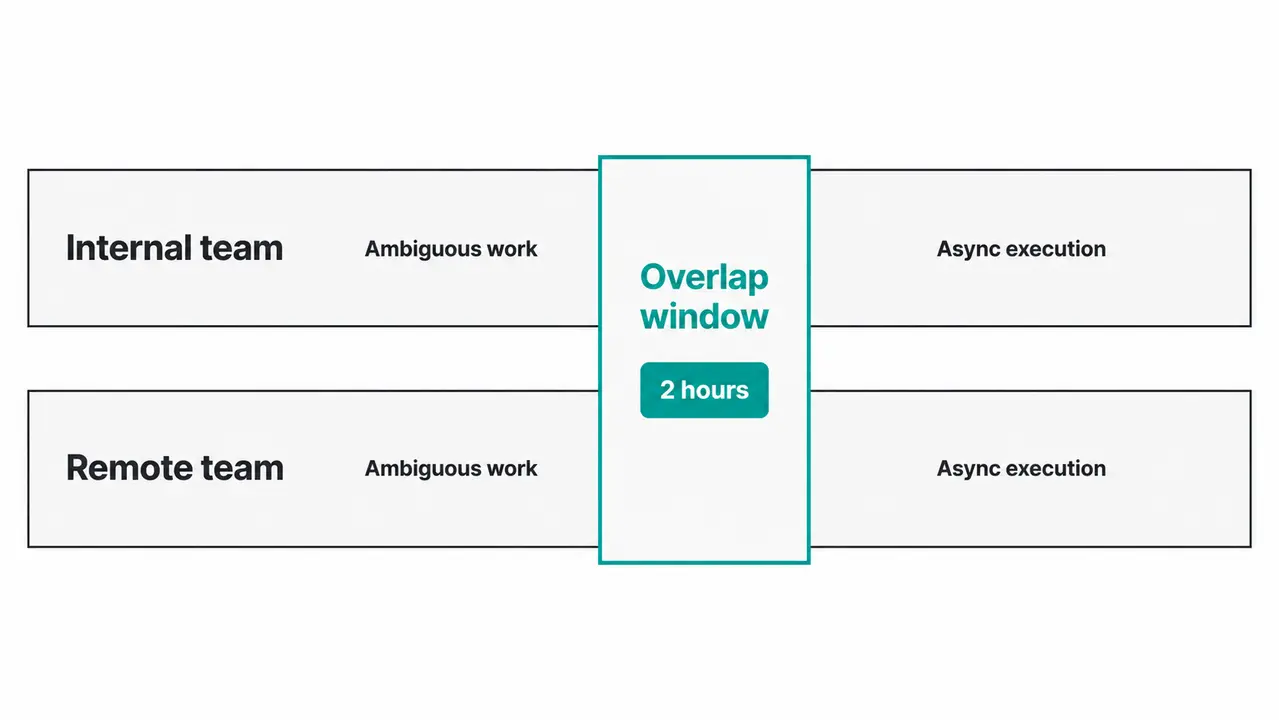
Sort the work first. Discovery, architecture, and ambiguous requirements need real overlap, because resolving ambiguity over chat takes days that a thirty-minute call settles. Bug fixing, well-specified execution, and maintenance can be entirely asynchronous. A team doing distributed software development across a five or six hour difference should place its overlap window over the ambiguous work and leave the execution to run overnight.
A workable policy is a two hour daily overlap window reserved for cross-site pairing, reviews that need discussion, and critical decisions. Everything else defaults to written form. Protect the window, because the first thing that erodes under delivery pressure is exactly the meeting time that resolves ambiguity, and that is how a two-day question becomes a two-week stall.
Both failure directions cost you. Constant meetings drain the team and convert your overlap into status theater. Zero overlap pushes every decision through chat, and decisions slow until people stop asking and start assuming. Two protected hours sits between the two, which is where most products actually need to be.
Async-first workflows that keep velocity stable
Distributed teams keep throughput when decisions, requirements, and reviews default to written artifacts that survive time zones. If the only record of a decision is a chat thread, the decision expires when the thread scrolls away. Async-first means the durable artifact is the default and the meeting is the exception.
The artifact set is small. Lightweight requests for comments for anything architectural. A decision log, one line per decision, with rationale and date. Pull request templates so every PR answers the same five questions before review. Operational runbooks for anything a human might need at 3 a.m.
Specify the formats concretely. A standard PR template covering what changed, why, how it was tested, and rollback notes. An architecture decision record format the team uses for all significant changes, however small the ceremony. Both take an afternoon to set up and pay for themselves within the first month.
The failure mode looks like this. The same API design debate happens three times over a quarter because the earlier resolution lives in a chat thread nobody can find. Tribal knowledge concentrates in two heads. Rework repeats because the rationale is gone. A work from anywhere hiring strategy is only real if your workflow runs on artifacts rather than presence, and the artifacts are what make global hiring survivable rather than merely possible.
Enforcing code quality in a distributed environment
Quality is a system of gates and habits, not a promise in a contract. A distributed engineering team exposes weak gates faster than a co-located one, because distance removes the informal corrections that paper over a missing process. If code review is optional in your repo, remote work makes that gap structural within weeks.
The non-negotiables are boring and proven. Continuous integration on every commit. Automated tests that run in CI, not just locally. Linting enforced by tooling, not by nagging. Code owners configured so the right reviewers are assigned automatically. Mandatory review, no exceptions for seniority. Release checklists that someone actually signs, a practice the IEEE 829 standard formalized for test documentation before it was superseded by the ISO/IEC/IEEE 29119 series, and which still anchors what a release checklist should contain.
The concrete anchor is branch protection plus a strict rule: no green build, no merge. Not occasionally. Not for hotfixes under pressure, because the hotfix exemption is how the rule dies. Configure it once in GitHub or GitLab, and the policy enforces itself without anyone playing gatekeeper.
Skip this and you get the velocity spike followed by the stabilization month, where the team ships fast for six weeks and then spends the next four fixing regressions instead of building features. Velocity that requires a recovery period was never velocity. It was borrowing, and the interest rate is always higher than expected.
Security and access controls that do not slow engineers down
Remote delivery stays safe when access is least-privilege, auditable, and designed into the environments from day one. Retrofitting security onto a running engagement costs more and annoys everyone. The pattern that works treats access like infrastructure, provisioned through the same pipelines as everything else.
The access stack is standard. Single sign-on across every tool, so an offboarding is one action, not fourteen. Role-based access with groups rather than per-person grants. Secrets in a managed vault, never in chat or a shared doc. Separate permissions for dev, staging, and production, with production access held by the smallest set that can operate it. An offshore development center arrangement, where physical distance removes the option of walking over to someone’s desk, makes this discipline mandatory rather than optional.
Two artifacts prevent most incidents. A standard access matrix by role, reviewed quarterly, and an offboarding checklist that runs automatically when someone rolls off, revoking access the same day. Your CI and build pipeline deserve the same rigor, and the NIST Secure Software Development Framework is the practical reference for supply chain security practices across the build chain.
The failure mode reads like an audit finding. Shared credentials in a wiki. A contractor laptop nobody manages holding repo access eight months after the engagement ended. Unclear ownership of artifacts in a third-party registry. Every one of those is an access matrix that was never written, surfaced at the worst possible moment.
Surviving attrition during a critical migration
Attrition is not an exceptional event. Over a multi-year engagement, people leave, and a plan that assumes otherwise is not a plan. What makes attrition survivable is capturing knowledge continuously and treating every transition as a process rather than an event.
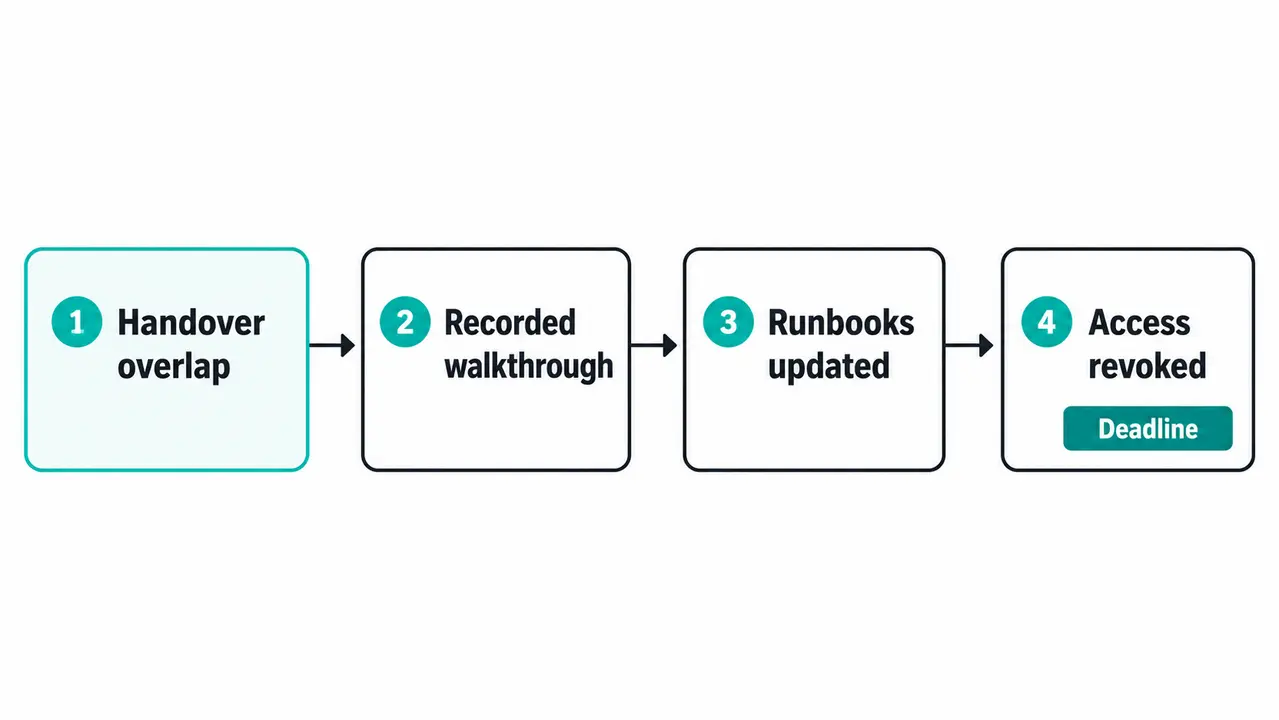
For any senior person rolling off, especially mid-migration, the requirements are specific. An overlapping handover period measured in weeks, not a farewell call. A recorded walkthrough of the components they own, because a recording survives the person. Updated runbooks. A current state diagram showing what is migrated, what is pending, and what is fragile. When an external engineering team manages its own staffing, transitions of this kind are their responsibility to run, and you should hold them to it contractually.
The concrete anchor is a minimum two week transition period plus a role replacement checklist that must be complete before access is revoked. Access revocation is the deadline that forces the handover to actually happen, so sequence it deliberately.
Without this, one departure stalls a migration. The departing engineer was the only person who understood the data mapping between the old billing service and the new one, and now someone is reverse-engineering their assumptions from commit history. Emergency rewrites follow, ownership goes brittle, and a planned migration becomes an archaeology project. A single point of failure is a design decision, not an accident.
Interviewing for team interfaces and judgment
When you hire a whole team rather than an individual, you are buying interfaces and judgment, and your interview process should test those directly. Algorithm puzzles test none of it. What you need to evaluate is how the team makes decisions, how they collaborate under disagreement, and whether their engineering hygiene holds when nobody senior is watching.
Structure the interview around real work. How would they respond to a production incident that started an hour ago, walked through as a scenario rather than a quiz. What do they look for when reviewing a pull request, in order. What is their testing philosophy, and where do they stop testing and accept risk. Give them deliberately ambiguous requirements and watch what they do first: ask questions, or start building the wrong thing.
The strongest signal is a paid exercise on real material. A code review of an actual PR from your repo, with the candidate told nothing about what is planted in it. Or a small scoped change inside an existing codebase, so you observe their workflow end to end, from reading the code to the PR description to how they handle your feedback.
The failure mode is hiring a collection of strong individual contributors who cannot operate as a unit. Five excellent engineers who each ship in their own style produce the same fragmentation as five contractors. With a managed development team, the partner runs this vetting for you, and your due diligence shifts to verifying their process rather than running it yourself, which is the entire point of the model.
Predicting delivery outcomes through due diligence
You can predict most delivery failures before signing, because the signals are in the artifacts a team uses daily, not in the sales deck. What you are evaluating in a product engineering partner is not their portfolio photography but their operating reality: how the team works, how they replace people, how they keep quality consistent across a year.
Ask for specific things. Their onboarding plan, the same ten day document you would require of them. A redacted sprint ritual example, showing what their ceremonies actually produce. Engineering metrics they track and act on. A documented escalation path, meaning what happens when something goes wrong at their end and who calls you.
The concrete move is requesting anonymized artifacts before signing. A PR template. A runbook excerpt. A sample sprint report. Any team with real process produces these without effort, and a team that needs two weeks to prepare them has just told you something important.
The failure mode here is the most common one in the market: choosing a partner based on polished sales material and discovering the operating reality only after the kickoff. Enterprise clients evaluate us this way at Sentice, and we encourage it, because a partner confident in their daily artifacts does not need to win on a slide deck. A partner who resists artifact review has answered your question, just not in the way they intended.
Tracking flow metrics instead of raw output
Output metrics are easy to game and usually gamed unconsciously. Story points inflate quietly, ticket counts reward splitting work into pieces, and lines of code measure nothing. What correlates with actual delivery is flow: how long work takes to move from started to running in production.
The metrics that matter are established and few. Lead time for changes. Cycle time per work item. Review time, meaning the queue that most teams ignore. Deployment frequency. Change failure rate, the fraction of deployments causing incidents. Escaped defects, bugs found by users rather than tests.
Run a baseline month before you set any target, and then define a target trend for two or three metrics only. A remote dev team drowning in five dashboards optimizes for looking good on dashboards. Three metrics with an owner and a monthly conversation beat fifteen metrics nobody reads.
The failure mode is optimizing for story points and getting fragile releases. Velocity climbs all quarter, then a release breaks in production and the post-mortem reveals the change failure rate had been rising the whole time, invisible because nobody was watching it. We have walked into engagements where the previous success metric was points burned, and the first month of real measurement told a different story. Points measure activity. Flow measures delivery.
Recognizing when it is time to rebalance the team
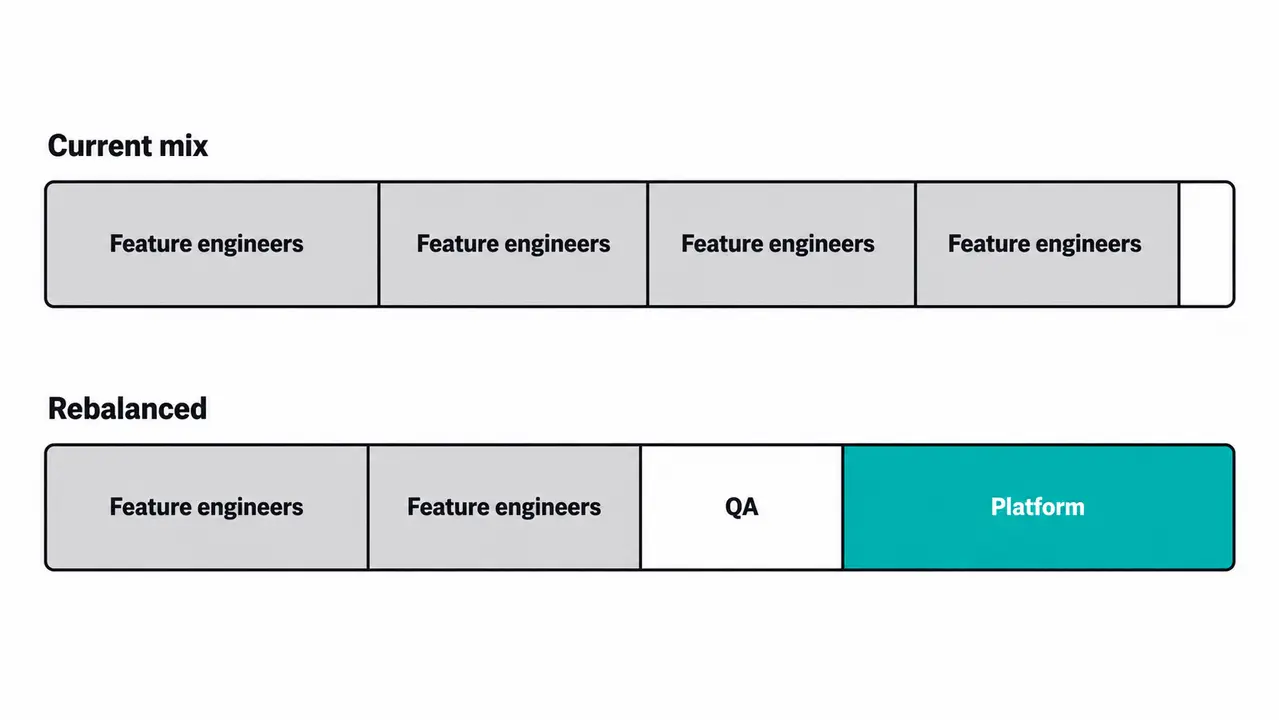
Teams need planned evolution. The mix that built your MVP is the wrong mix for scaling it, and the wrong mix creates bottlenecks that look like performance problems but are structural. A rebalanced outsourced engineering team often needs different people, not more people.
The signals are recognizable in retrospect. Feature work dominates the backlog while platform work starves. Incident frequency creeps up quarter over quarter. Reviews get slower even though headcount grew. Ownership boundaries blur, with two teams both assuming the other owns the integration layer. Each signal alone is noise. A pattern across three of them is a structure problem.
The concrete anchor is a quarterly capability review that maps roadmap themes to specific roles. Next quarter’s roadmap says performance and reliability, and the current team is six feature engineers and no platform person. That gap, found in a review, costs a hiring cycle. Found in a production incident, it costs a quarter.
When a partnership evolves well, the team’s shape follows the roadmap, and the question of scaling smart how boutique partnerships accelerate tech team growth becomes a quarterly planning item rather than a crisis response. The failure mode it prevents is the most expensive one in scaling: adding more developers when the actual constraint is architecture, QA capacity, or DevOps. Nine engineers against a database bottleneck deliver less than five engineers with the bottleneck fixed.
A 30 day launch plan for a new engagement
The first month sets the trajectory for the entire engagement. Its job is to establish shared cadence, shared standards, and a small set of production-safe wins that prove the workflow end to end. Getting ready is not the deliverable. Shipped value is.
Week one covers access, environments, repository orientation, and the first merged PR, which can be documentation, a small fix, anything real. Week two ships one thin-slice feature behind a feature flag while CI is tightened, because a flag lets you merge without exposing. Week three covers operational runbooks, monitoring hooks, and an incident drill run against staging, using the ISO/IEC/IEEE 29119 software testing standards as a reference point for structuring the drill and its documentation. Week four establishes the roadmap planning rhythm and the ownership map.
Two artifacts anchor the whole month. A single ways of working page, and a decision log started on day one. A nearshore development team working two or three hours ahead of your internal team can compress this plan further, because the overlap window covers all the synchronous work and the async time covers execution.
At Sentice we start engagements this way because establishing engineering standards in week one is cheaper than negotiating them in week ten. The failure mode is a month of setup theater: access granted, ceremonies scheduled, nothing shipped, and no evidence the workflow actually works until the pressure arrives.
Frequently asked questions
How much overlap time is enough for a distributed team?
Define overlap by work type, not by policy. Two hours daily covers discovery, architecture discussions, and pairing. Execution and bug fixing can run fully asynchronous on written artifacts, so overlap protects only the decisions that need faces.
What should we own internally even with a dedicated remote team?
Own the product vision, business priorities, and final acceptance criteria. The external team owns technical execution, internal cadence, and engineering standards. Handing over the first category is abdication. Handing over the second is delegation.
What is the fastest way to validate a team can work in our codebase?
Run a paid trial sprint focused on one thin-slice feature behind a feature flag. You evaluate their PR hygiene, testing standards, and communication rhythm against real constraints, with zero production risk. One sprint tells you what a sales call cannot.
How do we prevent the remote team from becoming a ticket factory?
Include their tech lead in architecture discussions from week one, and require the team to write their own technical specifications before implementation. Teams that write specs develop judgment. Teams that receive tickets develop dependency.
What documents should exist before the first sprint starts?
The minimum set is an architecture overview, a repository map, a definition of ready, a definition of done, and a one-page operating agreement covering decision rights. Five documents, each short, all writable in a week.
How do we handle embedded or system work when hardware access is limited?
Use remote device management tools, hardware-in-the-loop simulators, and a strict access matrix so engineers can iterate without physical devices. Simulators cover most of the loop, and scheduled device sessions cover the rest.
The decision you make before the first sprint
The real decision happens before any code is written, and it is a match between roadmap volatility and your appetite for day-to-day management. You are trading direct control for delivery continuity and access to specialized skills, and pretending the trade does not exist is how engagements fail politely. Draft your one-page operating model and your ten day onboarding checklist this week, before you evaluate a single external team, because those two documents will tell you more about your readiness than any vendor will.
Let’s scope your team
Share your roadmap and current delivery constraints, and we will map out what an embedded team would own from day one.
About Sentice

Sentice is a boutique software engineering partner founded in 2013 by Roni Levi and Martin Petkovic, now headquartered in Skopje, North Macedonia. Rather than supplying individual developers, we build embedded teams that blend with a client’s culture, tech stack and goals, working together from a single office under our own technical leadership. We deliver dedicated software engineering teams, end-to-end software solutions, product development, and system and embedded engineering, and we act as technical advisors across the full development lifecycle, from specification and architecture through development, testing and support. We use AI coding tools across every project, and we help clients integrate AI into their own products through chatbots, MCP services, connected application layers and workflow automation. Some of the clients we started with more than a decade ago are still building with us today.