
The sprint review was supposed to take forty-five minutes. It lasted twelve. The vendor demoed three screens from a staging environment nobody on your side could reach, the Product Owner was on vacation, and the one question that mattered, whether the payment retry logic actually worked against the live gateway, went unanswered because the code had never left the vendor’s internal repository. Everyone left the call with the word “agile” intact and no working software to show for six weeks of invoices.
That is not a failure of agile. It is a failure of an operating model that borrowed the vocabulary and kept the old procurement instincts underneath. We have spent more than a decade running outsourced agile engagements, and the pattern holds: the ceremonies are easy to copy, the system around them is what actually decides the outcome.
Below, we unpack how agile software outsourcing works as an operating model, where fixed vendor contracts break under a shifting roadmap, how to run product ownership, refinement and sprint reviews across organizational distance, and how to evaluate a partner before you commit.
Reading time: 11 min
Key points
- Agile outsourcing works only when the external team joins your rituals, board and pipeline as a full member, not when procurement buys a fixed feature list.
- Fixed-scope contracts punish backlog movement: every reprioritization becomes a change request, a re-estimation cycle and a throughput collapse.
- A written definition of done, enforced by automated pipeline gates, is what keeps an outsourced team releasable and honest.
- A dedicated embedded team preserves the continuity and reprioritization freedom that iterative delivery needs, which project-based delivery cannot.
Table of contents
Agile software outsourcing as an operating model not a procurement trick
Agile software outsourcing works when the external team integrates into your delivery system with shared rituals and clear product ownership. It fails when procurement buys it like office furniture, on a statement of work with a fixed feature list and a quarterly steering committee. The label on the contract says agile. The structure underneath says waterfall with extra meetings.
The control mechanism changes too. In a fixed-scope deal you control risk through approvals and sign-offs. In an agile outsourcing model you control risk through working increments every sprint and a prioritized backlog that you, the client, actively manage. Iterative development is the steering wheel, not a delivery nicety. If you are not reprioritizing the backlog based on what shipped last sprint, you are not doing iterative development, you are doing staged payments.
The test is simple. Does the external team attend your refinement, planning, and review as a full member? Do they deploy into your pipeline? If the answer is no, you have a vendor. A vendor is fine for some things. It is not agile outsourcing.
When roadmap shifts break fixed vendor contracts
Your quarter never survives contact with reality. A competitor ships a feature, a enterprise customer demands a change, an integration partner alters their API. Priorities shift mid-quarter and your team repoints the backlog in an afternoon. That is the whole point of agile.
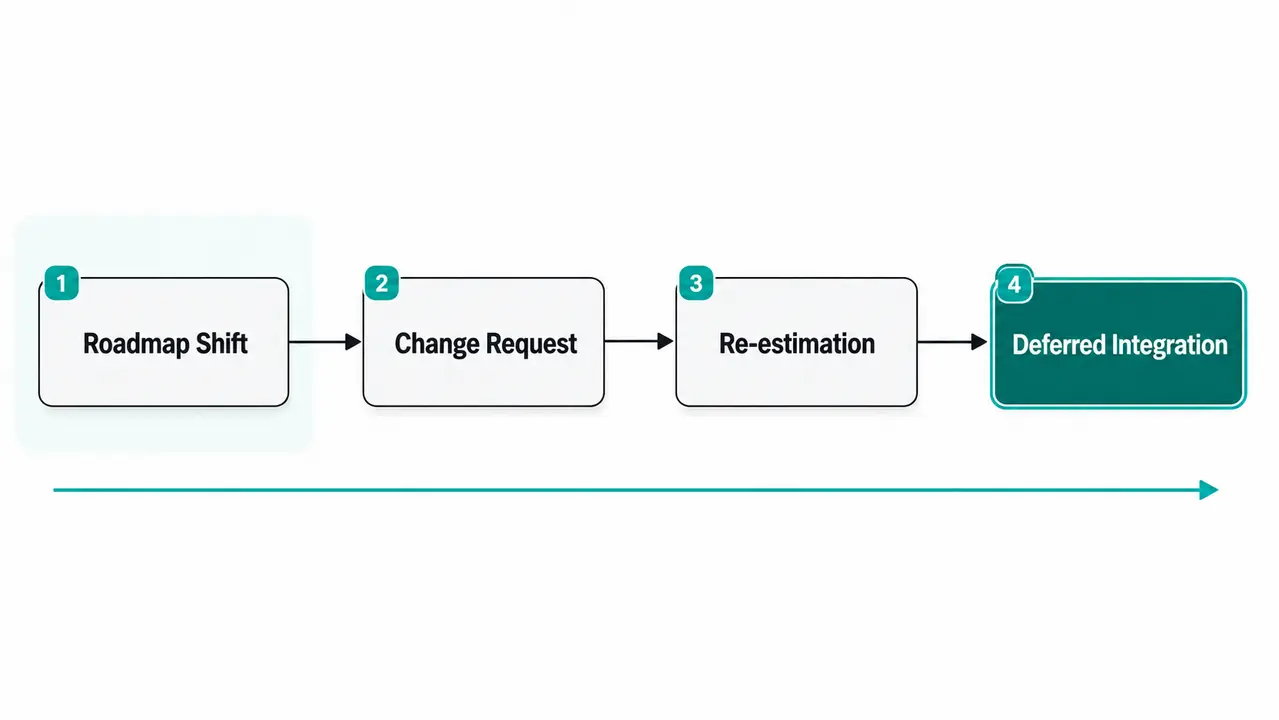
Then you forward the new priority to the vendor and the contract answers for you. Scope changes trigger a change request. The change request triggers re-estimation. Re-estimation takes two weeks because it runs through the vendor’s account manager, their delivery lead, and their commercial review. Sprint ceremonies keep happening on schedule while actual throughput drops to near zero, because the contract has trained the vendor to default to out-of-scope behavior the moment anything moves. Scrum outsourcing cannot outrun a commercial structure that punishes movement.
Design the agreement for reality. Negotiate explicit backlog reprioritization rights within the current budget, and make acceptance happen at iteration boundaries, not at stage gates. If your lawyers push back, ask them what the cost of a two-week re-estimation cycle is on a twelve-month roadmap.
Product ownership in distributed scrum teams
Outsourced scrum rarely fails because engineers sit in another time zone. It fails because nobody answers the daily questions. A remote scrum team generates between three and ten small product decisions per day: should the export respect the tenant filter, is the empty state an error or a valid result, does this button need a permission check. Each unanswered question becomes a stall, and each guessed answer becomes rework.
Appoint a named Product Owner on your side, and give them a delegate with a same-business-day response commitment written into the engagement. Product backlog ownership stays with you. It is not transferable to the vendor, because the backlog encodes your strategy and your trade-offs, and no external party carries those.
The classic failure arrives quietly. The vendor assigns a proxy product owner, usually a business analyst, because it looks like a service. The proxy guesses priorities from stale documentation, the sprint cadence drifts, and by the third month you are building a confident, well-tested version of the wrong product.
Backlog refinement as the core of iterative development
If you could keep only one ceremony from the entire agile set, keep refinement. Refinement is where iterative development actually happens, because it replaces the detailed upfront specification with continuous clarification. A story that enters sprint planning with clear acceptance criteria and identified non-functional requirements is a story that ships. A story that enters vague becomes a mid-sprint negotiation, and mid-sprint negotiations are where distributed teams lose their week.
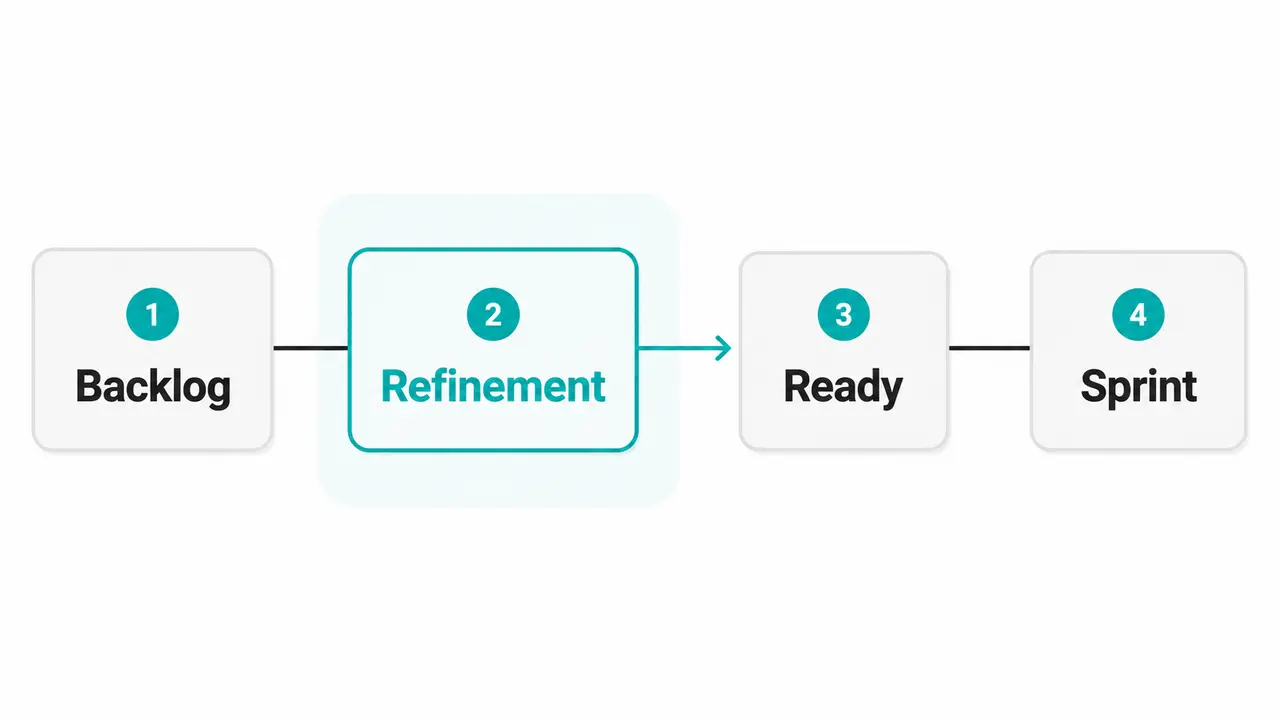
Run weekly refinement sessions with engineering, QA, and product in the same call, vendor engineers included, cameras on. Guard entry with a written definition of ready checklist: acceptance criteria stated, dependencies identified, test approach sketched, non-functional requirements named. The checklist takes an afternoon to write and saves a sprint per quarter.
Teams skip refinement when they feel busy, and that is exactly when they cannot afford to. Sprint planning that runs on an unrefined backlog is estimation theater. Everyone performs confidence nobody has.
Definition of done as an engineering contract
Every outsourced engagement we have rescued had the same defect: the tracker said 87 percent complete and production said otherwise. Tickets closed, the burndown looked beautiful, and the actual software could not be released. The root cause was always a definition of done that meant different things to different people, or that existed only as an oral tradition.
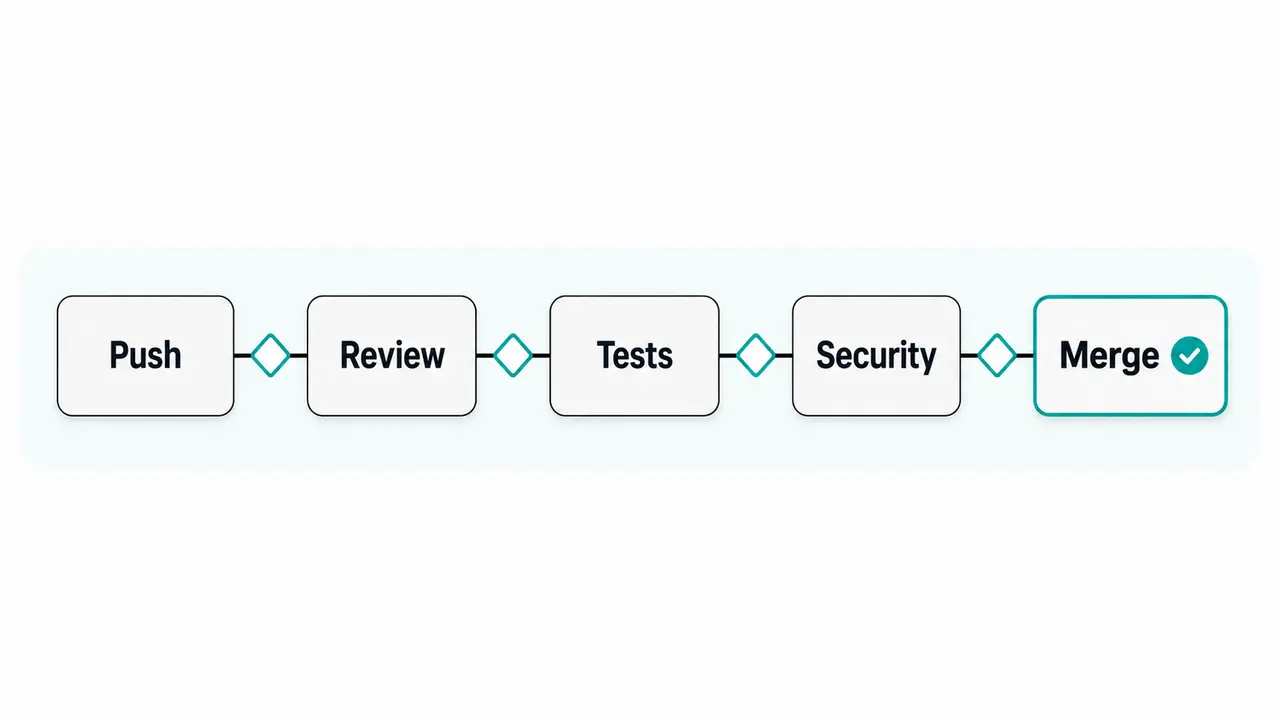
Write it down and version it like code. A workable definition of done includes mandatory code review by a named reviewer, automated tests covering the changed behavior, static analysis passing, security checks completed, and deployment readiness verified through your pipeline. Review the document every two sprints, because done should tighten as the engagement matures. The practices in the NIST Secure Software Development Framework offer a useful reference for establishing these quality gates as repeatable organizational practice rather than individual habit (NIST SP 800-218).
A shared definition of done also protects continuous integration. When every merged story meets the same bar, the main branch stays releasable and hardening sprints stay short.
Sprint planning for credible forecasting
Planning should produce a credible short-range forecast, not a motivational commitment. The difference matters more with an outsourced team, because a missed sprint compounds across the organizational distance and erodes trust faster than it would inside one building.
Credible plans need three inputs. Refined backlog items that pass your definition of ready. A known capacity plan that accounts for holidays, vacations, on-call rotations, and the reality that a ten-person team is rarely ten people. Visible role assumptions, so everyone knows who is reviewing, who is on QA, and who is partially allocated elsewhere. A stable two-week sprint cadence makes all three measurable over time; one-week sprints work for discovery work and three-week sprints for deep technical epics, but two weeks is the default that survives contact with a living roadmap. Release planning then becomes a matter of extrapolating from measured throughput instead of negotiating optimism.
Watch for the specific failure mode: the team over-commits to compensate for outsourcing anxiety, to prove the model works, and misses the sprint review entirely. Over-commitment is not ambition. It is a forecast error with feelings attached.
Daily coordination without status theater
The daily standup is the most frequently wasted fifteen minutes in distributed agile teams. It was designed to surface blockers and integration risks early. In practice it becomes an activity report delivered to a camera, where each engineer recites yesterday’s tickets for an audience that cannot act on any of it.
The fix is structural. Run the daily from a shared board, physical or digital, with every blocker carrying an explicit owner and a deadline. Give blockers an escalation path that bypasses waiting for the next ceremony: if a blocked item has sat more than twenty-four hours, it goes to a named person on your side, same day. Distributed teams cannot rely on corridor recovery, the accidental unblocking that happens when two engineers share a coffee machine. Your operating rhythm has to replace the corridor deliberately.
One warning from experience. When leadership starts attending the daily to “stay close to delivery,” the meeting becomes performance theater within two weeks and no real blocker is ever raised again. Keep the daily for the delivery team. Send leadership the metrics instead.
Sprint reviews that prove integration
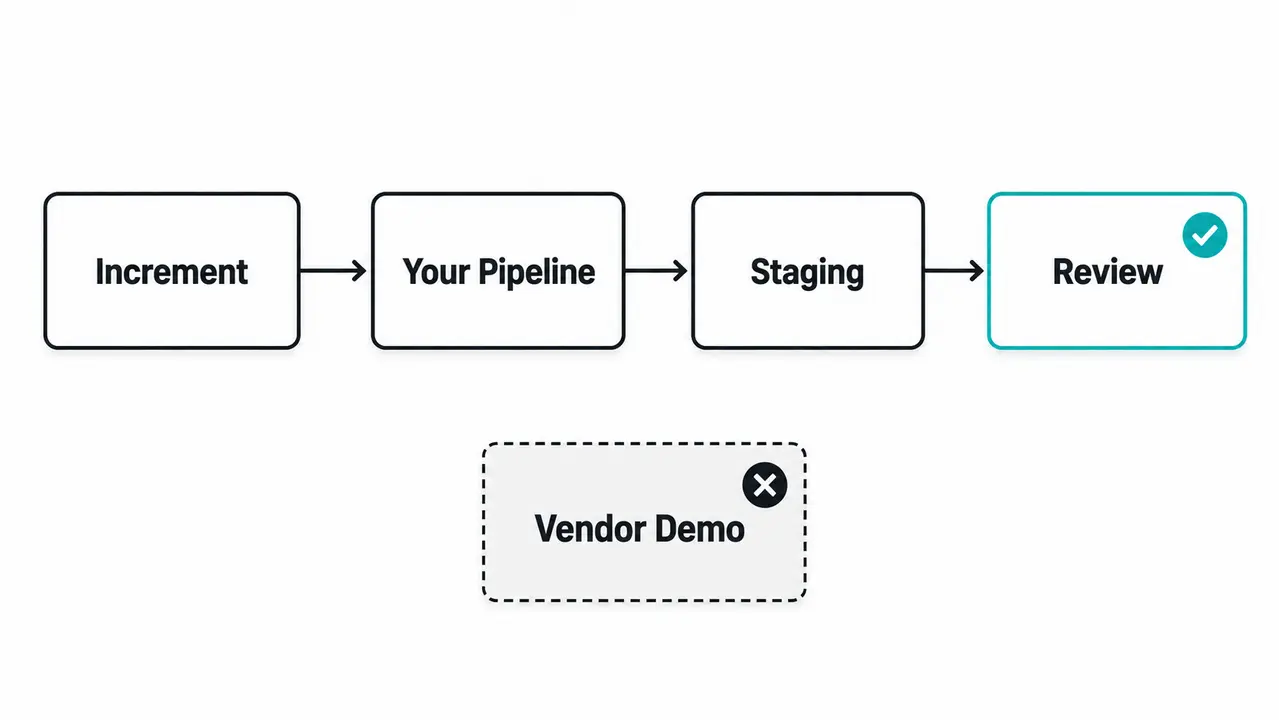
A sprint review has one job: prove the increment works. Not the design, not the plan, not the slide deck. The running software, in an environment that resembles production, against data that resembles real data.
Run the demo on a staging environment with realistic data shapes, and walk through a checklist tied directly to your definition of done. Did the acceptance criteria from the refined stories actually pass? Can the increment be deployed through the same pipeline production uses? Incremental delivery is only real if each increment travels the full path. A demo on a vendor laptop proves the vendor has a laptop.
The failure mode is seductive because it looks professional. Slide decks, mocked screens, carefully recorded videos. Everything appears under control until release day, when the integration risks that were never surfaced in a review arrive all at once, and you discover the “completed” authentication module has never spoken to your actual identity provider.
Retrospectives that change one behavior
Most retrospectives produce feelings. The useful kind produce one process change, with an owner and a due date, that the team verifies in the next sprint. One. A retrospective that generates eight action items generates zero, because no one can absorb eight simultaneous behavior changes and everyone knows it.
Maintain a retrospective action log with four columns: the action, the owner, the due date, and the success signal. The success signal is the column teams skip and the column that matters. “Improve estimation” is not an action. “Stories stuck in code review for more than three days drop below 10 percent, measured on the board” is an action, because next month you can check it.
A cross-functional team, vendor and client engineers in the same retrospective, surfaces friction you cannot see from either side alone. When retros degrade into venting sessions about the other company, the engagement is already sick. Cancel them entirely, as many clients do by month three, and you have removed the only mechanism that was repairing it.
Distributed team decision routing
Organizational distance turns every decision into a queue. An engineer needs an answer on whether to use an existing internal service or build a thin adapter. The question goes to the vendor delivery manager, who forwards it to your program manager, who adds it to next week’s steering committee agenda. Development on that thread stalls for six days to answer a question that took forty seconds to decide.
Define decision routing explicitly, by decision type. Product decisions go to the Product Owner or delegate. Architecture decisions go to a named architect, with significant choices recorded as architecture decision records so the reasoning survives team rotation. Security decisions go to your security owner, with a defined turnaround. Release decisions go to whoever owns production. Write it down in one page. Engineering governance does not need a framework; it needs a routing table that any engineer can read.
The alternative is the steering committee as universal router, which is delivery governance as bottleneck. If every question waits for a weekly call, your expensive distributed team spends its week idle.
Engagement models for iterative delivery
The right engagement model depends on two variables: who manages the day-to-day work, and how much product uncertainty you expect. High uncertainty with a roadmap that will shift quarterly needs a different structure than a well-specified compliance rewrite. Choosing on perceived cost alone is the most common and most expensive mistake.
The three practical options differ on accountability and continuity.
| Dimension | Staff augmentation | Embedded dedicated team | Project-based delivery |
|---|---|---|---|
| Who directs daily work | Your internal leads | Shared, with joint rituals | Vendor delivery manager |
| Scope flexibility | High | High, with stable team | Low, change requests |
| Knowledge continuity | Depends on your retention | Strong, stable roles | Weak, resets per project |
| Requires internal capacity | Significant | Moderate | Minimal |
For a living roadmap, dedicated software engineering teams offer better continuity than project-based delivery, because the team, its code ownership, and its delivery cadence persist across roadmap shifts instead of dissolving at each contractual boundary.
The weakness of project-based delivery for evolving products
Project-based delivery optimizes for exactly what its contract defines: delivering a fixed specification. When success is defined as spec compliance, every incentive points toward protecting scope and away from product outcomes. The vendor’s best strategy, rationally, is to build precisely what was signed, on schedule, and treat every discovery as a commercial event.
That works for stable problems. An office building renovation is a stable problem. A product roadmap is not. In evolving products, the change-control cycle dominates the timeline: every market-driven pivot becomes a change request, every change request becomes a re-estimation, and integration gets deferred to a final phase where it is most expensive to fix. Fixed fee pitfalls are rarely about the fee itself. They are about what the fee structure does to behavior under uncertainty.
The tell is cultural. In a healthy engagement the backlog is a learning tool, reordered as the team learns. Under a fixed spec, the backlog becomes a negotiation tool, argued line by line. If your backlog discussions feel like litigation, the commercial model is the problem, not the people.
Dedicated embedded teams for living roadmaps
A dedicated team model fits agile software outsourcing better than any alternative, because it preserves the two things iterative delivery needs most: continuity and reprioritization freedom. The team stays stable, with a tech lead, senior and mid-level engineers, and QA in fixed roles, running the same sprint cadence as your internal group. Roadmaps shift and the team simply repoints. No re-contracting, no re-estimation cycle, no new faces learning the domain from zero.
Team extension works the same way. The external engineers join your rituals, your board, and your pipeline as members, not suppliers, and the distinction is visible within two sprints: an extension asks “what should we build next,” a supplier asks “what is in scope.”
An agile development partner earns the title through this stability. Rotating engineers between client accounts, standard practice at large vendors, destroys code ownership and institutional knowledge with every rotation. Embedded teams accelerate product development precisely because they eliminate re-onboarding friction: the engineer who understood your billing logic in March is the same engineer extending it in October.
Scope your team around the roadmap you actually have
If your roadmap shifts faster than your contracts can, tell us about the delivery cadence you need and we will help you shape the team structure around it.
Staff augmentation under strong internal leadership
Staff augmentation is not a weaker model. It is a model with a precondition: your internal team must have the leadership bandwidth to absorb people quickly and direct them daily. When that precondition holds, augmented engineers plug into existing rituals and produce value inside two weeks. When it does not, augmentation becomes outsourcing without accountability, warm seats assigned to a roadmap nobody is steering.
Make the structure explicit. An internal tech lead owns code reviews, architecture decisions, and release calls. Augmented engineers work from your backlog and your definition of done. If your tech lead is already at capacity, a dedicated development team with its own lead is the honest answer, not three more augmented engineers who will spend their first month unmanaged.
Who you engage with matters as much as the model. Engaging a boutique delivery partner means the external team integrates into your product organization rather than operating as a detached vendor, because a small partner’s survival depends on each engagement actually working. A large staffing operation can absorb a failed account. Your roadmap cannot.
Onboarding to prevent the third sprint slowdown
Outsourced teams follow a predictable velocity curve. Sprint one is slow, everyone expects that. Sprint two accelerates as the team finds its footing. Sprint three collapses, because the initial tickets were the well-documented ones and now the team has hit the part of the codebase where the knowledge lives in three people’s heads and a Confluence page from two years ago.
Fast teams flatten that curve by investing before sprint one. A structured discovery sprint covering domain walkthroughs, architecture context, and priority alignment buys back weeks. Run onboarding with a first ten days checklist: repository and CI access, local development environment that actually builds on a clean machine, a working deployment through your pipeline, a walkthrough of the monitoring stack, and one small end-to-end slice of real work, a story that touches frontend, backend, and deployment. The slice is the point. Reading documentation teaches a domain. Shipping a slice teaches a system.
Knowledge transfer is a designed activity, not something that happens by proximity. If engineers start coding before they can run the test suite and deploy through the pipeline, every ticket they touch carries hidden risk.
Quality control through automated gates
You cannot inspect quality into a distributed team through meetings. Cross-company quality reviews, joint QA sign-offs, weekly defect triage calls: these add latency and produce arguments. Automated gates produce evidence.
Standardize the gates and let the pipeline enforce them. Pull request rules requiring at least one approval from a reviewer with ownership of the affected area. Automated test suites that run on every push, with coverage expectations on changed code rather than the whole legacy base. Static analysis with an agreed baseline, so old warnings do not block new work. Security scanning on dependencies before merge. A story meets the definition of done when the pipeline says so, and the pipeline does not negotiate.
Continuous integration is what makes the gates cheap. When merges are small and frequent, a failing gate costs an hour. When integration is deferred, the same failure costs a release. The failure mode to watch for is quality assurance reverting to a separate phase at the end of the sprint, a QA column that grows all week and empties on Friday. That structure guarantees delayed releases, no matter how good the engineers are.
Measuring success beyond velocity
Velocity is the most quoted and least useful agile metric. It measures estimation consistency, not delivery. Worse, it responds to incentive: the moment a client starts judging an outsourced team by velocity, story points inflate, and within two sprints the number means nothing. Optimizing velocity encourages point inflation and shallow work, the two behaviors you can least afford at organizational distance.
Three indicators carry real signal. Throughput of releasable increments, counted in increments actually deployed, not tickets closed. Cycle time, measured from a story entering the sprint to running in a target environment. Defect escape rate, the share of defects found in production versus found by the team, which is the single best proxy for whether your automated gates are working.
Put lead time from ready to done and deployment frequency on an executive readout updated weekly. Those two numbers tell a leadership team more about delivery health than any status deck, and they cannot be inflated, because the pipeline generates them. That is the standard we hold our own engagements to at Sentice: the metrics come from the delivery system, not from the people reporting on it.
Evaluating an agile development partner
Sales processes are irrelevant to delivery. Every partner you evaluate will run a polished discovery call, present impressive slides, and promise transparent communication. What separates a delivery organization from a sales organization is artifacts: the residue of how they actually work when nobody is pitching.
Ask for the residue. A definition of done document, written and versioned. Architecture decision records from a real engagement, anonymized if needed. A retrospective action log with owners and dates, ideally one showing actions closed. A sample sprint review agenda. A partner who runs these practices can produce them in a day. A partner who describes agile confidently but cannot produce a single artifact has told you everything.
Then run a pilot sprint before signing anything long. Treat the pilot as a technical interview at team scale, and judge how the partner handles ambiguity, not how confidently they promise timelines. Confidence is free. A partner that asks uncomfortable questions about your product ownership and your pipeline during evaluation is doing the job already.
Frequently asked questions
Can agile software outsourcing work with fixed scope expectations?
You can fix budget and capacity, and that combination works well. Fixing the feature list breaks the model, because iterative development assumes learning changes the plan. If stakeholders expect a contractually locked scope, address that expectation before kickoff, or the first reprioritization becomes a political crisis.
What sprint length works best with distributed teams?
Two weeks is the durable default. One week leaves too little room for refinement across time zones, and three weeks delays feedback past the point where it changes anything. Whatever you choose, keep the cadence fixed long enough to measure throughput, at least six sprints, before judging the team.
Who writes user stories in an outsourced setup?
The Product Owner owns the backlog, and your team writes the stories that carry strategy. Vendor engineers and analysts contribute heavily during refinement, drafting acceptance criteria and technical constraints, and they often draft stories for review. Ownership and drafting are different jobs. Keep the first, share the second.
How do we handle intellectual property and access control without slowing delivery?
Put IP assignment, repository ownership, and credential management into the master agreement, not into per-sprint approvals. Give the external team access to what the work requires through your existing identity provider, with the same audit logging you apply internally. Security handled as a gating process, rather than a per-request exception, avoids both risk and delay.
What is a reasonable pilot scope for an agile development partner?
Two to three sprints, one team, one meaningful slice that touches your pipeline end to end. The pilot must include real refinement, real acceptance, and a real deployment, because a pilot that skips integration proves nothing. Avoid the pilot that is a paid demo of a sample project in the vendor’s own environment.
When should we pause and reset the engagement?
Pause when the same failure repeats after being raised in two consecutive retrospectives, or when acceptance criteria and delivered software keep diverging. A reset means renegotiating the operating model, rituals, decision routing, definition of done, before scaling headcount. Adding engineers to a broken model makes it worse at greater scale.
What are the main agile outsourcing risks we should monitor?
The recurring risks are proxy product ownership, velocity inflation, deferred integration, and decision latency. Each has a measurable signal: stalled stories, growing point estimates, QA accumulating at sprint end, and questions waiting more than a day for answers. Monitor the signals monthly and the risks never surprise you.
A two sprint pilot that makes the decision obvious
Run a pilot that forces real integration and real acceptance. If the team refines a backlog with you, ships an increment through your pipeline, and fixes one process issue by sprint two, the model is viable. If not, change the operating model before you scale headcount. Decide on evidence, not optimism.
Run the pilot with a team that already works this way
Book a free consultation and we will scope a two sprint pilot against your real backlog, your pipeline and your definition of done.
About Sentice

Sentice is a boutique software engineering partner founded in 2013 by Roni Levi and Martin Petkovic, now headquartered in Skopje, North Macedonia. Rather than supplying individual developers, we build embedded teams that blend with a client’s culture, tech stack and goals, working together from a single office under our own technical leadership. We deliver dedicated software engineering teams, end-to-end software solutions, product development, and system and embedded engineering, and we act as technical advisors across the full development lifecycle, from specification and architecture through development, testing and support. We use AI coding tools across every project, and we help clients integrate AI into their own products through chatbots, MCP services, connected application layers and workflow automation. Some of the clients we started with more than a decade ago are still building with us today.