
Nearshore software development is often sold as a geography decision, but the real variable is feedback latency: how long it takes to clarify a requirement, review a change, and resolve a blocker across time zones. This article settles when overlap is worth paying for and when it is not, how to tell a genuine embedded partner from a staffing vendor, and how to run the first thirty days so the engagement proves itself with evidence rather than promises. Below we cover the decision thresholds, the failure modes buyers hit repeatedly, a comparison of the three engagement models, and a due diligence checklist you can use in your first screening call.
Reading time: 9 min
Key points
- Nearshore earns its keep when delivery depends on same-day clarification; fully specified, low-change work does not need it.
- A two to four hour overlap supports daily coordination; six or more enables pairing and shared incident triage.
- Pull request cycle time is the most honest metric of whether an external team is genuinely integrated.
- Demand process evidence and working agreements during due diligence, not sales decks.
Table of contents
Nearshore software development works when the work needs real time decisions
A pull request sits open because the engineer who wrote it needs one answer from your product owner before the change can merge. That is the moment the engagement model matters. Nearshore software development earns its keep when product delivery depends on fast feedback loops, shared working hours, and blockers resolved inside the same day they appear.
The difference is measured in hours to unblock versus next day to unblock. When your PM, your designer, and your engineer can get in one call during overlapping hours, a sprint keeps moving. When they cannot, the blocker waits overnight, the engineer context-switches, and the sprint plan quietly slips a day each time it happens.
The failure mode is predictable. Async handoffs turn into rework. Stalled pull requests pile up. Nobody decides anything, so everybody waits.
Choose nearshore for fast-moving product work that needs continuous alignment. Isolated task completion does not need it.
Where nearshore is a poor fit for the roadmap
Not every backlog rewards overlap. If the work can be fully specified upfront, has a low rate of change, and runs on handoff-based execution, paying for collaboration hours buys you nothing. Stable maintenance tasks, an isolated data migration with frozen requirements, or a low-touch QA execution cycle fit this profile. A fully specified batch job does not care whether the executor shares your afternoon.
This is where offshore and even pure staff augmentation remain legitimate options, and where insisting on a high-touch model inflates your cost structure without changing the output.
The counter-case matters just as much. The moment the domain is complex or the requirements are volatile, the advantage flips back. Collaboration needs grow faster than specification quality, and same-day clarification becomes worth more than a lower rate card.
Use nearshore capacity for change-heavy product development. Do not use it as a ticket factory, because that wastes the one property you are paying for.
Timezone aligned teams change the shape of Agile ceremonies
Timezone overlap is not a comfort feature. It is a structural requirement that determines whether planning, standups, pairing, and incident response happen in one loop or two. Two loops means every decision crosses a night. One loop means the team coordinates live and moves on.
The thresholds are practical. A two to four hour overlap window supports daily coordination, standups, and sprint grooming. Six or more hours enables pairing sessions, mob programming on hard problems, and shared incident triage when something breaks in production. Below two hours, you are running an offshore engagement with better marketing.
Here is the failure mode we see repeatedly: a timezone aligned team that never interacts live. Standups degrade into status reporting read off a board, and nobody escalates the small ambiguities that later become defects.
Structure the day around the overlap window. Put grooming and clarification sessions inside it. Same-day grooming beats a beautifully documented overnight question every time.
The regional development partner model is not staff augmentation
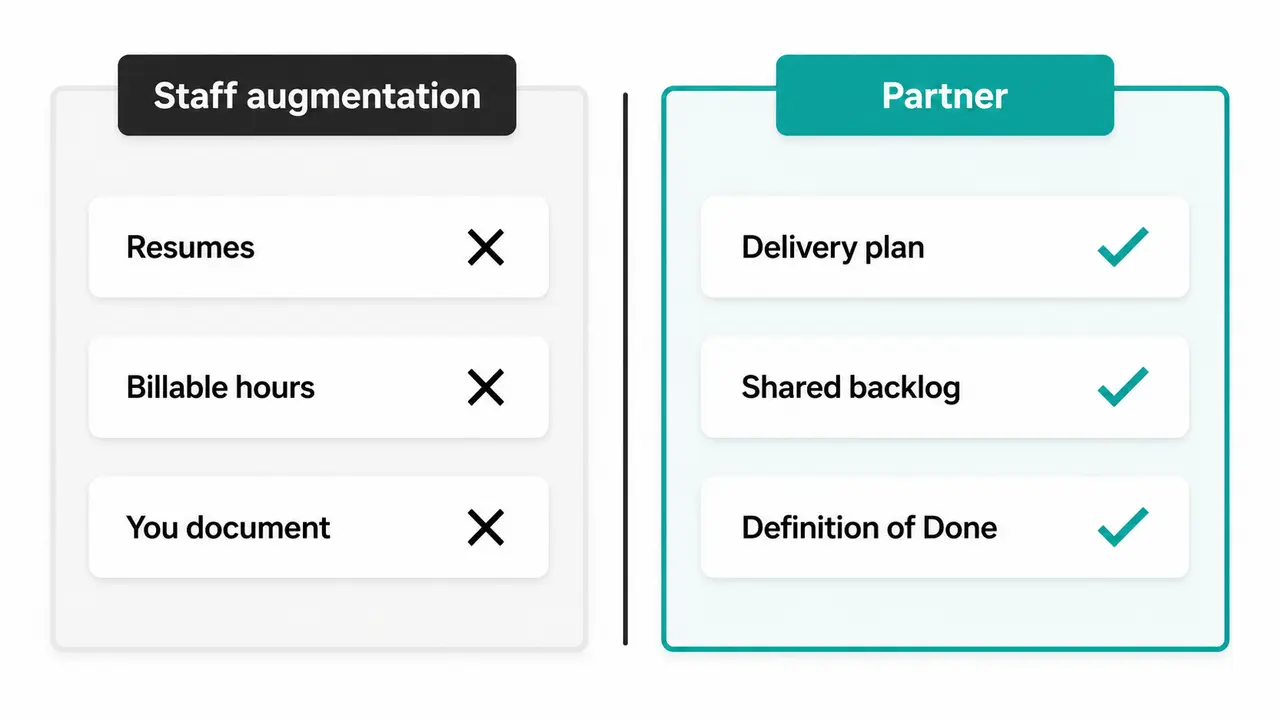
A regional development partner is accountable for outcomes and delivery health. A staffing vendor is accountable for resumes and billable hours. The two get confused constantly, and the confusion costs engagements.
The test is simple. Ask the partner for a delivery plan, a Definition of Done, a QA strategy, a release checklist, and a documentation baseline. If they cannot produce these artifacts without asking you what yours should look like, you are buying staffing.
An embedded team means the engineers work as one unit inside your system, following your practices and your communication style, which is the core of what we deliver through dedicated software engineering teams. Embedding is a mechanism, not a seating chart.
Require shared backlog ownership, where the partner’s tech lead shares prioritization calls with yours. Require shared on-call expectations where the workload justifies them. If the partner cannot own delivery mechanics, the engagement is staffing, and you should price it accordingly.
Nearshore vs offshore comes down to feedback latency
Strip away the geography and the practical difference between the two models is one number: how long it takes to clarify a requirement, review a change, and resolve a blocker across time zones. That is feedback latency, and it sets the rhythm of the entire project.
Trace it through the pipeline. Pull request review waits. QA cycles wait. Design iteration waits. Each wait is short in isolation. Stacked across a sprint, they define your velocity more than team size ever will.
Consider the concrete case. A critical bug surfaces at 3 pm your time. With a nearshore team, the fix starts before your standup ends. With an offshore team, the bug report arrives at the start of their next workday, twelve hours later, and the release stalls overnight while the release manager decides whether to roll back or wait.
Offshore works for stable, well-specified work where overnight latency is acceptable. Nearshore wins for fast-moving product teams where it is not.
Onshore teams still win for high trust edge cases
Pretending nearshore fits every situation is how buyers end up with a governance problem. Onshore delivery is strongest when the work requires frequent in-person alignment, deep domain immersion, or sensitive operational access that your compliance function has not extended outside the building.
Early-stage product discovery with heavy stakeholder interviews is one case. A regulated operational environment where auditors expect named on-site engineers is another. Hardware lab access, where the engineer needs hands on physical rigs during your business hours, is a third.
The counter-case is real too. Nearshore teams handle complex and regulated environments regularly, provided your organization is mature about security boundaries, access controls, and data classification. The constraint is usually your governance readiness, not their capability.
Use nearshore to scale build capacity. Keep trust-heavy functions close until your governance, your legal framework, and your access patterns are ready to extend.
The week a senior leaves mid migration
Every experienced buyer has a version of this story. A platform migration is six weeks in. The senior engineer who designed the approach resigns, on either side of the engagement. Delivery stalls, the migration gets abandoned, and the partial work becomes a permanent liability in the codebase.
Engagements fail this way when knowledge is trapped in one person and the partner cannot sustain continuity through documented decisions. The defenses are unglamorous and effective: architecture decision records, runbooks, onboarding docs, recorded walkthroughs of the tricky subsystems. ADRs matter most, because they capture the why, and the why is what leaves with the person.
Bus factor of one plus vendor turnover equals stalled delivery. It is arithmetic, not bad luck.
Enforce two-in-a-box configurations for critical components, so two engineers always know each subsystem. Rotate code ownership deliberately. Single points of failure in people are as dangerous as single points of failure in infrastructure, and easier to prevent.
Where teams underestimate onboarding
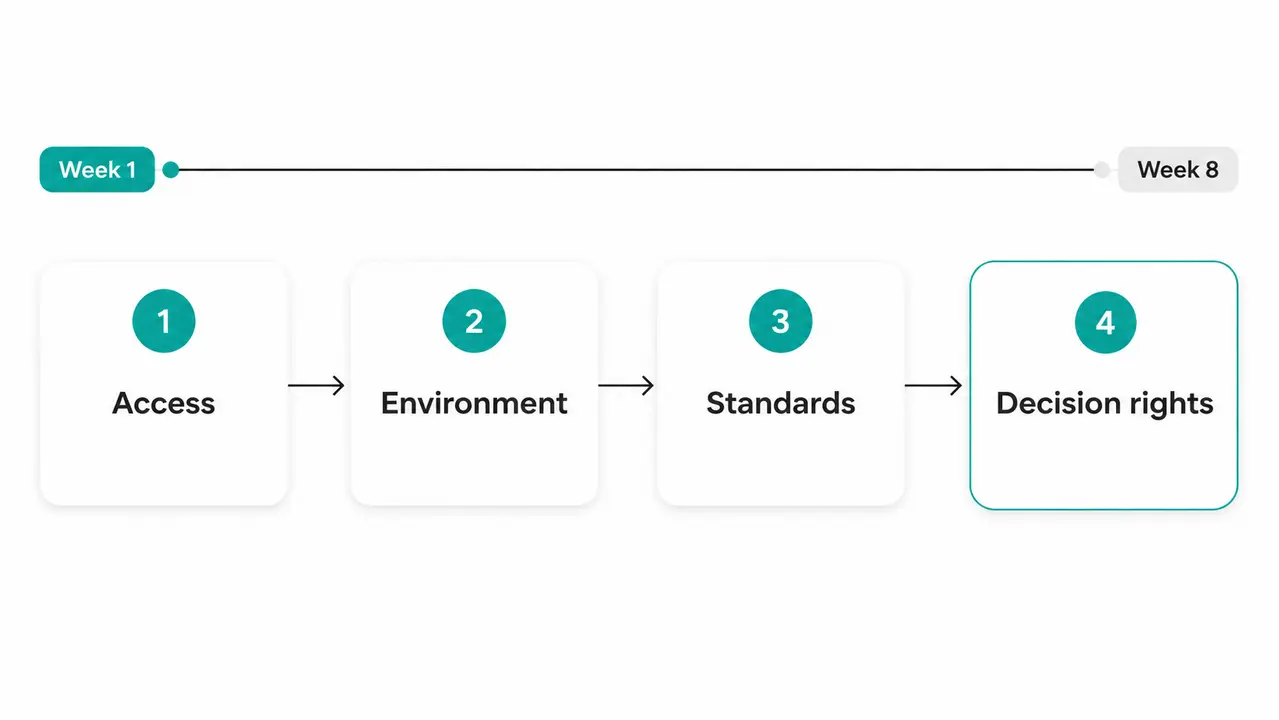
Teams treat onboarding as introductions and repository access. That framing guarantees a slow first month. Real onboarding is the alignment of domain knowledge, delivery standards, and decision rights, and it either happens deliberately or it happens badly over eight weeks of friction.
The minimum package is specific. An environment setup script that works on a clean machine. A local development guide. A written branching strategy. A code review checklist. A test strategy that says what must be covered before merge. Each artifact removes a week of questions.
Here is the uncomfortable counter-case. If these artifacts do not exist internally, the nearshore team will expose the gap within days, and the timeline will slip while you write them under pressure. That slip is not the vendor’s fault.
Assign four named people to guide the process: an engineering manager, a tech lead, a product owner, and a security contact. Named, not a distribution list. Onboarding fails when questions have nowhere to land.
The actual cost of a two day review queue
Pull request cycle time is the most honest metric in a distributed engagement. When reviews sit in a queue for two days, the problem is not reviewer workload. It is a leading indicator that the external team is not integrated into your engineering system.
Look at the cost chain. Delayed reviews increase merge conflicts, because the codebase moves underneath the waiting branch. They increase context switching, because the author picks up new work and pays to reload old context. They increase defect escape rates, because review feedback arrives after the author’s mental model has expired. Each cost compounds quietly.
The fixes are mechanical. Define review SLAs, measured in hours. Rotate reviewers so no single engineer is the gate. Enforce smaller PRs below roughly 400 changed lines. Add pairing windows during the overlap period so hard changes get reviewed live instead of asynchronously.
If review latency cannot be brought down, the engagement behaves like offshore regardless of geography. The map says nearshore. The cycle time says otherwise.
Delivery ownership needs a written decision map
Watch a decision travel between client and vendor without an owner. Architecture question raised Monday. Routed to the internal tech lead Wednesday. Answered partially the following Tuesday. The workstream stalls in between, and the idle time never appears in any status report. Hidden idle time is the tax on unclear ownership.
A nearshore team moves faster when architecture, product decisions, and operational approvals are mapped to named owners with explicit escalation paths. A RACI-style decision map covering architecture, security, releases, and data migrations is enough. Who decides, who is consulted, who executes, and how fast a blocked decision escalates.
Keep one rule in the working agreement: disagree and commit. Consensus is not a delivery strategy. When two senior engineers disagree on an approach and the cadence is stalled, the named owner decides, the team commits, and the dissent gets recorded in an architecture decision record for later review.
Cadence beats unanimity. Stalled decisions are the expensive kind of conflict.
How the three engagement models compare
The right model depends on one question: does your organization need extra hands, a managed workstream, or a long-term embedded team? Answering it honestly before signing prevents most engagement failures we see.
| Dimension | Staff augmentation | Dedicated team | Owned workstream |
|---|---|---|---|
| Accountability | Individual output | Team delivery against shared backlog | Outcome and roadmap milestones |
| Integration depth | Works inside your process | Shares your process and metrics | Runs the process, reports outcomes |
| Documentation burden | Falls on you | Shared | Falls on the partner |
| Best fit | Stable, well-specified work | Ongoing product evolution | Outcome-based end-to-end software solutions |
Pure staff augmentation fails when scope is volatile, because the external engineers lack product context and every change triggers a clarification cycle. Startups and scaleups usually outperform augmentation by moving to dedicated teams or owned workstreams after the first sprint. The upgrade is cheap early and expensive late.
Embedded teams need shared tooling and shared telemetry
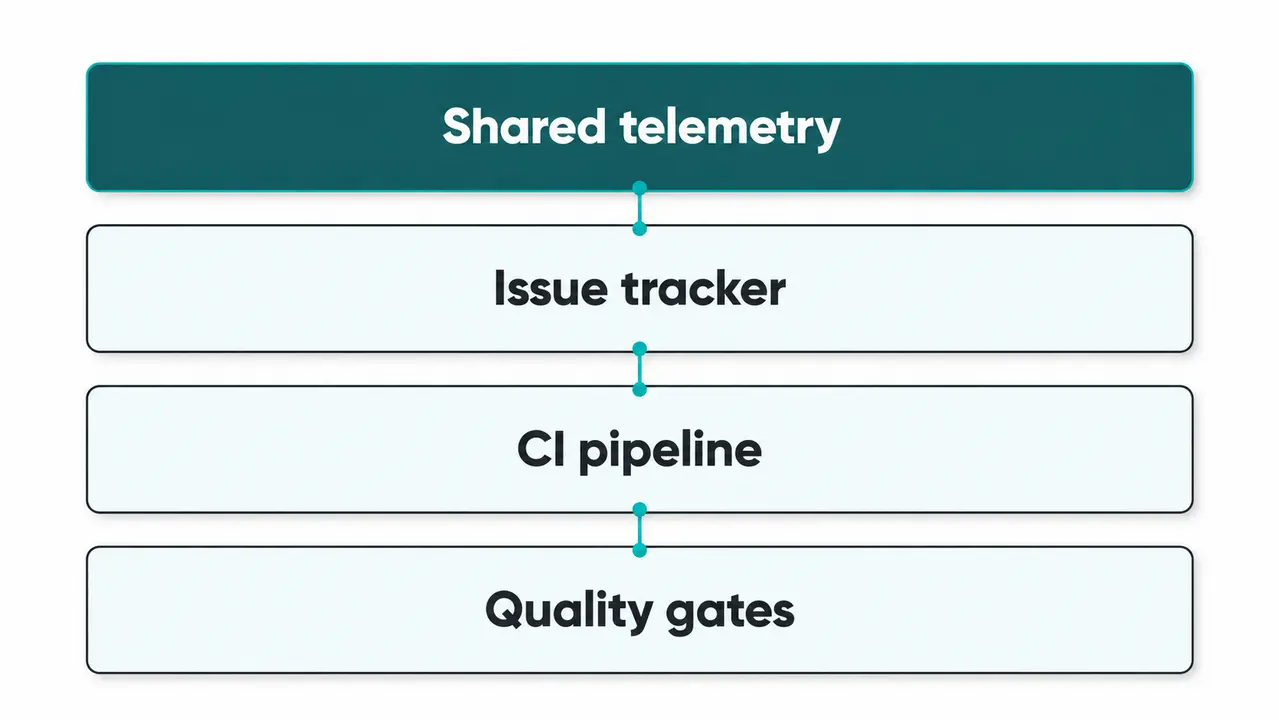
Integration is not a feeling. It is measurable, and it is measured when both sides work in the same systems and read the same delivery signals. An embedded team that lives in a separate Jira project with its own dashboards is embedded in name only.
The list is concrete: one shared issue tracker, one CI pipeline, shared code quality gates, a shared incident management channel in PagerDuty or an equivalent, and shared feature flags so both sides see what is shipping and what is dark. None of this is exotic tooling. All of it is skipped more often than not.
Parallel tooling creates parallel truth. Your dashboard says velocity is fine. Their dashboard says the backlog is growing. Two sets of numbers turn every retro into a debate about measurement instead of a discussion about delivery, and the debate rots trust.
Track lead time, deployment frequency, change failure rate, and mean time to recovery together, in one place, attributed to the combined team. Unified telemetry is the proof of embedding. Absence of it is the proof of a boundary.
Security and IP hygiene is an operating practice
Security in nearshore delivery is not a certification framed on a wall. It is an operating practice focused on access controls, secure SDLC, and auditability, executed daily by the people writing your code.
Enforce the basics first, because the basics carry most of the risk. Least privilege access scoped per repository and per environment. SSO with mandatory multi-factor authentication. Secrets in a managed vault, never in repository history. Automated code scanning and dependency scanning wired into the CI pipeline so CVEs surface at pull request time, not at audit time.
The counter-case is on your side of the table. If your organization cannot provide secure access patterns, reduce the scope of access until your governance matures. Giving a vendor broad production access because proper segmentation is inconvenient is the actual risk event.
Put IP assignment, confidentiality, and data handling expectations in the contract at a level that survives geography. Contracts enforce what operations practice. They do not substitute for it.
Regional teams can accelerate embedded and IoT programs
Embedded and IoT programs fail in the seams between layers. Firmware, cloud backend, and mobile application each have their own owners, and the program succeeds or dies on how tightly those release increments coordinate. Nearshore teams are useful here precisely when all three layers ship in one coordinated release train.
Take a concrete change. A device telemetry pipeline update requires a firmware revision, a backend ingestion change, and a dashboard update, all validated against the same device firmware version. Coordinating those increments across distant time zones is where system and embedded engineering from a regional partner earns its place, because the integration conversations happen the same day the incompatibility appears.
The failure mode is specific. Splitting embedded and cloud across distant time zones increases integration defects and delays hardware-in-the-loop testing, since the rig and the fix live in different workdays.
Use a regional team to align test rig schedules, release branching, and versioning strategy across the full stack. One workday for the whole chain is the point.
Validating delivery maturity in the first technical screening call
The first technical screening call usually tests whether the engineers can code. It should test something harder to fake: delivery maturity and operating model. Code skills show up in a trial sprint. Operating model gaps show up in month three, at twenty times the cost.
Ask for artifacts, not assurances. A sample onboarding plan, in the form they actually use. An example Definition of Done with real checklist items. Their approach to code review, including typical review turnaround. How they handle a production incident on a Friday afternoon, with roles named.
Then listen for the failure signal. Answers that stay at the slogan level, phrases like “we follow Agile best practices” with nothing concrete underneath, indicate the execution gaps will appear later. A partner who has run real deliveries describes specifics unprompted: which ceremonies they keep, which they cut, and why.
Close with one request. Ask for a walkthrough of a past delivery timeline, including where scope changed and how the change was managed. Every real delivery has turbulence. The walkthrough tells you whether they survived it honestly.
Predicting delivery quality through due diligence checklists
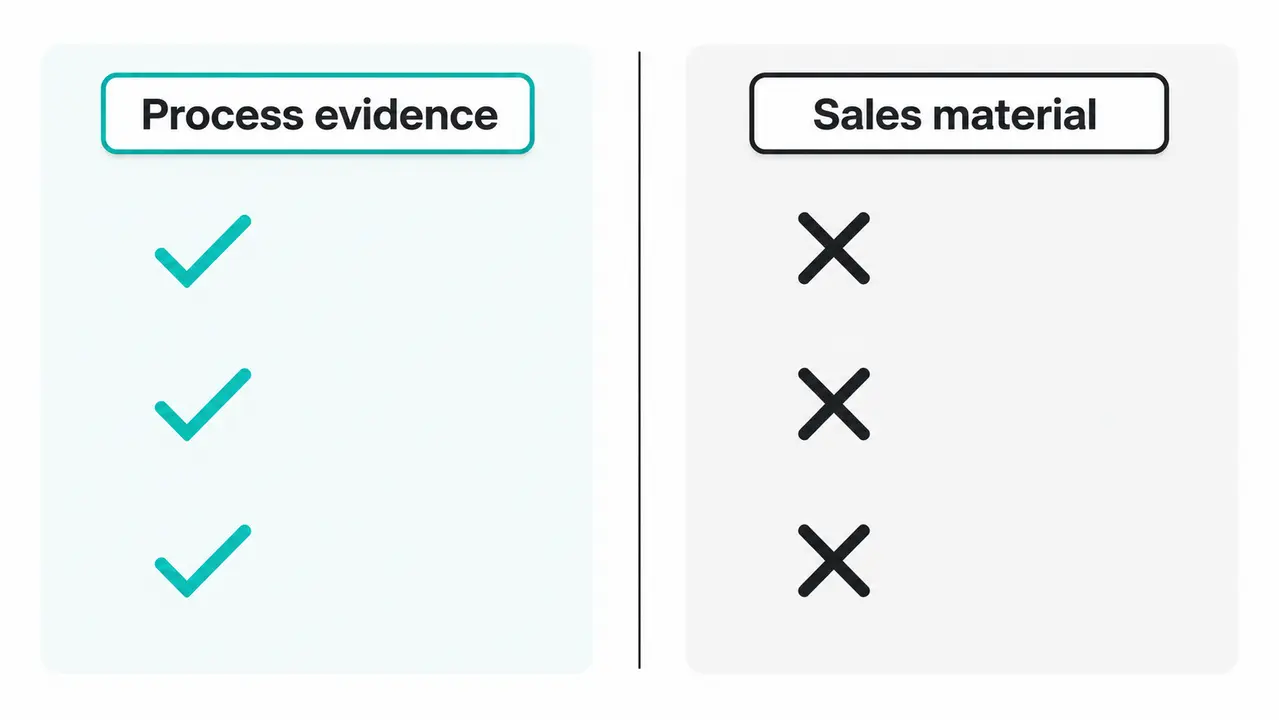
The best predictors of delivery quality are process evidence and working agreements, not sales decks. Demand the evidence before you shortlist. Referenceable engineering leaders willing to take a call. A sample statement of work showing how scope changes are handled. Anonymized pull request history patterns showing review turnaround. Test coverage approaches and release cadences in actual numbers.
Talent density in the region matters too, because it determines whether the partner can staff the team at the seniority promised. The scale of demand tells part of that story: Eurostat reports that 20.05% of EU enterprises employed ICT specialists in 2024, and among large enterprises the figure was 78.44% (ec.europa.eu), which frames how hard senior engineering talent is to reach for any single buyer.
Selecting on sales materials produces mismatched expectations and weak execution. The pattern repeats across failed engagements.
Run a trial sprint before committing. Define acceptance criteria, an exit plan, and a knowledge transfer plan up front, so the trial validates the proposal whether you proceed or not.
Running the first thirty days without losing momentum
The first month has one job: prove integration through one backlog, one cadence, one quality bar, and one release path. Four weeks, four checkpoints, each one producing evidence.
Week one covers access and the first small pull requests, deliberately trivial changes that exercise the full path from ticket to production. Week two ships a thin vertical slice behind a feature flag, small enough to be safe and real enough to touch every layer. Week three runs an incident drill, a simulated failure paged through the real channel with both sides responding. Week four holds a retrospective and adjusts the working agreement in writing.
The failure signal is unambiguous. If thirty days do not produce a shippable increment, the operating model is broken, not the people. Reset the scope and the model rather than extending the timeline and hoping.
Momentum in month one is a preview of delivery in month twelve. Teams that stall early stall forever.
Frequently asked questions
How much timezone overlap is enough for a nearshore team?
A minimum of two to four hours of overlap is required for daily coordination, while six hours or more enables pairing and mob sessions. Schedule standups, grooming, and clarification windows inside the shared window, not at its edges. For high-velocity product work, maximize the overlap rather than treating the minimum as the target.
What is the difference between a dedicated team and a project team?
A dedicated team shares your backlog and long-term roadmap, planning sprints alongside your internal staff. A project team works against a fixed scope with milestone acceptance criteria as the contract. Choose dedicated teams for ongoing product evolution and project teams for bounded, well-specified deliverables.
Who should own architecture decisions in a nearshore setup?
Map architecture decisions in a RACI matrix with client ownership and vendor accountability. Capture the rationale in architecture decision records so decisions survive staff changes. Keep the final authority with your internal tech lead, especially for anything touching data, security, or irreversible migrations.
How do you keep documentation from becoming shelfware?
Tie documentation creation to the Definition of Done and wire checks into the CI pipeline. Automated checks for missing README files or stale API specs catch drift before merge. Block pull request merges when required documentation is missing, and the documentation stays current by default.
What should be included in a handoff if the engagement ends?
A handoff must include runbooks, architecture decision records, environment access details, and current operational state. Schedule a two-week transition period with paired working sessions, not a document dump. Treat the exit plan as a condition of the original statement of work, so it exists before you need it.
What metrics show the team is truly embedded?
Shared lead time, deployment frequency, and change failure rate indicate real integration, because they measure the combined system rather than each side separately. Monitor the same sprint board and incident dashboard as one team. Reject parallel metric tracking, since it creates two versions of the truth.
The next step is a one sprint pilot with a real integration goal
Treat nearshore selection as an engineering rollout, not a vendor purchase. Pick one workstream with real dependencies, define acceptance criteria up front, and measure feedback latency, pull request cycle time, and release readiness against your existing baseline. Move forward only when ownership and delivery signals are stable. If the pilot cannot integrate into your cadence, change the model or stop.
Ready to run the pilot with an embedded team
Tell us about the workstream you want to test, and we will scope a one sprint pilot with a real integration goal, acceptance criteria, and a knowledge transfer plan from day one.
About Sentice

Sentice is a boutique software engineering partner founded in 2013 by Roni Levi and Martin Petkovic, now headquartered in Skopje, North Macedonia. Rather than supplying individual developers, we build embedded teams that blend with a client’s culture, tech stack and goals, working together from a single office under our own technical leadership. We deliver dedicated software engineering teams, end-to-end software solutions, product development, and system and embedded engineering, and we act as technical advisors across the full development lifecycle, from specification and architecture through development, testing and support. We use AI coding tools across every project, and we help clients integrate AI into their own products through chatbots, MCP services, connected application layers and workflow automation. Some of the clients we started with more than a decade ago are still building with us today.