
Outsourcing fails quietly. The standups run on time, the demos look polished, and the release still slips because nobody agreed on what “done” meant. This article treats software outsourcing as an engineering governance problem rather than a communication problem, and walks through the operational controls that keep an external team accountable: ownership of infrastructure, explicit decision rights, strong acceptance criteria, delivery gates, and artifacts that survive personnel changes. Below, you will find where control is won or lost in the first two weeks, how the three engagement models compare, and a two week reset you can run before scaling any external team.
Reading time: 10 min
Key points
- Most outsourcing failures are governance failures, not communication failures: delivery slips while every standup runs on time.
- Control is established in week one: repository ownership, named decision rights, and an access matrix, all in writing before the first sprint.
- Strong acceptance criteria replace supervision, which you cannot scale, with verification, which you can.
- If your internal team cannot ship a patch end to end without the vendor, you have a deployment monopoly, whatever the contract says.
Table of contents
The standup was flawless and the release still failed
Most software outsourcing risks do not surface as communication friction. They surface as a delivery that slips while every daily standup runs on time. We have watched it happen: the external team is responsive, the demos look polished, the Slack channel is alive with good questions. Then integration week arrives and nobody can agree on what “done” meant, because there was never a shared definition of it.
That is the failure mode nobody plans for. Teams blame the six-hour time difference, the language barrier, the cultural gap. The actual cause is usually weaker delivery governance than the same company would demand from an internal team sitting ten meters away.
This article treats outsourcing as an engineering governance problem, solvable with specific operational controls: ownership of infrastructure, explicit decision rights, delivery gates, and artifacts that survive personnel changes. Geography is the least of it.
The first week decides who actually holds the keys
Control is established on day one or it is not established. Before the first sprint starts, answer a short list of questions in writing. Who owns the Git organization? Who administers the CI pipelines in GitHub Actions or GitLab CI? Where do artifacts live, and under whose cloud account? If the vendor creates the repositories under their organization and invites you in, the relationship is structurally inverted from the start.
Decision rights matter just as much. Someone must be named as the approver for architecture changes, security exceptions, and production release trains. When that person is unnamed, the vendor fills the vacuum by default, and you discover the arrangement only when the first disagreement arrives.
Teams that defer these controls to sprint two start the engagement at a deficit. The most common symptom is the “we cannot ship a hotfix without them” dependency, which is expensive to unwind once the vendor’s workflows are load-bearing.
Where teams lose product context in week two
External engineers fail in a particular way: they build what the ticket says while missing the reasons your system evolved the way it did. The caching layer exists because of an incident in 2022. The queue abstraction exists because a previous vendor painted you into a corner. None of that context travels through Jira.
Onboarding needs a structured artifact set, not a walkthrough call. An architecture overview with the real topology. A domain glossary so a “device” and an “asset” never get conflated. Architecture decision records that capture why choices were made, so new engineers can evaluate tradeoffs against your history rather than their previous project’s conventions.
When the engineers sit together in one office and absorb your practices from week one, onboarding stops being a phase and becomes a handover. That is the standard we hold our own end-to-end software solutions to: the context gap is closed by structure, not by hope.
Weak acceptance criteria turn the backlog into a dispute
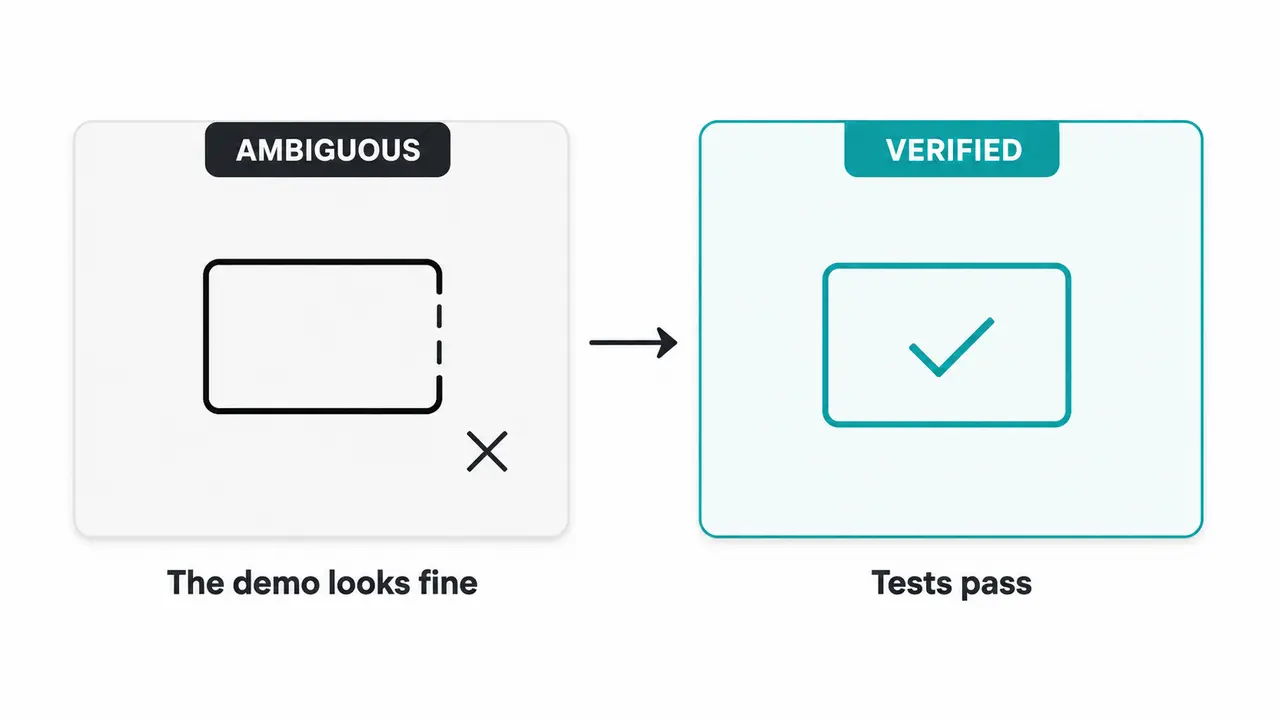
An ambiguous ticket is not a small problem. It is a contract with a loophole. The external team implements the cheapest reading of it, the demo looks fine, and the rework conversation starts a sprint later. Repeat that four times and trust erodes on both sides, with each party privately concluding the other is acting in bad faith.
The fix is a shared definition of done that applies to every single ticket: unit tests written, API documentation updated, deployment readiness verified. Acceptance criteria written in given-when-then format, with explicit non-functional requirements, close the interpretation gap that scope creep crawls through. “The endpoint responds” is not a criterion. “The endpoint responds in under 200ms at p95 with 50 concurrent users, and the response schema is validated by the contract test” is a criterion.
Strong acceptance criteria are the primary governance mechanism for outsourced work. They replace supervision, which you cannot scale, with verification, which you can.
Project based delivery and embedded teams fail differently
These two models break in opposite ways, and the controls have to match. Project based work, scoped through a statement of work, fails at the handoff cliff. The statement of work had a loophole, the deliverable technically matches the words, and the system is unmaintainable the moment the vendor rotates staff. Knowledge sits in their documentation, in their repo, in their deployment scripts.
Embedded teams fail differently. The risk is blurred ownership: the external engineers write code, nobody internally reviews it with authority, and within six months a subsystem exists that your own architects cannot explain. That failure is slower and quieter, but it compounds.
Our verdict is unambiguous. For long-lived products, an embedded team paired with strong internal product and technical ownership is the safer structure. Project based delivery has its place for bounded, well-specified work. Applying it to a product you intend to maintain for years is the expensive mistake.
How staff augmentation, dedicated teams, and full outsourcing compare
The three engagement models differ on who holds the pen. The right question is not which is cheapest, but who writes architecture decision records, who runs releases, and who owns quality assurance. Those three answers determine your risk profile more than any rate card.
| Dimension | Staff augmentation | Dedicated team | Full project outsourcing |
|---|---|---|---|
| Architecture decisions | Your team writes ADRs | Shared, with your final approval | Vendor owns them |
| Release authority | Your engineers run CI and deploys | Shared pipeline, your credentials | Vendor pipeline and schedule |
| Quality ownership | You define and enforce the gates | Team enforces gates you define | Vendor defines its own gates |
| Knowledge continuity | Depends on your onboarding capacity | High, if artifacts land in your systems | Low, concentrated at handoff |
| Typical failure mode | Onboarding neglected, output stalls | Blurred ownership without a product owner | Handoff cliff and SOW disputes |
Two failure patterns dominate. Dedicated software engineering teams underperform when the client has no real product owner, because decisions bottleneck on nobody. Staff augmentation fails when the client lacks onboarding capacity, because the augmented engineers sit idle or drift. Full outsourcing fails when the SOW is the only governance instrument.
The week a senior engineer leaves mid migration
Continuity risk peaks at the worst moment. A migration is half finished, the senior engineer who architected it resigns or gets rotated to another account by the vendor, and the release train stops. We have inherited systems where the deployment procedure existed in exactly one person’s terminal history.
The control is simple and cheap. During sprint planning, run a bus factor review: list the critical paths, the infrastructure components, and the release procedure, then check whether at least two people on the combined team can execute each one. Where the answer is one, the sprint plan includes a pairing task before feature work continues.
This is risk management in its most literal form. Systemic redundancy, documentation in your wiki rather than the vendor’s, and code ownership rules in the repository absorb the shock of personnel changes. Without them, a single resignation triggers an emergency rewrite.
Quality risk is visible in the review queue first
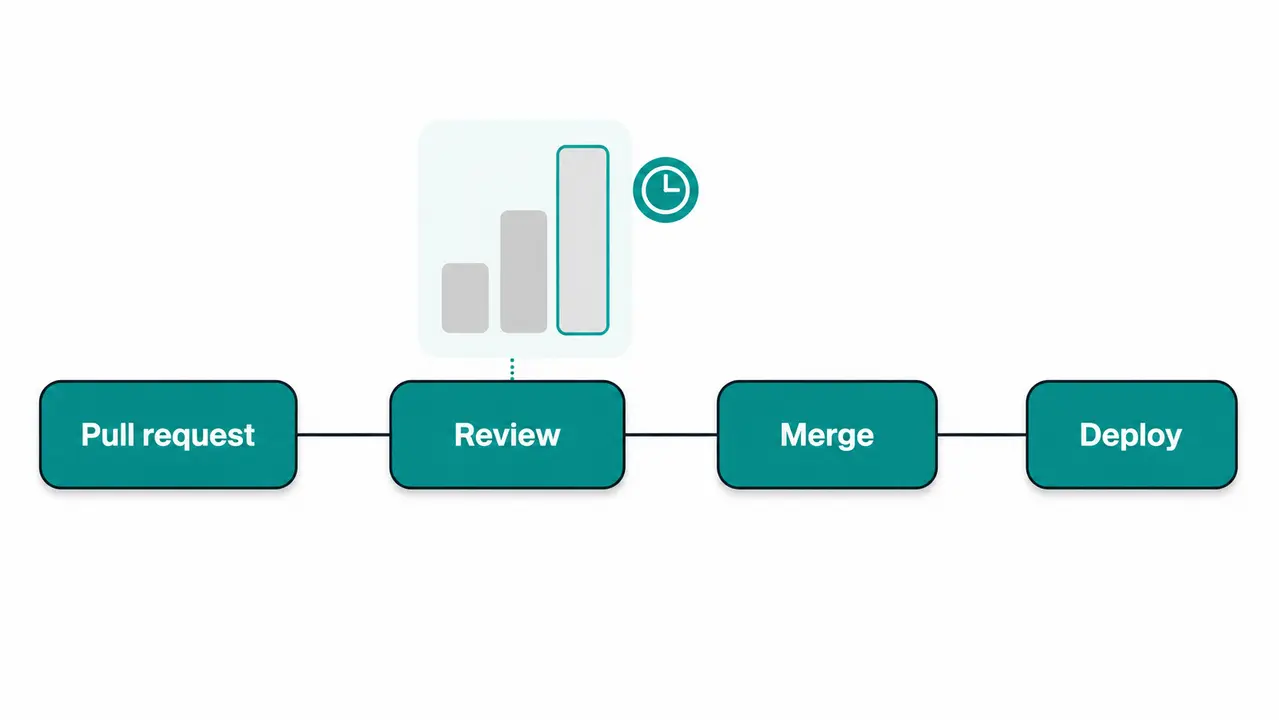
Quality problems announce themselves in workflow signals weeks before they cause a production incident. Pull requests growing past 800 lines. Review latency climbing from hours to days. Bug reopen rates rising sprint over sprint. Each signal alone is noise. Three together are a diagnosis.
The controls are standard. Enforce CODEOWNERS files so specific people must review specific paths. Gate merges on test coverage thresholds in the CI pipeline. Cap work in progress so oversized pull requests cannot accumulate. The 2024 DORA report found that elite performers realize dramatically better outcomes than low performers through continuous delivery practices, including far lower change failure rates and faster recovery from failed deployments (Source: DORA).
The alternative is discovering unmaintainable code when the prototype phase ends and someone tries to add a second feature to it. By then the cheap fix window has closed.
Security exposure starts with access design
The biggest security threat in an outsourced engagement is not the existence of external engineers. It is uncontrolled access to your repositories, environments, and data. A vendor with a shared admin account and standing production credentials is a supply chain incident waiting for a schedule.
Build an access matrix by role before the first login. Time-box all credentials, rotate secrets on a fixed cadence, and prohibit shared accounts across the entire engineering organization, yours and theirs. Every infrastructure change should be attributable to a person and traceable in an audit log. Terraform state under your organizational control, not theirs, closes the loop.
The NIST Secure Software Development Framework recommends exactly this class of control for mitigating the risk of software vulnerabilities: strict access control, defined roles, and auditable trails throughout the SDLC (Source: NIST SP 800-218). A vendor that resists an access matrix is telling you something. Believe it.
IP protection is operational before it is legal
Every outsourcing contract contains IP assignment language. It is necessary and it is insufficient. Ownership is established by where the work actually lands, continuously, during the engagement. Code pushed to your repository daily. Documentation in your Confluence or Notion workspace. Infrastructure definitions in your Terraform repos under your organization.
The end-of-project hostage situation is real and avoidable. It happens when the vendor hosts the source, the deployment scripts live in their pipeline, and the “handover” turns out to be a zip file with no history. Reversing the arrangement takes one hour of setup at the start and a contractual clause confirming it.
Our rule is blunt: if a system cannot be rebuilt from artifacts in your organization’s control, you do not own it, whatever the contract says. IP lives in repositories, pipelines, and runbooks. Paper just confirms what the infrastructure already made true or false.
Vendor lock in is created by deployment monopolies
Long-term collaboration does not create lock-in. Hidden deployment knowledge does. If only the vendor’s engineers can ship a patch, because the release procedure is tribal knowledge and the deploy tooling is bespoke, the relationship has quietly become a monopoly regardless of what either side intends.
Among the outsourcing challenges we see repeatedly, deployment monopoly is the most structural. The test is disarmingly simple. Run a quarterly takeover drill: your internal engineers must ship a small patch to production, end to end, without any assistance from the vendor. Build the pipeline, run the rollback, verify the monitoring alerts fire. If they cannot, you have measured your actual dependency.
Any engagement model is too risky if your internal team cannot run the system independently. That verdict applies to the friendliest vendor and the most hostile one equally, because the constraint is structural, not intentional.
Time zones become a risk only when decisions live in meetings
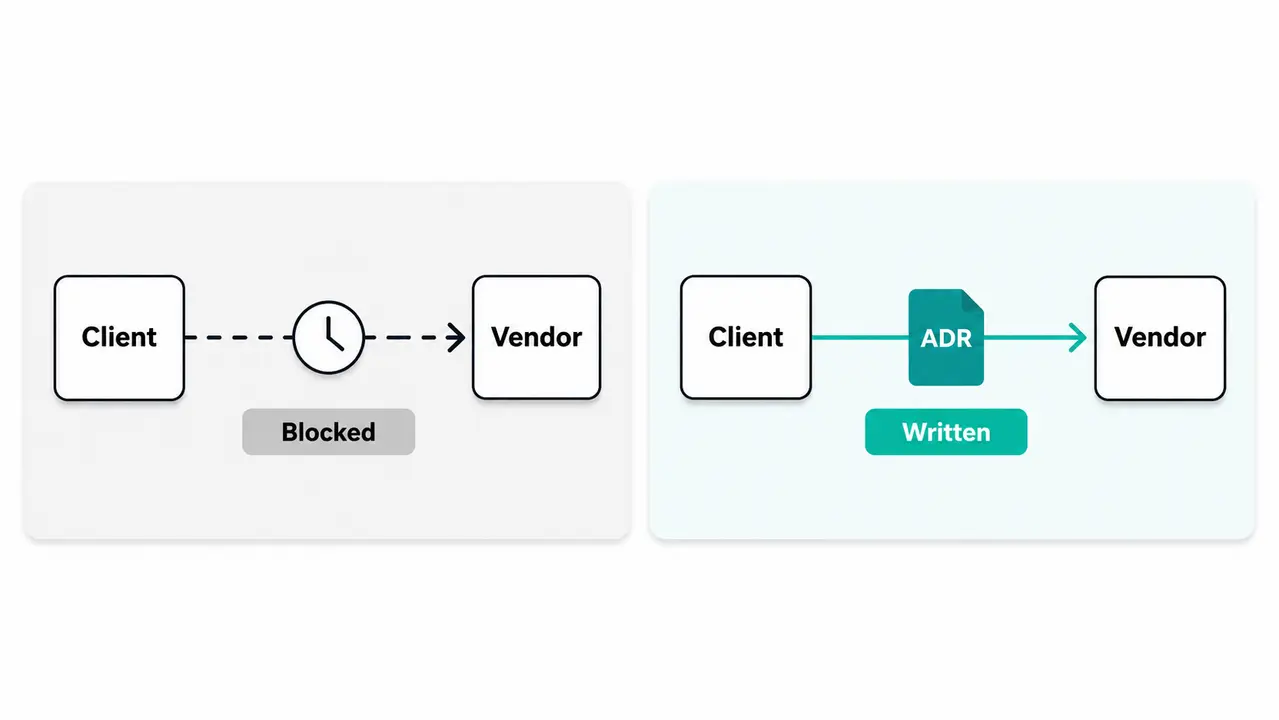
Distance is a solved problem. Undocumented decisions are not. When every architectural call is made verbally in a synchronous meeting, a six-hour offset turns into silent blocking, sprint churn, and engineers waiting half a day for an answer that should have been written down once.
The control structure is small. One channel for blockers, with a named triage owner who clears it on a fixed schedule. One weekly architecture sync during the overlap window, with decisions recorded as ADRs. Escalation paths that name people, not teams. Eurostat reports that in 2024 more than 10 million people were employed as ICT specialists across the EU, 5.0% of all employed people, so distributed engineering across borders is simply the operating reality now (Source: Eurostat).
Teams that run on written decisions barely notice the time difference. Teams that run on meetings feel every hour of it.
Embedded and systems work adds hardware to the risk list
Outsourcing firmware and driver work fails when it is governed like web development. The iteration loop includes physical objects: test fixtures, devices in the field, hardware-in-the-loop rigs. A blocked sprint in web work means a question unanswered. A blocked sprint in embedded work often means a shipment of devices that did not arrive.
Settle the physical questions before a line of driver code is written. Who owns the test fixtures and where do they physically sit? How are logs captured from devices in the field, and who can pull them? How is a reported field failure reproduced and by whom? Answering these after development starts means paying for the answer twice.
Our system and embedded engineering work runs on this discipline because the hardware does not forgive process gaps. Device cycles are measured in weeks. Web sprints can absorb a broken process. Hardware cannot.
Integration risk concentrates at the boundaries
Late-stage failures rarely happen inside a component. They happen between components, between services, between your code and the vendor’s code, between the firmware and the cloud backend. Two teams each test their side. The seam between them is tested by nobody.
The deadlock has a script. “It works on our side.” Both teams are correct. The API contract they each implemented exists only in their heads, and the heads disagree about null handling or error semantics.
Assign an explicit interface owner for every integration boundary, a named person responsible for the contract, not a team. Enforce schema versioning from the first integration. Add consumer-driven contract tests in the CI pipeline so a producer breaking a consumer fails the build, not the deployment. Interface ownership is an operational readiness checkpoint: no named owner, no integration work starts. This single rule removes more late-stage risk than any amount of end-to-end testing added afterward.
Governance that scales without reading every pull request
Effective governance gives you visibility and predictable outcomes without daily supervision. It runs on cadences and artifacts, not on technical leadership reviewing everything personally. A CTO reading every pull request is not governance. It is a bottleneck with a job title.
The working minimum is two meetings and one register. A weekly risk review, thirty minutes, focused on blockers and the current top three risks. A monthly architecture review covering defect trends, the tech debt register, and whether ADRs are being written. The register itself, kept in Confluence or the wiki, so debt is tracked as data rather than remembered as grievance.
Define what each sprint must demonstrate beyond completed features: updated documentation, tests covering the new paths, a deployable increment. Micromanagement scales badly. Cadences scale. A team that knows the monthly architecture review will inspect the debt register behaves differently in week one, without anyone watching.
Early warning signals you can read by sprint two
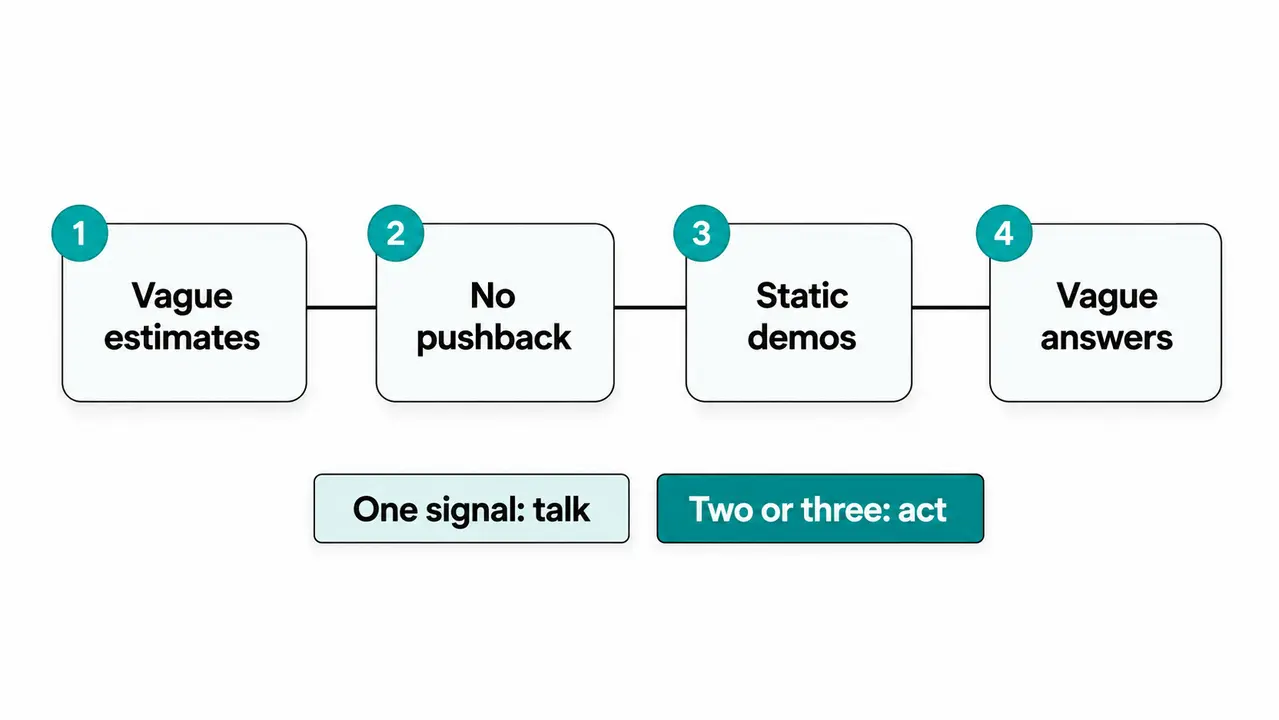
Outsourcing projects rarely fail suddenly. They leak signals in the first two sprints, and the signals are behavioral rather than technical. Review them explicitly in retrospectives before momentum and sunk cost make the conversation expensive.
Estimates that are always vague, given as ranges without decomposition or questions. A vendor that never pushes back on unclear scope, which means ambiguity is being stored for later, not resolved. Missing demos, or demos of static screens instead of running software. Questions about production that get answered with reassurance instead of specifics.
Each one alone might be nothing. Two together by sprint two warrant a direct conversation. Three warrant a structural response, because they indicate a seniority gap on the vendor side that no amount of process can compensate for. Discovering the architecture was built by juniors after deployment is attempted costs ten times what the sprint-two conversation costs.
Frequently asked questions
Is outsourcing risk higher for startups than enterprises?
Yes, structurally. Startups usually lack the spare engineering capacity to monitor an external team, so weak controls go undetected longer. An enterprise with a platform team and a security function catches the same failures in week two.
What should I keep in house even if I outsource most development?
Keep product ownership, architecture authority, and release approval. Whoever owns those three owns the system’s direction. Everything else, including most implementation, can sit outside if the controls in this article are in place.
What documents should exist before I sign anything?
A shared definition of done, an access matrix draft, a decision-rights matrix naming approvers for architecture and releases, and an IP clause that requires all work to land continuously in your repositories. The contract should reference these documents, not replace them.
How do I evaluate a vendor’s seniority without a long trial?
Give their proposed team a real design problem from your domain and review their written answer. Senior engineers ask about constraints and tradeoffs. Juniors accept the problem as stated and start listing technologies.
What if the vendor refuses repository and cloud ownership controls?
Treat it as a disqualifying signal. A partner confident in its delivery wants you to hold the keys, because continuous delivery into your systems protects both sides. Refusal usually means lock-in is part of the business model.
Can I outsource security sensitive components safely?
Yes, with an access matrix, time-boxed credentials, audit logging, and secrets management under your control, aligned with NIST SP 800-218 practices. The exposure is in access design, not in the nationality of the engineers.
The next step is a two week risk reset
Before scaling any external team, run a two week setup phase that establishes ownership, access, delivery gates, and documentation. The minimal outputs are an access matrix, a shared definition of done, initial architecture decision records, CI gates that block bad merges, and a scheduled takeover drill date on the calendar. Sentice structures these exact engineering controls into every engagement from day one, so control is never something you negotiate back later. Six artifacts, two weeks, and the risk profile of the next two years changes.
Run your risk reset with engineers who build this way by default
Tell us about your roadmap and we will walk through your current delivery controls, from repository ownership to release authority, in a single working session.
About Sentice

Sentice is a boutique software engineering partner founded in 2013 by Roni Levi and Martin Petkovic, now headquartered in Skopje, North Macedonia. Rather than supplying individual developers, we build embedded teams that blend with a client’s culture, tech stack and goals, working together from a single office under our own technical leadership. We deliver dedicated software engineering teams, end-to-end software solutions, product development, and system and embedded engineering, and we act as technical advisors across the full development lifecycle, from specification and architecture through development, testing and support. We use AI coding tools across every project, and we help clients integrate AI into their own products through chatbots, MCP services, connected application layers and workflow automation. Some of the clients we started with more than a decade ago are still building with us today.