
The vendor you picked demos beautifully. Six weeks later your lead engineer spends every afternoon unblocking them, and the backlog has moved sideways. That is the moment most teams realize they evaluated the wrong things. Learning how to choose outsourcing partner is not a procurement exercise. It is an engineering decision about how much execution risk you are willing to move off your own org chart, and onto someone else’s delivery system. Below, we’ll unpack what you are really selecting for, when outsourcing is the wrong move, how to test vendors on evidence rather than polish, and the contract and governance terms that keep quality stable after month two.
Reading time: 14 min
Key points
- Evaluate a vendor as a delivery system, not a portfolio: who owns architecture, who runs cadence, who owns production quality.
- Outsourcing fails without an internal product owner and a technical owner, plus roughly 10 hours per week of governance from your side.
- For evolving products, a dedicated team with shared rituals outperforms both pure augmentation and fixed-scope handoff.
- Demand verifiable evidence of production operation: postmortems, release notes, and a paired code review before you commit.
Table of contents
The decision you are actually making when you outsource engineering
Most selection processes read like hiring. You screen resumes, run interviews, and pick the team with the shiniest portfolio. That process selects for presentation, and presentation does not ship your product. When we help teams define their outsourcing criteria, we push them to evaluate the vendor as a delivery system: how quality stays predictable under pressure, how throughput is measured, and who answers when production breaks at 2 a.m.
Decide three things before you talk to a single vendor. Who owns architecture decisions. Who runs the delivery cadence. Who owns production quality. A vendor who cannot answer those three questions clearly will answer them by default, and the default is you, at midnight, in a war room.
The teams that succeed treat the external group as an integrated engineering system aligned with internal goals, not a ticket factory. If you are weighing internal expansion against external capacity, our piece on scaling smart a strategic guide in-house expansion outsourcing partnerships breaks that tradeoff down in detail. The failure mode is predictable: a generic ticket factory creates internal bottlenecks that eat every hour you saved.
When outsourcing is the wrong move for your team
Outsourcing fails in specific, repeatable situations. The work is inseparable from internal context nobody has written down. Core algorithm R&D with no specs. Highly political internal rewrites where every technical decision is really an org decision. Salvage missions for failing projects where leadership wants rescue in six weeks and discovery alone would take four. In those cases, external engineers become expensive witnesses to your internal dysfunction.
The hard gate is internal ownership. If you cannot name an internal product owner and a technical owner today, pause the engagement. Plan for roughly 10 hours per week of active technical governance and product clarification from your side, every week, for the life of the engagement. That is the minimum commitment that keeps decisions moving.
Skip that commitment and the failure arrives on schedule. The external team waits on approvals, your internal team resents the interruptions, momentum drains, and everyone blames the vendor. The vendor was never the problem. The missing owner was.
Writing a one page scope that vendors cannot misread
A one page scope beats a ten page narrative. The narrative invites vendors to fill gaps with assumptions. The one pager forces alignment on outcomes, constraints, and what done means, before proposals start shaping the conversation. For outsourcing vendor selection, this document is your first filter: watch how each vendor reads it, questions it, and pushes back on it.
List the artifacts you provide on day one. An architecture diagram. A backlog snapshot. API contracts. Hardware constraints if the work touches devices. Then write down target users, the top three workflows, explicit non-goals, integration points, environments, and the acceptance criteria style you expect, meaning test-based, demo-based, or checklist-based.
The non-goals section does the most work. It is the line that stops a vendor from quietly assuming you also want the admin panel rebuilt. Fixed assumptions built on incomplete narratives are what explode in sprint two. Scope creep is rarely malice. It is usually two teams who read the same paragraph differently in week one.
The engagement model that matches your risk profile
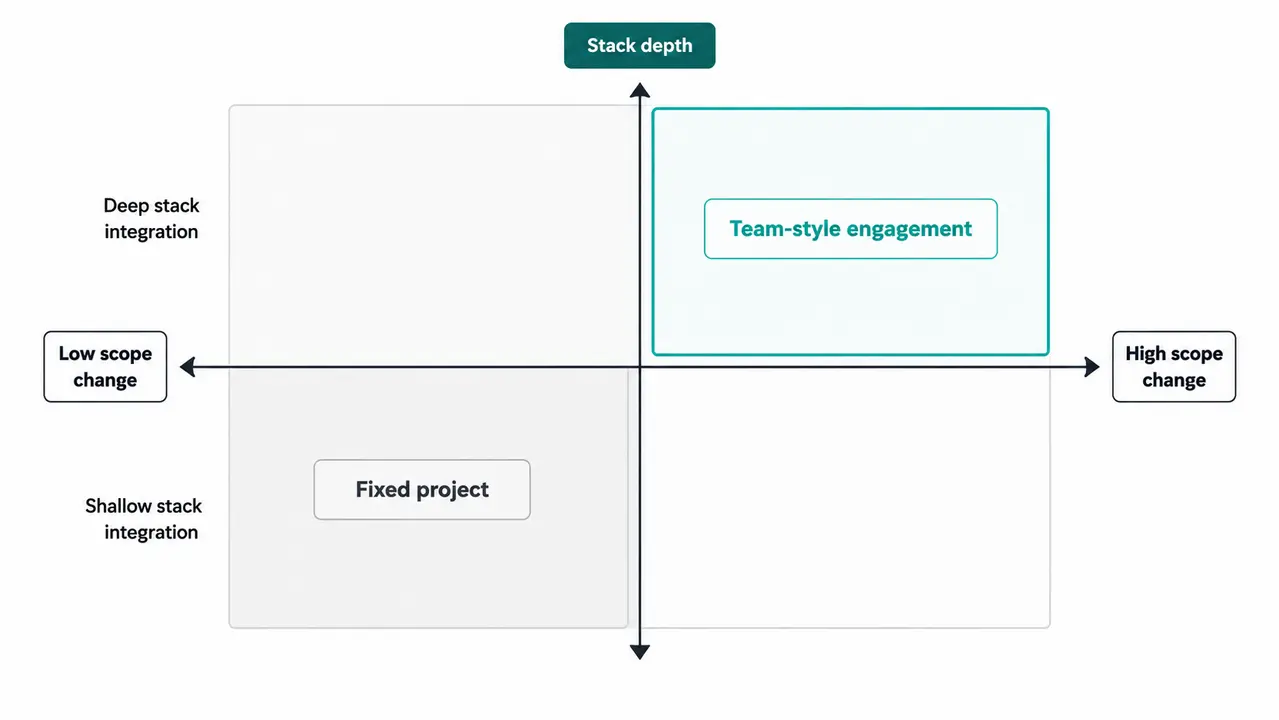
Choose the model from two variables: how much your scope will change, and how deep the team must work inside your stack. High uncertainty plus deep integration means you need a team-style engagement with a shared cadence, not a fixed-scope handoff. Low uncertainty plus clean interfaces can work as a project.
When evaluating dev partners, test their flexibility across models rather than their loyalty to one. A vendor who only sells staff augmentation will push augmentation at your R&D problem. A vendor who only sells fixed projects will push fixed scope at your evolving product. Read the decision signals honestly: backlog maturity, internal tech leadership bandwidth, and release frequency. Mature backlog and thin internal leadership points to end-to-end delivery. Immature backlog with strong internal leadership points to augmentation. Most scaleups land in the middle, where dedicated software engineering teams with a shared sprint cadence and shared rituals outperform both extremes.
For evolving products, pure project handoff is the weakest choice. It pushes change management into contract friction instead of engineering workflows, and every pivot becomes a negotiation.
How the three engagement models compare
Compare models on control, onboarding load, accountability, and continuity. The best model is the one that keeps engineering decisions close to your product reality, which usually means the dedicated team for anything longer than a quarter.
| Dimension | Staff augmentation | Dedicated team | End-to-end delivery |
|---|---|---|---|
| Architecture decisions | You own fully | Shared, you hold veto | Vendor owns, you approve |
| Onboarding load on you | Highest | Moderate | Lowest |
| QA responsibility | You own | Shared, defined in CI gates | Vendor owns |
| Communication path | Through your leads | Direct, shared rituals | Through vendor PM |
| Documentation expectation | Your standard | Joint standard, reviewed | Vendor standard, contractual |
| Continuity after exit | High, work is in your repo | High with handover clauses | Depends on contract terms |
Whatever model you pick, some things stay internal. Product decisions, security approvals, and production access remain inside your organization in all three columns. Ambiguity here is what turns a production incident into a finger-pointing exercise, because nobody agreed beforehand who pages whom and who owns the fix. Write the accountability boundary down before kickoff, not during the outage.
Separating domain experience from buzzword familiarity
Every vendor claims experience in your domain. The test is whether they can anticipate edge cases and constraints before you write them down. Buzzword familiarity shows up as generic answers, borrowed architecture diagrams, and case studies that never mention a single hardware limitation. Domain experience shows up as questions. Ask for a breakdown of a similar problem and the tradeoffs they chose, and listen for specifics: memory limits on the target device, timing constraints on the control loop, OTA update strategy, field diagnostics when the device has no network.
We tell teams evaluating Sentice for systems work to apply exactly this test to us, because deep systems work is where generic vendors are exposed fastest. If you are assessing hardware and software integration capability specifically, review the partner’s system and embedded engineering track record against concrete constraints, not brochure language.
The failure mode is expensive. Hardware or regulatory constraints discovered after the architecture is set force a redesign, and redesigns at that stage cost you a quarter or more.
Evidence of shipped work that you can verify
Portfolios are marketing artifacts. You need proof of production operation. Ask for an anonymized architecture overview of a system they run or ran, a pattern of release notes showing sustained delivery, a sample incident postmortem, and a test strategy outline. A team that has operated live systems produces these documents without hesitation, because postmortems and release notes are routine for them. A team that has only built prototypes will send you slide decks instead.
Reference calls matter, but only with the right prompts. Skip satisfaction scores. Ask the reference about the two weeks after a major scope change. Ask what happened during their worst production incident and who was on the call. Ask what the vendor did when they disagreed with the client’s technical direction.
The failure you are preventing is specific: a team that demos well during sales and collapses under real user load. Demos are rehearsed. Incidents are not. The postmortem document tells you more than the entire pitch deck.
A practical way to assess code quality before you commit
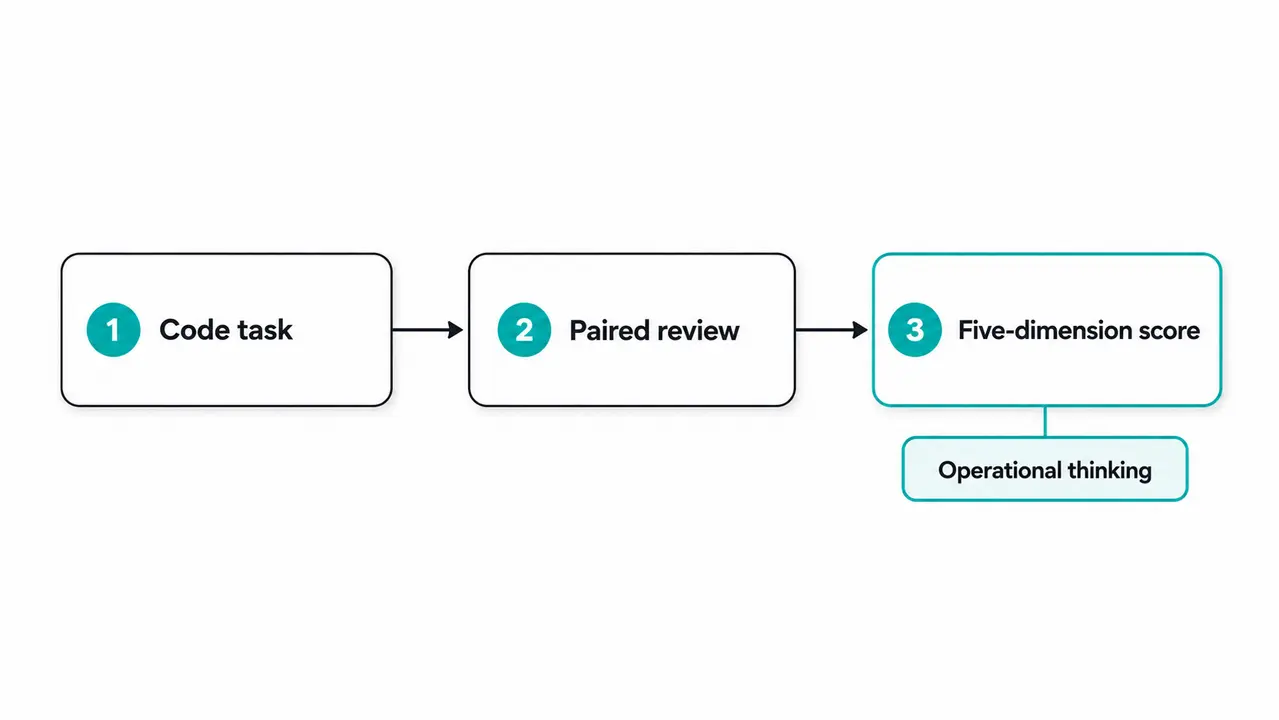
Run a small technical due diligence that mirrors your real workflow. A short take-home task aligned to your stack, or a paired code review session over video, reveals more than any interview loop. Score on five dimensions: correctness, testability, readability, security posture, and operational thinking. Operational thinking is the one teams forget, and it is the one that matters most. Does the candidate ask what happens when the service restarts mid-write?
Our favorite exercise: give them a specific module from your actual codebase, thirty minutes to read it, then ask for three improvements. Strong engineers propose changes that fit your constraints. Weak ones propose rewrites that ignore them.
Use GitHub Actions or GitLab CI in the exercise so you see how they reason about pipelines, not just code. The failure mode this prevents is discovering quality gaps after the codebase has grown and technical debt has compounded past the point where anyone wants to touch it. Two hours of diligence up front saves two quarters of remediation.
The week a senior engineer disappears after kickoff
The pitch team is never the delivery team. The architect who walked you through the proposal gets reassigned the week after signing, and day-to-day work falls to people you never met. In many big outsourcing arrangements this is standard practice, not an accident. Protect against it contractually.
Contract for named roles, not headcount. Require the lead engineer to attend sprint planning, code reviews, and architecture decisions for the first month, by name, in the statement of work. During evaluation, look for continuity signals: stable team composition across their existing clients, a clear escalation path, visible technical leadership, and a documented onboarding plan for replacements. A vendor with a real replacement process will show you the document. A vendor without one will describe the concept.
The failure mode is knowledge concentration. One senior resource holds the architecture in their head, leaves after the contract closes, and delivery collapses in the same week. Continuity is a system property, not a personality trait.
Communication that survives time zones and high stakes releases
Good communication is measurable, and if a vendor cannot describe it in measurable terms, treat that as data. You want short feedback loops, written decisions, and predictable response times during incidents and releases. “We are very responsive” is not a communication model. A documented escalation ladder with named roles and response windows is.
Design a sample weekly cadence before signing. Define overlap hours, four is a workable minimum for most teams. Agree on an async status format, a mid-sprint risk check, and the escalation ladder itself. Set explicit expectations for decision logs, so every architecture call is written down within a day, and daily updates, so async work stays visible without you asking.
Tools matter less than discipline. Slack plus Confluence works. Teams plus a shared wiki works. What fails is the silent drift, where everything appears fine until the deadline arrives and the deliverables are missing or incompatible with your stack. Written decisions are the antidote to drift, because drift cannot survive a decision log.
Security and access control without slowing engineers down
Treat the partner as an extension of your organization, with least-privilege access and auditable workflows from the first day. Security designed into onboarding costs a few hours. Security bolted on after credentials sprawl costs an incident. More than 1 in 5 EU enterprises, 21.54%, experienced ICT security incidents with consequences in 2023, according to Eurostat, and third-party access is a recurring contributor.
Build an onboarding checklist before kickoff: accounts, repository permissions, CI access, logging visibility, and incident reporting channels. Enforce SSO and role-based access across everything, including the tools teams forget, like the container registry and the secrets manager. Rotate tokens on a schedule, not on a crisis.
For verifying vendor SDLC maturity, use the NIST Secure Software Development Framework as your baseline checklist. Ask the vendor to map their practices against it. The failure mode is uncontrolled access sprawl: unclear breach liability, compliance exposure, and a cleanup project nobody budgeted for.
IP ownership and handover readiness from day one
Handover is not a phase at the end of the engagement. It is a continuous practice that shows up in documentation, test coverage, and how decisions are recorded, starting in week one. The contract should state that you own the repositories, the CI configuration, and all deliverables, and that ownership should be reflected in reality: your org owns the GitHub org, your company holds the cloud accounts.
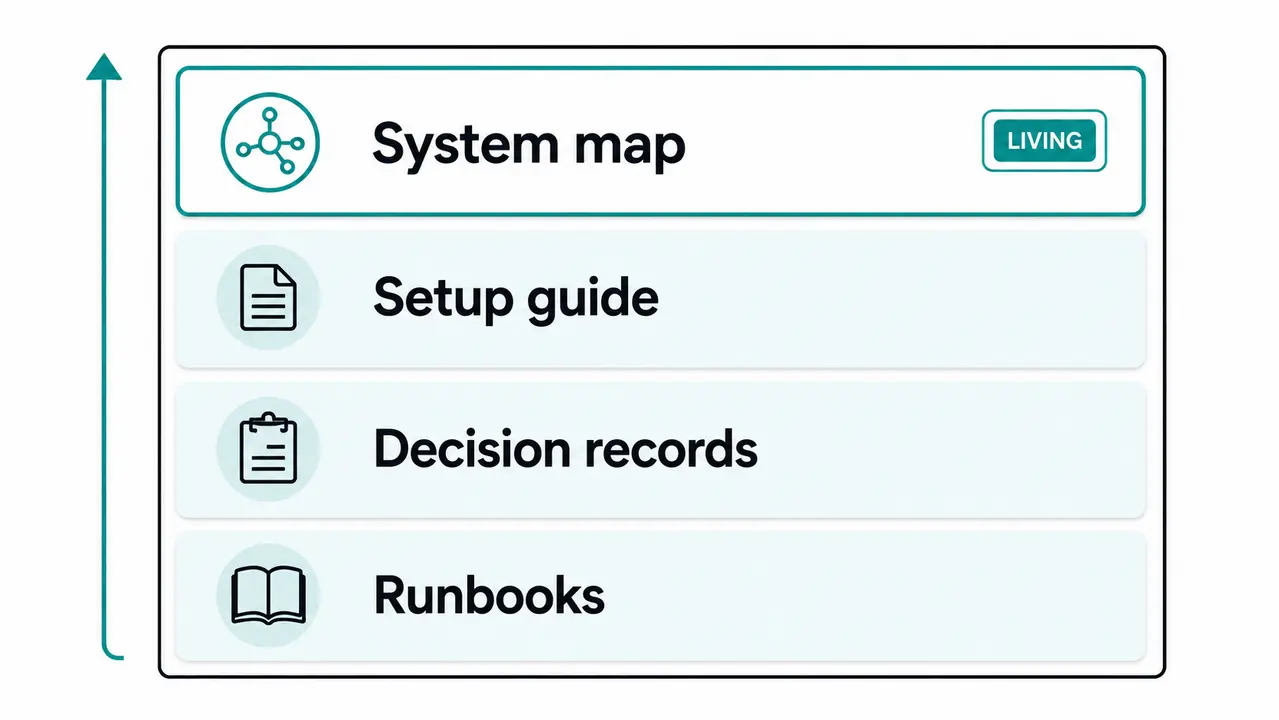
Require two artifacts as standing deliverables. A living system map, updated as the architecture evolves. A setup guide that gets a new engineer productive within two hours, including build reproducibility and environment setup standards. If a new internal hire cannot build the system from that guide, the guide is fiction.
Architecture decision records and runbooks belong in the engagement from the start, not in a final handover document assembled in the last sprint. The failure mode is vendor lock-in through tribal knowledge, where switching partners or bringing the work in-house becomes impossible without a rewrite. Documented systems keep you free to choose.
Onboarding that does not consume your best engineers
The hidden cost of a new external team is the internal team that stops shipping to babysit it. If your senior engineers spend three weeks as full-time orientation guides, you did not add capacity. You moved it. The right partner reduces onboarding load by arriving with structure: a discovery plan, an environment setup sequence, and first deliverables chosen to build shared context fast.
Target specific outcomes for the first two weeks. A clarified backlog with ambiguities surfaced. A risk register with the top five technical risks named. Environment parity, meaning an external engineer can run the full stack locally. First small pull requests merged into your mainline, not a feature branch that lives forever.
Structure onboarding in two tracks, product context and technical context, run in parallel. Product context covers users, workflows, and why the roadmap looks the way it does. Technical context covers the stack, the pipelines, and the definition of done. Two tracks prevent the default failure, where your best engineer becomes a full-time teacher and your roadmap slips a month.
Delivery governance that keeps quality stable after month two
Quality decays gradually, then suddenly. Month one is all best behavior. Month three is where shortcuts surface, and velocity charts still look fine while defect escape rates climb. Governance is how you catch the decay early. Global project risk governance practice, as described in World Bank guidance on project monitoring, is built on continuous monitoring of leading indicators rather than assumptions that early plans hold. Apply the same principle to your engineering engagement.
Track lead time, PR review time, defect escape rate, and test flakiness on a visible dashboard. Review them monthly with the vendor’s lead, not just your own leads. Define your definition of done and encode it as quality gates in CI: tests green, coverage threshold met, lint clean, security scan passed.
Decision rights need the same treatment. Who can merge to main, who approves a schema change, who declares an incident. Velocity on paper means nothing until production breaks under real user load and edge cases.
Running a pilot that predicts the real engagement
Most pilots are too synthetic to reveal anything. A greenfield demo project with no legacy constraints, no production adjacency, and no real stakeholders tests nothing except the vendor’s ability to build throwaway software. A good pilot tests collaboration and engineering judgment under conditions that resemble the engagement.
Good pilot shapes are specific. Integrate one real API into your existing system. Add one device capability behind a feature flag. Refactor one risky module and bring it under test coverage. Each of these forces the vendor through your actual workflow: your repo, your review process, your CI, your release constraints.
Set exit criteria before the pilot starts, across five dimensions: quality of the delivered work, communication clarity, delivery predictability against the estimate, documentation produced, and the ability to absorb critical feedback without defensiveness. Score against those criteria in writing. The failure mode is a pilot too fake to expose operational risk, which buys you a false sense of security and a full rollout of an untested working relationship.
Scoring vendors with a decision matrix your team will trust
Selection by charisma is the default, and charisma is uncorrelated with delivery. A weighted scorecard makes the decision explainable to engineering and to leadership, which matters when someone asks why you chose vendor B six months from now.
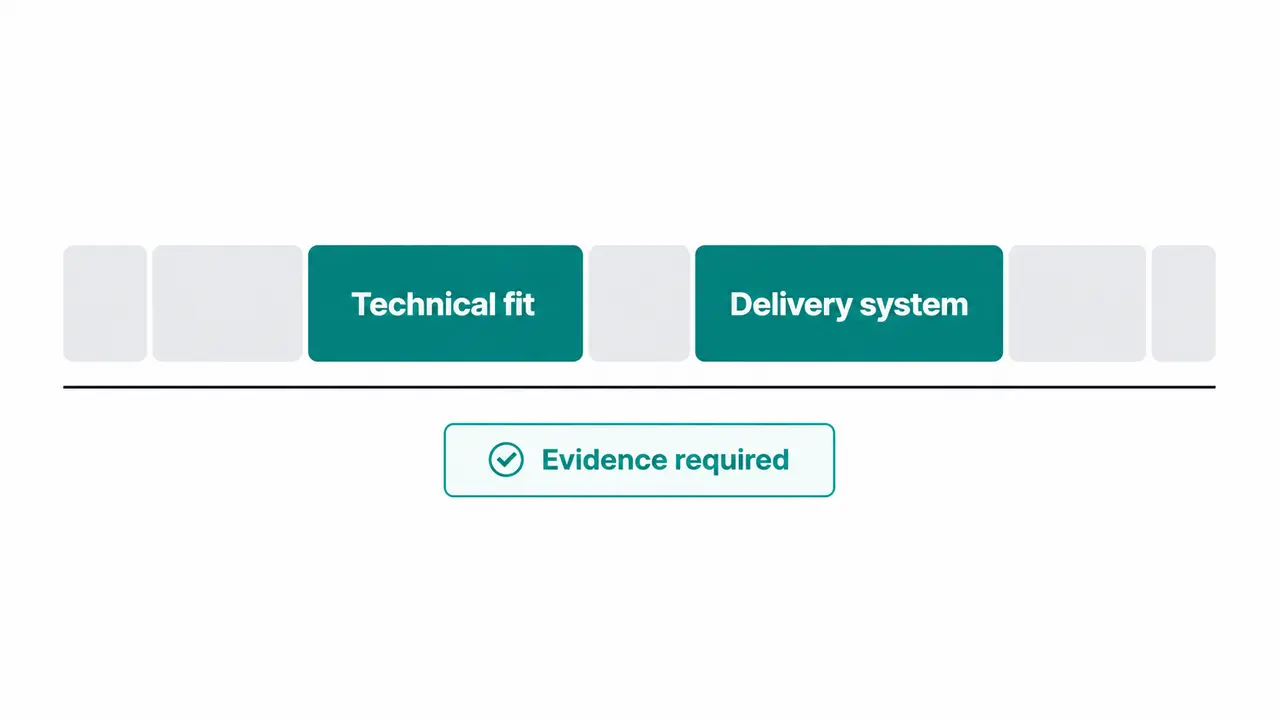
Score seven categories: technical fit against your stack, domain fit, delivery system maturity, security posture, communication quality, team continuity, and handover readiness. Weight the categories that predict delivery, not the ones that reward presentation polish. Technical fit and delivery system deserve the heaviest weights. Slide design deserves none.
The rule that makes the matrix credible: every score requires concrete evidence attached to it. A code sample, a document, a reference call note, a CI configuration you inspected. No evidence, no score. Opinions in a scorecard are just charisma with a spreadsheet wrapped around it. Run the scoring with the same panel that will govern the engagement, so the people who chose the vendor are the people accountable for making it work.
Contract and SOW terms that protect delivery quality
The contract is an engineering document, or it should be. Most disputes we have seen between clients and vendors trace back to acceptance criteria nobody defined and operational responsibilities nobody assigned. Encode the working rules that keep engineering healthy: scope boundaries, change handling, acceptance criteria, and who does what when production misbehaves.
Mandate specific artifacts in the statement of work. A documentation set maintained throughout. Runbooks for operational components. Test expectations per deliverable. Clear release process ownership, meaning who executes the release, who signs off, who rolls back.
Cover the standard terms: definition of deliverables, the review and acceptance process with realistic windows, ownership of repositories and CI, incident responsibilities and response expectations, confidentiality, IP assignment, and termination transition assistance with a defined notice period. The termination clause matters most. A vendor who knows the exit is documented and orderly has one less reason to hold your system hostage, and you have a clean path when the relationship has run its course. Vague acceptance criteria turn engineering discussions into legal negotiations, and legal negotiations ship nothing.
Turn your shortlist into a decision
If you want a partner who welcomes the postmortem, the paired code review, and the named-role contract, we are happy to go through all three with you.
Frequently asked questions
How many vendors should we shortlist before deep technical evaluation?
Shortlist three to five vendors. A larger pool dilutes engineering focus during technical due diligence, and your senior engineers burn days on paired reviews and code exercises that produce no real signal. Three strong candidates create genuine competitive pressure without turning evaluation into a second job for your team.
Who should be on the selection panel from our side?
Include a technical lead, a product owner, and a security or IT administrator. The technical lead assesses engineering capability, the product owner tests alignment on outcomes, and the administrator covers governance, access, and compliance angles. Skipping the security role is the common mistake, and it surfaces later as an onboarding scramble.
What is the best way to validate English communication for engineering work?
Run a paired debugging session or a mock sprint planning meeting. Standardized test scores do not predict clarity in async written updates or during an incident call under pressure. A thirty-minute joint session on a real problem reveals how they explain tradeoffs, ask questions, and disagree politely.
What should we ask to confirm they can work in our repo and CI safely?
Request their standard onboarding workflow for Git permissions, branch protection rules, and CI access controls. Ask how they manage secrets, how they rotate access tokens, and what their offboarding checklist looks like when an engineer leaves a project. A vendor with answers ready has done this before.
How do we evaluate a partner for embedded plus cloud integration work?
Ask for a system architecture diagram showing device-to-cloud data flow, and interrogate it. Question their approach to OTA updates, edge constraints like memory and power budgets, and offline synchronization behavior. A vendor who cannot sketch the failure modes of intermittent connectivity has not shipped this kind of system.
What should we do if we inherit a messy codebase from a prior vendor?
Mandate a two-week stabilization sprint before any new features. Focus the sprint on test coverage for the riskiest paths, documentation of what actually exists, and CI pipeline integrity. Adding features on top of an unverified foundation compounds the problem you inherited.
The next step after you pick a partner
Treat the first month as relationship engineering, because the habits set in week one persist for the life of the engagement. Schedule a joint discovery workshop, agree on a definition of done in writing, and set up CI quality gates before the first pull request lands. Publish a two-week delivery plan with named owners on both sides, then hold the first cadence review on schedule. The teams that start this way rarely need to reset.
About Sentice

Sentice is a boutique software engineering partner founded in 2013 by Roni Levi and Martin Petkovic, now headquartered in Skopje, North Macedonia. Rather than supplying individual developers, we build embedded teams that blend with a client’s culture, tech stack and goals, working together from a single office under our own technical leadership. We deliver dedicated software engineering teams, end-to-end software solutions, product development, and system and embedded engineering, and we act as technical advisors across the full development lifecycle, from specification and architecture through development, testing and support. We use AI coding tools across every project, and we help clients integrate AI into their own products through chatbots, MCP services, connected application layers and workflow automation. Some of the clients we started with more than a decade ago are still building with us today.