
The backlog grew 40 percent last quarter and your hiring pipeline produced one signed offer. That gap is the actual problem, and it arrives at every startup that ships faster than it recruits. You can wait out the pipeline, or you can buy senior execution now and build the org chart in parallel. Software outsourcing for startups is the mechanism for the second path, and it works when you treat it as added execution rather than delegated judgment. We have run both sides of this arrangement since 2013, and the difference between the engagements that compound and the ones that collapse is rarely talent. It is structure. This guide covers the structure.
Reading time: 13 min
Key points
- Outsource execution, never product judgment: strategy, architecture guardrails and acceptance criteria stay internal.
- The engagement model decides the failure mode: scope volatility breaks project delivery, missing leadership breaks augmentation, governance neglect breaks embedded teams.
- A preparation week before kickoff is the cheapest week you will buy; most engagements stall in week one, not month three.
- Put exit requirements in the contract at signing, when you still have leverage.
Table of contents
The moment adding engineering capacity becomes the rational choice
External help makes sense when delivery speed and senior execution outweigh the time required to build a full internal org chart. The arithmetic is simple. A senior backend hire takes months to source, interview, notice-period and onboard, and your roadmap does not wait. Demand keeps climbing too, with Eurostat reporting that in 2025, 10.45 million people were employed as ICT specialists across the EU, representing 5.0% of all employed people.
The trigger point looks like this: backend services, a mobile release, DevOps hardening and QA coverage all due in one quarter, with two engineers available. Adding a team that has already worked together closes that gap in weeks.
The failure mode is real. Teams that outsource to replace product judgment, rather than add raw execution speed, get exactly what they asked for and nothing they needed. Judgment stays with you. Speed is what you buy.
The work that must stay inside your company
Whoever writes the code, three things stay internal: product strategy, architecture guardrails, and acceptance criteria. An external development team can propose, prototype and even challenge decisions, but the decisions themselves belong to people whose entire incentive is your company’s success.
The mechanism is written artifacts, not meetings. Architecture Decision Records capture why the system looks the way it does. A definition of done sets the bar every pull request must clear. Release gates decide what ships and when. When these documents exist and are owned internally, an external team executes inside guardrails you can audit.
When they do not exist, competitive advantage decisions get delegated by default. Nobody notices until month nine, when the codebase reflects a vendor’s convenience rather than your business model, and long-term maintainability has quietly degraded. That remediation costs more than the engagement saved. Keep the pen. Hand over the keyboard.
Where early-stage teams lose the first month
Most engagements do not fail in month three. They stall in week one, because the startup cannot provide domain context, environments and decision access fast enough. The external engineers arrive ready and spend their first sprint waiting.
The checklist is unglamorous and absolute. Repository access with correct branch protections. A CI pipeline that runs on every push. A staging environment that mirrors production closely enough to trust. A secrets handling process, ideally through a vault or at minimum scoped, rotated credentials rather than a shared spreadsheet. And one named person on your side who can answer domain questions within a day.
When any of these are missing, the first sprint becomes setup work. Worse, the external team improvises workarounds that drift from your intended setup, and the drift stays invisible until it breaks something in month two. Budget a preparation week before the engagement starts. It is the cheapest week you will buy.
Three engagement models and what breaks in each
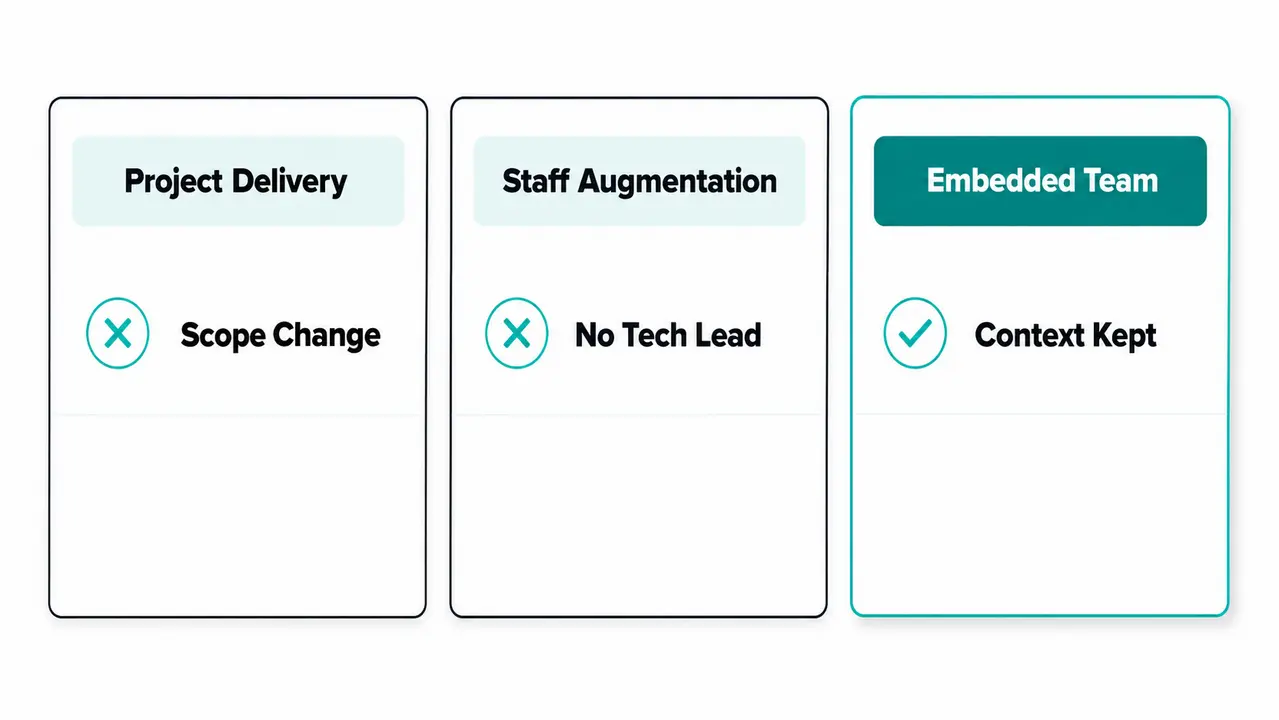
Project delivery, staff augmentation and embedded dedicated teams fail in different ways, which is why choosing the wrong one guarantees friction regardless of vendor quality. Scope volatility breaks project delivery. Missing technical leadership breaks augmentation. Governance neglect breaks embedded teams.
This table summarizes the decision:
| Dimension | Project delivery | Staff augmentation | Embedded dedicated team |
|---|---|---|---|
| Best fit | Stable, bounded scope | Existing internal lead | Shifting roadmap |
| Primary failure mode | Midstream direction change | No daily technical direction | Governance drift without owner |
| Ramp time | Longer, needs full spec | Short, needs your process | Medium, builds domain knowledge |
| Scope flexibility | Low | Medium | High |
| Your management load | Low until acceptance | High, daily | Medium, weekly cadence |
The verdict is straightforward. Embedded teams outperform when scope changes weekly, because the team carries context across pivots. Pure project delivery breaks under that same volatility, and no contract clause fixes it.
Project delivery when scope is stable
Bounded outcomes with clear acceptance tests and minimal dependencies fit project delivery well. A payment reconciliation module, an internal reporting tool, a hardware integration with a fixed protocol. These have a defined finish line, and a vendor can be held to it.
The contract needs four concrete artifacts. A fixed deliverable description. An integration contract, ideally an OpenAPI specification both sides sign off on. A test plan defining what acceptance means in executable terms. A release checklist covering deployment, rollback and monitoring handover.
The failure mode is treating an MVP like a fixed project. An MVP is a learning instrument whose direction changes after every user conversation. Sign a fixed-scope contract around one and you will either pay for change orders weekly or watch the vendor quietly stop raising risks. We have inherited the wreckage of both. Project delivery suits the stable 30 percent of your roadmap. Use it for that.
Staff augmentation when technical leadership exists
Startup outsourcing through staff augmentation fits one specific condition: an internal tech lead who sets standards and reviews code daily. That person defines the sprint plan, owns the review queue and makes the architecture calls. The augmented engineers are hands. The brain stays in your building.
When the internal lead exists and has review bandwidth, augmentation is the fastest model to start. Engineers join your standups, your board, your definition of done, usually within two weeks.
When that lead does not exist, or is stretched across eight initiatives and reviews pull requests every third day, augmentation fails predictably. Unreviewed code accumulates, standards fragment, and each engineer interprets quality privately. Six months later you discover three logging conventions and no test strategy. Augmentation without daily technical direction is not a team. It is headcount. Buy it only when someone on your side can steer it every single day.
Embedded dedicated teams for moving roadmaps
When priorities shift weekly and the product needs accumulated domain knowledge, embedded teams win. A stable group that has shipped four releases together carries context no onboarding document can hold. They know why the billing service looks strange. They remember the incident that shaped the retry logic.
Three practices make embedding work. Stable team composition, so the same engineers stay across sprints rather than rotating per ticket, which is exactly what our dedicated software engineering teams model is built around. A shared sprint cadence, with your product owner in the planning session. Weekly demos and joint retrospectives, so course corrections happen at sprint boundaries instead of quarter boundaries.
The failure mode is the opposite arrangement: rotating contractors who never learn the product. Each rotation resets context to zero, and you pay onboarding costs forever while domain knowledge evaporates on exit. Continuity is the entire point. Without it, you have augmentation with extra steps.
Not sure which model fits your roadmap?
A short conversation about your scope volatility, internal leadership and delivery pressure is usually enough to narrow it to one.
Documents that maintain control without micromanaging
You cannot attend every standup of a team you did not hire, and you should not try. Written artifacts do the controlling for you. They create clarity, reduce meeting load, and leave an audit trail of what was decided and when.
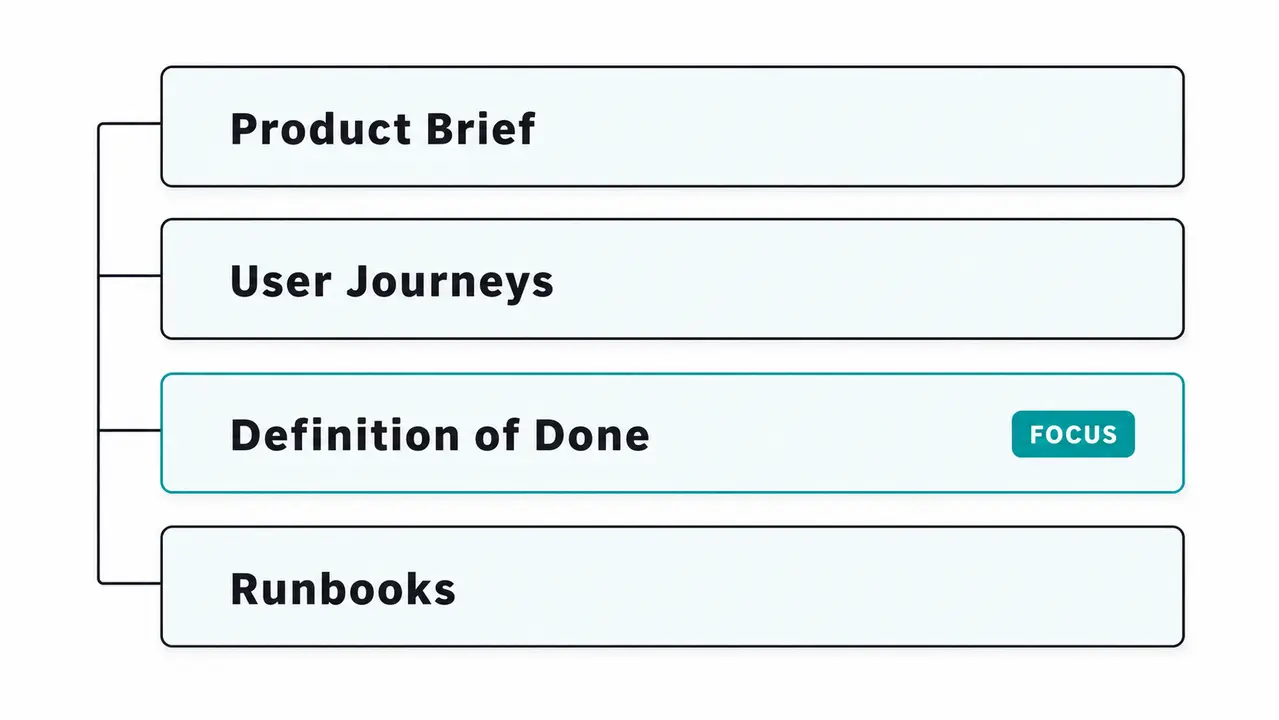
Four documents carry most of the weight. A one-page product brief stating the problem, the user and the success measure, written before any code. User journey notes mapping the paths that must work. A definition of done, owned by you, covering tests, review and documentation. Runbooks for anything that will page someone at night.
The failure mode these prevent is the rework loop. An unspoken assumption enters a sprint, ships silently, and surfaces six weeks later as a rewrite. The team says the requirement was ambiguous. You say it was obvious. Both are right, which is the problem. Written assumptions are cheap. Verbal ones compound.
Evaluating a startup software partner before signing
Sales processes and delivery benches are different departments, and the first tells you nothing about the second. Before signing with any startup software partner, test how their team thinks, writes and reviews code under real constraints.
Three tests separate the two. Meet the delivery lead who will actually run your engagement, not the account manager, and ask how they handled their last mid-project scope change. Request a paid discovery sprint, one or two weeks, with a defined output. Ask for a redacted pull request from a recent project and read the review thread. The review thread tells you everything: how seniors treat juniors, how disagreement is handled, whether tests are discussed or ignored.
A vendor who resists all three is telling you something. A strong sales process paired with a weak delivery bench is the most common and most expensive mismatch in this market. The demo is the product. Buy the demo.
Quality signals you can verify in two weeks
Engineering maturity is observable within one sprint if you know where to look. Ignore the portfolio. Watch the process.
Check four signals. Pull request size norms: healthy teams keep PRs reviewable in under an hour, and a history of 3,000-line PRs tells you review is theater. Review SLAs: whether a PR opened Tuesday gets feedback Wednesday or next week. Automated tests running in CI on every push, not a test suite that exists but is executed manually before releases. Release notes written per deployment, which proves deployments are routine rather than events.
The counter-signal is velocity. A team reporting spectacular story points may simply be accumulating unreviewed code that will surface as defects for the next two quarters. Velocity without review discipline is debt with good marketing. Ask to see the review queue timestamps. They are more honest than any dashboard.
Security and IP ownership as daily operating practices
Security is not a contract clause. It is what happens on Tuesday afternoon when someone needs production access. Day-to-day controls determine whether you actually own and safely ship the build, and the NIST Secure Software Development Framework makes the same point, defining a core set of secure software development practices that integrate into each stage of the SDLC.
Four practices cover most of the risk. Least-privilege access, so the mobile engineer cannot read the billing database. Secrets in a managed vault, never in chat history or repository files. Dependency scanning in CI, catching the vulnerable library before it ships. IP assignment language that transfers ownership of all work product, with contractor signatures, not just corporate ones.
The failure mode appears at the worst moment. Launch week arrives and the security review finds shared credentials, unscanned dependencies and ambiguous IP. The remediation project costs you the launch window. Verify these controls in week one, while changing them is still cheap.
Communication cadence that stops surprises
Surprises in outsourced delivery are almost never sudden. They are late. A predictable cadence surfaces them while they are still small.
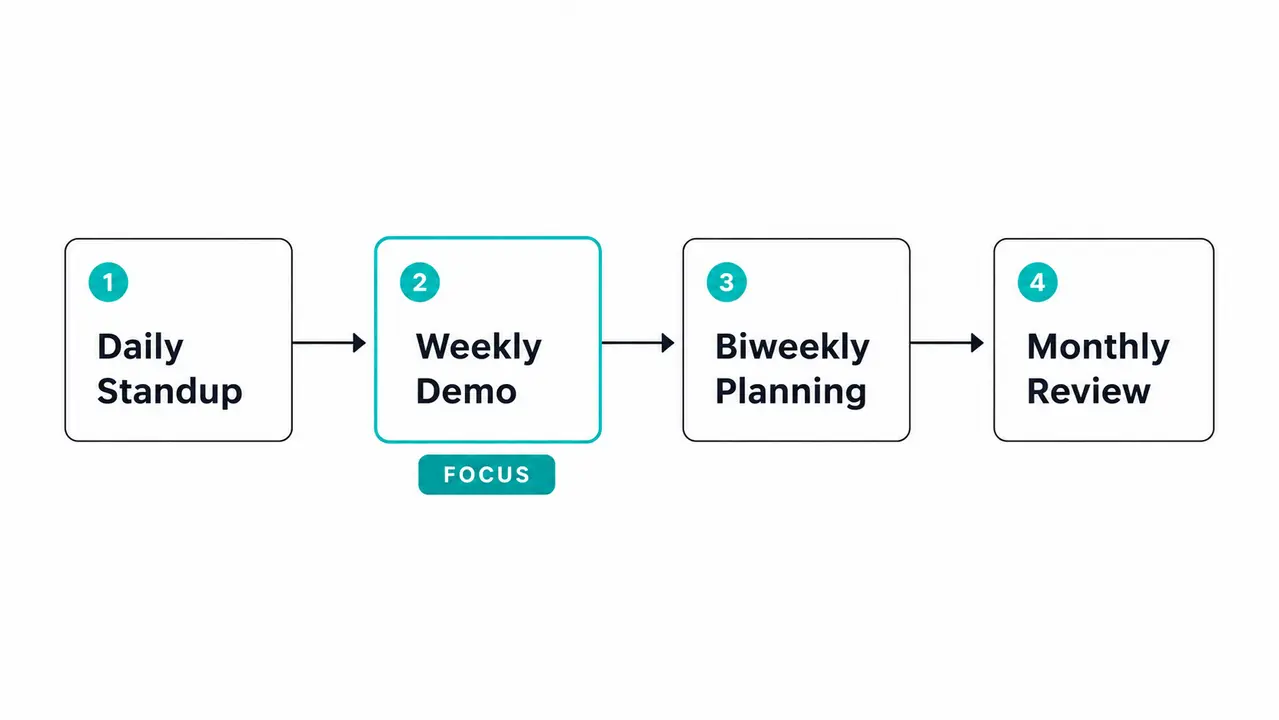
The cadence that works is boring. A daily async standup, written, in your channel, so anyone can read the last three days in two minutes. A weekly demo of working software, recorded, never slides. Biweekly planning that your product owner attends live. A monthly roadmap review where the team can push back on sequencing.
The counter-case is the status report that stays green until the week before launch. Green for six weeks, then red over a blocker that has actually existed for a month, is the signature of reporting theater. Demos prevent it structurally: working software cannot lie about its own state. If a vendor resists weekly demos, treat that as the loudest signal in the entire evaluation.
Time zones and handoffs that do not stall delivery
A three or four hour time difference is manageable. An undefined one is not. The variable is not the offset, it is whether overlap and escalation are designed.
Four elements do the designing. A stated overlap window, two to three hours minimum, where your lead and their lead are both online. On-call expectations written down, including what justifies waking someone. An incident process with a named first responder. Recorded demos and decisions, so the team waking up later can consume them without a sync call.
The failure mode is scheduling deep ambiguity work outside the overlap. A vague requirement hits the external team at their 9am, your 5pm, and the clarifying question waits fourteen hours for an answer. Two cycles of that and a two-day task takes a week. Rule of thumb: build features during overlap hours, do heads-down implementation and testing in the gap. The clock works for you when you plan around it.
Continuity planning when a senior engineer leaves
The senior engineer who knows the billing system will eventually leave. Yours or theirs, internal or external, the risk is identical, and it demands redundancy in knowledge, documentation and ownership.
Three practices build that redundancy. Pairing on critical areas, so at least two people understand the payment retry logic. Rotating reviewers, so no module has a single familiar reader. Runbooks for every operational surface, which is the same discipline our end-to-end product development teams apply, keeping documentation current as part of the definition of done rather than as a farewell gesture.
The failure mode is progress that exists only in one person’s head. The code shipped, the features work, and the knowledge to change any of it walked out the door with the departing engineer. Onboarding the replacement takes a quarter. Treat key-person risk as a defect in team design, not as bad luck, and measure it by asking one question: if this person left tomorrow, what stops moving?
Metrics that reflect actual delivery health
Vanity velocity is the most common metric fraud in outsourced delivery. Story points completed tells you how busy a team was, never how well the product is doing. Track flow, quality and predictability instead.
Four metrics cover it. Cycle time, from work started to deployed, which exposes handoff delays that burndown charts hide. Review queue time, how long a PR waits for feedback, which predicts quality collapse months in advance. Escaped defects, found in production rather than CI, per release. Deployment frequency, because teams that deploy weekly find integration problems weekly.
One honest caveat. Early MVP work may accept a higher defect rate deliberately, when risk stays contained to non-critical paths and speed of learning is the point. That is a decision, made explicitly, with a rollback plan. An accident that looks identical is not the same thing. The difference is whether anyone wrote down the accepted risk.
Keeping architecture decisions tied to business constraints
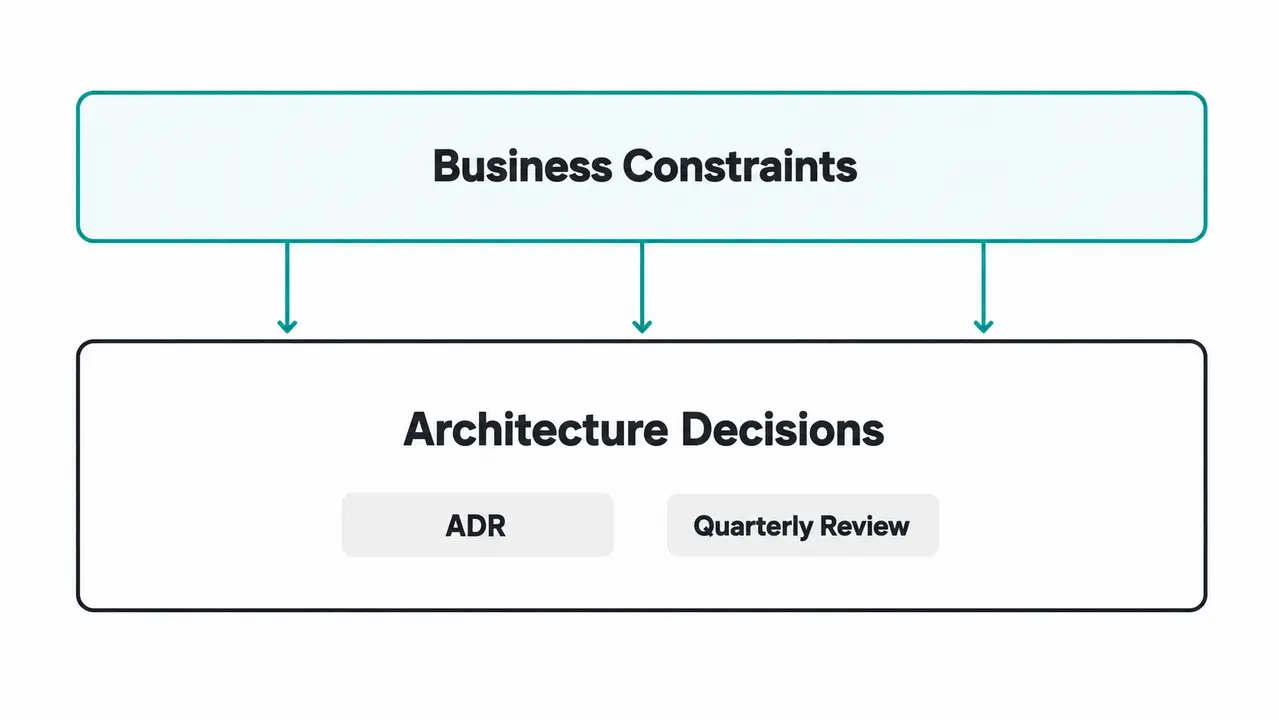
Architecture by default is the most expensive silent failure in startup engineering. Nobody chose the microservices. They accreted, one convenience at a time, until the system demanded three teams to ship one feature. Architecture works when it is guided by explicit product constraints and owned by a named decision-maker.
Three mechanisms keep it honest. An architecture owner role, a person, not a committee, accountable for structural decisions. An ADR workflow where every significant choice gets a one-page record of context, options and decision. A quarterly tech strategy review that asks whether the current structure still matches the current business model.
The failure mode arrives as a surprise audit finding: a default architecture that does not match how the company makes money. A realtime product running on batch assumptions. A single-tenant system three enterprise clients away from a rewrite. Constraints change quarterly. Architecture that nobody reviews does not change at all.
Designing an exit plan before you need one
An exit plan sounds pessimistic and is the opposite. Designing the exit forces documentation, ownership clarity and handover readiness, which are the same properties that make the engagement good while it runs. Plan the ending and you improve the middle.
Four artifacts constitute the plan. Infrastructure as code, so environments can be rebuilt from the repository rather than from one engineer’s memory. Environment documentation covering every dependency, integration and configuration. A credentials rotation plan, executable in a day, covering every secret the team touched. Scheduled knowledge transfer sessions, recorded, covering each system area before it becomes urgent.
The failure mode is vendor lock-in by omission. Nothing malicious happens. The documentation simply never gets written, the environments exist only in the vendor’s accounts, and leaving becomes a re-platforming project. Put the exit requirements in the contract at signing, when you have leverage. Afterward you are negotiating from inside the lock-in.
When external development stops being the right fit
Outsourcing is a phase-matched decision, not an identity. The shift toward hiring becomes right when the product stabilizes and the roadmap demands proprietary differentiation: the domain is settled, the hiring pipeline is predictable, and your internal platform maturity supports onboarding without heroics. Our own write-up on scaling smart a strategic guide covers the transition patterns in detail.
The counter-case matters as much. Pure outsourcing weakens as a long-term default for core differentiation when internal technical leadership exists. At that point you are paying an external margin for work your team understands deeply enough to own, and every architectural decision routed through a vendor adds latency to your product loop.
The honest sequence is hybrid. Keep an external development team for elastic capacity and specialized work, build internal ownership of the differentiating core, and re-evaluate the boundary every two quarters. Teams that never revisit the boundary end up either over-hired or over-dependent.
Frequently asked questions
Can a startup outsource the whole product and still succeed?
Yes, when the founder stays close to acceptance criteria and demos weekly. The risk is not who writes the code, it is who owns the product judgment. Keep a named internal decision-maker for scope and priorities and full outsourcing works, including for non-technical founders.
What should a CTO ask to confirm the team is senior?
Ask for a redacted pull request and read the review thread. Ask how they handled their last mid-project scope change, and what they would do differently. Senior engineers discuss tradeoffs and past mistakes specifically. Junior teams padded by one senior talk about processes instead.
How do we handle code reviews with an external group?
Put external engineers in your repository with your review tools from day one. Require that every PR has at least one reviewer from your side for critical paths, and give one external senior merge rights so the queue never stalls overnight. Review discipline is the contract, not the org chart.
What deliverables should we receive every sprint?
Working software deployed to staging, a recorded demo, updated documentation for anything changed, and release notes listing what shipped and what slipped. If a sprint ends with a status report instead of a demo, treat that as a delivery failure regardless of what the report says.
How do we avoid rebuilding the MVP later?
Hold the external team to a real definition of done: automated tests in CI, reviewed code, and ADRs for structural choices. Most MVP rebuilds are not caused by speed, they are caused by unreviewed accumulation. Enforce review and test discipline from sprint one and the MVP survives contact with scale.
What is a realistic first sprint outcome?
Environment setup, one thin vertical slice through the stack with tests, and a deployed demo. If the first sprint delivers only scaffolding and questions, the preparation phase failed. A competent team with prepared access should show working software within ten working days.
How do we integrate an external team into our tooling?
Give them seats in your stack, not a parallel one: your Git host, your CI, your Slack or Teams, your project tracker. Use your SSO for access with least-privilege roles from day one. Parallel tooling creates invisible silos that surface as integration pain months later.
A practical next step for choosing a partner
Pick one small, high-signal pilot before signing anything long: a one-week discovery phase plus one thin vertical slice, with tests, review and a deployed demo inside two weeks. That shape forces real collaboration, real code review and real delivery under constraint, which no proposal document can fake. Sentice runs exactly these structured pilots because they let both sides walk away cheaply if the fit is wrong. The tradeoff you are choosing between is simple: speed without governance becomes rework, and governance without speed becomes a missed window.
Test the fit with a structured pilot
One week of discovery plus one thin vertical slice, with tests, review and a deployed demo inside two weeks. Both sides walk away cheaply if the fit is wrong.
About Sentice

Sentice is a boutique software engineering partner founded in 2013 by Roni Levi and Martin Petkovic, now headquartered in Skopje, North Macedonia. Rather than supplying individual developers, we build embedded teams that blend with a client’s culture, tech stack and goals, working together from a single office under our own technical leadership. We deliver dedicated software engineering teams, end-to-end software solutions, product development, and system and embedded engineering, and we act as technical advisors across the full development lifecycle, from specification and architecture through development, testing and support. We use AI coding tools across every project, and we help clients integrate AI into their own products through chatbots, MCP services, connected application layers and workflow automation. Some of the clients we started with more than a decade ago are still building with us today.