
The velocity chart looked perfect for eight weeks. Then the senior engineer who reviewed every external pull request went on parental leave, review latency climbed from four hours to two days, and the sprint that was supposed to ship the payments rewrite produced three merged features and eleven reopened tickets. That is the moment most teams discover what they actually bought. The benefits of software outsourcing are real, but they arrive attached to an operating model, and the operating model is the part nobody puts in the contract summary.
We have spent more than a decade running external squads for product companies, and the engagements that worked had almost nothing to do with rates. They had to do with delivery ownership, written interfaces, and a product decider who answered questions in hours. This article walks through what actually produces the outsourcing advantages you were promised, and where each one quietly dies. Below, we’ll unpack the engagement models side by side, the guardrails that keep quality and security intact, and the checklist that decides whether you are ready to outsource at all.
Reading time: 11 min
Key points
- Treat outsourcing as a purchase of delivery capacity, not discounted labor hours; the artifacts that make it real are a shared backlog, a definition of done, and an agreed release cadence.
- A cohesive external squad onboards in three to six weeks, against three to five months for an internal senior hire, but only if a product decider answers questions within hours.
- Quality and security stay high when you control guardrails in CI and access governance, not when you review every keystroke.
- Of the three engagement models, embedded dedicated teams win on continuity and ownership for startups and scaleups building evolving products.
Table of contents
Outsourcing works when you are buying execution capacity, not just labor
The strongest benefits of software outsourcing show up when you treat the engagement as a purchase of predictable delivery capacity rather than discounted labor hours. Seat filling gives you hands on keyboards. Delivery ownership gives you working software in production, with a team that answers for outcomes instead of attendance.
Here is a scenario we see every quarter. A scaleup needs two parallel delivery streams for one quarter. One stream advances the core product. The other clears a backlog of customer-requested integrations. Internal hiring cannot produce six qualified engineers in twelve weeks, and the hiring pipeline has already been running for two months with three offers declined.
An outsourced development team plugs that gap only when capacity is made measurable. The artifacts that make it real are a shared backlog, a definition of done, code review rules, a release checklist, and an agreed release cadence. Without those, you have purchased velocity theater. The failure mode is predictable: a short-term spike in output, followed by months of rework and regression churn that erase every advantage you captured at the start. Engineering capacity is a contract about outcomes. Labor is a contract about hours. Teams that confuse the two get hours.
The real advantage is time to capability, not time to hire
How long does it take to get a senior engineer shipping in your codebase? Count it honestly. Sourcing takes weeks, interviews consume your best engineers’ evenings, notice periods run one to three months, and ramp time adds another month after the start date. Three to five months is the realistic total. A cohesive external squad with established practices onboards in three to six weeks, because the delivery model arrives with the people.
The roles show up together. A tech lead, a QA engineer, a DevOps practitioner, and a product-minded engineer who already know how to work as a unit, who already have a review cadence and a definition of done they have used on other products. Software development outsourcing compresses the gap between “we need this capability” and “we are shipping it.” That compression, not the hourly rate, is where the time to market gain actually lives.
The advantage evaporates under one condition. If requirements are undefined and nobody internally can own product decisions, the external team waits for direction instead of shipping, and you have hired an expensive queue. The verdict is simple. Development velocity gains are real only when someone on your side can answer product questions within hours, not sprint cycles.
Development efficiency improves when the partner brings a repeatable delivery system
Development efficiency is not an abstraction. It is less avoidable rework, fewer blocked pull requests, shorter review cycles, and a release process that does not depend on one person running a seventeen-step script from memory. When people talk about cost savings outsourcing can deliver, this is the honest version of the claim: savings on wasted engineering cycles, not cheaper hours. A team that ships clean code the first time saves you the cost of debugging it for the next three quarters.
The mechanism is a set of process artifacts you can inspect before signing. Trunk-based development or a disciplined branching strategy. Automated checks on every pull request, enforced in GitHub Actions or GitLab CI rather than by reviewer memory. Staging gates. A CI CD pipeline that catches regressions before they merge instead of after customers find them.
Watch for the hidden taxes that erode throughput. Review latency longer than 24 hours. Flaky tests that break confidence until engineers rerun everything twice. Deployments with manual steps nobody documented. Each one is small. Together they turn “we shipped faster” into “we spend every sprint stabilizing” within two months of the initial burst. DevOps practices are not a line item. They are the difference between velocity that compounds and velocity you pay back.
Access to specialized skills without reshaping your org chart
Some skills do not justify a permanent hire. Embedded firmware, systems programming, performance profiling, security review, build-system engineering, QA automation: each one appears on a roadmap for a bounded stretch, then sits idle for nine months if you hired for it. Outsourcing lets you add that expertise for the scope you actually have, without carrying a specialist you cannot keep busy year-round.
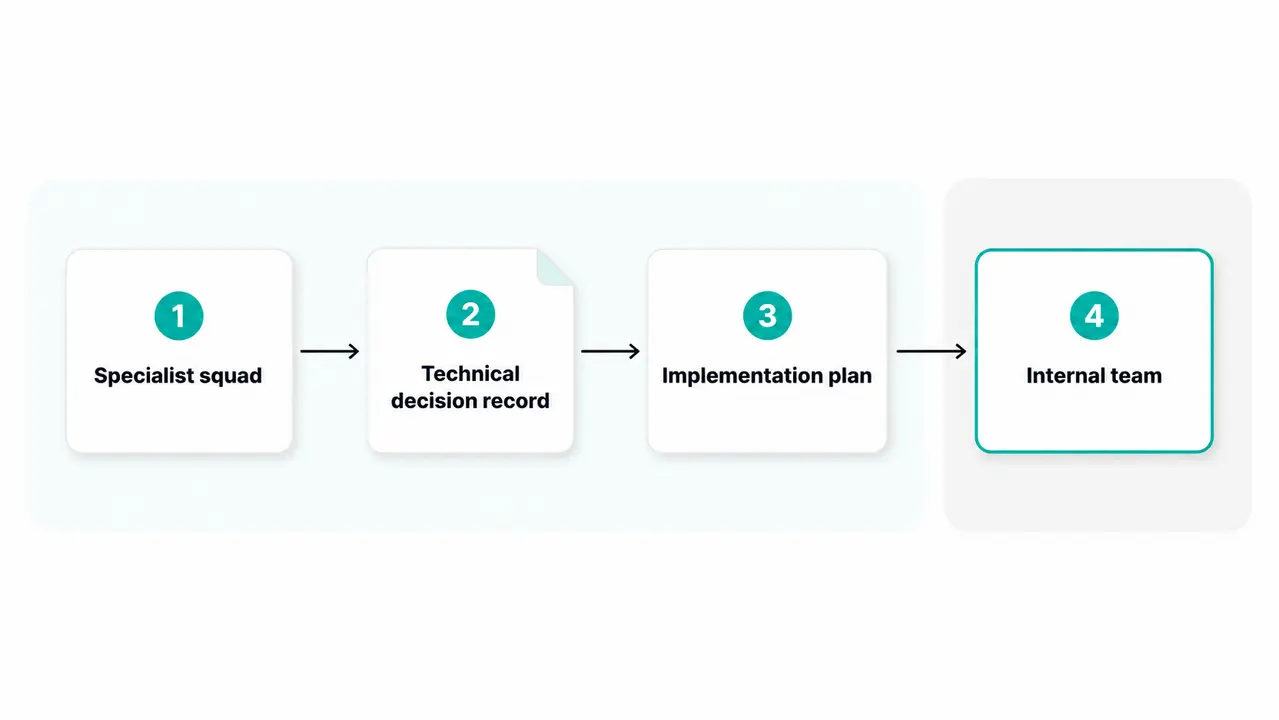
A pattern we use and recommend: bring in a specialist squad for a two-to-four-week spike that produces a written technical decision record and a follow-up implementation plan your internal team executes. The deliverable is knowledge, not just code. If you need deep firmware and low-level work specifically, system and embedded engineering is exactly the kind of specialized skill set available through an external partner without a permanent headcount commitment.
Know the boundary. This works best when the skill is scarce internally and the work has clear acceptance criteria. It works worst when the skill must live inside the product team long-term, because an outsourced specialist who stays becomes a coordination bottleneck instead of a capability. An embedded engineering team brought in for a spike should leave. One that stays forever on work your own engineers should own is a design smell.
The week a senior engineer leaves mid-migration
Picture a database migration that has been running for four months. The domain knowledge lives in one senior engineer’s head: which tables still have orphaned rows, which services write directly instead of through the API, why the cutover order matters. Then that person gives notice, or takes unexpected leave, and progress halts. Not slows. Halts.
A stable external team reduces this single-point-of-failure risk, because continuity is built into how the squad works. The operational artifacts that prevent a knowledge cliff are concrete: runbooks, architecture decision records, incident postmortems, an ownership map organized by subsystem, and documentation standards that every contributor updates as part of their definition of done. Knowledge transfer is not a one-time deck handed over in the final week. It is the continuous practice of writing down what changed and why, reviewed by someone outside the original author’s team.
This is where risk management in outsourcing gets underrated. The risk you are managing is not the vendor’s reliability. It is your own concentration of tacit knowledge. A squad that documents as it ships keeps a critical migration moving through vacations, attrition, and reorganizations that would otherwise stall it for weeks.
Product focus returns when internal leaders stop managing every hire
One of the most overlooked benefits of software outsourcing is what it gives back to your senior people. Hiring consumes them. Sourcing, screening, take-home reviews, interview panels, onboarding plans, mentoring during ramp, team-health management once the new engineer lands. Each hire takes dozens of hours from your best engineers before that person writes a single line of production code. Multiply by six hires and you have lost a quarter of your tech lead’s calendar to a pipeline.
The boundary matters. Architecture decisions, product strategy, security posture, and hiring of senior leadership stay internal. Implementation of well-scoped epics, test coverage, CI maintenance, and release automation can move to an outsourced development team without loss. The ownership model is the point: you keep direction, you delegate execution, and the freed hours go back into architecture and product rather than into scheduling interviews.
There is a counter-case, and it fails quietly. If leadership abdicates technical direction entirely and expects the external team to self-govern product decisions, the focus you freed up becomes drift. Delegating execution is a strategy. Delegating judgment is an abdication, and the product will show the difference within two release cycles.
Scaling up and down without breaking team topology
Adding people to a delivery organization is easy. Adding them without multiplying coordination paths is the actual problem. A delivery partner lets you change engineering capacity while the interfaces between teams stay stable, which is what keeps development velocity from degrading as you grow.
Use the team-topology vocabulary because it is precise. A stream-aligned squad owns a product slice end to end. An enabling function injects expertise temporarily. Platform dependencies must remain stable so a new squad can plug in without renegotiating how the system works. A concrete example: a company adds a second squad for one quarter to clear a backlog of customer-requested integrations. The squad integrates into the existing CI CD pipeline, follows the existing branching strategy, and ships against the existing API contracts. Nothing about the delivery model changes except throughput. If you want to grow your tech team without losing speed or quality, this is the mechanism that does it.
The failure mode is adding individual contractors ad hoc. Communication paths grow as n(n-1)/2, so ten people across five reporting lines produce forty-five potential coordination channels, and delivery slows to a crawl while coordination cost overtakes engineering work. Squads scale. Loose contractor pools accrete.
Better engineering throughput comes from clearer interfaces, not more meetings
Outsourcing forces you to make implicit assumptions explicit. That discipline alone improves throughput before the external team writes its first feature, because most internal slowness is ambiguity wearing a costume of busyness.
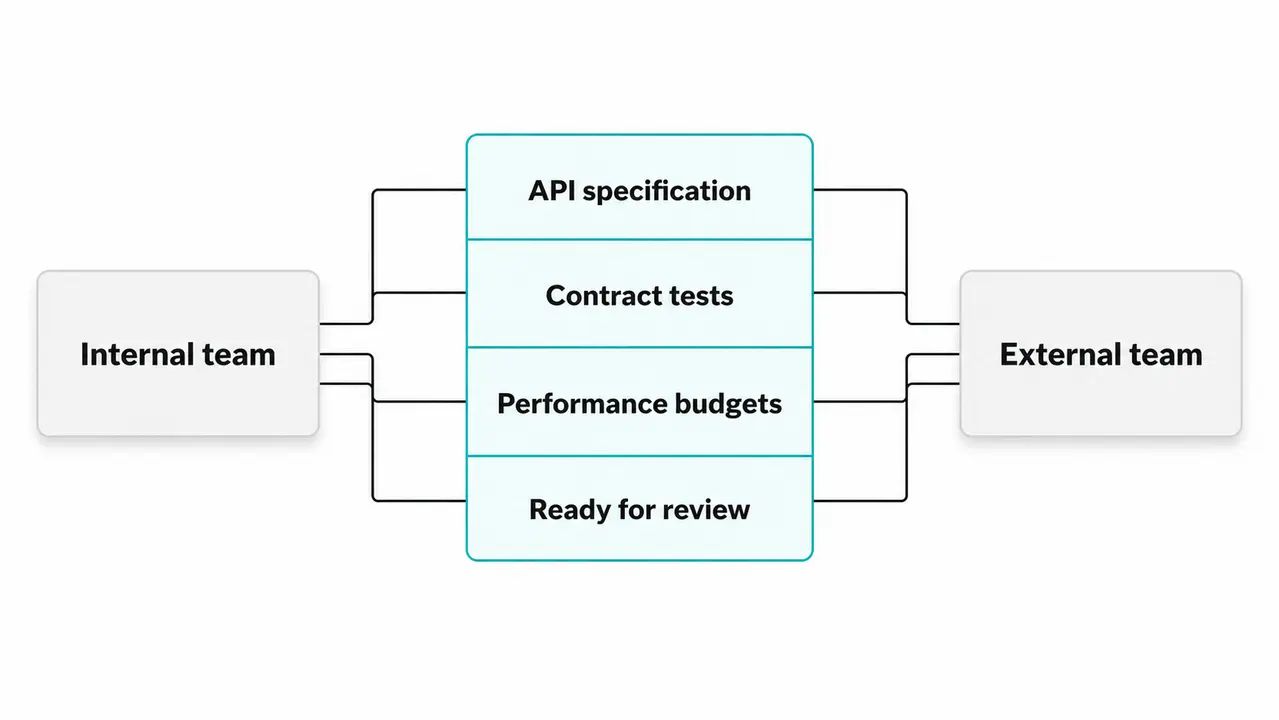
The artifacts that create clear interfaces between internal and external work are nameable: API specifications, contract tests, performance budgets, observability requirements, and an agreed definition of “ready for review.” Architecture guardrails written down beat architecture guardrails remembered. The alternative plays out across time zones every week. A pull request that would take five minutes to clarify in person becomes a 24-hour delay when the reviewer is six time zones away and the ticket lacks acceptance criteria.
Apply the verdict honestly. This approach works best for modular systems with well-defined boundaries, where an outsourced development team can own a slice and ship against contracts. It is weaker for tightly coupled legacy code where every change ripples across modules and no clean interface exists. In that codebase, ambiguity quietly turns a two-day task into a two-week stall while both teams exchange clarifying messages, and no amount of meetings fixes what a written interface would have prevented.
How the three engagement models compare
Three delivery models dominate the market, and they fail for different reasons. Project delivery takes fixed scope on a fixed timeline. Staff augmentation adds individual contractors to your existing team. Embedded dedicated teams give you a cohesive squad that integrates into your ceremonies and owns outcomes, the model behind what we call dedicated software engineering teams and the one most aligned with long-term product development.
| Dimension | Project delivery | Staff augmentation | Embedded dedicated team |
|---|---|---|---|
| Ownership of outcomes | Vendor owns scope | You own everything | Shared, squad owns delivery |
| Onboarding load on your team | Low after kickoff | High per contractor | Medium, front-loaded |
| Knowledge retention | Weak at handover | Depends on individuals | Strong, squad-based |
| Quality control | Acceptance criteria | Your process entirely | Shared guardrails |
| Integration with your rituals | Minimal | Full but fragile | Full and durable |
The verdicts are blunt. Team augmentation is weakest when you lack internal bandwidth to lead day to day, because you are paying for hands without direction. Project delivery is weakest when requirements evolve weekly, because change requests consume the timeline. An embedded engineering team is weakest when you need a one-off task, because the integration overhead exceeds the work. For startups and scaleups building evolving products, embedded teams win on continuity and ownership.
Not sure which model fits your roadmap?
Tell us about your delivery bottleneck and we’ll map it against the three engagement models in a short, technical conversation.
Where teams underestimate onboarding and pay for it later
Onboarding is the variable that decides most outsourcing outcomes, and its cost is measured in blocked work and misbuilt features, not in setup fees. The IT outsourcing benefits everyone quotes assume onboarding went well. When it does not, the external team ships plausible, well-tested code that is architecturally wrong for your domain, because nobody gave them the context living in your senior engineers’ heads.
An onboarding playbook should exist before the first production commit. It contains an architecture overview with diagrams, a working local development setup, a CI CD pipeline map showing what triggers what, coding standards with examples, key domain flows documented as walkthroughs, and recent incident history with root-cause summaries. One repository. Updated as part of the definition of done, not as a separate chore.
Two internal roles must exist before onboarding starts. A product decider who can answer scope questions within hours. An architecture owner who can approve or reject technical approaches before implementation begins. If either seat is empty, delay the start date. Documentation standards and knowledge transfer cannot substitute for a person whose job is deciding. Every week saved by skipping onboarding is repaid at compound interest in rework.
Quality stays high when you control the guardrails, not the keystrokes
The best code quality outcomes in outsourcing come from an inversion of the usual instinct. Internal leadership sets non-negotiable engineering guardrails. The external team executes freely within them. Reviewing every line of code is the opposite approach, and it bottlenecks delivery while teaching the external engineers that nothing is theirs to own.
The guardrails that keep quality high are inspectable. Linting and formatting rules enforced in CI, so style is never a review conversation. Test coverage expectations per module. Mandatory review by an internal approver for architectural changes. Architecture decision records for any change crossing module boundaries. Threat modeling for anything touching authentication, authorization, or sensitive data. For a verifiable definition of what disciplined development means, the NIST Secure Software Development Framework provides a baseline you can point to in a contract (NIST SP 800-218).
The counter-case is uncomfortable for the companies that need it most. If your internal reviewers rubber-stamp pull requests without reading them, quality degrades regardless of how skilled the external team is. The CI CD pipeline catches what machines can catch. Only engaged reviewers catch what machines cannot.
Security and IP protection depend on process discipline
Outsourcing can be secure. The condition is that access is least-privilege, environments are segmented, and audits are routine. Risk rises when access is informal, shared, or undocumented, which describes a surprising number of engagements we have inherited.
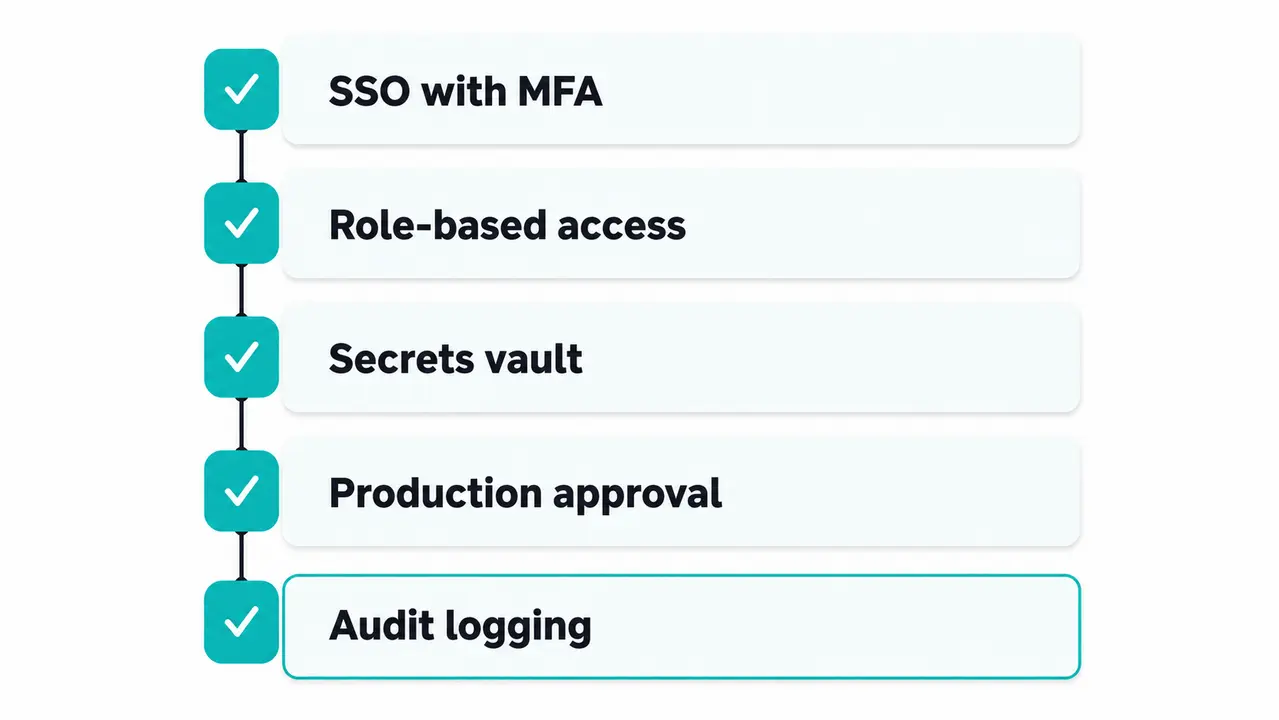
Security controls for vendors are a checklist you can demand in week one. Single sign-on with enforced MFA. Role-based access keyed to specific repositories and environments. Secrets managed through a vault rather than shared credentials pasted into chat. Separate production access requiring explicit approval. Logging of every privileged action for audit. The current risk picture for software supply chains is documented in the ENISA Threat Landscape 2024, and it is not a picture that rewards informality. For review priorities, the OWASP Top 10 remains the practical checklist for the vulnerability classes code review should catch.
IP protection process follows the same logic. Your IP is safest when it lives in your repositories, under your access governance, with every contribution logged. The verdict on feasibility is honest: vendor security is strongest in mature engineering organizations with baseline hygiene to extend. It is weakest when the company itself has no access governance to extend. You cannot outsource controls you never built.
Time zones become an advantage when handoffs are designed
The standard objection to nearshore and offshore development is the time-zone gap. The objection assumes synchronous work. Design asynchronous handoffs and minimize dependency chains that need real-time conversation, and the gap flips into a pipeline: one team reviews while the other sleeps.
The artifacts that make this function are unglamorous. Written daily updates posted before end-of-day. Recorded demos with walkthroughs. Pull request descriptions that include context and reproduction steps. A “ready for review” label convention. Agreed response times, for example review within one business day for routine PRs and within four hours for release-blocking ones.
The working pattern looks like this. An engineer in your time zone opens a PR with full context and reproduction steps at 6 p.m. The external reviewer picks it up at the start of their day, reviews, approves, merges. The change ships without a single synchronous meeting, and total cycle time beats a co-located team that batched its reviews until afternoon. The failure mode is equally concrete: waiting 24 hours to clarify one missing requirement that could have been written in the ticket description. Development efficiency across an outsourced development team is a writing problem before it is a scheduling problem.
What work should stay in-house
Keep work in-house when it defines your competitive differentiation, requires constant product discovery with users, or demands deep domain intuition that has never been written down. Software development outsourcing handles bounded work well. It handles identity poorly.
Concrete examples of work that should not move outside. The core ranking or recommendation algorithm. The proprietary data model that encodes your business logic. Safety-critical decision logic in embedded or medical systems. Rapid product strategy experiments that pivot weekly based on user feedback. Each of these either is the product or changes faster than any contract can track.
Here is a test any technical leader can apply in ten seconds. If we changed this component, would customers notice or churn? If yes, the work defines your product and stays internal. Risk management in outsourcing starts with knowing what not to hand over. Outsource supporting systems, integrations, and well-bounded components first, and expand scope only after the operating model proves stable across at least one full release cycle. The ownership model you publish internally should say which is which, in writing, before the first vendor conversation.
Measuring success in the first 30 days
Do not measure the first month by output volume. Measure it by integration quality, meaning how smoothly the external squad plugs into your delivery system. The signals worth tracking are specific: cycle time for tickets assigned to the external squad, PR review latency in both directions, defect escape rate to staging or production, reopened ticket count, and on-call noise attributable to new code.
DORA-style signals give you a baseline vocabulary: deployment frequency, lead time for changes, change failure rate, time to restore. Track them without overclaiming that outsourcing alone moved any of them, because you changed the team and possibly the process in the same month, and honest attribution matters more than a flattering chart.
What does good look like after 30 days? Fewer surprises in review. Smaller batch sizes. Predictable delivery on committed epics. A release cadence that matches or improves on your pre-engagement baseline, with QA automation catching regressions in the pipeline instead of on-call catching them at 2 a.m. The failure mode is judging success by lines of code, story points, or raw velocity, metrics that reward volume over correctness. Development velocity without code quality is a loan, and the interest comes due in production.
The decision checklist technical leaders actually use
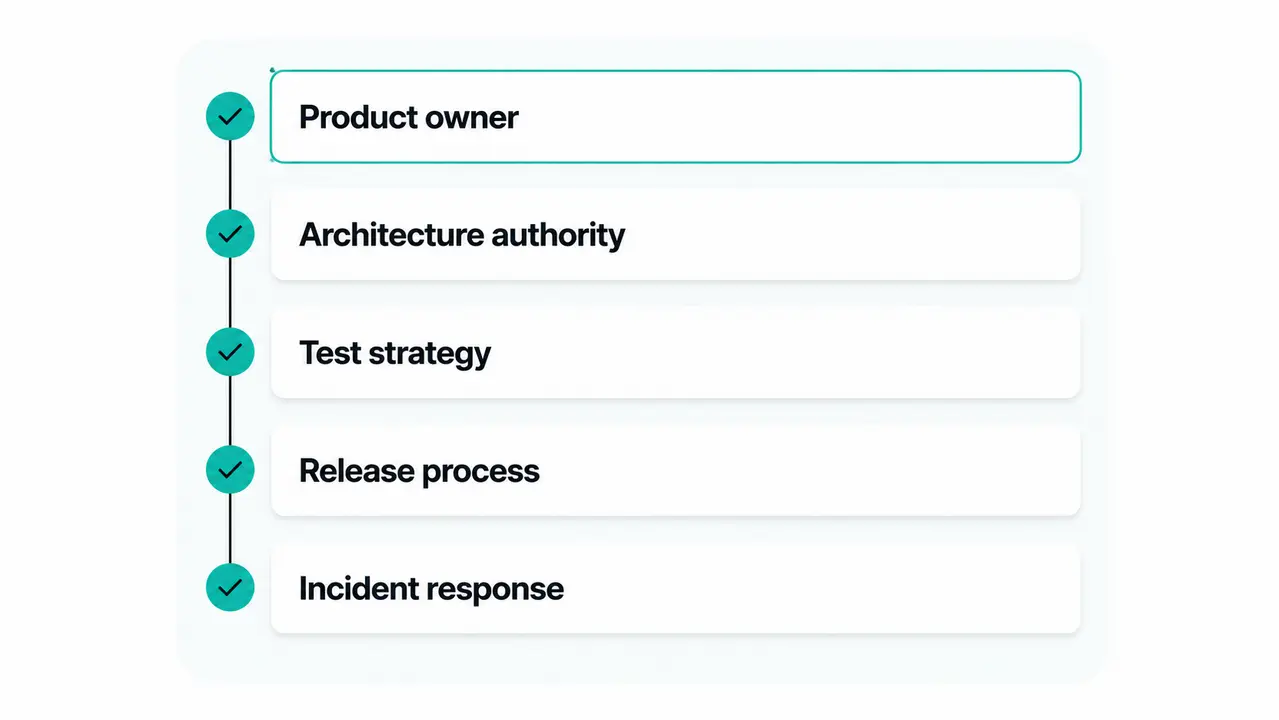
Before any outsourcing decision, run the checklist. It is short, and every answer should be a confident yes. Is there a clear product owner who can answer scope questions within hours? Is there an architecture authority who can approve or reject technical approaches? Are the non-functional requirements for performance, security, and scalability documented? Is there a test strategy defining what automated and manual coverage looks like? Is the release process documented and repeatable? Are incident response expectations defined for both internal and external engineers?
Six questions. Most teams fail two of them, usually the product owner and the release process, and those two failures account for most disappointing engagements we have been asked to rescue.
Make the checklist actionable with one deliverable: a one-page “ways of working” document, agreed in week one, capturing these decisions and reviewed monthly. It takes an afternoon to write and prevents a quarter of ambiguity. The counter-case decides itself. If leadership cannot allocate review time for architecture decisions and PR approval, outsourcing will amplify chaos rather than absorb it, because the delivery model inherits whatever discipline you already have.
Making outsourcing feel like one team in practice
The benefit ceiling rises when the external team participates in the same rituals and is held to the same engineering standards as your internal teams. Run them in a separate “vendor lane” and you get vendor-lane output: work that passes acceptance criteria and still feels foreign in the codebase six months later.
The rituals that create cohesion are ordinary. Shared sprint planning. Joint backlog refinement. A demo cadence where external engineers present their own work, not a liaison reading a status report. Shared on-call expectations where appropriate. A single set of coding conventions applying to everyone regardless of employer.
Communication norms do the rest. Decisions recorded in writing. Fewer ad hoc video calls. A clear escalation path for blockers. One rule worth adopting verbatim: any decision made in a hallway conversation must be posted to the team channel the same day. When the engineers sit in one office and follow your practices from week one, onboarding stops being a phase and becomes a handover. Embedded engineering team behavior consistently outperforms vendor-lane behavior for products that evolve over multiple releases, and the difference shows up in development efficiency long before it shows up in any retrospective.
Frequently asked questions
Is outsourcing still worth it if we already have a strong in-house engineering team?
Yes, when the in-house team is bottlenecked on delivery capacity rather than skill. Outsourcing adds a parallel stream that lets your senior engineers focus on architecture and product while the external squad clears implementation backlog. The benefit disappears if your internal team has idle capacity, because in that case you are adding coordination overhead without throughput gains.
How do we avoid vendor lock-in without slowing delivery?
Require the external team to use your repositories, your CI CD pipeline, and your documentation standards from day one. Insist on a documented ownership map so any engineer can trace which subsystem does what. Run a short transition exercise every quarter, handing one ticket from the external team to an internal engineer, to verify knowledge is not trapped.
What should we require before giving an external team production access?
Enforce SSO with MFA, role-based access limited to the specific services they touch, separate credentials for production that require explicit approval per session, and audit logging of every privileged action. Grant production access only after the external team has completed at least one successful release to staging through your standard pipeline.
How do we split ownership between an internal tech lead and an external tech lead?
The internal tech lead owns architecture direction and approves changes crossing module boundaries. The external tech lead owns day-to-day implementation decisions within the agreed architecture. Both co-sign the architecture decision records. The internal lead reviews for direction, the external lead reviews for execution quality.
What is the minimum documentation that prevents rework?
An architecture overview with diagrams, a local development setup guide, a CI CD pipeline map, coding standards with examples, key domain flows, and recent incident history. This onboarding playbook should fit in a single repository and be updated as part of the definition of done, not as a separate chore.
How long should a realistic onboarding take before the first production release?
Plan for three to six weeks for a cohesive squad, including local setup, pipeline access, domain walkthroughs, and a first small release to staging. A team that ships to production in week one is either exceptionally well supported or skipping steps you will pay for later. The clock starts when the onboarding playbook and the two internal owner roles exist, not when the contract is signed.
The next step is a pilot that proves integration, not promises
Run a small pilot that forces the hard parts into the open within two weeks: onboarding, code review, release, and ownership boundaries. Cover one bounded slice of the product with real users and real constraints, not a throwaway prototype that tests nothing. If integration is smooth and your internal team is not drowning in review load, scale scope rather than headcount. Outsourcing delivers when you can define outcomes and enforce guardrails, and it fails when you outsource decisions you have not yet made.
Ready to scope a pilot?
Bring one bounded slice of your roadmap and we’ll help you define the outcomes, guardrails and ownership boundaries a two-week pilot should test.
About Sentice

Sentice is a boutique software engineering partner founded in 2013 by Roni Levi and Martin Petkovic, now headquartered in Skopje, North Macedonia. Rather than supplying individual developers, we build embedded teams that blend with a client’s culture, tech stack and goals, working together from a single office under our own technical leadership. We deliver dedicated software engineering teams, end-to-end software solutions, product development, and system and embedded engineering, and we act as technical advisors across the full development lifecycle, from specification and architecture through development, testing and support. We use AI coding tools across every project, and we help clients integrate AI into their own products through chatbots, MCP services, connected application layers and workflow automation. Some of the clients we started with more than a decade ago are still building with us today.
Get in touch at info@sentice.com or call +389 70 307 837.