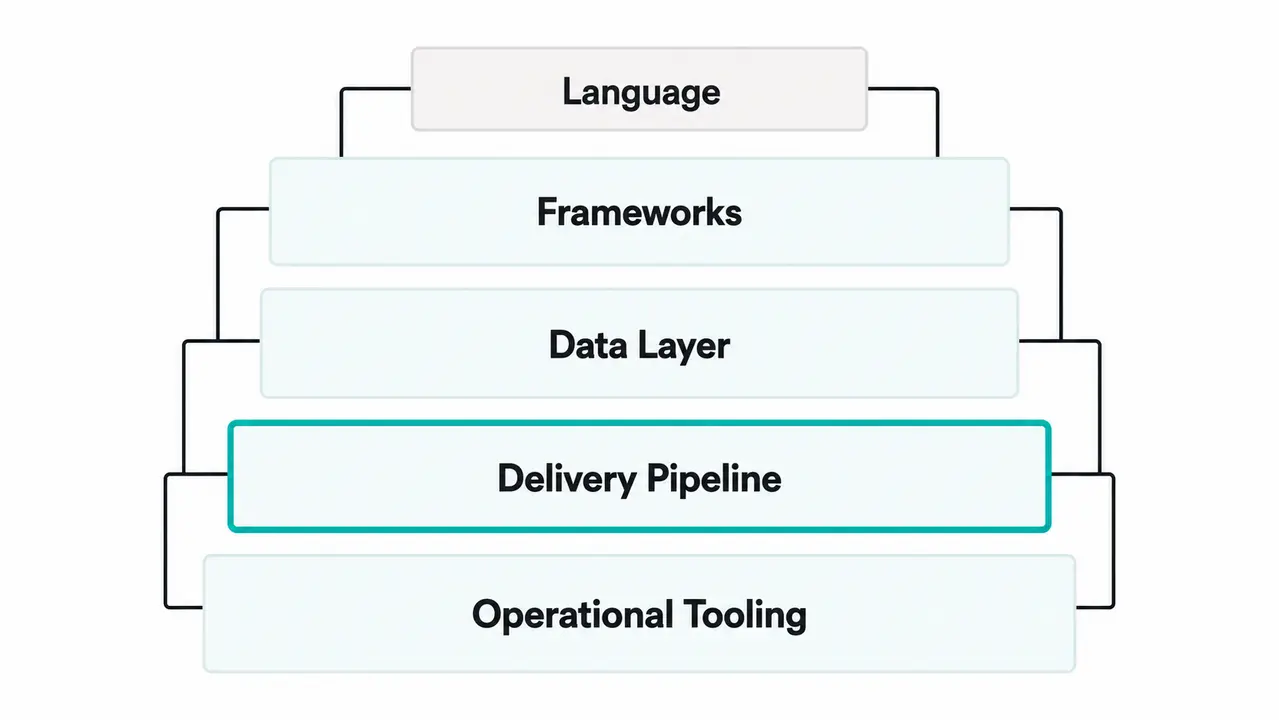
The code was fine. That is the part nobody expects. A scaleup we worked with had a stable product, clean tests, a healthy review culture, and still lost three weekends in one quarter to production incidents. The cause was not the code. It was the space around the code: a CI pipeline that ran on one engineer’s laptop, a staging environment that drifted from production, and a release process that lived in one person’s head. When teams talk about software development technologies, they usually mean languages and frameworks. The failures live everywhere else. This article maps the full technology set layer by layer, from the data layer to observability, and gives you a practical process for choosing, documenting, and revisiting each decision.
Reading time: 11 min
Key points
- Software development technologies cover far more than languages: the runtime, frameworks, data layer, delivery pipeline, and operational tooling all decide whether code survives production.
- A tech stack becomes an operating model only when it standardizes environments, review workflows, testing strategy, and deployment patterns.
- Tools are replaceable, platforms are commitments, and every major choice needs a one-page architecture decision record with revisit conditions.
- Security, testing, and observability controls belong inside the developer workflow from day one, not bolted on before launch.
Table of contents
Understanding software development technologies beyond programming languages
Software development technologies cover the full set of building blocks used to design, build, ship, and operate software, and the programming language is the smallest part of that set. A standard technology choice encompasses the runtime, the frameworks, the data layer, the delivery pipeline, and the operational tooling that keeps the whole thing running after launch. Map the layers out and you get language and runtime, frameworks, data stores, integration infrastructure, security controls, testing tooling, and observability. Most teams have opinions about the first two layers and defaults for none of the rest.
Treat the stack as an operating system for engineering throughput, not a shopping list. A web product can remain stable in code yet fail in production because CI, staging environments, and release controls are weak. We have inherited codebases where the language choice was excellent and everything around it was an accident. The reverse is rare.
The tech stack as an operating model for engineering teams
A tech stack is the repeatable set of technologies and practices that lets your team deliver software predictably. It becomes an operating model the moment it standardizes environments, review workflows, testing strategy, and deployment patterns. Before that moment, you have a pile of tools and a hope.
Watch what happens when two squads each pick their own build tool and authentication pattern. Platform maintenance work doubles. An incident in one squad’s auth flow teaches the on-call engineer nothing about the other squad’s. Quality gates diverge, incident response fragments, and every internal transfer becomes a re-onboarding.
A project stack serves one product. A company stack serves every team that will ever ship anything. The distinction matters because standardization is what turns engineering from a set of personal workflows into a system that survives hiring, growth, and people leaving. If you want the longer argument on how this compounds, read our piece on whether is your tech stack driving growth or dragging you down. Standardization is the compounding mechanism, and the cost of ignoring it shows up in velocity, not in any single line item.
Where teams confuse tools, frameworks, and platforms
Teams lose enormous amounts of time treating every new tool as a platform decision, and every platform decision as a tool choice. The two errors cost different amounts. Tools are replaceable. Platforms are commitments. Frameworks sit in between, carrying ecosystem lock-in that grows with every line you write against them.
One example per category: an API client is a tool, container orchestration is a platform, and a web framework is a framework. You swap an API client in an afternoon. You do not swap Kubernetes, or Rails, on a whim.
The quiet danger runs the other direction. A team adopts a “small” tooling choice, a specific task runner or a local database wrapper, and six months later that choice dictates your architecture, your hiring requirements, and your release cadence. We have watched a one-line dependency in a build script determine which engineers could be hired.
Here is the decision rule. Promote a tool to a platform only when it becomes shared infrastructure across teams. Until then, it stays a tool, and anyone may replace it.
Choosing programming languages based on delivery risk
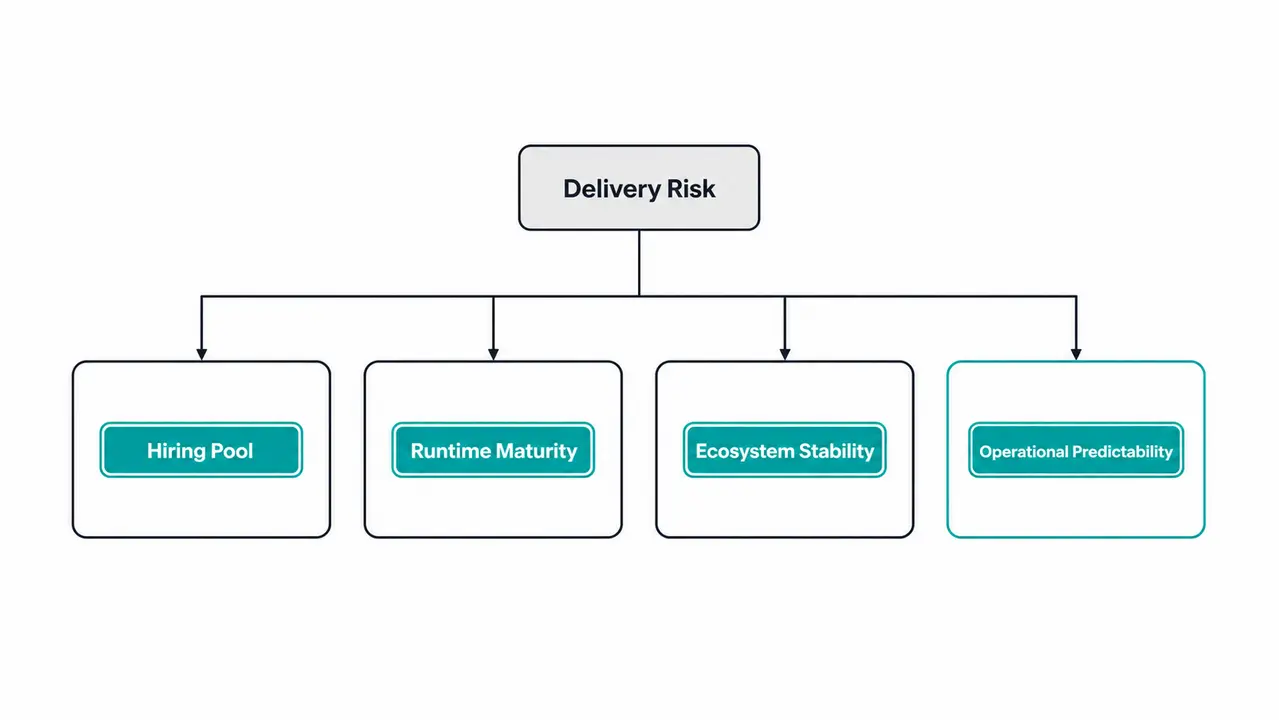
Programming languages are a risk decision, not a preference. The criteria are hiring pool, runtime maturity, ecosystem stability, and operational predictability. The best language is the one your specific team can ship and maintain with consistent quality, which is a statement about your organization as much as the language.
Score candidates on type safety, performance requirements, concurrency model, tooling quality, and dependency hygiene. Define “supported” concretely: linters, formatters, test frameworks, and production debugging workflows all exist and are maintained. Golang passes this test almost anywhere. Python passes it anywhere with a data component. A language without a working profiler in your target runtime fails it, whatever its other virtues.
Specialized domains justify narrower choices. Hard real-time constraints, specific hardware, or strict latency budgets can make a smaller hiring pool the correct price to pay. A team building trading infrastructure in a niche language is making a defensible risk trade. A team building a CRUD backend in the same language is paying the cost and buying nothing with it.
Frontend technologies that keep product velocity high
Frontend decisions must optimize for three things: maintainable UI architecture, predictable builds, and fast onboarding for new engineers. Everything else is negotiable. The goal is a stable component model, strong typing across the API boundary, and a build pipeline so boring nobody thinks about it.
Standardize component frameworks, state management approaches, build tooling, and design system integration inside the repository template, not inside individual projects. The template is the standard. A new frontend service starts with the component library wired in, TypeScript strict mode on, and the build configured before anyone writes a feature.
The failure mode is expensive and specific. A major redesign stalls for a quarter because UI patterns and accessibility rules were never codified. Every screen becomes a style debate. Code reviews slow to a crawl because reviewers are re-litigating layout decisions instead of checking logic. We have seen redesigns that were 80 percent done and 0 percent mergeable, purely because the patterns lived in the heads of two senior engineers who were both busy.
Backend technologies that survive scaleup growth
Backend choices must prioritize clear boundaries, testability, and operational visibility. Scaleup pain rarely comes from raw compute limits. It comes from unclear ownership, brittle integrations, and services nobody can debug at 2 a.m.
Define a golden path for every new service. The path includes structured logging, metrics, tracing, and automated deployment from day one, not as a maturity goal for later. A service that ships without instrumentation is invisible until it breaks, and then it is invisible in the worst possible way.
Teams that skip these foundations pay for it in elevated incident load and release cycles that stretch from days to weeks. The debt compounds quietly, one uninstrumented service at a time, until on-call becomes a rotation everyone dreads.
Here is the mandate: clear service boundaries and consistent API patterns beat the newest backend trend, every time. A boring service with a clean contract outperforms a fashionable one with ambiguous ownership. Fashion changes. Boundaries persist.
Data layer decisions that reduce future rewrites
Pick the data layer based on access patterns, consistency needs, and the operational skill your team actually has. Then design for change: migration tooling, schema versioning, and clear ownership from the first week. Most rewrites we get pulled into started with a data decision that was never revisited after product-market fit.
Evaluate each store type against a specific query pattern, not a general vibe.
| Store type | Fits when | Common misuse |
|---|---|---|
| Relational (PostgreSQL) | Transactional data with joins and strong consistency | Acting as a queue or a cache |
| Document (MongoDB) | Read-heavy, self-contained aggregates | Emulating relational integrity by hand |
| Time-series | High-volume append-only telemetry | Storing events in a relational table forever |
| Search index (Elasticsearch) | Full-text and faceted queries | Serving as the primary source of truth |
The most common self-inflicted wound: analytics queries running against the primary transactional store. Core users feel it as latency and timeouts while the analytics team wonders why dashboards are slow. Include backup and restore drills, and a retention policy, in the initial decision. A store you cannot restore is not a store.
API and integration technologies that keep systems composable
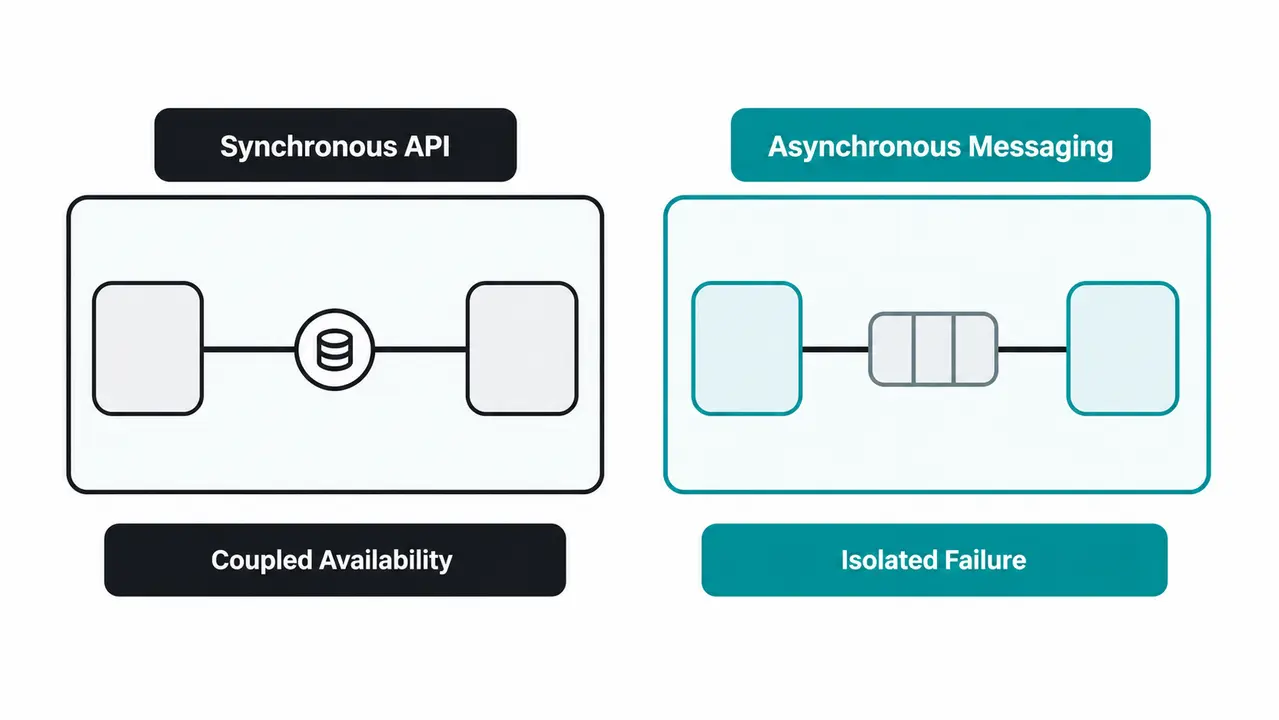
Integration technology exists to make change safe. That means versioned contracts, backward compatibility rules, and error semantics everyone agrees on before the first request flies. The best integration approach lets two independent teams ship on the same day without breaking each other.
Compare the two dominant patterns on failure isolation. Synchronous APIs are simple to reason about and couple availability: if the downstream is down, you are down, unless you build explicit timeouts and fallbacks. Asynchronous messaging isolates failure beautifully and makes debugging harder, because a message that vanished leaves no stack trace. Neither wins in the abstract. The one that wins is the one whose failure mode your team can handle at 2 a.m.
The failure scenario is well known. A partner integration breaks because error codes and retry policies were never agreed on, retries amplify the outage, and the release freeze that follows lasts a month. Require contract testing as a default quality gate for any cross-team integration. A contract test catches in CI what a cascading failure catches in production.
DevOps tooling as a product instead of a pile of scripts
DevOps tooling works when it is treated like an internal product, with owners, a roadmap, and a support channel. A directory of scripts with no owner is not tooling. It is a reliability tax you pay every release, and the rate goes up as the author’s memory fades.
Define the minimum baseline and hold it. Reproduducible builds, environment parity, release approvals, and a rollback strategy that has actually been executed at least once. Provide one pipeline template per service type, a frontend template, a backend service template, a batch job template, each with documented escape hatches for the cases that do not fit. GitHub Actions or GitLab CI both work; what matters is that there is one pattern, not five.
The counter-case is real. An early-stage prototype can run on a lightweight pipeline if it is explicitly labeled temporary and carries a migration deadline. Security baselines belong in CI from the start, and the NIST Secure Software Development Framework is a practical checklist for what that baseline should contain. Temporary is a status with an end date. Undefined is a status that lasts three years.
Containerization and environment parity for predictable releases
Containers matter as a mechanism for environment parity, not as a line on a technology résumé. The point is that the same artifact moves through development, testing, and production, with configuration as the only thing that changes. If your dev environment builds a different binary than your production one, you do not have parity, you have two products.
Enforce image immutability, strict configuration management, secrets handling, and dependency pinning across all environments. Pin the base image digest, not the tag. Tag digests do not change underneath you. Tags do, and the change arrives as a production incident with no corresponding commit.
The failure mode is familiar to everyone. “Works on my machine” returns because local and CI environments drifted apart, integration failures surface in the final week, and someone ships an emergency hotfix on a Friday. The fix is not more testing. The fix is making the environments identical so the failure cannot hide.
Cloud and infrastructure choices that reduce operational drag
Infrastructure decisions should reduce cognitive load for product teams. Managed services and clear platform boundaries beat bespoke infrastructure once uptime and security expectations rise above prototype levels. Running your own PostgreSQL feels like control until the first failover you have to perform yourself.
Define the ownership split explicitly. The platform team owns compute, networking, identity, and managed data services. Product squads own their applications and their configuration. Write the split down, because every ambiguity becomes an incident where nobody knows who is on the hook.
The talent math pushes the same direction. Eurostat reports that in 2024, more than 10 million people were employed as ICT specialists across the EU, representing 5.0% of all employed people, and internal specialist teams remain stretched thin as demand grows (ec.europa.eu). You will not out-hire that market to staff a bespoke infrastructure team. The alternative failure is worse: every product squad invents its own deployment pattern and incident response playbook, and operational standards fragment until an audit finds five ways to deploy the same class of service.
Security technologies that fit into the developer workflow
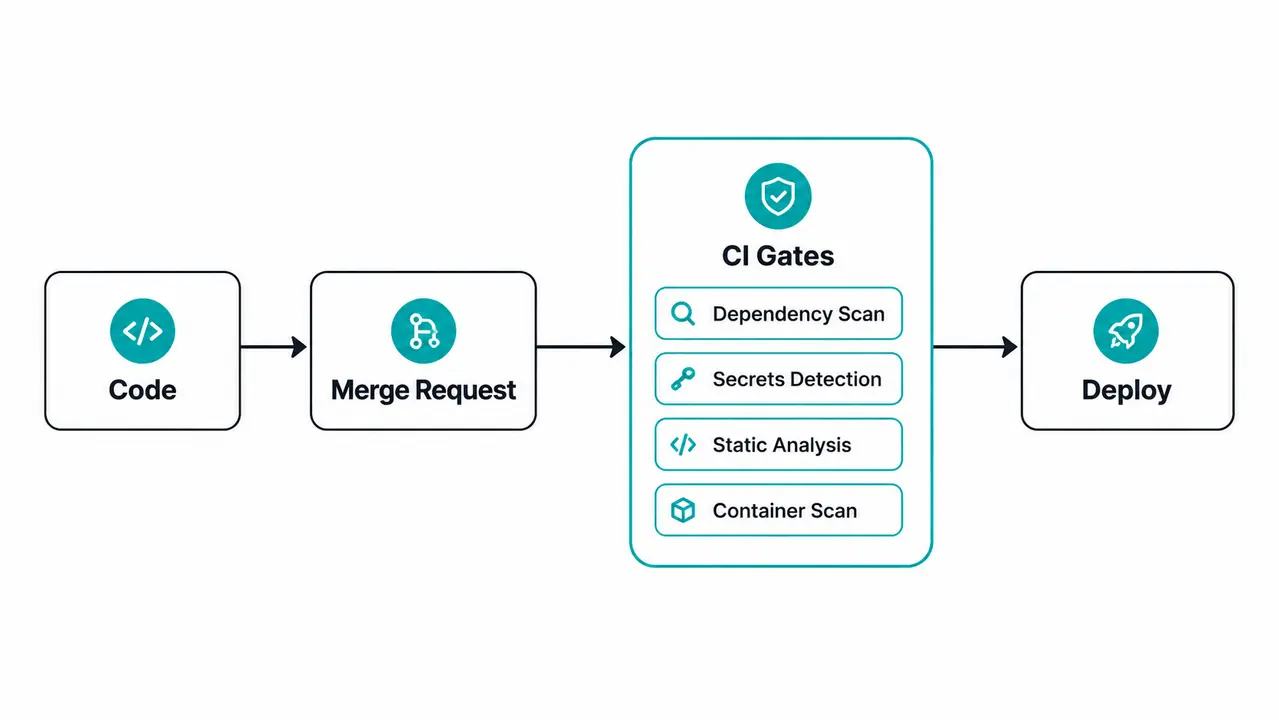
Security tooling is only effective inside the daily engineering workflow. The best security stack is the one developers cannot bypass and do not resent. Both halves matter, because a gate that engineers resent gets disabled, and a gate they cannot bypass but resent gets ignored in spirit.
Put the controls directly in CI: dependency scanning, secrets detection, static analysis, container scanning, and policy gates on every merge request. Add a lightweight threat modeling template, one page, for every new service, filled in during design rather than before launch. The template catches the unauthenticated endpoint while it is still a diagram.
When tools sit outside the workflow, security reviews become late-stage blockers. The team ships a feature, schedules the review, waits a sprint, and treats the findings as checkbox compliance. Nobody fixes a design flaw two weeks before launch; they file an exception. Exceptions accumulate. That is how a security posture degrades without a single decision to weaken it.
Testing technologies that raise confidence without slowing delivery
Testing technology must support a layered strategy: fast unit tests, focused integration tests, and a small number of high-value end-to-end checks. The tooling should make failures diagnosable, not merely detectable. A red test that tells you which component broke is an asset. A red test that tells you something somewhere is wrong is a tax.
Set explicit pyramid targets, implement a flake management protocol, and standardize the test data strategy. A flaky test gets quarantined within 24 hours, gets an owner, and either gets fixed or deleted within a sprint. No exceptions, because a quarantine folder that only grows is a graveyard, not a protocol.
The failure mode arrives slowly. The end-to-end suite grows to cover everything, flakes at a 5 percent rate, and the team stops trusting CI. Failures get ignored. Then a real regression ships, hidden inside the noise. Prioritize determinism and feedback speed over raw test count. A suite of 800 reliable tests that runs in four minutes is worth more than 3,000 tests nobody believes.
Observability technologies that shorten incident time
Observability is a development technology, not an operations afterthought, because it determines how quickly your team can ship and recover. Logs, metrics, and traces only help when they are tied to service ownership and routed to alerts a human will act on.
Define standard dashboards per service, establish Service Level Objectives, and route every alert to the owning team. An alert that pages whoever is on general call trains nobody and interrupts everybody. Ownership of the alert is ownership of the service.
We have walked into incident reviews where teams collected terabytes of telemetry and could not answer one question: what changed? No deployment markers, no correlation between the trace and the release, no way to connect the spike to the commit. Standardize instrumentation for all new services before they reach production, including release annotations in every dashboard. Telemetry without change tracking is a very expensive way to confirm that something, at some point, went wrong.
AI-assisted development tools with governance engineers accept
AI development tools accelerate routine work and increase risk at the same time, when review, testing, and IP controls do not keep pace. The right approach is a governed workflow with approved use cases and clear human accountability for every merged change. The author of record is the engineer who approved the merge, not the model that drafted the code.
Define the boundaries explicitly. Allowed: boilerplate generation, test scaffolding, migration scripts, documentation drafts. Restricted or prohibited: anything touching secrets, proprietary algorithms, or customer data in prompts. We use AI coding tools internally, including Claude Code, Cursor, and Gemini, inside exactly this kind of framework, and the framework is what makes the speed safe.
The failure mode is copy-paste propagation. AI-generated code references a deprecated API, the pattern gets pasted into six services, and the deprecation surfaces as a coordinated security fix across all of them at once. A governed workflow catches the deprecated call in review. An ungoverned one discovers it in an audit.
Embedded and IoT development technologies that change the stack

Embedded work changes the definition of a stack. Toolchains, hardware constraints, and release mechanics all differ from cloud software, and pretending otherwise produces projects that compile and cannot ship. The technology set must cover firmware, device management, and field diagnostics, end to end.
Specify the requirements early: cross-compilers, RTOS versus embedded Linux, over-the-air update infrastructure, device telemetry, and hardware-in-the-loop testing in CI. An OTA mechanism that cannot roll back a failed firmware push is a brick factory waiting for its first bad release.
The failure scenario is painful and common. A device misbehaves in the field, and the team cannot reproduce it in the lab because logs and firmware versions were never traceable to specific units. Diagnosis becomes guesswork across thousands of deployed devices. This is why system and embedded engineering demands its own delivery practices, not a stripped-down copy of the web team’s. The two stacks share principles. They share almost no tooling.
Evaluating a technology before committing to it
Evaluate technologies against a small set of measurable criteria: maturity, ecosystem health, operational fit, and exit cost. A two-week spike with explicit success criteria beats a quarter of committee debate, every time. The spike produces evidence. The debate produces slide decks.
Run the spike on a real slice of your problem, not a toy. Check documentation quality, upgrade cadence, community activity, and security posture, including the project’s own CVE history and how fast they patch. Write down the rollback plan before you start, because a spike without a rollback plan tends to become production by accident.
The failure mode is adopting a tool that goes unmaintained, or one that quietly forces a rewrite of your build and deployment pipelines to accommodate it. Exit cost is the criterion teams skip, and it is the one that hurts. When your internal bandwidth is the constraint, dedicated software engineering teams can run evaluation spikes in parallel with delivery, so the spike does not compete with the roadmap for the same three engineers. However you resource it, timebox it and decide.
Building a practical stack selection process for startups and scaleups
A good selection process starts from product constraints and team reality, then narrows to a small set of viable defaults. Three or four defaults per layer, no more. The output is a written standard that a new engineer can follow on day one without asking anyone.
Require a one-page architecture decision record for every major choice, paired with a repository template that encodes the decision. The record states the context, the options considered, the choice, and the conditions under which the choice should be revisited. One page. If it does not fit on one page, the decision is not yet understood.
The failure mode is silent knowledge loss. A senior engineer leaves mid-migration, the rationale disappears with them, and the stack drifts as each squad re-derives the decision from scratch. We have seen the same argument about the same ORM happen three times in one company, because nobody wrote down why it was chosen. Written standards end arguments. Unwritten standards restart them.
Turn your stack decisions into written standards
If your stack decisions live in people’s heads instead of decision records and repository templates, our engineers can help you document the standard and build the golden path around it.
Frequently asked questions
What is the difference between a tech stack and an architecture?
The stack is the set of technologies you build with; the architecture is the structure of what you build. Your stack might be Python, PostgreSQL, and Kubernetes while your architecture is event-driven microservices. A good architecture can survive a stack change. A stack change cannot fix a bad architecture.
How often should a company revisit its tech stack?
Review each layer annually, but only change what the decision record’s revisit conditions trigger. Scheduled rewrites are how companies burn quarters rebuilding what already works. Change when the original constraint that justified the choice no longer holds.
What makes a technology enterprise-ready?
Three things: a maintenance organization behind it, a documented upgrade path, and security response you can verify from its CVE history. Popularity is not on the list. A quiet tool with disciplined releases beats a popular one with breaking changes every minor version.
How do you prevent tool sprawl across teams?
Keep a short list of approved defaults per layer, and require an architecture decision record for any addition. Make the default the path of least resistance, so the repository template already includes it. Sprawl grows when the default is harder than the exception.
When should you split a monolith into services?
Split when independent deployment and clear team ownership deliver value you can name, not when the codebase feels large. Extract one boundary at a time, with contract tests in place before the split. A monolith with clean modules outperforms a distributed system with fuzzy boundaries.
How do you standardize across web and embedded teams without slowing both?
Standardize the process layer, not the toolchain. Code review rules, CI quality gates, release documentation, and incident process can be identical across both. Let each domain keep its own compilers, frameworks, and hardware-specific tooling. Forcing one toolchain onto both slows the faster team to protect the slower one.
The next stack decision to document this week
Pick one stack decision that is currently tribal knowledge and write it down this week as a standard, with named owners and a review cadence. Turn it into a golden path repository template that all new work must follow. Treat every deviation as an explicit decision, not an accident. That single change usually does more for delivery speed than any new tool you could add.
About Sentice

Sentice is a boutique software engineering partner founded in 2013 by Roni Levi and Martin Petkovic, now headquartered in Skopje, North Macedonia. Rather than supplying individual developers, we build embedded teams that blend with a client’s culture, tech stack and goals, working together from a single office under our own technical leadership. We deliver dedicated software engineering teams, end-to-end software solutions, product development, and system and embedded engineering, and we act as technical advisors across the full development lifecycle, from specification and architecture through development, testing and support. We use AI coding tools across every project, and we help clients integrate AI into their own products through chatbots, MCP services, connected application layers and workflow automation. Some of the clients we started with more than a decade ago are still building with us today.