
The penetration test lands on a Thursday. The report has forty-one findings, three of them critical, and your release is scheduled for Monday. Your engineers triage all weekend, fix the two easiest criticals, defer the rest into a backlog category called “security” that nobody owns, and ship. Six months later the same report comes back with thirty-eight findings. This is what security looks like when it is bolted on at release time, and it is the most expensive way to buy the feeling of security while accumulating none of it.
The alternative is not a bigger audit budget. It is a set of engineering practices that run inside your normal delivery loop, every sprint, without a security team standing over anyone. This article is about what those practices actually are, what they cost in engineering time, and how to tell a real capability from a slide deck.
Reading time: 12 min
Key points
- Secure development integrates security into design, implementation and delivery workflows instead of bolting it on at release time.
- A minimum secure SDLC fits on one page: threat models for high-risk modules, security review on flagged pull requests, dependency scanning in CI, and secrets scanning at pre-commit.
- Security gates survive only when they are fast, predictable and tuned to block only what is truly dangerous.
- A first month of baseline review, quick wins and a repeatable cadence establishes the program without stalling product delivery.
Table of contents
Secure development services are an engineering capability not a security audit
Secure development services help a product team build and ship software with security integrated into design, implementation, and delivery workflows instead of bolted on at release time. The distinction matters because of where the work happens. Security-first development touches the product backlog when a feature is still a ticket, the design review before a line of code exists, the pull request checks while the change is being written, and the release gates before anything reaches customers. An audit touches none of those. It arrives after the code is done and tells you what you already suspected.
The failure mode is predictable. Late-stage findings never fully get fixed, because the team is already committed to the next release, and the partial fixes accumulate as security debt sprint over sprint. We have inherited codebases where that debt had compounded for three years, and the interest payments came due during a customer security review. Building complete product workflows with security inside them, the way we approach end-to-end software solutions, is cheaper than paying that interest. Every time.
What technical leaders should expect to receive from an engagement
A strong engagement produces concrete artifacts your team can reuse, plus working integrations in your delivery pipeline. If the deliverable is a presentation, you bought a presentation. Ask instead for a threat model covering your critical flows, tailored secure coding guidelines for your actual stack, CI/CD security gates wired into your pipelines, and a prioritized remediation plan your engineers can work through without a translator.
The most useful artifact is often a definition of done. Auth changes must include rate limiting and session invalidation. Input validation must reject rather than sanitize where feasible. Logging must include correlation IDs. Secrets must come from the vault, never from a config file. Dependencies must be bumped on a schedule. When those criteria sit inside your ticket template, secure coding stops being an opinion and becomes a standard the team enforces on itself. Application security delivered this way changes daily engineering behavior, which is the only measure that counts.
When the work is done alongside your own engineers rather than handed to them, it sticks. That is the model behind our dedicated software engineering teams, where security practices transfer into your team’s habits instead of living in a consultant’s final report.
The minimum secure SDLC that still changes outcomes
You do not need a heavyweight program to reduce risk. You need a small set of repeatable practices that run every sprint: a threat model for anything touching high-risk modules, a security-focused review on flagged pull requests, dependency scanning in CI, and secrets scanning at pre-commit. That is the whole minimum. It fits on one page.
Define your high-risk modules explicitly, because that is where the practices concentrate. Auth, payments, admin actions, device update flows, and data export are the usual suspects. Everything else can flow through normal review. Prototypes and short-lived experiments can use a lighter version still, but they must not bypass secrets handling and access control basics, because prototypes have a habit of becoming production systems with the credentials still baked in.
The talent market reinforces why this needs to be systematic rather than heroic. Eurostat reports the number of ICT specialists in the EU grew by 4.0% from 2022 to 2023, 4.5% from 2023 to 2024, and 2.6% from 2024 to 2025 (ec.europa.eu), and application security expertise is the scarcest slice of that pool. You will not hire your way out with a specialist. Build the practices into the team you have.
Where teams underestimate threat modeling effort
Threat modeling fails when it becomes a one-time workshop instead of a habit tied to specific product changes. The workshop produces a diagram, the diagram goes into Confluence, and eighteen months later it describes a system that no longer exists. The model has to live where the changes happen.
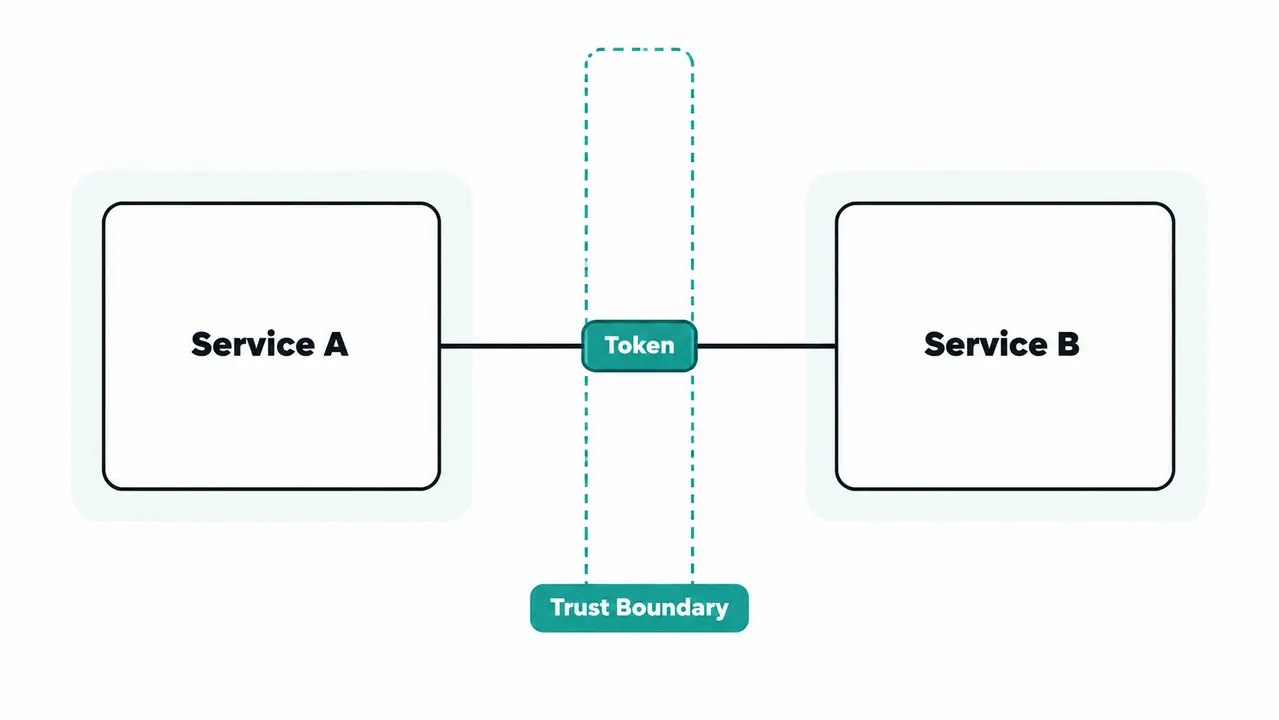
The working pattern is a 60 to 90 minute modeling session per major feature, with the output maintained as a living document next to the code. Trigger it on specific events: adding a new integration, changing authorization rules, exposing a new API endpoint, or introducing device-to-cloud messaging. Each of those changes the trust boundaries of your system, and trust boundaries are where application security breaks.
The failure this prevents is the authorization and data access gap that only appears once systems integrate. Individually, each service checks its permissions correctly. Connected, service A trusts a token from service B that was issued under rules nobody has looked at since the prototype. That class of flaw does not show up in a scanner. It shows up in a model, if the model is current.
Enforceable secure coding practices beat static documents
A 40-page secure coding standard reduces risk by approximately zero, because nobody reads it. Coding standards reduce risk when they translate into code review expectations, linter rules, and testable patterns. The document is the input. The enforcement is the deliverable.
Start with a short approved patterns library for your language and framework, five to ten patterns, each with a code snippet your engineers can copy. Cover input validation, safe serialization, parameterized queries, secure defaults, and error handling that avoids leaking stack traces and sensitive data into responses. Then attach a pull request checklist for reviewers that references those patterns by name, so a reviewer can write “use pattern 3 here” instead of re-arguing the principle.
This prevents two chronic problems. Inconsistent fixes, where two engineers patch the same vulnerability class differently and one of them is wrong. And recurring vulnerability classes across teams, because the knowledge lived in one senior engineer’s head and never reached the three people hired last quarter. Secure coding that is enforced by tooling survives attrition. Secure coding that lives in a PDF does not survive the quarter.
Code review that targets exploit paths not style
Security-focused code review should prioritize exploitability in the context of your architecture, not generic best practices. A reviewer who spends twenty minutes on naming conventions and two minutes on the new webhook handler has the ratio backwards. Define review triggers that force the deeper look: the change touches auth, adds a new external integration, adds a new admin action, introduces new cryptography, or adds new parsing of untrusted input.
Know your hotspots. Authorization checks, multi-tenant boundaries, file upload flows, deserialization, SSRF surfaces, webhook handlers, and device update endpoints are where real incidents start. A table helps reviewers route their attention.
This table reflects how we split review effort across a typical product.
| Change type | Review depth | Primary risk |
|---|---|---|
| Auth or authZ changes | Two reviewers, threat model update | Privilege escalation |
| New external integration | Security reviewer plus API contract check | SSRF, injection, credential exposure |
| File upload or parsing | Deep manual review | Deserialization, path traversal |
| UI styling or copy | Standard review | Not applicable |
Automated tools are weaker than human review for business logic and authorization flaws, and stronger for repeatable pattern detection. Use them for the patterns. Spend the humans on the logic.
CI CD security gates that developers do not bypass
Security gates work when they are fast, predictable, and tuned to block only what is truly dangerous. A gate that fails every build on low-severity findings gets disabled in week two, usually by the most senior engineer on the team, usually with everyone’s quiet relief. You have seen this happen. Security-first development that engineers route around is worse than none, because it produces a false record of control.
Set an explicit policy for severity thresholds and exceptions. Critical findings block the merge, full stop. High findings block unless an exception is filed, and every exception carries an expiry date so the debt cannot become permanent. Split the checks into tiers: fast checks like secrets scanning and lint rules on every pull request, deeper SAST and dependency scans nightly, and the full release gate for critical services only. A pull request check that runs in under two minutes will survive. One that adds eleven minutes will not.
The failure this prevents is quiet. Nobody announces they turned off the scanner. It just stops failing, and six months later nobody remembers why.
SAST DAST and SCA each catch different failure modes
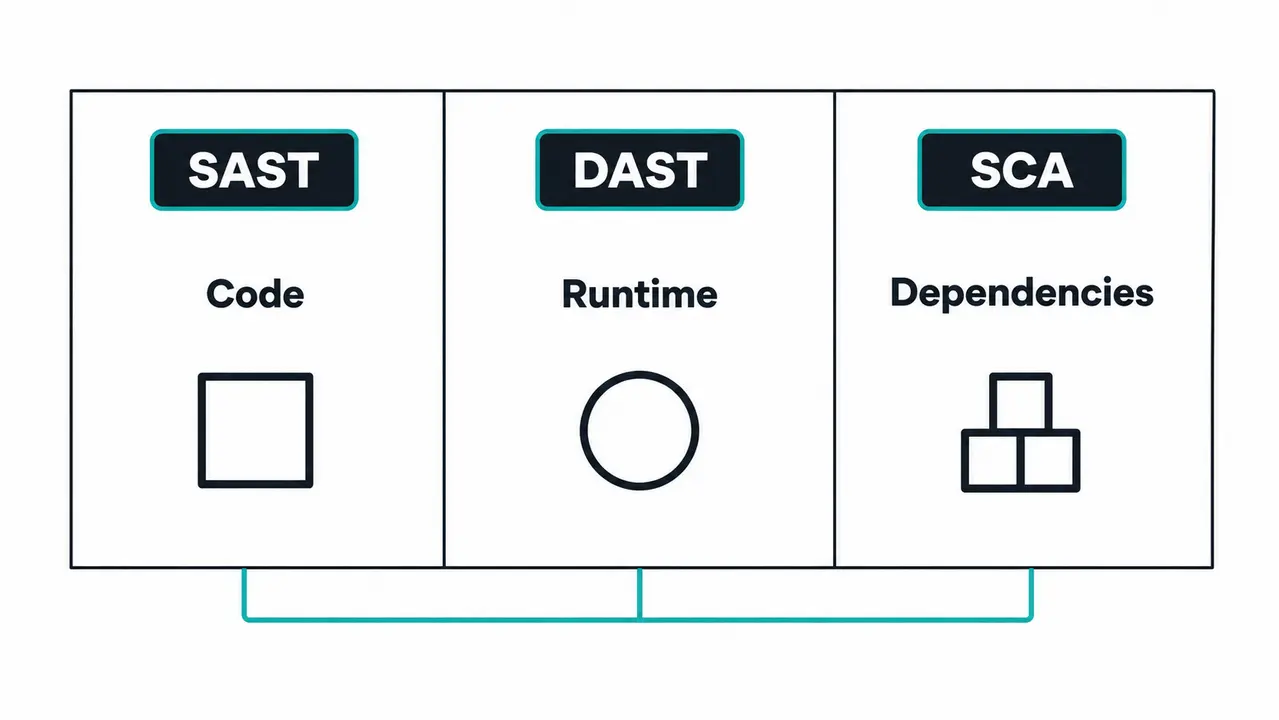
No single scanner covers secure development. You need complementary signals across code, running behavior, and dependencies, because each tool class is blind to what the others see.
SAST covers code patterns, so it catches things like unsafe function calls and injection-prone constructs before the code runs. DAST covers runtime behavior and misconfigurations, so it finds the admin endpoint with no authentication and the debug mode left on in staging. SCA covers vulnerable libraries and licenses, which is the layer where most of your actual third-party risk lives. Wire SAST and SCA into pull request checks where feedback is fast, and DAST into the release pipeline against a staging environment that resembles production.
Each has a weakness worth knowing. Relying on DAST alone is weaker for early feedback, because it needs a running system. Relying on SAST alone is weaker for configuration and runtime issues, because it never executes anything. SCA is non-optional for supply chain risk. Application security programs that lean on one tool eventually learn this from the incident report.
Supply chain controls belong in the build system not a spreadsheet
Modern secure development includes securing dependencies and build artifacts, because attackers have figured out that the path to production is often less defended than production itself. A compromised CI runner or a tampered base image bypasses every control in your application code. Security-first development has to treat the build system as part of the attack surface.
Require software bill of materials generation for releases, so you can answer “are we running the vulnerable version” in minutes instead of days. Treat build pipelines as production-grade systems: restricted runners, pinned third-party actions, protected branches, and audit logs on pipeline configuration changes. The people who can change your pipeline should be a shorter list than the people who can merge code.
The economics justify the rigor. The OECD tracks digitally-deliverable services as a growing share of commercial services trade (goingdigital.oecd.org), and the World Bank reports digitally delivered services exports reached a 54% share of total global services exports in 2022 (documents1.worldbank.org). Software is the delivery vehicle for that trade, which makes the build pipeline a target worth defending. The control this prevents is simple to state: compromised dependencies or tampered artifacts reaching customers with your signature on them.
Secrets management that survives real developer workflows
The goal is preventing long-lived credentials from leaking, and ensuring fast rotation when they do. Both halves matter. Most teams have scanning. Few teams have ever actually rotated a database password under time pressure, and the first attempt should not happen during an incident.
Put pre-commit and CI scanning in place to catch credentials before they reach the remote. Use short-lived tokens wherever your platform supports them, inject secrets per environment rather than copying them into config files, and write rotation playbooks for the credentials that matter most. Then define the incident steps for a leaked key: revocation, audit of what the key accessed, and retroactive log review to rule out misuse during the exposure window. Rehearse it once. The rehearsal will find the gaps.
Local development needs pragmatic patterns. Overly strict controls push teams to unsafe workarounds, and the workaround is usually a plaintext .env file in a personal Dropbox. Secure coding standards that ignore how developers actually work get routed around within a sprint. Give local dev a sanctioned path, like a shared vault with scoped dev credentials, and the workarounds stop being necessary.
Logging and telemetry that supports incident response
Secure development includes building observability that lets you answer what happened, without shipping sensitive data into your logs. The second half is where teams fail. We have reviewed logging setups that captured every request header, including authorization tokens, into a log aggregator with 90-day retention and no access controls. That setup is itself a vulnerability.
Define a log schema and a retention policy aligned to product risk. Log auth decisions, admin actions, permission denials, and high-risk events, each with a correlation ID that ties the trail together across services. Decide retention per data class: authentication events may warrant a year, request bodies warrant hours at most, and some fields warrant never. Write the schema down, because the incident responder six months from now will not guess it.
The failure this prevents is the breach that cannot be investigated. The intrusion is discovered, everyone asks what the attacker accessed, and the answer is that the right events were never captured, or were captured and expired, or were captured with no correlation ID so reconstructing the session is impossible. Application security that cannot answer questions after the fact is only half a program.
Cloud IAM and service to service trust are part of application security
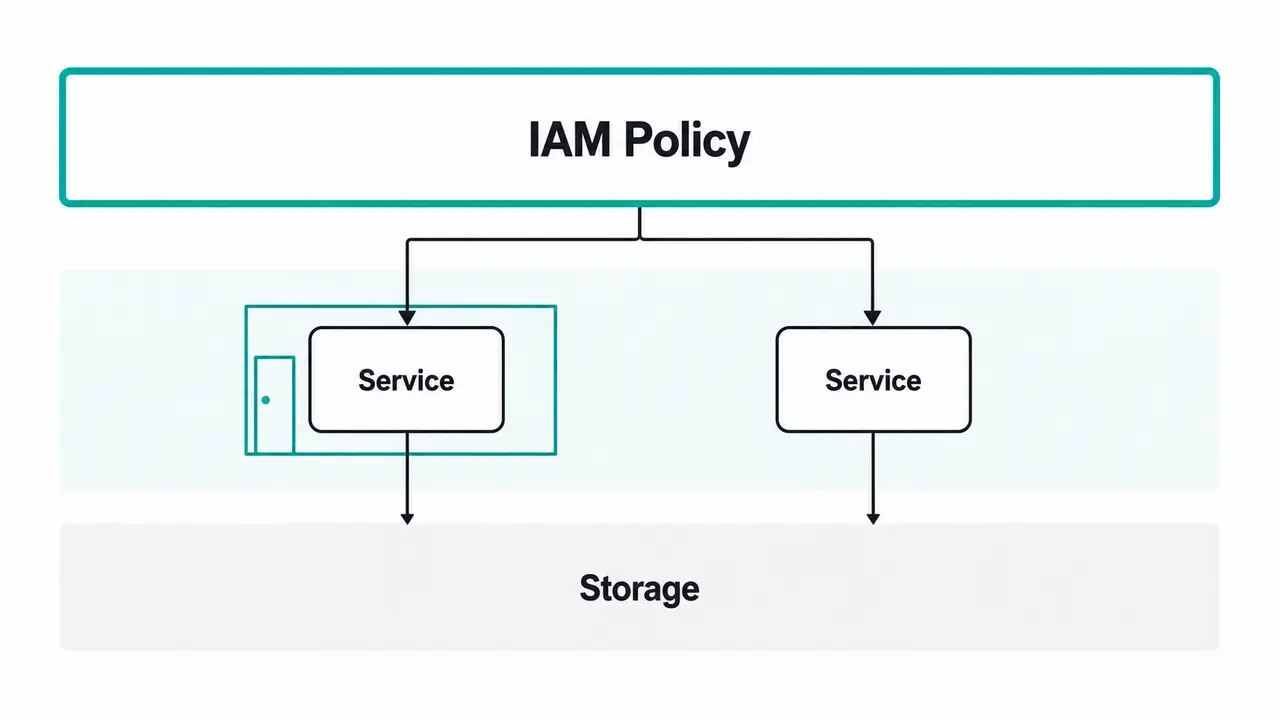
Many application compromises start with over-permissive identities and lateral movement, not a single vulnerable endpoint. One service account with broad storage access, one wildcard IAM role, and a modest injection flaw becomes full environment compromise. The endpoint was the door. The identity policy was the building.
Review IAM changes like code changes, with approvals and automated policy checks in the pipeline. Terraform and Ansible make this practical, because identity lives in version control and a policy check can run in CI like any other test. Apply least privilege roles, scoped service accounts per service, workload identity instead of long-lived keys, network segmentation between tiers, and secure defaults for storage and messaging, meaning private by default with explicit grants.
The failure mode this prevents is the blast radius problem. You will get compromised eventually; assume it. Security-first development in the cloud is mostly about ensuring that when one service falls, the attacker lands in a small room with locked doors, rather than in the hallway of the whole environment. That outcome is decided by IAM policy files, months before the incident.
Embedded and IoT products need a secure update story from day one
For devices, secure development must cover firmware integrity, update authenticity, and long-term maintenance, not just the cloud app. The cloud half gets the attention because it is easier to patch. The device half is where products actually die, because a fleet of field devices that cannot be updated safely is a permanent liability with a serial number.
Define early how devices authenticate to cloud services, and how keys are stored and rotated on hardware that may live in the field for seven years. Signed firmware images, verified boot, and an update mechanism that can fail safely without bricking the device are the baseline. The global growth of digitally delivered services and embedded systems is driving hardware security investment across industries (documents1.worldbank.org), and the device-to-cloud boundary is where most IoT incidents we have seen actually originate.
Our system and embedded engineering work covers both sides of that boundary, and secure coding on the device side is unforgiving in a specific way: you cannot fix a mistake by deploying on Friday. The update channel has to be trustworthy before the first unit ships, because retrofitting trust into a deployed fleet is the most expensive engineering project there is.
The week a customer security review blocks a deal
Secure development services often pay off first in a place nobody predicts: the customer security review. Your sales team closes the technical evaluation, the deal moves to procurement, and then the buyer’s security team sends a questionnaire with 180 questions and a two-week deadline. Engineering drops everything to answer it, the answers are inconsistent because three people wrote them, and the deal slips a quarter.
The fix is an internal security evidence pack that engineering keeps current, tied to real controls in the pipeline. Common asks include a secure SDLC description, your code review process, dependency management approach, vulnerability handling policy, and release controls. When those answers describe what your CI actually enforces, the questionnaire becomes a copy-paste exercise instead of an archaeology project.
Paper compliance without working controls collapses under deeper technical questioning. A buyer’s security engineer will ask to see the pipeline, not the diagram of the pipeline. Secure development services that build real controls give you answers that survive that conversation, and the review becomes predictable enough to schedule around.
What to measure so security work does not disappear in the sprint
Use a small set of engineering-friendly metrics that reflect risk reduction and delivery health. Metrics that require a security team to collect them will stop being collected. Good candidates: mean time to remediate critical findings, percentage of pull requests passing gates without exception, count of expired exceptions, dependency freshness on high-risk services, and secrets scanning coverage across repositories. Five numbers, one dashboard, reviewed in the existing engineering meeting rather than a new one.
Define ownership per metric, usually engineering leads with security support. Unowned metrics decay into wallpaper. The failure this prevents is security becoming an unowned backlog category that never competes well with features, because features have a product owner arguing for them and security findings have nobody.
The ongoing expansion of the ICT specialist workforce across Europe (ec.europa.eu) means engineering leads are carrying more responsibility per head, not less, and security-first development metrics are how that responsibility stays visible when the sprint gets tight. What gets measured gets merged.
How to choose between an embedded partner and a specialist consultancy
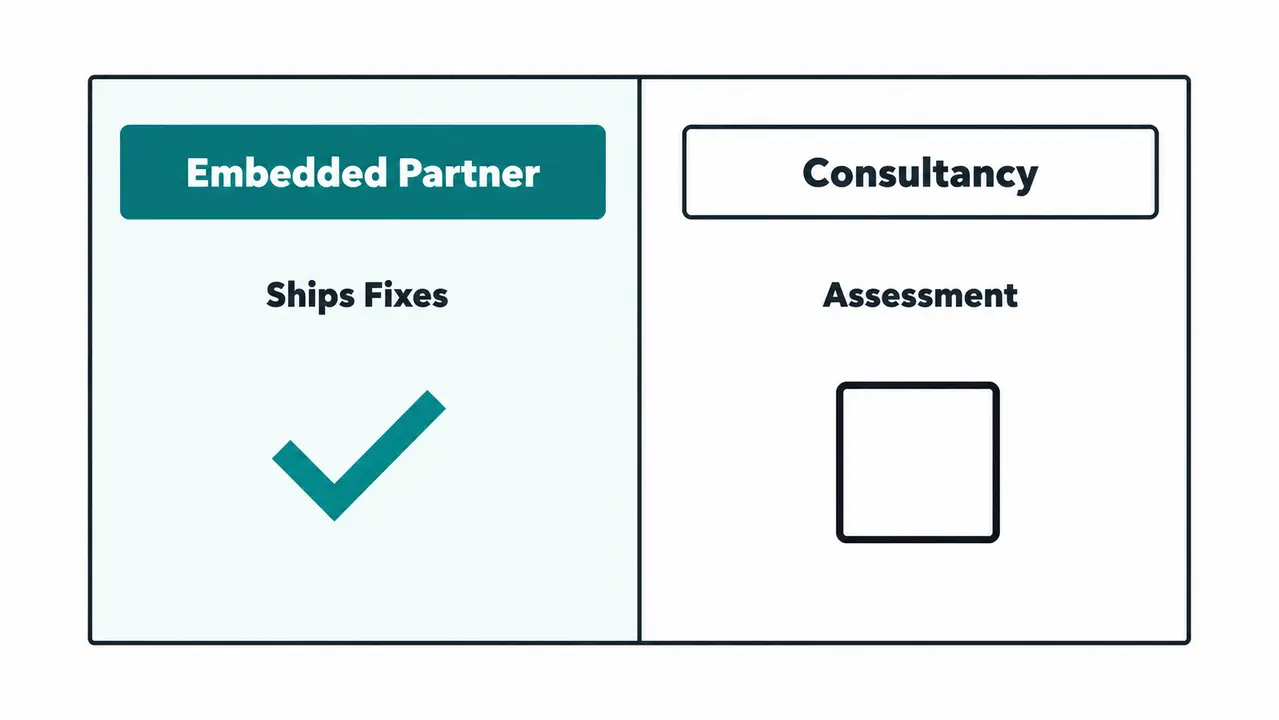
Choose based on whether you need hands-on implementation inside your codebase and pipelines, or primarily assessment and guidance. The two models sell different things, and buying the wrong one is expensive in a specific way: you get an accurate list of problems and no capacity to fix them.
A specialist consultancy brings independent validation, broad benchmark experience across many companies, and formal assessments for compliance or acquisition contexts. Those are real strengths, and for a point-in-time validation before a funding round or a sale, that is the right tool.
An embedded partner ships fixes, integrates tooling, updates CI/CD, pairs with your engineers, and builds habits that survive the engagement. Sentice works this way on secure development services, with engineers inside your repositories rather than auditing them from outside. For teams needing execution and workflow change, assessment-only is the weaker choice, because it creates a gap between findings and shipped remediation, and that gap is where security debt grows. The verdict is simple. If your problem is knowing what is wrong, buy the assessment. If your problem is fixing it at delivery speed, buy the hands.
Build the loop alongside your engineers
If you want security practices wired into your pipelines and adopted by your team rather than delivered in a report, talk to us about scoping the first thirty days.
A practical kickoff plan for the first thirty days
A good first month establishes scope, quick wins, and a repeatable cadence that does not stall product delivery. The mistake to avoid is turning on aggressive security gates in sprint one, watching three releases slip, and losing the engineering organization’s trust before the program starts. The core roles involved are a tech lead, a platform engineer, a product owner, and a security point of contact, whether that last role is internal or a partner.
Week one is baseline risk review and data flow mapping, so everyone agrees where the sensitive data actually lives. Week two implements fast pull request checks and secrets scanning, the quickest visible wins. Week three is threat modeling the top flows and running secure code review on the hotspots identified in week one. Week four tunes the gates, defines metric ownership, and documents the minimal secure SDLC on one page.
Thirty days, no stalled sprints, and the team has seen the practices work on their own code. That matters more than the artifacts. Secure coding adoption is a trust exercise, and trust is built by shipping.
Frequently asked questions
How does secure development differ from penetration testing?
Penetration testing is point-in-time testing of a finished system, and it answers the question of what is exploitable today. Secure development is continuous practice inside design, coding, and release workflows, and it answers the question of whether the next release will be safer than the last. You need both, but penetration testing without secure development just measures the debt you are committed to keeping.
Will security tooling slow down the CI CD pipeline?
It will if you run everything on every pull request. Tiered checks solve this: secrets scanning and lint rules in under two minutes per pull request, SAST and dependency scans nightly, and the full DAST gate only for critical services at release. Tune severity thresholds so the pipeline blocks on what is dangerous rather than what is noisy, and pipeline impact stays negligible.
Do developers need formal security training for this to work?
Role-based training helps, a half-day for backend engineers on injection and authZ patterns beats a generic annual course. The durable mechanism is code review reinforcement, where the approved patterns library and reviewer checklist teach the same lessons every sprint. Training without reinforcement decays in weeks. Reinforcement without training produces checklists nobody understands.
What frameworks can teams align to without becoming bureaucratic?
Map your existing controls pragmatically to widely used secure development frameworks such as OWASP SAMM or NIST SSDF, rather than adopting a framework top-down. Take the practices you already run, find the framework section each one satisfies, and fill the genuine gaps in priority order. Teams that start from the framework build documentation. Teams that map to it build controls.
What is the fastest way to reduce risk in an existing codebase?
Four moves, in order. Review the hotspots, meaning auth boundaries, admin actions, and external input handling. Get dependency scanning and automated updates running, since vulnerable libraries are the cheapest risk to remove. Rotate any long-lived secrets and put scanning in place. Then tighten authorization checks on multi-tenant boundaries. This sequence typically removes the majority of exploitable risk before any architectural work begins.
How do you handle security for firmware plus cloud services together?
Treat the device-to-cloud boundary as its own trust boundary with its own threat model. Signed and verified firmware updates, per-device identity with rotated keys, and hardened APIs on the cloud side that assume any device may be compromised. The cloud must never trust a device simply because it presents a certificate, and the device must verify update signatures independently of the transport channel.
Next step for technical leaders
Pick one critical user journey and one critical service, and run the minimal secure SDLC loop around only those. Produce two artifacts first: a one-page threat model for the journey and a pull request checklist for the service. Enable two gates: secrets scanning on every pull request and dependency scanning nightly. Once that loop runs for a full sprint without stalling delivery, scale it to the next service. If you want the loop built alongside your engineers rather than handed to them, that is exactly how Sentice delivers secure development services.
About Sentice

Sentice is a boutique software engineering partner founded in 2013 by Roni Levi and Martin Petkovic, now headquartered in Skopje, North Macedonia. Rather than supplying individual developers, we build embedded teams that blend with a client’s culture, tech stack and goals, working together from a single office under our own technical leadership. We deliver dedicated software engineering teams, end-to-end software solutions, product development, and system and embedded engineering, and we act as technical advisors across the full development lifecycle, from specification and architecture through development, testing and support. We use AI coding tools across every project, and we help clients integrate AI into their own products through chatbots, MCP services, connected application layers and workflow automation. Some of the clients we started with more than a decade ago are still building with us today.